

Forgettable Best Picture winner, the musical that helped bring sound to Hollywood looks simplistic today
Director: Harry Beaumont
Cast: Anita Page (Queenie Mahoney), Bessie Love (“Hank” Mahoney), Charles King (Eddie Kearns), Jed Prouty (Uncle Jed), Kenneth Thomson (Jacques Warriner), Eddie Kane (Zanefield), Edward Dillon (Stage Manager)
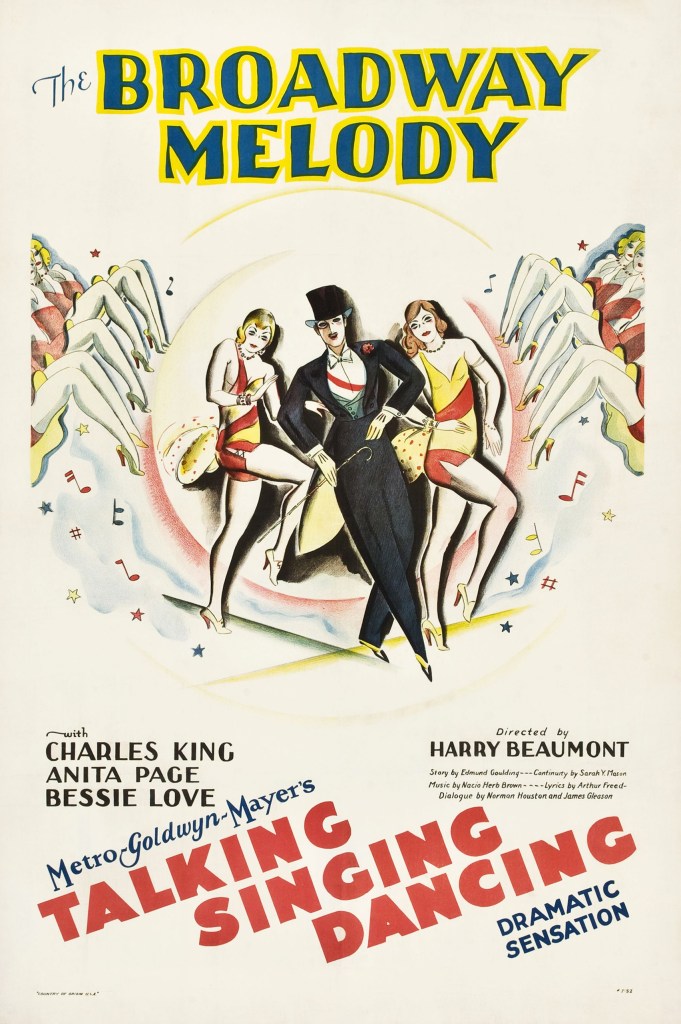
The early years of sound in Hollywood were difficult. Before sound, movies were often visual treats, crammed with inventive and imaginative camera moves. Watch some of the silent movie masters, and you’ll be blown away by the majesty and creativity of their vision. Then came sound. And to capture sound on movies, you held the camera as still as possible while the clunky sound recording equipment struggled to work. For years, all that visual invention was history and movies became flat, dull looking and clumsy.
But that didn’t affect the thrill audiences had at hearing synchronised sound. I mean wow! Could you imagine a painting talking to you? That would be incredible. Imagine it singing and dancing. You’d be blown away. It’s that context you need to bear in mind when watching The Broadway Melody. How did this fundamentally average, largely forgotten, flatly shot film win Best Picture? Because, quite simply, no one had seen anything like it before. This revolutionised cinema – and while that might look inexplicable now, it was like splitting the atom as far as Hollywood was concerned.
The plot, such as it is, is very minor. The Mahoney sisters, Queenie (Anita Page) and Hank (Bessie Love) arrive on Broadway to become stars with the support of Eddie Kearns (Charles King) who is engaged to Hank. But, don’t you know it, Eddie falls in love with Queenie and she with him. Who will end up with whom? And will the sister’s close relationship survive their love for the same man?
The Broadway Melody starts with an orgy of overlapping sound, music and speech all filling a Broadway office, as if trying to hammer home to the viewers how amazing all this is. And it probably was amazing. The filmmakers literally had to work out how to record sound as they went. Sets were rebuilt after takes to improve the sound conditions. Technology was tweaked and reworked. The actors performed their scenes over and over again to get the best recording. It must have been punishing to make.
Visually it’s hugely un-interesting. Shot almost entirely in mid-shot, the actors stand as still as possible so that the microphones can pick up every word (moving and talking was almost impossible). There are moments dialogue is less clear, in particular when actors turn away from camera. Storytelling is hugely influenced by silent cinema – there are even intertitle cards to announce different locations. The script is often just an excuse to move from one musical number to another. The film even stops to effectively stage a Broadway show, including shots of the programme introducing each act.
None of the songs comment on the actions and emotions of the characters. Instead, they are all established by the actor’s saying words to the effect of “I heard a great song – wanna hear it?”. Some of the songs are good and the singing of Kearns and Love in particular is fine. But they are snippable moments, not storytelling. It was to be a few years before film musicals did something more than filmed karaoke, and used songs to express character’s inner emotions.
There is a certain charm about The Broadway Melody though, for all its faults and it’s not the turkey you might have been led to believe. Sure, it’s primitive, but it has a certain bounce to it and the playing of the three leads is surprisingly committed. Its attitudes are surprisingly modern, reflecting its pre-code status. It doesn’t punish its characters for their ‘transgressions’ and is quite emotionally honest about the impact of a man falling in love with the beloved sister of his fiancée on all concerned. Other things have dated less well, in particular a camp costumier and Uncle Jed’s comic stammer, both played for dubious laughs.
But the romance plotline is surprisingly complex. There are moments of rawness in The Broadway Melody. Queenie (well played by Anita Page) is plunged into a self-loathing depression by her feelings for her sister’s fiancée, spiralling into the arms of a playboy – not the sort of reaction you expect from someone presented as “the sensible one”. Hank who reacts not with fury, but with a genuinely quite moving emotional desolation at realising her very existence is keeping the two people she loves most from being happy.
The real love story here might be between the two sisters, both desperate not to hurt each other. Bessie Love gives a very fine (Oscar-nominated) performance as Hank, torn up with guilt and surprisingly vulnerable, who eventually makes huge sacrifices. There is a very effective late breakdown scene for Love, after she deliberately burns her bridges with Eddie for her sister’s sake. The films finest moments are covered in the sad, regretful guilt between these two sisters, and a film focused more on this and less on the musical numbers would have more going for it today. As it is it manages at points to elevate its conventional love triangle.
The musical numbers are the real problem though: very much staged exactly as if the camera was filming an actual Broadway show from the middle of the stalls. In mid-shot, the camera is pointed at the numbers and the actors dance their way through them. You better like the title song by the way, because you are going to hear it performed three times in the first 40 minutes. It’s not really storytelling – and all of the dancing would be effortlessly bested by other films in the next few years. None of the numbers have zing or interest and end up bumping up the runtime.
It’s easy to be critical of The Broadway Melody. Sadly, time has dated it since the one thing that made it stand out was the sound. Now that we have literally heard-it-all-before and better in the decades since, the actual thing that now draws attention is its dull filming, middling story and repetitive musical numbers. Not a disaster as some claim, but a very forgettable film – one for completists.
 Movie Musings