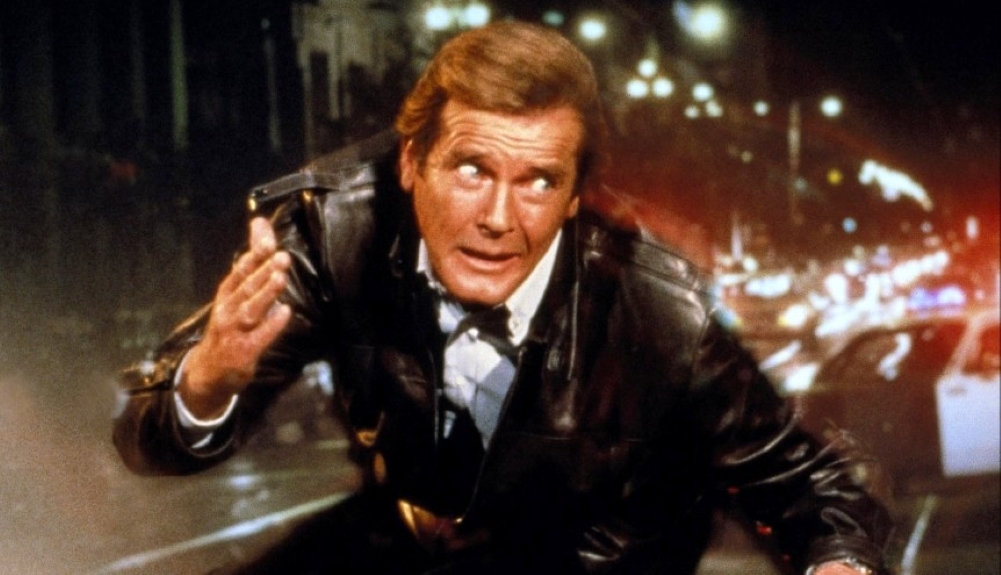
Possibly the worst film of the entire franchise, not helped by Moore’s being well and truly past it
Director: John Glen
Cast: Roger Moore (James Bond), Christopher Walken (Max Zorin), Tanya Roberts (Stacey Sutton), Grace Jones (May Day), Patrick Macnee (Sir Godfrey Tibbett), Patrick Bauchay (Scarpine), Willoughby Gray (Dr Karl Mortner), David Yip (Chuck Lee), Desmond Llewelyn (Q), Robert Brown (M), Walter Gotell (General Gogol), Lois Maxwell (Miss Moneypenny), Geoffrey Keen (Minister), Manning Redwood (Bob Conley), Alison Doody (Jenny Flex), Papillon Soo Soo (Pan Ho), Fiona Fullerton (Pola Ivanova)
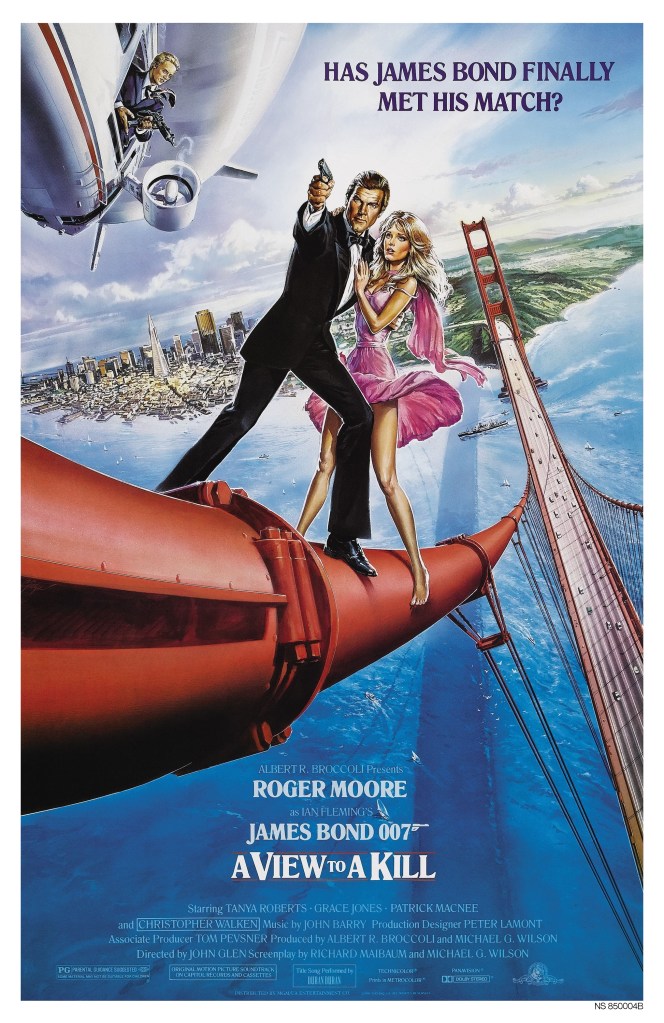
After watching A View to a Kill Roger Moore declared he probably should have stopped after Octopussy (others would say For Your Eyes Only would have been even better). He’s not wrong. Putting aside the whole question of age (of which more later) A View to a Kill is one of the worst outings Bond ever had on Her Majesty’s Secret Service. A blatant Goldfinger rip-off, it’s full of the sort of ridiculousness Moore made his own but with plenty of the sort of violent rough-and-tumble the other action stars of the 80s were doing. It manages to be neither remotely funny or particularly exciting.
Bond (Roger Moore) is roped into investigate dodgy goings on in Zorin Industries, run by grinning psychopath Max Zorin (Christopher Walken), aided by his terrifyingly tough girlfriend and chief henchwoman May Day (Grace Jones). Zorin, it turns out, is planning a dastardly plan to sink Silicon Valley (wait a minute: Max all is forgiven!) by blowing a hole in the San Andreas fault. From Paris to San Francisco, Bond is on the trail to foil this scheme, helped and hindered (mostly the latter) by oil heir Stacey (Tanya Roberts).
The elephant in the room of course is Roger Moore’s age. It’s genuinely jaw-dropping to think Moore was younger when he made this film than Tom Cruise was when he made his final Mission: Impossible. Moore looks like a gun-toting Methuselah, the most active part of his lined and winkled face being his immortal arched eyebrow. A film with more courage or wit would have lampshaded this – though of course Bond was never going to go full on “I’m too old for this shit”. There is something insanely icky at watching this ageing lothario take to bed a ludicrously young glamourous agent in the film’s prologue (sliding into the sheets of their mini-sub’s bed, he looks like a dirty old man) or, for that matter, Stacey (so much younger than him, he cooks her a post-fight quiche omelette to sooth her nerve, like a loving uncle). As for when he beds Grace Jones… Genuinely it’s the only point in the film you feel worried about his safety.
On top of this, you can’t help but wonder how much work Moore did on this film. He clearly never visited the Arctic, where the films skiing action entre takes place: a stunt-double zooms around the glaciers, while Moore pops up to raise an eyebrow in close-ups in front of a blue screen. It’s painfully obvious to see the stunt men take over all the driving and a large portion of the fighting (Glen probably deserves some sort of medal for framing so much of this action to not show Bond’s face). His horse-riding sequence is obviously Moore on a hobby horse (to be fair, it’s the same for Walken), while his stunt doubles climb around a fire truck ladder on a racing truck in San Francisco.
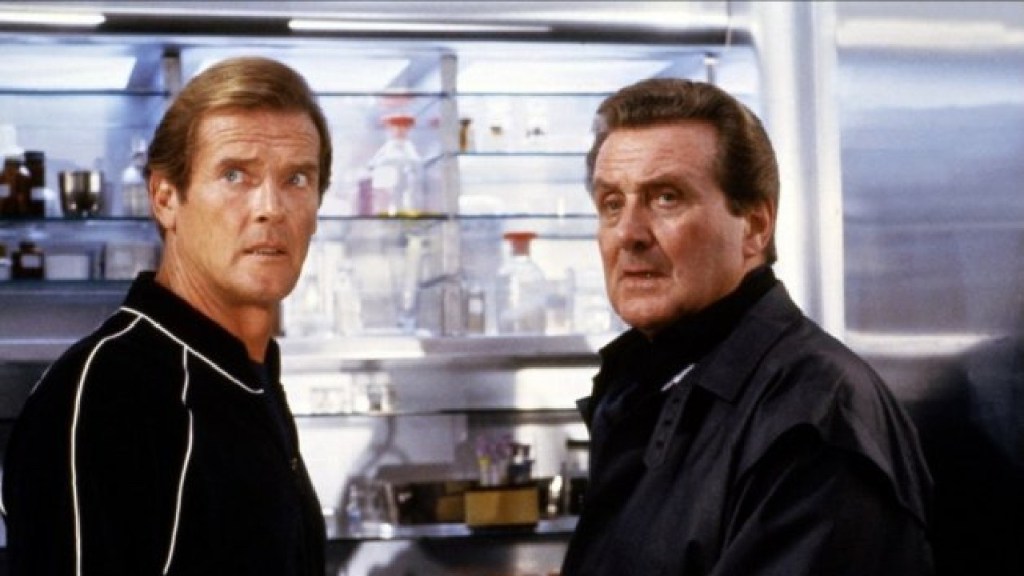
It’s all even more painfully in-your-face, because the costume designers clearly decided to dress Moore like a man thirty years younger to disguise his creaking joints. Tank tops and leather jackets? Even when he was in his 20s, Moore (a polo shirt or suit guy) would have looked ridiculous in this garb. They even throw in Patrick Macnee as an even older action star (he might as well be called John Unsteady). At one point these two dress up in dark leather jackets to raid a warehouse, theming look like two lost granddads trying to brazen out a tough Friday night on the town after the pubs have closed.
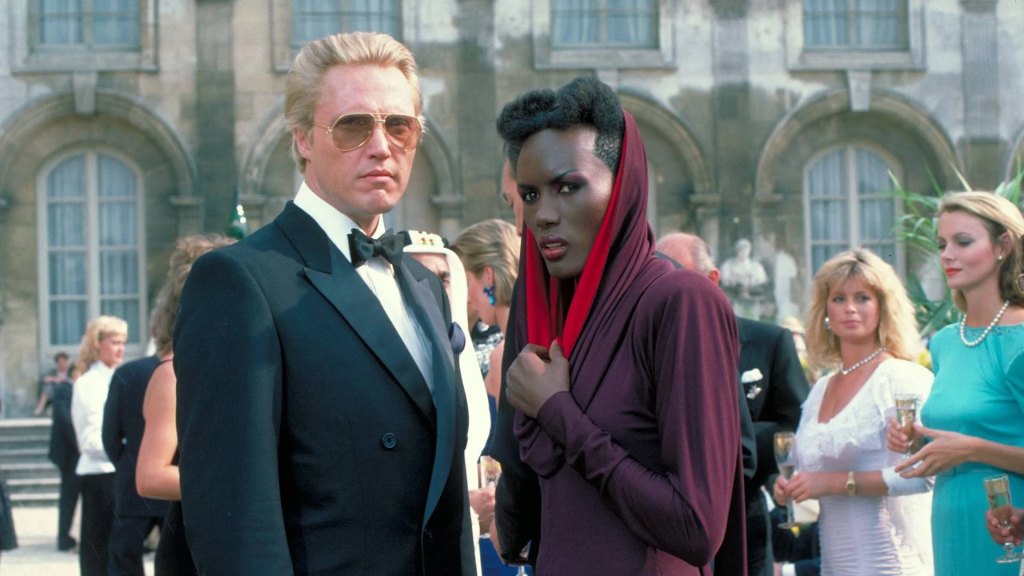
It’s particularly noticeable how doddering Moore is when he’s constantly being compared to the energetic youngsters he’s up against. Grace Jones is of course a lean strip of muscle and macho attitude. She may not be the greatest actor in the world – her range rarely stretches beyond ‘angry’ – but she sure can kick, punch and throw. Similarly, Christopher Walken lets his signature staccato delivery rip under a mop of blond hair and a wild-eyed grin. Zorin is a demented Nazi genetic experiment – like the wet dream of the baddies in The Boys from Brazil (he even has a Mengele-style daddy in Willoughby Gray’s monocle-clad scientist) – who throws himself into judo and action sequences with a sweaty-browed enthusiasm Moore could never match.
Zorin is possibly one of the meanest, most psychotic villains in Bond films. So much so, he sometimes feels a little out of place in the comic world of Moore’s Bond films. (Rather like everything in Moonraker being double-taking pigeons until a woman gets ripped apart by dogs). View to a Kill gives us goofy gags such as a bizarre Poirot parody (with the ludicrous name Achille Aubergine which is stupid rather than funny) who gets knocked off by a poisonous model butterfly (don’t ask) during a high society dinner. Then later it’s happy to give us a prolonged sequence of Walken machine-gunning underlings at point blank range while giggling like a schoolboy. That’s how far A View to a Kill can ying and yang.
It’s blatant Goldfinger rip-off is most obvious in its virtual replay (but less than half as good) of the villain’s briefing of his crony’s scene (right down to a flunky saying he’ll have no part of this madness and getting instantly dispatched), but it’s there throughout. Substitute horse-racing for golf, Silicon Valley for Fort Knox, a zeppelin for a bi-plane, throw in a last-minute bomb foiling and various offed side-kicks in cars and you’ve got Connery’s calling card. With the exception that Stacey Sutton is no Pussy Galore. A tiresome, whining and terminally stupid character (in a Bond Girl low point she fails to hear a slow-moving zeppelin noisily approaching her from behind) with whom Moore has no charisma (and, in fact, barely seems to like).
A View to a Kill stumbles through our geriatric lead tagging in and out with stunt-men, bumbling through set-pieces that never quite click into place, such as the otherworldly lack of danger to anything. How can a chase up the Eiffel Tower feel so dull? A car chase through San Francisco feel like it’s just killing screentime? Jokes rarely land, the villains feel like they are in a different film, the tone never seems consistent and most of it makes no real sense. It’s not really Moore’s fault – frankly, even a Connery or Craig couldn’t have saved this from being a pretty bad film. But it doesn’t change the fact that the only memorable thing about this that’s good is a knock-out Duran Duran song.