Tag: István Szabó

Colonel Redl (1985)

Colonel Redl (1985)

An impressively filmed, intelligent, if slightly slow, epic with a barnstorming central performance

Director: István Szabó

Cast: Klaus Maria Brandauer (Colonel Alfred Redl), Hans Christian Blech (Mj General Von Roden), Armin Mueller-Stahl (Archduke, Heir Apparent), Gudrun Landgrebe (Katalin), Jan Niklas (Colonel Kristóf Kubinyi), László Mensáros (Colonel Ruzitska), András Bálint (Dr. Gustav Sonnenschein), László Gálffi (Alfredo Velocchio), Dorottya Udvaros (Clarissa), Károly Eperjes (Lt Jaromil Schorm)
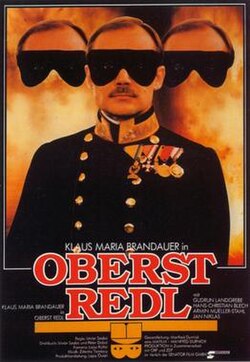
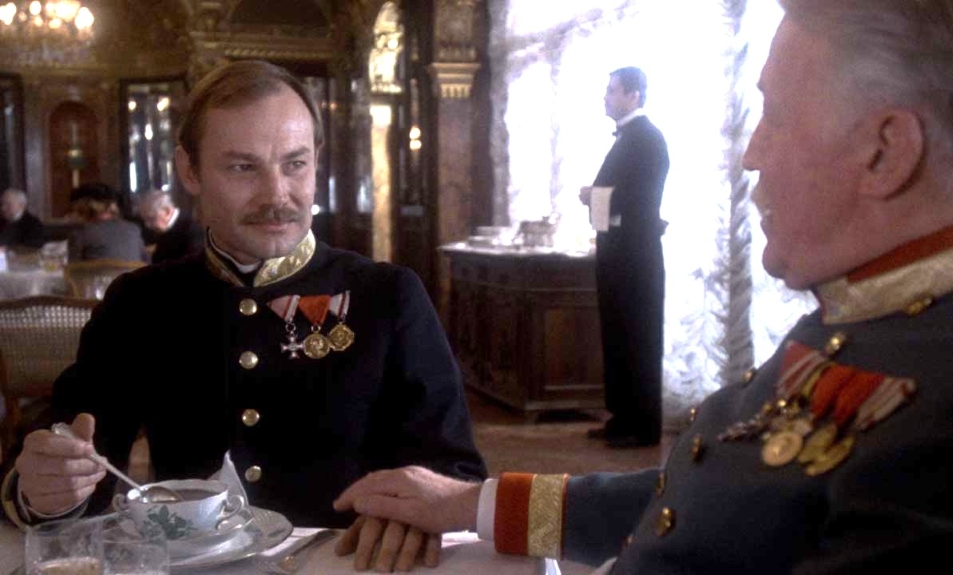
Colonel Alfred Redl was head of the Austo-Hungarian counter-intelligence corps in the build-up to World War One. He was also, possibly, blackmailed due to his homosexuality, into being a Russian double agent and was eventually left in a hotel room with a pistol to do ‘the honourable thing’ after he was caught, a year or so before the war that toppled the Empire began. That’s the basis for Szabó’s film, a reteaming with Brandauer after the success of Mephisto, which fictionalises Redl into a self-loathing mass of every trait the autocratic Austrian army hates.

Colonel Redl revolves around another tour-de-force performance by Brandauer, in a very different vein to his triumph in Mephisto but another searing embodiment of a man selling his soul for precious little return. Redl is a cold, distant, reserved man who on the surface seems to be a robotic machine of career advancement. But Brandauer masterfully makes him a man seething with self-disgust, loneliness and above all fear. Redl always seems on in dread of being found out: as working class, as a repressed homosexual, as a Rutherian, as a Jew. He’s trying to assimilate into a system that despises everything he is, and no amount of being more Austrian or Emperor-worshipping than anyone will change that. Szabó’s introduces him via his reflection in close-up and he’s a man who becomes the mask he’s practicing.

In Szabó’s classical, reserved film, Redl is forever the little boy who, on visiting the home of his aristocratic friend Kubinyi, panics because he doesn’t know how to turn a samovar off. His whole life is waiting for the inevitable moment when he’ll stand in a puddle of tea, desperately asking for help. Throughout the film, Brandauer’s Redl will lash out with terror when encountering people that compromise his carefully preserved exterior. He berates a Jewish man who invites him to a Friday Night dinner and remains petrified that contact with Jewish people will somehow pollute him. He practically throws money at his poor sister when she visits his office and commands her never to return. Brandauer’s face is awash with tortured shame, and Redl doesn’t shirk at condemning himself, even writing “insincere” as a character note in his army records.

This entirely constructed man reveals parts of himself to no-one. His one early bond is with aristocratic Hungarian friend Kubinyi, strikingly played with a mix of hauteur and entitled decency by Jan Niklas. From childhood, Redl covers for this indolent, rebellious friend – even breaking the school code by naming others for Kubinyi’s rule-breaking at their military academy – and continues to do so as an adult, protecting him from the consequences of a duel and carrying his friend with him in his early rise in the ranks. But Kubinyi, with all the privilege of rank, can afford to mock, criticise or even attack the Austrian system Redl dedicates his life to. A reaction that leads to a break between them that never really heals.

It’s a break partly brought about by Redl’s affair with Kubinyi’s sister Katalin, very well played by Gudrun Landgrebe. The two are drawn together by their shared past and unhappy, lonely lives. But it doesn’t stop Redl from confessing, during their first night together, he was thinking of Kubinyi. His suppressed, confused longing for his friend is evident from an early sexual encounter with a prostitute. There, he feels more interested in the prostitute’s previous encounters with Kubinyi – and Redl only feels stimulated after he spies on Kubinyi in the throw’s of passion with another woman. Redl and Katalin share an emotional closeness – Redl confesses he has told her things he has told no-one – but their sexual bond feels like one of convenience. Redl can later barely raise interest in the sickly Helene, who he marries to ward off rumours of homosexuality.

Redl has dedicated himself to a life of service to the Austro-Hungarian empire. An empire which, he slowly realises, is doomed to wither and die for many of the reasons he embodies. It’s a decaying, rigid system that treats anyone who deviates from its personal ideal with contempt. Throughout his career, Redl is given glimpses of the rotten regime he’s serving or encounters those like Lt Schorm (a world-weary Károly Eperjes) who are more far-sighted than in him in seeing the flaws. Even Kubinyi thinks the empire is doomed and is laying the groundwork for an independent Hungary. But Redl dedicates himself to the constructed version of himself he made in childhood.
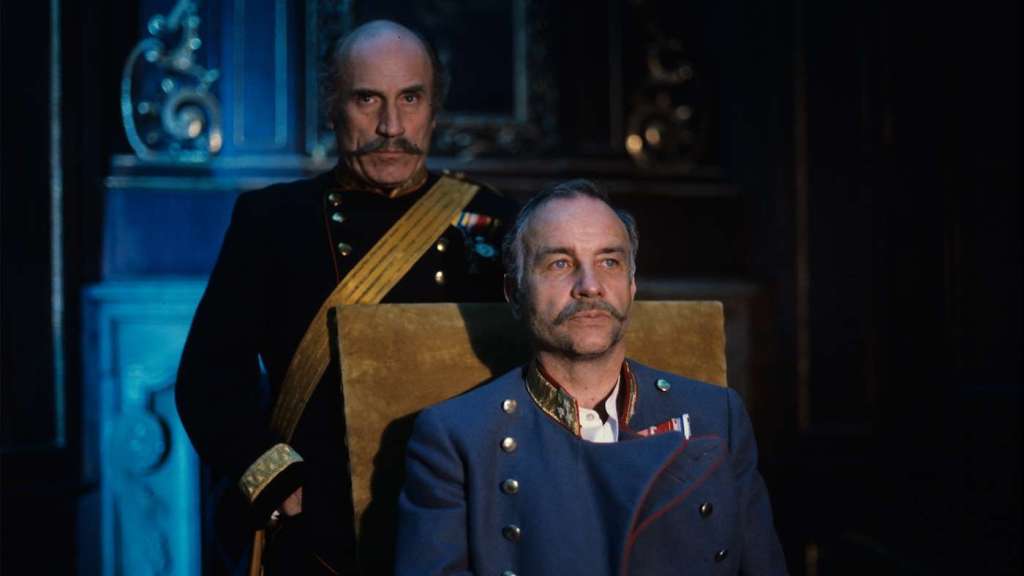
But it’s not enough. Colonel Redl spends much of its slower-paced second half walking through a web of state-sponsored deviousness that isn’t always explained clearly (or compellingly) in the film’s narrative. Needless to say, Redl’s loyalty and hard work end up counting for very little when he is the perfect fall guy for a confusedly ill-thought out idea the Heir (Armin Mueller-Stahl, excellent as a fictionalised version of Franz Ferdinand rife with power-hungry self-confidence) has to unify the army via a scapegoat trial. The ideal target is a man of very specific national and religious background – in fact, Redl’s doppleganger – and when that man inconveniently commits suicide by cop, Redl quickly suspects his own corrupt investigation is now being targeted at him.

Redl, it’s clear, has wasted his life defending, for no thanks, a crumbling regime ripe to fall. Colonel Redl grasps at some of the extensive nationalist and religious tensions that existed in the Austro-Hungarian empire. It doesn’t always do this completely successfully – even in its vast run time, it finds it hard to juggle making these complexities clear while also telling the personal story of its anti-hero. But it does make clear the misguided effort Redl has dedicated his life to: and, also, the strange relief he finds in finally being ‘discovered’. Even if the discovery is something he hasn’t done.

Szabó’s stately film – and its rich cinematography which moves from the chilly blues of Redl’s academy days, to the muted, fade that fills the screen during the court scenes, undermining their grandeur with grubby colours – sometimes gets itself slightly lost in this labyrinth, its pace slowing to a crawl. Some of its narrative ground echoes Mephisto, but with less of that film’s purist riff on Faust. But it is brought firmly back into life by Brandauer’s stunning, humane performance. Other actors would have been constrained by the rigid Redl, but he makes him a buttoned-up morass of barely suppressed tensions, who rarely feels relaxed and sometimes feels as unreadable to us as he does to those around him. And Brandauer deserves every plaudit for his extraordinary suicide scene, a burst of nervous, terrified energy that fills the final moments of the film with real emotional force.

Colonel Redl looks at the corrupt, failing flaws of Austro-Hungary and links it to the Stalinist trials and state control that would follow after another war. It’s less purely compelling than Mephisto and has a plot that sometimes feel a little too dense. But it hosts a fantastic Brandauer performance and finds a real tragedy in a man who would otherwise have felt coldly unknowable and distant.
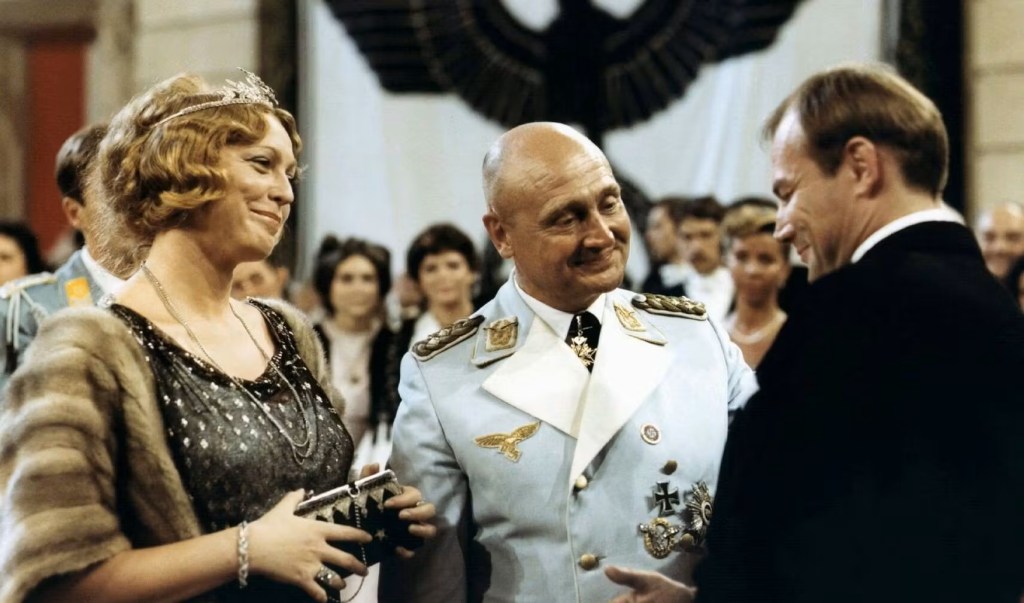
Mephisto (1981)

Mephisto (1981)

Brilliant exploration of the Faust story, a superb portrait of a man who sells what passes for his soul

Director: István Szabó

Cast: Klaus Maria Brandauer (Hendrik Hoefgen), Krystyna Janda (Barbara Bruckner), Ildikó Bánsági (Nicoletta von Niebuhr), Rolf Hoppe (The General), György Cserhalmi (Hans Miklas), Karin Boyd (Juliette Martens), Péter Andorai (Otto Ulrichs), Christine Harbort (Lotte Lindenthal), Martin Hellberg (Professor Reinhardt), Tamás Major (Oskar Kroge), Ildikó Kishonti (Dora Martin)

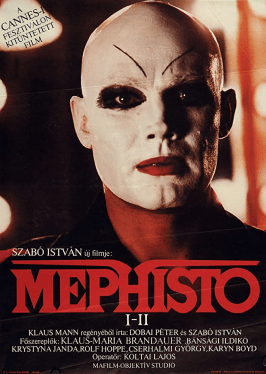
Dictatorships are also times of opportunity for those who can seize their chance. You just need the willingness to craft yourself into exactly what those in power want, learning your lines and putting on the ultimate show of unwavering commitment and devotion. In other words, helps to be an actor. Mephisto is a brilliant portrait of an actor in 1930s Germany who climbs to immense success by playing Mephistopheles on stage while playing Faust in real life, selling his soul for glory.

Hendrik Hoefgen (Klaus Maria Brandauer) is a fiercely ambitious actor, willing to adapt his views and opinions to match whatever the prevailing mood. As he tries to make his name, he throws himself into the Marxist theatre views of his colleagues, scorning the right-wingers among them. He marries Barbara (Krystyna Janda) the stage designer daughter of a liberal Mann-ish author and looks set to become the leading light of left-wing theatre. But that changes when Hitler comes to power and Hoefgen heads for Berlin and the patronage of the powerful Reichs General (Rolf Hoppe), transforming himself into the ultimate ambassador of the Reich’s vision of art.

Mephisto is not only a superbly well-judged film about the dangerous dance between art and politics, its also a brilliant character study of a man with almost no real personality at all. Superbly directed by Szabó (his masterpiece) it’s shot on a rich scale, dripping with the quiet menace of a deadly regime that cares nothing for anyone. All of which only briefly intrudes itself into the self-justifying mind of a man who becomes its willing propaganda mouthpiece, while constantly reassuring himself he’s only an actor.

The beating heart of Mephisto is the astonishing turn from Klaus Maria Brandauer, one of the greatest tour de force performances of the decade. Brandauer’s energy and surface charm is hypnotic. He throws himself into the theatricality, on and off stage, of Hoefgen as well as his boundless enthusiasm. Hoefgen will dance himself to exhaustion to entertain his lover or build grand theatrical castles in the sky with a flurried burst of exuberant passion. But he’s just as likely to erupt in carpet-chewing outbursts of childish rage at actors who don’t match his standards or roles denied him.

In those temper tantrums, you see the child in him. There is something very vulnerable and boyish in Brandauer: his lover, the cynical Black actor Juliette (a superbly whipper-sharp and perceptive Karin Boyd) comments he has the eyes of a child, and you can see that in his understanding of the world. He has a superb ability to divorce himself for the impact of his actions, absorbed entirely in his own theatrical concerns. To Hoefgen, whether or not he plays the lead in Faust or a Moliere farce really is the most important thing in the world. As Brandauer makes clear, it’s not that he’s naïve, more that he’s self-centred and myopic enough not to care.

Hoefgen is a man who needs love like oxygen, and he’ll gush it up from the biggest supply he can find. And, frankly, a one-on-one relationship isn’t going to satisfy him. He soaks up audience acclaim – and what we see of his performance as Mephistopheles it’s deserved, it’s a triumph of physicality and insinuating creepiness – but in his private life he oscillates between needy, demanding and distant. He implores his wife Barbara for her love, pawing at her like a teenager and claiming he needs her to save him; then happily leaves her in a heartbeat to seek out new opportunities in Berlin.

His personality seems half-empty. Is he even aware of the homosexual feelings he has for his old friend Otto (a charismatic Péter Andorai), the only person he takes any risks to protect as the head of the National Theatre? Brandauer finds both a childish hero-worship in Hoefgen’s devotion to this left-wing firebrand, and an unspoken romantic yearning (there is a beautiful moment when they stand together at a window and Brandauer rests his head on Andorai’s shoulder like a love-struck puppy). But really Hoefgen is a mass of opinions and views recrafted from the roles he has played (there is a hilarious montage of Brandauer in a parade of different on-stage costumes) and from those around him. He is a blank canvas, ready for the next scene.

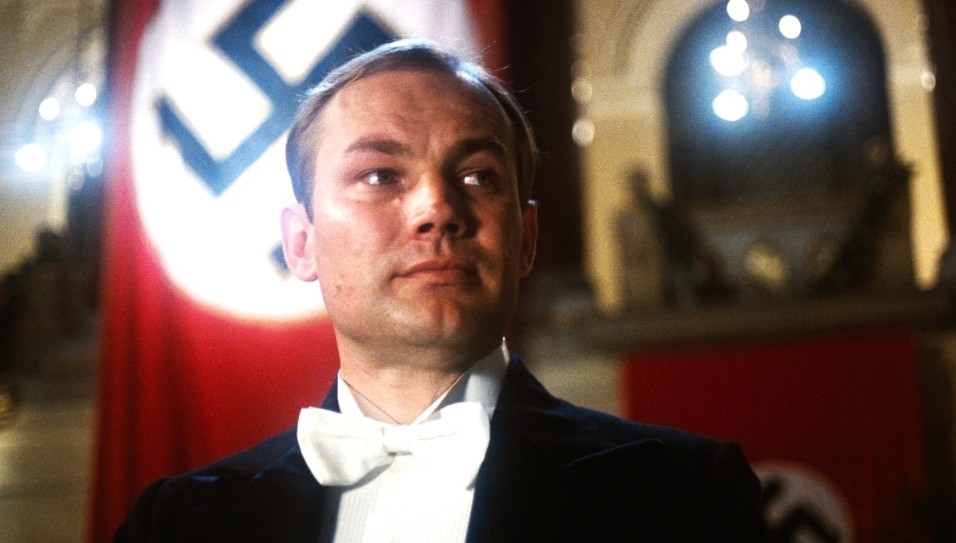
Really, he has no principles at all, making him the perfect Nazi actor. Is that what Rolf Hoppe’s General sees in him? The character goes un-named, but Hoppe’s build and manner alerts us to the fact this is Herman Goering. Imposing and terrifying, indulgent of his mistress the mediocre (but now hugely successful) Lotte Lindenthal (a wonderful Christine Harbot, in many ways a female version of Hoefgen), he’s a terrifyingly controlling presence, jovial one moment and irate the next. He also resembles Hoefgen’s Mephisto, making their Faustian pact all the more intriguing. He can give Hoefgen everything he wants, in return for Hoefgen’s absolute devotion and every fragment of his soul. And, of course, Hoefgen gives it without hesitation.

His soul is what changes. Over the course of the regime, he will report or betray fellow actors and turn away friends. Szabó establishes the ruthless vileness of the regime through fellow actor Miklas (György Cserhalmi, very good) who joins the party early, only to become disillusioned at the lack of advancement his mediocre talent gets compared to Hoefgen’s opportunism. His flirtation with Fascism ends in being marched from the theatre by the Gestapo to “die in a car crash” (in cold reality we are shown his fatal shooting, everyone pretends they don’t know he’s been murdered).

Hoefgen recrafts himself into a Fascist ubermensch. His revival as Mephistopheles is praised as “stronger” and more “fierce” than the original. He practices strengthening his handshake after the General points out its limpness. He culminates the film with re-presenting all his compelling “theatre of the people” staging ideas which he’d outlined at the start of the film (for a social realist piece in a working club), into a newly minted Aryan-Hamlet in which he and Lotte play the lead roles.

But it leaves him totally alone. Everyone who sees through his bullshit – from Juliette to his wife Barbara, wonderfully played by Krystyna Janda full of expressive honesty – is betrayed by him. Szabó has Brandauer increasingly turn his self-justifying pleas to the camera, as if we are the only people left listening to him. At the height of his success, Hoefgen becomes more pathetic than ever: frantically collecting socialist flyers from the theatre toilet and burning them in his office and finally terrorised by the General in Nuremberg’s floodlights, the spotlight he’s spent the whole film searching for only confirming to him what a plaything he is to his masters.

Szabó’s film is a brilliant musing on Faust, a wonderfully complex look at how a man can willingly be contorted and changed by ambition. And it demands repeated viewing to appreciate the towering performance by Brandauer, who burns through the screen with a charisma and power that actually heightens our awareness of his character’s blankness behind the show.