
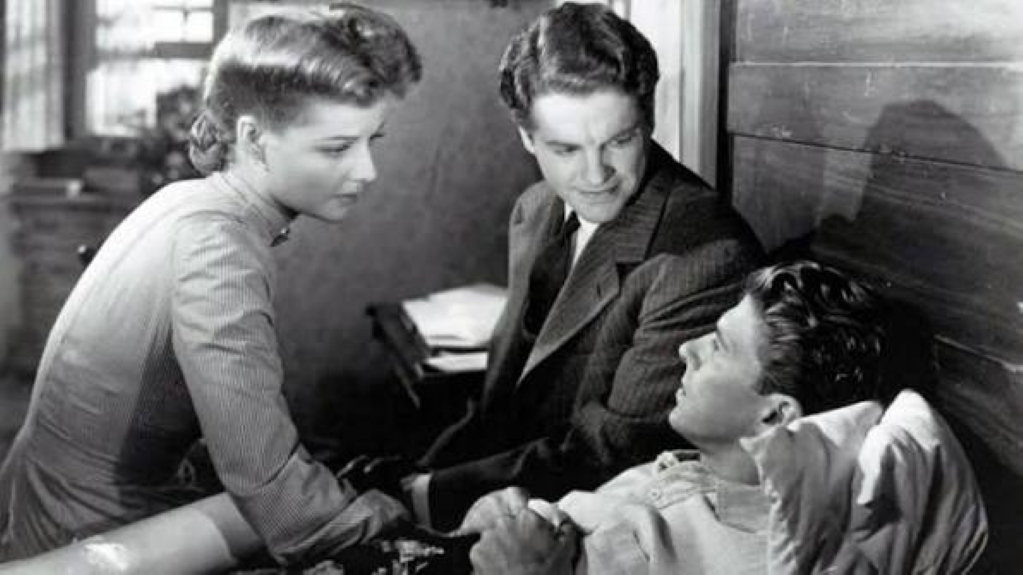
Soapy melodrama on the surface, viciously biting satire underneath – making it as two-faced as the town it’s about
Director: Sam Wood
Cast: Ann Sheridan (Randy Monaghan), Robert Cummings (Parris Mitchell), Ronald Reagan (Drake McHugh), Betty Field (Cassie Tower), Charles Coburn (Dr Henry Gordon), Claude Rains (Dr Alexander Tower), Judith Anderson (Harriet Gordon), Nancy Coleman (Louise Gordon), Kaaren Verne (Elise Sandor), Maria Ouspenskaya (Madame von Eln), Harry Davenport (Colonel Skeffington)
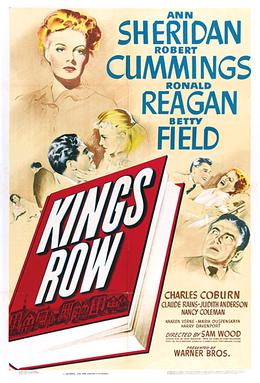
There are few things more idealised than the decent American small-town, where everybody knows your name and people leave their doors unlocked safe with their trusted neighbours. That ideal is comprehensively dismantled by Kings Row. Like some sort of proto-Twin Peaks, it presents a small-town that is all picket fences and porch swings on the surface, but a seething morass of petty jealousies, hypocrisies, lies, cruelties and sadism underneath. Kings Row was adapted from a best-seller by Henry Bellerman many considered unfilmable (among the things it features that are obscured in the film are incest and assisted suicide) and is a searingly successful melodrama.
Covering the 1890s to the 1910s, Kings Row follows the lives of four young people, all suffering from the older generation’s pettiness and wickedness. Parris Mitchell (Robert Cummings) is a young man, training to be a doctor, in love with his austere mentor Dr Tower’s (Claude Rains) sensitive daughter Cassie (Betty Field). His best friend Drake McHugh (Ronald Reagan) is an amiable lothario, denied engagement to Louise (Nancy Coleman), daughter of the snobby Dr Gordon (Charles Coburn) and his wife (Judith Anderson). After personal disasters and tragedies for both men, Parris travels to Venice to train as a psychiatrist and McHugh finds true love with daughter-of-the-railroad Randy (Ann Sheridan). But the dark forces of Kings Row demand a price from Drake.
Kings Row is a sensational plot-boiler, bought to life with great care and a delicious sense of the tender and salacious by Sam Wood. Working closely (again) with William Cameron Menzies on the design and tone, this must have been a glorious change of pace for the pair after the worthy (but flawed) Our Town, which treated similar ideas with reverence. There is none of that in Kings Row, with its frequent recourses to moody skies and Gothic storms via James Wong Howe’s Oscar-nominated expressionistic lighting of its imposing local buildings. This is not a town of homespun values and decency, but lean, mean cruelty and possessiveness, with dark secrets behind every door.
You get that sense from the start, as our characters bound around the town as children. As a young girl, Cassie Tower’s birthday party competes with the announcement Louise Gordon will hold hers on the same day. Sure enough, Parris alone attends Cassie’s – the humiliated torment of this girl at the head of a large empty table, loaded with food, is agonising – while the rest of the town piles into the Gordon’s party. This is a town that plays favourites, and the Gordons are at the top of the social tree. But then, the Towers are not pure as the driven snow. Rains gives a horrific air of quiet, suggestive menace to Tower’s controlling iciness, a grim ogre at the heart of his Gothic pile. Glimpses of Tower’s wife are seen upstairs, confined in isolation like Jane Eyre’s Bertha. His control extends over every inch of Cassie’s life, keeping her isolated and firmly in place.
This continues well into her adulthood – there is a lovely transition here, with a close up of young Parris’ foot stepping over a style with a distinctive brush of the surface, and his adult foot (with the same brush) crossing back over in the same shot – a control that has helped turn her into a flustered, anxious, neurotic, played with intensity by Betty Field. She still attracts the love of Robert Cummings – who does well in a rather thankless role as our quietly, stoic centre – but its doomed by her father’s possessive assumption that he knows what’s best for both her and Parris. The shockingly brutal action Tower takes – and the, on reflection, under-the-carpet brushing of this deed the powers that be carry out – is a clear sign this midwestern town is in fact a ghastly place.
Perhaps the only decent person of the older generation is Maria Ouspenskaya, very heartfelt as Parris’s Russian grandmother. As her health deteriorates, it’s commented by the town’s higher ups that with her passes an era of decent values: an inadvertent satirical comment in itself, since this representative of American values is a Russian accented immigrant. Real Kings Row values are controlled by the Gordon’s: Harriet (played by Judith Anderson in sub-Danvers form) is a bitter snob, while Charles Coburn’s Dr Gordon is the must unsettling character he ever played, a sadistic quack who refuses anaesthetic (and worse) to patients he deems morally inferior and treats the town’s working classes as his personal societal petri dish.
Perhaps it shouldn’t be a surprise that the one guy everyone in the town thinks is a nailed on cad, is the most decent guy there. Ronald Reagan never had a better role than Drake McHugh (his most famous line “Where’s the rest of me!” became the title of his first autobiography). Reagan makes Drake warm, likeable, refreshingly loyal and honest, a ladies man but also a man of his word, treating everyone around him with respect. Kings Row is, in many ways, a parade of events to crush his decency, losing the chance to forge his own business, his trust fund filched, his body mutilated by a sadist doctor.
The dramatic and emotional force ends up being our wish that Drake survives everything the town throws at him. He has the support of best friend Parris, a horrified witness to the evils around him, and Randy played with a charisma and charm by Ann Sheridan that makes an instant impact, despite only making her first appearance an hour into the film. Randy becomes the force of good and hope in the film: alongside her working-class family bastions of true decency, in a town where everyone else seems two-faced, wicked or willing to shove their heads in the ground pretending everything is fine.
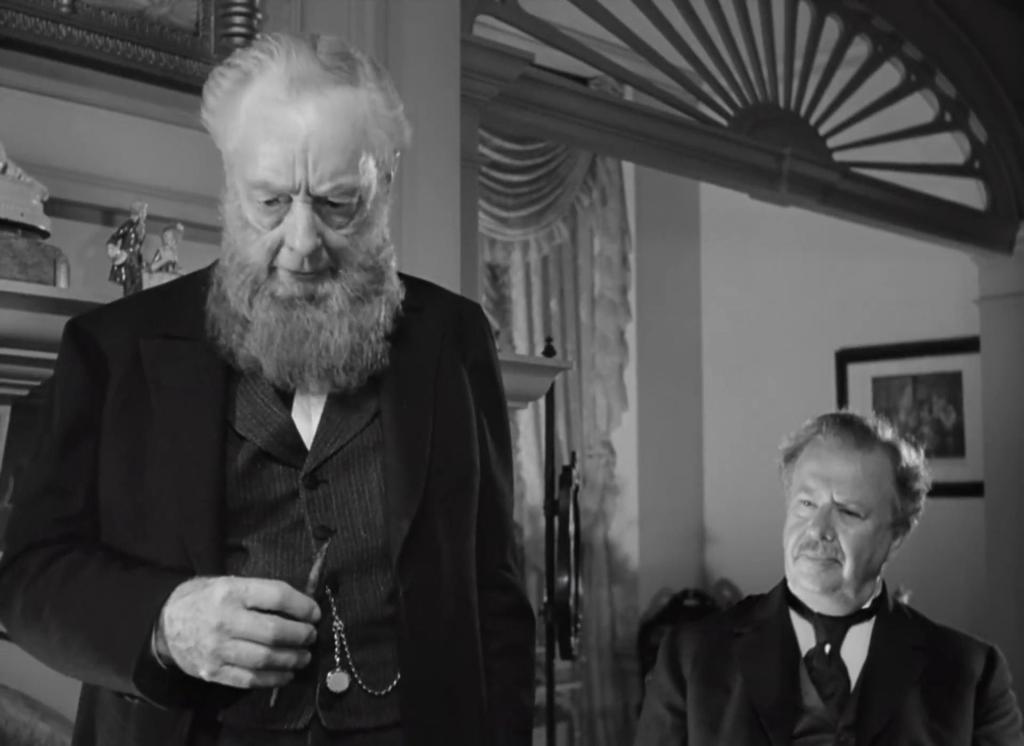
After all, nothing can be allowed to rock the boat in Kings Row. You could argue Harry Davenport’s Colonel Skeffington, who good-naturedly wants to keep everything ticking over, is even the real villain. There seems to be nothing he won’t hush up: fraud, murder-suicide, an epidemic of surgical maiming… Nothing can challenge the idea Kings Row presents on a sign at the town’s boundary: it is “A Good Town. A Good, Clean Town. A Good Town to Live In and a Good Place to Raise Your Children”. Doth the town protest too much?
With this darkness and clear-eyed vision, Kings Row may frequently feel soapish, but it’s a vicious satire exploding a particular all-American ideal and exposing it as rotting garbage, a fountain of lies where the decent and vulnerable (like Drake and Cassie) suffer the most. It makes Kings Row, in its own way, one of the most consequential films of its kind, the sort of denunciation (dressed up as reassuring melodrama) that Hollywood would wait decades before daring to repeat.

