
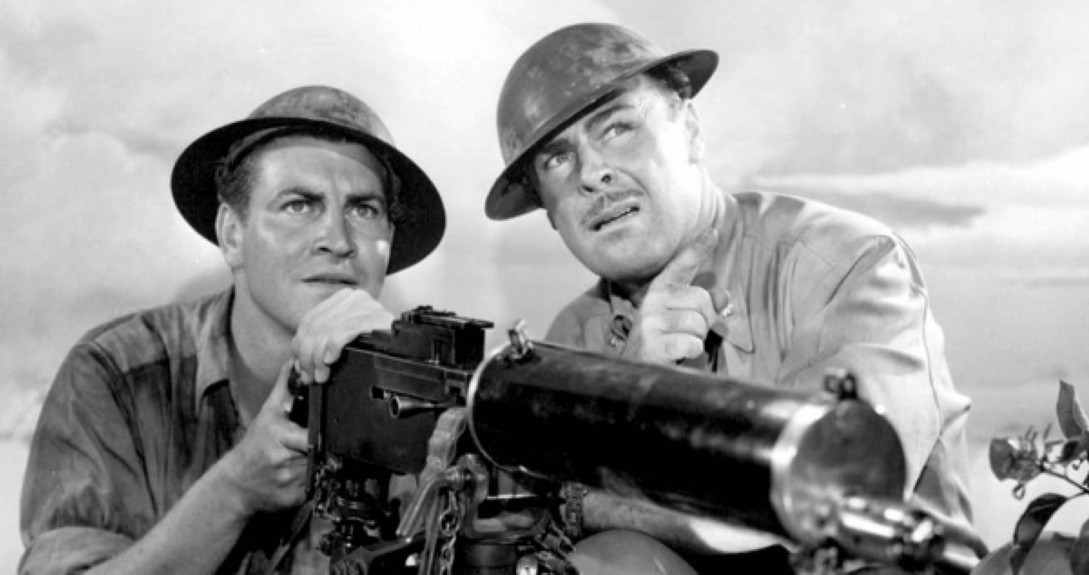
Wartime propaganda, very well made and still stirring that helped inspire a nation to fight
Director: John Farrow
Cast: Brian Donlevy (Major Caton), Macdonald Carey (Lt Bruce Cameron), Robert Preston (Pvt Joe Doyle), William Bendix (Pvt Alpoysius “Spanksie” Randall) Albert Dekker (Shad McClosky), Walter Abel (Commander Roberts), Mikhail Rasumny (Ivan Probenzky), Rod Cameron (Captain Pete Lewis), Philip Van Zandt (Cpl Gus Goebbels)
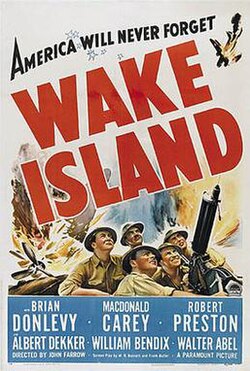
Films about military defeats are more a British thing than an American one. But in 1942, America needed a film to encourage men to march that long road to victory. And what could stir up emotions more than by showing the heroic last stand of American forces on tiny Wake Island against Japanese invaders, holding the island for 16 long days after Pearl Harbor. The battle was fresh news and it’s remarkable how quickly it was bought to the screen, with a skilful combination of newsreel footage, location shooting (somewhere else) and Hollywood backlot filming.
Wake Island doesn’t really shake up the expected formula. But then that’s the point. Cliches like this make for marvellous propaganda, and that’s what Wake Island really is. A grand recruitment video (its final shot is columns of American marines marching to avenge the fallen), that’s also about setting out the absolute moral certainty of the mission. To do that, it carefully fits all its characters into certain standard trope, sets up some interpersonal conflict all to show them coming together with unity of purpose.
We get Brian Donlevy as a stiff-necked, by-the-book officer, never seen dead without his swagger stick. Will he step up to the plate (after commander Walter Abel is killed in the first air raid) to inspire his men? You bet he will. Will Albert Dekker’s civilian contractor, obsessed with the bottom line and regularly clashing with the Army grunts, cast aside his walk-to-rule feelings when the first bombs fall? You bet he will, forming a fire-forged friendship with Donlevy where previously both characters were next-door to enemies.
The entire film celebrates this coming-together of patriots when danger comes, and how quickly they will fall into line to defend each other and the American dream. Robert Preston and William Bendix (recipient of a rather generous Supporting Actor nomination) are goof-off soldiers who love to moan and mock. Bendix is counting down the days to his decommissioning – inevitably his ‘last day’ is December 7th – and can’t wait to get home to his squeeze. But, of course, he will insist on joining back up (even before he’s told he doesn’t have a choice) and he and Preston will take a samurai last stand in a fox hole against waves of Japanese invaders.
Bolstering the sense of patriotic pride are several personal sob stories. Donlevy leaves a loving family behind in Hawaii as he heads to his new posting – we can tell he’s destined to never see them again. Flying ace Macdonald Carey has also left his new wife behind at Pearl Harbor: the tragic result of that decision is communicated to him in a well-shot quiet moment of literal light and shade in an airplane repair hanger. Bendix even has a beloved pet dog, that goes missing in the first raid only to be found in a later raid with a litter of puppies.
Just the right level of sentiment is found all over the place, while our heroes carry on with a stoic dedication to duty. A naval pilot flat out refuses to leave the island with vital intelligence documents until Donlevy point-blank orders him to. Soldiers carry out suicidally risky missions to try and buy their comrades a few more days. John Farrow’s punchy film brilliantly stages a series of air raids which are punishing on the base, buildings and planes exploding and bodies thrown and mangled in the explosive wake. Corpses are often found after the dust clears lying in a tragic heap.
And of course, every propaganda film like this needs an enemy. The Japanese are largely a mass of deadly but beatable soldiers, whose main strength is their limitless numbers. The only Japanese character we hear speak is a visiting dignitary a few days before Pearl Harbor, very much lying for his country. Later the military waves are plucky but no match for American grit: 24 Japanese planes are routed by a handful of American aces. When they land on the island, they are a swarm it’s impossible to overcome. They also have a relentless violence: defeated and wounded soldiers are mercilessly shot and machine-gunned, the Japanese portrayed as having no sense of any rules to this war.
It’s slightly uncomfortable today to see this whole race pigeon-holed in as a mass of rules-free killers and liars with little sense of morality. But then that’s what America then needed to hear. And Wake Island delivers the message loud and clear, using all the narrative tools in its arsenal to do it. It’s sentiment and telegraphed tragedies are well done enough that they become actual strengths, under John Farrow’s assured hand. The recreation of war is very well done, and the final last stand is as moving as it should be as, one by one, our characters are overcome by impossible odds. Is Wake Island a masterpiece? No, not really. But as a piece of war-time propaganda, it’s outstanding.

