
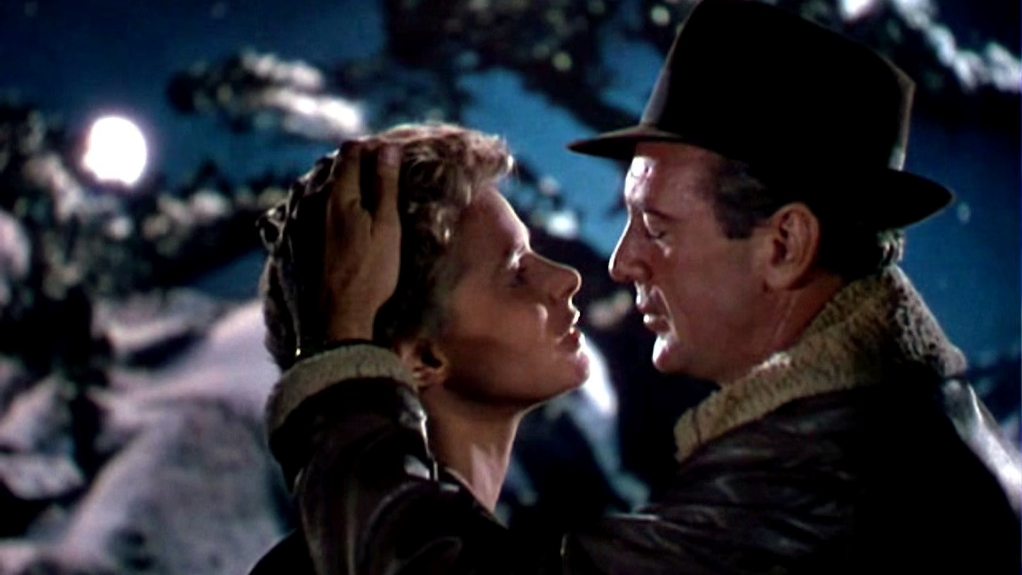
Lusciously shot epic, that feels more like an adventure romance film than the political work the novel was
Director: Sam Wood
Cast: Gary Cooper (Robert Jordan), Ingrid Bergman (Maria), Katina Paxinou (Pilar), Akim Tamiroff (Agustin), Arturo de Cordova (Agustin), Vladimir Sokoloff (Anselmo), Mikhail Rasumny (Rafael), Fortunio Bonanova (Fernando), Eric Feldary (Andres), Joseph Calleia (El Sordo)
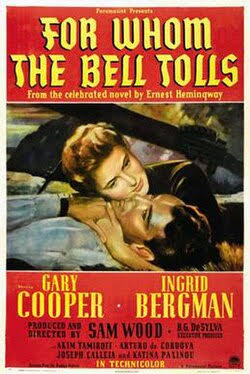
“No man is an island entire of itself” is the opening of John Donne’s Meditation XVII in Devotions Upon Emergent Occasions. That’s where the phrase “never seek to know for whom the bell tolls” comes from, and it lies at the heart of Hemingway’s Spanish Civil War novel, where he and hundreds of other like-minded individuals came together to (unsuccessfully) fight Fascism with self-sacrifice for the common good a calling card. After the novel became a hit, it’s not a surprise Hollywood came calling, moulding Hemingway into an expensively mounted blockbuster.
There was no question who would play the lead, stoic American Spanish lecturer and explosives expert Robert Jordan. After all, Gary Cooper was basically Hemingway’s model when he created the character. Ingrid Bergman beat off a string of competitors to play Maria, victim of Fascist assault, now living with partisans in the Spanish hills. Jordan joins these partisans, to blow a critical bridge. But the journey not only throws up romance for Robert and Maria but also troubles with guerilla leader Agustin (Akim Tamiroff), worried the mission will imperil what’s left of his people, and his wife Pilar (Katrina Paxinou) convinced the mission must be carried out.
Sam Wood, described as a near Fascist by Groucho Marx, seems an unlikely directorial choice for a film celebrating a group of Communist guerillas. But the Second World War makes for strange bedfellows. And, in any case, For Whom the Bell Tolls is less interested in politics than Hemingway. In fact, it practically bends over backwards to remove as many references about the political stakes as it can, re-crafting the book into much more of a men-on-a-mission romp, a tragedy-tinged Guns of the Navarone.
It’s a big-budget crowd pleaser, with a handsome, exotic setting beautifully shot by Ray Rennahan, who managed to make the Sierra Nevada mountains pass as the hills of Catalonia. Mix that with the tragic romance between Cooper and Bergman, in a series of beautifully-lit lingering shots, his reserved decency contrasted with her vulnerability and nerves. Interestingly, despite being hand-picked for the role, this is one of Cooper’s dullest performances, the neutered script removing many of the character’s doubts and fears. It’s only at the end, that Cooper is given any amount of real emotional depth to play with (even if it is via a rather forced voiceover), but otherwise Wood’s film crafts Cooper into the epitome of Fedora-wearing masculine toughness and stoic strength.
Ingrid Bergman fairs a little better as the Spanish lady who wins his heart. Unlike the rest of the cast playing Spaniards, Bergman isn’t caked in layers of brown make-up (something that looks particularly awful in Rennahan’s stylish filters), but the script plays up her character’s melodramatic elements. Bergman does her best to lend dramatic weight to this, but Wood’s film keeps pushing her towards tearful outbursts of fear at the possible loss of Jordan. For Whom the Bell Tolls makes a valiant effort at exploring Maria’s tragic background but shies away from the sexuality of the novel (it did after all coin the phrase “the earth moved”). It’s ironic Bergman was desperate to land this role, but now is best remembered for her other (Morocco-based) 1943 role.
What becomes clear the longer you watch For Whom the Bell Tolls is, that for all the handsome visuals and rich scoring of Victor Young, Wood can’t find the sort of poetic, narrative depth the source material demands. Put frankly, the literary and political force of the novel feels lost to him. It’s hard not to compare this to the sort of thematic depth Lean found in the far-less-complex story of Bridge on the River Kwai. It’s telling that what Wood delivers makes Hemingway feel more like a high-brow Alistair MacLean novel. This doesn’t mean For Whom the Bell Tolls isn’t frequently enjoyable: but it does feel Wood mistakes length and sweep for complexity and depth.
The film’s complete shelving of politics plays into this. There are half-hearted attempts to understand where the guerillas are coming from, but its telling that when it comes to atrocities, more screen-time is given to the past excesses of the communists – hurling decent representatives of the old regime off cliffs to their death – rather than the ruthlessness of the fascist oppressors (even though Jordan starts the film shooting a wounded comrade rather than let him fall into the hands of the Francoists). But it’s very possible to watch For Whom the Bell Tolls and not be completely sure when exactly it is set, or what the issues are everyone is fighting about. Can that be what Hemingway had in mind when it came to the screen?
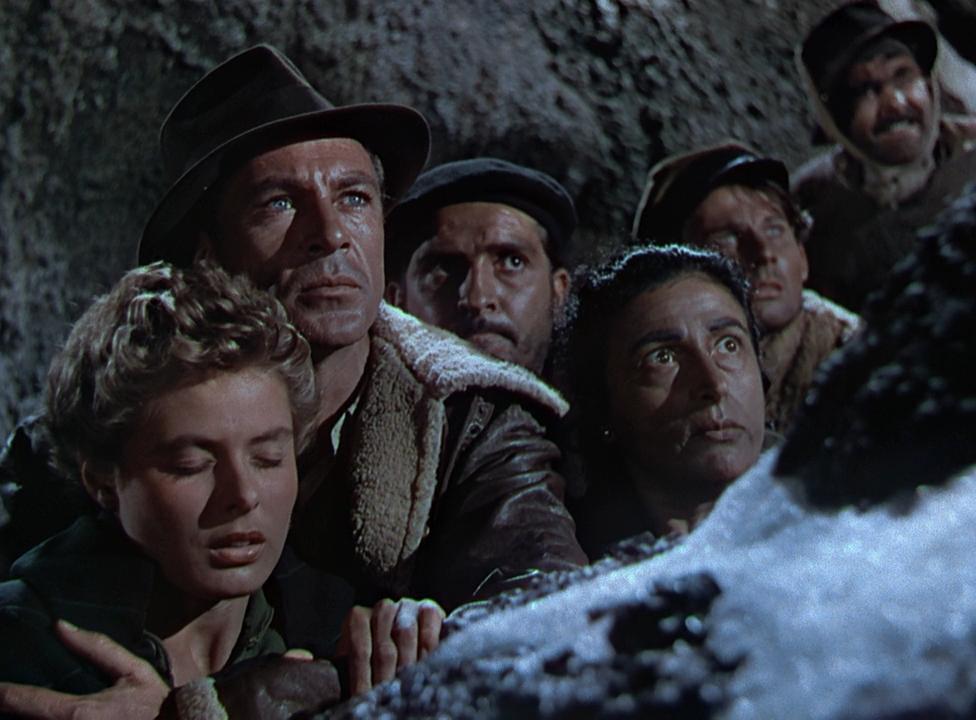
Instead, guerilla drama boils down to questions of guts and character. Akim Tamiroff (Oscar-nominated, like Cooper) gives a fine performance of ambiguous bluster as a guerilla leader who may be concerned about the lives of his men, or may just have completely lost his nerve. Tamiroff is magnificently larger-than-life, with a streak of low-cunning mixed with cowardice. Katrina Paxinou won an Oscar as his wife, the fiercely determined Pilar who deals out romantic device with the same hard-boiled grit that she plans military actions. The guerilla leadership sways between these two throughout, with just enough tension between where they will land.
But For Whom the Bell Tolls remains, at heart, a men-on-a-mission film – something that feels quite reductive considering the passion of where it comes from. Everyone seems to still believe they are actually making a literary statement. The strained sense of self-importance behind the film can make it wearing, and its telling it is at its most engaging and emotionally fulfilling when emersed in action, be that a desperate stand by a group of guerillas in the mountains or the final assault on the bridge, with the heavy cost that brings to the group.
There is another world where For Whom the Bell Tolls could have united its epic scale, military action, doomed romance, passionate humanism and boys-own adventure into something that really coherent and deep, the sort of intellectual epic David Lean would win truckloads of Oscars for 15 years later. But it feels instead torn between echoing the melodramatic sweep of Gone with the Wind with the bravo-filled heroism of Sergeant York. It can’t really square that circle, making it, like the Spanish Civil War, a doomed noble effort. An inadvertent political point, more impactful than any in the film.

