Tag: Katina Paxinou

For Whom the Bell Tolls (1943)

For Whom the Bell Tolls (1943)

Lusciously shot epic, that feels more like an adventure romance film than the political work the novel was

Director: Sam Wood

Cast: Gary Cooper (Robert Jordan), Ingrid Bergman (Maria), Katina Paxinou (Pilar), Akim Tamiroff (Agustin), Arturo de Cordova (Agustin), Vladimir Sokoloff (Anselmo), Mikhail Rasumny (Rafael), Fortunio Bonanova (Fernando), Eric Feldary (Andres), Joseph Calleia (El Sordo)
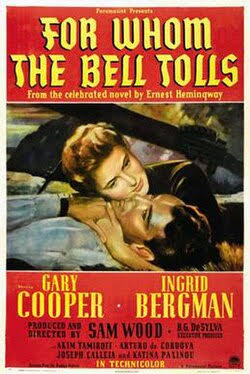
“No man is an island entire of itself” is the opening of John Donne’s Meditation XVII in Devotions Upon Emergent Occasions. That’s where the phrase “never seek to know for whom the bell tolls” comes from, and it lies at the heart of Hemingway’s Spanish Civil War novel, where he and hundreds of other like-minded individuals came together to (unsuccessfully) fight Fascism with self-sacrifice for the common good a calling card. After the novel became a hit, it’s not a surprise Hollywood came calling, moulding Hemingway into an expensively mounted blockbuster.

There was no question who would play the lead, stoic American Spanish lecturer and explosives expert Robert Jordan. After all, Gary Cooper was basically Hemingway’s model when he created the character. Ingrid Bergman beat off a string of competitors to play Maria, victim of Fascist assault, now living with partisans in the Spanish hills. Jordan joins these partisans, to blow a critical bridge. But the journey not only throws up romance for Robert and Maria but also troubles with guerilla leader Agustin (Akim Tamiroff), worried the mission will imperil what’s left of his people, and his wife Pilar (Katrina Paxinou) convinced the mission must be carried out.

Sam Wood, described as a near Fascist by Groucho Marx, seems an unlikely directorial choice for a film celebrating a group of Communist guerillas. But the Second World War makes for strange bedfellows. And, in any case, For Whom the Bell Tolls is less interested in politics than Hemingway. In fact, it practically bends over backwards to remove as many references about the political stakes as it can, re-crafting the book into much more of a men-on-a-mission romp, a tragedy-tinged Guns of the Navarone.

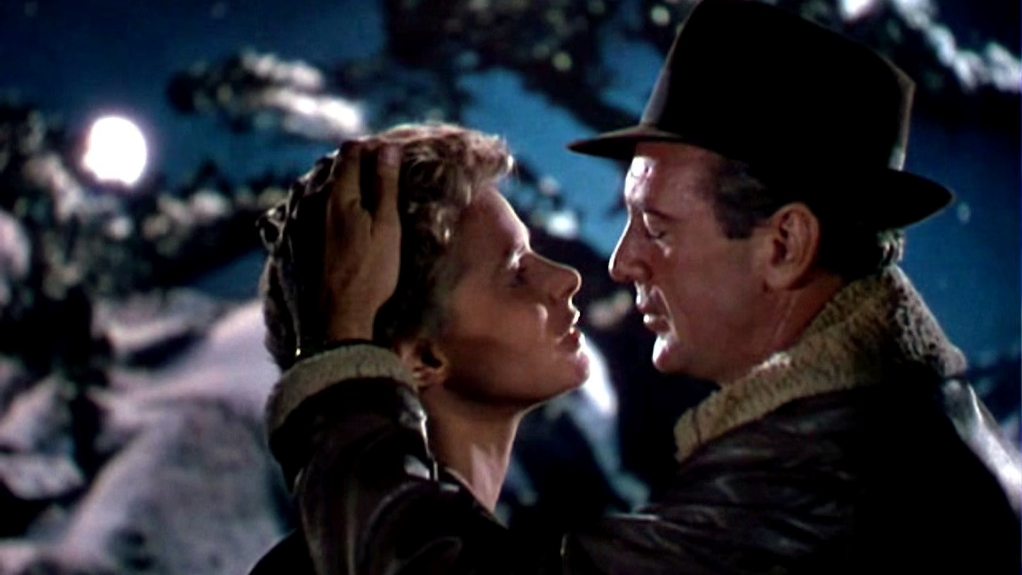
It’s a big-budget crowd pleaser, with a handsome, exotic setting beautifully shot by Ray Rennahan, who managed to make the Sierra Nevada mountains pass as the hills of Catalonia. Mix that with the tragic romance between Cooper and Bergman, in a series of beautifully-lit lingering shots, his reserved decency contrasted with her vulnerability and nerves. Interestingly, despite being hand-picked for the role, this is one of Cooper’s dullest performances, the neutered script removing many of the character’s doubts and fears. It’s only at the end, that Cooper is given any amount of real emotional depth to play with (even if it is via a rather forced voiceover), but otherwise Wood’s film crafts Cooper into the epitome of Fedora-wearing masculine toughness and stoic strength.

Ingrid Bergman fairs a little better as the Spanish lady who wins his heart. Unlike the rest of the cast playing Spaniards, Bergman isn’t caked in layers of brown make-up (something that looks particularly awful in Rennahan’s stylish filters), but the script plays up her character’s melodramatic elements. Bergman does her best to lend dramatic weight to this, but Wood’s film keeps pushing her towards tearful outbursts of fear at the possible loss of Jordan. For Whom the Bell Tolls makes a valiant effort at exploring Maria’s tragic background but shies away from the sexuality of the novel (it did after all coin the phrase “the earth moved”). It’s ironic Bergman was desperate to land this role, but now is best remembered for her other (Morocco-based) 1943 role.

What becomes clear the longer you watch For Whom the Bell Tolls is, that for all the handsome visuals and rich scoring of Victor Young, Wood can’t find the sort of poetic, narrative depth the source material demands. Put frankly, the literary and political force of the novel feels lost to him. It’s hard not to compare this to the sort of thematic depth Lean found in the far-less-complex story of Bridge on the River Kwai. It’s telling that what Wood delivers makes Hemingway feel more like a high-brow Alistair MacLean novel. This doesn’t mean For Whom the Bell Tolls isn’t frequently enjoyable: but it does feel Wood mistakes length and sweep for complexity and depth.

The film’s complete shelving of politics plays into this. There are half-hearted attempts to understand where the guerillas are coming from, but its telling that when it comes to atrocities, more screen-time is given to the past excesses of the communists – hurling decent representatives of the old regime off cliffs to their death – rather than the ruthlessness of the fascist oppressors (even though Jordan starts the film shooting a wounded comrade rather than let him fall into the hands of the Francoists). But it’s very possible to watch For Whom the Bell Tolls and not be completely sure when exactly it is set, or what the issues are everyone is fighting about. Can that be what Hemingway had in mind when it came to the screen?
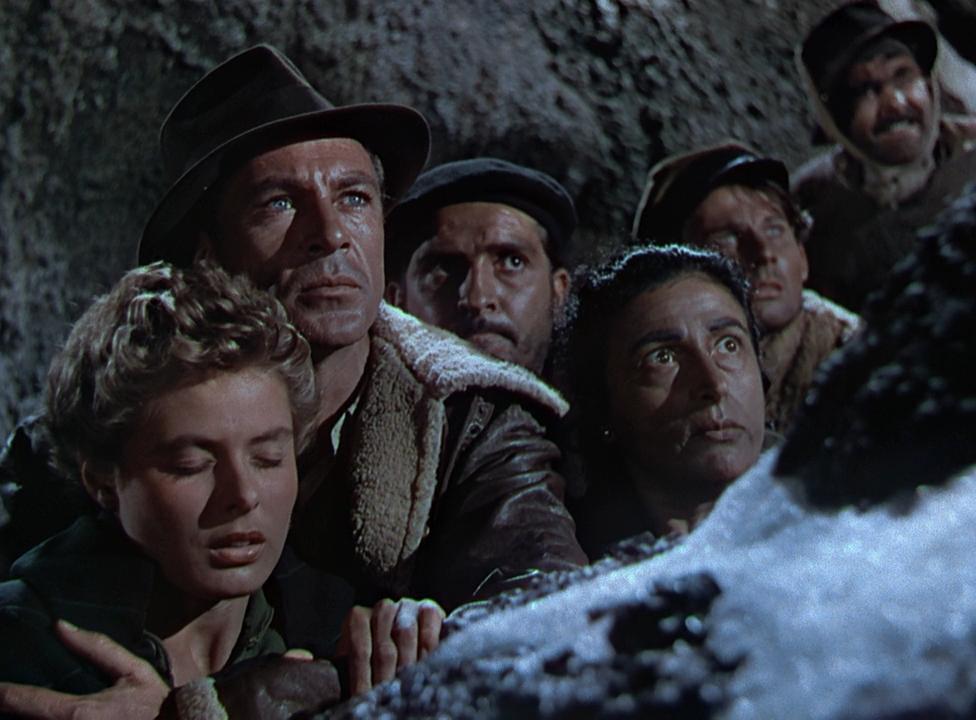
Instead, guerilla drama boils down to questions of guts and character. Akim Tamiroff (Oscar-nominated, like Cooper) gives a fine performance of ambiguous bluster as a guerilla leader who may be concerned about the lives of his men, or may just have completely lost his nerve. Tamiroff is magnificently larger-than-life, with a streak of low-cunning mixed with cowardice. Katrina Paxinou won an Oscar as his wife, the fiercely determined Pilar who deals out romantic device with the same hard-boiled grit that she plans military actions. The guerilla leadership sways between these two throughout, with just enough tension between where they will land.

But For Whom the Bell Tolls remains, at heart, a men-on-a-mission film – something that feels quite reductive considering the passion of where it comes from. Everyone seems to still believe they are actually making a literary statement. The strained sense of self-importance behind the film can make it wearing, and its telling it is at its most engaging and emotionally fulfilling when emersed in action, be that a desperate stand by a group of guerillas in the mountains or the final assault on the bridge, with the heavy cost that brings to the group.

There is another world where For Whom the Bell Tolls could have united its epic scale, military action, doomed romance, passionate humanism and boys-own adventure into something that really coherent and deep, the sort of intellectual epic David Lean would win truckloads of Oscars for 15 years later. But it feels instead torn between echoing the melodramatic sweep of Gone with the Wind with the bravo-filled heroism of Sergeant York. It can’t really square that circle, making it, like the Spanish Civil War, a doomed noble effort. An inadvertent political point, more impactful than any in the film.

Rocco and His Brothers (1960)

Rocco and His Brothers (1960)

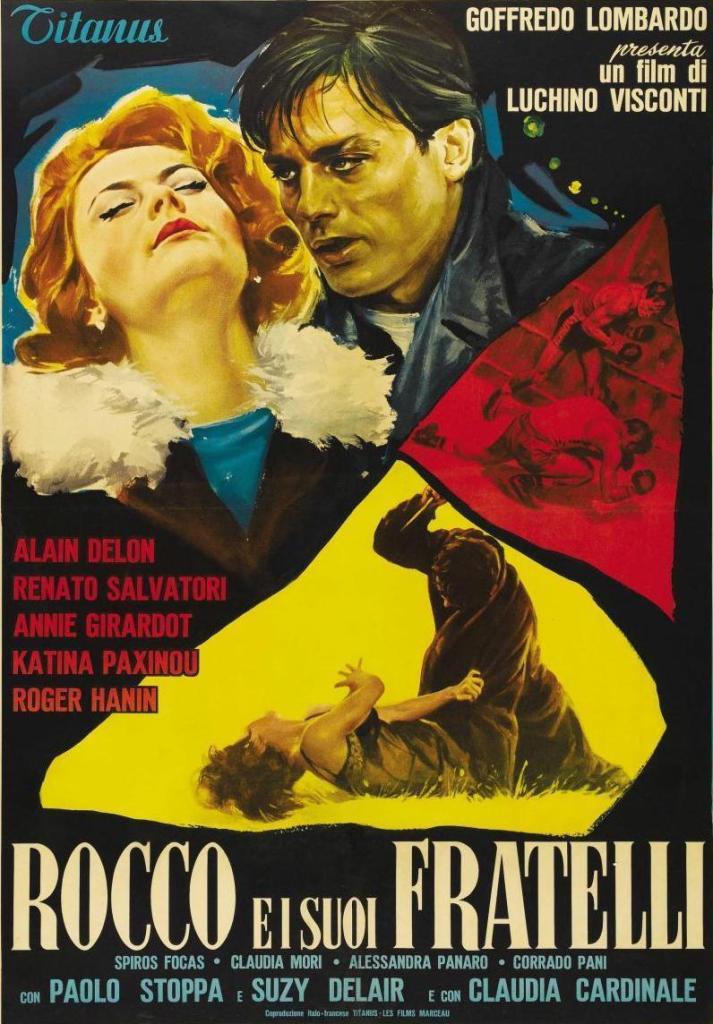
Visconti’s realistic family epic simmers with the dangers of split loyalties, but is mixed on gender politics

Director: Luchino Visconti

Cast: Alain Delon (Rocco Parondi), Annie Girardot (Nadia), Renato Salvatori (Simone Parondi), Katina Paxinou (Rosaria Parondi), Roger Hanin (Duilio Morini), Spiros Focas (Vincenzo Parondi), Claudia Cardinale (Ginetta), Paolo Stoppa (Tonino Cerri), Max Cartier (Ciro Parondi), Rocco Vidolazzi (Luca Parondi, Alessandro Panaro (Franca), Suzy Delair (Luisa), Claudia Mori (Raddaella)

Visconti was born into a noble Milanese family: perhaps this left him with a foot in two camps. He could understand the progress and achievement of northern Italy in the post-war years, those booming industry towns which placed a premium on hard work, opportunity and social improvement. But he also felt great affinity with more traditional Italian bonds: loyalty to family, the self-sacrificing interdependency of those links, and the idea that any outsider is always a secondary consideration, no matter what. It’s those split loyalties that power Rocco and His Brothers.

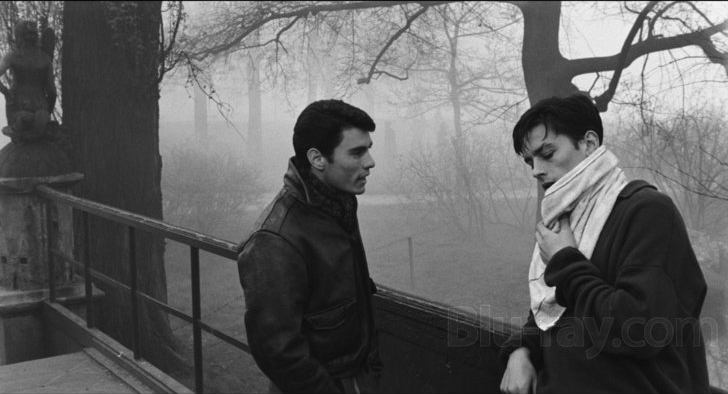
Rocco (Alain Delon) is one of five brothers, arriving in Milan from the foot of Italy looking for work with his mother Rosaria (Katina Paxinou). The hope of the family is second brother Simone (Renato Salvatori), a sparky pugilist destined for a career as a boxing great. But Simone can’t settle in Milan, too tempted by the opportunities he finds for larceny and alcohol. He falls in love with a prostitute, Nadia (Annie Girardot), until she rejects him and then he drifts ever downwards. Rocco, always putting family first, inherits his place first as a boxer than as Nadia’s lover. Problem is, Simone is not happy at being replaced, and the three head into a clash that will see Nadia become a victim in the twisted, oppressive, family-dominated loyalty between the two brothers.

Rocco and His Brothers is a further extension of Visconti’s love of realism – but mixed with the sort of classical themes and literary influences that dominated his later period pieces, themselves in their stunning detail a continuation of his obsession with in-camera realism. Filmed in the streets of Milan, where you can feel the dirt and grit of the roads as much as the sweat and testosterone in the gym, it’s set in a series of run-down, overcrowded apartment blocks and dreary boxing gyms that you could in no way call romantic.

This ties in nicely with Visconti’s theme. Rocco and His Brothers is about the grinding momentum of historical change – and how it leaves people behind. In this case, it’s left Rocco and Simone as men-out-of-time. Both are used to a hierarchical family life, where your own needs are sacrificed to the good of the family and every woman is always second best to Momma. While their brother Ciro knuckles down and gains a diploma so he can get a good job in a factory, Simone drifts and Rocco bends over backwards to clean up the mess his brother leaves behind. Naturally, Simone and Rocco are the flawless apples of their mother’s eye, Ciro an overlooked nobody.

The film focuses heavily on the drama of these two. And if Visconti seems split on how he feels about the terrible, destructive mistakes they make, there is no doubting the relish of the drama he sees in how it plays out. Rocco, by making every effort to make right each of the mistakes his brother makes, essentially facilitates Simone’s collapse into alcoholism, criminality and prostitution. Simone flunks a boxing contract? Rocco will strap on the gloves and fulfil the debt. Simone steals from a shop? Rocco will leave his personal guarantee. Simone steals from a John? Rocco will pay for the damage.

Caught in the middle is Nadia, a woman who starts the film drawn to the masculine Simone but falls for the romantic, calm, soulful Rocco. Wonderfully embodied by Annie Girardot, for me Nadia is the real tragic figure at the heart of this story. Whether that is the case for Visconti I am not sure – I suspect Visconti feels a certain sympathy (maybe too much) for the lost soul of Simone. But Nadia is a good-time girl who wants more from life. Settling down to a decent job with Rocco would be perfect and he talks to her and treats her like no man her before. Attentive, caring, polite. He might be everything she’s dreaming off, after the rough, sexually demanding Simone.

Problem is Nadia is only ever going to be an after-thought for Rocco, if his brother is in trouble. Alain Delon’s Rocco is intense, decent, romantic – and wrong about almost everything. He has the soul of a poet, but the self-sacrificing zeal of a martyr. He clings, in a way that increasingly feels a desperate, terrible mistake, to a code of conduct and honour that died years ago – and certainly never travelled north with them to the Big City. When Simone lashes out at Nadia with an appalling cruelty and violence, making Rocco watch as he assaults her with his thuggish friends, Rocco’s conclusion is simple: Simone is so hurt he must need Nadia more than Rocco does. And it doesn’t matter what Nadia wants: bros literally trump hoes.

Rocco does what he has done all his life. He wants to live in the south, but the family needs him in the north. He wants to be a poet, but his brother needs him to be a boxer. He loves Nadia but convinces himself she will stabilise his brother (resentful but trapped, she won’t even try, with tragic consequences). All of Rocco’s efforts to keep his brother on the straight-and-narrow fail with devastating results. Naturally, his mother blames all Simone’s failures on Nadia, the woman forced into trying to build a home with this self-destructive bully. Rocco’s loyalty – he sends every penny of his earnings on military service home to his mother – is in some ways admirable, but in so many others destructive, out-dated indulgence.

And it does nothing for Simone. Superbly played by Renato Salvatori, he’s a hulk of flesh, surly, bitter but also vulnerable and self-loathing, perfectly charming when he wants to be – but increasingly doesn’t want to. His behaviour gets worse as he knows his brother is there as a safety net. It culminates in an act of violence that breaks the family apart: not least because Simone crosses a line that Ciro (the actual decent son, who Visconti gives precious little interest to) for one cannot cross and reports him to the police.

That final crime is filmed with a shocking, chilling naturalism by Visconti, horrific in its simplicity and intensity. But I find it troubling that Visconti’s core loyalties still seem to be with the out-of-place man who perpetrates this crime and his brother who protects him, rather than female victim. Rocco and His Brothers could do and say more to point up the appalling treatment of Nadia, or at least make clearer the morally unforgiveable treatment she receives from both brothers (she’d have done better disappearing from Milan after Simone’s attack and never coming back, not playing along with Rocco’s offensive belief that Simone’s assault was a sort of twisted act of love).

Saying that, this is a film of its time – perhaps too much so, as it sometimes feels dated, so bubbling over is it with a semi-Marxist view of history as a destructive force. But it’s shot with huge vigour – the boxing scenes are marvellous and their influence can be felt in Raging Bull – and it ends on a note of optimism. The film may have disregarded Ciro, but there he is at the end – happy in his choices, settled, making a success of his life. Rocco and Visconti may see the drama as being exclusively with the old-fashioned brothers, making their counterpoint a paper tiger, but it ends with him – and (I hope) a reflection that Ciro’s path may be duller and safer, but also nobler and right.