Category: World War II

The More the Merrier (1943)

The More the Merrier (1943)

Very funny farce, excellently acted with some near pin-perfect farce.

Director: George Stevens

Cast: Jean Arthur (Constance Milligan), Joel McCrea (Joe Carter), Charles Coburn (Benjamin Dingle), Richard Gaines (Charles J Pendergast), Bruce Bennett (FBI Agent Evans), Frank Sully (FBI Agent Pike), Don Douglas (FBI Agent Hardy)

Wartime in Washington and housing space is at a premium, with the city full to bursting. Here to solve this housing problem is millionaire Benjamin Dingle (Charles Coburn), who is ironically unable to find a place himself to lay his head. Luckily, through charm and bull-headed perseverance, he persuades young statistician Constance Milligan (Jean Arthur) to sub-let her apartment to him. Taking a shine to the buttoned-up Constance, Dingle sub-lets half of his half to army engineer Sergeant Joe Carter (Joel McCrea), planning to play Cupid. Something he commits to even more after meeting Constance’s stuffy pen-pushing fiancée Pendergast (Richard Gaines). As the Farragut-loving Dingle says: Full steam ahead and damn the torpedoes!

This zany set-up is delivered to the screen with plenty of bounce and zing by George Stevens. Especially its first half, a near master-class in pin-perfect, near-miss, door-opening-and-closing farce that would have made Chaplin or Keaton proud. The More the Merrier is a funny, surprisingly sexy film boosted by not taking itself too seriously and powered by three lead actors having a whale of a time. If its final resolution feels a little too forced – and Dingle’s manipulations at points verges towards the sinister – that doesn’t change the fact there are so many laugh-out-loud moments along the way.

The More the Merrier starts with a dry, witty sense of tongue-in-cheek parody as a sonorous news-reel voiceover introduces us to Washington where “living is pleasant and leisurely”, singing the praises of the city’s hospitality, fine dining and gentility while a montage of shots shows us it’s a whirligig of frantic movement, food grabbed on the street and “no vacancy” signs turned towards us with a slap. It’s a sign of the film’s wry wit and the fun it will have at the nonsense just behind the way we talk about everyday life. It’s also a sign that Stevens understands gags land best with a straight bat and a sly wink – a subtlety that serves the film well.

It’s first act, as Dingle and then Carter move into the home of the reluctant Constance, sees all three actors playing wonderfully into the straight-faced farce. An obsessive control-freak, running her life to a tight timetable, Constance hands a detailed minute-by-minute itinerary of the day’s first half hour to Dingle, that’s hilarious in its minutiae. Jean Arthur deserved an Oscar nomination for this scene alone, a perfect minute of ludicrously detailed instructions on everything from newspaper collecting to bathroom door closing to coffee brewing – with Coburn’s earnest bafflement equally fine. The inevitable disintegration of this plan the next day (a parade of the two locking each other out of the apartment, knocking into furniture, getting sprayed by an errant shower and losing a pair of trousers) is such a masterclass in farcical underplaying – in particular from Coburn – that it’s guaranteed to bring the house down.

But perhaps even better is the next morning, the first after Carter has been smuggled into the house without Constance’s knowledge. With only Dingle aware of the situation – and wanting to keep it secret as long as possible – Stevens positions the camera in the hall and delights us with a five-0minute sequence of perfectly timed door comedy, as McCrea and Arthur continuously just miss each other, culminating in a perfectly timed corridor cross where both actors only narrowly miss walking smack into each other. This is choreographed comedy at its finest.

The More the Merrier seems ripe for fast-paced screwball from there, but Stevens shifts gears into a romance that’s both natural and surprisingly sensual. He’s helped by the huge chemistry between Arthur and hand-picked co-star McCrea, who with minimal fuss and no grand-standing manage to communicate beautifully two people surprised to be absolutely besotted with each other. Their playing of Carter’s gifting of a travel case to Constance simmers with sexual tension, as McCrea quietly but intensely leans in to extol the virtues of every feature while Arthur breathlessly agrees – never before has excitement about a suitcase been such a clear stand-in for something else.

Their spark only grows, lingering glances and an intense desire to be left without the interference of Pendergast (Richard Gaines doing exactly what’s required as a tedious bore and obstacle to happiness). They have a late-night walking scene culminating in them sitting on their apartment stairs that feels like one of the raciest scenes in screwball. Stevens leans into this with his shooting of their bedrooms. Shot from the exterior, their windows subtly blur the rooms together (at one shot, the dividing wall is just a blurry line making the two appear to be in bed together) culminating in a final sequence that gets the slow-build to a final wall punchline spot on.

All of this works as well as it does thanks to the excellence of the three stars. Jean Arthur is very funny as a control-freak growing increasingly flustered as her well-organised life spins out of control (even if her final act wailing becomes a little wearing). McCrea perfectly mixes dry, low-key wit with a quiet sexuality. Coburn won an Oscar for possibly his finest ‘cheeky old uncle’ performance, a gruff mischief maker with a twinkle in his eye. All three of the actors spark of each other in any combination, right down to Coburn and McCrea throwing themselves into reading cartoons out loud with childish glee.

But the final act doesn’t quite deliver. A forced resolution involving the FBI never quite feels like it matches with what’s come before. The manipulations of Coburn’s character at times become a little too forceful – and it’s hard not to feel more than a little uncomfortable when he takes Constance’s accidentally abandoned diary and reads it out loud, an invasion of privacy the film never holds him to account for. If there is one point where the chemistry between Arthur and McCrea doesn’t land, its ironically in many of the final scenes, not helped by those continual frantic wails from Arthur. You get the sense Stevens had a great set-up but not quite a clear idea on how to finish it. But what gets us there is witty, fast-paced and very funny – and that’s just more than enough.

The Pied Piper (1942)

The Pied Piper (1942)

A perfectly judged star vehicle, very slight and competent but entertaining enough

Director: Irving Pichel

Cast: Monty Woolley (Howard), Roddy McDowell (Ronnie), Anne Baxter (Nicole Rougeron), Otto Preminger (Major Diessen), J. Carrol Naish (Aristide Rougeron), Lester Matthews (Mr Cavanaugh), Jill Esmond (Mrs Cavanaugh), Peggy Ann Garner (Shelia), Merril Rodin (Willem), Maurice Tauzin (Pierre), Fleurette Zama (Rose), Marcel Dalio (Focquet), Odette Myrtil (Madame Rougeron), Marcelle Corday (Madame Bonne)

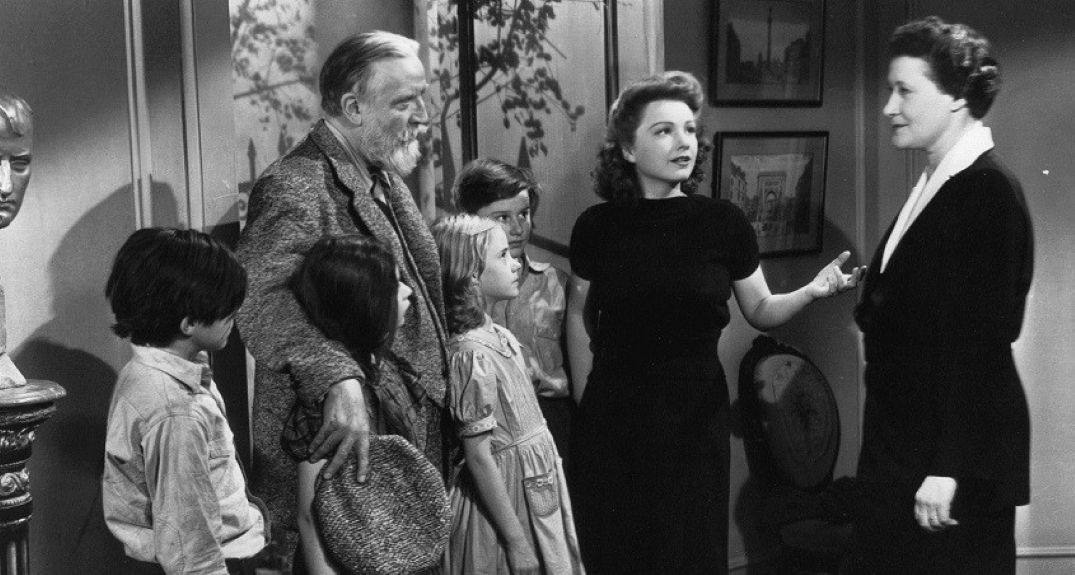
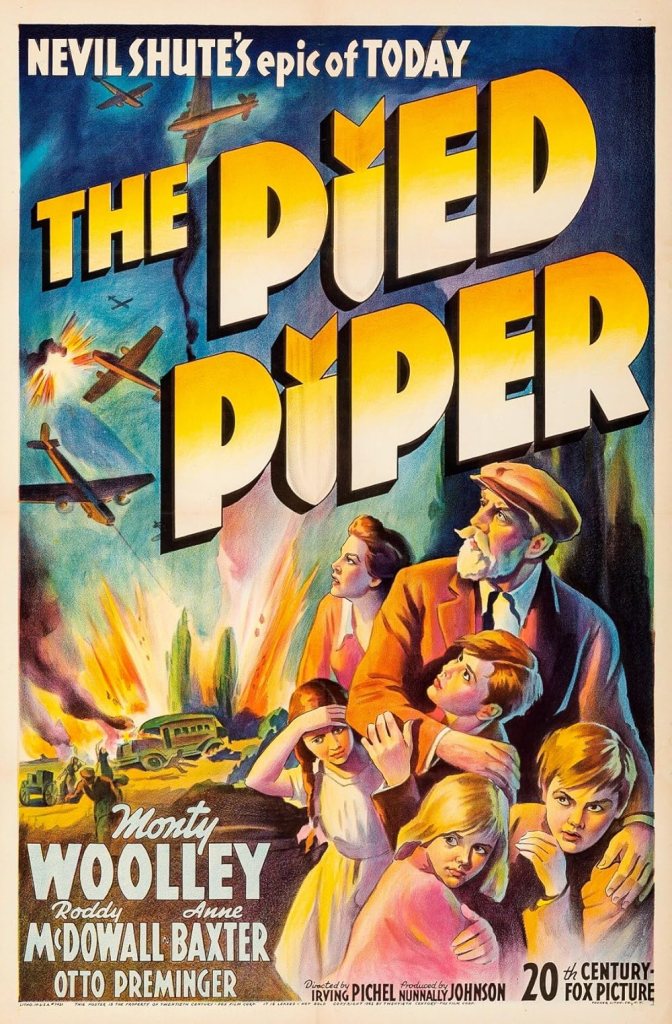
Talk about a part tailor-made for its lead. We need a curmudgeonly old duffer, with the twinkly charm of an avuncular uncle and a secret heart of gold – get Monty Woolley on the blower! In this Nevil Shute adaptation, he plays Howard, caught up in the 1940 German invasion of France while on a fishing holiday. With great reluctance, he agrees to escort Ronnie (Roddy McDowell) and Shelia (Peggy Ann Garner), children of a League of Nations diplomat, across France. Along the way, as well as dodging the Germans, he picks up a shell-shocked French orphan and a scrawny Dutch child and recruits the help of an old ‘acquaintance’ of his son, Nicole (Anne Baxter). Will Howard dodge the Germans and escape?

Woolley eases into this crusty old-timer with consummate ease – after all it’s essentially a twist on his star-making turn in The Man Who Came to Dinner, and Howard might as well be the twin of Since You Went Away’s Colonel Smollett. But he can sell the heck out of characters like this, duly picking up an Oscar nomination. Introduced reluctantly helping Shelia with her homework – a running gag is Howard’s complete lack of knowledge of American geography, insisting Rochester is a state – he’s prickly around the kids, but not too prickly. Leaving us in no doubt that his gruff distance will soon melt on the road. Which of course it does, despite the occasional abrupt grumbling.

Not least since Woolley brings out a tender concern at how these kids are being exposed to the horrors of war. Little flashes of sadness as they see a dead body for the first time, and the sad understanding that crosses his face when he inspects the shell-shocked Pierre. Howard has a hard-won understanding of war, Woolley stiff of lip as he confesses the death of his RAF pilot son, mixed with pride that it took ‘three of them’ to take him down. It’s clear shepherding these children becomes, for him, the war service he was considered too old to do. We already know he’s got a determined never-say-die spirit, imperiously telling a surrender-monkey who joins him to listen to Churchill (a truly terrible voiceover impersonation) that he best never speak to him again.

Woolley is front-and-centre of nearly everything good in The Pied Piper, an otherwise fairly straight-forward mix of road movie, family adventure and war movie. It’s got a smoothly adapted script by Nunnally Johnson and competent, if uninspiring, direction by Irving Pichel. I found the film’s recurrent use of various predictable refrains – most irritatingly ‘Twinkle, twinkle little star’ – incredibly grating after a while. Most of The Pied Piper is all too obviously shot on studio sets, spiced up with the odd piece of stock footage. (Not surprisingly, considering it was shot while the world was tearing itself apart). Following in the spirit of its woeful Churchill radio impersonator, there are some desperately wobbly plane models super-imposed over a bombing raid on an evacuation convoy. It’s a swift and pacey film – but also a rather slight one.

Because The Pied Piper is only willing to go so far in showing the horrors of war. It will let its precocious children see a dead body but not us. The sense of peril, about what might happen to Howard if caught, isn’t quite there. Perhaps because it’s somehow implausible that anyone caught on the French-Swiss border in 1940 would think their best option was crossing occupied France rather than shooting across the border to Switzerland (those League of Nation parents must have been kicking themselves). The danger of Nazi pursuit only kicks in half-way through the film – until then, Howard doesn’t even bother to conceal his nationality. It’s not helped by The Pied Piper (like most 40s war films) totally failing to wrap its head around what a concentration camp is.

There is an episodic feeling to the film’s half, before most of the second half settles into a single location, with our heroes under the thumb of Otto Preminger dutifully trotting out one of his occasional angry Nazis. Along the way they pick up Anne Baxter, wrapping her tongue around an “ooo la la” accent that sticks out even more when several other members of the cast (including Marcel Dalio as a defiant fisherman) are actual refugee expats. But then part of the film’s family appeal is there isn’t too much peril.

The final act does introduce some – the introduction of a firing squad threat feels suddenly quite extreme – but also resolves all problems with the sort of contrivance that feels a bit like the story has been painted into a corner and without any other way to get out of it. There is a romantic innocence to it in some ways, the hope that any character could have a secret, sentimental weakness that might make them do a good thing. And the capture of our heroes does allow Woolley to showcase another weapon in his arsenal, his ability for proud, stiff-backed defiance in the face of evil.

The Pied Piper is sweet, charming, flies by quickly and offers a perfect, tailor-made star turn. The kids, thankfully, manage to not be too grating (in fact you even kind of wish Roddy McDowell and Peggy Ann Garner were given more to do). It’s a surprise to find a story so slight as this breathing in the vaulted air of the Oscar Best Picture short list, but it’s hard to argue against the relief of watching everyday heroism in the midst of war.

The Thin Red Line (1998)

The Thin Red Line (1998)

Malick’s return from self-exposed exile is, for better or worse, a war film unlike any other

Director: Terrence Malick

Cast: Sean Penn (Sgt Edward Walsh), Adrien Brody (Cpl Geoffrey Fife), Jim Caviezel (Pvt Robert Witt), Ben Chaplin (Pvt Jack Bell), George Clooney (Captain Bosche), John Cusack (Capt John Gaff), Woody Harrelson (Sgt Keck), Elias Koteas (Capt James Staros), Jared Leto (Lt Whyte), Dash Mihok (Pfc Don Doll), Tim Blake Nelson (Pvt Tillis), Nick Nolte (Lt Col Gordon Tall), John C Reilly (Sgt Maynard Storm), Larry Romano (Pvt Mazzi), John Savage (Sgt McCron), John Travolta (Brig Gen Quintard)

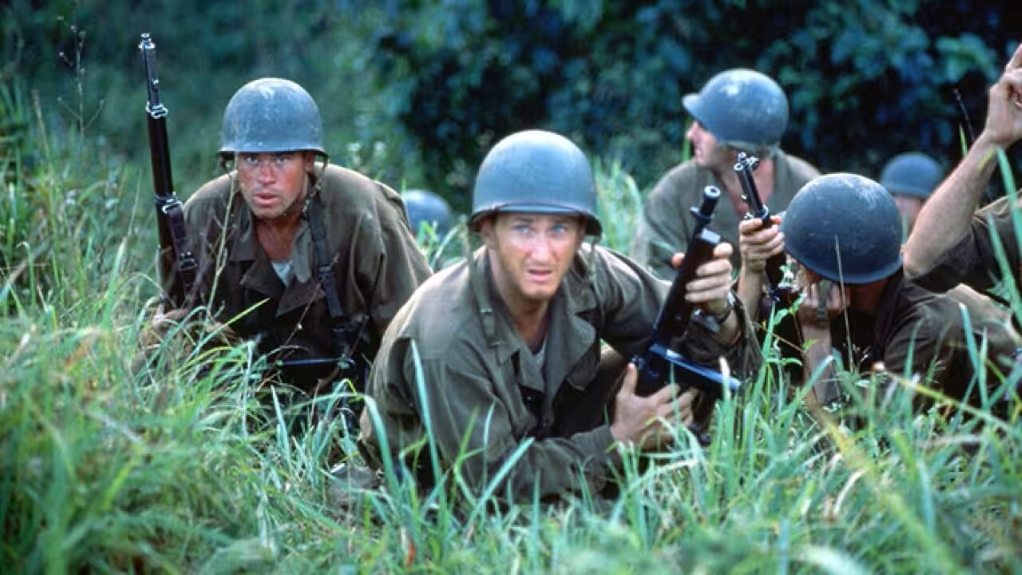
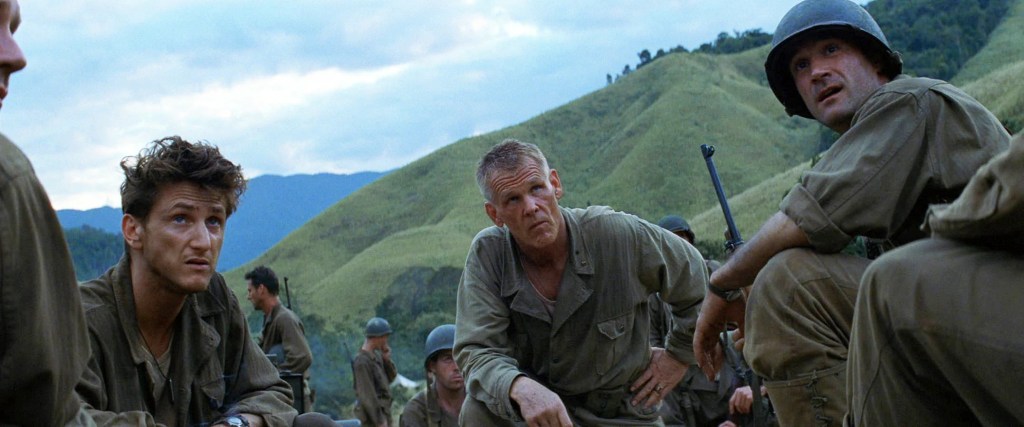
There are war movies. And then there are Terrence Malick war movies. With The Thin Red Line Malick returned from a self-imposed twenty-year exile, during which his mystique had grown to mythical status. His return screened the same year Spielberg was widely credited as re-inventing the entire genre with Saving Private Ryan. But, while that was a visceral gut punch, The Thin Red Line makes its men-on-a-mission approach seem conventional. Malick’s film is a poem, musing on man’s place in nature, humanity, spirituality, good and evil – in fact anything except Dirty Dozen style shenanigans.

Set on the US invasion of Guadalcanal, it follows the men of a single company as they march and fight their way across the island, principally focusing its ‘plot’ on a two-day mission to capture a non-descript hill from a largely unseen enemy. In the smorgasbord of characters, Malick’s roving eye lights on a few key figures: the spiritually-minded, independent Witt (Jim Caviezel); Bell (Ben Chaplin) who day-dreams about the wife he left at home; Doll (Dash Mihok) a terrified blow-hard; stoic professional Sgt Welsh (Sean Penn) who holds the company together; feuding commanders, humanitarian Captain Staros (Elias Koteas) and ambitious Colonel Tall (Nick Nolte).

But these characters are merely a jumping off point for a film that ruminates with sometime self-indulgent luxury, and bravely dares to suggest the ‘good war’ of World War II was a pointless, inhuman brawl that served little real purpose. Few war films start with peaceful shots of nature at work, featuring a crocodile drifting lazily through the waters (the same croc is later captured by the soldiers – no escape for nature from the war), lingering shots of birds and wildlife and one of its principal characters (Caviezel’s Witt), AWOL and paddling gently across a river, among an indigenous tribe.

The Thin Red Line draws a tender portrait of these indigenous people – whose calmly life is corrupted by conflict, not in terms of destruction but how the violence of war seeps into their culture. When Witt returns later, on leave after sterling front-line service, he finds these people clashing as never before, mirroring the brutal anger of the war he has left. In the film’s frequent, mumbling, ruminative voiceover, characters ask again and again where violence comes from – does it come from the same place as goodness? If you plug into this sort of thing – and some won’t – it can have a hypnotic power.

What makes The Thin Red Line unique among war films is that its real heart is in the poetry, full of deep, open-ended questions which are either unanswerable or mystifyingly oblique. It stretches as few others do for deeper spiritual answers. Malick adapted the film from a conventional war novel, by James Jones – but during the editing he jettisoned much of its plot (much to the shock of Adrien Brody, playing the novel’s lead character but reduced to a few lines) and leaned into the mystical, spiritual questions he was asking. Malick spotted earlier than any others the messianic, martyr qualities in Jim Caviezel, who is excellent as a rebelliously minded but deeply sensitive and spiritual man who senses instinctively his bond with the world around him.

The Thin Red Line touches throughout on the possibility of some benign – or otherwise – force that runs throughout existence and ties us all together. Malick frequently finds small moments where the soldiers become fascinated and irresistibly drawn towards nature, running their hands over leaves, admiring the waves, watching a bird dance from branch to branch… What, The Thin Red Line wonders, makes us turn from being part of a symbiotic whole, to shooting lumps out of each other? And for what? All for ‘fuckin’ property’ as Welch grouches?

As such it’s fitting the combat almost exclusively revolves a scuffle for Hill 210, a grassy pile that Malick never considers important enough to place in context or give us a clear view of. We are frequently mystified about how far up this lump of earth the soldiers have made, what is on the other side, or how it’s conquest will affect the war effort. Instead, this beautiful countryside surrounding – and Malick doesn’t stint on showing how gorgeous Guadalcanal is – serves to flag up even more the violence happening in it. The stunningly luscious photography by John Toll, becomes almost part of the point, hammering home the vicious inhumanity war brings into the natural world.

Instead, war focuses on brutal and trivial ends, that so often betray us into death. The hill’s main importance for Colonel Toll – a charismatically fierce performance of frustrated bitterness by Nick Nolte – is as a pathway to career advancement in a war he has waited his whole life for. Just as its essential pointlessness – it can be bypassed and taken in a slower flanking approach – means Koteas’ (a wonderfully measured performance) captain is unwilling to order his men into a suicidal attack. The phone clash between these two – a furious Nolte and a pressured Koteas trying to remain calm – is Malick’s most accessible narrative beat, expertly delivered.

In fact, the action and the epic sweep of the combat is a reminder that Malick may long to be a poet but he is also an astute and gifted narrative storyteller (when he chooses to be). For all the excitement of John Cusack’s Captain Gaff leading a charge up the hill, the film’s heart is the strange balance every character walks between the martial and mystical, between the call of nature and the grinding duty of killing. Qualities that can be seen fighting in Sean Penn’s fiercely professional sergeant who can weep at the tragedies around him, and fiercely attack the shallowness of the war they are wrapped up in. In fact, much of Thin Red Line feels like a Malick Art Project, a sort of rarefied air that you need to prep to make an expedition towards.

Of course, with all this to admire, it’s also hard not to deny that The Thin Red Line can also be long (and feel very long) and that it’s air of self-importance does, at times, wear the viewer down. It’s deliberately obscure and oblique narrative – not to mention that its voiceover is frequently rather hard to match to particular characters – can whiff somewhat of overindulgence. You could argue the essential message of the film – we’d all be better off if mankind could accept its place as part of a larger Gaia-like whole – is hardly re-inventing philosophy.

But it’s the undefinable, mystical whimsy of the film that makes it stand out – for good or ill. Since many – and, I’ll be honest, me as well sometimes – will find the films muttered whimsy carrying more than an air of self-important pontificating. Despite this, you can see why so many Hollywood stars were desperate to work on it – Travolta and Clooney have tiny cameos, several others hit the cutting room floor. It’s hard to imagine anyone else in Hollywood making a war film anything like this, to have the artistry to mix gunshots and birdsong and give equal weight to both. There are few films quite like it. So thank God for Malick, an artist who has a distinctive voice, the courage to commit to it and the skill to pull it off. The Thin Red Line has moments that few other Hollywood film makers have matched in their whole career – and that alone makes it a film to hold tight and cherish.

Lawrence of Arabia (1962)

Lawrence of Arabia (1962)

Brilliant epic, one of the greatest films ever made – not to mention possibly my all time favourite

Director: David Lean

Cast: Peter O’Toole (T. E. Lawrence), Omar Sharif (Sherif Ali ibn el Kharish), Alec Guinness (Prince Feisal), Anthony Quinn (Auda Abu Tayi), Jack Hawkins (General Edmund Allenby), José Ferrer (The Turkish Bey), Anthony Quayle (Colonel Harry Brighton), Claude Rains (Mr Dryden), Arthur Kennedy (Jackson Bentley), Donald Wolfit (General Archibald Murray), I. S. Johar (Gasim), Gamil Ratib (Majid), Michel Ray (Farraj), John Dimech (Daud), Zia Mohyeddin (Tafas), Howard Marion-Crawford (Medical officer), Jack Gwillim Club secretary)

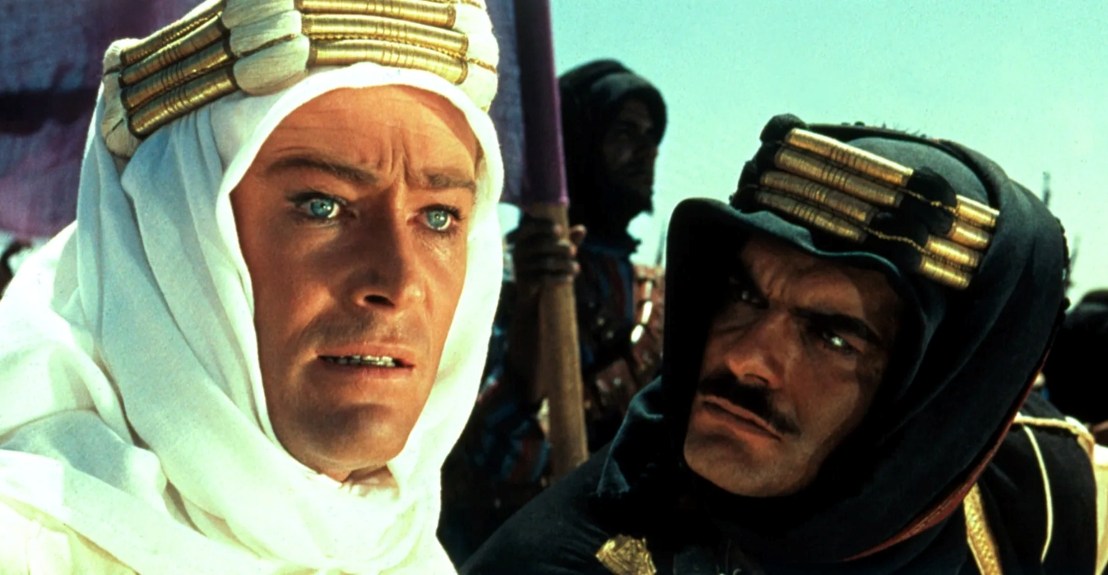
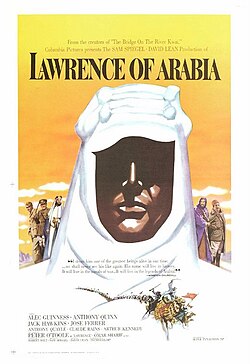
There is no beating around the sand dune. Lawrence of Arabia is probably my favourite film of all time. It’s also the apogee of David Lean’s career and, arguably, the entire genre of epic film-making. No other epic is as massively, awe-inspiringly grand as this and perhaps no other combines the stunning scale with such intense, fascinating and astute character insight. It’s a film that succeeds on every front and leaves any viewer with such a searing visual impression that, once seen, it’s almost impossible to forget. And, of course, everyone should see it.

It was decades in the making before Sam Speigel and David Lean marshalled it to the screen. Based on TE Lawrence’s Seven Pillars of Wisdom, it’s strikingly modern in that it’s a biography of Lawrence without attempting the full cradle to grave. Instead, told in what it’s easy to forget is interrogative flashback after Lawrence’s death in a motorcycle accident, it focuses exclusively on Lawrence’s (Peter O’Toole) campaigns with the Great Arab Revolt during World War One – but in a style heavily influenced by Shakespeare’s fast-and-loose approach to history, where events drill down into that elusive question: what sort of man exactly was Lawrence? In other words: “Who are you?”

And fascinatingly for a film increasingly misremembered today as some sort of imperialist fan-fare blower or white saviour narrative, the answer is frequently not particularly flattering. In line with his historical self, this Lawrence is a deeply conflicted figure, perfectly captured in Peter O’Toole’s breath-takingly superb performance as a quirky, thoughtful introvert who frequently role-plays as an extrovert barrelling into the limelight. He’s a man capable of staggering insight, devoid of the knee-jerk racism of his fellow Brits. But he’s also a bombastic egotist with a major messianic complex who compares himself to Moses. That’s not even touching on his repressed sexuality, sadism or his deep discomfort at his in-built relish for violence and bloodshed.

Throughout O’Toole treats triumph with a giggling schoolboy relish, then collapse into dead-eyed, silent gloom when grimmer repercussions emerge. It’s a stunning performance, and fascinating figure to set at the centre of a war epic. O’Toole’s Lawrence is handsome, charismatic and a genius – but also fey, camp even, nervous, confident only when he is in control, likely to collapse into nervous giggles when things go wrong. O’Toole also brilliantly conveys the growing darkness and cruelty in Lawrence, shocked and appalled by his excited relish in killing Gasim or his excited anticipation at the slaughter of a group of Turks. It feeds an ego that believes he is above normal men, stunned at the moments when he discovers he is not, that leads him to ever darker determination to prove he can change the world through will alone.

Lean’s film is remarkable in how it presents Lawrence’s achievements with the jaw-dropping marvel they deserve – but also in showing his failures, cruelties, delusions. It’s remarkable how often Lawrence is punctured or bought-down after moments of success – especially as any moment of success has him even further convinced of his own genius. His saving of Gasim in the Nefud desert is followed shortly after by his executing the same man to preserve the fragile peace in his Arab coalition. His conquest of Aqaba is followed by guiding his teenage servant Daud into quicksand. A successful attack on a Turkish train is followed by getting his other teenage servant, Farraj, killed. His almost suicidal pride in entering Derra alone dressed as an Arab, leads to his capture, beating and rape by a perverted Bey (a lip-smackingly sinister cameo from Jose Ferrer, who considered this his finest performance).

Is there an epic film more cynical and critical about British Empire building than Lawrence of Arabia? Away from Lawrence, the Brits are represented by the Blimp-ish Murray (Donald Wolfit in fine form), Allenby (a marvellous Jack Hawkins) who doesn’t let principle get in the way of duty and a duplicitous Dryden (a magnificently austere Claude Rains). Both Allenby and Dryden well understand the game they are playing (with varying degrees of enthusiasm) – help the Arabs, but not too much, bring them together, but not too much, get rid of the Turks put the Brits in their place. Lawrence of Arabia is far from a flag-waver, presenting a cynical, two-faced view of rapacious Empire building. Its even uncomfortably rejected by Anthony Quayle’s endearingly straight-forward Colonel Brighton (who stands out as the film’s most honourable character).

In comparison, the Arabs are seen as perhaps naïve and chaotic, but largely honourable and honest and their campaign for independence and self-government is presented sympathetically (only their most Westernised representative, Alec Guinness’ reserved Prince Feisel, can match Dryden and Allenby in ruthless politics). There is a vibrant genuineness in Arab culture, even if it’s also shown to be as full of bitter hierarchical rivalries between tribes as the British are in their club memberships. Much of this is captured in Omar Sharif’s extraordinary performance as Sherif Ali (a sort of Arab version of Lawrence, both introverted and extroverted), a man of deep principles whose discomfort grows with Lawrence’s increasing wildness.

Lawrence’s unpredictability is what the film circles round to again and again. It’s fascinating both how flawed and unknowable he becomes. You only need to look at his costume: in ill-fitting military outfit, the trousers too short, O’Toole feels utterly out-of-place compared to his comfort in flowing white robes. But those robes become progressively more filthy, transparent and ghost-like the longer the film goes on. Does any other epic lay so bare the complex sexuality of its hero, his sado-masochistic desires (“the trick is not minding it hurts” indeed!), his part-shame, part-excitement about his assault by the Bey, his unmistakeable relish for death?

It’s striking how Lean so frequently frames Lawrence as unseeable: watch the Act 2 train attack, where we see Lawrence from behind, his feet striding along a train and then his body framed with the sun behind him. Or the film’s conclusion that turns him into even more of a ghost, a spectral figure behind a curtain and a jeep passenger almost invisible behind a mud-smeared windscreen. It’s extraordinary visual work to communicate a depth of theme. Constantly, he’s framed as a figure shrinking into the chaos, slipping through our fingers when we think we understand him.

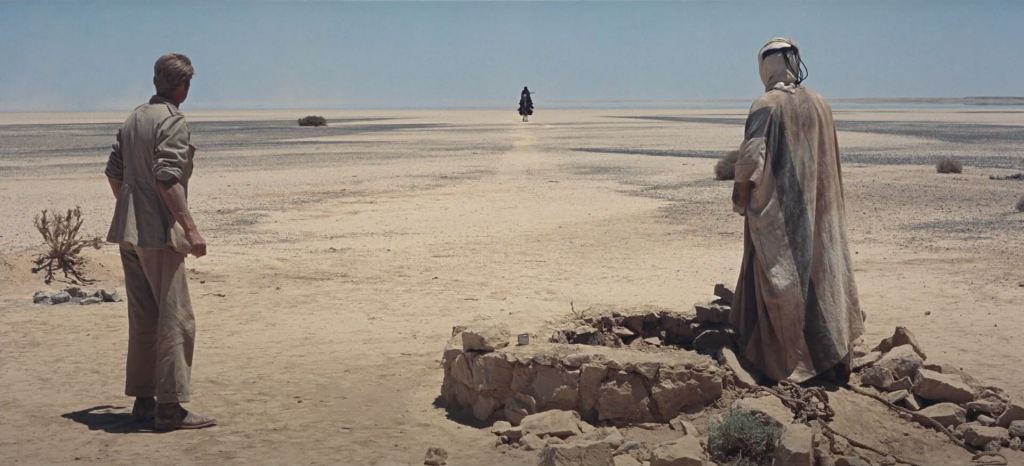
That’s in a film crammed with extraordinary images. “No Arab loves the desert” are true words, but Englishmen do and Lean certainly did. His shooting of this vast panorama of dunes and sand is second to none. Is there a greater shot in history than the slow arrival of Sharif from the wavy mirage mists of the desert? That stands out in a film of extraordinary images: Lawrence’s progress through the mountains; the tracking shot of the attack on Aqaba, that ends on the powerless guns; a train puffing through the desert; even the small moments – Lawrence’s goggles dangling on a branch after his accident is a gorgeously simply, brilliantly evocative image. Everything in Lawrence is perfect technically: John Box’s superb sets, Maurice Jarre’s breathtakingly evocative music; Anne V Coates flawless editing (witness one of the greatest cuts of all time).

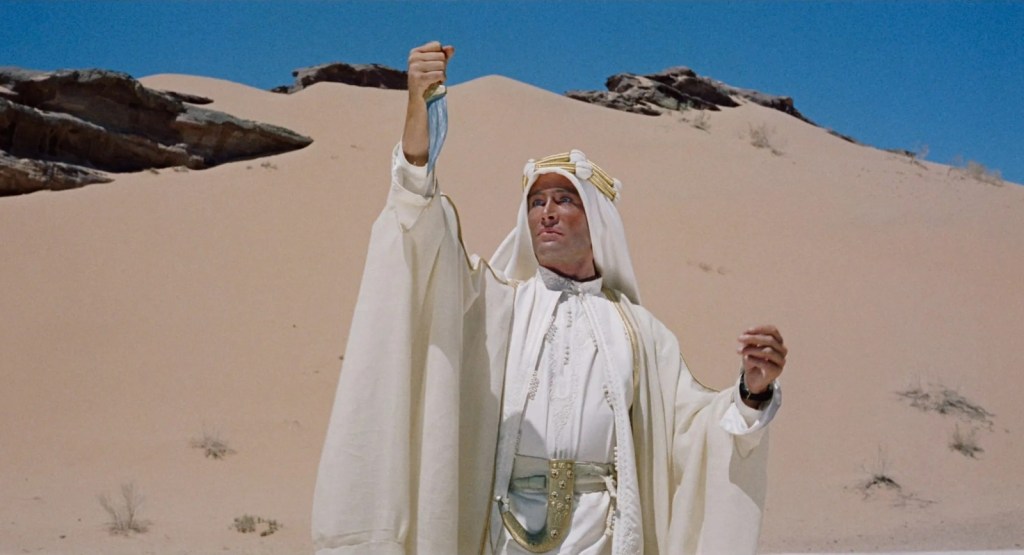
But it’s always bought back to the sharp critical eye on its lead, powered by Robert Bolt’s superbly iconoclastic script and Lean’s directorial discipline. This is a film that mirrors Lawrence’s playful dance in his new robes, stopping to admire himself in the reflection of his dagger with Lawrence, 90 minutes of screentime later, echoing the gesture to stare in horror at his blood-soaked clothing. That makes its last military action not the capture of Damascus, but Lawrence’s brutal massacre of retreating Turks at Tafas. Which ends with its hero covered in failure and sent packing as an awkward figure in the new age by both sides.

It’s a huge thematic complexity that gives Lawrence the chance to cement itself as one of the greatest films ever made. With its matchless technical brilliance, it brings a sharply insightful, critical eye to its lead and resolutely refuses to indulge in any hero-worship at all. It brings great depth and passion to its portrayal of the Arab people (I will grant Guinness’ casting today is unfortunate – less so with Quinn who was always ethnically ambiguous and is knock-out, charismatically brilliant), showing them as warts and all but rejecting the temptation to present them as a noble but simple people, but instead of a rich, non-Westernised culture forced to play by someone else’s rules. Lawrence marshals this while constantly leaving us questioning and changing our mind about the lead character, so superbly bought to life by O’Toole you could make a case for it as one of the greatest performances of all time. You can certainly make the case for the film as one of the greatest, a stunningly assembled, wonderfully directed, breathtaking mix of spectacle and character study that rewards the viewer every single time they see it.

Mister Roberts (1955)

Mister Roberts (1955)

Dry and stagey version of a theatre hit, that never quite comes to life cinematically

Director: John Ford, Mervyn LeRoy (Ward Bond, Joshua Logan)

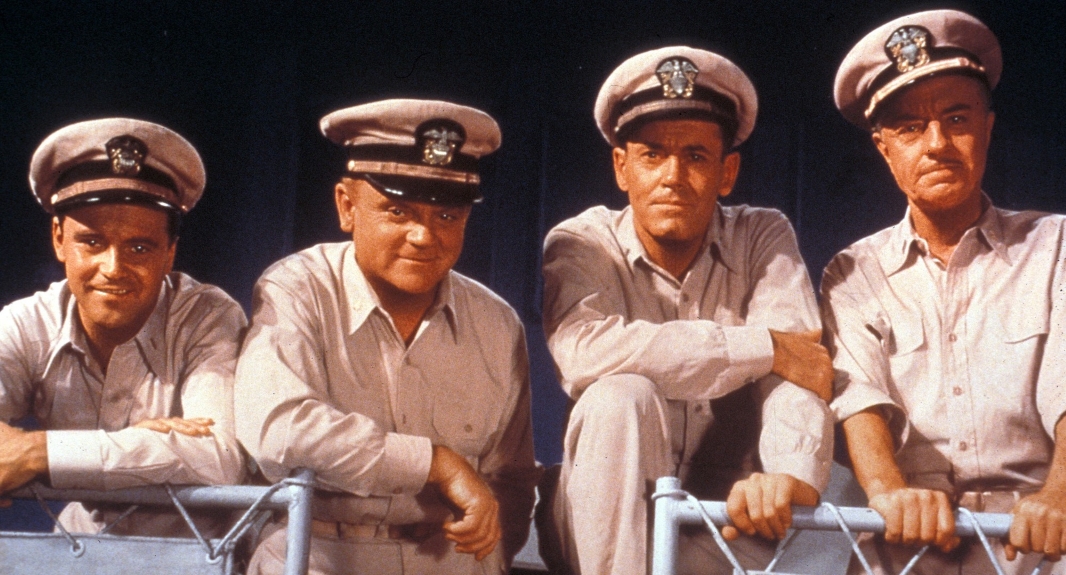
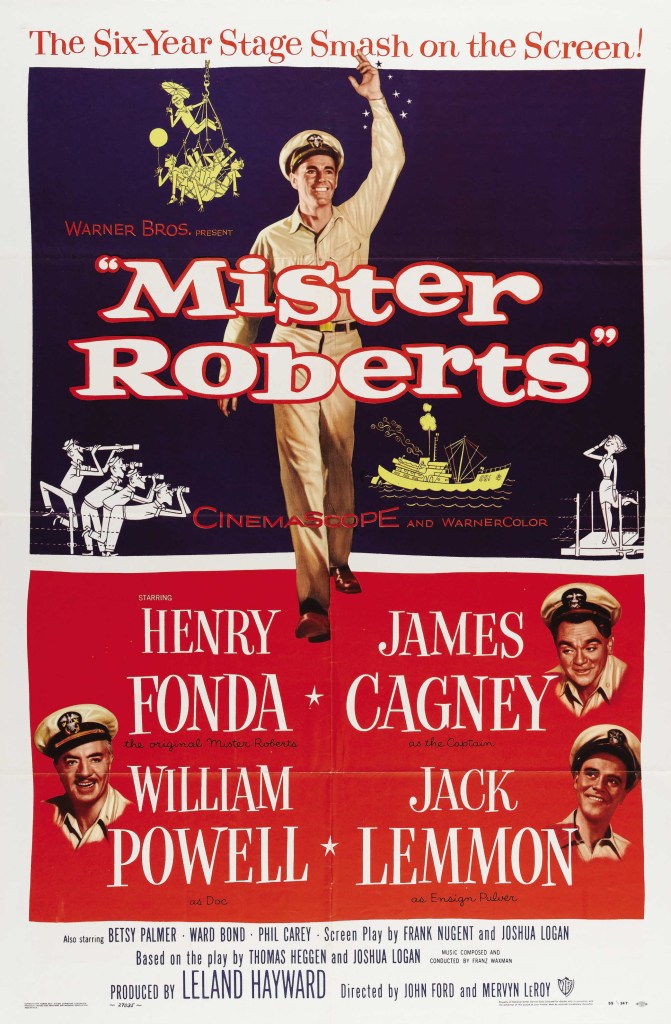
Cast: Henry Fonda (Lt Jnr Gd Doug Roberts), James Cagney (Lt Cmd Morton), William Powell (Doc), Jack Lemmon (Ensign Frank Pulver), Betsy Palmer (Lt Ann Girard), Ward Bond (CPO Dowdy), Ken Curtis (Dolan), Philip Carey (Mannion), Nick Adams (Reber), Perry Lopez (Rodrigues), Patrick Wayne (Bookser), Harry Carey Jnr (Stefanowski)

Henry Fonda hadn’t made a film for almost seven years, spending the intervening years collecting garlands on Broadway: and a lot of those were for his over 1,000 performances of Mister Roberts. When the hit play came to the screen, he was the only choice (even if Fonda looked a bit long-the-tooth for a junior lieutenant). Fonda was less than happy with the film – despite its financial success and Oscar nominations – and it’s easy to see why. This is an uneasy mix of awkwardly opened up filmic sweep and stagy set up, with the original’s saltiness watered down to gain Naval co-operation.

Fonda is Lt Jnr Grade Doug Roberts, second-in-command of naval cargo ship Reluctant (known as the Bucket). It’s 1945 and the ship is under the tyrannical command of Lt Commander Morton (James Cagney), a lazy placeman riding Robert’s organised shirttails to career success. That’s why he’s unwilling to grant Roberts’ wish to be transferred to a combat ship so he can do his bit. Roberts is the buffer between Morton and the crew, Morton taking any opportunity he to impose his Bligh-like authority through punishments. How will the power struggle between the two men play out?

The most interesting thing about Mister Roberts is the immense turmoil of its making, burning through no less than four directors. Ford butted heads with Fonda (never the easiest guy in the world), who felt he knew far the material better than Ford. This eventually led to a punch-up and Ford hitting the bottle big-time before he was sent to a sanatorium. Ward Bond took over before Mervyn LeRoy was shipped in. LeRoy claimed to have directed over 90% of the film (allegedly in Ford’s style), before he too was replaced by Logan, the original Broadway director, who only didn’t get the job in the first place because Fonda had also fallen out with him. Logan felt the recut script ripped the heart out of the play and, like Fonda, that the film was not a patch on the original.

This chaos perhaps explains why this feels like such a bland and stagey affair. There is the odd widescreen shot of Reluctant puffing through the seas, or Fonda surveying the panorama. But these are outweighed by static camera set-ups of a sound-stage recreation of the ship. Scenes play out in angles that seem to basically replicate the way they were set on stage (most strikingly, a scene where the crew stare out at the nurses on the island through binoculars – you can almost picture the sailors peering out into the stalls). It’s the worst type of ‘opened-out’ film adaptations, where the opening-out is restricted solely to the odd widescreen shot of a vista while the rest of the film is shot and staged like it’s still in a theatre.

On top of this, Fonda and Logan was probably right that a lot of the play’s energy was lost when its harsher beats were trimmed. It’s not a surprise the saltier dialogue was thrown overboard. But Morton was changed from a Queeg-like bully into a broader, comic character, a ludicrous martinet whose obsession with his palm-tree pot-plant was dialled up to the max. James Cagney gives a broad performance, either frothing at the mouth or fainting away in fury. He’s such an absurd figure, he can’t be seen as a genuine threat, possibly because the Navy could not abide the idea that a bully who placed his own career before his crew’s wellbeing could ever land a command.

It rather mutes the more satirical points about the unpredictability of rigid command structures. You can still see beats of it in the film’s recurrent, slightly bizarre, ‘now hear this’ announcements over the intercom (a surprisingly M*A*S*H-ish touch) or in some of the more mad-cap destructive elements of Lemmon’s slacker Ensign Pulver. Just as the crew’s poor moral and willingness to find ever more obscure reasons to shirk duty might have played more into criticism of the domineering navy regime on stage. Not here.

With a slightly neutered content and flat direction, what Mister Roberts relies on is the strength of its performances. It certainly got a trio of legends and an up-and-comer destined for great things. A very fine Fonda, with that long experience, gives his trademarked decency mixed with a sensitivity for his men and bitterness at his commander. It plays out with an indulgent fatherly regard for his men and a subtle cheek for his captain. His disgust for Morton is tangible as is his emotion at the crew’s regard.

Equally good is William Powell, in his final role, an archly dry commentator on events, as playful forging whisky as he is quietly amused at the crew’s wild attempts to escape their duty. Jack Lemmon Oscar-winning turn as Pulver was an early display of both the manic comic energy, tinged with an adolescent sexual excitement, that he bought to several later roles. But he also manages to find some genuine moments of emotional depth. Cagney blisters in a 2D role, but few do bombast better.

But Mister Roberts frequently feels a little slow and dry, and it’s never quite funny or zany enough for what it’s trying to do. Not surprising, since Ford and LeRoy are hardly anyone’s idea of satirical, screwball directors. When it does go for zany energy, it ends up making its characters look like dicks – the crew’s shore leave (after a year on ship) is clearly meant to be amusing (Fonda gives them a ‘boys-will-by-boys’ smile). But the actions described (trashing an ambassador’s house, ripping clothes off women, turning a dinner party into a brawl) sounds more like drunken louts than charming rogues (hard not to feel Morton isn’t more than a little bit right to be furious).

It says a lot that the broad comedy lands less well than the serious moments – especially as the film’s sudden tragic ending is its most effective moment. The stagy, dry production feels like it has made only the most awkward transition to screen – I suspect Fonda was right to wish more people had seen it on stage than on celluloid.

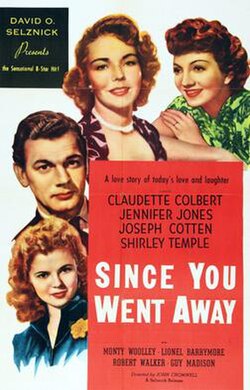
Since You Went Away (1944)

Since You Went Away (1944)

Overlong attempt to make an American Mrs Miniver which can’t sustain its focus over three hours

Director: James Cromwell

Cast: Claudette Colbert (Anne Hilton), Jennifer Jones (Jane Hilton), Joseph Cotton (Lt Tony Willett), Shirley Temple (Bridget Hilton), Monty Woolley (Colonel William G Smollett), Lionel Barrymore (Clergyman), Robert Walker (Corporal William G Smollett II), Hattie McDaniel (Fidelia), Agnes Moorehead (Emily Hawkins), Nazimova (Zofia Koslowska), Albert Basserman (Dr Golden), Keenan Wynn (Lt Solomon)

With America embroiled in the Second World War, David O. Selznick felt it was his duty to do his bit. And what better way than making a movie. So was born Since You Went Away, adapted by Selznick himself from Margaret Buell Wilder’s epistolary novel, about a woman writing letters to her husband while he fights the good fight abroad. It was nothing more or less than Selznick’s attempt to create a Mrs Miniver for America, to bring the tribulations of those left behind to the screen.

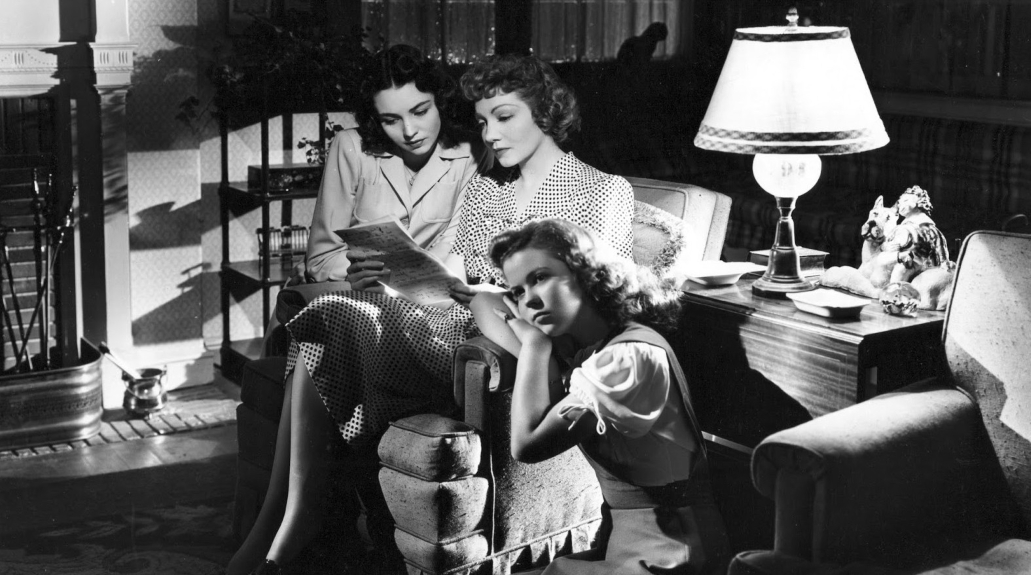
Our family is the Hiltons. Over the course of 1943, they wait for news of husband and father Tim as serves abroad. With Tim’s income gone, wife Anne (Claudette Colbert) needs to make economies and bring in a lodger, avuncular retired Colonel Smollett (Monty Woolley). This brings into their lives Smollett’s nephew Bill (Robert Walker), who begins a romance with Anne’s oldest daughter Jane (Jennifer Jones), while her younger daughter Bridget (Shirley Temple) builds a friendship with their lodger. The family is aided by friends, not least Tim’s best friend Tony Willett (Joseph Cotton), the subject of a long-standing crush of Jane’s and is himself in love with Anne. Over the year, the family does everything they can to support the war effort.

There is probably a fine couple of hours in Since You Went Away. Unfortunately, it’s buried in a film so long it sometimes feels like you are living a year in the life in real-time. It’s not helped by the film’s sentimental scope often repeating the same beats over and over again, a soapy message of the overwhelming importance of hearth and home and the unbreakable bonds of love that keep families faithfully together forever (it’s ironic that this paean to duty and fidelity was made while Selznick was breaking up his marriage for an affair with Jones, while she ended her marriage to Robert Walker).

Essentially, the film has made most of its points and observations by the half-way mark, and is reduced to repeating them again in the second half, all accompanied by Max Steiner’s overly insistent score (which won the film’s only Oscar) which hammers home every single emotional point with laboured riffs on songs like No Place Like Home or Come Let Us Adore Him. Much of the drama is undermined by having almost no sense of threat: unlike Mrs Miniver there is zero chance of any of the characters actually being bombed at home but, just like that film, there is also absolutely no chance at all that Anne will be tempted by the heavily suggestive flirtation of Tony.

Instead, there is a slightly cosy air of gentleness under Since You Went Away. We are told the war, and loss of Tim’s salary, has caused hardship for the family – but it’s the sort of hardship that sees a hugely wealthy family adjusting to merely being comfortably well-off. The main concessions seem to be setting up a vegetable patch and taking in a well-paying lodger (who, of course, becomes an honorary family member). Even their Black maid (Hattie McDaniel, in a truly thankless part) is so devoted that she continues to serve them during her time-off from her new job (for no pay). There is never even a suggestion they may need to move from their massive five-bedroomed house or stop moving in their affluent circle.

This circle is represented by Agnes Moorehead, sneering like a suburban witch wrapped in ostentatious furs, who scorns any idea of pulling her weight during the war and crows about how cleverly she’s exploiting rationing loopholes. This is contrasted with the families growing civic duty, embodied by Jennifer Jones’ Jane casting aside her giddy teenage years to devotedly work as a volunteer nurse with war wounded (much to the disgust of Moorehead) and Anne’s shift to training as a welder in a munitions factory. Since You Went Away heavily pushes the angle that everyone must do their bit, hammered home by refugee welder Nazimova who gives a misty eyed reading of the famous Statue of Liberty message.

What Since You Went Away starts to feel like at times is an over-inflated, Little Women-ish drama, with war as a backdrop. There are moments of loss: Tim is reported missing, cause for much stoic resilience and heartbreak and the son of the local store is killed early on. The film has a tragic romance in the form of Jones and Walker’s Smollett Jnr, which goes through a gentle flirtation, playful hay-rolling into an overly empathetic departing train goodbye (expertly parodied in Airplane!), that holds together due to the charm of the actors. But the main message is one of cosy reassurance: it’s a million miles away from the more doubtful The Best Years of Our Lives – there’s no doubt Tim will settle straight back into a world unchanged from that he left behind.

The characters are pretty uniformly predictable and conventional, but are delivered effectively. Colbert, in many ways with a rather dull part, effectively underplays as the endlessly patient, dutiful and calm Anne, bottling up her doubts and fears into her diary. She makes a generous still centre of the film, even if the film doesn’t call for one minute of playfulness for her as an actor. She cedes much of the best ground to Jones (Selznick’s complete control of the film surely played a role in this), who is full of radiant sparkiness, even if her teenage giddiness gets a little wearing. Jones, looking in her twenties, plays the role as if she was in her teens while Shirley Temple, looking in her early teens, plays her like she was still at elementary school. Needless to say, there is no chance of either of these girls causing serious trouble or going off the rails.

Opposite them, Monty Woolley delivers exactly what is required as the outwardly gruff Colonel whose frosty exterior inevitably melts over time. Woolley does bring a lot of depth to Smollett’s quiet grief and playfulness from Smollett’s love-hate relationship with the families pet bulldog. Joseph Cotton just about manages to make Tony charming – charming enough that his hanging around and constantly flirtation with both mother and daughter isn’t too reminiscent of his psychopathic uncle in Shadow of Doubt. (In many ways, Tony is an overly insistent creep).

But the successes of the film are drowned by its absurd length and overly insistent sentimental hammering home of every single point. It does look fabulous – the shadow-laden photography of Lee Garmes and Stanley Cortez adds a great deal of noirish emotional depth – but it’s flatly directed (Cromwell was one of many directors on the project, including Selznick himself) and lacks pace. In trying to present a reassuring celebration of all-American family values, it frequently lets character and drama drift and never presents a plot development that surprises or challenges. It’s no Mrs Miniver.

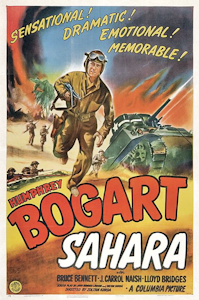
Sahara (1943)

Sahara (1943)

Bogart does desert warfare, in this tense, very well-made war film both men-on-a-mission and a siege film

Director: Zoltán Korda

Cast: Humphrey Bogart (Sgt Maj Joe Gunn), Bruce Bennett (Waco Hoyt), J. Carrol Naish (Giuseppe), Lloyd Bridges (Fred Clarkson), Rex Ingram (Sgt Maj Tambul), Richard Nugent (Captain Jason Halliday), Dan Duryea (Jimmy Doyle), Carl Habord (Marty Williams), Patrick O’Moore (Bates), Louis Mercier (Frenchie), Guy Kingsford (Stegman), Kurt Kreuger (Captain von Schletow), John Wengraf (Major von Falken)

Sahara was ripped from the headlines: with the war still in full swing. So much so, it not only told a tale of a battle effectively still being fought but is also perhaps the only American film in existence to credit a Soviet film for providing the original story. It’s 1942 and the British army are in full retreat from Rommel’s Afrika Korps. Among them is Sgt Joe Gunn (Humphrey Bogart) and his tank Lulubelle, one of a small group of American tanks getting some real life combat experience with the Brits. Heading South through the desert, Gunn and his crew, Waco (Bruce Bennett) and Joe (Dan Duryea), pick up a motley collection of Allied soldiers led by Captain Dr Halliday (Richard Nugent) including Sudanese sergeant Tambul (Rex ingram) and his Italian prisoner Giuseppe (J. Carrol Naish). All of them are caught between two enemies: the Germans and the complete lack of water in the desert.

Sahara is an exciting, assured war film that combines a ‘men on a mission’ set-up with a classic ‘base under siege’ setting. Our heroes eventually find themselves at a dried-up desert well and the target of a desperately thirsty German battalion. Gunn decides to hold the dry well to slow the German advance down, fighting a gruelling siege, desperately waiting for relief, as the battle takes a terrible burden. This is Boys Own Adventure stuff, but told with a genuinely affecting sense of duty and sacrifice, as our heroes knuckle down in impossible circumstances.

At the heart of it, Bogart delivers exactly the movie star charisma the film needs while. Rudolph Maté’s photography is extraordinary, transforming the Californian desert into the African sands. Sahara brilliantly understands the importance of resources in the desert, and Korda captures perfectly the sweaty, sand-covered desperation for liquid. Sahara is tense, exciting and surprisingly hard-hitting with a strong cast.

What it really is of course, is a celebration of the attitudes that separate the Allies from those nasty Nazis. The Allies are a smorgasbord of nationalities, all of whom are shown (after some clashes) to work together with respect, admiration and a shared sense of purpose. Richard Nugent’s medical officer modestly defers leadership to the tank-and-combat experience of Bogart’s sergeant – no awkward arguments of seniority. Despite the collection of Americans, Brits, a South African, a Free Frenchman, a Canadian and a Sudanese sergeant, there is almost no trace of either national or racial clashes.

These men work in partnership, deferring to other’s areas of expertise to survive. Rex Ingram – excellent as Sergeant Tambul – instantly proves himself invaluable with his survival knowledge and ability to locate water. It’s Tambul who is at the heart of a tense search for any moisture in the seemingly dried up well our heroes hole up at, and later he is pivotal in the defence of the well. Saraha has a marvellously low-key but affecting scene of cross-cultural understanding as Tambul and Bruce Bennett’s Texan Waco jokingly compare outlooks on the world that are far more similar than they expect.

The message here is clear: teamwork, respect and the ‘dignity of freedom’ gives the Allies the moral edge over the Axis. The supportive respect, good humour and unflashy bravery of the Allies who get on with it and put duty first while respecting the rules of war is contrasted with the Germans. Bogart may flirt with the idea of abandoning Giuseppe in the desert (to preserve their water supply) but of course, when push comes to shove, he won’t (as Waco and Jimmy suspected he wouldn’t). Later, Bogart will even share the same limited water ration with their German prisoners.

Compare and contrast with the Germans. Their main representative, captured pilot von Schletow (played with a wonderfully smug viciousness by Kurt Kreuger), is portrayed as an instinctive racist (he’s the only character to make any slur towards Tambul), a bully and fanatic. There’s very little trace of decency in him: he’s confrontational, two-faced and dripping with nationalist superiority. The other Germans we see aren’t much better: a German soldier turns on his companion for a drop of water, a senior German officer breaks on a truce and the Germans fight as individuals rather than a supportive unit.

Caught in the middle? The Italians, represented by Giuseppe. J. Carrol Naish is excellent (and Oscar-nominated) as a soldier a million miles from Kreuger’s fanatic: a family man who keeps his word and just wants to go home. Naish has two knock-out scenes: the first a desperate pleading to Gunn to not be left to certain death in the desert and the second a contemptuous denunciation of German fanaticism to von Schletow: as he puts it, it’s a job to the Italians but a way of life to the Germans. Perhaps it was easier (with America’s large Italian population) to give the Italians more of a pass, but it allows the film to suggest there is some hope that behind the fanatics stood many regular people (something it’s hard not to see mirrored in the desperate German soldiers).

Sahara marshals all of this into a final siege that threatens to head the film into very dark territory indeed. Death is a constant in Sahara: the film opens with a view of the wreckage of battle, the unforgiving harshness of the desert is constantly stressed and we are shown repeated images of makeshift graves as bodies pile up and it becomes clear no-one is safe. Many heroic deeds have fatal outcomes and there is a hardened realism to the fighting. Like the Allies, the viewer ends up hoping for a miracle. It’s makes for a gripping and overlooked war film, that provides a genuinely hard-hitting taste of how unforgiving war can be. Tense, well-filmed and exciting it’s a little gem.

Nuremberg (2025)

Nuremberg (2025)

Terribly handled drama that accidentally deals a favourable hand to a leading Nazi

Director: James Vanderbilt

Cast: Rami Malek (Dr Douglas Kelley), Russell Crowe (Herman Göring), Leo Woodall (Sgt Howie Triest), Michael Shannon (Justice Robert Jackson), Richard E Grant (David Maxwell Fyfe), John Slattery (Colonel Burton C Andrus), Mark O’Brien (Colonel John Amen), Colin Hanks (Dr Gustave Gilbert), Wrenn Schmidt (Elsie Douglas), Lydia Peckham (Lila), Lotte Verbeek (Emmy Göring)

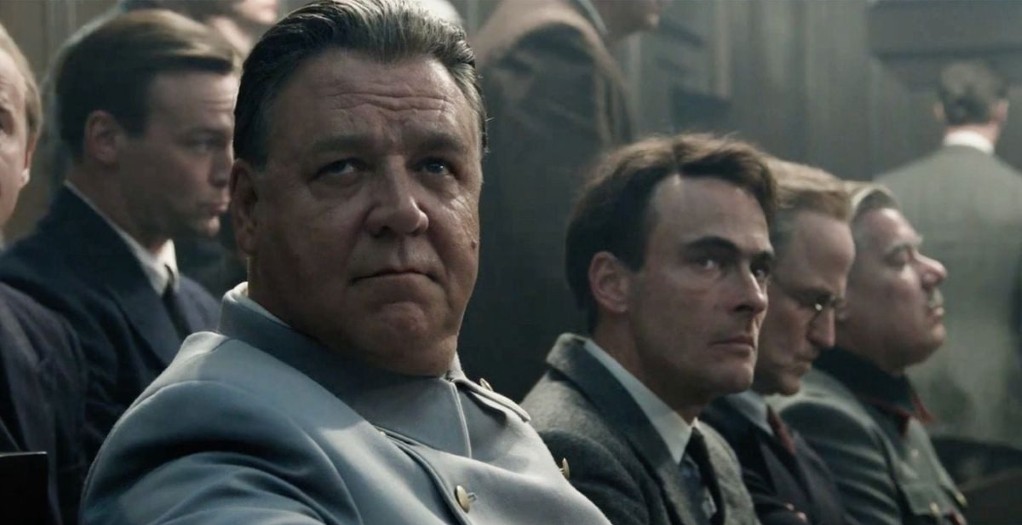
If one thing captures what a miserable failure James Vanderbilt’s Nuremberg is it’s this: if Herman Göring rose from the bowels of whatever Hell he currently resides in and saw it, he’d probably freaking love it. The misguided history lesson has a political and moral message that is obscured and fudged, its points either lost or delivered with thudding obviousness. But the one thing it’s consistent in doing is presenting the most infamous Nuremberg defendant as a fiendishly clever Hannibal Lecter, multiple steps ahead of everyone, whom the film allows to fudge (without sufficient correction) his responsibility for the Holocaust and who goes down due to his loyalty to his lost leader. Ye Gods.

Vanderbilt’s film is an old-fashioned film that simultaneously gives a spotlight to the relationship between Göring (Russell Crowe) and psychiatrist Douglas Kelley (Rami Malek) and attempts to tell the entire history of the set-up, planning, prosecution and judgement of one of the longest trials in history. It succeeds at neither of these things, and does so while cramming dry, exposition-heavy dialogue into its actors’ lips (the sort of speeches where people launch into lists of the Nuremberg Laws or the trial’s legal framework). Much of it is dramatically inert – at least those parts you’ll be able to see through the film’s impossibly murky camerawork (I expected the lights to shoot up in the courtroom in a standard ‘truth-bought-to-the-light’ cliché, but even here it’s hard to see).

The material around the trial set-up essentially takes a fascinating subject – the wrangling of four allies (three of whom didn’t really trust the fourth) to create a legal framework for an international tribunal never attempted before – and makes it dull as ditchwater. Michael Shannon does his best as Justice Jackson, architect of the trial, but the vast majority of his scenes are little more than exposition (his best is a meeting with Pius XII, whom he effectively blackmails into supporting the trial, in recompense for Pius’ lack of action against the Nazis). Richard E Grant adds a little flavour, even though this film’s whisky-from-a-teacup Maxwell Fyfe (in reality, a stern man in his 40s) feels more like Grant-101 than a real person.

While the trial is a drag, the rest is a farce. Rami Malek flails as Douglas Kelley, in a poorly written role. I suspect, based on the film’s final ham-fisted scene, the intention was to suggest Kelley got too close to Göring and bought a little of what he was selling until the scales fell from his eyes during the trial (and the Holocaust evidence). That Kelley would serve as a dark warning that even the brightest can get seduced by charismatic Nazis. This would have added real fire to the film’s closing vision of Kelley as a drunken Cassandra, desperately railing on US public radio that it could happen here. But clearly someone was worried positioning our hero as someone who admired Göring for a while was going to be hard for regular viewers to sympathise with.

Instead, we get a clumsy dance, where its repeatedly stressed Kelley is only getting close to Göring because he wants to exploit him for a best-selling book. That his sticking up for Göring (including giving credence to Göring’s argument that he couldn’t possibly know about the Holocaust, because that was Himmler’s department) and being nice to his wife and child was all part of this.

It then awkwardly tries to have this cake and eat it, by suggesting Kelley also realising the trial is about real people not just turning a buck. It spectacularly lacks the skill to pull this off. Even worse, it hilariously keeps providing evidence that Kelley is a terrible psychiatrist. Göring manipulates him with ease and, in the real low-point, we cut from Kelley blithely saying he spoke to previously-depressed prisoner Robert Ley and he seemed calm – straight to the aftermath of Ley’s grisly suicide.

This is as nothing to the film’s strange admiration for Göring. Not helped by Russell Crowe giving the film’s best performance, it feels like Vanderbilt never realises how quietly favourable the cards he gives Göring are. (It even actively absolves Göring of antisemitism, arguing he was just an opportunist supporting it for advancement.) He has all the best lines and dominates his scenes. The film draws attention to his fiendish cunning (allowing himself to be captured so he can manipulate the trial, hiding his ability to speak English etc.), shows him effortlessly running rings around everyone he talks to, weaning himself off a pills addiction through will alone… It wants the sort of Hans Gruber like villain who controls the whole trial from his cell.

It undersells small moments, such as Göring’s nervous reaction before, and complete denial after, the Holocaust film played in the trial. Even worse it gives Göring wiggle-room, unquestioned, to deny his responsibility for the Holocaust. Let’s not beat about the bush: Göring signed the order authorising it. In the real trial, his charisma butted up against the damning facts of his involvement from everything from petty art thefts, to murder of allied airmen, setting up the Gestapo and ordering the Holocaust. Nuremberg is brave enough to show Jackson’s real-life poor cross-examination of Göring – but allows Göring’s weasel words on a debatable mistranslation of his order on the Final Solution to go unexposed for the bollocks it was.

The film’s ‘gotcha’ moment in the trial is feeble, reduced down to Fyfe getting Göring to say he continued to support Hitler. This is played as the key moment that would turn Germany away from the Nazis, but surely was hardly off-putting to many in a country that had almost literally fought to the death for Hitler less than year earlier. Göring would call it loyalty – another thing he’d be thrilled the film showed him displaying.

It gets worse. A final shot of the executed Nazis’ bodies is in such staggeringly poor taste I almost can’t believe I saw it: laid out exactly like Holocaust victims, they are driven in the back of a van to be incinerated in a concentration camp. I can see Vanderbilt was going for “poetic justice” – but it’s awful. After that gut-punch, watching a drunken Kelley in a coda all-but-say ‘Watch out Trump’s-a-comin’ and he’s a Nazi!’ almost feels okay (except of course it’s awful in a different way, as subtle as every other point in the film).

Nuremberg is terrible. It’s at its best when it’s merely slow and boring. At its worst when it borderline admires Göring. If you want to watch this story, search out the 2000 mini-series Nuremberg with Alec Baldwin as Jackson and a (possibly) career-best Brian Cox as Göring (Cox, and the series, succeed in showing him with surface charm, smart, but full of vicious cruelty and staggering bombastic overconfidence). Don’t watch this.

Decision Before Dawn (1951)

Decision Before Dawn (1951)

Tense war drama finds sympathy for the enemy, in an over-looked war film

Director: Anatole Litvak

Cast: Richard Basehart (Lt Dick Rennick), Gary Merrill (Colonel Devlin), Oskar Werner (Corporal Karl Maurer “Happy”), Hans Christian Blech (Sgt Rudolf Barth “Tiger”), Hildegard Knef (Hilde), Wilfried Seyferth (Henitz Scholtz), Dominique Blanchar (Monique), OE Hasse (Oberst von Ecker), Helene Thimig (Paula Scheider)

Decision Before Dawn tends to be remembered – if it is remembered – as an aberration in Hollywood history, one of the few films to receive only one nomination other than its Best Picture nod – with that nod generally put down to excessive Fox executive lobbying. I’d heard it described as a ‘fairly standard World War II film’ and expected it to be pretty disposable. But I guess I should have looked into things more: no less a director than Stanley Kubrick called it a hidden gem, claiming to have seen it five times. After a viewing, it’s hard not to think he might be right.

It’s a real, peeled-from-the-headlines tale. Shot entirely on location in Germany, in the very cities its characters are travelling through, still the bombed-out wreckage sites they were in 1944. With the assistance of (what was still then) the Occupying Powers, Fox and Anatole Litvak (himself a one-time refugee from the Nazis) recreated, to an astonishingly convincing degree, war-torn Germany six months before the death of Hitler, on locations littered with Germany military equipment. Everything in Decision Before Dawn feels astonishingly real because it largely is. When “Happy” tumbles through a bombed-out theatre or walks through bedraggled factories and grand houses converted to military bases, that’s the real thing.

Alongside this visceral sense of realism, is a surprisingly mature message. Helped by the presence of several German ex-pats, Decision Before Dawn casts a sympathetic eye over the Germans at a time when most of viewers would probably echo the initial sentiments of Richard Basehart’s scornful Lt Rennick: ‘they’re all just Krauts’. Rennick’s is part of an intelligence unit, tasked with ‘flipping’ German POWs and sending them back into Germany. Their two latest recruits couldn’t be more different: cynical Sgt Barth aka Tiger (Hans Christian Blech) motivated by earning a quick buck and thoughtful Corporal Maurer aka Happy (Oskar Werner) who believes Germany can only be saved when the madness of Nazism is defeated.

It’s Happy we follow when, after his recruitment, he is parachuted back into Germany and instructed to find the location of the XXth Panzer corp, while Rennick and Barth land further West to locate, and arrange the surrender of, a Wehrmacht Army Unit. Decision Before Dawn has already spent its opening act humanising erstwhile opponents via Happy. Happy is honest and principled with a strong sense of morality. He won’t lie to please his captors but he also won’t countenance the blind loyalty or bitter cynicism of his fellow prisoners. He is brave enough to save his country by ‘betraying’ it.

And it’s through Happy’s eyes we also see Germany. Many of his fellow POWs have no real love for Nazism; far from slathering fanatics, they are just guys knuckling down, wanting to stay alive. Behind-the-lines in Germany, the people Happy meets on his journey are striking in their everyday ordinariness. Decision Before Dawn’s most compelling sequences follow this ‘Pilgrim’s Progress’ through the Reich, where episodic encounters mix with moments of panic and terror as a Gestapo net draws tighter.

The only two true believers he encounters are a glasses-wearing (it still loves some of the cliches) relentless Gestapo officer, and a Hitler Youth kid who still swallows true loyalty to the Fuhrer because he doesn’t know anything else. The others, by and large, are ordinary people trapped in a nightmare, trying to carry on. From a senior officer who reluctantly executes a deserter days before he knows the army will surrender to a depressed widow trying to make a living turning tricks. They are among a parade of regular citizens who, other than that fact they are commuting through a war zone, could be no different from Americans in their everyday concerns.

This places much of the film’s success on the shoulders of Oskar Werner, making his English-language debut. Werner, himself a deserter opposed to Nazism, brings the role a quiet, deeply affecting sincerity, expertly breathing life into a man who lives by his own firm moral code. ‘Happy’ deplores the taking of life but will do so if there is a reason: that won’t involve poisoning a colonel or standing by during the lynching of a POW by his fellow prisoners, but he will turn a gun on a direct threat. Werner makes him a thoughtful, compassionate man while giving him a strong streak (a Werner speciality) of in-built martyrdom, that a feeling he is too strait-laced and honourable for this world.

By making our hero a German – and the character we follow for almost the whole movie (despite Basehart’s top billing) – Decision Before Dawn is invites it’s American audience to emphasise with the enemy. To learn, alongside Rennick, that they are not ‘all Krauts’ so that we and Rennick can both be appalled by the unfairness when a Corporal mutters this at the film’s. That’s quite a thing for an American film, a few years after the war. By giving us handsomely staged spectacle centred around a man most of the audience were primed to expect to turn traitor, rogue or coward is no mean feat.

Of course, not every German can be good. The other potential recruits (one of them a young Klaus Kinski) are not a promising bunch and ‘Tiger’ (a fine, weasily performance by Hans Christian Blech) is betrayed as selfish, cowardly and perfectly happy to sacrifice anyone and everyone around him to ensure his safety. Litvak’s film does acknowledge it’s easier for the Americans to relax their feelings for the Germans than many of the other nations of Europe. Dominique Blanchar’s OSS officer makes it perfectly clear that, while she likes ‘Happy’, she’s still a long way from every imagining a relationship with a German of any sort.

Decision Before Dawn is well-directed, Litvak easing expert tension behind-the-lines and wonderfully shot among the ruins of Germany. Its final resolution may seem a little pat and obvious – and Basehart’s Rennick is such a terminally dull character I can only assume a host of more famous actors turned it down – but there is a lot of rich, fascinating tension and excitement here. Putting it frankly, Decision Before Dawn is a very pleasant surprise: a unique and mature war film that deserves far more recognition.

Battleground (1949)

Battleground (1949)

Marvellously realistic, grunt’s-eye view of war, very well made and still carrying impact

Director: William A Wellman

Cast: Van Johnson (PFC Holley), John Hodiak (Pvt Jarvess), Ricardo Montalbán (Pvt Roderigues), George Murphy (Pvt “Pop” Stazak), Marshall Thompson (Pvt Layton), Jerome Courtland Pvt Abner Spudler), Don Taylor (Cpl Standiferd), Bruce Cowling (Sgt Wolowicz), James Whitmore (Staff Sgt Kinnie), Douglas Fowley (Pvt “Kipp” Kippton), Leon Ames (Chaplain), Herbert Anderson (Pvt Hansan), Denise Darcel (Denise), Richard Jaeckel (Pvt Bettis)

Apparently, the Hays Code would let bad language slide, if it was being used about War Heroes. Not many 40s film start with a credit crawl proudly calling its cast a bunch of bastards (in this case “the Bastards of Boulogne”). That’s our Battleground, the Battle of the Bulge, based on the experiences of screenwriter Robert Pirosh (who won an Oscar). Reflecting Pirosh’s experience, this is the Battle from the Grunt-eye-view, following a platoon of privates and sergeants pushed up from the rear to Bastogne, filling in the time between terrifying shelling and German advances, with grouching about everything from the food, to the lack of leave to the rotten army life.

As such, it’s not a surprise that Battleground proved a huge, multi-Oscar nominated hit (including Best Picture). Many in the audience surely saw their own war experiences reflected back at them: crappy rations, freezing cold fox-holes and the horrifying prospect of sudden death from the sky, that many American GIs knew from the war. Louis B Mayer believed the country was sick of war but producer Dore Schary persisted and was proved absolutely right.

It’s a film soaking in authenticity, that genuinely feels like it’s been filmed in the mist and snow covered chill of Boulogne rather than the sunny uplands of California (it’s cinematography won a deserved Oscar for Paul C Vogel). Director, William A Wellman, a decorated veteran from World War One, not only knew how soldiers thought, he was also grimly familiar with the mix of machismo, grit and terror on the front. Most of the cast were veterans, some only just out of uniform: and Battleground was the first film that put its cast through boot-camp to get them bonding like a company.

It’s a film rooted in the detail of army banter, with the same topics coming up time-and-again, in the distinctive language of the trenches. There is the insular togetherness of men who have seen a great deal of suffering and survived. Where a fellow soldier may get on your nerves but you’ll defend him to the death. The suspicion and dismissive attitude to replacement recruits until they have earned their chops. The delight in small moments of humanity also ring true: the Californian private thrilled at seeing snow for the first time, the protective way Van Johnson’s Private Holly guards and protects the eggs he’s dying to eat, the eager joy (and suppressed disappointment) when mail arrives (or fails to). These little touches make the characters feel real, their bonds feel lived in – and makes their moments of fear and panic all the more real.

And Battleground is perhaps unique in 40s war films for not judging soldiers when they show fear (in fact, when new recruit Layton confesses to being scared out of his wits, grizzled cynic Jarvess supportively congratulates him on joining a club everyone is a member of). When the men re-encounter Bettis, a man who ran at the first shelling, there is no judgement or condemnation towards him. After all, so many of them nearly did it themselves. All of them fear becoming a bleeding heap, sobbing for their mamas (as we see one of them do in a quietly affecting moment). Private Holly, our closest thing to a hero, twice nearly cuts-and-runs but both times circumstances and self-reproach see him disguise this with acts of bravery. Others may suspect the truth, but it’s what a man does that matters not why he does it.

Battleground gives a focus most war film never give. There are no generals, no sense of tactics or scale and precious little of the enemy. The Battle of the Bulge is a slog, sitting in a snow-filled pit trying not to die. Paranoia and fear is constant: news of German’s disguised as GIs lead to several awkward encounters, including a darkly funny scene of patrols demanding each other to name various pieces of American trivia to prove their bona fidas (even a senior officer). When they sit down to read the GI news, the men are mystified not only about who they are fighting (“Who is von Rundstedt?”) but even the name the press give the battle (“What’s the Bulge?”). Half of them have no idea where they are (opinion seems divided on Belgium or Luxembourg), few speak French and there is a sense that what the war is about matters less than surviving it.

Perhaps to combat this, in a potentially sentimental moment that Wellman and Pirosh manage to make feel uplifting, an army chaplin (well played by Leon Ames) assures the men ‘why they fight’ really does matter – and that if, later, people question the point of sending young Americans thousands of miles to die for strangers, then they know not of what they speak. In Battleground this sense of pride and honour, that what they are doing matters, is an essential battery recharge after weeks of freezing struggle: and it still carries real impact now, reflecting on what so many did for a cause larger than themselves.

Battleground’s cast is largely made up of MGM contract players seizing the opportunity to embody the sort of gritty, earthy parts so rarely available to actors serving in second-string roles or uninteresting leads in B-movies. Van Johnson’s Holly masks his fear with rumbunctious enthusiasm and exaggerated moaning. George Murphy gives a career-best turn as a determined veteran, ready to go home. John Hodiak’s Jarvess is a pillar of wisdom, Ricardo Montalbán’s Roderigues a burst of exuberant life. James Whitmore (Oscar-nominated) as Sergeant Kinnie practically defines Hollywood’s view of the grizzled, grouchy sergeant who secretly loves his men.

It all comes together very well and if Battleground feels overlong and even a bit repetitive at times, that’s to be expected considering it’s reflecting the experience of its characters. But there can be few 40s films as clear-eyed, realistic and unjudgmental about the pressures ordinary soldiers felt under extraordinary circumstances. That focused on the grim slog of surviving, over the glamour of conventional heroism in battle. And perhaps that’s why Battleground spoke to so many and feels so different.