Tag: Donald Wolfit

Lawrence of Arabia (1962)

Lawrence of Arabia (1962)

Brilliant epic, one of the greatest films ever made – not to mention possibly my all time favourite

Director: David Lean

Cast: Peter O’Toole (T. E. Lawrence), Omar Sharif (Sherif Ali ibn el Kharish), Alec Guinness (Prince Feisal), Anthony Quinn (Auda Abu Tayi), Jack Hawkins (General Edmund Allenby), José Ferrer (The Turkish Bey), Anthony Quayle (Colonel Harry Brighton), Claude Rains (Mr Dryden), Arthur Kennedy (Jackson Bentley), Donald Wolfit (General Archibald Murray), I. S. Johar (Gasim), Gamil Ratib (Majid), Michel Ray (Farraj), John Dimech (Daud), Zia Mohyeddin (Tafas), Howard Marion-Crawford (Medical officer), Jack Gwillim Club secretary)
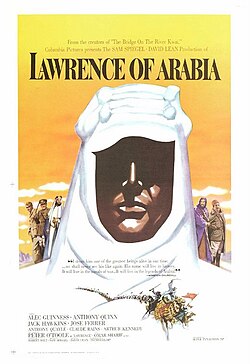
There is no beating around the sand dune. Lawrence of Arabia is probably my favourite film of all time. It’s also the apogee of David Lean’s career and, arguably, the entire genre of epic film-making. No other epic is as massively, awe-inspiringly grand as this and perhaps no other combines the stunning scale with such intense, fascinating and astute character insight. It’s a film that succeeds on every front and leaves any viewer with such a searing visual impression that, once seen, it’s almost impossible to forget. And, of course, everyone should see it.

It was decades in the making before Sam Speigel and David Lean marshalled it to the screen. Based on TE Lawrence’s Seven Pillars of Wisdom, it’s strikingly modern in that it’s a biography of Lawrence without attempting the full cradle to grave. Instead, told in what it’s easy to forget is interrogative flashback after Lawrence’s death in a motorcycle accident, it focuses exclusively on Lawrence’s (Peter O’Toole) campaigns with the Great Arab Revolt during World War One – but in a style heavily influenced by Shakespeare’s fast-and-loose approach to history, where events drill down into that elusive question: what sort of man exactly was Lawrence? In other words: “Who are you?”

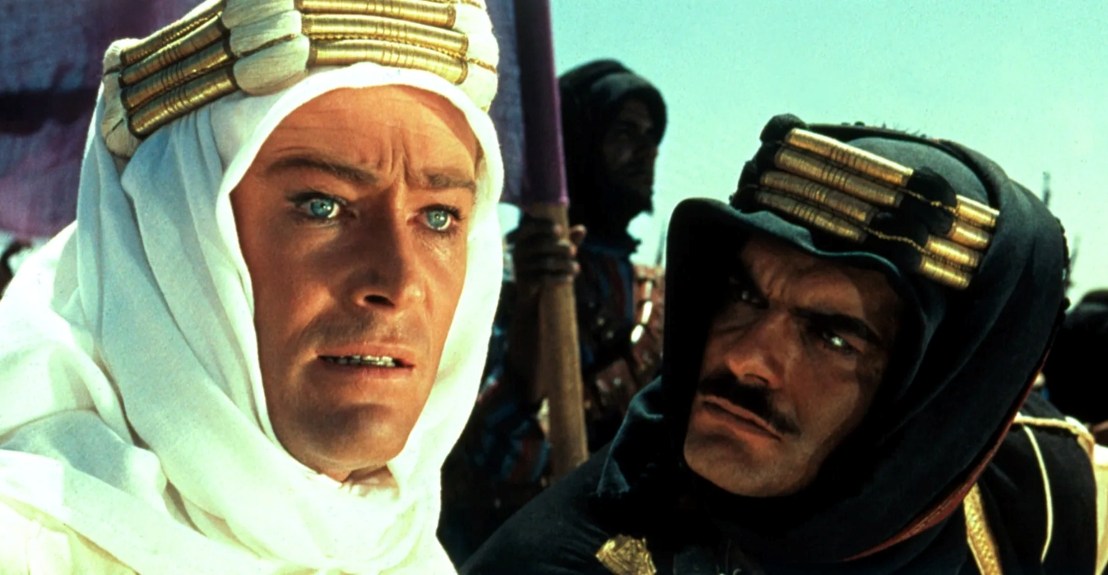
And fascinatingly for a film increasingly misremembered today as some sort of imperialist fan-fare blower or white saviour narrative, the answer is frequently not particularly flattering. In line with his historical self, this Lawrence is a deeply conflicted figure, perfectly captured in Peter O’Toole’s breath-takingly superb performance as a quirky, thoughtful introvert who frequently role-plays as an extrovert barrelling into the limelight. He’s a man capable of staggering insight, devoid of the knee-jerk racism of his fellow Brits. But he’s also a bombastic egotist with a major messianic complex who compares himself to Moses. That’s not even touching on his repressed sexuality, sadism or his deep discomfort at his in-built relish for violence and bloodshed.

Throughout O’Toole treats triumph with a giggling schoolboy relish, then collapse into dead-eyed, silent gloom when grimmer repercussions emerge. It’s a stunning performance, and fascinating figure to set at the centre of a war epic. O’Toole’s Lawrence is handsome, charismatic and a genius – but also fey, camp even, nervous, confident only when he is in control, likely to collapse into nervous giggles when things go wrong. O’Toole also brilliantly conveys the growing darkness and cruelty in Lawrence, shocked and appalled by his excited relish in killing Gasim or his excited anticipation at the slaughter of a group of Turks. It feeds an ego that believes he is above normal men, stunned at the moments when he discovers he is not, that leads him to ever darker determination to prove he can change the world through will alone.

Lean’s film is remarkable in how it presents Lawrence’s achievements with the jaw-dropping marvel they deserve – but also in showing his failures, cruelties, delusions. It’s remarkable how often Lawrence is punctured or bought-down after moments of success – especially as any moment of success has him even further convinced of his own genius. His saving of Gasim in the Nefud desert is followed shortly after by his executing the same man to preserve the fragile peace in his Arab coalition. His conquest of Aqaba is followed by guiding his teenage servant Daud into quicksand. A successful attack on a Turkish train is followed by getting his other teenage servant, Farraj, killed. His almost suicidal pride in entering Derra alone dressed as an Arab, leads to his capture, beating and rape by a perverted Bey (a lip-smackingly sinister cameo from Jose Ferrer, who considered this his finest performance).
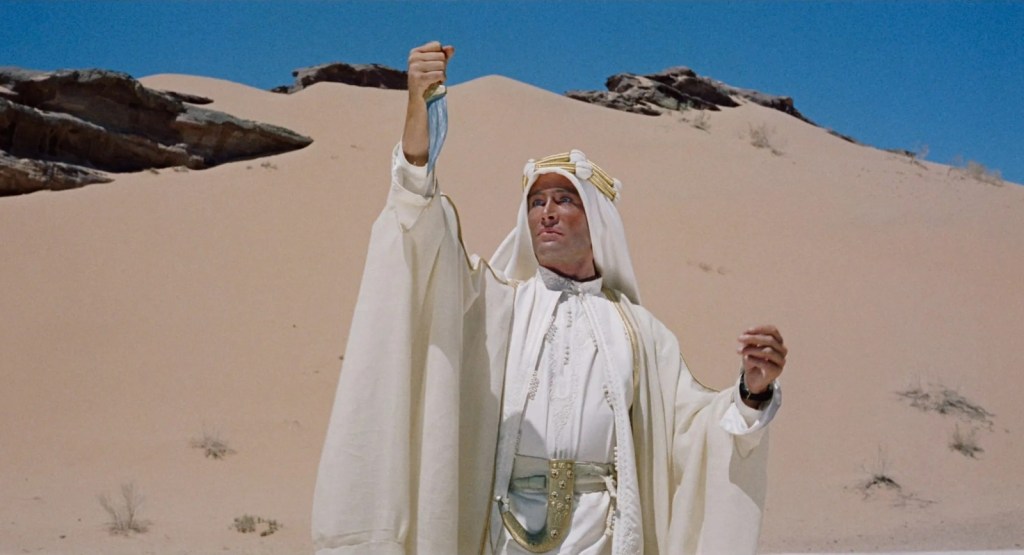
Is there an epic film more cynical and critical about British Empire building than Lawrence of Arabia? Away from Lawrence, the Brits are represented by the Blimp-ish Murray (Donald Wolfit in fine form), Allenby (a marvellous Jack Hawkins) who doesn’t let principle get in the way of duty and a duplicitous Dryden (a magnificently austere Claude Rains). Both Allenby and Dryden well understand the game they are playing (with varying degrees of enthusiasm) – help the Arabs, but not too much, bring them together, but not too much, get rid of the Turks put the Brits in their place. Lawrence of Arabia is far from a flag-waver, presenting a cynical, two-faced view of rapacious Empire building. Its even uncomfortably rejected by Anthony Quayle’s endearingly straight-forward Colonel Brighton (who stands out as the film’s most honourable character).

In comparison, the Arabs are seen as perhaps naïve and chaotic, but largely honourable and honest and their campaign for independence and self-government is presented sympathetically (only their most Westernised representative, Alec Guinness’ reserved Prince Feisel, can match Dryden and Allenby in ruthless politics). There is a vibrant genuineness in Arab culture, even if it’s also shown to be as full of bitter hierarchical rivalries between tribes as the British are in their club memberships. Much of this is captured in Omar Sharif’s extraordinary performance as Sherif Ali (a sort of Arab version of Lawrence, both introverted and extroverted), a man of deep principles whose discomfort grows with Lawrence’s increasing wildness.

Lawrence’s unpredictability is what the film circles round to again and again. It’s fascinating both how flawed and unknowable he becomes. You only need to look at his costume: in ill-fitting military outfit, the trousers too short, O’Toole feels utterly out-of-place compared to his comfort in flowing white robes. But those robes become progressively more filthy, transparent and ghost-like the longer the film goes on. Does any other epic lay so bare the complex sexuality of its hero, his sado-masochistic desires (“the trick is not minding it hurts” indeed!), his part-shame, part-excitement about his assault by the Bey, his unmistakeable relish for death?

It’s striking how Lean so frequently frames Lawrence as unseeable: watch the Act 2 train attack, where we see Lawrence from behind, his feet striding along a train and then his body framed with the sun behind him. Or the film’s conclusion that turns him into even more of a ghost, a spectral figure behind a curtain and a jeep passenger almost invisible behind a mud-smeared windscreen. It’s extraordinary visual work to communicate a depth of theme. Constantly, he’s framed as a figure shrinking into the chaos, slipping through our fingers when we think we understand him.
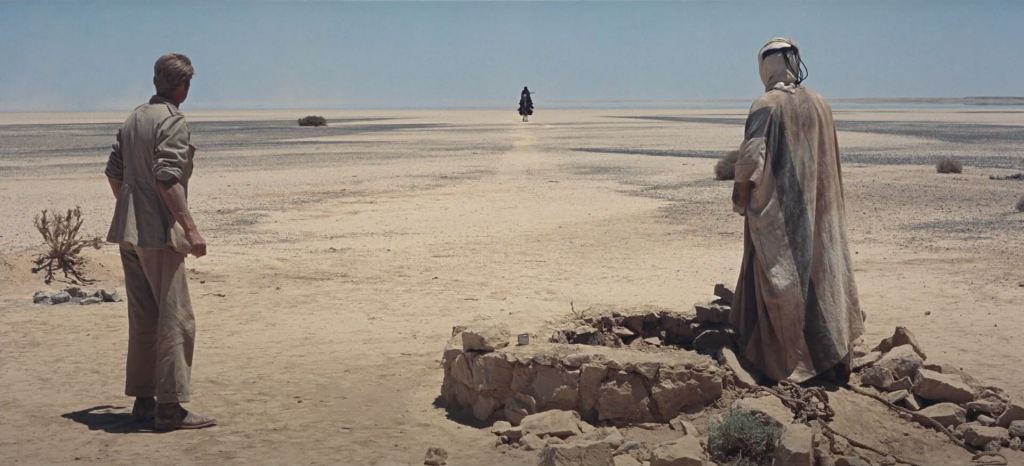
That’s in a film crammed with extraordinary images. “No Arab loves the desert” are true words, but Englishmen do and Lean certainly did. His shooting of this vast panorama of dunes and sand is second to none. Is there a greater shot in history than the slow arrival of Sharif from the wavy mirage mists of the desert? That stands out in a film of extraordinary images: Lawrence’s progress through the mountains; the tracking shot of the attack on Aqaba, that ends on the powerless guns; a train puffing through the desert; even the small moments – Lawrence’s goggles dangling on a branch after his accident is a gorgeously simply, brilliantly evocative image. Everything in Lawrence is perfect technically: John Box’s superb sets, Maurice Jarre’s breathtakingly evocative music; Anne V Coates flawless editing (witness one of the greatest cuts of all time).

But it’s always bought back to the sharp critical eye on its lead, powered by Robert Bolt’s superbly iconoclastic script and Lean’s directorial discipline. This is a film that mirrors Lawrence’s playful dance in his new robes, stopping to admire himself in the reflection of his dagger with Lawrence, 90 minutes of screentime later, echoing the gesture to stare in horror at his blood-soaked clothing. That makes its last military action not the capture of Damascus, but Lawrence’s brutal massacre of retreating Turks at Tafas. Which ends with its hero covered in failure and sent packing as an awkward figure in the new age by both sides.

It’s a huge thematic complexity that gives Lawrence the chance to cement itself as one of the greatest films ever made. With its matchless technical brilliance, it brings a sharply insightful, critical eye to its lead and resolutely refuses to indulge in any hero-worship at all. It brings great depth and passion to its portrayal of the Arab people (I will grant Guinness’ casting today is unfortunate – less so with Quinn who was always ethnically ambiguous and is knock-out, charismatically brilliant), showing them as warts and all but rejecting the temptation to present them as a noble but simple people, but instead of a rich, non-Westernised culture forced to play by someone else’s rules. Lawrence marshals this while constantly leaving us questioning and changing our mind about the lead character, so superbly bought to life by O’Toole you could make a case for it as one of the greatest performances of all time. You can certainly make the case for the film as one of the greatest, a stunningly assembled, wonderfully directed, breathtaking mix of spectacle and character study that rewards the viewer every single time they see it.
Room at the Top (1959)

Room at the Top (1959)

An ambitious man chooses between a damaging love affair and career in this fabulous kitchen-sink drama

Director: Jack Clayton

Cast: Laurence Harvey (Joe Lampton), Simone Signoret (Alice Aisgill), Heather Sears (Susan Brown), Donald Wolfit (Mr Brown), Donald Houston (Charlie Soames), Hermione Baddeley (Elspeth), Ambrosine Phillpotts (Mrs Brown), Allan Cuthbertson (George Aisgill), Raymond Huntley (Mr Hoylake), John Westbrook (Jack Wales), Richard Pasco (Teddy)

If there is one thing that preoccupied British cinema of the late 50s and early 60s it was class. How was a working class boy from the wrong end of the tracks supposed to pull himself up and make himself some room at the top? That’s certainly one of the many themes that you find in Jack Clayton’s sensational hit, nominated for a string of Oscars, but it’s also as much about how the search for that mystical nirvana that sees you invited for tea and crumpets at the conservative club, also means sacrificing huge shards of your own soul.

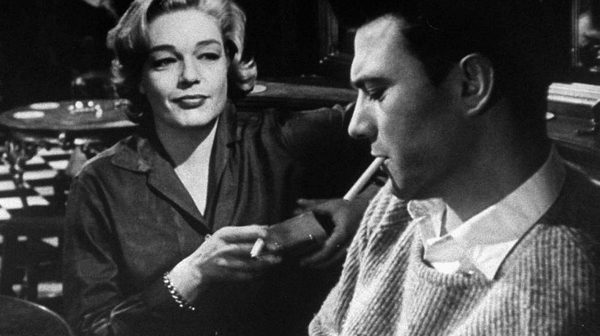
Joe Lampton (Laurence Harvey) arrives in the a Yorkshire town to take on a dreary, poorly-paid post in the Treasurer department of the local council – but has the bonus of being office work that gives him a chance at working his way up to the top. To that end he sets his ambitious cap at Susan Brown (Heather Sears), daughter of major local business magnate Mr Brown (Donald Wolfit). But Joe is also a man of his own passions, which fly in the face of his ambition, and he finds himself drawn towards married older French woman Alice Aisgill (Simone Signoret), who he meets at the local amateur drama club and who encourages him to surrender his ambitions and instead lead a life of contentment and happiness with her. Which possible life will Joe choose?

Perhaps the very first of what became the kitchen-sink genre, Room at the Top is beautifully filmed by Jack Clayton (as you would expect), but also brings the other major strength of this overlooked director to the fore, his ability with actors and to wring all-encompassing tragedy from the most everyday of circumstances. That’s what he does here, creating an almost epic scale of internal struggle for its hero, prickly as he is, drawn between two deeply conflicting goals, that asks what profits a man who gains the world at the cost of his soul?

Because, Room at the Top is that uniquely British film, that shows ambition and desire to better yourself often comes hand-in-hand with the sort of ruthless disregard of your roots, backgrounds and those around you in order to find your own path. Joe Lampton is a former POW, chippy, insecure, bitter, angry and determined to gain the sort of life he deserves. Of course it’s not hard to agree that he is more deserving than some of the tweedy, chinless fools around him and the sneers and condescension he receives from the officer class (his rival for Susan’s affections delights in calling him Sergeant, and reminding him constantly of his superior war record) is more than enough to motivate Joe.

What’s really striking about Joe therefore as how weak the character is. In undoubtedly the finest performance of his career, Laurence Harvey (a difficult and unreadable actor, with a style bridged between minimalism and woodenness) bravely shows both the bullish determination and the fundamental insecurity and weakness of Joe. A character who defines himself solely around what he feels he can achieve, he’s also a man completely unaware of what happiness is and how he to get it – and the thawing of her personality into something warmer and more loving with Alice, only serves to highlight how misguided and weakly he suppresses and kills such feelings in order to seize opportunities in life he feels entitled to.

It’s a rich contrast to Alice herself, a woman who is far braver and more certain about what she wants, and willing to fly against the conventions expected of her if it means she can gain happiness. The novel was adapted to turn Alice into a French ex-pat (married to a brutally cold RAF type played with an imperious selfishness by Allan Cuthbertson) solely so Signoret could be cast in the role – and it’s a match made in heaven. Simply wonderful, Signoret brings the part not only an imperious sexuality, but also a deep and lasting vulnerability under the surface of Euro-chill, a woman who we see opening herself up to the possibility of an affair becoming something truly lasting and deep, who has the courage to understand who and what she wants in a way Joe never can. 

The tragedy is in that inability of Joe to understand his yearnings. Clayton’s brilliantly subtle film demonstrates time and time again, contrasting its romantic freedom laced with passion when Joe and Alice are together with the stilfed, contained suppression and chill that the more buttoned up, angered Joe meets elsewhere. If Joe had the will and strength he would top fighting for the things he should want in order to seize the opportunities he actually wants. His tragedy is that he can’t – and can’t begin to understand himself, or acknowledge his desires, until it is too late.

This was all a deep shock – and carried real power – at the time when Britain was shifting out of post-war hierarchies into the freer 60s, and Room at the Top was a massive hit at the box office. But it made such impact because its attitudes feel so deep and real, and the simple, everyday tragedy it details of two relationships doomed for different reasons, bound together by the self-defeating ambition of its lead character. Because wherever he goes, Joe will have people like Mr Brown (Donald Wolfit is very good by the way, in a role far outside his usual style) constantly reminding him of his oik status, so any victory in inbuilt with failure. Joe’s ambition and intelligence serve largely to blind and deflect him from the things he really wants. A lesson for us all.

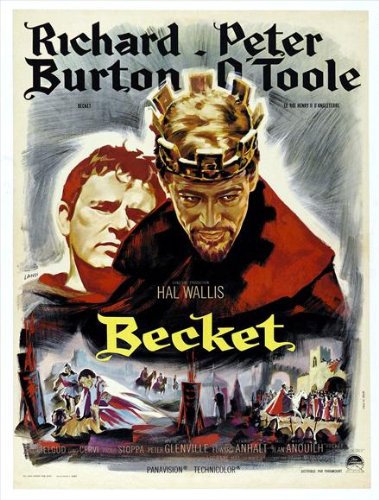
Becket (1964)

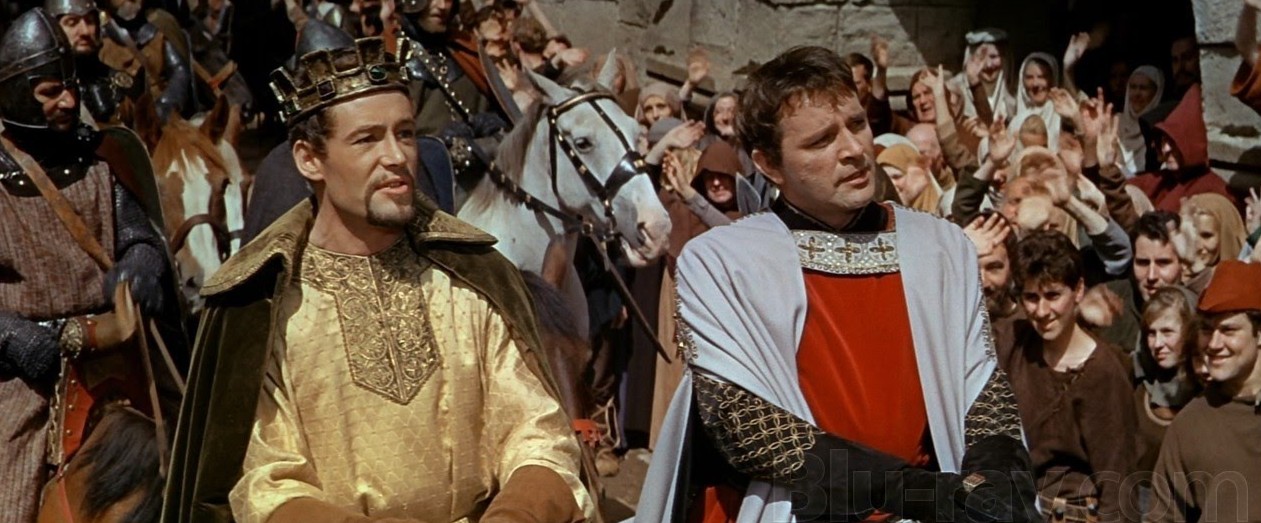
Peter O’Toole and Richard Burton make unlikely friends (and then enemies) in Becket

Director: Peter Glenville

Cast: Richard Burton (Thomas Becket), Peter O’Toole (Henry II), John Gielgud (Louis VII of France), Donald Wolfit (Bishop Gilbert Foliot), Martita Hunt (Empress Matilda), Pamela Brown (Eleanor of Aquitaine), David Weston (Brother John), Sian Phillips (Gwendolen), Felix Aylmer (Archbishop of Canterbury), Paolo Stoppa (Pope Alexander III), Gino Cervi (Cardinal Zambelli)

Burton and O’Toole in the same movie? There must have been a few late night benders on that shoot… You suspect actually that the backstage fun might have been just a little more sprightly and engaging than the movie itself, a lavish 1960s Hollywood Prestige film of English history. Based on Jean Anouilh’s semi-satirical play, it translates the clash between Church and State under Henry II into a very personal conflict between two men who each feel the other has let them down. 

Thomas Becket (Richard Burton) is a Saxon who has risen high in the service of Henry II (Peter O’Toole) at a time when all the top jobs are held by Normans. Becket and Henry do everything together: hunting, hawking, whoring, you name it, the two of them are inseparable. But while both are sharply intelligent men, Henry is basically lazy and principally interested in enjoying life, while Becket always has a slight streak of responsibility for his people and their rights. But despite this, the two men both have England’s interests at heart and a strong friendship. So when Henry makes Becket Archbishop of Canterbury, it should work a treat, right? Well wrong, because Becket quickly begins to feel his loyalty is to the Church and God, not to Henry – and soon a debate over the legal rights of the church has blown up into a full scale clash between the two former friends. Will no one rid Henry of this turbulent priest?

Becket is a fairly sharply written, waspish play about the love/hate relationship between two men, but its themes and ideas are basically secondary to the showcasing opportunities it gives to its two lead actors. That’s pretty much what happens with this film: for all the ups and downs of the plot, the thing that really lifts this film are those two performances. Take that away and you essentially have a stately period pace, flatly and unimaginatively filmed with the look-at-the-scenery-and-costumes steadiness of other films of this genre and time. So it’s just as well that both leads are clearly having a whale of time.

Burton invests Thomas Becket with a quiet authority and a growing sense of something that, if it’s not morality, is at least a sort of moral certitude. Burton’s Becket is not the straightforward good-guy: his stances are always governed at least partly by his own pride and ambition. His defence of the Church is partly motivated by the need to secure his position, and in his career beforehand he constantly shows that he is won’t let doing the right thing damage his position at the court. But there are also touches of genuine faith throughout, and Burton plays the monologues imploring God for guidance with earnest conviction. Alongside this, he plays Becket with a great deal of wry observance and subtle wit that makes this kaleidoscopic character constantly fascinating: you never quite know what he is thinking.

Burton’s restraint also allows O’Toole more room in the more expansive role of Henry II. The powerful king – proud, controlling, intelligent and bombastic – was always a perfect role for O’Toole: indeed he would play it again four years later in another play adaptation, The Lion in Winter (becoming one of the few actors to get two Oscar nominations for the same character). O’Toole roars through the film, bringing immense energy and humour to Henry’s many scenes of intense speechifying. But what O’Toole does so well is balance this with a genuine sense of vulnerability, a genuine pain at losing Becket’s friendship. For all the power and control, O’Toole understands that Henry is essentially a very lonely man with only one man anywhere near his equal. O’Toole’s sharply intelligent, dynamic performance is a real treat.

And it feeds into the underlying theme of the film: this sense of unrequited love between the two men. Henry, for all his egotism, is clearly in love on some level with Becket: a fact that Becket seems aware of, but doesn’t quite return with the same intensity. And in fact, to double Henry’s pain, it feels like the friendship is one partly driven by Henry’s position rather than something genuine between the two men – Becket is always more guarded and more critical as a companion. Though of course that is fair enough: Henry is, however good-naturedly, a supreme ruler who cares little for the welfare of the Saxons under his rule, happy to help himself to attractive women from the peasantry if he wants them. But then perhaps it’s Becket’s very distance, his certain level of speaking truth to power, that makes him so appealing to Henry: when Becket is around, Henry has competition for smartest guy in the room.

There is a lot going on between the two leads, so it’s not surprising that much of the rest of the film doesn’t get a look in. For the other performers, John Gielgud landed an Oscar nomination for his two scenes (barely five minutes) as an arch and manipulative King of France, while Donald Wolfit is all puffed-up pomposity as Becket’s church rival. But the film is only focused on the two men and their political rivalry, so the context is always sketched in quickly, and the energy drops out of the film noticeably when they are apart. The film wants to frame the rivalry so much as a personal one that it doesn’t develop another interest in the political issues – so when scenes are obliged to focus on this, you feel the film starting to drag.

But that might also be because Anouilh’s play is famously historically inaccurate. For starters, Becket wasn’t Saxon, so his early lack of social standing makes no sense. The Constitutions of Clarendon (historically the reason for the falling-out in the first place) don’t merit a mention. Henry’s wife Eleanor of Aquitaine is presented as a shrew rather than one of the most intelligent women of the era, while Henry is also shown to be on poor terms with his mother, again contrary to the truth. 

But that stuff all stems from the play, and in the end it hardly matters as the film is positioning itself as the tale of a friendship turned sour between two men. O’Toole and Burton are sublime, and if the direction and film-making around them is pretty pedestrian (although the film looks great and has an impressive score) it doesn’t really matter in an actors’ piece like this. Most of what is good from the play is carried over to the film, and the dialogue and speeches are often very strong. It’s a very stately and rather overlong play that doesn’t really keep the momentum up. But it’s still enjoyable, still has plenty to admire and even if it’s overlong and dry, it gives you performances that really sing.