
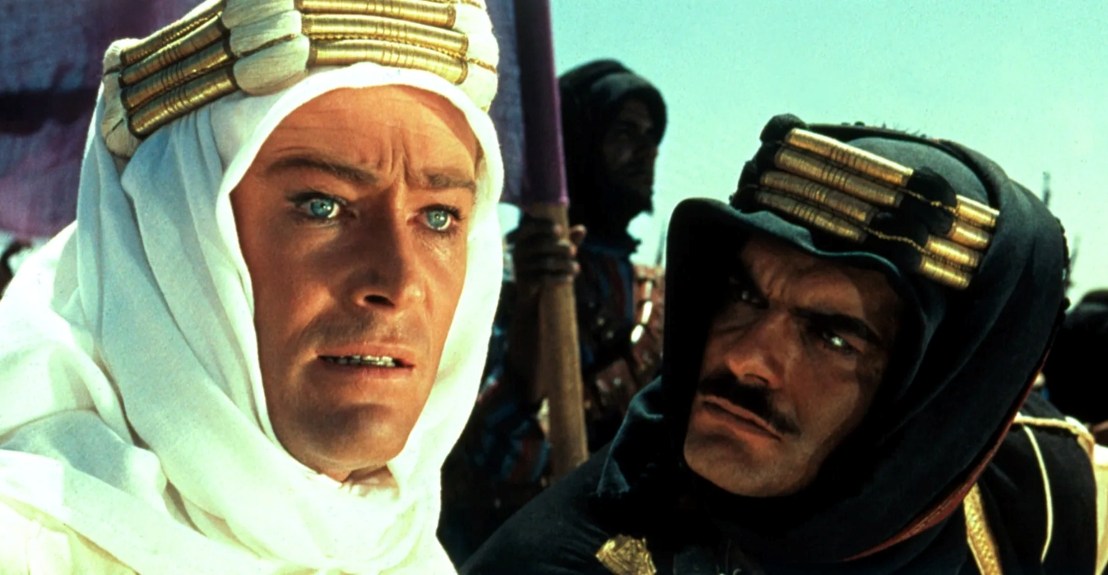
Brilliant epic, one of the greatest films ever made – not to mention possibly my all time favourite
Director: David Lean
Cast: Peter O’Toole (T. E. Lawrence), Omar Sharif (Sherif Ali ibn el Kharish), Alec Guinness (Prince Feisal), Anthony Quinn (Auda Abu Tayi), Jack Hawkins (General Edmund Allenby), José Ferrer (The Turkish Bey), Anthony Quayle (Colonel Harry Brighton), Claude Rains (Mr Dryden), Arthur Kennedy (Jackson Bentley), Donald Wolfit (General Archibald Murray), I. S. Johar (Gasim), Gamil Ratib (Majid), Michel Ray (Farraj), John Dimech (Daud), Zia Mohyeddin (Tafas), Howard Marion-Crawford (Medical officer), Jack Gwillim Club secretary)
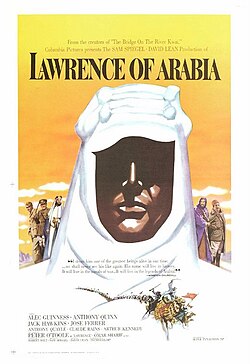
There is no beating around the sand dune. Lawrence of Arabia is probably my favourite film of all time. It’s also the apogee of David Lean’s career and, arguably, the entire genre of epic film-making. No other epic is as massively, awe-inspiringly grand as this and perhaps no other combines the stunning scale with such intense, fascinating and astute character insight. It’s a film that succeeds on every front and leaves any viewer with such a searing visual impression that, once seen, it’s almost impossible to forget. And, of course, everyone should see it.
It was decades in the making before Sam Speigel and David Lean marshalled it to the screen. Based on TE Lawrence’s Seven Pillars of Wisdom, it’s strikingly modern in that it’s a biography of Lawrence without attempting the full cradle to grave. Instead, told in what it’s easy to forget is interrogative flashback after Lawrence’s death in a motorcycle accident, it focuses exclusively on Lawrence’s (Peter O’Toole) campaigns with the Great Arab Revolt during World War One – but in a style heavily influenced by Shakespeare’s fast-and-loose approach to history, where events drill down into that elusive question: what sort of man exactly was Lawrence? In other words: “Who are you?”
And fascinatingly for a film increasingly misremembered today as some sort of imperialist fan-fare blower or white saviour narrative, the answer is frequently not particularly flattering. In line with his historical self, this Lawrence is a deeply conflicted figure, perfectly captured in Peter O’Toole’s breath-takingly superb performance as a quirky, thoughtful introvert who frequently role-plays as an extrovert barrelling into the limelight. He’s a man capable of staggering insight, devoid of the knee-jerk racism of his fellow Brits. But he’s also a bombastic egotist with a major messianic complex who compares himself to Moses. That’s not even touching on his repressed sexuality, sadism or his deep discomfort at his in-built relish for violence and bloodshed.
Throughout O’Toole treats triumph with a giggling schoolboy relish, then collapse into dead-eyed, silent gloom when grimmer repercussions emerge. It’s a stunning performance, and fascinating figure to set at the centre of a war epic. O’Toole’s Lawrence is handsome, charismatic and a genius – but also fey, camp even, nervous, confident only when he is in control, likely to collapse into nervous giggles when things go wrong. O’Toole also brilliantly conveys the growing darkness and cruelty in Lawrence, shocked and appalled by his excited relish in killing Gasim or his excited anticipation at the slaughter of a group of Turks. It feeds an ego that believes he is above normal men, stunned at the moments when he discovers he is not, that leads him to ever darker determination to prove he can change the world through will alone.
Lean’s film is remarkable in how it presents Lawrence’s achievements with the jaw-dropping marvel they deserve – but also in showing his failures, cruelties, delusions. It’s remarkable how often Lawrence is punctured or bought-down after moments of success – especially as any moment of success has him even further convinced of his own genius. His saving of Gasim in the Nefud desert is followed shortly after by his executing the same man to preserve the fragile peace in his Arab coalition. His conquest of Aqaba is followed by guiding his teenage servant Daud into quicksand. A successful attack on a Turkish train is followed by getting his other teenage servant, Farraj, killed. His almost suicidal pride in entering Derra alone dressed as an Arab, leads to his capture, beating and rape by a perverted Bey (a lip-smackingly sinister cameo from Jose Ferrer, who considered this his finest performance).
Is there an epic film more cynical and critical about British Empire building than Lawrence of Arabia? Away from Lawrence, the Brits are represented by the Blimp-ish Murray (Donald Wolfit in fine form), Allenby (a marvellous Jack Hawkins) who doesn’t let principle get in the way of duty and a duplicitous Dryden (a magnificently austere Claude Rains). Both Allenby and Dryden well understand the game they are playing (with varying degrees of enthusiasm) – help the Arabs, but not too much, bring them together, but not too much, get rid of the Turks put the Brits in their place. Lawrence of Arabia is far from a flag-waver, presenting a cynical, two-faced view of rapacious Empire building. Its even uncomfortably rejected by Anthony Quayle’s endearingly straight-forward Colonel Brighton (who stands out as the film’s most honourable character).
In comparison, the Arabs are seen as perhaps naïve and chaotic, but largely honourable and honest and their campaign for independence and self-government is presented sympathetically (only their most Westernised representative, Alec Guinness’ reserved Prince Feisel, can match Dryden and Allenby in ruthless politics). There is a vibrant genuineness in Arab culture, even if it’s also shown to be as full of bitter hierarchical rivalries between tribes as the British are in their club memberships. Much of this is captured in Omar Sharif’s extraordinary performance as Sherif Ali (a sort of Arab version of Lawrence, both introverted and extroverted), a man of deep principles whose discomfort grows with Lawrence’s increasing wildness.
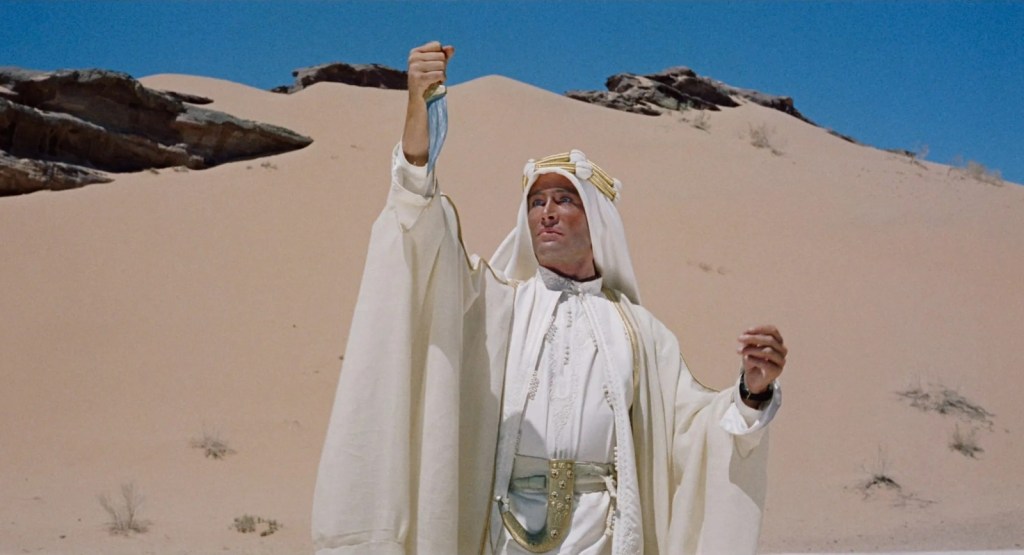
Lawrence’s unpredictability is what the film circles round to again and again. It’s fascinating both how flawed and unknowable he becomes. You only need to look at his costume: in ill-fitting military outfit, the trousers too short, O’Toole feels utterly out-of-place compared to his comfort in flowing white robes. But those robes become progressively more filthy, transparent and ghost-like the longer the film goes on. Does any other epic lay so bare the complex sexuality of its hero, his sado-masochistic desires (“the trick is not minding it hurts” indeed!), his part-shame, part-excitement about his assault by the Bey, his unmistakeable relish for death?
It’s striking how Lean so frequently frames Lawrence as unseeable: watch the Act 2 train attack, where we see Lawrence from behind, his feet striding along a train and then his body framed with the sun behind him. Or the film’s conclusion that turns him into even more of a ghost, a spectral figure behind a curtain and a jeep passenger almost invisible behind a mud-smeared windscreen. It’s extraordinary visual work to communicate a depth of theme. Constantly, he’s framed as a figure shrinking into the chaos, slipping through our fingers when we think we understand him.
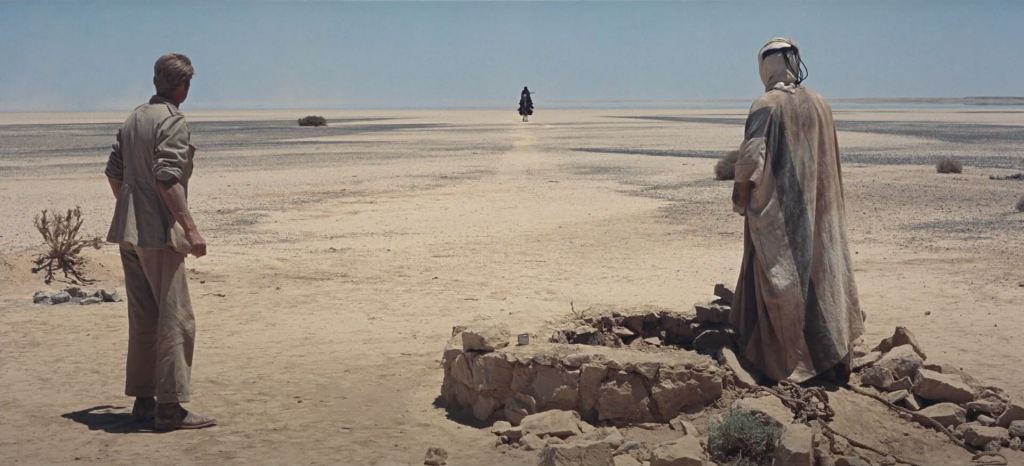
That’s in a film crammed with extraordinary images. “No Arab loves the desert” are true words, but Englishmen do and Lean certainly did. His shooting of this vast panorama of dunes and sand is second to none. Is there a greater shot in history than the slow arrival of Sharif from the wavy mirage mists of the desert? That stands out in a film of extraordinary images: Lawrence’s progress through the mountains; the tracking shot of the attack on Aqaba, that ends on the powerless guns; a train puffing through the desert; even the small moments – Lawrence’s goggles dangling on a branch after his accident is a gorgeously simply, brilliantly evocative image. Everything in Lawrence is perfect technically: John Box’s superb sets, Maurice Jarre’s breathtakingly evocative music; Anne V Coates flawless editing (witness one of the greatest cuts of all time).
But it’s always bought back to the sharp critical eye on its lead, powered by Robert Bolt’s superbly iconoclastic script and Lean’s directorial discipline. This is a film that mirrors Lawrence’s playful dance in his new robes, stopping to admire himself in the reflection of his dagger with Lawrence, 90 minutes of screentime later, echoing the gesture to stare in horror at his blood-soaked clothing. That makes its last military action not the capture of Damascus, but Lawrence’s brutal massacre of retreating Turks at Tafas. Which ends with its hero covered in failure and sent packing as an awkward figure in the new age by both sides.
It’s a huge thematic complexity that gives Lawrence the chance to cement itself as one of the greatest films ever made. With its matchless technical brilliance, it brings a sharply insightful, critical eye to its lead and resolutely refuses to indulge in any hero-worship at all. It brings great depth and passion to its portrayal of the Arab people (I will grant Guinness’ casting today is unfortunate – less so with Quinn who was always ethnically ambiguous and is knock-out, charismatically brilliant), showing them as warts and all but rejecting the temptation to present them as a noble but simple people, but instead of a rich, non-Westernised culture forced to play by someone else’s rules. Lawrence marshals this while constantly leaving us questioning and changing our mind about the lead character, so superbly bought to life by O’Toole you could make a case for it as one of the greatest performances of all time. You can certainly make the case for the film as one of the greatest, a stunningly assembled, wonderfully directed, breathtaking mix of spectacle and character study that rewards the viewer every single time they see it.

