
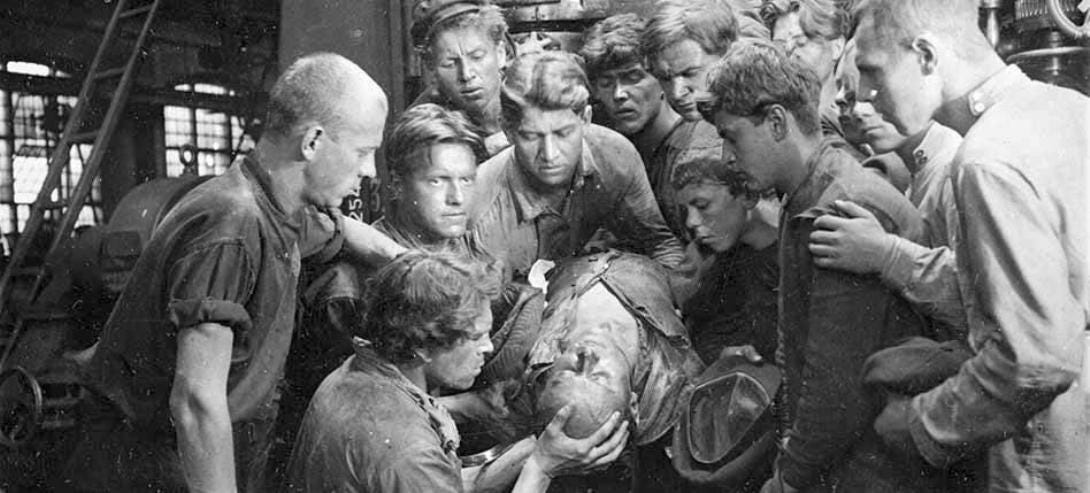
Eisenstein’s masterfully stylish slice of pro-worker propaganda, full of political anger and filmmaking flair
Director: Sergei Eisenstein
Cast: Maksim Shtraukh (Police spy), Grigori Aleksandrov (Factory foreman), Mikhail Gomorov (Worker), I. Ivanov (Chief of police), Ivan Klyukvin (Revolutionary), Aleksandr Antonov (Member of strike committee), Yudif Glizer (Queen of thieves) Vladimir Uralsky (King of thieves)
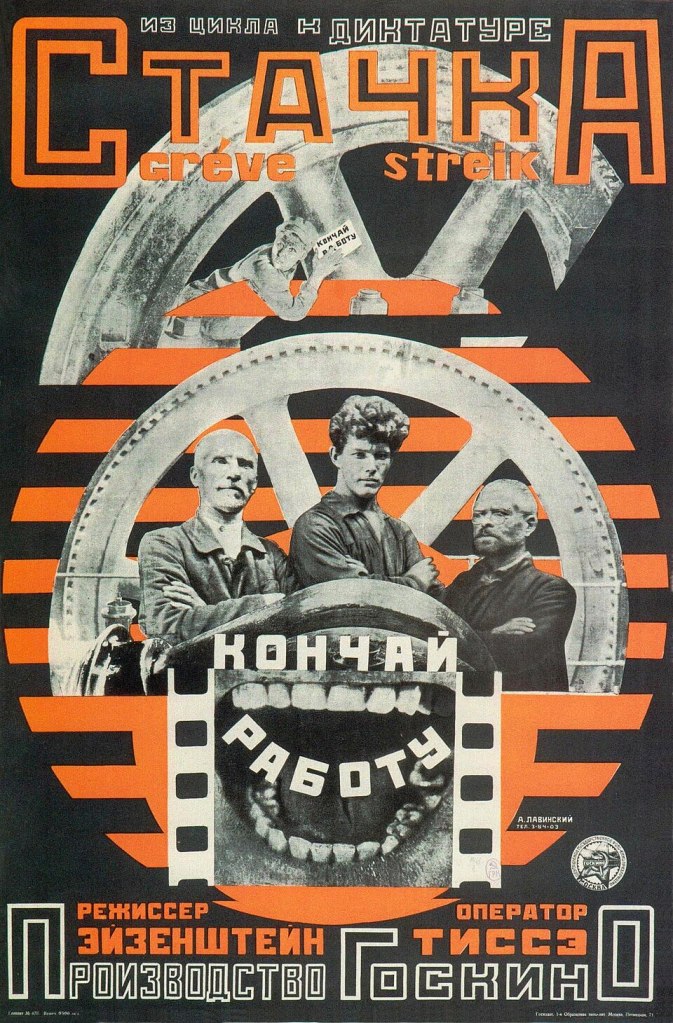
In a touch of irony, Eisenstein was nearly sacked from Strike. After two days, Mosfilm’s Board was certain this experimental theatre director didn’t have a clue what he was doing with a movie camera. It was only the intervention of cinematographer Eduard Tise and producer Bris Mikhin that kept him on. On chances like that, does the history of cinema turn. Eisenstein’s bravura use of visuals and editing would mark him out as a megastar of Soviet filmmaking, a reputation cemented by Battleship Potemkin. Eisenstein gave Strike, in many ways a shameless slice of propaganda, an artistic integrity that dramatically increased its power and legacy.
Strike doesn’t really have a plot as such. Based on a 1903 factory strike under Tsarist Russia, it charts the outbreak of industrial action (sparked by a noble worker committing suicide after being falsely accused of theft by his heartless bosses), the attempts of the police to subvert the noble, unified joint action of the workers and the final brutal repression of the strike by Cossacks and a platoon of rifle carrying soldiers who don’t care who they trample and shoot on the way to restoring ‘order’.
It’s odd watching Strike since, unusually to us Westerners, it’s largely devoid of identifiable heroes or characters. We expect to get to know the leaders of this proto-revolution, but the whole point in the Soviet system is that the individual is the villain and the hero the masses acting as one. As such, the strikers feel very much like a homogenous, organic group, with assorted individuals popping up to carry out specific actions before disappearing into the crowd again. By contrast, Eisenstein’s film spends more time establishing the recognisable faces of the strike’s opposition: the cigar-puffing fat cats with no intention of negotiating, the rat-faced class-traitor supervisors, the weaselly government agents and the vermin-like thieves who are willing to betray the workers. These individuals are the face of greed.
It feels right to use animal metaphors as it echoes one of Eisenstein’s pioneeringly suggestive editing style. Throughout Strike he introduced the sort of implicit suggestion and comparison via cutting between disconnected imagery that would power much of his future career. Strike frequently uses animals for this. The opening sequence introduces a gallery of government agents, nearly all of whom have animal nicknames (the owl, the cat, the fox etc.) with their animalistic, twisted features intercut with the animals they represent. The cutting consciously makes us see them as less human, less noble than the peerlessly upright workers. This suggestive animalistic intercutting reaches its apogee in the film’s closing moments, when the final brutal repression of the strike is intercut with a wide-eyed bull being slaughtered by unseen butchers (as pinched by Coppola, decades later, for Apocalypse Now).
This style is applied masterfully throughout Strike. The mechanical movements of the workers in the factory are intercut with the careful preparations of the suicide of the falsely accused worker. Throughout the factory, we repeatedly cut between the machinery moving the equipment and the hands of the workers, stressing their centrality to the operation of the factory. After the strike, a brilliant shot sees three stoic workers stare directly down the camera while behind them a giant cog slowly grinds to a halt. Later scenes of carnage are intercut with the laughing faces of the head of police and the bosses. Associations are clear to the viewer throughout.
The workers themselves are a dedicated, decent, hard-working but exploited mass, who act together on principle and shun turncoats and traitors. Their outburst of righteous fury in the strike is noticeably not tinged with violence – they restrict themselves to tipping their supervisors into a rancid pool, as opposed to the gunfire of their bosses. During the days of the strike, fathers play with their children and workers gather for bucolic meetings in the forest, embracing the freedom and beauty of nature noticeably absent from the factory where all everything is coldly, dirtily, mechanical.
Contrast with the smug, heartless bosses, who sit in a what looks like a giant gentleman’s club, puffing cigar smoke upwards like the chimneys in their factory, delightedly revealing secret booze cabinets and wiping their shoes with the written demands of the workers for fair pay and fair hours (all while bemoaning how politics has entered the workplace). The authorities will stoop to any low to undermine the noble workers – nearly all of whom are upright, steadfast and have perfect jawlines – including hiring a host of provocateurs (a surreal sequence, where the ‘king of thieves’ and his entourage of class traitors live, like a bunch of circus freaks or herd of rats, in a series of subterranean pots in a junkyard) to justify brutal smackdowns.
Strike is brilliantly assembled by Eisenstein, who has an overlooked eye for beautiful compositions. Wonderful shots, like an overhead camera tracking through the factory office corridor strewn with papers, abound. The chilling suppression of the strike sees some truly unique images of Cossacks riding on horseback through multiple levels of a block of apartments – shots that darkly mirror the imposing view of workers as little more than cogs in the factory complex.
These images are superbly edited together, most strikingly in the film’s final sequences of brutal repression. If there is a joyous sense of release and community action in the outbreak of the strike, as workers strive as one glorious mass through the factory, shutting down machines and driving out the supervisors, it gets its dark mirror when oppression comes. Water cannons spray jets of water on workers, sharp cutting taking us to face after face of innocent people buffeted and flattened by jets. It’s nothing to the brutal suppression, as troops hack down fleeing workers, throw babies from apartment blocks, trample fleeing workers and take potshots at retreating crowds. Fast intercutting and a quick parade of images leave a powerful impression of repression and cruelty.
It would need the Bolsheviks to give these comrades the back-up they need to beat back the heartless bosses, and to let the mass thrive against the tyranny of the individual. Ironically, Eisenstein himself – with the growing fame that started here – would come to be seen by authorities as just such a dangerous individual in a society that praised the masses. But, here and now, he made a statement for the power film and editing could have in forming a political stance.

