
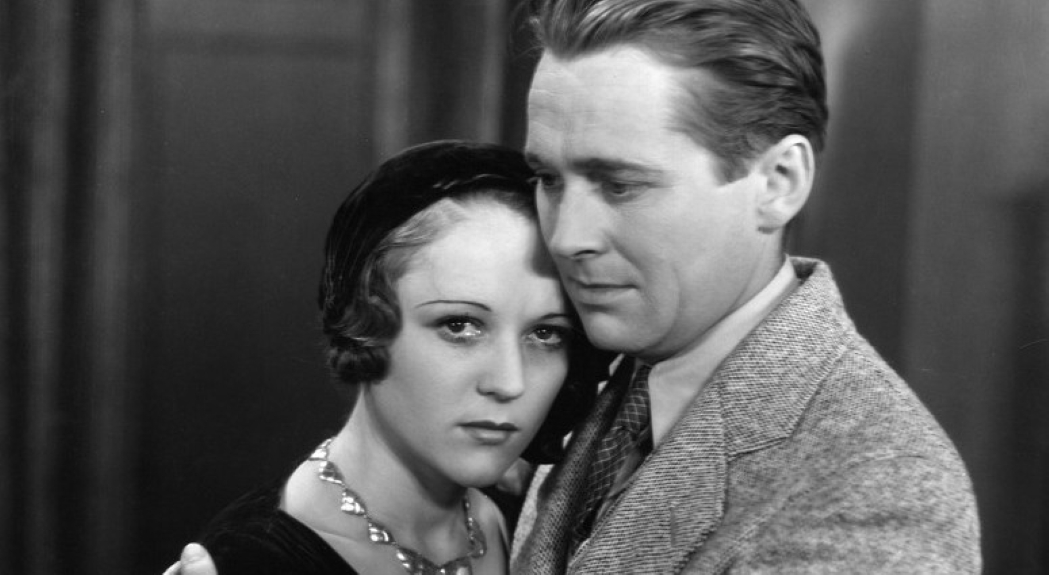
Somewhat mistitled film, which is really a sort of dramedy of misunderstandings
Director: Frank Borzage
Cast: Sally Eilers (Dorothy Haley), James Dunn (Eddie Collins), Minna Gombell (Edna Driggs), Claude King (Dr Burgess)
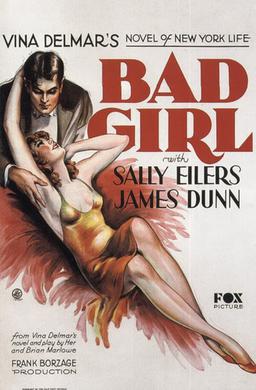
Boy meets girl, they fall in love – what could go wrong? Quite a lot it turns out. Dorothy (Sally Eilers) works in a department store and enjoys nights out with best friend Edna (Minna Gombell). On one such trip she a man she meets is annoyed by her ukulele playing (who can blame him) and then doubles down on his crime by not flirting with her. But she’s fascinated by Eddie Collins (James Dunn) and, before they know it, they are into a whirl-wind marriage. Within months, both are convinced the other believes they have made a terrible mistake and want out.
Despite its salacious title – and the look of its poster – today Moderately Cheeky Girl would be a better title than Bad Girl. A better title than either would really be A Dramedy of Errors. Because that’s really what it’s about: two slightly naïve, decent people terrified that the other feels trapped. It’s the sort of gentle melodrama where the entire plot would fall apart in thirty seconds flat if either spoke honestly to the other. Instead, mistakes and misunderstandings are (often wilfully) allowed to continue, as they conceal things or allow misunderstandings to continue out of social embarrassment.
As such, it’s hard not to think Bad Girl as being both rather slight and silly. It just about manages to counteract this by its careful pacing and the sweet earnestness of the performances by Sally Eilers and James Dunn, counter-balanced by the sparky comic sharpness of Minna Gombell. Between them, these three just about keep Borzage’s sentimental translation (of a far spicey book) going. But, rather like the characters dilemmas, if you stop to think about it, it’s strikingly artificial.
Most of the many misunderstandings revolve around Dorothy’s pregnancy. This pregnancy itself is practically the last vestige of ‘bad’ left in the film: it’s very heavily implied this baby has its roots in a spicey piece of pre-marital sex shortly after they met. (Borzage rather artfully communicates this with a slow pan from a middle-of-the-night shot of a bed to the two lovers hugging – fully clothed – in a chair the other side of the room). But it serves as a jumping off point for paranoid misunderstandings, rooted in Dorothy’s fears that (like her mother) she’s destined to die in childbirth.
First, Dorothy is too panicked to admit she’s pregnant (worried that Eddie will disappear over the horizon the second he finds out he’s destined to be a dad). So she speaks about needing to find her own job, leading to Eddie blowing his entire life savings on setting them up in a fully furnished flat to reassure her she doesn’t need to work. This calamitous decision ends at a stroke both Eddie’s dream of setting up his own business and burns through their reserves for the incoming infant. As such, when Dorothy sweats over needing the finest doctor, Eddie is reduced to (secretly) throwing himself into being beaten to a pulp in a prize fighting ring and then literally begging the doctor to work for free to help her – all while allowing her to believe he doesn’t really give a toss.
The film’s love of melodrama is never clearer than when Dorothy greets the bruised, late-night returning Eddie with a weary contemptuous assumption he’s been out on the piss and Eddie doesn’t even try to correct her. Neither does she question how they can suddenly afford the best doctor in town, nor does Eddie attempt to inform her. In a series of misunderstandings stemming from neither talking honestly to each other at all, Eddie remains convinced Dorothy can’t bear the thought of a child while Dorothy believes Eddie feels she and the child have ruined his life.
How much you run with this sort of stuff, rather depends how much you can lose yourself in a drama where you might be dying for someone to knock some sense into these tyros. Minna Gombell’s Edna seems best suited to do this but, partly due to not wanting to stick in her nose too far, partly because she almost can’t believe these two can be so blind, she doesn’t. Fortunately, James Dunn finds a great deal of little-boy-lost charm in the try-hard but quietly anxious Eddie, while Sally Eilers Dorothy has a winning quality of sounding more worldly than she actually is.
The misunderstandings comprehensively outweigh the “badness” which looks incredibly tame today. She likes to flirt, looks for dates out on the town and doesn’t mind seeing a boy late at night – what a temptress! In fact, if anything, the way poor Dorothy and Edna constantly fall back on a parade of invented prize-fighting husbands and protective grandfathers to fend off the unwanted attentions of lascivious bosses and customers makes them feel rather sympathetic.
Borzage won an Oscar for his direction, which feels slightly surprising today considering the light melodrama of the script (like a puff of air) and the fairly comfortable mid-shot most of the film is shot in. There are some flashes of invention – the film’s opening is a neat misdirect, with Dorothy kitted out in wedding attire for what turns out to be a fashion parade at her department store; there is a neatly shot toboggan ride – but largely Borzage’s main achievement here is not making it seem totally ridiculous. The drama around Eddie’s investment in a top notch apartment they can’t afford actually carries a fair bit of impact – helped by the shocked horror of Eilers when its unveiled in front of a room of their friends – and the film’s final, slightly ridiculous reveal of the truth manages to just about work even though it’s the most swiftly contrived thing you can imagine.
Bad Girl is an entertaining enough little melodramatic semi-comedy of misunderstandings, that powers through with its genuine earnestness and rather winning sweetness. It may not be anything particularly special or striking, but it slides past with a crowd-pleasing ease.

