
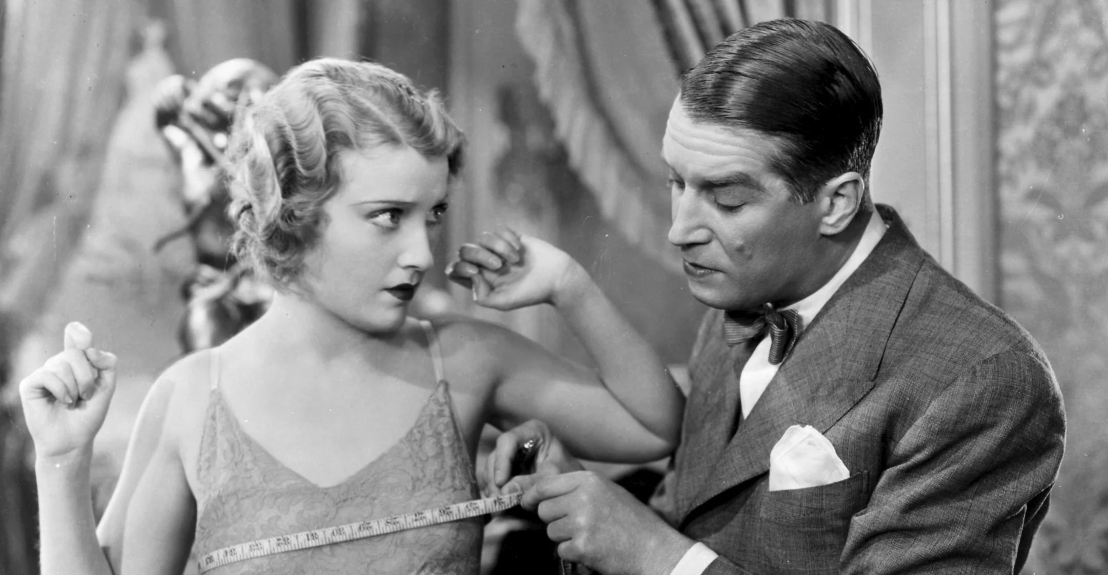
Delightful semi-parody of Lubitsch, that’s one of the most enjoyable and brilliant films of the decade
Director: Rouben Mamoulian
Cast: Maurice Chevalier (Maurice), Jeanette MacDonald (Princess Jeanette), Charles Ruggles (Vicomte Gilbert de Varèze), Charles Butterworth (Comte de Savignac), Myrna Loy (Comtesse Valentine), C. Aubrey Smith (Duc d’Artelines), Elizabeth Patterson (First aunt), Ethel Griffies (Second aunt), Blanche Friderici (Third aunt)
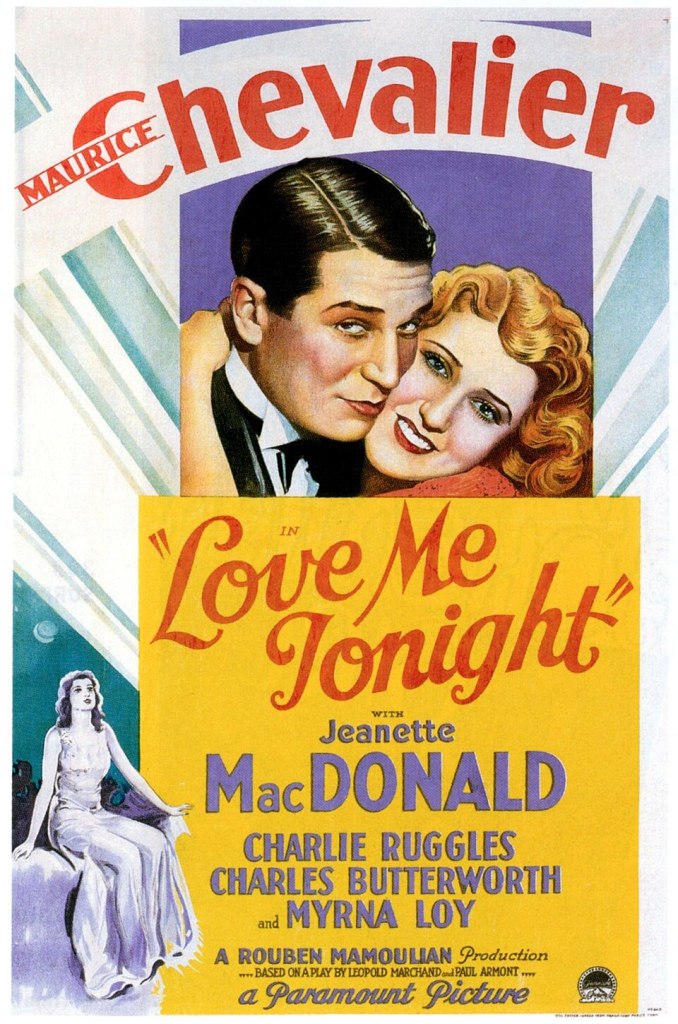
It’s very easy to assume Love Me Tonight comes from Ernst Lubitsch’s masterful hands. It does seem to have every element of his classic “Touch”: mixing light comedy in refined, courtly circles with charming ear-worm ditties – not to mention the presence of Maurice Chevalier and Jeanette MacDonald as an unlikely couple drawn (inevitably) together. It’s a surprise then that itwas directed by that overlooked master Rouben Mamoulian, intended as a parody of Lubitsch’s style. But it was so masterfully witty and well-delivered, that arguably became the greatest Lubitsch comedy ever.
It’s certainly one of the finest, funniest and most inventive musical comedies you’re going to see. Set in Paris at some point in the 1920s (despite which, only Chevalier has any trace of an accent), we meet Maurice (Chevalier), a plucky tailor with a dream, thrilled to land the big-spending Vicomte de Varèze (Charles Ruggles) as a client: and less thrilled to discover the Vicomte never pays his bills. Maurice rides post-haste to the Vicomte’s family manor, where the guilt-free Vicomte (worried his uncle (C. Aubrey Smith) will cut him off in disgrace) passes him off as a hidden royal, while he tries to raise money. Maurice falls in love with the Vicomte’s cousin, widowed Princess Jeanette (MacDonald), who at first can’t stand him, but soon discovers his charm.
Perhaps you should be tipped off this is a parody (of sorts) of vehicles the stars had made at least twice already with Lubitsch, that Love Me Tonight doesn’t even bother to change their names. But Love Me Tonight has a rich, cheeky script full of risque one-liners (tragically, some of the naughtiest stuff is lost forever after a post Hays Code recut) and it barrels along with an effortlessly smooth comic charm. Although the stars both found Mamoulian harder to work with than Lubitsch, these are two of their lightest, funniest most endearing performances, with Chevalier archly flirtatious while still a perfect gentleman and MacDonald austerely repressed with just a hint of excitement.
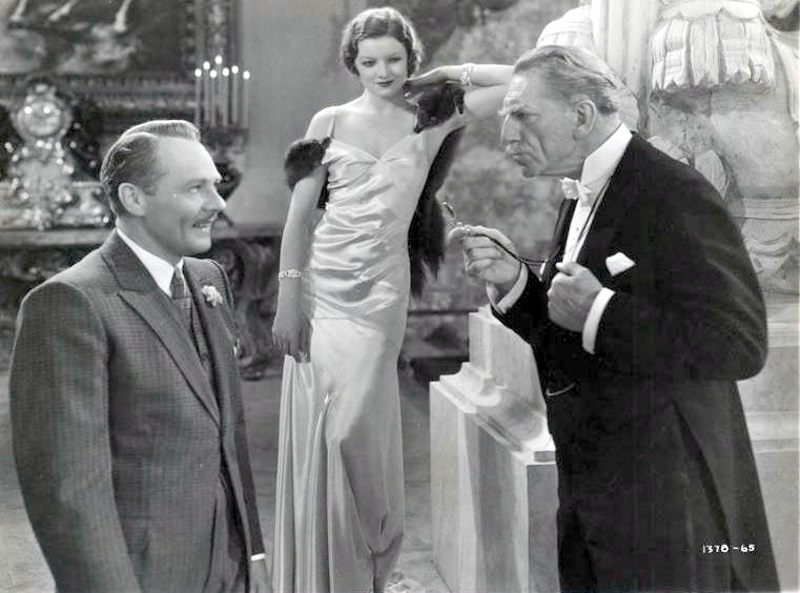
It’s a film stuffed with gloriously eccentric characters, with a top-of-the-line comic cast, all throwing themselves into top-of-the-line songs. Charles Ruggles is full of shameless, comic selfishness as the Vicomte who genuinely doesn’t understand why he should pay debts. C. Aubrey Smith shows more playfulness here (including a delightful moment where he dances in glee) than he did in his whole career of stiff-upper-lipped army officers. Charles Butterworth scowls and sulks superbly as MacDonald’s unwanted suitor. Elizabeth Patterson, Ethel Griffies and Blanche Friderici are great fun as a pack of easily-flustered maiden aunts (“Oh let me die!” one quietly mutters at a moment of risqué shock) who are one-third Macbeth’s witches, two thirds excited, yapping puppies. Perhaps best of all, Myrna Loy is a vampishly, sex-obsessed young woman making a pass at anything with a penis and a pulse.
Backed with a host of excellent songs – ‘Isn’t it Romantic’, ‘Mimi’, ‘Love Me Tonight’ and ‘The Son of a Gun is Nothing but a Tailor’ are first rate – the film is crammed with genuinely funny lines and marvellous moments of comic invention. From Maurice (shamelessly) mumbling the most risqué lines of ‘Lover’ (making his intentions all too clear) to a hilarious sequence where he derails a stag hunt by escorting the lucky animal to safety in a cottage, there is something to make you laugh almost every minute. Mamoulian directs with real zip and pace throughout, keeping the delightfully light confection gloriously whisked without ever letting it grow heavy.
That’s just scratching the surface of Mamoulian’s outstanding work. Disparaged as a director obsessed with innovation, it’s hard to see how anyone felt that was a negative when you see results as rich as this. Love Me Tonight is so full of brilliantly dynamic use of sound, visuals and editing, that I’m stunned it isn’t referenced more often as a landmark in Hollywood’s emerging understanding of what was possible. The fact it does all this, in fabulously enjoyable way, in gorgeously designed sets where charming actors effortlessly do their work is even better.
The invention is right there from the opening frames. Taking a theatrical technique he had used on Broadway in Porgy and Bess, Mamoulian opens the film on the street of Paris. One-by-one the citizens emerge to go about their daily business – sweeping streets, cobbling shoes, beating carpets, washing windows – the cacophony building up into a rhythmic beat that leads us into the opening number. It’s superbly done, so simple but so far ahead of the imaginings of other directors at the time, it smacks a smile on your face.
It continues with the masterful delivery of the ‘Isn’t it Romantic’ song. Starting with Chevalier singing the song (off-the-cuff) in his tailor shop, it’s picked up (in turn) and then travels across the country, via a customer, taxi driver, composer in the taxi, platoon of soldiers, fiddler in the country and finally winds its way under Jeanette’s window for MacDonald to sing. With an effect both natural and brilliantly artificial, the two stars are linked together by one song without even meeting. Again, it’s simple but perfect.
Love Me Tonight is crammed with superb moments like this that take the breath way. At a shocking reveal, a ceramic urn smashes on the ground – but the sound is replaced by a dynamite blast, reflecting the impact the reveal has had. A superb split screen gives the appearance of Chevalier and MacDonald in bed together (they are of course in different beds dreaming of each other). When Chevalier is given the crazed horse Solitary to ride at the hunt (so called, as the horse always come home alone) Mamoulian uses sped-up-film to masterful effect. He then balances this with artfully slow-motion footage, when the hunt ‘tip toes’ away from the resting stag – he even uses reverse film for a stunt to show Chevalier leaping onto the back of MacDonald’s horse. A final horse-train chase sequence wouldn’t like out of place in an action thriller, in its brilliant use of composition and editing to suggest speed and dynamism.
There is barely a frame in Love Me Tonight that doesn’t have a stroke of theatrical or cinematic genius. But these never overwhelm the story or unbalance it. Even without noticing the superb nature of the film’s construction, you could still love every minute of its humour, charm and romance – not to mention the effortless likeability of everyone involved. Love Me Tonight may have began as a parody of a familiar genre, but it’s also possibly the greatest example of the genre in existence, mastering the Lubitsch touch so well, it turns out it didn’t need Lubitsch at all. One of the best films of the 1930s.

