
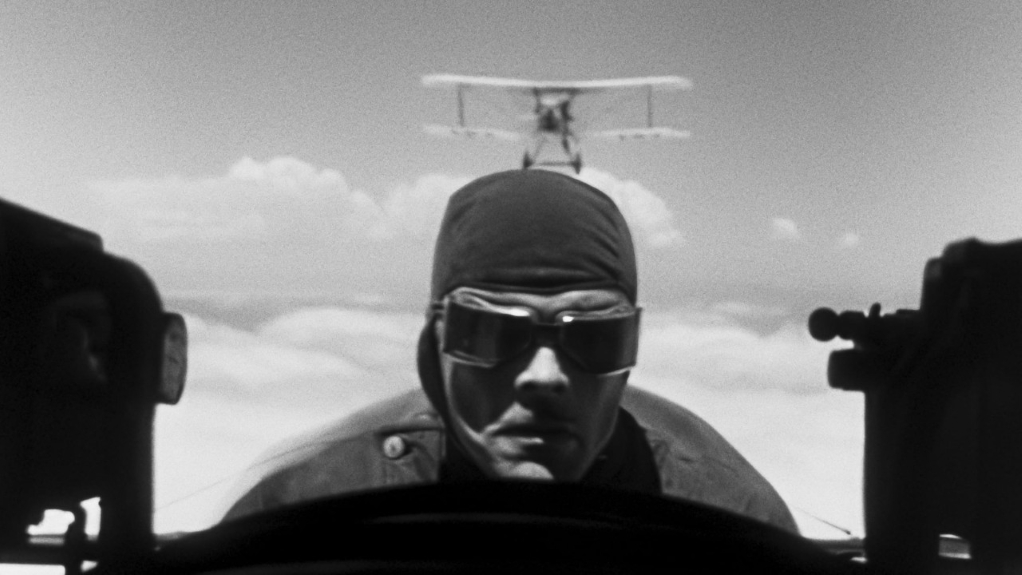
Hughes magnificent folly has stunning scenes of aerial combat, among it’s more functional dialogue scenes
Director: Howard Hughes (& James Whale)
Cast: Ben Lyon (Monte Rutledge), James Hall (Roy Rutledge), Jean Harlow (Helen), John Darrow (Karl Armstedt), Lucien Prival (Baron von Kranz), Roy Wilson (Baldy Maloney)
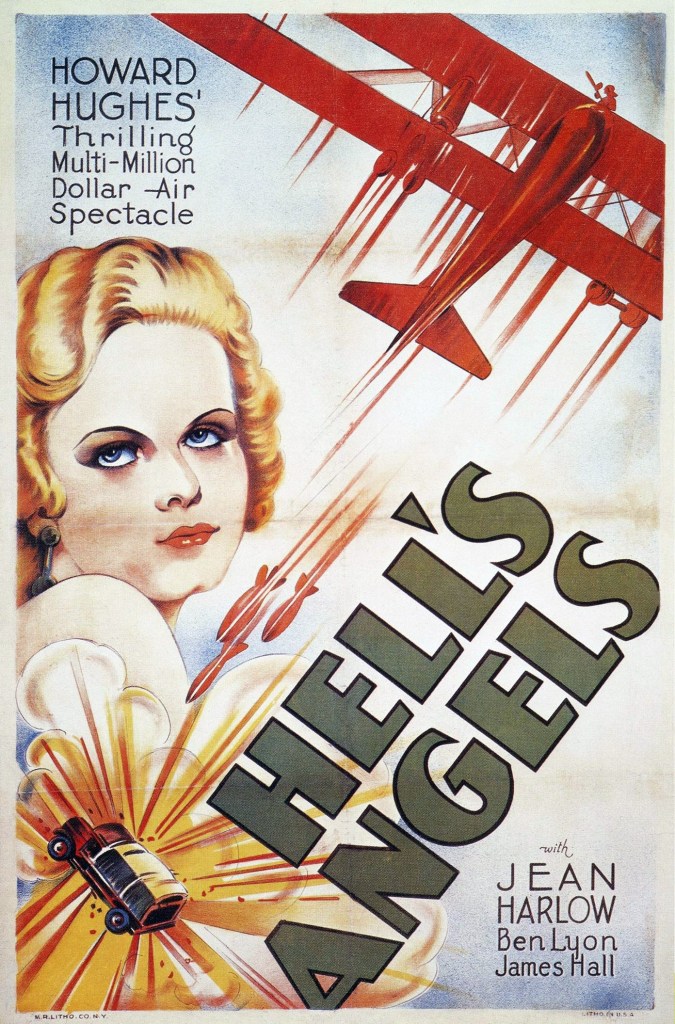
There is an old line about Orson Welles calling a film set “the biggest train set a boy ever had”. A feeling no doubt shared by Howard Hughes, one of the wealthiest men in America, who loved pouring his fortune into his private passions: fast planes and big movies. So, why not throw the two of them together into Hell’s Angels, the film which he planned to use to scoop recent Best Picture winner Wings title as the greatest fighter-ace film ever made. To get there, money would be no object at all.
Which meant Hughes didn’t think twice of reshooting most of the film over again when sound took over Hollywood. After all, why not put more money in: he had already spent millions on assembling a personal army of world-war-one planes, all of them frequently kept waiting on the ground for days on end (pilots and film crew sitting around collecting pay cheques) while he waited for the clouds to be perfectly positioned to best demonstrate the speed the planes flew at. Since he was waiting, why not bring in James Whale to re-shoot all the dialogue scenes with all the actual talking?
Whale came on board, fresh from directing Journey’s End on Broadway (after his work was finished, Hell’s Angels release was so further delayed he had time to shoot a film of that too and release it before anyone outside Hughes’ office saw a frame of Hell’s Angels), Whale first insisted the script be re-written. Hughes was more than happy with that, since I doubt he really gave a damn about the very-loose story used to join together the bits with the planes in. The cast was kept the same, bar one change: original female lead Greta Nissen’s Norwegian accent was judged impenetrable, so Jean Harlow was bought in to slip into something a little more comfortable in her place.
Not that it mattered particularly. The story of Hell’s Angels is simplicity itself. Two Brit brothers (though neither them or Harlow make any attempt to change their accents) join the flying corp at the outbreak of war. One brother, Monte (Ben Lyon), is a selfish, care-free rogue. The other, Roy (James Hall) is so painfully noble and dutiful (he even fights duels on behalf of the cowardly Monte) he’s nearly an idiot. Roy loves Helen (Jean Harlow) but is utterly unaware that she is nymphomaniac vamp who will do it with anything in a uniform – including Monte. Monte thinks war is a fool’s crusade, Roy considers it well-worth dying for – attitudes that will lead to a clash when they both volunteer for what turns out to be a suicide mission behind enemy lines.
None of this is particularly a surprise and, despite Harlow’s charisma, none of the three leads particularly stand-out on the acting front (though James Hall makes a decent fist of Monte’s big speech on the suicidal futility of war). Each of these characters is fairly thin in any case, and none of their actions carry any real surprise factor at any point. Whale shoots the dialogue scenes with a breezy competence, doing his best with material that on paper would hardly be winning any plaudits.
In fact, the most interesting thing about these scenes is how much it seems to subvert expectations of a martial flag-waver. It’s natural to assume the cowardly brother will either redeem himself or shown to be completely in the wrong, while the noble brother will be vindicated. In fact, Hell’s Angels ends up having more than a little sympathy with Monte who, while undeniably “yellow” (he looks terrified after his first solo flight and its downhill from there), is also given a fair bit of sympathy when he rants about war being murder and patriotism being just a word. It’s hard not to feel he’s right after watching the insane uber-nationalism of the German zeppelin crew who willingly fling themselves to their death to lighten their ship with cries of “Kaiser and Reich!” on their lips.
Just as it’s hard not to think Roy’s blind-nobility makes him less of a hero and more of a clueless buffoon. How he misses that Helen (who, at one point, staggers out of a bush immediately followed by an officer straightening his uniform) is as shallow as a puddle and faithful as a cat in heat is a complete mystery. It’s hard not to see him as a duped cuckold, cluelessly waiting for Monte in their digs (unaware Monte and Helen are currently going at it), or insanely obsessed with honour as he nearly gets himself killed fighting a duel in Monte’s place. It’s not surprising that (as Monte says) war is “like being drunk – it brings out who you really are”. It makes Monte increasingly wild and selfish, and Roy increasingly mule-like his in rigid following of form.
This subliminal interest is the best spark you can take from the otherwise fairly turgid dialogue scenes. The real interest is those dog fight scenes. And they remain outstanding today. There was no question Hughes wasn’t going to direct those – and he directed them from the sky himself, calling the shots from a plane amongst the action. These sequences are all stunningly assembled and genuinely compelling in their sense of speed and danger. There is also a real visual beauty to them: in particular a shot of a German zeppelin emerging from blue tinged clouds is awe-inspiring. The epic sweep of tight formation planes, swooping closely between each other, tailing each other, bullets flying and pilots whizzing by is brilliant.
And the film doesn’t shirk on the horrors. Flames – whether they come from machine guns or from burning planes – are hand painted yellow to make the destruction stand out. The human impact on the pilots is brilliantly captured. During these battles, pilots will burn or die with blood streaming from their mouth. Panicked flyers will gulp back shots of whiskey midair, or scream in agony as their bullet riddled planes and bodies crash to the ground. Planes ram into each other in fiery explosions, or streak bullets across each other. That’s not to mention the horrifying madness of that German zeppelin crew stepping into the oblivion of a long fall, pushed towards their fate by their fanatically insane captain (who has already sacrificed/murdered sympathetic German Karl – an old college friend of Monte and Roy – to lighten the zeppelin).
The dog fight sequences are compelling and if the drama on the ground never quite reaches these heights, in a way that’s only to be expected. For all the quiet subversion – and it’s up to you how much you think Hughes noticed or cared about that – they are functional moments to carry us to the drama in the skies. That’s what Hell’s Angels does best – and few have done it better.

