
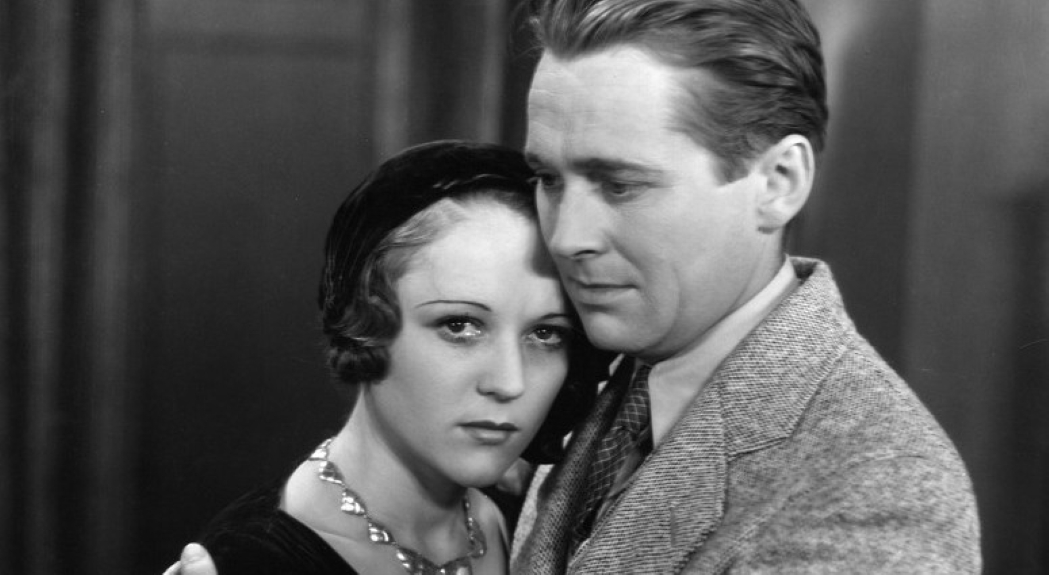
Tag: James Dunn

Bad Girl (1931)

Bad Girl (1931)

Somewhat mistitled film, which is really a sort of dramedy of misunderstandings

Director: Frank Borzage

Cast: Sally Eilers (Dorothy Haley), James Dunn (Eddie Collins), Minna Gombell (Edna Driggs), Claude King (Dr Burgess)
Boy meets girl, they fall in love – what could go wrong? Quite a lot it turns out. Dorothy (Sally Eilers) works in a department store and enjoys nights out with best friend Edna (Minna Gombell). On one such trip she a man she meets is annoyed by her ukulele playing (who can blame him) and then doubles down on his crime by not flirting with her. But she’s fascinated by Eddie Collins (James Dunn) and, before they know it, they are into a whirl-wind marriage. Within months, both are convinced the other believes they have made a terrible mistake and want out.

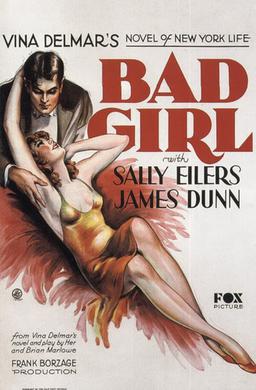
Despite its salacious title – and the look of its poster – today Moderately Cheeky Girl would be a better title than Bad Girl. A better title than either would really be A Dramedy of Errors. Because that’s really what it’s about: two slightly naïve, decent people terrified that the other feels trapped. It’s the sort of gentle melodrama where the entire plot would fall apart in thirty seconds flat if either spoke honestly to the other. Instead, mistakes and misunderstandings are (often wilfully) allowed to continue, as they conceal things or allow misunderstandings to continue out of social embarrassment.

As such, it’s hard not to think Bad Girl as being both rather slight and silly. It just about manages to counteract this by its careful pacing and the sweet earnestness of the performances by Sally Eilers and James Dunn, counter-balanced by the sparky comic sharpness of Minna Gombell. Between them, these three just about keep Borzage’s sentimental translation (of a far spicey book) going. But, rather like the characters dilemmas, if you stop to think about it, it’s strikingly artificial.

Most of the many misunderstandings revolve around Dorothy’s pregnancy. This pregnancy itself is practically the last vestige of ‘bad’ left in the film: it’s very heavily implied this baby has its roots in a spicey piece of pre-marital sex shortly after they met. (Borzage rather artfully communicates this with a slow pan from a middle-of-the-night shot of a bed to the two lovers hugging – fully clothed – in a chair the other side of the room). But it serves as a jumping off point for paranoid misunderstandings, rooted in Dorothy’s fears that (like her mother) she’s destined to die in childbirth.

First, Dorothy is too panicked to admit she’s pregnant (worried that Eddie will disappear over the horizon the second he finds out he’s destined to be a dad). So she speaks about needing to find her own job, leading to Eddie blowing his entire life savings on setting them up in a fully furnished flat to reassure her she doesn’t need to work. This calamitous decision ends at a stroke both Eddie’s dream of setting up his own business and burns through their reserves for the incoming infant. As such, when Dorothy sweats over needing the finest doctor, Eddie is reduced to (secretly) throwing himself into being beaten to a pulp in a prize fighting ring and then literally begging the doctor to work for free to help her – all while allowing her to believe he doesn’t really give a toss.

The film’s love of melodrama is never clearer than when Dorothy greets the bruised, late-night returning Eddie with a weary contemptuous assumption he’s been out on the piss and Eddie doesn’t even try to correct her. Neither does she question how they can suddenly afford the best doctor in town, nor does Eddie attempt to inform her. In a series of misunderstandings stemming from neither talking honestly to each other at all, Eddie remains convinced Dorothy can’t bear the thought of a child while Dorothy believes Eddie feels she and the child have ruined his life.

How much you run with this sort of stuff, rather depends how much you can lose yourself in a drama where you might be dying for someone to knock some sense into these tyros. Minna Gombell’s Edna seems best suited to do this but, partly due to not wanting to stick in her nose too far, partly because she almost can’t believe these two can be so blind, she doesn’t. Fortunately, James Dunn finds a great deal of little-boy-lost charm in the try-hard but quietly anxious Eddie, while Sally Eilers Dorothy has a winning quality of sounding more worldly than she actually is.

The misunderstandings comprehensively outweigh the “badness” which looks incredibly tame today. She likes to flirt, looks for dates out on the town and doesn’t mind seeing a boy late at night – what a temptress! In fact, if anything, the way poor Dorothy and Edna constantly fall back on a parade of invented prize-fighting husbands and protective grandfathers to fend off the unwanted attentions of lascivious bosses and customers makes them feel rather sympathetic.

Borzage won an Oscar for his direction, which feels slightly surprising today considering the light melodrama of the script (like a puff of air) and the fairly comfortable mid-shot most of the film is shot in. There are some flashes of invention – the film’s opening is a neat misdirect, with Dorothy kitted out in wedding attire for what turns out to be a fashion parade at her department store; there is a neatly shot toboggan ride – but largely Borzage’s main achievement here is not making it seem totally ridiculous. The drama around Eddie’s investment in a top notch apartment they can’t afford actually carries a fair bit of impact – helped by the shocked horror of Eilers when its unveiled in front of a room of their friends – and the film’s final, slightly ridiculous reveal of the truth manages to just about work even though it’s the most swiftly contrived thing you can imagine.

Bad Girl is an entertaining enough little melodramatic semi-comedy of misunderstandings, that powers through with its genuine earnestness and rather winning sweetness. It may not be anything particularly special or striking, but it slides past with a crowd-pleasing ease.
A Tree Grows in Brooklyn (1945)

A Tree Grows in Brooklyn (1945)

Easy-going father-daughter sentimentality in Kazan’s debut, which softens up an already gentle novel

Director: Elia Kazan

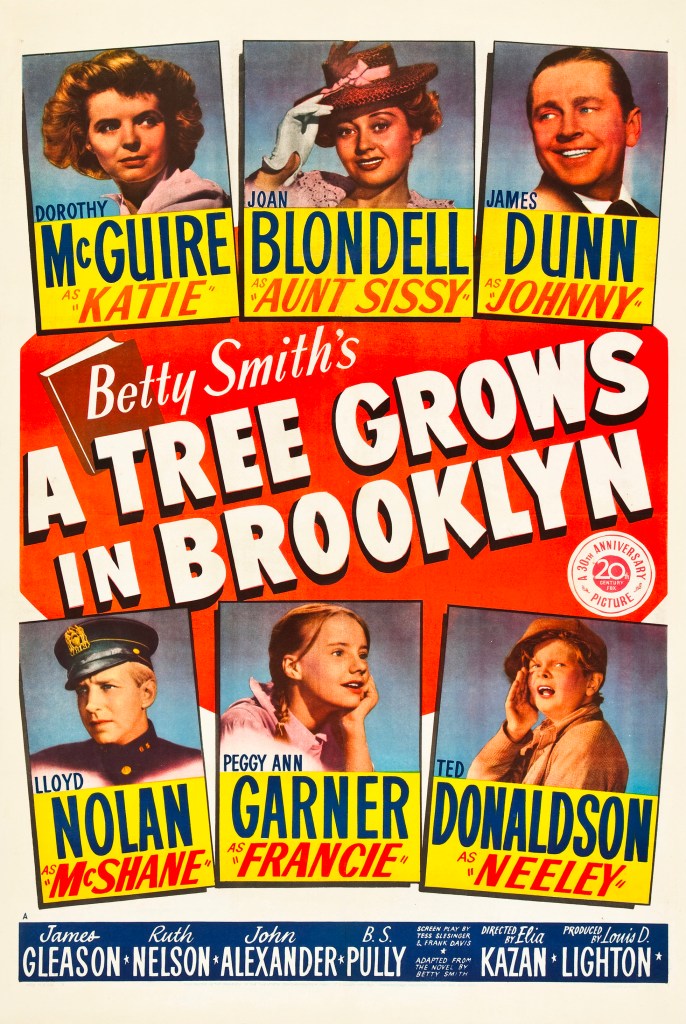
Cast: Peggy Ann Garner (Francie Nolan), Dorothy McGuire (Katie Nolan), Joan Blondell (Aunt Sissy), James Dunn (Johnny Nolan), Lloyd Nolan (Officer McShane), Ted Donaldson (Neeley Nolan), Ruth Nelson (Miss McDonough), John Alexander (Steve Edwards)

In 1912 an Irish-American family, the Nolans, struggle to make ends meet in Brooklyn. Mother Katie (Dorothy McGuire) keeps a close eye on the purse strings to ensure she can keep a roof over the head of her children: 13-year-old Francie (Peggy Ann Garner) and young Neeley (Ted Donaldson). Problem is, Katie also has a third child: her husband Johnny (James Dunn), a happy-go-lucky dreamer and “singing waiter” who is also a hopeless drunk. Johnny, with his “live-your-dreams” outlook on life, natural charm and instinctive understanding of people, is Francie’s idol. With another child on the way, and the Nolan cash reserves at breaking point, can the family hold together?

A Tree Grows in Brooklyn drips with sentimental, old-fashioned, easy-watching charm. Adapted from a best-selling novel by Betty Smith, it strips out most of the plot (which covers nearly 17 years rather than the single one featured here) and considerably waters down the original’s content. (It also, hilariously, avoids any appearance at all of the eponymous tree at the centre of the Nolan tenement block, which is cursorily referenced only twice.) Smith’s book was a semi-auto-biographical chronicle of a life of struggle survived by a daughter who flourishes, but the film is more of an optimistic fable of the triumph of family love.

It feels strange that this is the first film of Elia Kazan, who would become better known for hard-hitting, location-shot, method-tinged dramas rather than the tear-jerking charm here. Kazan was later sceptical about the film – highly critical of what he considered his overly theatrical staging, particularly of the scenes set in the Nolan home – and even at the time stated he was so unsure about what he was doing that the film was effectively co-directed by cinematographer Leon Shamroy. But Kazan’s skill with actors shines through and he invests it with a great deal of pace and emotional truth.

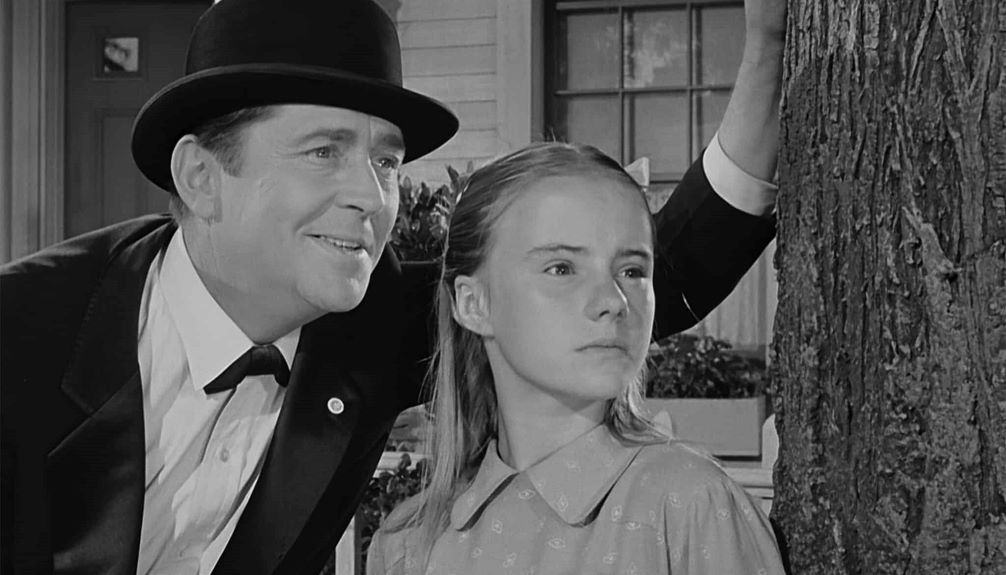
His main benefit is the very strong performances from Garner and Dunn in the film’s most important relationship. Both actors won Oscars (Garner the juvenile Oscar, Dunn for Best Supporting Actor) and it’s the loving meeting of hearts and minds between father and daughter that lies at the film’s heart. Francie is a young girl dedicated to education – slavishly, but obsessively, reading through the local library in alphabetical order, regardless of suitability of the books – who dreams of going to a better school and bettering her life. It’s a dream that her mother struggles to grasp – largely unable to see beyond the immediate needs of putting food on the table – but which her father understands and is desperate to support.

This bond is partly what leads to Francie’s idolising her doting dad. And Johnny is doting. He’ll do things her mother won’t dream of doing – including weaving an elaborate fantasy to win her a place at that better school. He’ll joke and laugh, sing songs and entertain her while indulging her artistic leanings. Unfortunately, he’ll also make promises to reform he won’t keep, stumble home late at night or be found, drunk in the street, having boozed away every penny he’s earned.

Dunn poured a lot of himself into this self-destructive dreamer. A vaudeville comedian who had a successful run of films with Shirley Temple in the 1930s, he had blown most of his fortune in bad investments. By the 1940s was struggling to find work with his drink problem widely known. But he was also charming, decent and kind, but seen to lack the drive to build a successful career. In effect, Johnny was a version of his own life, and Dunn not only nails Johnny’s charm but also laces the performance with a rich vein of sadness, guilt and shame, but still loved by all.

While Johnny jokes and laughs with the neighbours, Katie cleans the hallway of their tenement block to earn extra bucks and moves the family to a smaller room to save what money she can. Played with a fine line in drudgery and put-upon stress by Dorothy McGuire (in a role as thankless as Katie’s life is), Katie remains unappreciated by her daughter (who sees her as a moaner who won’t cut her father a break) and by her husband as being too obsessed with the purse-strings.

The major flaw, for me, of A Tree Grows in Brooklyn is that the film falls almost as uncritically in love with Johnny as Francie. Getting older it’s hard not to see Johnny as essentially irresponsible and selfish, a well-meaning but destructive force on the family, the cause of the poverty which has made Katie crushed, dowdy and increasingly stressed and bitter. She essentially suffers everything – skipping meals, slaving over multiple jobs, saying no to every desire Francie has – while Johnny flies in, cracks jokes, says yes to everything and disappears when its time to work out how to deliver.

A Tree Grows in Brooklyn, however, wants to tell a sentimental story of a father-daughter bond and hasn’t got too much time for Katie – or for making Francie really face the flaws in her father and the virtues of her mother (for all the film gives mother and daughter a late reconciliation). There is something fake about this (tellingly the book gives a sharper realisation for Francie and subtly changes Johnny’s fate to make it less idealised). But all edges are shaved off here and the family divisions are bridged as easily as poverty is eventually solved. (There is also considerable watering down of the liberated lifestyle of Katie’s sister, engagingly played by Joan Blondell).

It makes for a film that’s warm, comforting and essentially light and even a little forgettable. It’s all too easy to drop off in front of it on a Sunday afternoon. Try as you might, you can’t say that about other Kazan films. A little more grit to this would have increased its impact considerably.