Tag: Bruce Bennett

The More the Merrier (1943)

The More the Merrier (1943)

Very funny farce, excellently acted with some near pin-perfect farce.

Director: George Stevens

Cast: Jean Arthur (Constance Milligan), Joel McCrea (Joe Carter), Charles Coburn (Benjamin Dingle), Richard Gaines (Charles J Pendergast), Bruce Bennett (FBI Agent Evans), Frank Sully (FBI Agent Pike), Don Douglas (FBI Agent Hardy)

Wartime in Washington and housing space is at a premium, with the city full to bursting. Here to solve this housing problem is millionaire Benjamin Dingle (Charles Coburn), who is ironically unable to find a place himself to lay his head. Luckily, through charm and bull-headed perseverance, he persuades young statistician Constance Milligan (Jean Arthur) to sub-let her apartment to him. Taking a shine to the buttoned-up Constance, Dingle sub-lets half of his half to army engineer Sergeant Joe Carter (Joel McCrea), planning to play Cupid. Something he commits to even more after meeting Constance’s stuffy pen-pushing fiancée Pendergast (Richard Gaines). As the Farragut-loving Dingle says: Full steam ahead and damn the torpedoes!

This zany set-up is delivered to the screen with plenty of bounce and zing by George Stevens. Especially its first half, a near master-class in pin-perfect, near-miss, door-opening-and-closing farce that would have made Chaplin or Keaton proud. The More the Merrier is a funny, surprisingly sexy film boosted by not taking itself too seriously and powered by three lead actors having a whale of a time. If its final resolution feels a little too forced – and Dingle’s manipulations at points verges towards the sinister – that doesn’t change the fact there are so many laugh-out-loud moments along the way.

The More the Merrier starts with a dry, witty sense of tongue-in-cheek parody as a sonorous news-reel voiceover introduces us to Washington where “living is pleasant and leisurely”, singing the praises of the city’s hospitality, fine dining and gentility while a montage of shots shows us it’s a whirligig of frantic movement, food grabbed on the street and “no vacancy” signs turned towards us with a slap. It’s a sign of the film’s wry wit and the fun it will have at the nonsense just behind the way we talk about everyday life. It’s also a sign that Stevens understands gags land best with a straight bat and a sly wink – a subtlety that serves the film well.

It’s first act, as Dingle and then Carter move into the home of the reluctant Constance, sees all three actors playing wonderfully into the straight-faced farce. An obsessive control-freak, running her life to a tight timetable, Constance hands a detailed minute-by-minute itinerary of the day’s first half hour to Dingle, that’s hilarious in its minutiae. Jean Arthur deserved an Oscar nomination for this scene alone, a perfect minute of ludicrously detailed instructions on everything from newspaper collecting to bathroom door closing to coffee brewing – with Coburn’s earnest bafflement equally fine. The inevitable disintegration of this plan the next day (a parade of the two locking each other out of the apartment, knocking into furniture, getting sprayed by an errant shower and losing a pair of trousers) is such a masterclass in farcical underplaying – in particular from Coburn – that it’s guaranteed to bring the house down.

But perhaps even better is the next morning, the first after Carter has been smuggled into the house without Constance’s knowledge. With only Dingle aware of the situation – and wanting to keep it secret as long as possible – Stevens positions the camera in the hall and delights us with a five-0minute sequence of perfectly timed door comedy, as McCrea and Arthur continuously just miss each other, culminating in a perfectly timed corridor cross where both actors only narrowly miss walking smack into each other. This is choreographed comedy at its finest.

The More the Merrier seems ripe for fast-paced screwball from there, but Stevens shifts gears into a romance that’s both natural and surprisingly sensual. He’s helped by the huge chemistry between Arthur and hand-picked co-star McCrea, who with minimal fuss and no grand-standing manage to communicate beautifully two people surprised to be absolutely besotted with each other. Their playing of Carter’s gifting of a travel case to Constance simmers with sexual tension, as McCrea quietly but intensely leans in to extol the virtues of every feature while Arthur breathlessly agrees – never before has excitement about a suitcase been such a clear stand-in for something else.

Their spark only grows, lingering glances and an intense desire to be left without the interference of Pendergast (Richard Gaines doing exactly what’s required as a tedious bore and obstacle to happiness). They have a late-night walking scene culminating in them sitting on their apartment stairs that feels like one of the raciest scenes in screwball. Stevens leans into this with his shooting of their bedrooms. Shot from the exterior, their windows subtly blur the rooms together (at one shot, the dividing wall is just a blurry line making the two appear to be in bed together) culminating in a final sequence that gets the slow-build to a final wall punchline spot on.

All of this works as well as it does thanks to the excellence of the three stars. Jean Arthur is very funny as a control-freak growing increasingly flustered as her well-organised life spins out of control (even if her final act wailing becomes a little wearing). McCrea perfectly mixes dry, low-key wit with a quiet sexuality. Coburn won an Oscar for possibly his finest ‘cheeky old uncle’ performance, a gruff mischief maker with a twinkle in his eye. All three of the actors spark of each other in any combination, right down to Coburn and McCrea throwing themselves into reading cartoons out loud with childish glee.

But the final act doesn’t quite deliver. A forced resolution involving the FBI never quite feels like it matches with what’s come before. The manipulations of Coburn’s character at times become a little too forceful – and it’s hard not to feel more than a little uncomfortable when he takes Constance’s accidentally abandoned diary and reads it out loud, an invasion of privacy the film never holds him to account for. If there is one point where the chemistry between Arthur and McCrea doesn’t land, its ironically in many of the final scenes, not helped by those continual frantic wails from Arthur. You get the sense Stevens had a great set-up but not quite a clear idea on how to finish it. But what gets us there is witty, fast-paced and very funny – and that’s just more than enough.
Sahara (1943)

Sahara (1943)

Bogart does desert warfare, in this tense, very well-made war film both men-on-a-mission and a siege film

Director: Zoltán Korda

Cast: Humphrey Bogart (Sgt Maj Joe Gunn), Bruce Bennett (Waco Hoyt), J. Carrol Naish (Giuseppe), Lloyd Bridges (Fred Clarkson), Rex Ingram (Sgt Maj Tambul), Richard Nugent (Captain Jason Halliday), Dan Duryea (Jimmy Doyle), Carl Habord (Marty Williams), Patrick O’Moore (Bates), Louis Mercier (Frenchie), Guy Kingsford (Stegman), Kurt Kreuger (Captain von Schletow), John Wengraf (Major von Falken)

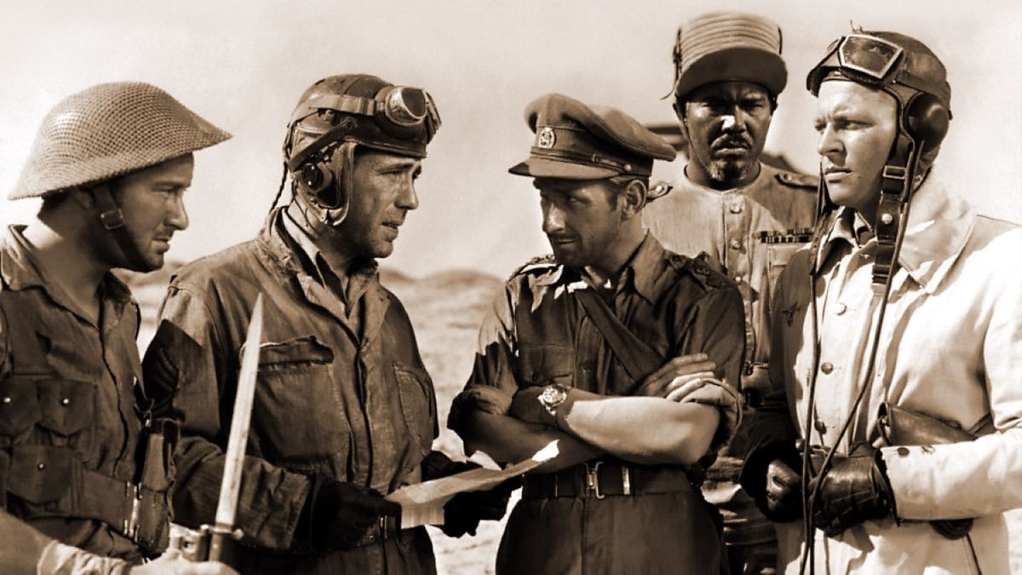
Sahara was ripped from the headlines: with the war still in full swing. So much so, it not only told a tale of a battle effectively still being fought but is also perhaps the only American film in existence to credit a Soviet film for providing the original story. It’s 1942 and the British army are in full retreat from Rommel’s Afrika Korps. Among them is Sgt Joe Gunn (Humphrey Bogart) and his tank Lulubelle, one of a small group of American tanks getting some real life combat experience with the Brits. Heading South through the desert, Gunn and his crew, Waco (Bruce Bennett) and Joe (Dan Duryea), pick up a motley collection of Allied soldiers led by Captain Dr Halliday (Richard Nugent) including Sudanese sergeant Tambul (Rex ingram) and his Italian prisoner Giuseppe (J. Carrol Naish). All of them are caught between two enemies: the Germans and the complete lack of water in the desert.

Sahara is an exciting, assured war film that combines a ‘men on a mission’ set-up with a classic ‘base under siege’ setting. Our heroes eventually find themselves at a dried-up desert well and the target of a desperately thirsty German battalion. Gunn decides to hold the dry well to slow the German advance down, fighting a gruelling siege, desperately waiting for relief, as the battle takes a terrible burden. This is Boys Own Adventure stuff, but told with a genuinely affecting sense of duty and sacrifice, as our heroes knuckle down in impossible circumstances.

At the heart of it, Bogart delivers exactly the movie star charisma the film needs while. Rudolph Maté’s photography is extraordinary, transforming the Californian desert into the African sands. Sahara brilliantly understands the importance of resources in the desert, and Korda captures perfectly the sweaty, sand-covered desperation for liquid. Sahara is tense, exciting and surprisingly hard-hitting with a strong cast.

What it really is of course, is a celebration of the attitudes that separate the Allies from those nasty Nazis. The Allies are a smorgasbord of nationalities, all of whom are shown (after some clashes) to work together with respect, admiration and a shared sense of purpose. Richard Nugent’s medical officer modestly defers leadership to the tank-and-combat experience of Bogart’s sergeant – no awkward arguments of seniority. Despite the collection of Americans, Brits, a South African, a Free Frenchman, a Canadian and a Sudanese sergeant, there is almost no trace of either national or racial clashes.

These men work in partnership, deferring to other’s areas of expertise to survive. Rex Ingram – excellent as Sergeant Tambul – instantly proves himself invaluable with his survival knowledge and ability to locate water. It’s Tambul who is at the heart of a tense search for any moisture in the seemingly dried up well our heroes hole up at, and later he is pivotal in the defence of the well. Saraha has a marvellously low-key but affecting scene of cross-cultural understanding as Tambul and Bruce Bennett’s Texan Waco jokingly compare outlooks on the world that are far more similar than they expect.

The message here is clear: teamwork, respect and the ‘dignity of freedom’ gives the Allies the moral edge over the Axis. The supportive respect, good humour and unflashy bravery of the Allies who get on with it and put duty first while respecting the rules of war is contrasted with the Germans. Bogart may flirt with the idea of abandoning Giuseppe in the desert (to preserve their water supply) but of course, when push comes to shove, he won’t (as Waco and Jimmy suspected he wouldn’t). Later, Bogart will even share the same limited water ration with their German prisoners.

Compare and contrast with the Germans. Their main representative, captured pilot von Schletow (played with a wonderfully smug viciousness by Kurt Kreuger), is portrayed as an instinctive racist (he’s the only character to make any slur towards Tambul), a bully and fanatic. There’s very little trace of decency in him: he’s confrontational, two-faced and dripping with nationalist superiority. The other Germans we see aren’t much better: a German soldier turns on his companion for a drop of water, a senior German officer breaks on a truce and the Germans fight as individuals rather than a supportive unit.

Caught in the middle? The Italians, represented by Giuseppe. J. Carrol Naish is excellent (and Oscar-nominated) as a soldier a million miles from Kreuger’s fanatic: a family man who keeps his word and just wants to go home. Naish has two knock-out scenes: the first a desperate pleading to Gunn to not be left to certain death in the desert and the second a contemptuous denunciation of German fanaticism to von Schletow: as he puts it, it’s a job to the Italians but a way of life to the Germans. Perhaps it was easier (with America’s large Italian population) to give the Italians more of a pass, but it allows the film to suggest there is some hope that behind the fanatics stood many regular people (something it’s hard not to see mirrored in the desperate German soldiers).

Sahara marshals all of this into a final siege that threatens to head the film into very dark territory indeed. Death is a constant in Sahara: the film opens with a view of the wreckage of battle, the unforgiving harshness of the desert is constantly stressed and we are shown repeated images of makeshift graves as bodies pile up and it becomes clear no-one is safe. Many heroic deeds have fatal outcomes and there is a hardened realism to the fighting. Like the Allies, the viewer ends up hoping for a miracle. It’s makes for a gripping and overlooked war film, that provides a genuinely hard-hitting taste of how unforgiving war can be. Tense, well-filmed and exciting it’s a little gem.

The Treasure of the Sierra Madre (1948)

Three men go in search of The Treasure of the Sierra Madre

Director: John Huston

Cast: Humphrey Bogart (Fred C Dobbs), Walter Huston (Howard), Tim Holt (Bob Curtin), Bruce Bennett (James Cody), Barton MacLane (Pat McCormick), Alfonso Bedoya (Gold Hat)

Is there anything that warps the human character more than greed? Humanity sometimes seems driven only by the desire for more, to fill our pockets with cash and leave the rest behind. It’s greed that becomes the subject of John Huston’s masterful The Treasure of the Sierra Madre – and specifically the effect it has on Humphrey Bogart’s Fred C Dobbs. If you can pick up as much gold as you want off the ground around you, why does it become so difficult to watch others take it away?

Dobbs and Bob Curtin (Tim Holt) are down-on-their-luck drifters in Mexico, bumming spare change off American businessmen and struggling on hand-to-mouth jobs for shady businessmen. So how could they resist the chance to team up with fast-talking old-timer Howard (Walter Huston) who knows that there’s gold in dem da hills? Heading into the wilderness – partly financed by Dobbs’ lucky small lottery win – the three men strike lucky and start pulling the gold from the ground. Problem is as the piles grow, so slowly does the men’s suspicion each other – not least Dobbs, who grows increasingly paranoid and unbalanced at the thought of any danger to his gold. In the wilderness of Mexico, with bandits across the countryside can the men’s growing suspicion of each other be held off long enough to get the gold back home?

Based on a novel by B Traven – an author so notoriously private that even today no one knows who he was – John Huston’s classic is part adventure story, part treatise on the human condition. It’s also gloriously entertaining at every turn. One of the first major Hollywood films to be shot largely on location, it drips with the sultry heat of Mexico, beautifully filmed by Huston. Huston’s masterful script also packs the film with a punch, from quotable titbits (most famously the oft-misquoted “Badges? I don’t have to show you any stinkin’ badges!”) to its Shakespearean touches as a rambling, mad, paranoid Dobbs walking alone through the desert wilderness like a cut-price Lear.

Dobbs is the heart of the film – and there is perhaps no anti-hero more ‘anti’ in the whole of Hollywood than this ruthlessly selfish, obsessive paranoiac. Bogart probably gives his finest performance ever as the scruffy, sweaty, unshaven and bitter drifter who finds he can’t abide the idea of having to give away any of what he sees as his share of the loot. And, worse than that, becomes convinced that the whole world is out to take it from him. 

Bogart digs deep into the weasily, rat-like greed of this man. Bogart fought long and hard to play who he called “the worst shit you ever saw”. Dobbs has a strange moral code and sense of honour that’s entirely personal. Having his character impugned by others is an affront he can’t abide – though murder and violence are perfectly acceptable. He’s the sort of guy who will savagely beat a man who stiffs him for wages and then precisely take only what he’s owed from the guy’s wallet. Bogart is perfect as the cold-eyed loner who talks big at first about partnership, but later whines about how he staked most of the starter capital so should be getting a larger share of the profits. Bogart, in perhaps one of the biggest snubs in Hollywood history, missed out on an Oscar nomination in a notoriously weak year for Best Actor. Perhaps, the vision of Rick Blaine bitterly muttering to himself, covered in flies and filth, while plotting the murder of his friends in the Mexican outback was too much for the voters to take. Either way, Bogart’s late mental collapse into near-Shakespearean envy, jealousy and twitchy paranoia is as effective as it is subtly done.

More fortunate at the Oscars were the Huston family. John had written the part of Howard for his father Walter. It bought Huston Snr the Oscar for Best Supporting Actor. Walter Huston is wonderful as this fast-talking eccentric, rocketing through his dialogue at a hundred miles an hour, as if he has lived so long through the events he is talking about that he barely has the time or patience to tell the story at a normal pace. Huston adds touches of wonderful eccentricity, to Howard’s insane jig of joy when finally finding the site of the gold, to his infectiously unrestrained cackling laughter. 

Eccentric as he is though, Howard is a decent and honourable man who has every intention of sharing the gold and is well aware of its corrupting influence. The wily Howard is also the only essential member of the crew – the only one with the experience to survive in the wilderness, the only one who can recognise and knows how to mine for gold. The most loyal to the fellowship, he’s the good angel to Dobb’s bad. In the middle of this moral spectrum, John Huston places Tim Holt’s Bob, a plain-speaking, more naïve figure who has elements of both characters in his pride and hunger for gold, matched with his sense of honour and loyalty. The film partly becomes an unspoken struggle for the soul of Holt’s Bob, as we wait to see which way he will fall. 

Not that any of these men are angels. They are all determined to protect what they have. Struggling in shoot-outs with bandits is fine. They even vote on whether or not to execute a fellow drifter (played by Bruce Bennett) who encounters their stake and enquires about joining them for a share. Bennett’s Cody is, by the way, the smartest character in the film, who sees with pathetic ease through the nervy lies told by the three men, as well as acutely analysing their situation and options with a sharpness that seems beyond all of them. 

Of course by that point suspicion between them – specifically Dobbs and Bob – has already grown dramatically. Dobbs takes to spying on his fellows and digs a separate hiding place to which he carefully takes his own share (Curtin takes to doing the same). John Huston includes a marvellous sequence where the three men each wake up in turn during the night – and react with suspicion on noting the absence from the tent of the others. Later Bob will think long and hard before saving Dobbs from a mining cave-in. Only Howard seems less affected about the gold – although with his talk of the corruption he has seen in the past, perhaps he was a Dobbs himself in the past, now grown wiser and more accepting of the easy-come-easy-go nature of gold. 

Huston’s Oscar winning script (he also lifted the Oscar for Best Director, although Best Picture went to Laurence Olivier’s Hamlet) keeps the rich vein of irony running throughout the script, even while it shows how susceptible men are to corruption. The film’s final act – and the eventual fate of the gold – is a treat, a natural extension of the films theme of mankind being a dog-eat-dog world. What else can you do but sit in the dust and laugh at it all? 

There are no heroes really in The Treasure of the Sierra Madre – even the mountain remains named only in the title of the film – just three men, scruffy, seedy and not that smart, struggling to grab what they can from the earth. Life becomes more and more cheap as the film goes on – Dobbs and Curtin are like brothers at the start, but increasingly come to see both other people and each other as expendable rivals. With Dobbs like some scruffy Smaug, the film boils down to each man confronting his own emptiness. The only character with any emotional hinterland is the drifter Cody, looking for gold for his wife and kids (his story has real impact on Curtin), the rest are just living from moment to moment.

John Huston’s classic is a marvellous musing on the nature of greed and humanity, superbly filmed by Huston with not a single false note in acting or writing. Perfectly placed, it mixes a western vibe with a Shakespearean grandness – and has a simply wonderful performance by Bogart. A classic that really delivers.

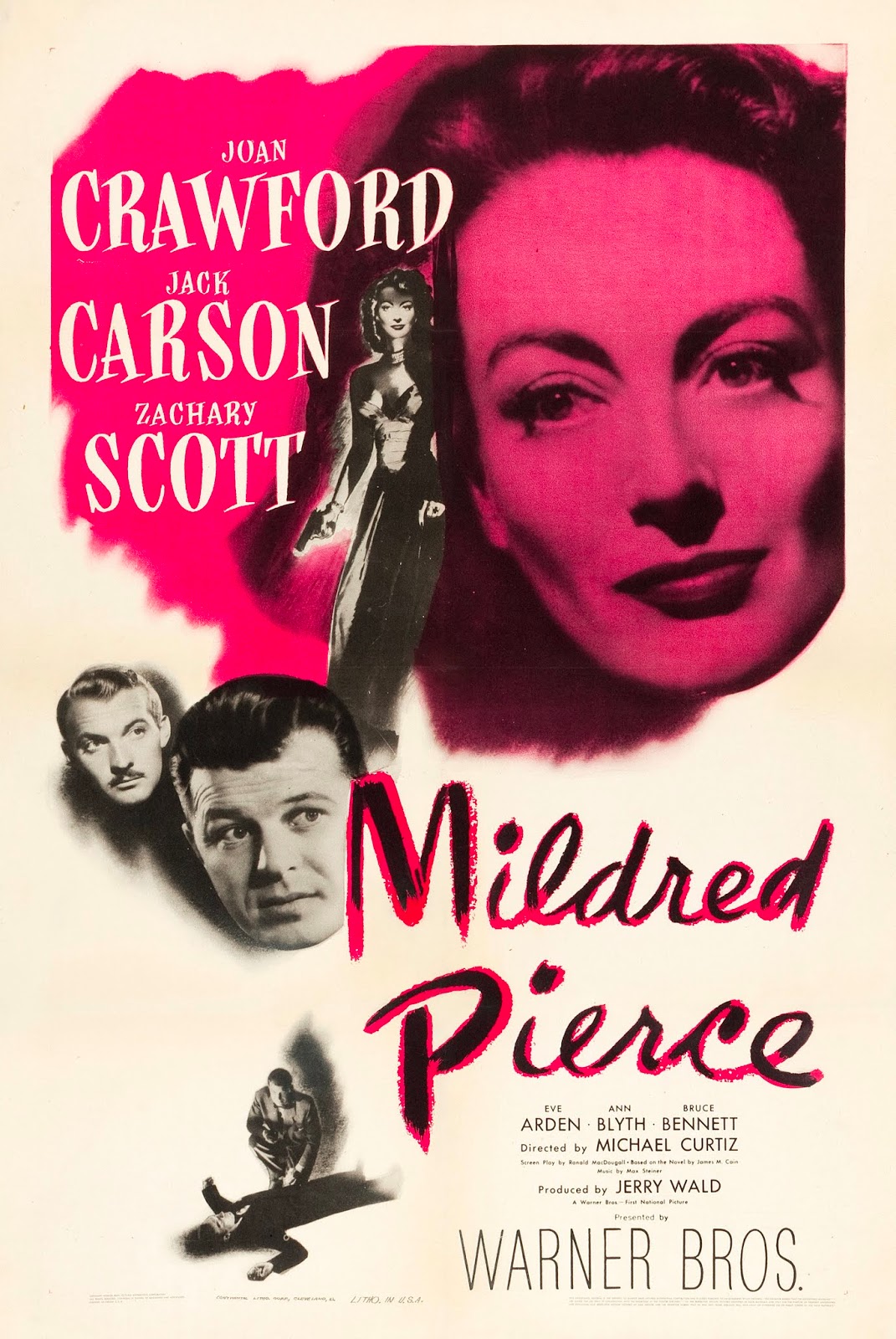
Mildred Pierce (1945)

Joan Crawford sacrifices everything for a daughter who doesn’t deserve it in Mildred Pierce

Director: Michael Curtiz

Cast: Joan Crawford (Mildred Pierce), Jack Carson (Wally Fay), Zachary Scott (Monte Beragon), Eve Arden (Ida Corwin), Ann Blyth (Veda Pierce), Bruce Bennett (Bert Pierce), Butterfly McQueen (Lottie), Lee Patrick (Mrs Maggie Biederhoff), Moroni Olsen (Inspector Peterson)

There are few things that classic Hollywood did quite as well as a melodrama. Adapted loosely from a James M Cain novel – its murder plot line is a flourish solely for the screen – this is a triumphantly entertaining picture that mixes themes of sex and class with good old-fashioned family drama. It’s got psychology and it’s also got the high-concept family feuding around the building of a restaurant business that you could find in Dynasty. Put simply, Mildred Pierce is a prime slice of entertainment.

After her second husband Monte (Zachary Scott) is shot dead, Mildred Pierce (Joan Crawford) is brought in by the police for questioning. After the collapse of her first marriage to Bert (Bruce Bennett), Mildred has expanded her home-baking business into a full restaurant chain, with the support of Bert’s old business partner Wally Fay (Jack Carson). Mildred’s goal is to provide for all the needs of her eldest child Veda (Ann Blyth), a selfish snob who despises her mother for having to work for a living. The tensions between self-sacrificing mother and demanding, unloving daughter, lead Mildred to take a series of disastrous personal and business decisions, culminating in her wastrel, upper-class, Veda-approved, second husband Monte going down in a hail of bullets. But who pulled the trigger?

The murder mystery plotline adds effective spice to this very well directed (Michael Curtiz is at the top of his game) melodrama. Full of domestic thrills and spills, it races along like a combination page-turner and soap, perfectly matching a deeply sympathetic, self-sacrificing heroine with a host of deeply unsympathetic wasters, chancers and bullies. It’s capped by giving our heroine possibly the least sympathetic child in film history, the deliberately selfish and greedy Veda. 

Sure you could argue that its psychology is either pretty lightly developed, or thrown in only for effect. It’s never clear when or why exactly Veda and Mildred’s relationship went south so completely, or where Veda’s deep resentment and ideas above her station come from. It also avoids looking at how Mildred’s complete devotion has probably completely spoiled a child who clearly needed to be told “no” a lot more, a lot sooner. But it doesn’t really matter as the film follows the logic of an event-filled plot-boiler, throwing revelations and cliff-hangers at you left, right and centre.

In the lead, Joan Crawford took on a role that many had turned down before her – stars at the time were not keen to be seen playing roles that suggested they were old enough to have mothered children as old as Ann Blyth. The decision to push for the role paid off as she netted an Oscar and it’s the finest performance of her career. A somewhat haughty actress, Crawford here demonstrates depths of vulnerability and tenderness as a much-put upon woman who, despite everything, will stop at nothing to give her daughter what she wants. Crawford dominates the film, her air of self-sacrifice never once tipping over into self-pity, even as the character so desperately seeks for the sort of love and affection that is denied her from those around her. 

Around her most of the cast – with the exception of Eve Arden’s entertaining, wise-cracking best friend (Oscar nominated) – are basically a bunch of sharks. None sharper than Ann Blyth’s (also Oscar nominated) sweet-faced but dead-inside daughter. Rarely has a display of more naked grasping, snobbish disdain ever been captured on film, matched with unapologetic greed. Veda has no compunction about the moral consequences of her actions and, like Zachary Taylor’s archly lazy Monte, is as interested in spending Mildred’s money as she is contemptuous of its source. 

Curtiz’s film constantly however plays with our judgements and expectations of people. Veda has more than her share of moments of pain and vulnerability as she shares some of the more painful travails of her mother. Similarly, Wally Fay (very well played by a roguish Jack Carson) oscillates between being a trusted confidante of Mildred, and a lascivious greedy creep. First husband Bert (a somewhat dry Bruce Bennett) starts as a love rat but may have more decency about him than anyone else (except Mildred).

The film is wonderfully shot in luscious black-and-white by Ernest Haller, in a dynamic noirish style. Water reflections lap across ceilings. Smoke from fires and cigarettes rises up and seems to dance and swirl in the light. There are some beautiful shots of faces – the camera work in particular perfectly locates a vulnerability in Crawford’s superior features – and there is a beautiful shot late on when two people caught in an illicit kiss roll their heads back from the shadows to emerge into the light. The entire design of the film is spot-on, and it looks and sounds fabulous today.

Mildred’s struggles make this a brilliant example of the stereotypical “women’s picture”, a tale of a woman struggling against all the odds to make her way in the world, with the twist that the daughter she is straining to support is a monster and the men she chases are feckless wasters. Mildred makes chronically terrible decisions throughout but for the best of motives – and part of the film’s appeal is that you are so invested in her fundamental decency you are willing her not to make the same mistakes again and again.

Curtiz’s melodrama is brilliantly enjoyable and never lets up. It’s also a feminist icon of a sort – Mildred is never punished for having a career, indeed she’s celebrated for it (and is far more savvy about it than nearly all the men). She leaves her husband, runs her own household, pushes for her own divorce all while protecting and providing for her child (not her fault the child ain’t worth it). Mildred Pierce is ahead of its time, and still a fabulously entertaining film.