
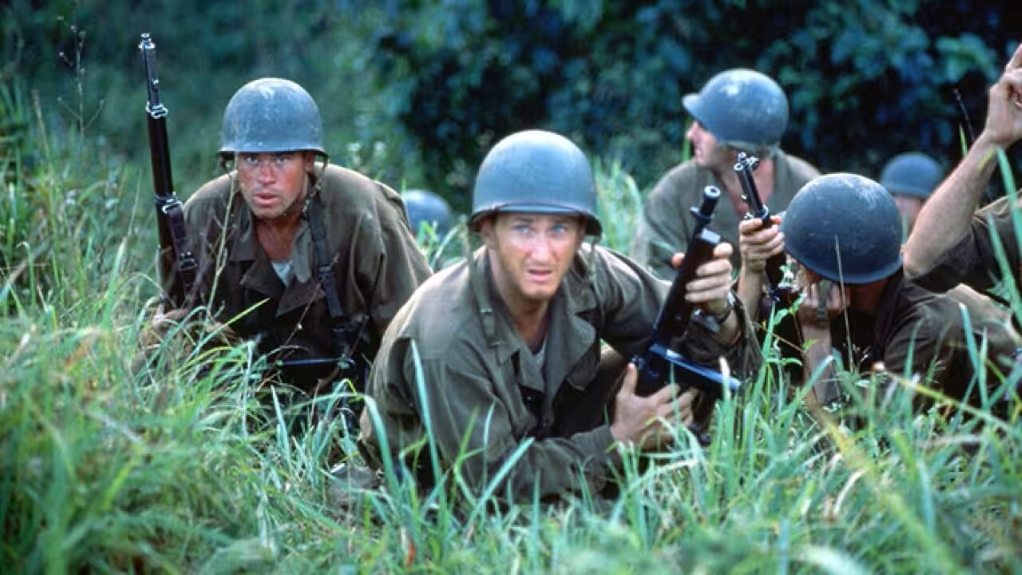
Malick’s return from self-exposed exile is, for better or worse, a war film unlike any other
Director: Terrence Malick
Cast: Sean Penn (Sgt Edward Walsh), Adrien Brody (Cpl Geoffrey Fife), Jim Caviezel (Pvt Robert Witt), Ben Chaplin (Pvt Jack Bell), George Clooney (Captain Bosche), John Cusack (Capt John Gaff), Woody Harrelson (Sgt Keck), Elias Koteas (Capt James Staros), Jared Leto (Lt Whyte), Dash Mihok (Pfc Don Doll), Tim Blake Nelson (Pvt Tillis), Nick Nolte (Lt Col Gordon Tall), John C Reilly (Sgt Maynard Storm), Larry Romano (Pvt Mazzi), John Savage (Sgt McCron), John Travolta (Brig Gen Quintard)
There are war movies. And then there are Terrence Malick war movies. With The Thin Red Line Malick returned from a self-imposed twenty-year exile, during which his mystique had grown to mythical status. His return screened the same year Spielberg was widely credited as re-inventing the entire genre with Saving Private Ryan. But, while that was a visceral gut punch, The Thin Red Line makes its men-on-a-mission approach seem conventional. Malick’s film is a poem, musing on man’s place in nature, humanity, spirituality, good and evil – in fact anything except Dirty Dozen style shenanigans.
Set on the US invasion of Guadalcanal, it follows the men of a single company as they march and fight their way across the island, principally focusing its ‘plot’ on a two-day mission to capture a non-descript hill from a largely unseen enemy. In the smorgasbord of characters, Malick’s roving eye lights on a few key figures: the spiritually-minded, independent Witt (Jim Caviezel); Bell (Ben Chaplin) who day-dreams about the wife he left at home; Doll (Dash Mihok) a terrified blow-hard; stoic professional Sgt Welsh (Sean Penn) who holds the company together; feuding commanders, humanitarian Captain Staros (Elias Koteas) and ambitious Colonel Tall (Nick Nolte).
But these characters are merely a jumping off point for a film that ruminates with sometime self-indulgent luxury, and bravely dares to suggest the ‘good war’ of World War II was a pointless, inhuman brawl that served little real purpose. Few war films start with peaceful shots of nature at work, featuring a crocodile drifting lazily through the waters (the same croc is later captured by the soldiers – no escape for nature from the war), lingering shots of birds and wildlife and one of its principal characters (Caviezel’s Witt), AWOL and paddling gently across a river, among an indigenous tribe.
The Thin Red Line draws a tender portrait of these indigenous people – whose calmly life is corrupted by conflict, not in terms of destruction but how the violence of war seeps into their culture. When Witt returns later, on leave after sterling front-line service, he finds these people clashing as never before, mirroring the brutal anger of the war he has left. In the film’s frequent, mumbling, ruminative voiceover, characters ask again and again where violence comes from – does it come from the same place as goodness? If you plug into this sort of thing – and some won’t – it can have a hypnotic power.
What makes The Thin Red Line unique among war films is that its real heart is in the poetry, full of deep, open-ended questions which are either unanswerable or mystifyingly oblique. It stretches as few others do for deeper spiritual answers. Malick adapted the film from a conventional war novel, by James Jones – but during the editing he jettisoned much of its plot (much to the shock of Adrien Brody, playing the novel’s lead character but reduced to a few lines) and leaned into the mystical, spiritual questions he was asking. Malick spotted earlier than any others the messianic, martyr qualities in Jim Caviezel, who is excellent as a rebelliously minded but deeply sensitive and spiritual man who senses instinctively his bond with the world around him.
The Thin Red Line touches throughout on the possibility of some benign – or otherwise – force that runs throughout existence and ties us all together. Malick frequently finds small moments where the soldiers become fascinated and irresistibly drawn towards nature, running their hands over leaves, admiring the waves, watching a bird dance from branch to branch… What, The Thin Red Line wonders, makes us turn from being part of a symbiotic whole, to shooting lumps out of each other? And for what? All for ‘fuckin’ property’ as Welch grouches?
As such it’s fitting the combat almost exclusively revolves a scuffle for Hill 210, a grassy pile that Malick never considers important enough to place in context or give us a clear view of. We are frequently mystified about how far up this lump of earth the soldiers have made, what is on the other side, or how it’s conquest will affect the war effort. Instead, this beautiful countryside surrounding – and Malick doesn’t stint on showing how gorgeous Guadalcanal is – serves to flag up even more the violence happening in it. The stunningly luscious photography by John Toll, becomes almost part of the point, hammering home the vicious inhumanity war brings into the natural world.
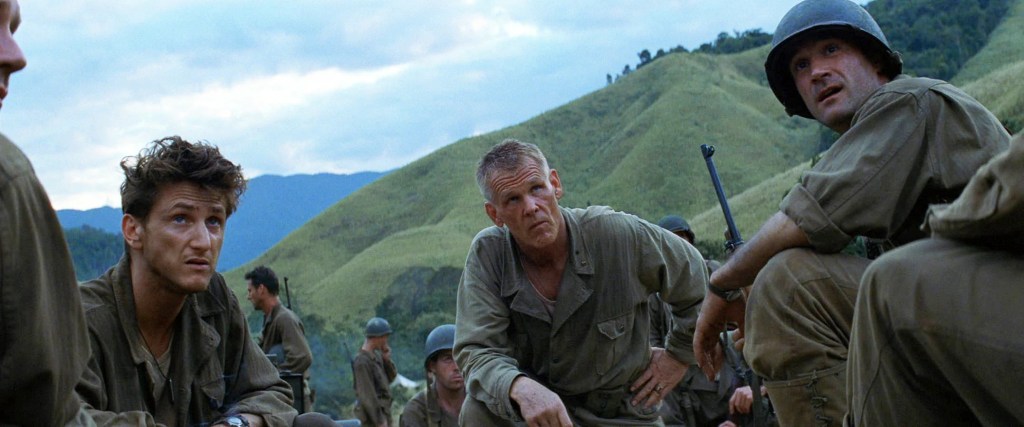
Instead, war focuses on brutal and trivial ends, that so often betray us into death. The hill’s main importance for Colonel Toll – a charismatically fierce performance of frustrated bitterness by Nick Nolte – is as a pathway to career advancement in a war he has waited his whole life for. Just as its essential pointlessness – it can be bypassed and taken in a slower flanking approach – means Koteas’ (a wonderfully measured performance) captain is unwilling to order his men into a suicidal attack. The phone clash between these two – a furious Nolte and a pressured Koteas trying to remain calm – is Malick’s most accessible narrative beat, expertly delivered.
In fact, the action and the epic sweep of the combat is a reminder that Malick may long to be a poet but he is also an astute and gifted narrative storyteller (when he chooses to be). For all the excitement of John Cusack’s Captain Gaff leading a charge up the hill, the film’s heart is the strange balance every character walks between the martial and mystical, between the call of nature and the grinding duty of killing. Qualities that can be seen fighting in Sean Penn’s fiercely professional sergeant who can weep at the tragedies around him, and fiercely attack the shallowness of the war they are wrapped up in. In fact, much of Thin Red Line feels like a Malick Art Project, a sort of rarefied air that you need to prep to make an expedition towards.
Of course, with all this to admire, it’s also hard not to deny that The Thin Red Line can also be long (and feel very long) and that it’s air of self-importance does, at times, wear the viewer down. It’s deliberately obscure and oblique narrative – not to mention that its voiceover is frequently rather hard to match to particular characters – can whiff somewhat of overindulgence. You could argue the essential message of the film – we’d all be better off if mankind could accept its place as part of a larger Gaia-like whole – is hardly re-inventing philosophy.
But it’s the undefinable, mystical whimsy of the film that makes it stand out – for good or ill. Since many – and, I’ll be honest, me as well sometimes – will find the films muttered whimsy carrying more than an air of self-important pontificating. Despite this, you can see why so many Hollywood stars were desperate to work on it – Travolta and Clooney have tiny cameos, several others hit the cutting room floor. It’s hard to imagine anyone else in Hollywood making a war film anything like this, to have the artistry to mix gunshots and birdsong and give equal weight to both. There are few films quite like it. So thank God for Malick, an artist who has a distinctive voice, the courage to commit to it and the skill to pull it off. The Thin Red Line has moments that few other Hollywood film makers have matched in their whole career – and that alone makes it a film to hold tight and cherish.


