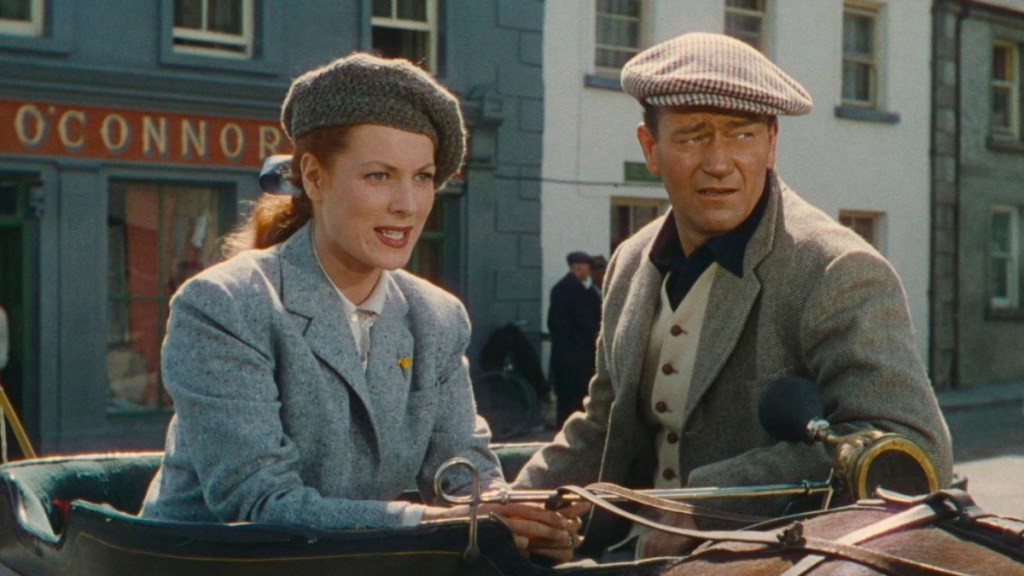
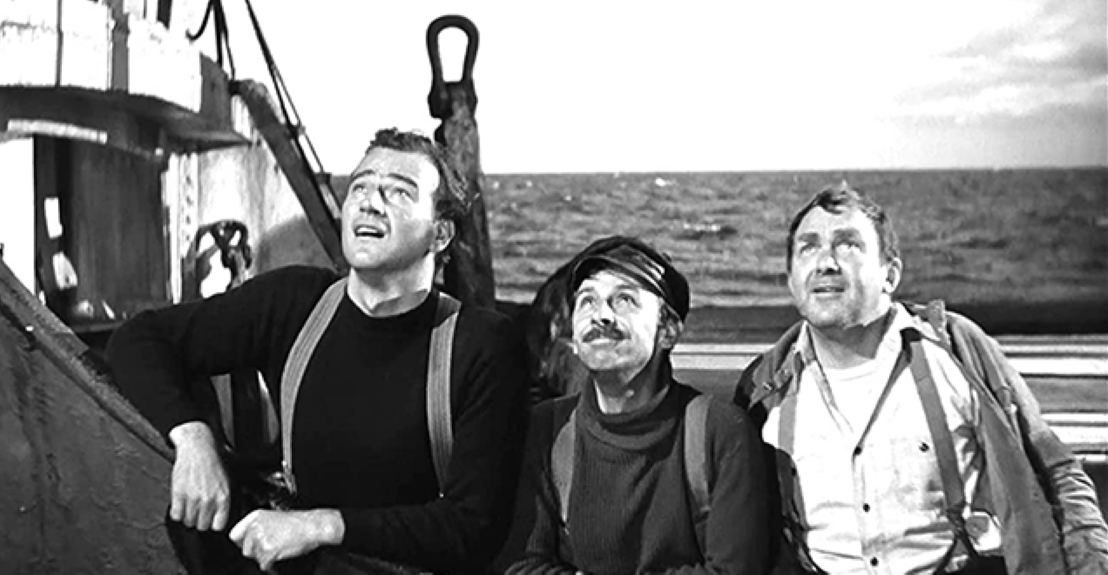
Tag: Arthur Shields

The Long Voyage Home (1940)

The Long Voyage Home (1940)

Ford’s stylistic triumph is weak on narrative but strong on expressionist visual beauty

Director: John Ford

Cast: John Wayne (Olsen), Thomas Mitchell (Driscoll), Ian Hunter (Smitty), Barry Fitzgerald (Cocky Stuart), Wilfrid Lawson (Captain), John Qualen (Axel Swanson), Mildred Natwick (Freda), Ward Bond (Yank), Arthur Shields (Donkeyman), Joseph Sawyer (Davis), J.M. Kerrigan (Crimp)
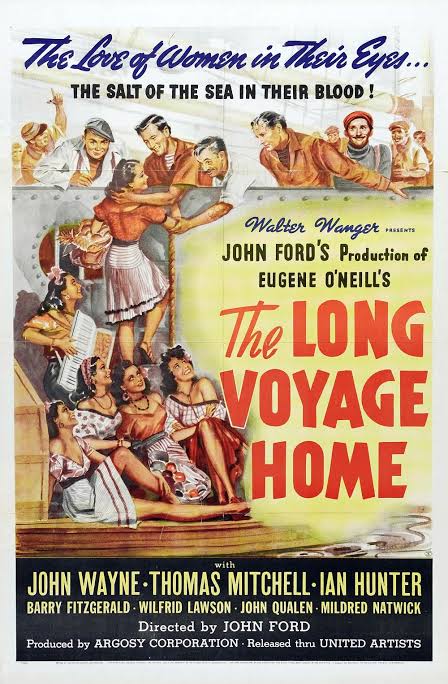
John Ford is most associated with the grand vistas of the West. But ask him what film he really admired, and he was likely to answer FW Murnau’s Sunrise. The atmospheric beauty of the only ever winner of the Oscar for Unique and Artistic Picture inspired Ford to make this adaptation of four one-act Eugene O’Neill plays. The look and feel was so important to Ford, he even willingly shared his title card with photographic maestro Gregg Toland. The Long Voyage Home is not always a film of outstanding narrative, but it can claim to be possibly the most visually striking film Ford ever made.

The story focuses on the crew of the British merchant ship Glencairn, making its way from the West Indies back to England during the Second World War. Captained by a distant skipper (Wilfrid Lawson), the moral leader of the mostly Irish crew is boisterous, good-natured Driscoll (Thomas Mitchell). His shipmates include genial young Swede Ole Olsen (John Wayne), brooding, suspicious Englishman Smitty (Ian Hunter), trouble-maker Cocky (Barry Fitzgerald), burly bruiser Yank (Ward Bond) and timid Swede Axel (John Qualen). During the voyage, tragedy will occur, suspicion of treachery will fall on Smitty and Olsen will struggle to return to his family after ten years away.

The Long Voyage Home mashes the plots of these four O’Neill play into one loose narrative (and it is very loose), where you can almost see the joins as we progress from one play to another. But O’Neill loved the end result – he claimed to have watched his print of the film so often it wore out. Essentially, every twenty-five minutes or so, a new crisis or plot point kicks off and runs its course towards a (usually) tragic ending, all of which serves as a neat reminder that serving at sea is a tough life with more than a few perils, made even worse when you do it during war time.

But The Long Voyage Home is really an impressionistic Murnau film populated by the sort of amiable, good-natured, hard-drinking, quick-to-fight-quick-to-laugh Irishmen Ford loved. It’s a sort of Quiet Man Goes to Sea (a double gag now, since Wayne is the quietest man in it), with Thomas Mitchell’s larger-than-life mix of sentimental affection and roaring, fist-throwing joi d-vivre driving the narrative. It’s Driscoll who smuggles on Caribbean lovelies and alcohol for the crew before departing the West Indies, leads the way in any fights, but also comforts the dying and casts a fatherly arm over those in need. He’s the heart in Ford’s experiment in pushing the stylistic envelope.

It’s a very successful pushing, because The Long Voyage Home looks fabulous. This is possibly some of the finest photographic work Gregg Toland ever did – on the basis of this, Welles decided Toland was the man for Citizen Kane. From its opening, Long Voyage Home is a sumptuous collection of moody, fog-filled shots, where streaks of light cast powerful shadows over multiple scenes. Toland opens with a deep focus shot of the ship at sea, with West Indian women foregrounded from the opening and moves from there to mist being sliced through by searchlight torches to reveal the ship.
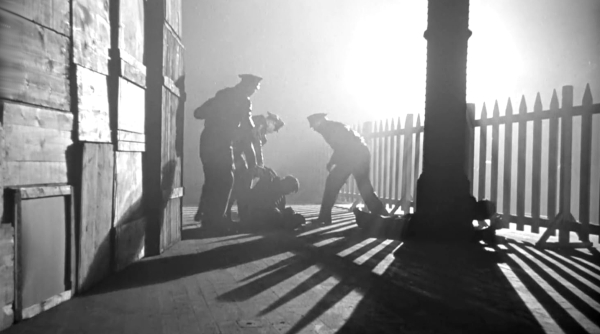
It’s a stylistic benchmark the film maintains throughout. Only Ford and Toland may have been brave enough to use light and shadow so strikingly. Some scenes are even lit facing into a strong light, casting long shadows towards the camera from which characters emerge. The ship is shot from unique and imaginative angles, most strikingly a low angle lens that Ward Bond’s luckless Yank is washed towards like a mannequin. The sort of striking visual imagery from The Informer is pushed even further. A character dies in a row boat, suddenly peppered by a Luftwaffe machine gun, his leg hanging over the side. The English port sees light dance off the cobble-stones and dingy pubs turned into places of shadow-filled beauty. A final punch-up is partly shot through dropped torches and lit matches. It’s a visual masterpiece.

The fact it’s not more highly regarded in Ford’s cannon is possibly because the episodic story is not always the most compelling, largely because it lacks a true through-line as it moves from event-to-event. But, in many ways, the way it plays a bit fast and loose with O’Neill is to its credit. No slavish, stagey reprise here (unlike, say, Ford’s less successful Mister Roberts). But it does make it a film that’s easy to drop in and out of, and one hard to summarise other than “(mostly) Irish sailors shoot the breeze on a ship”. Many of these chapters are striking, but it’s a film lacking narrative force.

What it’s straining towards is the idea that these men – all of whom are almost like big kids on a day trip – are deeply in love with the freedom of the sea, while also feeling trapped in its embrace. And that, perhaps, with the tendency to drink and fight at the drop of a hat, makes them their own worst enemies. Nearly every crisis in the film comes out of one or other of these demons. I suspect the idea doesn’t crystalise because Ford can’t shake his affectionate regard for exactly those qualities. (It’s also an unremarked irony that for nearly all these guys, this is not a ‘voyage home’ at all).

It’s also perhaps overlooked because people can’t wrap their head around the on-paper bizarre casting of John Wayne. The Duke, surely, was literally no one’s idea of a Swede. It’s a reminder of what a star Wayne was that your eye is so constantly drawn to him, considering how little he does for most of the film. He makes a noble attempt at an accent, but it must have been even worse than what we end up with considering Ole barely speaks for almost an hour and twenty minutes. Ford, who wasn’t that convinced by Wayne’s acting at the best of times, clearly cut some losses here.

The Long Voyage Home is at its best when it focuses on the visuals, and when it falls back on the natural charisma and easy-bond between its character actor stars, in particular Mitchell and Fitzgerald (Mildred Natwick also gives a fine performance as a guilt-ridden good-time girl). The atmospheric, brooding intensity is outstanding and, perhaps more than any other Ford film, it has shots you could hang in a gallery. It’s a lovely reminder of what an artist, the hard-drinking tough-guy really was.
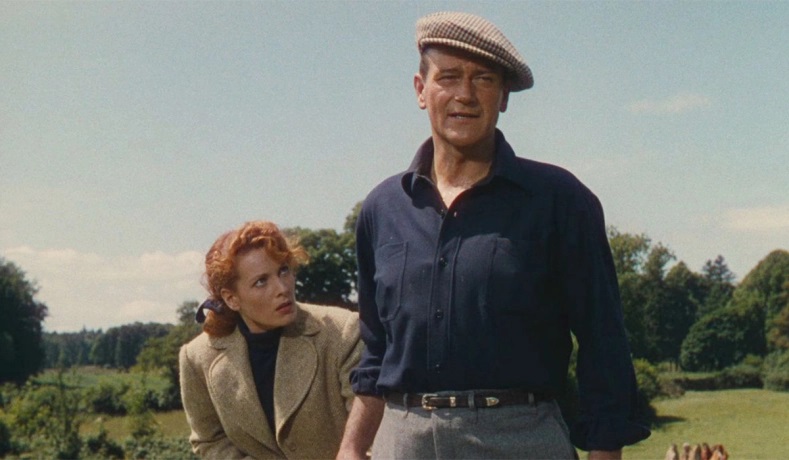
The Quiet Man (1952)

The Quiet Man (1952)

Ford’s sweet and funny Irish fable is possibly his most purely enjoyable film

Director: John Ford

Cast: John Wayne (Sean Thornton), Maureen O’Hara (Mary Kate Danaher), Barry Fitzgerald (Michaleen Oge Flyyn), Ward Bond (Father Peter Lonergan), Victor McLaglen (Squire Will Danaher), Mildred Natwick (The Widow Sarah Tillane), Francis Ford (Dan Tobin), Eileen Crowe (Mrs Elizabeth Playfair), Arthur Shields (Reverend Cyril Playfair), Charles B Fitzsimmons (Hugh Forbes), James O’Hara (Father Paul), Jack MacGowran (Ignatius Feeney), Sean McClory (Owen Glynn)

John Ford wasn’t born in Ireland, but he loved the place in the way only the child of ex-pats could. The Quiet Man is a loving, romantic, almost fairy-tale view of Ireland, an affectionate feelgood fantasy that transcends any possibility of patronising its subject through its warmth and charm. It’s an unashamedly feel-good film, a delightful fable full of luscious scenery and tenderly sketched characters that plays out like a warm end-of-term treat where we are all invited to the party. It’s possibly Ford’s most purely enjoyable and heart-warming film.

Set in 1920s Ireland, Sean Thornton (John Wayne) returns to his childhood home of Inisfree after growing up and becoming a boxer in Pittsburgh. Sean loves his home country, but with his American upbringing is out-of-step with the customs and traditions of Ireland – something that becomes very clear when he falls in love with Mary Kate (Maureen O’Hara), sister of local squire Will Danaher (Victor McLaglen). Their rules-bound courtship – overseen by matchmaker Michaleen Oge Flynn (Barry Fitzgerald) – eventually leads to marriage, but via tricking Will, who withholds Mary Kate’s dowry, the sign of her independence. Mary Kate wants Sean to fight for it – but the former boxer is haunted by the accidental killing of an opponent in the ring and wants to live-and-let-live. Problem is everyone, from Mary Kate down, sees that as cowardice.

Ford was desperate to make The Quiet Man, the rights for which he had paid $10 for in 1933 when the short story was published by Maurice Walsh (Ford ensured Walsh received another $5k when the film was finally made). B-movie studio Republic Pictures was the only one willing to take a punt on it. But, alarmed by Ford’s insistence to shoot in colour and (even more expensively!) on location, they were convinced they had a box office bomb on their hands. They insisted Ford and his cast made a western first – the literally for-the-money Rio Grande – to cover the expected losses. They even demanded Ford couldn’t make it longer than 2 hours. Ford screened the final 2 hours and 9 minutes cut to them, stopping the film on exactly the two hour mark and asking them what they’d cut. They released the film unchanged. The film was an Oscar-nominated smash-hit.

It’s not a surprise why, because the film is a whimsical delight. Ford isn’t often remembered for his sense of fun, but The Quiet Man is unarguably funny. It’s crammed with sight gags – from sly double takes (there is a delightful one from the railway station workers, who watch first a determined Sean then a horse walk straight past them), to Sean and Will grimacing in pain but smiling as they exchange a brutal handshake, to Mary Kate jumping over obstacles as Sean drags her back to the village to have it out with her brother. It famously ends with an extended comic set-piece as Sean and Will launch a mano-a-mano “Queensbury Rules” fistfight that takes most of a day, moves across the whole village, and is interrupted only by a break for a pint.

All of this takes place in an Ireland that, while it never feels entirely real, is drawn with such loving affection and cast with such careful exactitude that it hardly matters. Ford’s insistence on shooting all the exteriors on location paid off in spades. The country has never looked more ravishing than through Winton C Hoch’s technicolour lens. Rolling vistas, gentle brooks, quaint villages, perfect beaches. You totally understand why Sean, on arrival, simply stands on a stone bridge and stares across the valley of Inisfree, lost in memories and his emotions.

Sure, it’s a romantic vision. And 1920s Ireland wasn’t the sort of haven depicted here, where Catholic and Protestant lived in perfect harmony, politics never reared its head and the local IRA man is a jolly joker in the pub. If The Quiet Man had not been so well-meaning, you can imagine people taking offence at a picture of the country full of roguish charm, horse-drawn carriages, drinking and fighting. (You could say The Quiet Man shaped many Americans’ perceptions of what the country is like.) But Ford never makes any of this a subject of humour. In fact, it’s a subject of love. The joke is never on the Irish. Inisfree is in fact a haven of community spirit, a supportive village where its people are wise, caring and decent, tradition is respected and what people say and do matters.

It’s why so many are shocked by Sean’s seeming cowardice at not raising his fists earlier. That’s not what “men” do. John Wayne is very effective as the easy-going Sean, a guy who just wants to settle down to marriage. It’s a decent playing-against-type by Wayne, that balances his quiet sense of dignity with the sort of manly determination we know will eventually come through. It’s easy to see why he and Mary Kate fall in love. Also, why she is both swept up in his masculinity and also enraged that he doesn’t behave enough like a man, by refusing to take a stand to defend her honour and secure that dowry that will make her a true wife.

O’Hara is marvellous in a challenging role as Mary Kate. This is a feisty and determined woman, who knows what she wants but denies to herself what that is. She and Wayne share a striking, windswept early kiss – her mood in it going form surprise, to fascination, to irritation, to surrendering to her own desires. While you could suggest the film’s comic set-piece of Sean dragging her (sometimes literally) back to the village so she can watch him fight her brother the way she’s demanded from the start feels uncomfortable today, but it’s also Sean not only delivering what she has wanted him to do from the start, but also strangely the thing that finally bonds them together.

A bond is what they have, both of them straining against the confines of the courtship rules of Ireland. Together they flee the chaperoned carriage ride Michaeleen (a delighful Barry Fitzgerald) takes them on to ride a tandem through the streets. Mary Kate constantly, bashfully, tries to go after what she wants – and a large part of that is the lurking “bad boy” tendency that she detects under the surface of the quiet Sean. Something her less-bright brother Will can’t see.

Victor McLaglen (Oscar-nominated) swaggers, slurs and puffs himself up as this rough-and-tough, punch-first-think-later bruiser, who constantly thinks he’s being cheated. He and Wayne throw themselves into the long dust-up that ends the film with the same comic energy and enthusiasm they did exchanging handshakes. Part of The Quiet Man’s success comes from the comfort and familiarity the cast felt for each other. The trip to Ireland was like a friends-and-family holiday: old mates like Ward Bond, Ford’s brother, O’Hara’s brother, Wayne’s children – they all round out the cast. It helps build even more the family and community feeling that makes the film a delight.

Above all, The Quiet Man leaves you with a smile on your face. With expertly filmed set-pieces – a horse race, Sean and Mary Kate’s long walk back to Inisfree and the epic punch-up – combined with luscious shooting (also done with wit – a sexually frustrated Sean pounds through the countryside, tossing heavily puffed cigarettes aside, after Mary Kate withdraws favours) – it’s also fast-paced, witty and warm. The cast even effectively take bows as Ward Bond’s (his finest hour) priest delivers a final voiceover. Full of affection and charm, it’s a delight and is perhaps the only foreign “Irish” film that has been embraced by the Irish.