
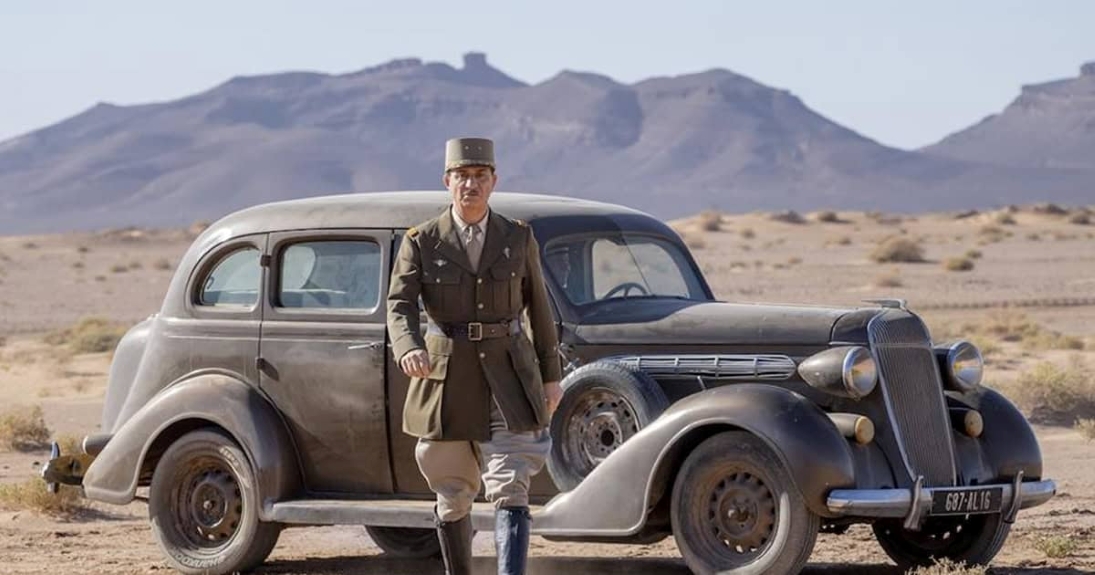
Old fashioned but energetic and engaging WW2 biopic with a fabulous central performance
Cast: Antonin Baudry
Cast: Simon Abkarian (Charles de Gaulle), Niels Schneider (Philippe Leclerc), Thierry Lhermitte (Henri Giraud), Karim Leklou (Blazej), Simon Russell Beale (Winston Churchill), Campbell Scott (Franklin D Roosevelt), Matthieu Kassovitz (Admiral Darlan), Benoît Magimel (Marie-Pierre Koenig), Félix Kysyl (Jean Moulin), Loïc Corbery (René Pleven), Florian Lesiuer (Fernand), Anamaria Vartolomei (Livia), Pip Torrens (General Montgomery), Daniel Betts (Dwight D Eisenhower), Tom Mison (Anthony Eden), Stephen Campbell Moore (Harold Macmillan), Anthony Calf (Anthony Spears)
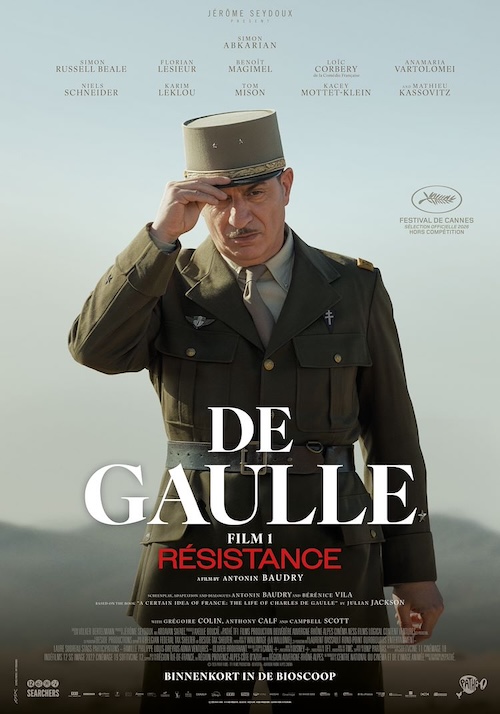
In 1940 France was in ruins. Crushed in weeks by the Nazi war machine, occupied and run by a collaborating government, its army defeated, morale crushed and future open to question. Should the ragged remains of its army fight on or not? The overwhelming consensus seemed to be no. Hundreds of commanders, willingly or not, aligned with Marshal Petain’s Vichy government, on paper the only thing with a claim to being the legal government. It was not a view shared by Charles de Gaulle (Simon Abkarian), newly minted as a French General and determined, against all logic, to carry on fighting.
By doing so, he became a national hero. But that was very, very far from being a foregone conclusion. Something that comes out loud and clear in Antonin Baudry’s reassuringly old-fashioned slice of military biography, handsomely filmed on an epic canvas. De Gaulle doesn’t shirk at all in showing how frequently De Gaulle’s building of the Free French and gaining recognition as a legitimate ally was a Don Quixote like quest. De Gaulle is even given a Sancho Pansa: Blazej a Polish plumber recruited as loyal aide (an invented character, designed to subvert a negative French stereotype). It perhaps could only have been achieved by someone as relentlessly focused, committed, uncompromising and shrewdly cunning like Le General. Truly right-man-right-place.
Across its two parts (and over five hours) De Gaulle mixes an atmospheric look at the back-room struggles for power in the Free French – the anti-Petain French forces being rive with conflicting agendas and awash with Johnny-come-latelies and Nazi-sympathisers who smell the way the wind is blowing – with well-shot and edited WW2 battle sequences. The latter have the added advantage of being less well-known (outside France) battles: Bir Hakeim (1942) and Ksar Ghilane (1943). Both showpiece heroic against-all-odds stands by the French against overwhelming German forces. They both also serve as a clear indication of the extreme lengths the Free French had to go to both their worth. Near suicidal acts of courage, with a heavy cost, essential to establish their moral and political force.
De Gaulle himself is absent from the battlefield, but very much engaged in a long-running struggle to build a Free French movement. From arriving in England, he meets obstinacy and defeatism. De Gaulle is very good at showing how this organisation is slowly and painfully built, almost a recruit at a time. The very qualities that will make De Gaulle such a powerful figure later – stubbornness, bluntness and unbending determination – frequently put-off supporters (there is a great expectation-defying scene where De Gaulle gives a hilariously blunt recruitment speech to captured French naval men, who respond by almost to a man refusing). Most of Part 1 covers the incremental steps of turning the Free French from a room of believers, to an actual military force that’s part military movie, part caper (with De Gaulle and co smuggled over African borders). So well does the film stress the difficulty, that each step forward is enormously satisfying.
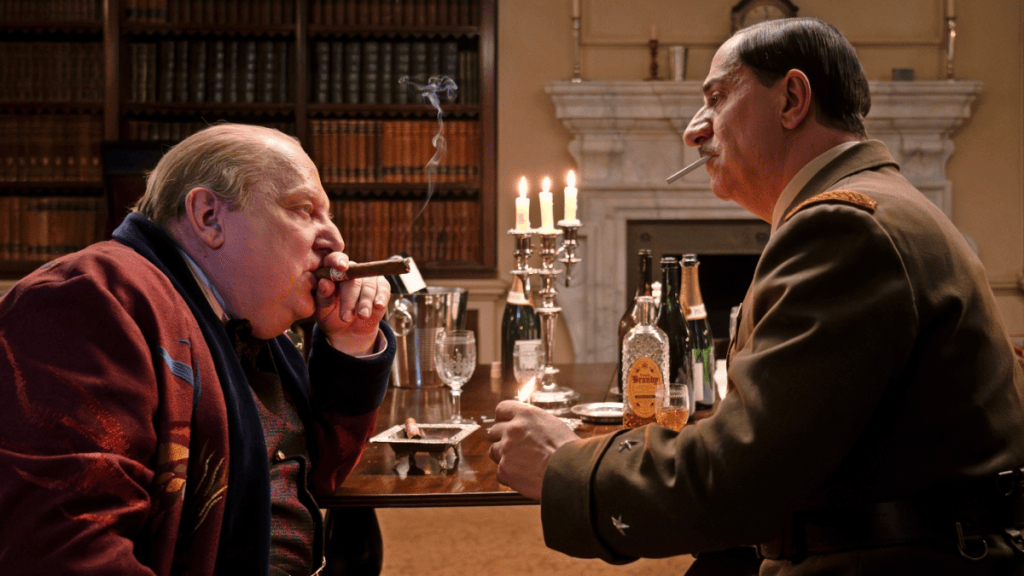
De Gaulle suggests the main advantage its subject had was Winston Churchill recognising the prickly maverick as a kindred spirit. De Gaulle’s main relationship – awash with arguments as it is – is the love-hate bromance between De Gaulle and the British leader. Francophile Churchill – talking in an easy if stilted French – sees a lot to respect in another leader taking a stand when all seems lost. Excellently played by Simon Russell Beale, Churchill is a mass of realpolitik and teary sentimentality, backing De Gaulle when no-one else will, then frequently demanding he be cut lose in favour of a more pliant leader. But De Gaulle returns time and again to the sentimental affection and respect between the two, for all their vast differences.
You can’t say the same for De Gaulle and Roosevelt. Interestingly, if De Gaulle has a villain its the US President. Sure, the Germans are enemies on the battlefield – and brutal occupiers and torturers in Occupied France – but they are mostly anonymous or glimpsed only through dust-filled binoculars on battlefields. It’s the De Gaulle-loathing Roosevelt, played with self-satisfied superiority by Campbell Scott, who becomes the face of every obstacle in the way of a Free France, depicted as planning to turn the country into a US-occupied colony (a real plan, that never advanced as far as it is shown here).
Roosevelt backs a wave of alternative leaders, from collaborationist Admiral Darlan (Matthieu Kassovitz, suitably arrogant and two-faced) to the deferential General Giraud (Thierry Lhermitte, brilliantly using bluffness to hide how out of his depth he is). He excludes De Gaulle from decisions and refuses to work with him. De Gaulle is keen to show other Americans – noticeably Eisenhower – unhappy with this. But it’s a sign of current Euro-US relations that De Gaulle presents the Americans more as obstacles than crucial allies. (De Gaulle also shows many of the Free French’s most effective soldiers are Africans from their colonies – all of them, to a man, banned from D-Day thanks to American segregationist policies).
De Gaulle runs a parallel storyline of the growth of resistance movements in France. It does this with surprising nimbleness, seeing the development through the eyes of two young idealists: Fernand (Florain Lesier) and the Jewish Livia (Anamaria Vartolomei). At first, both these characters feel like representative figures – it’s one of Part 1’s neatest tricks to reveal Fernand is in fact very much real with a crucial role to play in world events. Livia, very well played by Vartolomei, represents a host of brave women caught up in the tensions and terrors of the resistance. The resistance itself, like the rest of the Free French, is a hard-won battle to form, fought by Félix Kysyl’s Jean Moulin (a very much real hero of the French resistance) – like De Gaulle a stoic but determined man, willing to take risks to save France’s honour. These sequences – from early student protests met with hard-handed Petain responses to the growth of networks and tense rooftop escapes from the Gestapo – have a palpable tension.
But the heart of De Gaulle is the general himself. It’s lucky the film has landed such a perfect actor for the role. Simon Abkarian not only looks a great deal like this ram-rod military man, but also brilliantly mixes De Gaulle’s utter self-belief and domineering refusal to compromise with small moments of doubt. Abkarian’s fantastic performance has just enough humanity to keep us rooting for him. De Gaulle charts the subtle developments of his political skills – from the imperious man of the start of Part 1 who alienates as many as he wins over, to Part 2 balancing his stubbornness with wily politicking and weaponizing of his unassailable reputation.
One of De Gaulle’s key insights is that the battle for France was as much – if not more – about deciding who would represent the country, as much as it was defeating the occupying forces. If France was led by non-entities or those (like Darlan) tarred by working with Germans, its place on the world-stage post-war would have been a very different one. De Gaulle also understands that presenting unjust against-the-odds battles (both military and political) very quickly leads us to admire and root for the heroes struggling to do the right thing.
It may be, in many ways, an old-fashioned film, carefully laying out events and focused on a grand canvas of the war, rather than recent trends for biographies to focus on single, representative events in detail. There are, as a result, scenes where characters essentially tell each other news to keep the plot going. It’s easy to see spiritual similarities with Patton, another epic biopic of a prickly figure with a messianic complex (although De Gaulle is far less ambiguous about its lead). But De Gaulle tells a story that, certainly outside France, is far fresher and less familiar.
And it manages to make the struggle to win France’s freedom and honour constantly on a knife-edge. Either on the battlefield or in the committee room, the odds never favour De Gaulle. Desperate punts are made, some of which fail spectacularly. Humiliations are frequent. But they make the success sweeter. It’s that – and Abkarian’s excellent recreation of the future French icon – that makes De Gaulle such a satisfying watch. I’d be fascinated in seeing a sequel, covering De Gaulle’s post-war French leadership, (De Gaulle pointedly states at one point he has recognised the UK will always favour the US over Europe, a neat wink at his later political positions). But for now, this is an old-fashioned, grand WW2 epic that tells a less familiar story with a great deal of energy.

