
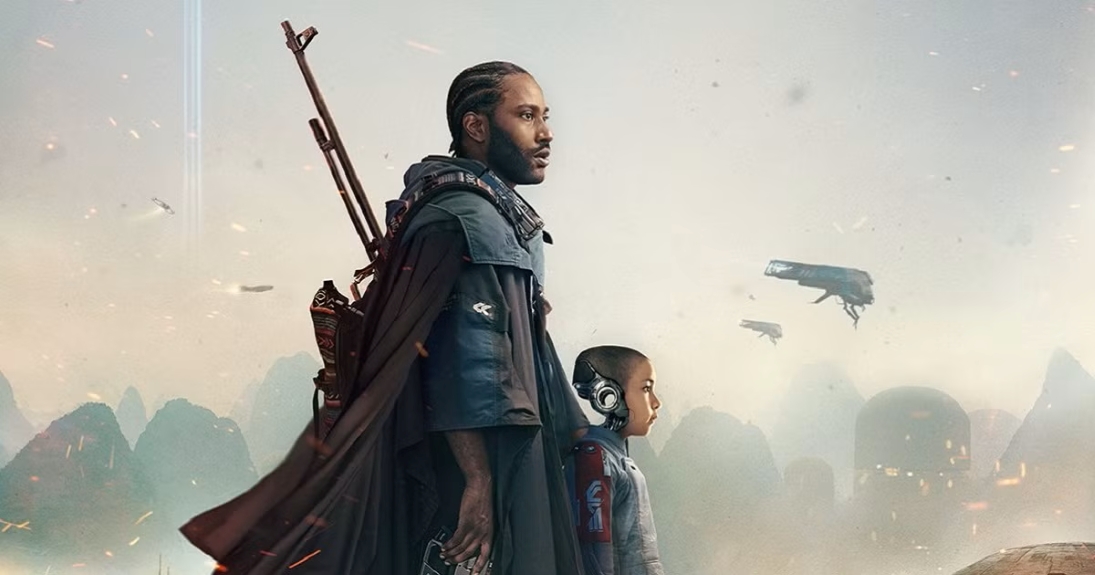
Clumsily plotted, emotionally stunted film perhaps the most AI sympathetic ever made
Director: Gareth Edwards
Cast: John David Washington (Sgt Joshua Taylor), Mardeline Yuna Voyles (Alphie), Gemma Chan (Maya Fey), Allison Janney (Colonel Howell), Ken Watanabe (Harun), Sturgill Simpson (Drew), Amar Chadha-Patel (Omni/Sek-on/Sgt Bui), Marc Menchaca (McBride), Ralph Ineson (General Andrews), Robbie Tann (Shipley)
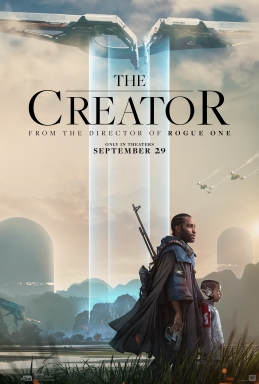
Its 2065 and America is at war with AI, after the detonation of a nuclear warhead in Los Angeles ten years earlier was blamed on AI’s attempt to wipe out mankind. Now AI – in the form of various androids – lives in New Asia with their human allies, under constant threat of deadly nuclear air strikes from NOMAD, the destructive American space station orbiting the planet. Sgt Joshua Taylor (John David Washington) was sent undercover to locate the secretive Nirmata, AI’s genius human architect, but instead fell in love with AI ally Maya (Gemma Chan). She got pregnant and was believed killed in an airstrike after a raid blew Josh’s cover. He spiralled into depression but is called back by the promise of hardline Colonel Howell (Allison Janney) that Maya is alive and well and can be reunited with Joshua if he uses his knowledge to finally locate Nirmata.
The Creator looks great. But is a complete mess. It’s one of those films where you can take a stab at what all the twists are going to be in the first few minutes – and if you’ve seen more than one film, you’ll get nearly all of them right (starter for ten: you got one guess who the mysterious Nirmata might be. If you need a second guess… watch more movies.). The story plods through a number of hugely predictable beats and character developments without giving you anything to remotely really invest in. It presents a world overflowing with inconsistent rules about distances, securities and motivations. It’s almost completely devoid of wit or psychological complexity, and our hero is a surly and not particularly sympathetic obsessive with an angry axe to grind. It’s not good.
But the positives right? The special effects to create the robots are very well done. The androids have whirling metallic holes in their necks – I have no idea why as it seems to be a major weakness – look amazingly realistic. The camera work is often immersive, particularly when it follows the street fights between humans and AI. It does look great.
But almost everything else is a negative. The Creator surely sets some sort of benchmark as the most AI positive film ever made. Its sympathetic viewpoint towards AI, the idea that computers really could be morally superior and make a better fist of building a decent world than us organics, already feels painfully dated today (and I’m writing this only three years after its release!). Would it have killed the film to use the word simulant for the parade of humane, caring and decent robots ruthlessly machined gunned down by the humans, rather than AI? Today you’re more likely to see Hollywood turn out a film sympathetic to sex predators than AI.
So heroically and empathetically are the robots portrayed – living in kumba-ya communities with hordes of Buddhist supporters – and so tattooed, gung-ho and brutally alpha are the humans hunting them (Allison Janney, as their field commander, thinks nothing of executing captured robots with head shots) that we are in no doubts where our sympathies are meant to be. I’m mystified why the war has been going on as long as it has, so overwhelmingly does the film tip the military odds against the plucky AI. Every battle is virtually a curb-stomp – these must be the only androids in science-fiction history, where it none of them have advanced reflexes or intellect.
Ah, but I guess if they were superhuman, we’d not root for them. This basic emotional intelligence doesn’t extend to John David Washington’s Taylor. We are clearly meant to see this guy as a man on a mission to reunite with lost love Gemma Chan’s Maya. But never once does the film address Joshua started this romance with a parade of lies. Or that he intended (from the start!) to murder Maya’s android family. Or that, last time she saw him, she was so furious she turned a gun on him. Taylor is a deeply flawed egotist and incredibly possessive, who is almost sociopathically focused purely on his own wants and needs before anything else. Does the film at any point get him to acknowledge these huge flaws? Nope. In fact it almost doesn’t notice they are there, taking Taylor on his own merits. Never once does Taylor express any regret for this actions or acknowledgement that he might have done something wrong. In fact he clearly believes his destiny is to carry Maya away with him to ‘safety’, which seems to mean a life with him alone.
Which makes him feel rather like an abusive partner, hunting down the victim of his lies, convinced that she must love him. And that his memory of their uncomplicated joy is the unquestioned truth – even though it involved cutting everyone else she loved out of her life. This impression isn’t helped by Washington’s flat, unengaging and rather unlikeable performance. Even pairing him up with a child android who is the exact age his lost child would be (you got one guess…) doesn’t really soften him up. His primary motivation for protecting Alphie, for a long time, is to reclaim Maya. It never crosses his mind (or the film’s) that she might not want to see him again. Or that he should apologise or explain his actions. That’s before we even begin to consider the parade of innocents who die as collateral damage to fuel Taylor’s obsessive search.
But the plot demands that Taylor, as we know he must (because he’s the lead character), switches sides to sympathise with the AI. And that he accepts Alphie as a surrogate child, despite their striking lack of chemistry. The final act is a conga line of convenient plot holes and sudden reversals, which allow our heroes to break into NOMAD. The station’s security is apparently so strict that they need little more than a hat, stolen jumper and the ability to run to break on board. By the time we hit the end, the logic train has long since departed – and the film ends with such a clumsy, utterly unearned series of ‘emotional’ encounters, you’ll be dying for the thing to end.
Edwards is a cool visualist and has some neat ideas. But, as this and films like Rogue One and Godzilla have shown, he is a poor storyteller. The Creator gives us heroes it’s almost impossible to relate to and villains who are too boring and clumsily drawn to hate. It takes a long time to grind its way to a series of illogical endings that will leave you frustrated, bored and unengaged. It’s a terrible film.

