
Solid, slightly old-fashioned war film with good performances among some familiar beats
Director: Anthony Maras
Cast: Andrew Scott (Group Captain Dr James Stagg), Brendan Fraser (General Dwight D Eisenhower), Kerry Condon (Lt. Kay Summersby), Chris Messina (Colonel Irving P Krick), Damian Lewis (General Bernard Montgomery), Con O’Neill (Air Chief Marshal Sir Trafford Leigh-Mallory), Robert Portal (Admiral Sir Bertram Ramsey)
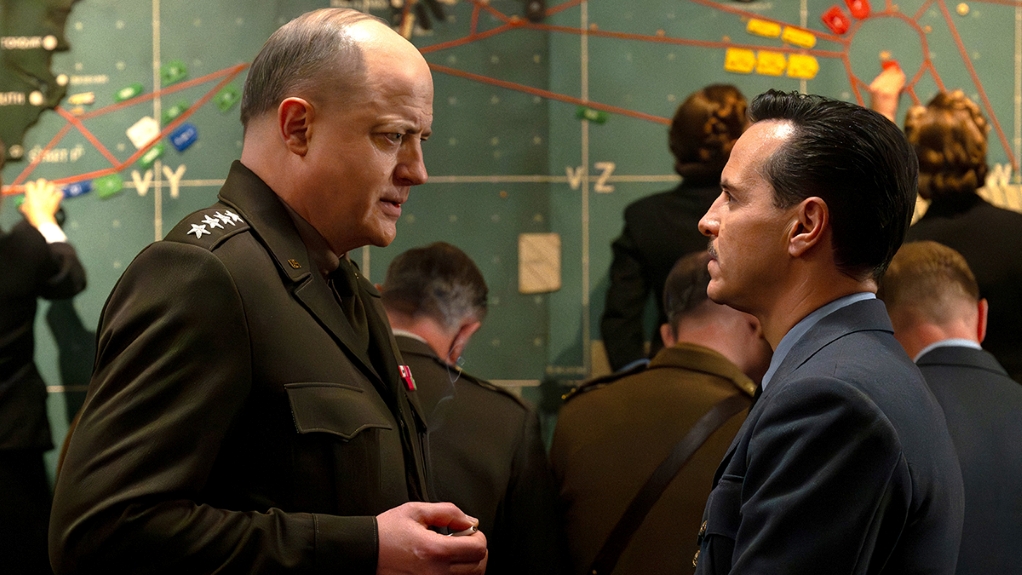
If you think your job is tough, imagine dealing with what’s on Dr James Stagg’s (Andrew Scott) plate. Plucked from his heavily pregnant wife in June 1944, Stagg – the RAF’s top meteorologist – is summoned to a top-secret military HQ in the British countryside. The Allies are planning D-Day for June 5th (there’s a plot clue, history buffs) and Eisenhower (Brendan Fraser) needs a forecast for those choppy channel seas. His pet US forecaster Colonel Krick (Chris Messina) says it will be fine, music to the ears of gung-ho General Montgomery (Damain Lewis). But the meticulous and stubborn Stagg believes otherwise. Atmospheric pressures are going to ratchet up into a storm, as much as interpersonal pressure is going to set sparks flying.
Adapted from a play by David Haig (who’s made a career playing the sort of poorly social-skilled seeming stuffed shirts Stagg represents), Pressure is solidly entertaining, a tight, old-fashioned war movie with a neat, theatrical structure that doesn’t re-invent the wheel but spins it well. It also interestingly drills down into parts of war mechanics people don’t dwell on: how sometimes battle outcomes depend on dull logistically problems, rather than on the guts and glory of soldiers.
And what could be more ploddingly everyday than the weather? It’s easy to forget how what a punishing exercise in planning and organisation D-Day was. Ferrying hundreds of thousands of men and equipment about a hundred miles across the channel was not exactly a casual swim. Throw in that it was taking place in a country notorious for its hellishly unpredictable weather and you have a nightmare in hand. Opening with the blood-filled waters of the aftermath of training op disaster Operation Tiger, carried out in April 1944, Pressure makes clear the cost of error. And it’s etched into the face of Fraser’s Eisenhower, as he walks past hundreds of bodies caught in a a nightmare of friendly fire fuck-ups after a communications breakdown.
Avoiding that is what getting the right forecast is all about. It’s the pressure hanging over Stagg: a pressure made worse by Stagg being quite open about forecasting being, essentially, a sort of educated guess. You can track weather patterns, prevailing winds, pressure build-ups – but it can all dissipate in a few hours. All you really have to go on is expertise and experience. Pressure shows that’s where Stagg, with a lifetime of studying the UK’s moody weather comes into his own. And has the advantage over Colonel Krick, obsessed with past weather patterns that, in Stagg’s eyes, are as useful as using a coin toss a year ago to predict a coin toss today.
Problem is, Stagg is not exactly the easiest person to get on with. Andrew Scott is a very good at showing how Stagg’s professional exactitude and no-nonsense focus comes across as cold-fish distance. Certainly when compared to the piano-playing, all-singing, all-dancing Krick (Stagg, in a fit of strait-laced professionalism, removes the piano from their office once he has taken over). He’s constantly prickly and awkward with his staff, ignoring small talk his refuses to play any interpersonal games. Which comes across as domineering, almost maverick behaviour. Stagg’s here for a job and saves his warmth for his beloved wife – he’s introduced cooking her breakfast, making sure she gets their egg ration, a neat indication he’s a warmer man than we might otherwise think.
Scott also brilliantly makes clear he’s a man who cares deeply, both about his job and the lives entrusted to him. And, as such, even though it’s not going to make him popular he will not buckle down and deliver the optimistic forecast his superiors expect. This leads into several of the films finest sequences, where Pressure really comes to bear: heated exchanges between Stagg and Eisenhower and the allied commanders – the stormiest of which seeing an under-pressure Stagg, worried about his pregnant wife, unbuttoned and tieless, finally letting rip on forecasting not being a popularity contest but a science in which he’s the expert.
Rightly, he doesn’t want to see drowned bodies on the beaches of Normandy. Feelings he shares, under all the distant authority, with Brendan Fraser’s Eisenhower. Fraser’s sensitivity and sense of doubt (much is made of his lack of experience – a bit odd, considering the real Eisenhower had already been C-in-C of the amphibious landing on Sicily, making him the most experienced man in the whole allied army) probably isn’t a good fit for the real Eisenhower, but is for this film’s sympathetic version of him. Fraser does a good line in creating a man working overtime under the burden of so many lives on his shoulders.
He’s aided in this by trusted expert factotum Kay Summersby, played with warmth and heart by Kerry Condon. Its Summersby who quietly keeps the base running and is on hand for pep-talks with Stagg or late-night whiskies with Ike. These may be fairly predictable opportunities for character beats, but Condon does a great job as a role part audience surrogate, part heart of the movie. While it’s interesting to see a major film still so coyly dance around the high likelihood that the real Ike and Kay were more than just colleagues (its hinted at heavily with their closeness and use of first names), it still adds further humanity to the film.
Pressure is a solid, well-made, old-fashioned film that goes by in an interesting and enjoyable 100 minutes. It relies a little heavily on manufactured personal crisis for a bit of pressure too far (has Stagg’s wife been killed in an air raid in hospital?), and its solid, reliable plotting and pacing can feel a little by the numbers. But it has good actors and while its theatrical roots are clear it delivers a few well-handled speeches and dialogues that entertain and inform. It’s destined for a long life on bank holiday TV.

