An impressively filmed, intelligent, if slightly slow, epic with a barnstorming central performance
Director: István Szabó
Cast: Klaus Maria Brandauer (Colonel Alfred Redl), Hans Christian Blech (Mj General Von Roden), Armin Mueller-Stahl (Archduke, Heir Apparent), Gudrun Landgrebe (Katalin), Jan Niklas (Colonel Kristóf Kubinyi), László Mensáros (Colonel Ruzitska), András Bálint (Dr. Gustav Sonnenschein), László Gálffi (Alfredo Velocchio), Dorottya Udvaros (Clarissa), Károly Eperjes (Lt Jaromil Schorm)
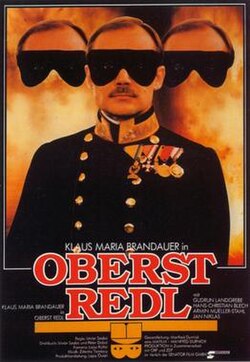
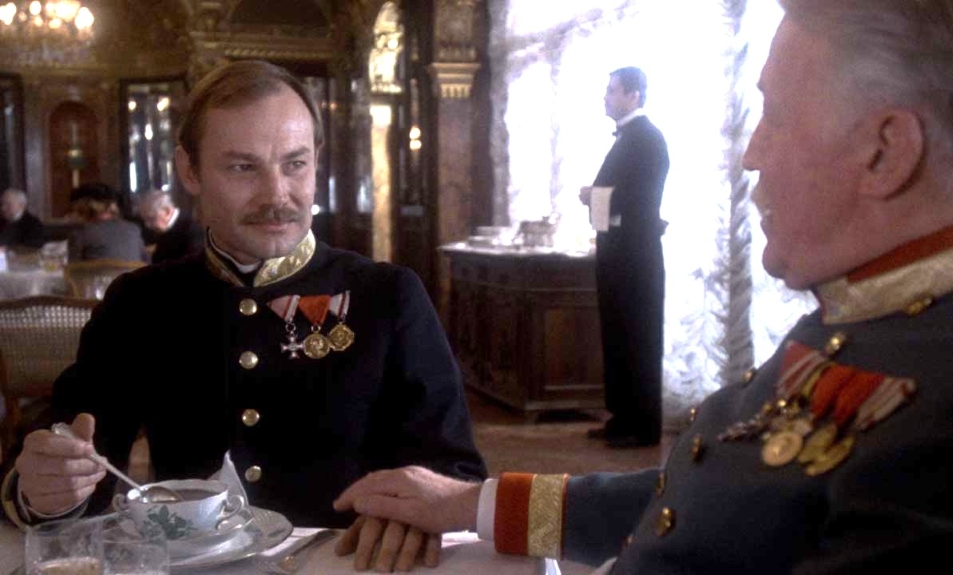
Colonel Alfred Redl was head of the Austo-Hungarian counter-intelligence corps in the build-up to World War One. He was also, possibly, blackmailed due to his homosexuality, into being a Russian double agent and was eventually left in a hotel room with a pistol to do ‘the honourable thing’ after he was caught, a year or so before the war that toppled the Empire began. That’s the basis for Szabó’s film, a reteaming with Brandauer after the success of Mephisto, which fictionalises Redl into a self-loathing mass of every trait the autocratic Austrian army hates.
Colonel Redl revolves around another tour-de-force performance by Brandauer, in a very different vein to his triumph in Mephisto but another searing embodiment of a man selling his soul for precious little return. Redl is a cold, distant, reserved man who on the surface seems to be a robotic machine of career advancement. But Brandauer masterfully makes him a man seething with self-disgust, loneliness and above all fear. Redl always seems on in dread of being found out: as working class, as a repressed homosexual, as a Rutherian, as a Jew. He’s trying to assimilate into a system that despises everything he is, and no amount of being more Austrian or Emperor-worshipping than anyone will change that. Szabó’s introduces him via his reflection in close-up and he’s a man who becomes the mask he’s practicing.
In Szabó’s classical, reserved film, Redl is forever the little boy who, on visiting the home of his aristocratic friend Kubinyi, panics because he doesn’t know how to turn a samovar off. His whole life is waiting for the inevitable moment when he’ll stand in a puddle of tea, desperately asking for help. Throughout the film, Brandauer’s Redl will lash out with terror when encountering people that compromise his carefully preserved exterior. He berates a Jewish man who invites him to a Friday Night dinner and remains petrified that contact with Jewish people will somehow pollute him. He practically throws money at his poor sister when she visits his office and commands her never to return. Brandauer’s face is awash with tortured shame, and Redl doesn’t shirk at condemning himself, even writing “insincere” as a character note in his army records.
This entirely constructed man reveals parts of himself to no-one. His one early bond is with aristocratic Hungarian friend Kubinyi, strikingly played with a mix of hauteur and entitled decency by Jan Niklas. From childhood, Redl covers for this indolent, rebellious friend – even breaking the school code by naming others for Kubinyi’s rule-breaking at their military academy – and continues to do so as an adult, protecting him from the consequences of a duel and carrying his friend with him in his early rise in the ranks. But Kubinyi, with all the privilege of rank, can afford to mock, criticise or even attack the Austrian system Redl dedicates his life to. A reaction that leads to a break between them that never really heals.
It’s a break partly brought about by Redl’s affair with Kubinyi’s sister Katalin, very well played by Gudrun Landgrebe. The two are drawn together by their shared past and unhappy, lonely lives. But it doesn’t stop Redl from confessing, during their first night together, he was thinking of Kubinyi. His suppressed, confused longing for his friend is evident from an early sexual encounter with a prostitute. There, he feels more interested in the prostitute’s previous encounters with Kubinyi – and Redl only feels stimulated after he spies on Kubinyi in the throw’s of passion with another woman. Redl and Katalin share an emotional closeness – Redl confesses he has told her things he has told no-one – but their sexual bond feels like one of convenience. Redl can later barely raise interest in the sickly Helene, who he marries to ward off rumours of homosexuality.
Redl has dedicated himself to a life of service to the Austro-Hungarian empire. An empire which, he slowly realises, is doomed to wither and die for many of the reasons he embodies. It’s a decaying, rigid system that treats anyone who deviates from its personal ideal with contempt. Throughout his career, Redl is given glimpses of the rotten regime he’s serving or encounters those like Lt Schorm (a world-weary Károly Eperjes) who are more far-sighted than in him in seeing the flaws. Even Kubinyi thinks the empire is doomed and is laying the groundwork for an independent Hungary. But Redl dedicates himself to the constructed version of himself he made in childhood.
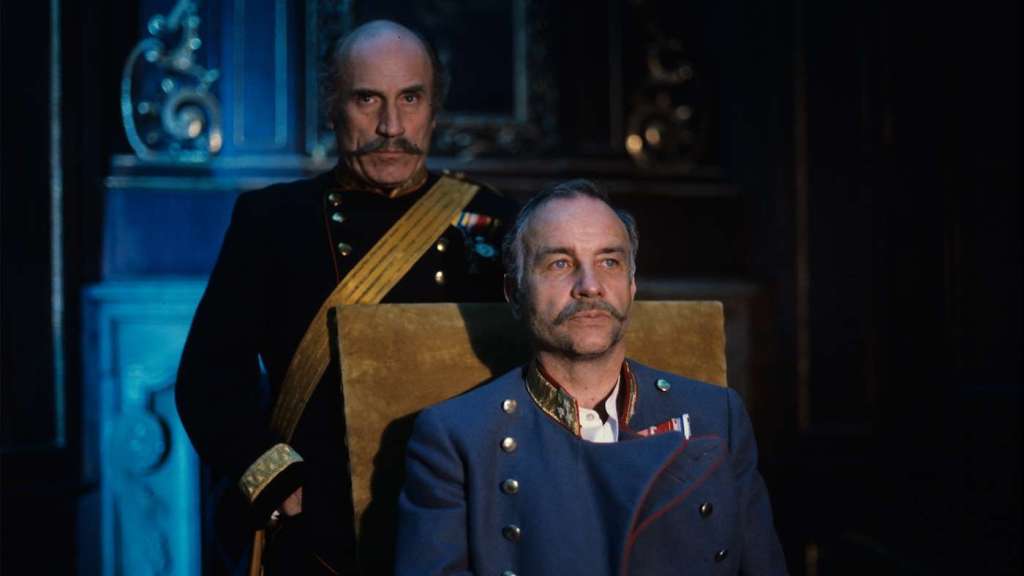
But it’s not enough. Colonel Redl spends much of its slower-paced second half walking through a web of state-sponsored deviousness that isn’t always explained clearly (or compellingly) in the film’s narrative. Needless to say, Redl’s loyalty and hard work end up counting for very little when he is the perfect fall guy for a confusedly ill-thought out idea the Heir (Armin Mueller-Stahl, excellent as a fictionalised version of Franz Ferdinand rife with power-hungry self-confidence) has to unify the army via a scapegoat trial. The ideal target is a man of very specific national and religious background – in fact, Redl’s doppleganger – and when that man inconveniently commits suicide by cop, Redl quickly suspects his own corrupt investigation is now being targeted at him.
Redl, it’s clear, has wasted his life defending, for no thanks, a crumbling regime ripe to fall. Colonel Redl grasps at some of the extensive nationalist and religious tensions that existed in the Austro-Hungarian empire. It doesn’t always do this completely successfully – even in its vast run time, it finds it hard to juggle making these complexities clear while also telling the personal story of its anti-hero. But it does make clear the misguided effort Redl has dedicated his life to: and, also, the strange relief he finds in finally being ‘discovered’. Even if the discovery is something he hasn’t done.
Szabó’s stately film – and its rich cinematography which moves from the chilly blues of Redl’s academy days, to the muted, fade that fills the screen during the court scenes, undermining their grandeur with grubby colours – sometimes gets itself slightly lost in this labyrinth, its pace slowing to a crawl. Some of its narrative ground echoes Mephisto, but with less of that film’s purist riff on Faust. But it is brought firmly back into life by Brandauer’s stunning, humane performance. Other actors would have been constrained by the rigid Redl, but he makes him a buttoned-up morass of barely suppressed tensions, who rarely feels relaxed and sometimes feels as unreadable to us as he does to those around him. And Brandauer deserves every plaudit for his extraordinary suicide scene, a burst of nervous, terrified energy that fills the final moments of the film with real emotional force.
Colonel Redl looks at the corrupt, failing flaws of Austro-Hungary and links it to the Stalinist trials and state control that would follow after another war. It’s less purely compelling than Mephisto and has a plot that sometimes feel a little too dense. But it hosts a fantastic Brandauer performance and finds a real tragedy in a man who would otherwise have felt coldly unknowable and distant.