

Bergman’s masterpiece, a fascinatingly brilliant Rorschach test that challenges and rewards the viewer
Director: Ingmar Bergman
Cast: Bibi Andersson (Alma), Liv Ullman (Elizabet Volger), Margareta Krook (Doctor), Gunnar Björnstrand (Herr Volger), Jorgen Lindstrom (Boy)
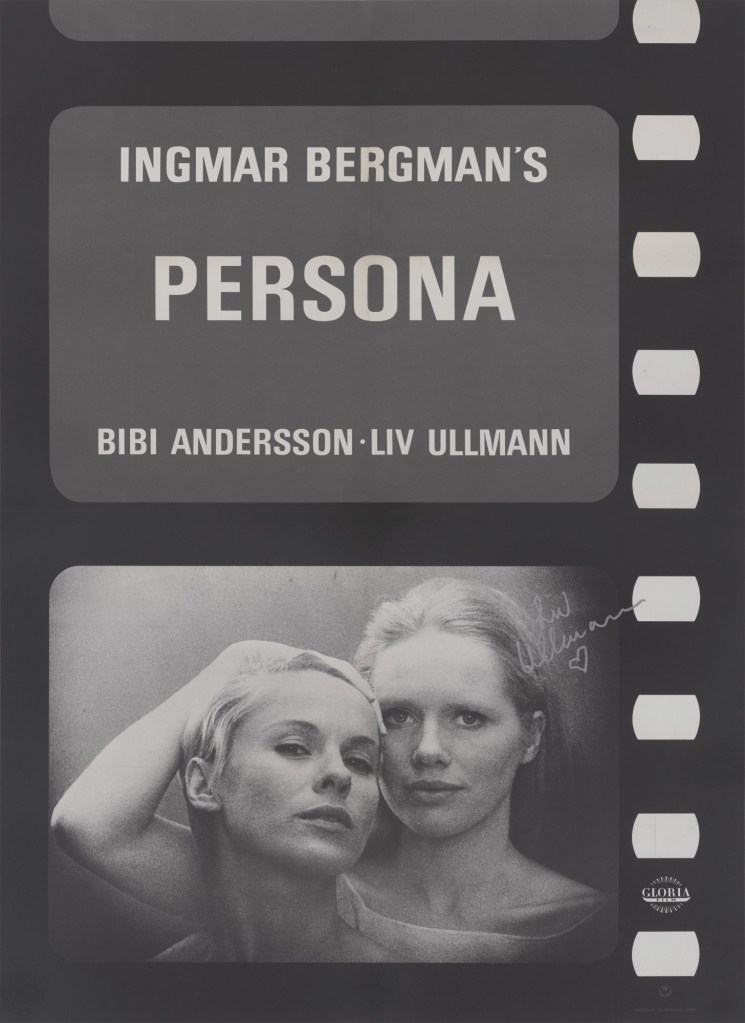
Even Bergman considered Persona a moment he “had gone as far as I could go…touched wordless secrets that only cinema can discover”. Persona, Bergman’s most consciously artistic and psychologically challenging work is a mass of contradictions and puzzles that defies easy categorisation (even Bergman claimed to be only half sure what definitively was happening). A whirling mix of themes, haunting moments and unknowable incidents all within a framework that constantly reminds us we are watching a film, Persona has been influencing, challenging and fascinating viewers for over 60 years. If cinema’s Everest is Citizen Kane, Persona is its K2.
The plot seems simple. Famed actress Elizabet Volger (Liv Ullman) fell silent for a minute during a production of Electra, then carried on. A day later she stopped speaking and hasn’t spoken since. Her doctors can’t find an answer so she is sent to an island to recuperate, with the support of a nurse, Alma (Bibi Andersson). On the island, Alma fills the silence with long monologues that become more and more confessional, intimate and personal. Does Elizabet betray these confidences in a letter to her doctor? Does Alma plot revenge? Are these events even happening? As the personalities of the two women blur, merge, swop and consume each other the film fractures (at one point literally so) until we are left as uncertain of who and what is real as perhaps the women themselves.
There is, in some ways, no understanding Persona. It perhaps best resembles a cinematic Rorschach test. I’d argue it’s a fool’s journey to stare at it for a definitive answer. Different days, different moods, different conditions will make the picture re-shape and resemble something else. Bergman has created a film devoid of traditional ‘clues’, that provides no trace of an ‘answer’, but instead asks – demands? – us to take away only what we choose.
Throughout, Bergman makes it vitally clear film is a constructed, artificial representation of reality. Persona starts and ends with film literally spooling through a projector, the arc lights cranking up to project a reality. The opening prologue is a host of suggestive images which may, or may not, relate to what we are about to watch. Their meaning is almost deliberately vague – much as the epilogue’s brief shot of Bergman and crew shooting the film is – but it lets us know beyond doubt this is a subjective presentation of a series of images, not real life. Perhaps reading meaning into it is as impossible a task as trying to interpret the contents of a library from the page of a single book.
Which is to say, I think Bergman is both inviting us to interpret the film but also warning us that this isn’t a jigsaw, but a deliberately obtuse and open-ended work, our experience of it controlled by the director. Film is after all a dream – a world where we think we move freely, but in fact we never do. Which might make you think Persona is Bergman’s punking the world, a Thermot’s Last Theorem designed to infuriate. It isn’t because it’s made with such grace, humanity and honesty.
To understand Persona you can only discuss – and wonder – at the complex, multi-layered themes and decide which speaks most to you on the day. A lot of this boils down to how you are affected by the breathtaking, seismic performances from Andersson and Ullman. Playing two characters whose identities merge, shift, mirror and absorb each other both performers give outstandingly intelligent, infinitely challenging and unreadable performances. For Andersson the film is virtually a monologue, where the more Alma talks, the more our grasp on who (or what?) she is slips through our fingers. Ullman’s impassive face, awash with micro-expressions (caught in scintillating close-ups) constantly disorientates – is that a sneer or a smile? Is that head-turn impatience or a desire to know more?

At several points I find myself falling into the trap Bergman lays of wanting to categorise the film, as I became convinced first one than the other of these women was just an element of the psyche of the other. It’s not as simple as that. They are both the same and different, two people and one. Bergman frequently frames their bodies overlapping and, in one horrifying moment, their face literally merged half-and-half. Elizabet, we think at first, is a near vampiric figure sucking the life out of Alma, drawing confessions from Alma to restore herself. Then Elizabet becomes a ghostly figure, moving in the margins of Alma’s life, a horrific silent figure from her subconscious holding her back. Then you feel Alma to be nothing more than Elizabet’s id, demanding her right to be independent.
The unreadability of the film becomes ever more acute at the half-way point. After an enraged Alma deliberately leaves Elizabet to cut her foot on glass, the film pauses, burns away and then restarts with an echo of its earlier montage. Has the story restarted? Did all or any of what went before actually happen? Or is everything from this point a cinematic fantasy? Later in the film Bergman throws in a sequence with Alma and Elizabet back in the hospital before returning to the island – is this a flashback or a dream or a vision or something else entirely?
Bergman’s mastery of horror comes to the fore. The haunting repeated shot of Elizabet embracing Alma from behind, the two of them starring into a mirror (and the camera) at times seems sexually charged, at others disturbingly possessive at others supernaturally controlling. Is Bergman’s point that the context of an image can change its meaning? These hazy definitions of truth and reality lie throughout. The confrontations between the two taking on an increasingly surreal nature.
In a stunning sequence, Bergman repeats the same Alma monologue twice, one focused solely on Elizabet (her face contorted with pain as she hears of her rejection of a child), the second on Alma (now dressed identically to Elizabet), Alma’s bitterness now taking on a totally different light. Alma, back in nurses’ outfit, confronts Elizabet screaming that she is her own person even as her words collapses into an incoherence that might as well match Elizabet’s silence. Which is projection and which reality? When they leave at the film’s end, do they go their separate ways or merge? Does Alma imagine herself with Elizabet’s husband, or when Elizabet’s husband recognises Alma as his wife is he tipping the nod to us?
Bergman gives no clear reasons for Elizabet’s silence. It could be connected to horror at the world’s terrors (Vietnam and the Holocaust are referenced). It could be shame at her own post-natal depression. It could be that the silent Elizabet is a projection of the Alma-Elizabet’s own turmoil and isn’t real in the first place. After all the hospital we are introduced to Elizabet in doesn’t feel like a real place but a sparsely dressed film set (and shot like it).
Sex weaves it’s way tellingly through the film. The sexual bond between Alma and Elizabeth, physically, seductively close and possibly sleeping together is clear. Alma relates a hugely erotic monologue about an orgy she and a friend initiated on a beach, the only time she describes herself a purely happy and content. Is this her memory or a fantasy of Elizabet’s? If Alma is Elizabet, is this what she longs for or the thing she finds missing now from her own life? Alma talks of wanting a family – but in a haphazard, casual way and has already had an abortion. Elizabet has a son but doesn’t want him – is Alma what she dreams she could be, or is Elizabet the truth Alma doesn’t want to face? At various points both, all or nothing of the above could be true.
The film opens with a mysterious boy starring at a blurred series of images of female faces. We never learn who he is (theories abound from Elizabet’s son to Bergman himself). He wakes seemingly from the dead, but perhaps he is given life by the film. Perhaps, Bergman is saying, Alma and Elizabet are themselves given life only by the film. That both of them are fictious illusions, as unreal as the blurred pictures on the wall. Persona is the sort of film only a director of pure courage could have made. An object that fascinates and frustrates but always leaves you wanting to reconsider and reposition it to see if the picture becomes clearer or if new truths are presented if you look at it from a different angle. Maybe Elizabet is a succubus. Maybe Alma is an angry inner self, longing to escape and liver her own life. Maybe Alma is the silent actress. Maybe Elizabet longs for the simpler life of the nurse. Perhaps every single idea is true and perhaps none of them are. That’s part of the mystery that makes Persona one of the greatest films ever made.
 Movie Musings