
Bresson’s bleak film is the least romantic, most depressing Arthurian film out there
Director: Robert Bresson
Cast: Luc Simon (Lancelot du Lac), Laura Duke Condominas (Queen Guinevere), Humbert Balsan (Gawain), Vladimir Antolek-Oresek (King Arthur), Patrick Bernhard (Mordred), Arthur De Montalembert (Lionel)

Only Bresson could have made a King Arthur film like this. Lancelot du Lac takes Bresson’s spare, thoughtful style and applies it to that most unlikely of genres, the historical epic. What we end up with (for better or worse) is something perhaps bleaker and more difficult than any other King Arthur film out there. Bresson repackages Camelot not as the dreaming spires of hope, but a spare, vaguely mechanical world where Arthur and his knights are going through the motions of duty and honour, while stumbling towards inevitable death. However much the characters want to believe in a higher purpose, they can’t escape the cynical truths of the world, or their own lusts and desires.
Lancelot du Lac opens with the return of the knights from a disastrous Grail Quest. The best of them, Percival, never came back. Neither did most of the rest, all dead in some distant land. Arthur (Vladimir Antolek-Oresek) is a worn-out man who doesn’t seem to know what to do next. He’s delighted to see Lancelot (Luc Simon) return. Just as pleased is his queen Guinevere (Laura Duke Condominas), whose historical affair with Lancelot is an increasingly open secret in Camelot. Lancelot talks about letting it lie in the past, but temptation inevitably fractures the kingdom as Mordred (Patrick Bernhard) plots a coup.
Bresson doesn’t compromise on any of his distinctive style. Scenes mix between carefully structured longer takes, that frequently feature on obscure parts on the body (in particular legs, whose motion frequently fills the frame) and simple cutting between the faces of two people in conversation. He casts non-professional actors and, as before, ruthlessly drills them until they deliver every line with a flat, defiantly non-actorly, monotone. Nearly every event of note happens off screen. Every human is a choiceless cog in a much larger machine, unable to impact or effect the actions around them.
There is no romance whatsoever in Lancelot du Lac. The film is bookended with what passes (in Bresson) for moments of action. A clash between knights at the start ends (after a very short and perfunctory swinging of swords) with a blood spurting decapitation and another blood spurting disembowelment. (The blood spurting style was effectively piss-taked within a year by Monty Python and the Holy Grail.) It ends with a deliberately underwhelming Battle of Camelan, in which we see no fighting only faceless knights dead in a woody clearing, as archers rain arrows down. There is no glamour here, no glory or honour in combat – just pointless, mechanical sacrifice.
It’s the same with the jousting tournament which takes up a surprisingly large portion of the film’s runtime. Bresson shoots this almost with an almost irritatingly cheeky lack of spectacle. As horses charge at each other, the camera lingers on: the arms of a bagpipe player, the legs of horses, the ends of spears and the impassive faces of Arthur and Gawain in the crowd. Occasionally flags go up to denote new jousts and helmets crash down over faces. But any sense of what’s going on, or the point of it, is secondary to the sense of the knights as nothing more than humble parts of a great, pointless machine, churning out martial events by rote.
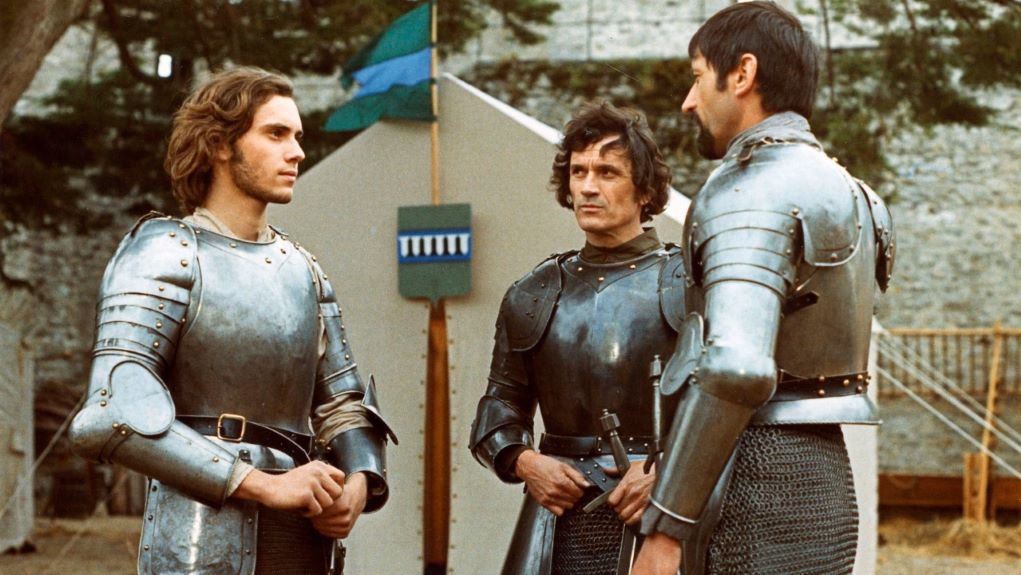
That sense of a machine is behind all of Bresson’s vision of Camelot. The actors all wear armour, all the time, clunking around the set like clumsy automatons, every flinch accompanied by the clank of armour. (John Boorman’s Excalibur would present the Wagnerian contrast of this same aesthetic choice.) Towards the end, Bresson repeats four of five times in sequence near identical shots of knights slamming helmets over their faces making them look like even more like robots.
It’s here where the actors deliberately lifeless performances work, and actually create a sort of hypnotic power. Bresson’s style makes them all feel like tired, exhausted figures at the end of their tethers, scarcely knowing the point anymore. Lancelot looks like a middle-aged bank manager sticking to the letter of a code because it’s all he’s got. Arthur is so disengaged from any sense of the ‘dream of Camelot’, he practically allows a civil war to break out due to apathy. Gawain is so constrained by his idea of duty that he allows himself to be killed, seeking revenge for the death of a brother he couldn’t stand. Mordred is the only guy who really feels aware of the world he lives in, a middle-manager who stirs up trouble and then gets others to deliver for him.
No wonder Guinevere constantly questions the whole set-up and the point of anything anyone is doing. Why shouldn’t she and Lancelot try and cling to something real, even if it will destroy everything else? After all it’s not the original sin: Camelot was already long since corrupted, way before they hooked up. There is no sense in Bresson’s work that medieval honour really means much to anyone, and the only people who really talk about it (Gawain and Lancelot) respectively die for no reason and betrays everyone after convincing himself his betrayal was an act of honour.
There is a fatalistic, hypnotic quality to this after a while as we watch characters square their actions against abstract ideals irrelevant to the situation they are in. So, Lancelot steals Arthur’s wife and then rides to a pointless death for the man he betrayed. Arthur allows men to die on crusades, allowing his kingdom to become fatally weakened in pursuit of purity. Everyone talks about honour all the time, but no one does anything to turn the situation into something actually honourable. Instead, their lives are ones of empty, unknowing fatalism leading to inevitable ends. It makes for a powerfully bleak Bresson tale – and faith and Christianity is notable by its absence in this world. Without it, it seems the knights have nothing to cling to.
 Movie Musings