
Atmospheric, heart-rendering and beautifully constructed supernatural film, an emotional look at grief
Director: Nicolas Roeg
Cast: Julie Christie (Laura Baxter), Donald Sutherland (John Baxter), Hilary Mason (Heather), Clelia Matania (Wendy), Massimo Serato (Bishop Barbarrigo), Renato Scarpa (Inspector Longhi), Leopoldo Trestini (Hotel manager), Giorgio Trestini (Woekman)

We tend to trust our senses, don’t we? We like to see the world as something solid and factual, that we can process and understand with rational thought. What we don’t have time for is the idea of a sixth sense about the world beyond us. We can’t measure that, so we prefer to ignore those feelings. Don’t Look Now is partially about the terrible consequences of ignoring gut-instincts about the unexplainable, as well as the terrible, all-consuming horror of grief. On top of that it’s a horrifying quasi-ghost story, a moving portrait of marriage and a terrifyingly beautiful image of Venice that’s quite unlike anything else on film.
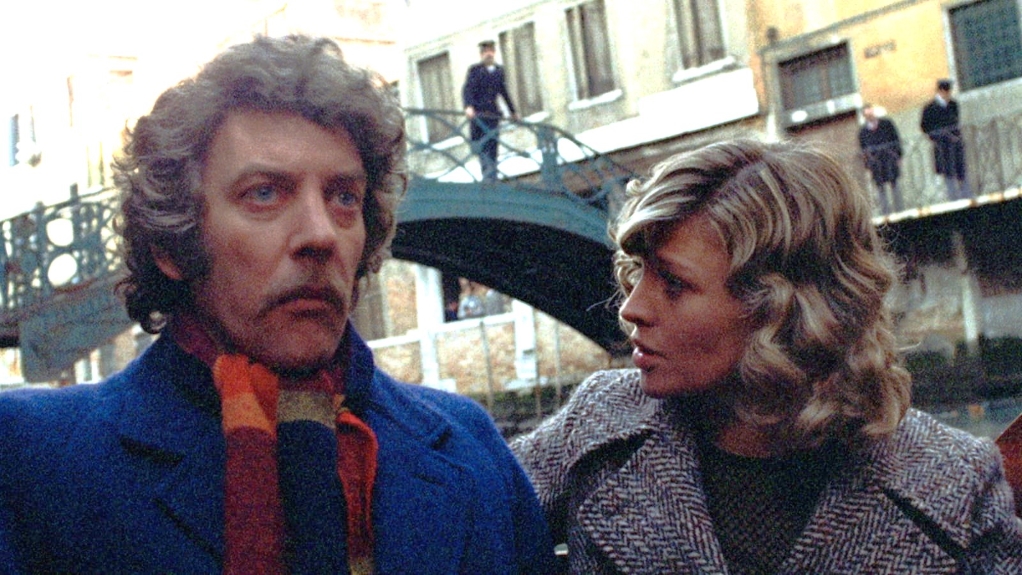
John (Donald Sutherland) and Laura Baxter (Julie Christie) are in Venice, a few months after the death of their daughter in a tragic drowning accident. John is busying himself at work restoring a church, Laura is looking for distraction from grief. Chance leads to a meeting between Laura and two mysterious sisters (Hilary Mason and Clelia Matania), one of whom claims to have second sight and to be able to ‘hear’ messages from the Baxter’s late daughter. Laura is desperate to believe, but John is resolutely unconvinced. But it’s John who starts seeing visions of a child in a red coat – a red coat just like the one their daughter was wearing when she drowned – and becomes increasingly troubled by strange coincidences and feelings.
Roeg’s stunning film is a masterpiece of atmosphere. Shot in vivid colours in a coldly intimidating Venice – which Roeg manages to make feel both beautiful and deeply, disturbingly unknowable and dreadfully intimidating. Don’t Look Now constantly unsettles and disorientates you, a gorgeous city hosting an insidious gothic mystery. It’s a masterfully edited film, that uses our ‘knowledge’ of the language of cinema to disorientate us, forcing us to form associations between images by juxtaposing them together (for instance, Roeg cuts from John casting doubts on the motives of the sisters to them laughing joyfully something that context makes us see as sinister).
The clue in Don’t Look Now is in the title – once we are told to look at something, we’ve got an overwhelming desire to stare straight at it. John’s mind is mind sending a plethora of subconscious warnings: but the more his mind says ‘don’t look’, the longer he stares. He should be picking up on the visual signals from Roeg’s extraordinary design: Don’t Look Now is awash in red. In almost every scene, splashes of striking crimson abound – from coats, to bags, to signs, to everyday objects, to blood – as if the film itself is trying to warn him (at one crucial moment, he even turns away from a street of green fronted shops and cafes, to charge down a street lined with red ones). Don’t Look Now is the tragedy of a man with great powers of intuition who comprehensively ignores them because it’s the rational, sensible thing.
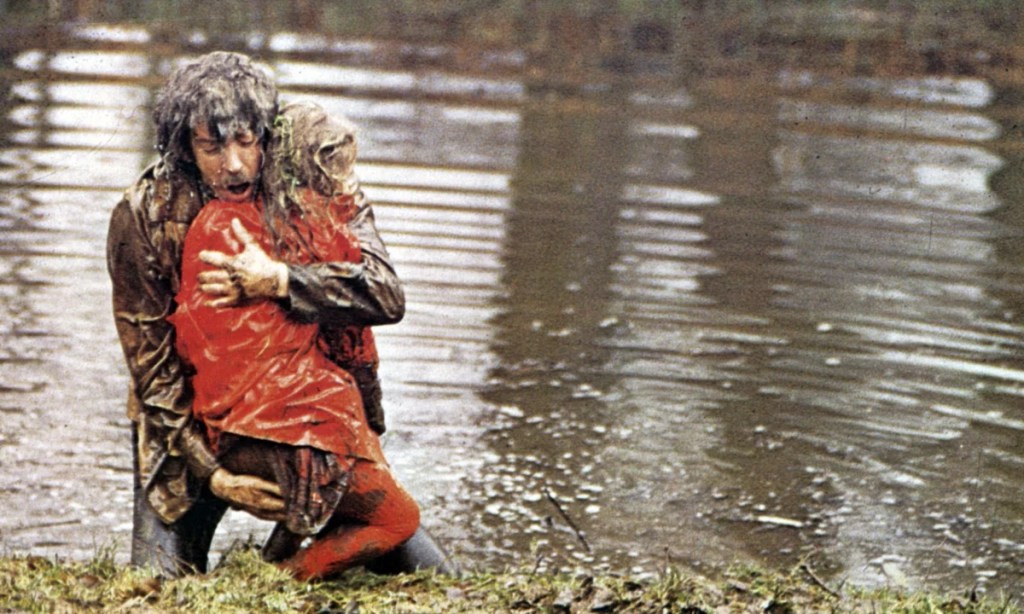
Already he has been warned of the dangers of ignoring his instincts. Roeg opens the film with the drowning of the Baxter’s daughter, while her parents rest indoors after a large Sunday meal. It’s a sequence of ominous, intense anxiety and terrifying, gut-wrenching impact as we cut back and forth between the daughter playing outside (with broken glass and lost balls floating on ponds), to John and Laura continuing casually talking while a slide frame of the Venetian church John is working on soaks in spilled water and the red of a girl’s coat in the image bleeds across the it (as much a prescient warning of John’s danger, as it is of his daughter’s). A distracted John is finally unable to resist the of danger he is feeling – racing instinctively to the pond, but too late to prevent tragedy.
The heart-rendering, raw pain as John fishes his daughter from the pond – the elemental roar from Donald Sutherland being almost unwatchable – caps a deeply affecting sequence in Don’t Look Now’s profound and tender study of grief and the strain it places on a loving relationship. Sutherland and Christie give beautifully judged, profoundly humane and sympathetic performances as shell-shocked people, barely able to process tragedy and looking for anything to distract them from the crushing grief that is hollowing them out. Grief in this wintery city is practically a third wheel in the relationship, an unspoken mix of regrets (and recriminations, Laura at one point blaming John’s lax rules for their daughter’s death) and barely expressed pain.
This doesn’t detract from the deep love they still feel from each other. Don’t Look Now’s (in)famous sex scene carries the erotic charge it does, because it genuinely feels like a long-married couple reconnecting physically, intimately familiar with each other’s bodies. Brilliantly, this sense is actually increased by Roeg intercutting from their love-making to their post-coital dressing, somehow the act of them half-watching each other put their clothes on being as loving as what they did before. Both have a deep desire to protect the other: John is distracting himself from his grief by ‘looking after’ Laura, while she re-focuses on an intense desire to protect her remaining family.
Laura at first feels the more vulnerable of the two: her emotions rawer (she collapses in distress after her first encounter with the sisters), her need for spiritual connection – either lighting candles in the Church, or desperately trying to believe she can communicate with their late daughter – much greater. It’s only when they are separated (after she rushes home to see their son after an injury at school) that the depths of John’s vulnerability and fragility become clear. Without her to distract him, he quickly seems to fall apart: becoming paranoid, increasingly fixated on possible disasters, ever-more obsessed with his glancing images of that girl in the red coat.
Roeg presents much of the world exactly as John sees it, and his masterful framing and editing of key moments and sequences both leave us in as much doubt about what is real as John is, suckering us into making the same mistakes he does. Again, our trust of how visual images are presented works against us, just as John misinterprets and misunderstands premonitions as events literally happening at that moment. It’s what lies behind his obsessive hunt for his ‘kidnapped’ wife, after seeing her on a boat on the canal hours after she flew back to England. Later events will demonstrate how disastrously he has misinterpreted these warnings.
John is drawn into an ever-more Kafkaesque nightmare (there is a lovely touch that, the more distressed John becomes, the more his Italian evaporates – in his element at the church, rebuilding frescoes, he’s fluent – at other times he can barely string a sentence together). A sinister police inspector – Roeg deliberately not correcting Renato Scarpa’s phonetic delivery of his English dialogue, making it unsettingly ‘wrong’ – seems sympathetic, but has John watched. The off-season city empties out (even the Baxter’s hotel closes), becoming a ghost town of echoey, identical streets which John hurtles down. The dark mystery of a serial killer haunting Venice becomes more prominent, concluding in the film’s horrifying reveal of what lies under that red coat, John realising all too late the skills of intuitive understanding that make him a skilled restorer of fragmented mosaics, was the same ignored intuition warning him of the dangers first to his daughter then himself.
Don’t Look Now is not only a masterpiece of atmosphere and superb editing and structure, it’s also Roeg’s most humane and tender work. It’s a deeply affecting portrait of a loving marriage struggling with grief – with extraordinary performances from Christie and Sutherland – and the way our longings combat with our rational mind to confound us. Set in a Venice that is eerily, ghostly and unsettling, it’s a haunting, powerful and superb piece of film-making.
 Movie Musings