
Silent crime drama has some real moments of interest, before it gets bogged down in stagy framing
Director: Lewis Milestone
Cast: Thomas Meighan (Captain James McQuigg), Louis Wolheim (Nick Scarsi), Lucien Proval (Chick), Marie Prevost (Helen Hayes), G. Pat Collins (Patrolman Johnson), Henry Sedley (Spike Corcoran), George E. Stone (Joe Scarsi), Sam De Grasse (DA Welch), John Darrow (Dave Ames)

In an unnamed city that-could-be-anywhere (but is definitely Chicago), the corrupt political machine is under the thumb of “The Big Man”. And he’s in cahoots with Caponeish gangster Nick Scarsi (Louis Wolheim), a kingpin pedalling Prohibition-breaking booze and knocking off opponents when and where he pleases. In this bent city, the only straight shooter is police Captain James McQuigg (Thomas Meighan) – and he’ll do everything within the law’s power (but no further) to bring down Scarsi. Banished to the sticks of the 28th Precinct, he gets his chance when Scarsi’s feckless kid brother Joe (George E. Stone) is arrested for a hit-and-run but leaves his girlfriend Helen Hayes (Marie Prevost) to take the rap. Can she help McQuigg bust the case?
Interestingly, The Racket only survives today because a copy was among the films in Howard Hughes’ personal collection. Hughes produced this late silent film – and also a talkie remake in 1951 starring Roberts Mitchum and Ryan. The Racket was adapted from a work-a-day Broadway play that gave Edward G. Robinson a big break as the snarling Scarsi and was one of the first Oscar nominees for Best Picture. Directed by Lewis Milestone it’s a strange mixture of the inventive and the mundane, surprisingly daring in its subtle cynicism about government, with intriguing opening half giving way to a final hour that feels trapped by its stage roots.
It starts with a (silent) bang – literally. Milestone’s camera tracks two assassins overlooking a deserted street, watching a target late at night. As thee unwitting figure walks along, they take their shot and miss, their target ducking for cover into a doorway – where he meets Scarsi and we discover this was (literally) a warning shot. We have to wait for the next scene to discover the target isn’t a gangster (as we assume), but a Police Captain called McQuigg. It’s a tense and intriguing opening, well shot and edited, that sets up a personal struggle between two men that the film doesn’t always deliver on (a Cagney-era film would have made these two childhood friends, turned rivals on different sides of the law).
The first act of The Racket follows in this vein, with a series of fast-paced, tense sequences which will culminate in Scarsi’s defiant murder of a rival in front of a roomful of witnesses and McQuigg’s being despatched to the sticks for rocking the boat far too much for “The Old Man’s” taste. Milestone throws in a large-scale street battle between Scarsi and a rival gang, with bullets (and bodies) flying, cars crashing and an army of McQuigg’s cops charging into settle the peace. A retaliatory hit attempt at Scarsi’s club may see Milestone fail to find the sort of sultry tone Sternberg found for nightclub scenes during Marie Prevost’s singing, but his quick cutting from Scarsi’s face to the various hitmen gathering at tables builds tension well and he introduces a truly imaginative shot, from under a table, focused in close-up, on Scarsi’s gun and his target in long-shot. The invention continues at the resultant funeral, where rows of gangsters face each other, a cross fade revealing their black hats all hide pistols.
It’s a shame the invention dies out as we arrive at McQuigg’s 28th Precinct over one-long-night, and the film hues extremely close to the one-location ins-and-outs of its Broadway roots. Exclusively taking place in the Precinct reception and McQuigg’s next-door office, the film turns becomes much less visually interesting, more stationary and theatrical as characters enter and exit and the world of the film shrinks with only the odd montage of newspaper headlines reminding us of the bigger picture. Considering the expansive world earlier, it also introduces logic gaps – McQuigg doesn’t recognise Scarsi’s brother despite having clearly seen him earlier and (even more baffling) half his cops don’t even recognise Scarsi himself. With just this second act, it’s hard to imagine The Racket would have stood out from the crowd at all, as the action becomes increasingly stunted and theatrical.
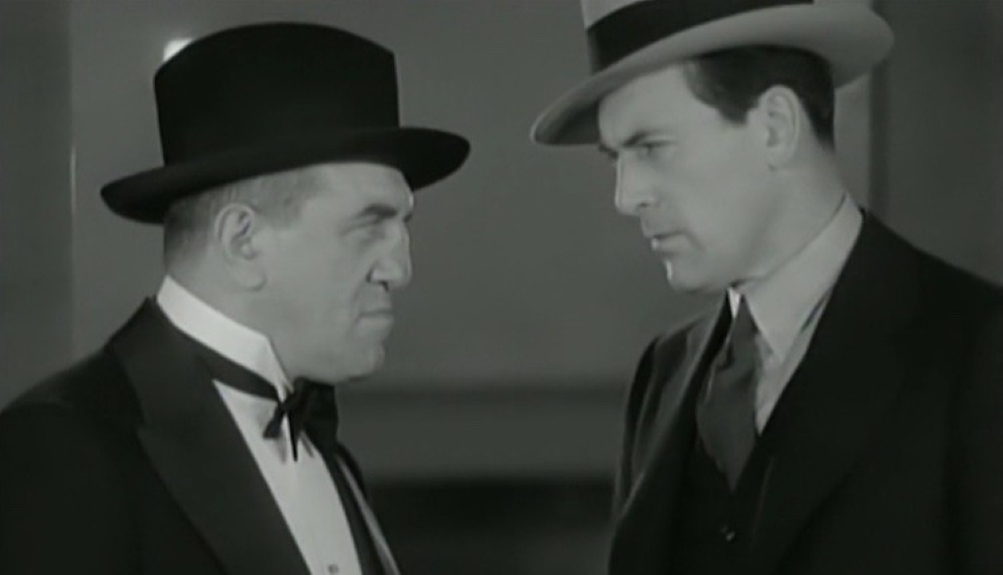
What helps is the performance of Louis Wolheim as the thuggish Scarsi. Wolheim had an excellent line in smug brutality – his looks really helped here, his broken nose (he was contractually banned from repairing it) giving him a thuggish look. Wolheim is full of simmering potential violence, something he exploits well when during a striking bit of business he fans his coat while talking with one of McQuigg’s cops (leading us to expect a gun) only to produce a wodge of cash for a bribe attempt. It’s a striking performance of menace and potential violence, far more interesting than Meighan’s strait-laced, formal playing as McQuigg.
Scarsi is also at the heart of the one of the film’s more interesting subtexts. He’s fixated on McQuigg (who he seems obsessed with as a worthy rival) and constantly talking about how women are ‘poison’ to him. With his closest confidante Chick (Lucien Proval) a fey figure, it’s hard not to read a homoerotic context into the macho Scarsi. I doubt any of that is intended, but it makes for interest today.
Just as its interesting to see The Racket be so subtly negative about elected officials. The authorities running the big city are utterly corrupt, everything managed for the benefit of the unseen “Old Man”. The DA lacks any scruples, elections are openly fixed (Scarsi owns half the precincts), and anyone inconvenient can be judicially murdered. The film concludes with a brief paean to the government by professional that on paper reads as praise, but after what we’ve seen is almost certainly intended as a subtle dig at how utterly corrupt all these professionals are.
It’s an interesting, surprisingly bitter and cynical ending – our hero even spends the last few moments mostly with his head in his hands – that restores interest in The Racket right at the final beat. Too much of the second act feels trapped by its stage roots, but Milestone creates several touches of visual and cinematic interest, Wolheim is great and it’s opening acts of gang violence may be dwarfed by the sort of action we’d see only a few years later in The Public Enemy but still provides excitement today.
 Movie Musings