
Overlooked gutter press drama, a bit melodramatic, but with strong performances
Director: Mervyn LeRoy
Cast: Edward G. Robinson (Joseph W Randall), Marian Marsh (Jenny Townsend), HB Warner (Michael Townsend), Anthony Bushell (Philip Weeks), George E. Stone (Ziggie Feinstein), Frances Starr (Nancy (Voorhees) Townsend), Ona Munson (Kitty Carmody), Boris Karloff (T Vernon Isopod), Aline MacMahon (Miss Taylor), Oscar Apfel (Bernard Hinchecliffe), Purnell Pratt (French), Robert Elliott (Brannegan)
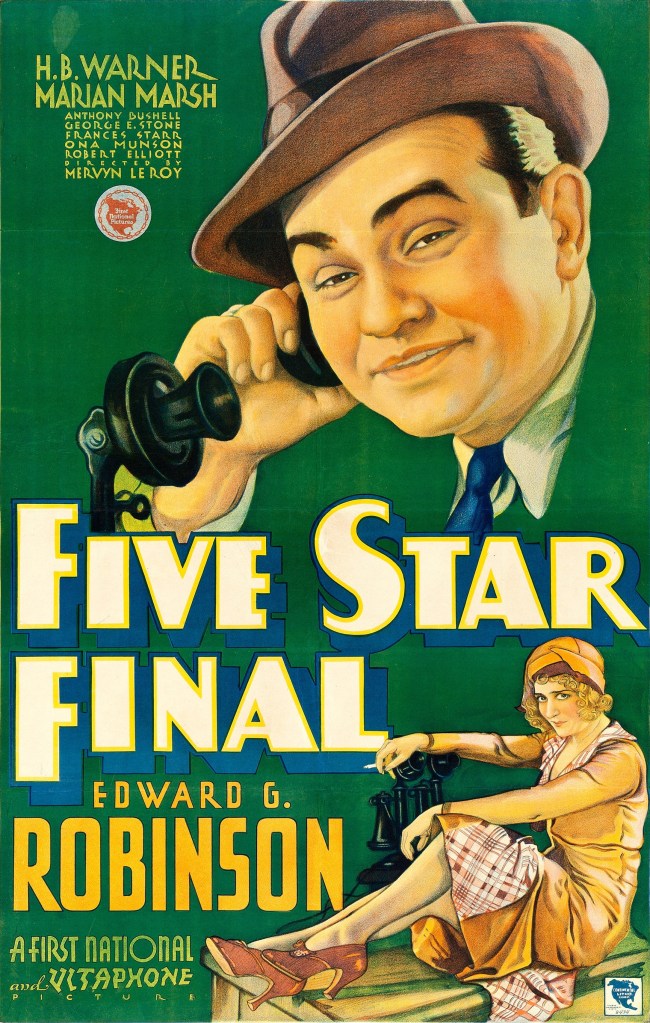
The cynical newspaperman was a popular genre of the 1930s, most famously The Front Page (largely due to its wildly popular offspring His Girl Friday). Five Star Final (the title refers to a famous gutter press font), adapted from Louis Weitzenkorn’s hit Broadway play. Weitzenkorn was a former editor of New York Evening Graphic, a paper so prurient it was known as the “porno-Graphic”. Proving no one is more keen on their work than a poacher turned gamekeeper, Weitzenkorn’s play is a vicious attack on a newspaper industry that couldn’t give a hoot about the impact of its actions so long as its selling hundreds of thousands of copies daily into the hands of a muck-raking public.
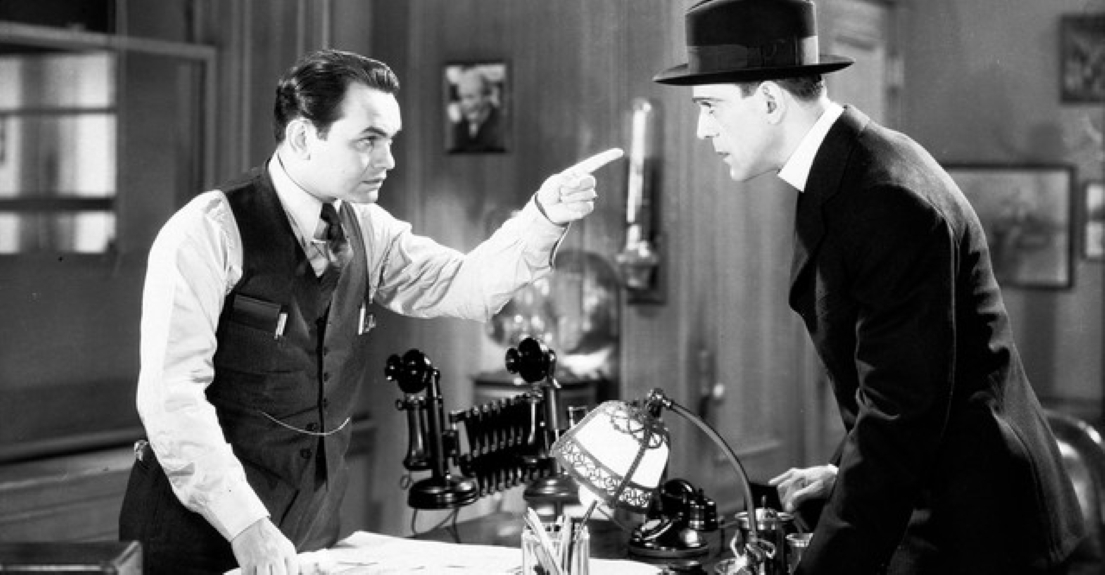
Five Star Final’s hero feels like an idealised self-portrait of Weitzenkorn. Joseph W Randall (Edward G. Robinson) is editor of the New York Evening Gazette, a gutter-press rag which, with weary baby-steps, he has tried to drag up market for years much to the objection of publisher Bernard Hinchecliffe (Oscar Apfel), who firmly believes that salacious stories (with dubious, hypocritical moral angles) about sex and violence is what the people really want. Randall agrees to go muck-raking, dragging back into the limelight Nancy Voorhees (Frances Starr), a stenographer acquitted twenty years ago of killing the no-good boss who impregnated her. Nancy is now married to Townsend (HB Warner), who has raised her daughter Jenny (Marian Marsh) as his own. Jenny is about to marry scion of wealth Philip (Anthony Bushell) and is utterly unaware of the time bomb Randall is about to explode in their lives – with tragic consequences.
Five Star Final is, in many ways, interesting and engaging than The Front Page, even if it takes its story of journalistic ethics relentlessly seriously. It’s view of the newspaper industry is devoid of any hope for journalistic ethics. The paper reports events with a devil-may-care salaciousness using splashes sensationalist headlines without any care for their impact. Hinchecliffe and his staff are utterly unconcerned about morality, or indeed any higher calling to their trade: their focus is solely on circulation. They’re not alone in this – their rival papers have taken to literally launching oil-chucking assaults on newsstands selling the Gazette and countless other outlets climb on board the Voorhees story the second the paper drags it back to life.
The staff are, almost to a man, utterly devoid of any sense of shame. Recent recruit, femme fatale turned journalist Kitty Carmody (Ona Munson, on fine morally ambivalent form) is happy to use any wiles to pursue a story, her first instinct when confronting tragedy to demand a photo. She’s but a beginner compared to Boris Karloff’s reprehensible Isopod, his genteel manner the only thing left of his past as a defrocked priest (for seducing various women), now a tipsy sewer-rat who thinks nothing of dressing as a priest to wean embarrassing facts out of the Townsends and barely shrugs at the impact of his actions. The reporters are without any decency. They don’t even have the crack-a-jack wit of their compatriots in Front Page: you don’t enjoy spending time with them you just want to shower afterwards.
But perhaps even worse, in a way, is Robinson’s Randall – because he knows what he is doing is wrong, wrong, wrong (in case we miss this, we are repeatedly shown Randall washing his hand’s Pilate-like, in sudsy guilt-shedding). In one of his finest performances, Robinson nails the acid-sharp patter, but also his self-destructive embracing of his trade’s worst aspects: his arrogance and ability to beat down his own conscience being his Achilles heels. Robinson’s complex performance implies Randall so disgusted with Hinchecliffe and his ilk, he wants to demonstrate their moral vileness by spinning the paper even deeper. And he does it all from a position of believing he’s better than everyone around him (“put me on a cigar box and I’d be above our readers”), while his actions show him as morally bankrupt as the rest.
The moral cut-and-thrust of the newspaper world dominates the film. LeRoy gives it some real visual interest, from the opening shots of the phone operators taken from ‘inside’ the exchange (their bodies framed through wires) to the skilful split-screen effect used for later phone calls. By comparison, it’s very easy to see the domestic bliss-turned-tragedy in the Townsend home as from a far more theatrical, melodramatic film. Much of this is shot and played with a slightly hokey, home-spun sentimentality – while Frances Starr, in particular, is prone to the sort of middle-distance starring that wouldn’t seem out of place in a matinee.
But you can excuse it for the surprising power of the restraint LeRoy stages a late-act tragedy in the Townsend home, all filmed with use of shadows, implication and shots of agonised hands clutching door frames. HB Warner finds an emotional depth in a man forced to spin personal anguish while Marian Marsh and Anthony Bushell break out of otherwise thankless parts as oblivious lovers to lend real moral force to late outbursts.
But it’s the assault on the gutter press – literally so in the final image of the film, that sees a copy of the Gazette, smeared with mud, washed down a drain – that powers the film. It’s done with a real outrage, that you feel stemmed from Weitzenkorn’s self-loathing. The film relies on the excellence of Robinson’s restrained performance of moral ambiguity (he also has a lovely interplay with his Jiminy Cricket, Aline MacMahon’s secretary) to stop it being a little too shrill and insistent (which it still is at points), but as an impassioned cry for some sort of decency in the media you can see the roots of films like Network in it. Definitely worth uncovering.
 Movie Musings