Author: Alistair Nunn

Murphy’s War (1971)

Murphy’s War (1971)

This heavy-handed anti-war Don Quixote story is far from a success

Director: Peter Yates

Cast: Peter O’Toole (Murphy), Siân Phillips (Dr Hayden), Phillipe Noiret (Louis Brezan), Horst Janson (Captain Lauchs), John Hallam (Lt Ellis)

In the dying days of World War Two, the merchant ship Mount Kyle is sunk in the Venezuelan Orinoco by a German U-Boat. Surviving the machine-gunning murder of the crew is Irish engineer Murphy (Peter O’Toole), who is treated at a Quaker mission by Dr Hayden (Siân Phillips). Murphy at first seems happy to be out of the war: but that changes, after the murder of fellow survivor Lt Ellis (John Hallam) by u-Boat captain Lauchs (Horst Janson), hunting the survivors. Murphy, assisted by Frenchman Louis (Phillipe Noiret), decides to take revenge, kitting out a crashed bi-plane to launch a series of increasingly obsessive attacks on the u-Boat with Murphy succumbing to a vendetta.

Peter Yates takes an action-adventure novel and adjusts into an anti-war epic that becomes increasingly shrill as it reaches its nihilistic ending. This shift led to several clashes between Yates and the film’s producer Michael Deeley, who was looking for a box-office hit with a charismatic star. While Yates’ film is complex in its eventual structure, the overall impact of the film is confused and blunted, its sympathies mixed and logic often flawed. It has its moments but doesn’t quite work.

As part of its anti-war set-up, Yates believed it was essential to humanise the German sailors (after all, he wanted the viewer to feel unease at Murphy’s destructive crusade). Unfortunately, creates a dissonance in the film. The first thing the German sailors do is ruthlessly machine-gun the Mount Kyle’s sailors as they tumble into burning waters. Graphically shown is every beat of the fear, as charred machine-gunned bodies fill the frame while the Germans show not a moment of regret (indeed we next see them celebrating the Captain’s award of an iron cross). The captain murders Lt Ellis with a face filled with regret, but his execution involves bullets causing Ellis’ body to jerk in its graphic death throws. How are we supposed to sympathise with them after that?

The focusing on such brutality fits the anti-war hell the film wants to lay out. But it fatally undermines the film’s aim to sure Murphy’s campaign to destroy the u-Boat as an obsessive and destructive campaign. With no reason given for the brutal war crimes committed by the u-Boat (for good measure they also machine gun the Quaker settlement, killing many of the villagers), its hard not to feel that actually Murphy has a point and that these guys deserve punishment. Would a throwaway line about a secret German mission or a need to hide have hurt the film?

The film can’t have it both ways. It can’t luxuriate in the destruction and murder war soldiers commit and then ask us to sympathise with these same soldiers when their death is threatened by another obsessive soldier on a quest for revenge. In a better developed film this sort of clash of sympathies might feel more natural. Instead, the Germans are either monstrous or sympathetic depending on the needs of the scene while Murphy himself makes an awkward shift late on from a guy with righteous anger into a destructive figure we are invited to condemn.

This is a particular shame as there is a lot in Murphy’s War to admire. Yates directs with an assurance and sense of epic scale. The Venezuelan scenery is shot with a real beauty by Douglas Slocombe and the film is edited with a professional excellence by future-Bond-director John Glen. The film’s first half hits a “boy’s own adventure” tone very effectively – making the later shift into 70’s anti-establishment nihilism more awkward – with inventive sequences as Murphy, McGiver-like, reassembles the downed biplane and jerry-rigs some home-made bombs.

A big part of any success is the charismatic performance of Peter O’Toole, who tears into the role of this Irish rebel with relish. Mixing insouciant wit with a bitter irony that slowly gives away to a sociopathic gleam as obsession takes hold, this is an excellent performance. O’Toole manages to make a character who is, in many ways, slightly incoherent work effectively. After all this rebel we hear condemning war with counter-culture cool, who fights to the bitter end; a guy who expresses indifference for his colleagues but goes to unimaginable lengths to avenge them. These contradictions don’t feel naturally developed, but ideas that are put in place to ease the plot.

Saying that, the film has some interesting beats as Murphy collapses more and more into Don Quixote like obsession, tilting at his underwater windmill. (Yates clearly had a passion for this angle as he would make two attempts to make a film of Don Quixote before finally making a TV version in 2000). O’Toole is perfect for this increasing severing from reality and as his Sancho Panza, Phillipe Noiret contributes a warm, humane performance as reluctant Louis, who silently acquiesces in a campaign he clearly feels is misguided and delusional. Equally good is Siân Phillips, balancing exasperation and affection for Murphy, finally unable to brake through his walls of aggression.

There are good ideas and moments in Murphy’s War but its poor-plotting (its story is also strikingly slight, with the preparation of the biplane and its test flight filling an elongated stretch of the film) and jumbled mix of adventure and anti-war sentiments eventually fatally undermine its effectiveness. Despite fine work from Yates and a charismatic and highly watchable performance from O’Toole it’s, at-best, an interesting failure.
Sansho the Bailiff (1954)

Sansho the Bailiff (1954)

Mizoguchi’s masterpiece, a stirring, humane fable tinged with the tragedy of the real world

Director: Kenji Mizoguchi

Cast: Kinuyo Tanaka (Tamaki), Kyōko Kagawa (Anju), Eitarō Shindō (Sanshō the bailiff), Yoshiaki Hanayagi (Zushiō), Ichirō Sugai (Minister of Justice Niō), Ken Mitsuda (Fujiwara no Morozane), Masahiko Tsugawa (Zushiō as a Boy), Masao Shimizu (Taira no Masauji), Chieko Naniwa (Ubatake), Kikue Mori (Priestess), Akitake Kōno (Tarō), Ryōsuke Kagawa (Donmyō Ritsushi)

You could imagine the lead characters of Sansho the Bailiff as Hansel and Gretel. There is a fairy tale quality to Sansho the Bailiff, combined beautifully by Mizoguchi with a throbbing humanism. Imagine a fairy tale named after The Wicked Witch of the Gingerbread House then spliced with the trauma of captivity. Mizoguchi’s film is a gorgeous, deeply moving and heartbreaking fable, that yearns for us to hold to our inner goodness but shows the terrible struggle to sustain this in a cruel world and the terrible costs we go through for glimmers of hope.

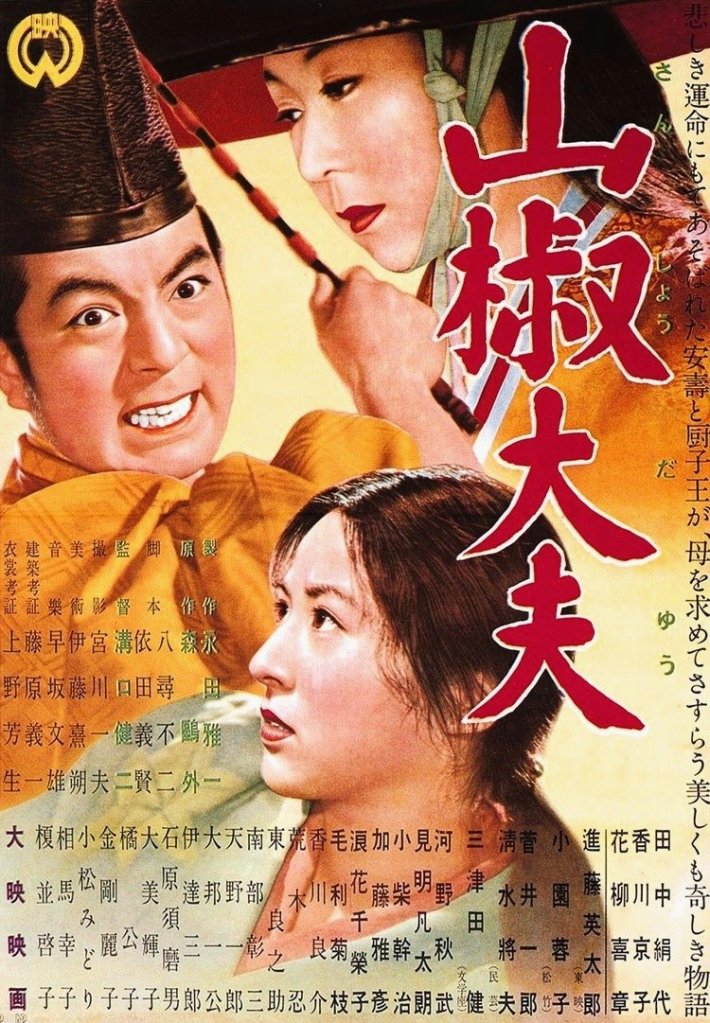
Based on an old Japanese folktale, an eleventh century feudal official is unjustly dispatched into exile. He leaves his family with a mantra: “without mercy, man is a beast. Even if you are hard on yourself, be merciful to others.” A few years later, while travelling, his wife Tamaki (Kinuyo Tanaka) and children are tricked and sold into slavery. Tamaki becomes a prostitute on the island of Sado, her children slaves on the estate of the brutal Sansho (Eitarō Shindō). As young adults, the son Zushiō (Yoshiaki Hanayagi) has buried his humanity as a cruel overseer but his sister Anju (Kyōko Kagawa) still clings to hope and her father’s principles. Can Zushiō’s principles be reborn, despite the brutality of their surroundings?

Mizoguchi’s film is a masterpiece on man’s capability to inflict suffering and cruelty, most particularly on women. Although full of qualities of a classic folk tale, Sansho the Bailiff is grimly realistic and unflinching about the suffering that slavery can inflict and remarkably unblinking in the human cost escaping from such a world can be. There are no fairy tale endings in Sansho, no clear victories, no satisfying conclusions. For every flash of hope, there is the grim realisation of the cost others have paid to achieve it. In particular, women carry an appalling burden of sacrifice.

The family is cruelly invaded in Sansho suffering a double separation – first the other members from the father, then the wrenching separation of mother from children. Shot throughout with a calmly controlled focus by Mizoguchi, with long takes combined with carefully controlled angles that frequently give a terrible distance to events, making the viewer feel powerless to prevent them. Tamika – played with extraordinary humanity and depth of emotion by Kinuyo Tanaka – suddenly understands what is happening and responds with a desperate struggle (which sees her faithful servant unceremoniously dumped off a boat to drown) while her children struggle hopelessly on land. Superbly subtle editing and framing that stresses distance (placing mother and children at opposing ends of the frame in alternate shots) only add to the sense of a family being torn apart.

This is as nothing to the grim world of Sansho’s estate. Slaves who do not work are beaten. The children are thrown into a shack and bluntly told to work or die. Anyone attempting to escape the estate is brutally branded. Old retainers at the end of their working life are expelled to die in the hills. Even Sansho’s son Tarō (Akitake Kōno) can’t bear life on the estate, refusing to brand recaptured slaves (much to the contempt of his father) and leaving for a life as a priest. Mizoguchi wants to show us a world where humanity has no concern for its brothers and sisters. Later we will see no one in power really gives a damn about the morality of estates like Sansho.

In this environment, the son gives up and makes the sacrifices he needs to survive. He becomes dead-inside, forgetting his father’s words and killing his humanity, the man Tarō refused to be. He will brand a recaptured slave (an old man who welcomed him on his arrival years ago) without a second glance. Yoshiaki Hanayagi’s eyes are dead, his spirit a curled animal which has forgotten itself. It’s his sister Anju, beautifully played with sensitivity and hope by Kyōko Kagawa, who clings to their past life and the belief that they can return to it.

To make that return, it’s Anju who will make terrible sacrifices. Sansho the Bailiff is awash with the cost of the world’s cruelty and lack of humanity on women. Tamika is torn from her children, her faithful servant drowned. On Sado, Tamika’s desperate attempt to escape and find her children sees her dragged back to the brothel and hamstrung to prevent her trying again. The dream of seeing her children again – captured in a beautiful sequence as she hobbles to the top of a cliff and sings notes of her sad song of longing for her children – becomes almost a curse, a continual beating on a bruise that will never heal, a longing others will taunt her with.

Memory lies through Sansho the Bailiff like a golden thread. Moments of quiet nature remind Tamika of her husband. His words will be constantly repeated by his family, the last-remaining link to an old life and principles that feel impossible to sustain in their new one. To close your mind to memory and the past, as Zushiō does, is to kill part of yourself. Tamika’s song of yearning is a new memory link. These memory links are strong – they have to be to try and sustain us.

And the words of her song travel. A new slave in the estate speaks of the sad song, to Anju’s delight – finally contact of a sort with her mother. In a moment of magical spiritualism, the words Tamika sang on the cliff seems to travel across the wind to be heard by her children at their lowest point. Zushiō in particular seems to wake from a deep sleep, and suddenly finds the humanity he had so brutally repressed. Mizoguchi shoots these moments with the same affecting simplicity – but it’s that carefully composed, painterly minimalism that gives them such huge power.

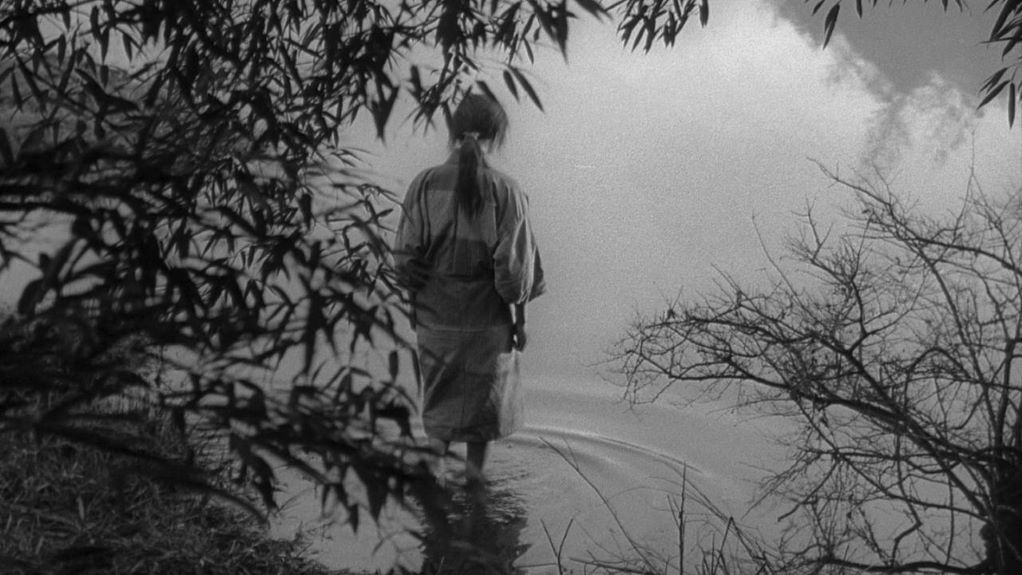
This powerful minimalism is nowhere more effective than Anju’s supreme sacrifice (the fate of women in Mizoguchi’s world). Giving Zushiō the chance to escape, Anju becomes aware that torture for knowledge of where her brother went is inevitable. With serene certainty she walks into the river to drown herself, moving with a sense of freedom she has not known for years. In a single shot we see her walk until Mizoguchi cuts away then back to show bubbles calmly rising to the surface of the water. It is an act of love, stunningly simple and hugely moving – and apiece of a world where freedom and any trace of goodness can only come about through irreversible sacrifices.

Like a folk tale Zushiō is restored to his father’s office, but finds he can make few changes. Slavery is abolished at Sansho’s estate – but the system cannot really be changed. The slaves know this to – they take their chance to sack the estate, aware that fortune’s wheel could return them once again to servitude. Sansho learns nothing from the events, and the suspicion is the next governor will pardon him (after all he brings more revenue in than anyone else). Sansho is the real world and he is inescapable – so much so he even owns the name of a film in which he is a minor player.

It builds towards the final conclusion on a windswept beach, perhaps one of the most heart-rending moments on film. In a Western film, this would be a scene of joyful reconciliation in which two damaged people heal through sharing grief. Mizoguchi had lived through the horrors of war and knew this would have been a lie. Reuniting doesn’t wash away the pain or heal the wounds – physical or spiritual – and doesn’t change the world. It’s just two people on a beach, clawing towards a moment of peace in a difficult world.

Sansho the Bailiff is clear-eyed and realistic about a world where people hurt each other and care nothing. Told with a classic, artistic simplicity, it is both a deeply moving and deeply spiritual piece, a great humanistic artist making his ultimate statement on the nature of the world. An essential film.

Spellbound (1945)

Spellbound (1945)

Hitchcock dives into psychiatry with mixed success in a middle-brow effort

Director: Alfred Hitchcock

Cast: Ingrid Bergman (Dr Constance Petersen), Gregory Peck (Dr Edwardes/John Brown/John Ballantyne), Michael Chekhov (Dr Alexander Brulov), Leo G Carroll (Dr Murchison), Rhonda Fleming (Mary Carmichael), John Emery (Dr Fleurot), Norman Lloyd (Mr Garmes)

Spellbound was born out of Selznick’s faith in the magic of psychiatry. It opens with a touchingly naïve dedication that stresses a little touch of Freud is a magic bullet: “once the complexes that have been disturbing the patient are uncovered and interpreted, the illness and confusion disappear and the devils of unreason are driven from the human soul”. Oh, would that it was so easy. Spellbound turns psychiatry as a sort of detective game, the subconscious a sort of smorgasbord of clues that, when shuffled into the correct order, will produce the answer.

The mystery is what exactly has happened to the new head of Green Manors Psychiatric Hospital, Dr Edwardes, here to replace the not-exactly-happy-to-retire Dr Murchison (Leo G Carroll)? The man who has arrived claiming to be Edwardes (Gregory Peck) may be charming but his odd obsessions with dark parallel markings on white surfaces, tendency to faint and lack of familiarity with psychiatry in general raise suspicions. Dr Constance Petersen (Ingrid Bergman), leading light of the Hospital, deduces Edwardes or “JB” as he vaguely remembers his initials being, is suffering from guilt-induced amnesia. Petersen refuses to believe – despite mounting evidence – that this man she has fallen in love with could be a killer. On the run, she recruits her old mentor Dr Brulov (Michael Chekov) to help analyse JB’S dreams, convinced the answer to the mystery is there.

Selznick hired his psychiatrist to act as a consultant on the film. This didn’t matter that much to Hitchcock, who considered the film essentially another murder-mystery thriller with a bit of Freudian dressing and bluntly told the advisor at one point when she protested yet another inaccuracy “my dear, it’s only a movie”. Spellbound is a decent, mid-level Hitchcock effort, with a touch or two of the master’s invention and magic, but which slows down for an extended act three analysis scene crammed with dodgy psychiatry and a detailed Salvador Dali-inspired dream sequence.

Of course, no one watching the film (rather like Cary Grant in Suspicion) could ever believe for a minute that the charming, handsome Gregory Peck is actually a murderer. Hitchcock’s trick is to keep the tension up, since (at best) there are only two suspects (and only one of them has a heavily advertised motive). You could argue here the trick is a “howdunnit” rather than a “who”. What mystery is Peck holding in his head and why can’t he remember who he is? Hitchcock throws in a host of little flourishes to keep us guessing, and if he clearly cares very little about Freudian insight (just as well, imagine the field day Freud would have had with Hitch) that hardly seems to matter.

Spellbound still manages to fairly barrel along, with a sparky script by Ben Hecht interweaving screwball banter between Peck and Bergman with cod-psychiatry. Hitchcock lets most of this play out fairly traditionally, but punctuates it with moments of flair. An early romance dialogue takes place in voiceover over a series of shots of doors opening to reveal a never-ending corridor (a neat visual metaphor for delving inside the mind). A tracking shot on a disturbed Peck down a flight of stairs, focuses on a cut-throat razor in his hand, ending with the razor alarmingly large in-shot. Disturbing POV shots make objects appear ultra-large, from a glass of milk (echoes of Suspicion) to a gun barrel turned to face us at the film’s conclusion. All of this is accompanied by an excellent score by Miklos Rosza which brings together romantic strings and the theremin to suggest the unsettling undercurrents of the subconscious. Rosza, rightly, won an Oscar for his hugely atmospheric work.

Spellbound is also notable for the way it inverts gender expectations. Peck effectively plays the damsel-in-distress here. Vulnerable and scared about what he could do, he lapses into catatonic panicked silence as much as smooth banter. Instead, for all the film stresses her feminine weakness when in love, it’s Dr Petersen who is the protagonist here. Played with a relaxed authority by Bergman, Constance is an assured professional and a dedicated campaigner for the truth. It’s she who constantly drives the plot forward and its her who plays both doctor and detective to crack the case and confront (with an assured coolness) the killer.

Hitchcock’s film provides a subtle commentary on the experience of women. Searching for JB in a hotel lobby, Petersen is first pestered by a drunk traveller who drunkenly all-but calls her a cock-tease when she asks him to leave her alone. Even when saved from an unpleasant scene by a hotel detective, he assumes her to be a schoolteacher or governess, and Petersen immediately recognises that disguising her accomplishments is a perfect way to gain this would-be-saviour’s help. Petersen also has to shrug off the pestering attentions of a colleague (John Emery).

But it’s her who eventually deduces the meaning of JB’s dream. This dream was heavily promoted as the work of Salvador Dali. While full of striking imagery, it feels more like a pastiche of Dali, as if a Hollywood art director threw The Persistence of Memory and Eyes for Your Eyes at the wall see what stuck. Which is pretty much what happened: Dali’s work was largely discarded for being too weird and overlong and William Cameron Menzies was bought into create something in Dali’s style. Selznick hardly cared – what mattered was promoting the Dali collaboration (Hitchcock had little to do with the scene, until it drew praise and he then claimed authorship).

It’s another striking moment in Spellbound. But truthfully the film is a careful construction of striking moments and performances, which power a simplistic and unrealistic plot which relies on coincidence and bizarre logic gaps. Psychiatry is a magic bullet – it’s hard to imagine anyone in real life reacting with the sort of glee JB does here when he discovers he didn’t murder his brother in his childhood, only accidentally fatally impaled him on some railings outside his house. The “revelations” from the analysis takes an over-extended single session with the unconscious yielding a series of Agatha Christie-style clues.

But then that fits Spellbound in the tradition of Hollywood psychiatry, from this to Ordinary People to Good Will Hunting, a touch of confession on a couch eventually solves all problems (all the kissing Peck gets from Bergman – which didn’t stop off camera – also clearly helped). Hitchcock’s work here is professional, but middlebrow. However, the odd imaginative shot, and the impressive performances (Bergman, Peck and also famous acting-coach Michael Chekov, immensely playful and Oscar-nominated as Constance’s cuddly mentor) still make this an entertaining watch.

Killers of the Flower Moon (2023)

Killers of the Flower Moon (2023)

Scorsese tries to tell an Indigenous story – but from the persecutor’s perspective

Director: Martin Scorsese

Cast: Leonardo DiCaprio (Ernest Burkhart), Robert De Niro (William King Hale), Lily Gladstone (Mollie Kyle), Jesse Plemons (Thomas Bruce White), Tantoo Cardinal (Lizzie Q), John Lithgow (Peter Leaward), Brendan Fraser (WS Hamilton), Cara Jade Myers (Anna Brown), JaNae Collins (Reta), Jillian Dion (Minnie), Jason Isbell (Bill Smith), Louis Cancelmi (Kelsie Morrison), William Belleau (Henry Roan)

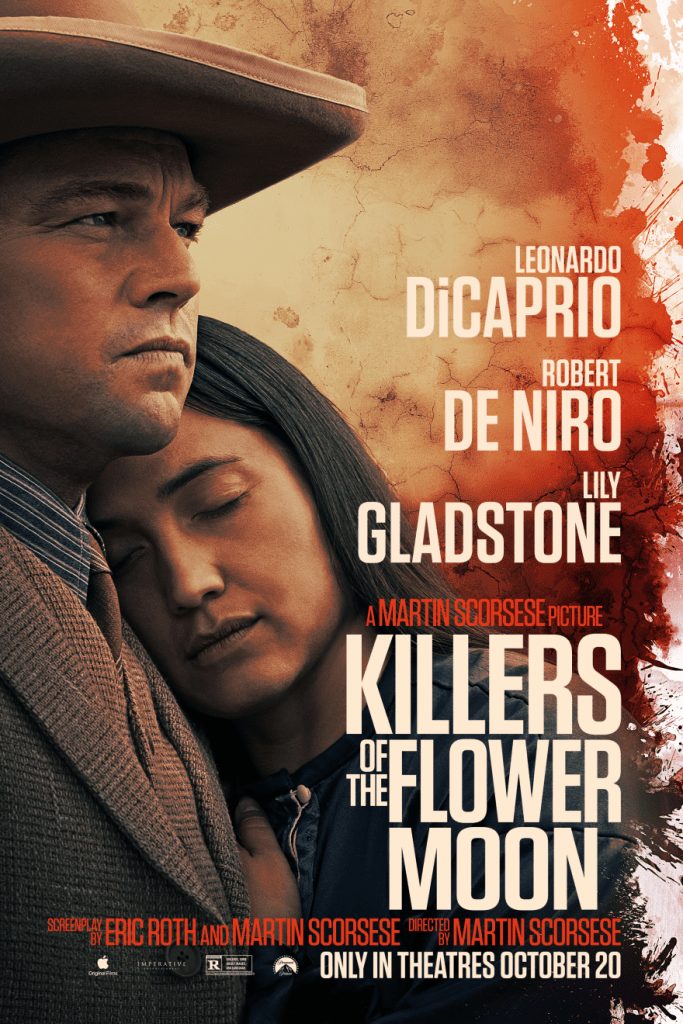
In the 19th century, the American government forcibly shifted Indigenous nations from their rich, fertile lands to unwanted backwater reservations. The Osage nation was moved from Missouri to Oklahoma, land no-one wanted… Until oil was discovered there in the early 20th century. Suddenly hugely rich, the Osage nation’s land once again became the focus of white Americans, as keen to dispossess these Indigenous people as they were in the last century. This ruthless grab of oil rights – and the brutal exploitation and murder of dozens of Osage people – is the theme of Scorsese’s epic Killers of the Flower Moon.

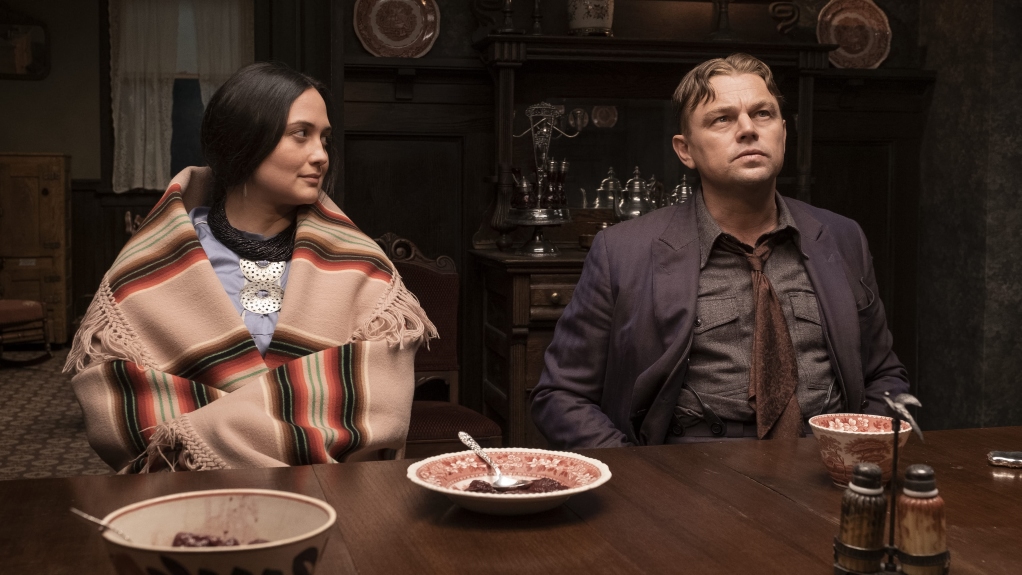
Ernest Buckhart (Leonardo DiCaprio) returns from war service (as a cook) to live with his uncle William King Hale (Robert De Niro) in Oklahoma. Hale lives on a ranch in the heart of reservation country and has built himself a powerful local presence by acting as benefactor of the Osage people. But Hale is, in fact, a ruthless sociopath who smiles cheerily at his neighbours, while plotting ceaselessly to steal their oil rights. Hale persuades Buckhart to marry Mollie Kyle (Lily Gladstone), whose family own headrights. While the gullible and easily-led Buckhart truly loves Mollie, he also willingly takes an active part for years in Hale’s schemes to murder the rest of Mollie’s family, so that their oil rights will collect with Mollie – and, in effect, with Hale.

Scorsese’s film is certainly a rich tapestry, but also a curiously mixed viewing experience. It feels at times like what it is – a film that dramatically changed its focus several times during its development, eventually reaching towards bringing the Indigenous experience to the screen, only to find that reach exceeding its grasp. The original book by David Grann focused on the FBI investigation into the crimes with DiCaprio originally set to play FBI investigator White (now played by Jesse Plemons). DiCaprio instead was drawn to the role of Buckhart, with the film repositioned to focus on the killers rather than the investigators or victims. During Scorsese’s extensive work with the Osage nation, the filmmaker became increasingly compelled by the exploitation of the Indigenous people.

Watching the film, it feels like a late swerve in focus Scorsese isn’t quite able to deliver on. However, some of the film’s most compelling content is its commentary on the Indigenous experience and the brutal exploitation and murders by a white community that sees the Osage people as second-class human beings. As a sort of twisted natural progression from encroaching on land a hundred years ago, people like Hale talk of marrying into Indigenous families, breeding out the blood and turning these communities into extensions of their own white families so they can control their wealth.

Over the course of the film, Scorsese carefully shows community gatherings becoming more and more dominated by white faces. Even tribal functions and ceremonies become awash with white faces, staring on with paternalistic, unfeeling smiles. From an early montage of Indigenous people enjoying their unexpected wealth (in a mix of historical and recreations photos and film stock), we progress ever more sharply into seeing whites take over. These fall into two firm categories: Masonic pinstripe types who stick together to cover-up crimes, and trailer trash and inept lesser-family members who are farmed out like cattle to soak up Osage wealth.

Scorsese’s film doesn’t shirk from depicting the casual racism of this community. A KKK march heads through the town. When Hale attends the cinema, he first sees newsreel footage of the Tulsa massacre then The Birth of the Nation. A montage of suspicious Osage deaths is marked by a Mollie voiceover stressing the lack of investigation. Osage oil owners are dispatched with increasing blatantness, as pretence of staged suicides and accidents degenerates into shootings, executions and finally bombs. Hale rants about the need to “take back control” and coldly states that they can escape any retribution because, fundamentally, no one cares or will remember.

But yet… this is still a film where we see a traumatic event happen to a group, but which focuses overwhelmingly on the perpetrators rather than the victims. I find myself agreeing with one reviewer that it feels at times like Get Out, told from the perspective of the white people. Scorsese’s film’s main beat feels like regret and guilt and perhaps what it needed was anger. For all its noble efforts, it’s hard to escape the fact that Mollie is the only Osage character in its epic runtime who is made to feel like a character, and she remains a person things happen to. The other Osage characters are, by and large, victims – Mollie’s sisters or William Belleau as Hale’s drunken, depressed neighbour – people who pop up in order to be dispatched.

I was reminded somewhat of The Searchers. In 1956, a film that criticised a John Wayne hero as an unpleasant racist was a big statement – but in a film where the Indigenous characters were still faceless nobodies, villains or comic relief. It’s similar here: Killers of the Flower Moon shows us the vileness of its white villains, but doesn’t really give us a full Indigenous perspective. And it feels, in 2023, we should do better. Even the impact and workings of reservations, land displacements and white-guardians isn’t explained in the film. Gladstone is marvellous – her eyes are full of suppressed pain, suspicion, fury and glimmers of the possibilities of forgiveness – but her character remains somewhat of a cipher, never quite receiving the exploration the killers of her family receive.

It feels like a realisation made during the filming, but without the time to deliver (after all the stars are playing the killers). Scorsese gives two beautiful Osage-themed bookends (and his carefulness around avoiding cultural appropriation is to be applauded), but the Osage themselves become passengers in their own story, allowed only a few brief moments to protest or express their anger. In a film that stretches over 200 leisurely minutes, more really should have been done.

Saying that, the film is blessed with two wonderful performances by Di Caprio and De Niro. DiCaprio, his mouth stuffed with rotten teeth, his body stumbling from scene-to-scene, expertly walks a tightrope between weakling and coward. Does he realise the moral morass he has climbed into? Or does he not care? How does he manage the mental gymnastics of plotting the deaths of his wife and her family and yet also convince himself that he is protecting her? It’s a fascinating performance. De Niro gives his greatest performance in 25 years as a polite, gentle man who warmly means every word of his friendliness but is also capable of acts of shocking murder and violence towards ‘his friends’ without even batting an eyelid. De Niro’s avuncular presence chills noticeably over the course of the film, brilliantly letting the egotistical dark heart leak out into the surface.

There is a lot to respect about Scorsese’s film, not least the way the late Robbie Robertson’s heartbeat-inspired score constantly creates an air of menace. It’s beautifully filmed – even if it is incredibly stately in its huge runtime – and it’s trying, very hard, to address an under-addressed issue in American culture. But it fumbles the ball because, for all its good intent, it still tells the story of an Indigenous group through the eyes of white people. Worse – their white persecutors. A braver, better (and shorter) film would have centred Gladstone’s Mollie rather than making her, at times, a passenger on a very long ride. Killers of the Flower Moon strains to make amends to Indigenous Americans – but instead it feels like a long guilt-trip for its white film-makers.

Richard III (1955)

Richard III (1955)

Olivier stamps his claim to Shakespeare’s greatest villain in this gorgeous theatrical epic

Director: Laurence Olivier

Cast: Laurence Olivier (Richard III), Cedric Hardwicke (Edward IV), John Gielgud (Clarence), Ralph Richardson (Buckingham), Claire Bloom (Lady Anne), Helen Haye (Duchess of York), Pamela Brown (Mistress Shore), Alec Clunes (Lord Hastings), Laurence Naismith (Lord Stanley), Norman Wooland (Catesby), Clive Morton (Lord Rivers), Douglas Wilmer (Dorset), Stanley Baker (Richmond), Mary Kerridge (Queen Elizabeth), Esmond Knight (Ratcliffe), John Laurie (Lovell), Patrick Troughton (Sir James Tyrell), Michael Gough (Murderer)

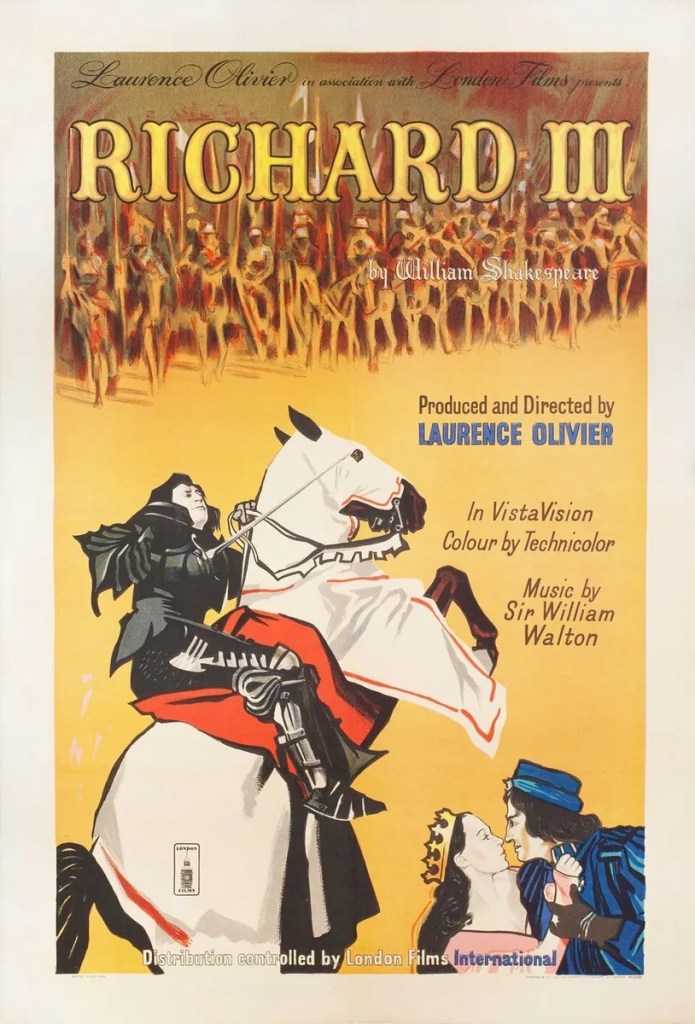
Olivier had played the greatest Shakespeare hero in Henry V and made Hamlet the most romantic princes of film. Having scaled those heights, did he also want to set the benchmark for Shakespearean villainy? Perhaps, with his vaulting ambition and competitiveness, he knew his clipped, precise tones and physical suppleness was perhaps best suited to playing the villain. What better role to prove it than the “poisonous, bunch-backed toad” himself, Richard III. Olivier bought to the screen a performance that would be as influential as his Hamlet (perhaps even more so), an embodiment of the role that all future Richards would be compared to.

I like to think of Richard IIII as a twisted inversion of Henry V. Like that film, the action is shot in lusciously beautiful technicolour, with beautiful costumes and a marvellously stirring, magnetic score by William Walton. It has courtly intrigues, a charismatic lead, the seduction of a young princess, many of the same actors and caps itself in a bravura battle shot on location. The only difference being that, instead of “the mirror of all Christian kings”, our lead is a twisted, remorseless killer who acts as his own Chorus to bring us on-side with his Machiavellian schemes. (There is a fun little opening message, stressing that this is a legend not the truth, that almost feels like an apology in advance to the Ricardian societies of today).

Olivier’s performance is the heart and soul of this film, and it’s possibly his finest cinematic (and certainly his finest screen Shakespeare) role. This Richard is openly – almost proudly – cruel and hypocritical, sociopathic in his amoral ease with the death and slaughter of his nearest and dearest (including his beloved wife, brother and nephews to whom he is sweetness and charm), overwhelmingly impressed with his own cunning and eagerly inviting us to share in his villainy. Olivier practically caresses the camera in his readiness to get close to us, forever turning towards it with a smile, quick aside or delighted breakdown of schemes to come. Olivier inverts his matinee idol looks into a stooped smugness (his costume, with its dangling sleeves, frequently makes him look like a spider) and his clipped vocal precision is dialled up to stress his heartless self-confidence.

Stare into Richard’s eyes and all we see is an uncaring blankness, the chill of a man who cares for nobody except himself. His sigil maybe a boar, but he resembles a wolf, devouring the Lords around him. Much of the first two thirds sees him keep a steady illusion of outward good fellowship. He comforts Gielgud’s Clarence with genuine care, greets Hastings like an old friend, is mortified and hurt by the suspicions cast on him by the Queen and her family, smiles with affection at his cousins. It means the moments where Olivier lets the mask slip even more shocking: the matter-of-fact abruptness he urges murderers not to take pity on Clarence, the whipped glare of pure loathing he shoots at the princes after an ill-advised joke about his hunched back or the imperious hand he shoots at Buckingham to kiss after being acclaimed by the crowds, harshly establishing the hierarchical nature of their ‘friendship’.

While the charisma of course is natural to a performer as magnetically assuring as Olivier – and this Richard is truly, outrageously, wicked in his charm – he also nails the moments of weakness. Having achieved the crown, Olivier allows not a moment of enjoyment of his feat, but his brow furrows into barely suppressed concern and anxiety that he may be removed by schemes exactly like his own. The threat of armies marching on him sees him first lose his temper publicly and then leap to cradle the throne in his arms like a possessive child. The morning of Bosworth, he even seems quietly shocked at the very idea that he could feel fear.

Richard III, despite its length, makes substantial cuts to the original play, including throwing in elements from Henry VI. Several characters – most notably Queen Margaret, whose major confrontation scene with Richard is lost altogether – are cut or removed all together. Olivier reshuffles the order of events, most notably shifting the arrest of Clarence to split up the seduction of Lady Anne. Richard’s late speech of remorse before the battle of Bosworth hits the cutting-room floor (Olivier’s Richard never seems like a man even remotely capable of being sorry for his deeds). Several small additions from the 18th century by Colley Cibber and David Garrick are kept in (most noticeably his whisper to his horse on the eve of battle that “Richard’s himself again”).

The film is deliberately shot with a sense of theatrical realism to it, Olivier favouring long takes so as to showcase the Shakespearean ease of the cast (much was made of the cast containing all four of the Great Theatrical Knights of the time in Olivier, Richardson, Gielgud and Hardwicke). The camera frequently roams and moves, most strikingly during the film’s first monologue from Olivier, where it flows from the coronation retinue outside the throne room, through a door, to find Richard himself waiting for us in the hall. It’s set is similarly theatrical, a sprawling interconnected building (with some very obvious painted backdrops) where the Palace of Westminster, the Tower of London and Westminster Abbey seem to be one massively interconnected building.

The film makes superb use of shadows, the camera frequently panning from our characters (especially Richard) to see their shadows stretch across floors and up walls. The claustrophobia of the interconnected set also helps here, making events seem incredibly telescoped (it feels like the film takes place in just a few days at most). It makes the court feel like a nightmare world completely under the control of Richard, who knows every corner to turn and can seemingly be in several different places at once. In that sense, filming Bosworth outside on location in Spain seems like a neat metaphor for Richard’s lack of control of events: suddenly he’s in a sprawling open field, where it’s possible to get lost and it takes genuine time to get from A to B.

Olivier may dominate the film with a performance of stunningly charismatic vileness, but he has assembled a superb cast. Ralph Richardson is superb as a supple, sly Buckingham, a medieval spin doctor whose ambitious amorality only goes so far. While I find Gielgud’s delivery of Clarence’s dream speech a little too poetic, there are strong performances from reliable players like Laurence Naismith’s uncomfortable Stanley and Norman Wooland’s arrogant Catesby while Stanley Baker makes a highly effective debut as a matinee idol Richmond. Claire Bloom superbly plays both Lady Anne’s fragility but also a dark sexual attraction she barely understands for this monster. Perhaps most striking though is Pamela Brown’s wordless performance as Mistress Shore (mistress first to Edward IV then Hastings), a character referred to in the play but here turned into a sultry, seductive figure who moves as easily (and untraceably) around the locations as Richard does.

Fittingly for a film obsessed with the quest for power, we return again and again to the image of the crown. It fills the first real shot of the film, bookmarking its beginning and end and frequently returns to fill the frame at key moments. With the films gorgeous cinematography, it’s a tour-de-force for its director-star and a strikingly influential landmark in ‘traditional’ Shakespeare film-making.

Cleopatra (1934)

Cleopatra (1934)

DeMille’s blockbuster is a fun, camp spectacle with plenty of his suggested sex and naughtiness

Director: Cecil B DeMille

Cast: Claudette Colbert (Cleopatra), Warren William (Julius Caesar), Henry Wilcoxon (Marc Anthony), Joseph Schildkraut (King Herod), Ian Keith (Octavian), Gertrude Michael (Calpurnia), C Aubrey Smith (Enobarbus), Irving Pichel (Apollodorus), Arthur Hohl (Brutus), Edwin Maxwell (Casca), Ian Maclaren (Cassius), Eleanor Phelps (Charmion), Leonard Mudie (Pothinos)

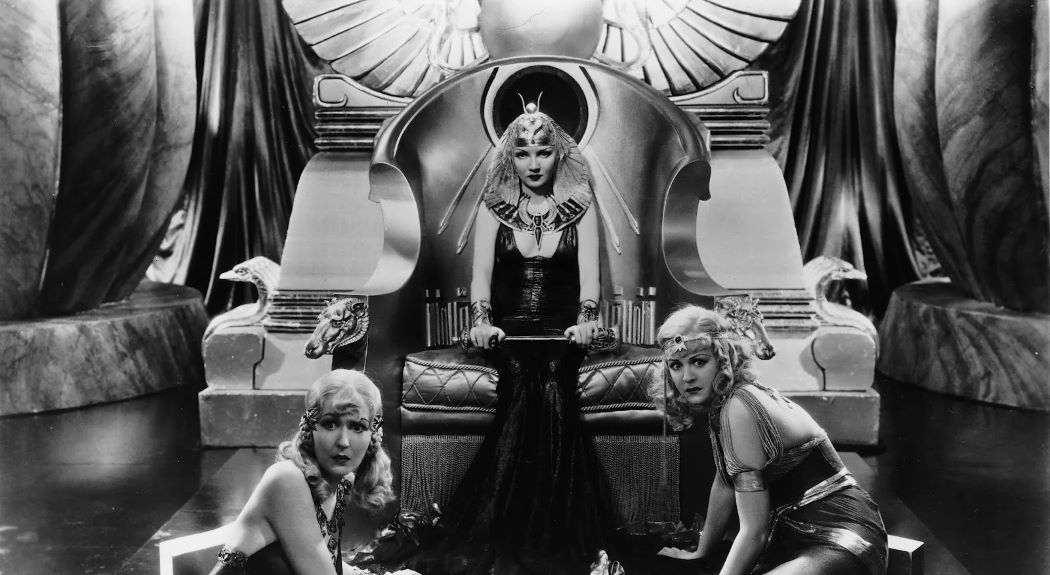
When a sand-and-sandals epic opens with a not-particularly-disguised naked woman cavorting erotically with incense, you know you are in Cecil B DeMille territory. Thirty years before the ill-fated Taylor-Burton epic, DeMille’s Cleopatra was the box-office hit of 1934. It was also a stompingly silly film, crammed with hammy performances and sexual imagery which it got-away-with in those pre-code days because it was an important historical subject taking place on humongous sets. But Cleopatra is also extremely good fun, a film so camply delighted in its naughtiness (and bowling along with such pantomimic energy) that it knocks spots off the turgid 1963 flop.

This Cleopatra follows pretty much the same structure (literally in half the time). Cleopatra (Claudette Colbert) is at war with her brother for the throne of Egypt. Smuggled into the presence of Julius Caesar (Warren William) wrapped in a carpet, she reveals the evil machinations of her rival Pothinus (Leonard Muddie) and seduces Caesar (possibly more with the prospect of controlling Egypt, since this Caesar is a power-mad cold-fish). When Caesar is dispatched by conspirators during the Ides of March, Cleopatra’s focuses on man’s-man Marc Anthony (Henry Wilcoxon) who is very open to her seduction. Before they know it though, the two are at war with envious technocrat Octavian (Ian Keith) who marches all of Rome to Cairo to crush the two. Bring on the asps!

DeMille shoots all this with relentless energy and pace, though not quite enough that you don’t notice the dialogue clunking out of the actor’s mouths (“You and your Friends, Romans, Countrymen…” a bitter Octavius observes about Anthony’s funeral oration). Cleopatra, like many of the Great Showman’s finest films (of which this is unquestionably one) gives us all the sex and smut we could possibly want, disguised in its classic setting. Cleopatra absolutely drips in lust and is crammed with suggestive imagery from top to bottom.

From that cavorting incense-carrier, we cut to the rooms Cleopatra has been kidnapped from. These look like nothing less than the aftermath of a kinky orgy, including a hog-tied servant who looks like he’s passed out in an asphyxiation sex-game. Colbert models a series of deep-dive dresses that leave little to the imagination. Poor, randy Marc Anthony doesn’t stand a chance (we know he’s a hot-blooded man because he never goes anywhere without his two barking greyhounds). Cleopatra even dresses at time like some musicals starlet, trailing billowing fabric behind her as she descends stairs.

Meeting her on her pleasure barge (this ship is practically Tardis-like in its interior dimensions) he’s treated to the sort of show that wouldn’t be out of place in Amsterdam’s Red-Light district. Scantily-clad ladies cavort, dancers dressed in skin-tight leopard skin are marshalled by a whip-carrying ring-master, while they cavort and engage in (literal) cat-fights until broken up by a crack of the whip. All the time Cleopatra reclines on a silk-covered bed, Colbert’s eyes flashing unmistakable “come hither” glances. No wonder the randy sod quickly finds himself going all-in on Egypt.

Along with sex, the film mixes in plenty of action. Caesar’s assassin is rather imaginatively filmed through a POV shot (“You? You too Brutus?!” Warren William intones in despair), as daggers fly in. The forthcoming battles are teased in an early scene where Caesar, bored with an Egyptian delegation, fiddles with various models of siege engines. All of these come into play in the film’s later sequences, that sees a parade of fast-cut war scenes overlaid: siege engines fire, armies plough at each other over deserts, ships clash at sea, men drown in agony. Much like the epic scale of Cleopatra’s court and barge, the film doesn’t skip on the epic conflict.

Between these two tent poles, we basically get a soap dressed to-the-nines in sandals, short skirts and armour. Claudette Colbert in a banner year (this was one of three hits she had, and she won the Oscar for It Happened One Night) is sultry, playful and if she never feels for even-one-minute like a figure from antiquity, at least she has that in common with the rest of the cast. She gives Cleopatra a charismatic energy that makes her believable as a figure round whom all else revolves. Wilcoxon plays Anthony with a thigh-slapping, hail-fellow-well-met quality. Warren William underplays as Caesar – which can make him look dull in a film as overblown as this – but makes for an effectively cold and calculating man.

Egypt, in its voluptuous naughtiness makes all Rome look rather dull though. Our capital is introduced in a house-party where the conspirators pose and moan like hammy matinee performers, stroking their historically incorrect beards, while the ladies bitch like New York housewives gleefully spreading catty gossip. Octavian is re-imagined as whining middle-manager, a weasily Ian Keith constantly moaning about never getting enough attention and clearly far-too inhuman to ever be stirred by Cleopatra the way the lusty Anthony is. With the frame of the film being classic antiquity, we can even pretend this is somehow serious drama when really it’s just Dallas.

These actors march their way through a series of break-ups and get-togethers, punctuated by moments of silly drama. (Cleopatra, Hamlet-like, even stabs Porthinus through a curtain seconds before he can assassinate Caesar!) But it all kind of works because you suspect nothing is really taken that seriously. DeMille is making a big pageant here, a walloping epic of lusty suggestion, powered by larger-than-life performances. It’s meant to fill you with excitement and awe, to make you gasp in awe. It doesn’t really matter that we get a shit-stirring King Herod (a smirking Joseph Schildkraut) or an Enobarbus who puffs like a regimental sergeant-major (C Aubrey Smith, giant of beard). It’s all about the spectacle, the drama and showmanship. And no one really does that sort of stuff better than Cecil B DeMille.

M (1931)

M (1931)

Lang’s masterpiece, a thrilling and complex crime drama that explores the horrors of crime and mob justice

Director: Fritz Lang

Cast: Peter Lorre (Hans Breckett), Gustaf Gründgens (Safecracker), Otto Wernicke (Inspector Lohmann), Ellen Widmann (Mother Beckmann), Inge Landgut (Elsie Beckmann), Theodor Loos (Inspector Groeber), Friedrich Gnaß (Franz, the burglar), Fritz Odemar (Cheater), Paul Kemp (Pickpocket), Theo Lingen (Conman), Rudolf Blümner (Beckert’s defender)

A murderer prowls Berlin’s streets. For weeks children have been murdered and the citizens are at fever pitch. The police are desperately trying every weapon in their investigative arsenal. The heightened police presence on the streets hampers the lives of regular criminals: they too decide to take matters into their own hands, pooling their resources to catch the killer. And the killer himself? Not a mastermind, but a peculiar, timid man (Peter Lorre), a slave to uncontrollable impulses.

All this forms Fritz Lang’s masterpiece, his first sound film and one of the greatest German films of all time. A rich, psychologically detailed procedural thriller it is a stunning indictment of mob violence, a detailed look at the flawed assumptions of the official forces and an unflinching look at the horrific personal impact of crime. Lang’s film is extraordinary, a brilliant mix of impressionistic insight and documentary realism covered in an all-revealing social tapestry. It’s gripping and extraordinary.

Lang’s film was heavily inspired by real-life cases, most notably Peter Kürten (“the Vampire of Dusseldorf”) and the structure of the Weimar police department. Just like the real Berlin, his fictional one has a criminal underworld governed by a sort of German mafia, the Ringvereine, who a bizarre social set of rules among criminals. M tied into debates around the death penalty: was it right to take a life, even for unspeakable crimes? Is a life in a psychiatric prison fair for the murderer of several children? M is fascinating as it provides enough ambiguity to support either side (Goebbels claimed, when watching it, that it was a sure sign that Lang would become “one of us”).

This stems from Lang’s superbly detailed, anthropological filming style, which throws the viewer into the centre of a world that feels extremely real. Streets are lined with beggars and an array of adverts, posters and political messages. The camera prowls down streets and over tenement blocks, catching shadows and gets lost in cigarette smoke. It captures every detail of the Berlin police department: forensic labs that breakdown fingerprints, annotated maps, criminal psychologists pontificating on the intellectual make-up of the killer based on his handwritten notes to newspapers. Detective Lohmann (an increasingly harried Otto Wernicke) puffs cigars, pulls together facts and fails to make any real progress, looking increasingly buffeted by events rather than controlling them.

It’s one of the film’s subtle criticisms of the political situation at its time. The official forces have every resource going, but seem powerless. Instead, Lang contrasts them ever more closely with the criminal underworld or use brute, uncontrolled, unordered force to tackle the problem. Is it my imagination, or is there the stench of Nazism in this group? Their nameless leader (Gustaf Gründgens) strides, with a leather-clad firmness, emotionlessly forward, fixated on the end result – despite, with at least three murders on his score card, arguably not being that different from the man he’s chasing killer. He instructs the criminals to effectively throw a dictatorial cordon around the city, their solution being stamping out freedom and taking unilateral action.

Lang’s film is sharply critical of the kneejerk horrors of this mob justice. Crowds are whipped up by press coverage (which they excitedly read, the papers hitting the streets with a special edition after every murder) into a mob desperate to lash out, crowding around posters offering rewards for catching the killer. A man giving the time to a child in the street is nearly lynched, a raised camera angle reducing him to a tiny figure compared to his aggressor towering over him. A group of people playing cards in a bar descend into blows after one accuses the other of behaving suspiciously. The criminal put together a show trial (with a token, powerless defence counsel) where the killer is allowed a few brief words before his pre-ordained lynching (no legality with Nazism).

Again, it’s hard not to consider the growth of street violence in Germany in 1931, an atmosphere where justice was slowly dying as the Nazi party argued people had the right to take violent action against those who they see as enemies of the state. The criminal organisation here are worryingly efficient and organised. Lang brilliantly intercuts between two meetings, both in smoke-filled rooms, as the police and the criminals plan their operations. Sentences started in one location are finished in another. Complementary camera angles echo each other. In the police meeting there are also calls for unilateral action. Lang criticises the authorities who are active but ineffective (and some sympathetic to the criminal’s viewpoint), as much as the brutal mob justice of the criminals.

And the killer himself? Brilliantly played by Peter Lorre (who resembles a perpetually frightened paedophilic toad), Hans Breckett is weak, feeble, as scared of himself as he is of others, unable to understand or control his urges. He is driven by a whistling tune of In the Hall of the Mountain King for Grieg (a whistling that he sometimes produces, at others seems to hear around him) and consumes the things he desires – be they apples, drinks or children – with an impulsive immediacy. His letters to the papers suggest he is desperate to be seen. But when he is, chased by the crowds, he’s weak, terrified and utterly unimposing, trembling amongst the flotsam of a factory almost indistinguishable from the debris around him. At his trial he attempts to vindicate himself with a whining desperation. But, as Lang quietly suggests, do we have the right to kill him?

After all, Breckett is almost certainly a war veteran. He shares that with several other characters – as we are reminded by beggars with wooden limbs. Maybe his split personality – perhaps that’s why he stares with curiosity at his own face in the mirror, as if he doesn’t recognise himself – is a relic of a conflict where men were encouraged to kill, then returned back into society where expected to do the opposite. Perhaps the same feelings also lie behind the ease so many people have with mob justice – and also those in the criminal jury who show some sympathy for Breckett’s forbidden urges.

As well as balancing these complex ideas, Lang’s film is also a masterpiece of visual and aural technique. A child’s death is suggested by a newly orphaned ball rolling into frame. A gorgeous hand-held camera shot wanders through the beggar’s bar, where beggars gather used cigars, rescued sandwich fillings and sign up to be the criminal’s eyes on the street. Sound transitions between scenes are handled with an extraordinary confidence. The silence of armies of policeman walking through the streets turning into burst of noise as they move through raids. The Grieg leitmotif is used to brilliant effect.

Lang’s film though never forgets the victims. we start and end with the parents. The mother of the film’s first victim, Elsie Beckmann, waits with increasing panic in her apartment, each knock of the door promising her daughter’s return but disappointing (we’ve already seen Elsie disappear, hand-in-hand, with Breckett’s whistling shadow). It’s to her the film returns to her at the end, her tear-stained face telling us no sentence will bring back the dead. Appearing over a wordless scene of Beckett’s actual trial (the result of which we never discover), its Lang’s subtle reminder that mob justice brings only false satisfaction, that killing never heals the wounds of loss and our effort would be better directed to protection rather than revenge. It’s a message that feels particularly poignant in a German film made in the final years before Nazism would lead the country into devastation.

Filled with stunning film-making confidence, mixing documentary realism and brilliantly confident visual and audio mastery, Lang’s M could be argued to be one of the greatest film noir detective dramas ever made – and also a brilliantly insightful look at human and social nature. M is a masterpiece, as gripping and relevant today as it was Lang filmed it.

The Last Command (1928)

The Last Command (1928)

Hollywood and the revolution meet in von Sternberg’s sympathetic look at White Russians

Director: Josef von Sternberg

Cast: Emil Jannings (Grand Duke Sergius Alexander), Evelyn Brent (Natalie Dabrova), William Powell (Lev Andreyev), Jack Raymond (Assistant director), Nicholas Soussanin (Adjutant), Michael Visaroff (Serge)

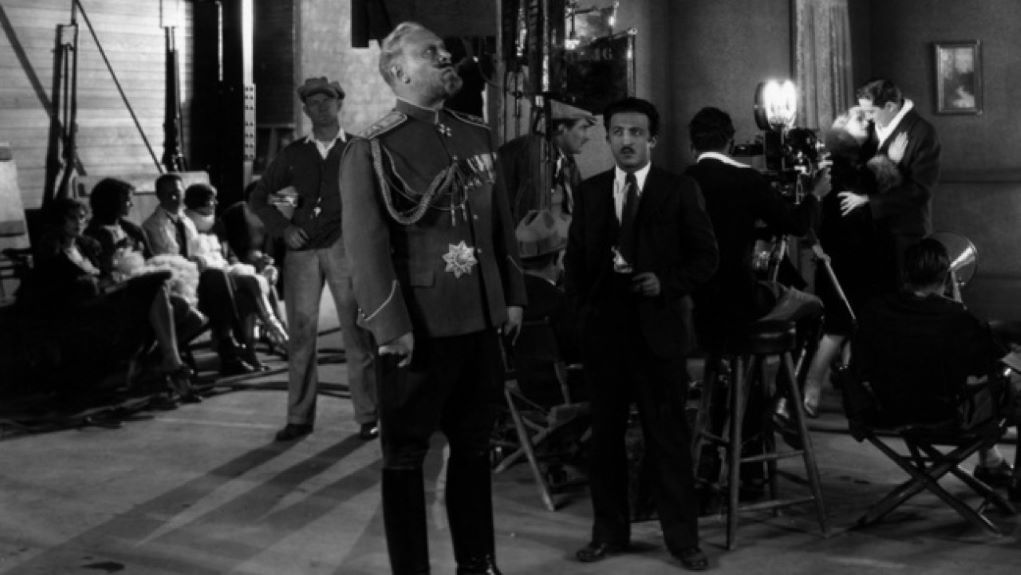
Hollywood director Lev Andreyev (William Powell) flicks through photos of extras, searching for someone to play the Russian General in his WW1 epic. His eyes light up – the perfect face! Sergius Alexander (Emil Jannings) is summoned. But Andreyev has ulterior motives: Sergius Alexander is a former Grand Duke who clashed with the revolutionary Andreyev in Russia ten years ago and this is the chance for revenge Andreyev has longed for. A cousin of the Tsar, Sergius Alexander was commander of the Western Front. Imperious but noble, deeply patriotic, he gave everything for Russia, despite falling in love with revolutionary Natalie Dabrov (Evelyn Brent). The revolution turned Sergius into a traumatised shell and kitting him out in uniform again impacts his sanity.

Von Sternberg’s The Last Command is two films mixed into one. It’s partly a satire on Hollywood, a machine specialising in creating artificiality that chews extras up and spits them out with little regard for their well-being (rather like the trench system the film is set in). The other – and more dominant – part is a classic melodrama of a noble Russian lost and powerless as his world collapses around him. It’s this second part that dominates the film, almost an hour of its ninety-minute run-time being taken up with its Russian flashback sequence. Like many von Sternberg films it’s charged with a mix of sex and sadomasochism, while also being a sympathetic, white-Russian look at the revolution.

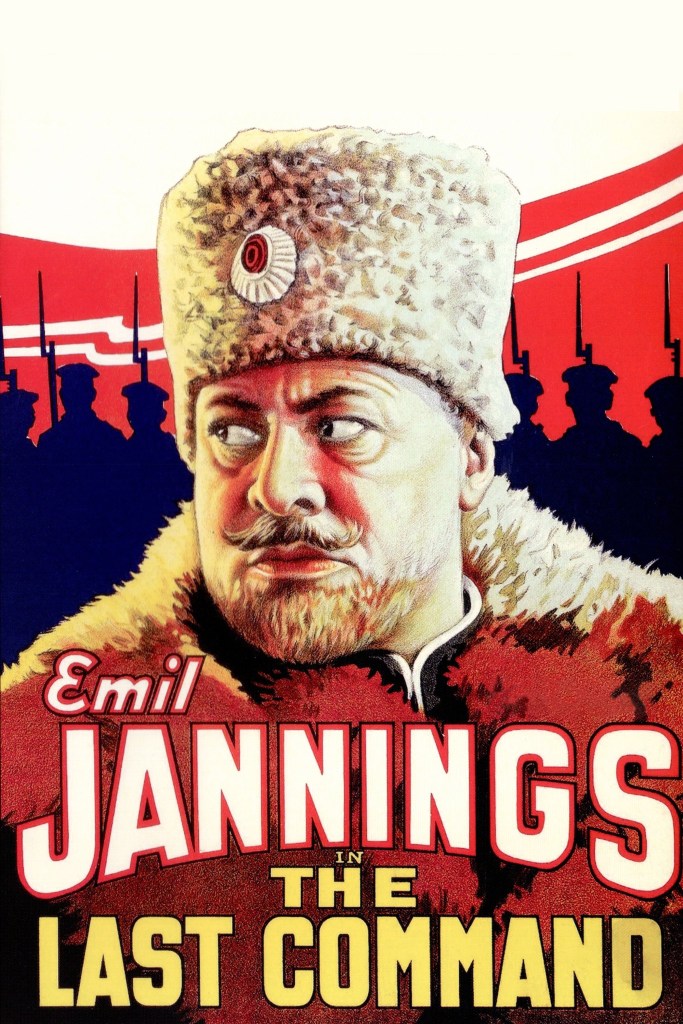
Emil Jannings received the first ever Best Actor Oscar for this (and the now lost The Way of all Flesh). At the time Jannings was seen as one-of (if not the) greatest actor in the world, based on his mastery of the expressive arts of silent cinema. Janning’s physicality, his emotion-filled piercing gaze is duly showcased. Jannings effectively plays two parts: the Sergius Alexander of the Russian era, the Russian aristocrat who emerges as a man of honour, dignity and patriotism; and the Sergius Alexander of the present day, a timid, broken man, forever twitching, scared to look people in the eye. In both cases, von Sternberg’s camera constantly pulls back to Jannings whose ability to transform and twist his body – from ram-rod officer to broken husk – is executed perfectly.

Von Sternberg’s gives the bulk of the film’s run-time over to the build-up of the Russian revolution. While The Last Command gives some criticism to the ancién regime – our first shot is of a poverty-stricken mother and baby sitting in the snow, while the Tsar is a paper king more interested in parades than reality – von Sternberg’s affection is clearly for the decent nobles trying to make the system work. The revolutionaries are largely violent or shadowy manipulators (we get a brief scene with obvious Lenin and Trotsky stand-ins, presented as hypocritical middle-class looking schemers focused on power). On the contrary Sergius Alexander is interested only in the good of Russia.

It’s that which wins him the unexpected respect of feared revolutionary Natalie Dabrova, well played by Evelyn Brent. Dabrova is a power-keg whose fire and passion seizes the fascination of Sergius. Their initial meeting is the only time von Sternberg presents him as a tyrannical figure, sitting in an office questioning potential revolutionaries for his own amusement (including a whip across the face for Andreyev). But from there Sergius’ essential decency emerges – his politeness, his old-school chivalry. He treats her like a lady and (eventually) courts her with a Victorian gentility.

That contributes to Natalie’s shift towards seeing Sergius as a man trying his best in difficult circumstances rather than the ogre she assumed. Von Sternberg masterfully shoots the pomp and pageantry of the old Russia, full of military parades, fine dining and smart uniforms using this pageantry to show how it disguised the real threat facing the country. There are also elements of the sado-masochistic in the relationship between Natalie and Sergius. This bastion of the system is attracted to this woman who wants to burn the whole thing down. Visiting her in her bedroom, spotting a hidden pistol, is there an air of debased excitement when he turns his back on her and all but invites her to shoot him? In turn, Brent is almost a prototype of the classic Dietrich character, a strong, imperious woman, who dominates men, torn between conflicting desires.

There is a neat series of contrasts and contradictions in all the characters in The Last Command. Sergius is both a Tsarist bully, a decent man interested only in his country and a shattered husk in Hollywood. Lev is a firebrand revolutionary and an aristocratic Hollywood director. Natalie is a fascinating mix: a banner-waving anarchist who fits neatly into Sergius’ cocktail parties, who despises and loves the General. Duality and hidden identities hints at hidden desires within all the characters in a world tearing itself apart.

That collapse of order is the stunning heart of von Sternberg’s film. The seizure of Sergius’ train by revolutionaries, the final act before his exile, is superb in its vibrant tracking shots and Eisenstein-inspired energy. Jannings is placed at the heart of the crowd in a series of tracking-shot marches through baying crowds all pulling, spitting, pushing and abusing him that is part walk to calvary, part fantasy of humiliation. There are moments of understanding for the masses – a scene shows Tsarist soldiers machine-gun down a mob – though it’s balanced by the ruthless shooting they carry out on wounded soldiers. Sergius is reduced to the lowest-of-the-low, a humiliated figure shovelling coal for his revolutionary masters while they conduct (what looks like) an orgy in his state compartment.

Humiliation is also the name of the game in Hollywood. While The Last Command is more about its sympathetic look at good White Russians let down by the system (fitting von Sternberg’s imperialist sympathies), it throws in to its first and final act an uncomfortable look at Hollywood. Extras crowd at the studio door as another sea of desperate humanity (Sergius’ buffeting here in this crowd, must remind him of that humiliating walk through the mob in Russia). Costumes are flung at people identified only by tickets. Assistant directors treat people like dirt and extras are seen only as props.

But the satire is blunted by the fact that the treatment on set is motived by personal animosity. After all this is Lev – William Powell, rather good and clearly channelling von Sternberg – living out his own revenge fantasy. A sharper satire would have had no link between director and extra, merely seen the heartless system exploit a past trauma for its own benefit – with terrible consequences.

The Last Command is less a satire on Hollywood and more a rose-tinted look at the decent figures in the Tsarist system, with touches of satire on revolutionaries who are either power-mad middle-classes or working-class simpletons seduced by the temptations of drink and sex. It’s also a subtle smuggling in of the director’s own sexual fascinations, with Jannings a superb vehicle for this fantasy of humiliation with Brent shot with the sultry imperiousness of a potential dominatrix. For all this it’s a fine film, a visual marvel and a fascinating character study.

Apu Sansar (1959)

Apu Sansar (1959)

Satyajit Ray’s trilogy comes to close with another masterfully done small-scale story of hope and loss

Director: Satyajit Ray

Cast: Soumitra Chatterjee (Apu), Sharmila Tagore (Aparna), Alok Chakraborty (Kajal), Swapan Mukherjee (Pulu), Dhiresh Majumdar (Sasinarayan), Sefalika Devi (Sasinarayan’s wife), Dhiren Ghosh (Landlord), Tusar Banerjee (Bridegroom), Abhijit Chatterjee (Murari)

As he stands, consumed with despair, watching a train rush perilously close to him, does Apu (Soumitra Chatterjee) remember when he ran with excitement after the trains as a boy? Apu Sansar, the conclusion of Ray’s breathtakingly humanist trilogy, concludes another cycle in Apu’s life; one touched, as with the previous ones, with loss, tragedy and a dream of hope. Beautifully filmed, simple but deeply affecting, it’s a breath-taking culmination of this masterful trilogy.

Apu (Soumitra Chatterjee) is now a young man longing for a career as a writer in Calcutta. Attending the marriage of his friend Pulu’s (Swapan Mukherjee) cousin Aparna (Sharmila Tagore), he finds himself surprisingly roped into the role of groom to take the place of the unsuitable intended (as part of Hindu tradition to prevent the risk of Aparna never marrying). Returning with Aparna to Calcutta – and a life of poverty she is unused to – their romance flourishes into a happy marriage, until tragedy strikes leading to Apu tumbling into years of drift and depression.

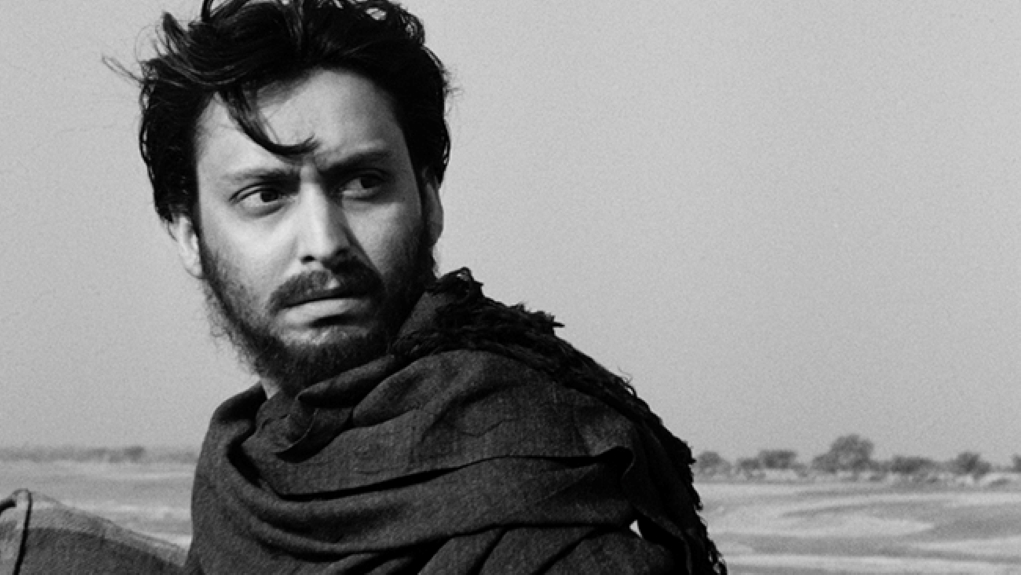
Apu should be used to tragedy by this point. In Ray’s series, death has always raised its deadly force in his life. In Pather Panchali his beloved sister passed away from sudden illness. In Aparajito the death of his mother leaves Apu stricken with guilt and grief. It’s natural that Ray’s subtle trilogy continues to look at how closely tragedy and sadness dog hope and contentment. Tragedy this time strikes Apu out of the blue, a searing, raw pain that Ray conveys to us almost entirely through a series of still, tender shots of Soumitra Chatterjee’s face as Apu’s world falls apart around him.

Ray’s film, with its beautiful observational style and low-key camera work (and use, at several points, of low angles) reminded me sharply on this viewing of Yasujirō Ozu. Apu Sansar follows in Ozu’s footsteps in its careful, focused study of the lives of ordinary people and how whole worlds of love, hurt and joy can be contained within small rooms. Unlike Pather Panchali or Aparajito, there are few shots of the widening countryside or the scale of the cities. Instead, Apu’s world seems smaller and more intimate, its focus on his apartment and a few other locations, site of momentous events that will shape his life.

Marriage is at the heart of that. His relationship with Aparna has an inauspicious start, Apu roped in as a husband due to the mental incapacity of Aparna’s intended. (There are hints that the possibility of a replacement husband being expected lie behind the last minute, out-of-the-blue invite Apu receives from his friend Pulu which, if true, does add a slightly more manipulative quality to his amiable college friend). The two of them don’t know each other and have little or no idea if they even have anything in common. Their first night together is one of slightly awkward, exploratory talking and it leaves the viewer wondering if common ground can be found.

But Ray sketches out the development of this relationship into something strong, living and (eventually) heartbreaking with a mastery of little touches and his skill with montage and transition. Aparna is at first thrown by the poverty of Apu’s life in Calcutta (similarly to the Dickensian nature of Aparajito he lives in a rain-soaked apartment on a month-to-month basis). But she sets to work to turn this place into a home and soon little touches abound that denote their growing closeness. A cigarette pack hidden under Apu’s bed that Aparna has written a message in, pleading him to smoke only after meals. Late night conversations – which involve a brilliant Ray cut as the camera zooms into the fan between them and out again as a transition finds them sitting again opposite each other on a different night. The pleasure Apu takes in buying her the smallest gifts and the pride Aparna has in turning his home into something cleaner and more decent.

The future seems bright for them. In Ray’s trilogy the future and the march of time and civilisation has often been represented by trains. This theme continues masterfully in Apu Sansar, however this time with the train taking on a more sinister, dangerous presence. Apu’s apartment overlooks a major railway junction his home frequently invaded by the sounds of the train and an onslaught of smoke from the engines. Rather than offering tempting possibilities, this increasingly feels like an intrusion, an outside force intruding into the haven that Apu and Aparna are trying to create.

This sense of invasive menace is captured exquisitely in a beautiful but haunting shot as Apu stands on his balcony – the train sounds build and then smoke from the engines pours across the balcony and seems to envelop Apu. His home can be a place of wonder and beauty, but its harmony is always under siege from transportation that, like time, relentlessly moves forwards. It’s the train that will carry Aparna away from Apu, back into the countryside for her fateful lying in before giving birth. It’s a gift of a toy train – a chance at a future together – that Apu’s son will throw in his face five years later. It’s the same train, that dangerous future finally left behind, that Aparna’s father will clutch to him as Apu heads into a more hopeful future. Throughout trains intrude, threaten and signal danger and separation for Apu.

Soumitra Chatterjee is excellent as this young man who has seen so much, learned so many things, but also seems destined to repeat the mistakes of the past. Like his father he is a dreamer, planning a loosely autobiographical novel and beginning to exhibit the same Micawber-like expectations that something will turn-up. Perhaps over time, without tragedy, Aparna might have become his mother, beaten down with the burdens of being the sensible rock for a flighty man unable to settle.

Perhaps tragedy is what is needed for Apu – Apu Sansar is notable for its lack of romanticism for poetic longings and its favouring of embracing actual responsibilities. There are few other films where the destruction of a nascent novel could be met with such bitter-sweet acceptance. Certainly, no Western films, where the dream of having it all is baked in. The Apu Trilogy is partially about accepting things as they are and taking on your responsibilities: dreams and self-focused desires have no place in that. After all the trilogies hero, perhaps even more so than Apu, is his mother Sabarjaya who gave everything to give Apu opportunities.

Apu finally accepts his place in this cycle after years of denial and grief by seeking to build a relationship with a son he has never met. Ray charts this slow thawing between strangers with a delicacy and emotional force striking in its simplicity. It’s really striking to me how each film in this trilogy is slightly shorter than the one before, as Ray mastered that less really can be more with every frame: that sometimes the emotional force of a single glance can be greater than that of a tracking shot. Apu Sansar is a film brimming with confidence, from a director who has mastered his aim and subject. A heart-breaking, but also heart-warming, conclusion to a great trilogy.

Venom (2018)

Venom (2018)

Totally unoriginal and standard comic book caper, saved only by its inventive lead performance

Director: Ruben Flesicher

Cast: Tom Hardy (Eddie Brock/Venom), Michelle Williams (Anne Weying), Riz Ahmed (Carlton Drake/Riot), Scott Haze (Roland Treece), Reid Scott (Dan Lewis), Jenny Slate (Dora Skirth)

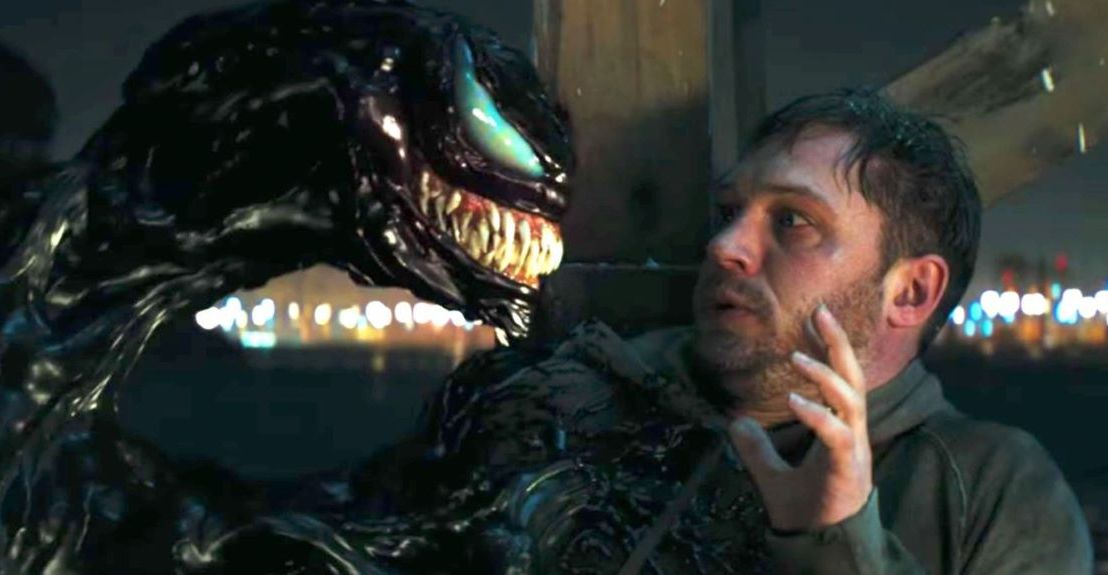
Did this film catch me in a good mood? Much to my surprise I rather enjoyed this dopey attempt to bring fanboy-fav villain Venom to the big screen. Last seen adding to the silliness in the utter mess that was Spider Man 3, the outer-space slime who possess its host returns as an anti-hero. Sure, he likes to eat people and suchlike, but when push-comes-to-shove he’s on our side helping to keep our world safe. Safe sums up Venom, which offers a series of set-pieces none of which are troubled with originality. What makes it stand out is the delight Tom Hardy brings to the role.

Hardy is Eddie Brock an investigative journalist framed by the film as a success who gets unlucky, but embodied by Hardy as a loser (it’s the first sign of Hardy’s originality butting up against the film’s obviousness). Fired after his investigation into shady goings-on at Biotech company Life Foundation – run by charismatically cold billionaire Carlton Drake (Riz Ahmed) – Brock goes from hero-to-zero and his fiancée, lawyer Anne Weying (Michelle Williams) leaves him after finding out he stole from her to gain access to Life Foundation. Brock continues his investigation after homeless people start to go missing. They were unwilling test subjects in Drake’s attempt to bond human beings to mysterious alien symbionts. Eddie is infected with one of the symbionts, Venom, the two of them forming an uneasy partnership in their body share. Will they work together to save the Earth?

Most of the success in Venom is exclusively down to Hardy. Where the film zigs, Hardy zags. Venom clearly wants a traditional, handsome, charismatic journalist hero, the sort of guy who puts the greater good first and only fails when he’s let down. Hardy plays him as a grungy odd-ball with a whiny voice, frames most of his decisions as taking the easy path and is happy to show him backing down from challenges. Hardy then pounces on the chance to counter-balance this with Venom, a gravelly id-machine that ends up playing like the dark underbelly of Brock’s hidden desires.

The most interesting parts of the film by far is the internal conversation between these two Hardy performances. Venom is the foul-mouthed monster who wants to indulge himself, Brock is the passive timid figure forever asking Venom to behave himself. Hardy gives the film a sort of gay subtext as frenemies Brock and Venom settle into an odd-couple life partnership. At one point Venom infects a second character: how does he “re-enter” Eddie? Through a passionate kiss between the Venomised second host and Brock. The two of them spark off each other like a feuding married couple, with Venom’s decision to protect the Earth based eventually on ‘liking’ Eddie.

It’s the main original beat in the film that Hardy seizes upon to make its heart. His performance is droll, playful, physically committed, strangely funny and rather sweet. It’s a heck of a lot better than the film deserves and its leaning into making its personality-split lead a weakling and a monster who effectively, unspokenly, fall-in-love feels very different from things we’ve seen elsewhere.

Which is good because almost everything else has been seen and done elsewhere. Fleischer largely fails to make any of the action sequences particularly new or interesting. There is a punch-up in an apartment (which does see Hardy bouncing around the room with a symbiote induced athleticism), a traditional car chase full of car smash-ups that Flesicher is so excited about he presents the smash-ups occurring multiple times from different angles. A SWAT team chases Venom around a building before a Terminator 2 style tear-gas filled foyer smackdown – with the hero imploring the killing machine he’s working with not to hurt anyone. (The humanising of Venom does have echoes of the taming of Arnie’s Terminator).

As in multiple Marvel films the villain is a dark echo of the hero. Riz Ahmed coasts through a barely written role of an egotistical Steve Jobs type, before merging with a-properly-Evil symbiote intent on loosely defined global destruction. This inevitably leads to a prolonged film-closing CGI-smackdown, as two opponents with the same skills face-off to control the launch of a rocket. No interesting comparisons or contrasts are drawn between Brock and Drake who gets only a whiff of motivation.

There are more interesting beats – though again not quite original – with Michelle Williams’ former fiancée who is given both a few proactive beats and a highly likeable and sympathetic new boyfriend in Reid Scott’s Dan Lewis (playing against the sort of smug roles he is often cast in). These fine actors bounce well off Hardy – and share in his delight in dopey humour and slapstick, noticeably in a posh restaurant sequence that sees Hardy sink himself in a lobster tank and eat the inhabitants.

Away from this though Venom is nothing special. So why did I enjoy it? Because I suppose in its derivativeness it at least offers brain-relaxing fun and it’s lifted to a slightly higher level by Hardy’s inventive approach. Aside from him there is almost nothing original, interesting or different here – but yet I enjoyed it while it passed the time.