Category: Ancient Rome film

Centurion (2010)

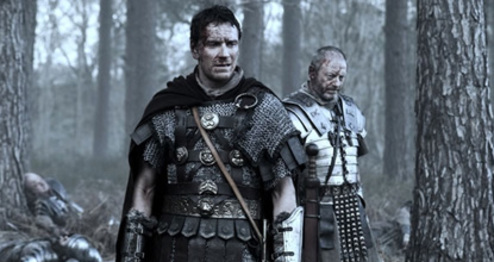
Michael Fassbender surveys the devastation that is Centurion

Director: Neil Marshall

Cast: Michael Fassbender (Quintus Dias), Olga Kurylenko (Etain), Dominic West (General Titus Flavius Virilus), Liam Cunningham (Brick), David Morrissey (Bothos), JJ Feild (Thax), Noel Clarke (Macros), Riz Ahmed (Tarak), Dimitri Leonidas (Leonidas), Ulrich Thomsen (Gorlacon), Imogen Poots (Arianne), Paul Freeman (Gnaeus Julius Agricola), Rachael Stirling (Drusilla), Less Ross (Septus)

It’s an old fable: the “missing” Roman legion, the 9thLegion that allegedly marched to Scotland around 120 AD. We don’t know what happened (if anything) but it usually gets tied into Hadrian’s decision to build his famous wall. Anyway, Neil Marshall’s film tries to plug the gap, with the Legion eradicated on an ill-judged expedition north to settle affairs there once for all. A “ragtag bunch” of survivors (all of whom match expected character tropes) have to run over hostile countryside, led by surviving senior officer Centurion Quintus Dias (Michael Fassbender) to get back to safety and Roman lines.

It’s a Neil Marshall film, so you can expect blood-letting aplenty and high-octane action on a budget. And you more or less get it, mixed with his love for accelerator-hitting chases and against-the-odds action. It’s entertaining enough, but its main problem is that it feels a little too by-the-numbers, as if all the thought about how to make it original and exciting went straight into the look and style of the film – all drained out colours and serious claret – and none at all into storytelling or character.

You sort of end up caring for the characters in a functional way – largely because they are all such familiar types – but their personalities seem to have been designed entirely around the various deaths that have been invented for them. So the enthusiastic meet unjust ends, the likeable fall to cruel chance, the world-weary give their lives for one more stand, the selfish meet justice. At the end, the characters you would basically expect to stumble to the finish line do. It’s a film that lacks any uniqueness.

In fact, what gives the characters life is the professional character actors playing them, all of whom can do what they are doing here standing on their heads and look like they were largely there with an eye on pleasant after-shooting hours in a series of local pubs. It’s hard otherwise to think what attracted them to these cardboard cut-outs and pretty familiar structure.

Not that there is anything wrong with what Marshall does with his film here – it’s a lot of fun when stuff is happening, it’s just that nothing feels like it carries enough weight or originality to survive in the memory. Everything is fine but nothing is really inspired. There is very little sense of Ancient Rome or any other place. The Romans are basically squaddies, an idea that sounds interesting until you remember turning period warriors into versions of modern soldiers is hardly new, while the Brits chasing them are woad-covered psycho stereotypes.

So while it passes the time, Centurion does nothing special with it. It feels like a wasted opportunity – that with a cast this good and a decent premise, plus a nice little historical mystery to pin it onto in order to give it depth, Marshall could have come up with something that was more than the sum of its parts rather than less. Perhaps it needed more time with its ragtag group so they actually became characters rather than plot devices. Perhaps it needed to take more of a rest from its constant chasing to allow quieter moments of reflection and character. Perhaps it’s just a chase film that is never quite compelling enough to make you overlook these things. Either way, Centurion isn’t an all-conquering empire of  film.

King Arthur (2004)


Clive Owen leads his merry men in clumsy would-be Arthurian epic King Arthur

Director: Antoine Fuqua

Cast: Clive Owen (Arthur), Ioan Gruffudd (Lancelot), Keira Knightley (Guinevere), Stellan Skarsgård (Cerdric), Ray Winstone (Bors), Mads Mikkelsen (Tristan), Joel Edgerton (Gawain), Hugh Dancy (Galahad), Ray Stevenson (Dagonet), Stephen Dillane (Merlin), Til Schweiger (Cyrnic)

The story of King Arthur has entertained generations for so long, it’s actually a bit of a surprise that there hasn’t been a great movie made about it. Sure there have been entertaining guilty pleasures (like my love for the bobbins Excalibur) but there hasn’t been a great action adventure made about the legendary king. And this Jerry Bruckheimer actioner sure ain’t it. But it re-enforces my seemingly never-ending appetite for distinctly poor, big-budget, epic films.

Arthur (Clive Owen) is a half-Celtic Roman cavalry officer who commands a Sarmatian cavalry unit, serving a fixed term of service with Rome. They help to guard Hadrian’s Wall against rebel native Britons. Before their discharge, the knights are given one last job: go behind enemy lines to rescue a prominent Roman citizen living beyond the wall. Once they arrive, they find he has enslaved the local Brits – including imprisoning a young woman named Guinevere (Keira Knightley). Knowing a Saxon invasion force lead by the fearsome Cerdric (Stellan Skarsgård) is ravaging Britain – and that the Romans are withdrawing from the empire – Arthur decides to lead the whole group back to the wall and safety.

King Arthur isn’t a terrible film, just a totally mediocre one. It’s an uninspired coupling together of half-a-dozen other better movie: from its Dirty Dozen line-up, through its Gladiator style score (Hans Zimmer rips himself off again), to its remix of a thousand period sword epics from Spartacus on, mixed with its Braveheart style design and battle scenes. It’s almost completely unoriginal from start to finish. There is no inspiration here at all – it’s made by people who have seen other films and based everything on that rather than wanting to make a film themselves.

It even wraps itself up with an unseemly haste, as if all involved knew they hadn’t nailed it so decided the best thing to was to knock the whole thing on the head and call it a bad job.

The film probably stumbles from the start with its claim to present a sort of “true historical story” of King Arthur. Now I’m not one to get hung up on historical accuracy too much – except when it’s making extravagant claims which are just not true – but the “true story” here is bobbins. Nothing really feels right – from the Roman politics to the idea of a group of loaded Roman settlers setting up a huge estate deep into Scotland (I mean what the fuck was Hadrian’s Wall for eh?). The knights bear very little resemblance indeed to their legendary counterpoints. In fact it’s almost as if they had a script about a brave band of Roman soldiers and just stuck the name King Arthur on it for the name recognition (perish the thought!).

The idea of a group of seasoned, grizzled warriors isn’t a bad one – and it works rather well here because most of the actors in these roles are pretty good (particularly Mads Mikkelsen as a sort of Samurai Tristan). It makes for some interesting dynamics and always some fine character work – the best arc going to Ray Stevenson’s Dagonet as a knight who finds something to fight for. It also contrasts rather well with Stellan Skarsgard’s world-weary villain, who’s seen it all and finds it hard to get excited about ravaging and pillaging anymore.

But it’s a shame that this promising set-up gets wasted. After a good start, when we get to see all our heroes’ personalities reflected in their fighting styles as they repel an attack on a bishop, these dynamics quickly settle down into the usual tropes: you’ve got the joker, the cocky one, the reluctant one who’s only out for himself… Fortunately the Director’s Cut (which I watched) deletes the worst of Ray Winstone’s comic “banter”, but it’s still pretty standard stuff.

The mission behind the wall then pretty much follows the pattern you would expect: the guy they go to rescue is an unsympathetic bastard, they find themselves protecting the weak, it’s a dangerous journey back to safety, blah-blah-blah. Although a battle on the ice has some genuine excitement to it, there isn’t anything new here at all. Everyone just feels like they are going through the motions. 

When the battles kick off in earnest, they are pretty well mounted – even if they are hugely reminiscent of the opening battle of Gladiator and the low-camera, immersive battles of Braveheart. Sure there is a smoky immediacy about them, like a sword wielding Saving Private Ryan, but it’s still pretty much what you would expect. The action pans out with no real surprises – our heroes and villains even match up for the expected clashes.

Clive Owen is a fine actor, but he is manifestly wrong for the role of a classical hero and the awe-inspiring battlefield heroics he is called to carry out here. He’s too modern an actor, with too much of the world-weary smoothness to him, for him to really convince as this hardened medieval warrior. Owen’s delivery and style is so restrained he can’t bring the bombast or elemental force the part requires. Allegedly he was cast because Bruckheimer believed he would be the next James Bond – the actor they turned down for Arthur? Daniel Craig… 

Nope. Sorry.

Similarly Kiera Knightley is just as miscast. Let’s put aside the fact that she is half Owen’s age. There is a prep school headgirlishness to her that just doesn’t work when we are asked to buy her as woad-covered warrior princess. She’s too strait-laced, too polite, too sophisticated. When she does step into the full-on Boudicca look, you’ll giggle rather than tremble. For all her exertion, she’s not convincing in the role either.

But then that’s King Arthur all over: trying hard but not convincing, with such a tenuous link back to the original myth that the fact they are just using the Arthur name to flog some more tickets is all the more obvious. Major elements of the legend are missing – in particular the Arthur-Lancelot-Guinevere love triangle is cut down to the merest of suggestions, enough for it to be noticed but not enough for it to feel like a real plot – and other elements (Merlin, the Sword in the Stone, the Round Table) seem shoe-horned in for no real effect. It’s basically just a bombastic B-movie, a sort of Gladiator rip-off without the poetry. Moments of fun, but still not that good.

The Robe (1953)


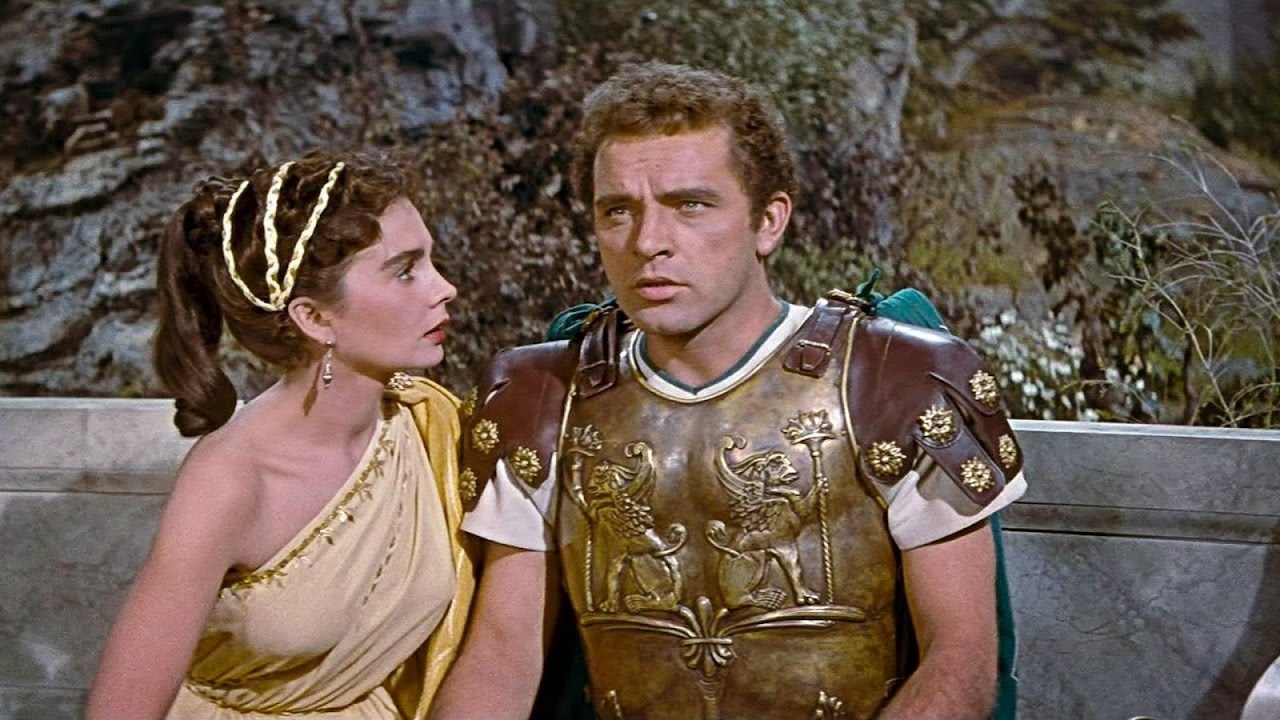
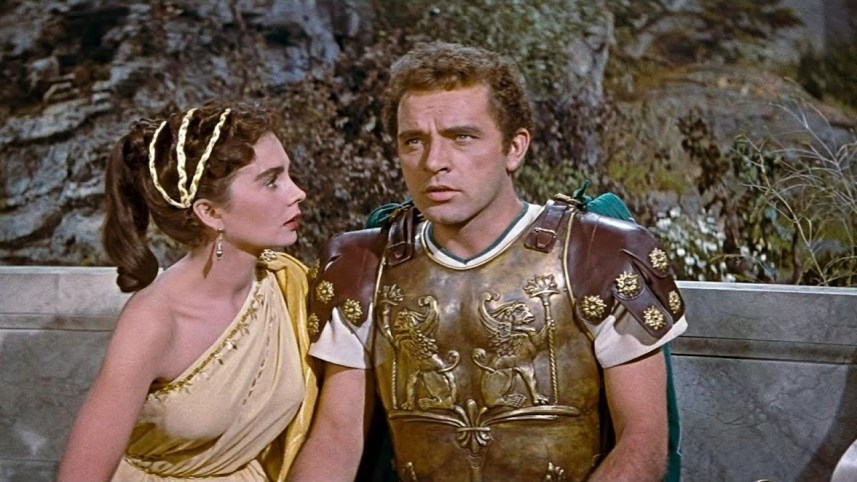
Richard Burton puts on his best “worried with a hint of madness” face as he explains Christianity to Jean Simmons and the viewers.

Director: Henry Koster

Cast: Richard Burton (Marcellus Gallio), Jean Simmons (Diana), Victor Mature (Demetrius), Michael Rennie (Peter), Jay Robinson (Caligula), Dean Jagger (Justus), Torin Thatcher (Senator Gallio), Richard Boone (Pontius Pilate), Betta St John (Miriam), Jeff Morrow (Paulus), Ernest Thesiger (Tiberius)

In 1953, Hollywood was running so scared of TV they needed a magic cocktail to win viewers back to the big screen. They settled on their main advantages over TV – a very big screen, colour and a lot of money. Sweeping epics were born – but in order to get as many people in as possible, gotta make sure it’s an important piece of filmmaking as well. What’s more important than religion?

Marcellus Gallio (Richard Burton) is a carefree playboy Tribune, interested only in splashing his cash on bets and slaves. After betting against heir-to-the-throne Caligula (Jay Robinson) for rebellious slave Demetrius (Victor Mature) – plus charming away Caligula’s betrothed Diana (Jean Simmons), also Marcellus’ childhood sweetheart – he is banished to Palestine. Marcellus is soon ordered to crucify a humble carpenter from Nazareth, leader of a new religion that Demetrius swiftly converts to. After being confronted by his former slave atop Calvary, Marcellus finds himself wracked with guilt about his actions – and on a journey towards conversion and martyrdom. The Robe of the title is the Turin shroud, here a red rag macguffin passed from pillar to post.

By any objective standards, The Robe is a pretty terrible film. It’s long, self-important, slow, talky, episodic, poorly-structured and, above all, boring. Despite its length, nothing much really happens. Marcellus is a waster, he crucifies Christ, he feels guilty, he goes a bit barmy, he converts, he dies. That’s kind of it. When important moments happen, they flash past so quickly you start to think you missed something – I rewound Marcellus’ crucial conversation with St Peter where he finally converts as I assumed I’d missed something he changes his mind so quickly. I hadn’t.

The whole film is full of sudden, juddering changes like this. Marcellus and Diana are estranged for years – next thing we know they are in each other’s arms. Demetrius is a convert after one glance. Within seconds of screentime, Marcellus goes from unconcerned to wracked with guilt over Christ’s death. The whole first scene sets up Caligula as an antagonist only to have him disappear for almost an hour. Demetrius is suddenly being racked in a dungeon in Rome. The film keeps slowing down for lots of Christian reflection on the righteousness of the holy message.

Oh blimey, the Christian message of the film is not subtle. The film drips with sanctimony and wearying self-importance, with no trick missed. Angelic voices, light from the sky, actors staring upwards with awe, impossibly sweet youths frolicking with joy, wise old buffers droning on: it’s all here, every single note you would expect of the classic Hollywood “Swords, sex, sandals and sanctimony” epics. It’s all ridiculously on the nose, with Burton reduced to having to carry the entire weight of Christianity seemingly on his shoulders, with only the most bland and forgettable of lines to support him. Nothing eases up right into the final moments, when Marcellus and Diana walk towards the camera as the background fades away to be replaced by clouds. Yeah we get it: they are off to heaven. The big thing the film struggles to get across in all this is why the Christian message had such appeal to Marcellus and others, or why these people might have put so much at risk for it, but this sort of thing is beneath the film’s clumsy interest, as if any actual analysis would be sinful.

Burton, bless him, struggles through the role with the slightly disconnected air of a man who thinks the entire film is beneath him (he famously called the role “prissy”). He must have been stunned to get an Oscar nomination. But to be fair it’s a really tough part, with Marcellus required to go from a sort of relaxed dissoluteness, via disconnected pride, to a sort of catatonic series of fits before back to serene peace. Saying that, Burton’s fits over the robe itself aren’t going to win any awards for subtlety, done with a wild eyed hamminess that looks impossibly old fashioned today. But it’s all comparable – next to Robert Taylor in Quo Vadis, Burton feels like the height of emotional realism. It’s not helped that he’s paired a lot of the time with Victor Mature, who acts throughout with a sort of balsawood earnestness that requires a great deal of middle distance staring in awe. The video below gives a good idea of both performances. Watch how wildly varied the writing is of Burton’s part and feel a little bit sorry for him.

Very few of the other performances make positive impressions. Jean Simmons as Diana is such a bland, forgettable character that her conversion only really makes sense because we have learnt so little about her over the course of the movie. Jay Robinson goes for overblown as Caligula but instead sounds like a shrieking child in a pretty woeful performance. 

These two failed performances add to the film’s problems. Caligula is such a non-presence for most in the film that, as the nominal antagonist, his lack of impact makes the film shapeless, lacking any “villain” we can hate or provide any sort of obstacle for Marcellus to struggle against. Similarly Diana is so bland and anonymous a personality, that we neither root for their relationship, nor experience any concern for its outcome.

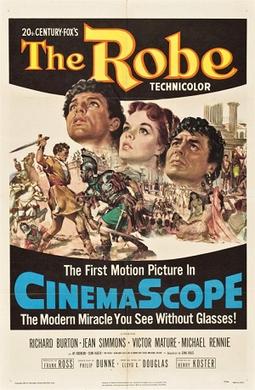
The film is directed and framed in an equally dull way. Its only claim to fame today is its status as the first film to be released in Cinemascope. This ultra-wide screen was intended to be another rival to TV – never mind the little box, look at the mighty vistas! But the importance of widescreen hangs over every creative decision of the film. Nearly every shot in Koster’s turgid direction is either middle or long, with the camera held static, focused on getting as much of the background in as possible, the actors often reduced to focus or foreground interest around the scale. It’s no wonder few performances break through this overbearing backdrop.

Every so often you get moments where you think the film is going to burst in life. They’re rare but they are there. There is a great scene between Demetrius and a man revealed (eventually, but it’s pretty obvious from the start) to be Judas Iscariot fresh form Gethsemane (Michael Ansara as Judas might, in two minutes of screentime, give the best performance in the film). Marcellus has a pretty good (if inexplicable) sword fight with a former rival. A mission is launched to rescue Demetrius. But every time something happens like that, the film immediately doubles back into heavy-handed symbolism and dull, unrevealing chat, all of which is focused on hammering home the message. 

The Robe is an impossibly dated religious epic, worthy, dull and lacking any real interest or reason to watch it. Its star seems a little embarrassed to be there. No-one else makes any impact. It’s directed with a flatness that turns it into a series of lifeless paintings. Its story turns a major moment of history into a boring, inconsequential series of events. It lacks even the campness that many epics of this genre carry that make it a good tongue-in-cheek watch. It’s just a yawnathon from start to finish, a crushingly tedious saga that has all the subtlety of being hit across the face by a prayer book for over two hours.

Quo Vadis (1951)


Peter Ustinov revels in the Status Quo (Vadis) of Imperial Rome

Director: Mervyn LeRoy

Cast: Robert Taylor (Marcus Vinicius), Deborah Kerr (Lygia), Leo Genn (Petronius), Peter Ustinov (Nero), Patricia Laffan (Poppaea), Finlay Currie (St. Peter), Abraham Sofaer (St. Paul), Marina Berti (Eunice), Buddy Baer (Ursus), Felix Aylmer (Plautius), Ralph Truman (Tigellinus), Rosalie Crutchley (Acte), Nicholas Hannen (Seneca)

In the 1950s, epic films were the way for the movie studios to defeat the onslaught of television. What better way to best the creeping presence of the small screen in every home than offering more action, sets, crowds and colour than could ever be squeezed into that small box in the corner of the room? Quo Vadis was the first film that started a wave.

Returning to Rome after years on campaign, Marcus Vinicius (Robert Taylor) falls in love with a Christian hostage, Lygia (Deborah Kerr). Gifted Lygia as a reward by the decadent Emperor Nero (Peter Ustinov), Marcus slowly becomes fascinated by her religion – and more aware of the insanity of Nero. Petronius (Leo Genn), Marcus’ uncle and Nero’s cynical retainer who hides his barbs under double-edged flattery, unwittingly plants in the Emperor’s mind the plan for a Great Fire in Rome. After the mob reacts with fury, Nero kicks off a persecution of Christians that will end in slaughter in the arena…

There is a charming stiffness to some of this film which actually makes it rather endearing. Like many films that followed it, this balances a po-faced reverence for Christian history with a lascivious delight in sex, destruction and violence. This means the audience can be thrilled by Rome burning, entertained by Nero’s decadence, watch Christians mauled by Lions and burned alive – while also being comforted by the triumph of good-old fashioned Christian values and persuaded the film has some sort of higher purpose because it ties everything up with a nice faith-shaped bow.

Of course this all looks rather dated today, but back in 1951 this was the studio’s most successful film since Gone with the Wind and the biggest hit of the year: it started a nearly 15-year cycle of similarly themed religious epics. The money has clearly been chucked at the screen – the sets are huge, the casts sweeping, the staging of the Roman fires and Christian sacrifices very ambitiously put together. Perhaps the only surprise is that the lush, attractive cinematography isn’t in wide-screen – this was the last film of this kind to not be filmed in the widest lens available. 

Despite its nearly three-hour run time, this is quite an entertaining story, laced with enough real history to make it all convincing (even if it telescopes the last few years of Nero’s reign into what seems like a week or so). Despite this, the storytelling does feel dated at times as we get bogged down in back and forth about Christianity (told with an intense seriousness by the actors, mixed with long-distance-stares type performances), and the homespun simplicity of its message lacks the shades of grey we’d expect today (as well as being a little dull) but it just about holds together.

The main problem is the lead performers. Robert Taylor is an actor almost totally forgotten today – and it’s not difficult to see why here. Not only does he speak with the flattened mid-Atlantic vowels recognisible from American leads in historical films from this era (the jarring mixture of accents in the film is odd to hear) but he is an uncharismatic, wooden performer sorely lacking the power a Charlton Heston would have brought to this. Marry that up with his character being a dull chauvinist and you’ve got a bad lead to root for. The relationship between him and Deborah Kerr’s (equally dull) Christian hostage is based on a terminally dated, borderline abusive, set-up: he kidnaps her from her home and wants her to change her faith, she won’t but never mind she loves him anyway without condition and surely her love will make him a good man, right!

Despite the efforts of the leads and some decent supporting actors (Finlay Currie in particular makes a very worthy Peter) the Christian story never really picks up. There are some nice visual flourishes – the recreation of some Renaissance paintings is well-done, and the stark image of Peter crucified is striking – but the Christian story isn’t what anyone will remember from this film. It’s all about the corrupt Romans.

Not only do they have the best lines and all the best scenes, but in Leo Genn and Peter Ustinov they also have the only actors who perhaps seem to realise they are not in a work of art, but a campy popcorn epic. Both actors give wonderfully complementary performances. Genn’s dry wit as the cynical Petronius (whose every line has a cutting double meaning) underpins his wry social commentator to fantastic effect, delivering many of the films laugh-out loud moments. He elevates many of the best lines in a dry but educated script.

Genn’s low-key performance also brilliantly contrasts with Ustinov’s extravagance as Nero, making the emperor a sort-of sadistic Frankie Howerd. Ustinov has enormous fun in the role, cheerfully going up and over the top with Nero’s man-child depravity, bordering on vulnerability and a needy desire to be liked and respected by the people and his underlings. Depictions of his singing are hilarious, his petulant sulking extremely funny. Yes, it’s an absurd performance – more a comic sketch almost – but it somehow works because (a) everything else in the film is so serious and (b) Genn’s world-weary cynicism anchors the character for the first two-thirds of the film, giving Ustinov much freer reign to go over the top. 

So it’s all about the baddies – as was often the way with films of this era. You’ll remember the scenes of Nero holding court, and the archly written dialogue between Petronius and Nero. Ustinov and Genn are, in very different ways, terrifically entertaining (both received Oscar nominations). The Christian message of the film is on-the-nose (to say the least), and the lead actors are more like kindling for the Great Fire than actual characters. It’s a strange film, at times a bloated far-too-serious religious epic, at others a campy tragi-comedy with a dry wit. Yes it’s dated and far from perfect, but it’s also strangely entertaining and even a little compelling.