Category: Army drama

The League of Gentlemen (1960)

The League of Gentlemen (1960)

Gentlemen don’t get mad: they get even in this fun, well-structured heist movie

Director: Basil Dearden

Cast: Jack Hawkins (Lt Col Norman Hyde), Nigel Patrick (Major Peter Race), Roger Livesey (Captain “Padre” Mycroft), Richard Attenborough (Lt Edward Lexy), Bryan Forbes (Captain Martin Porthill), Kieron Moore (Captain Stevens), Terence Alexander (Major Rupert Rutland-Smith), Norman Bird (Captain Frank Weaver), Robert Coote (Brigadier “Bunny” Weaver), Nanette Newman (Elizabeth Rutland-Smith)

You throw a gentleman on the scrap heap at your peril. After a lifetime of service, Lt Colonel Norman Hyde (Jack Hawkins) has been made redundant – and, to put it bluntly, he’s pissed off. However, a gentleman doesn’t get mad, he gets even. And what better way to do that than using your army training to mastermind the finest bank heist Britain has ever seen? To pull it off, Hyde recruits a team of similarly disgruntled Army officers (all cashiered from the army for a range of offences, from theft to implied sexual demeanours) all of them highly trained specialists. What could possibly go wrong?

The League of Gentlemen was the first film from a short-lived British production company Allied Films. The company was a partnership between Dearden, Hawkins, Attenborough (who did a lot of the producing) and Forbes (who wrote the film’s witty, playful script). The film is a delight, a wonderfully executed heist movie, told with an archness that turns its criminals into sympathetic rogues. It’s really a sort of dry comedy and gets a lot of fun out of British attitudes at the time.

For starters, who would think that gentlemen like this (war heroes for goodness sake!) would ever be involved in anything so naughty as armed robbery? Especially in a country so deferential that – in a cunning raid to pinch guns from a military base – conman “Padre” (Roger Livesey, riffing delightfully on his Blimpish persona, as a conman with a shady past) simply turns up dressed as a superior officer and is instantly accepted as such. Just to complete the satire of prejudices at the time, the members of the team lifting the guns are ordered to speak with Irish accents as after all “We British never give the Irish the benefit of the doubt”, and even the a whiff of an Irish accent will whack the blame straight onto the IRA.

But this also a film having a bit of fun with demobilised fellows who have never quite found their place in civvie street – and may even miss the glamour and excitement of the war. Most of the team are clearly veterans of WW2, and many of them are struggling with demanding landlords, unfaithful wives or dismally dull jobs. How could they resist saddling up for one more grand adventure? Especially when there is a huge suitcase of money waiting for them at the end of it.

Dearden’s direction is taut, sharp but also gives more than enough room for the character comedy. He stages the heists with a briskness and efficiency that you can imagine Michael Mann being quite pleased with (the gas mask wearing, gun totting soldiers have more than a passing resemblance to the robbers in Heat – enough to make you think Mann may have watched this film somewhere along the line). Dearden’s storytelling is clear, well staged and inventive (the raid on the army base is shown to us without briefing, meaning we work out the plan as it progresses).
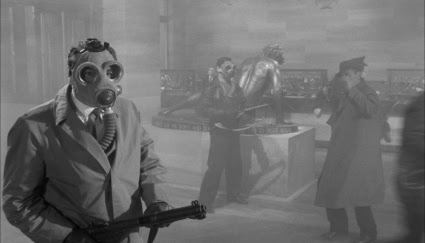
He’s helped enormously by Bryan Forbes’ fun and quotable script, that swiftly but skilfully distinguishes the characteristics of each man and their motivations and makes a perfect balance between affectionate comedy and the sharpness of danger (the group make clear they will “do what’s necessary” if pushed, even if they aim is no bloodshed). The film is built around several wonderful set pieces – and has a classic, almost pre-James Bond parody opening as Hawkins emerges from a manhole cover dressed in a dinner suit and climbs into a car.

Hawkins is great here, spoofing the troubled war heroes and authority figures he spent his whole career playing. Here he inverts all this straight-shooting, “Queen and country first” attitude into a man with the outside trappings of decency, but with a bitter heart and cynicism towards the world. He carries most of the film with a deceptive effortlessness, but nails the tone exactly between fun and genuine frustration at the world.

The whole cast follow his lead. Nigel Patrick is very good as a cashiered Major who enjoys mockingly parroting all the eccentric mannerisms of upper-class gentlemen. Livesey enjoys the self-parody almost as much as Hawkins (he spends nearly every seen looking like he’s only a few degrees away from giggling). Attenborough is fun as a chippy junior officer while Terence Alexander is great as a frustrated cuckold lost on civvie street. There isn’t a weak link in the whole cast.

The film is a delight, fun but with more than enough tension. It brilliantly captures a sense of the camaraderie and loyalty between these ex-soldiers, as well as their delight at being used able to use their skills one final time. It’s a film squarely on the side of these criminals thumbing their noses at the system (and who are planning as close as they can get to a victimless crime, albeit at gun point). The film has to give them some sort of comeuppance at the end – but you’ll be sorry to see it, as by then you’ll be invested at pulling off the heist as they are. Well directed, acted and written it’s a perfect entertainment.

The Bounty (1984)

The Bounty (1984)

Hopkins and Gibson present a more historically-accurate Bounty movie that’s serious but solid

Director: Roger Donaldson

Cast: Mel Gibson (Fletcher Christian), Anthony Hopkins (Lt William Bligh), Laurence Olivier (Admiral Hood), Edward Fox (Captain Greetham), Daniel Day-Lewis (John Fryer), Bernard Hill (William Cole), Phil Davis (Edward Young), Liam Neeson (Charles Churchill), Wi Kuku Kaa (King Tynah), Tevaite Vernette (Mauatua), Philip Martin Brown (John Adams), Simon Chandler (David Nelson)

The story of the mutiny on The Bounty has intrigued for centuries. It’s been made into plays, novels and no fewer than three films. Most versions have been inspired by a 1932 novel that painted Bligh as an ogre and Christian as a matinee idol. That image was cemented by the classic Best Picture winning Laughton/Gable version. The real story is far more intriguing – and operates much more in shades of grey – and this 1984 film tries to find a middle ground, with mixed success.

In real life, Bligh was a prickly, difficult but fundamentally decent man, who had worked his way up the naval ranks through merit. He was a superb sailor – as seen by his feat of navigating a small open boat of loyalists over hundreds of miles back to a British port. Cleared of any guilt for the mutiny, he had a successful career and retired as Vice Admiral. Fletcher Christian, on the other hand, was an entitled young man who owed everything to his rich family, rather than merit. The truth has been lost in fictionalised versions who were devil and saint. The truth was far more complex.

This film was a long-standing dream of David Lean, who planned the film for many years, before pulling out at the last moment. The script was written by long-time collaborator Robert Bolt (although ill health meant it was finished by an uncredited Melvyn Bragg). Producer Dino de Laurentis – not wanting to write off the money invested – bought in Australian Roger Donaldson to direct. The final product is a competent, if uninspired, middle-brow history film with a slight air of stodge, and a haunting – if incredibly 80s – electronic score from Vangelis. Where the film really lucked out is the superb cast of actors assembled, with Gibson on the cusp of mega stardom and the cast stuffed with future Oscar winners and nominees.

Anthony Hopkins had been attached to the film for almost seven years, and his carefully researched performance as Bligh is what really gives makes the film work. He gets closer to the personality of the real Bligh than anyone else ever has. Awkward, shy, uneasy with men under his command, insecure at his poor background and the West Country burr to his accent, Hopkins’ Bligh is a world away from a bad man. But he is a demanding and rigid leader, who inspires fear but not respect. He’s far from cruel, but he’s short-tempered, inflexible and has trouble empathising. All too often, he relies on his position alone to ensure obedience, rather than building respect. You sympathise with him, at the same time becoming deeply frustrated at his intransigence. You can understand why many would find him an extremely difficult man to work with (let alone work for).

Fletcher Christian is young, naïve and impetuous, a man whose experiences in Tahiti lead him to become surly and impatient with the confines of a naval life. Gibson later said he felt the film didn’t go far enough to depict Christian as selfish and motivated by a desire for the ‘good life’, and the film does try to show him standing up for the crew against Bligh’s demands for perfection. But Gibson is willing to embrace Christian’s darkness. He hurls himself into the (historically attested) near mental collapse, consumed with violent and unpredictable emotion, that Christian demonstrated during the mutiny, losing all control of himself in an explosion of self-pity and frustration.

The film’s highpoints revolve invariably around these actors. Hopkins’ demanding Bligh sets the tone on the ship. The roots of the mutiny can be seen in Bligh’s public bawling out (and demotion) of his first officer Mr Fryer (a disdainful Daniel Day-Lewis) in front of the entire ship, setting a precedent for disrespect. Every action he intends to build spirit and health in the crew has the exact opposite effect (from pushing them to excel, to enforced dancing sessions for exercise). Hopkins is perfect as man believing he is acting for the best but constantly getting the tone wrong, either too distant and reserved to inspire affection, or too enraged to inspire loyalty. Similarly Gibson, in the less intriguing part, really sells the growing self-absorption of Christian, especially his feckless weakness, easily manipulated into actions that go a step beyond his desires (Phil Davis is very good as a darkly Iago-ish Ned Young, using Christian’s popularity to his own ends).

However, the film itself is a little too traditional. Using Bligh’s trial (all captains who lost their ship were placed on trial to judge their responsibility) as a framing device brings us slightly too many interjections of the “and then you did this” variety – even if it allows actors as impressive as Olivier and Edward Fox to narrate us through the film. This stodgy structure carries us into a narrative that is professionally handled but lacks inspiration, ticking off events but not giving them a force outside of the performances of the actors. The film is competently but not inspiringly made, and never quite captures the sense of the epic that the location and scale should bring.

Perhaps this is because a true-to-life version of the mutiny is a little less traditionally dramatic. Despite some truly impressive performances from the leads (and the rest of the superbly chosen cast), it never quite shakes off the feeling of being a history lesson.

Glory (1989)

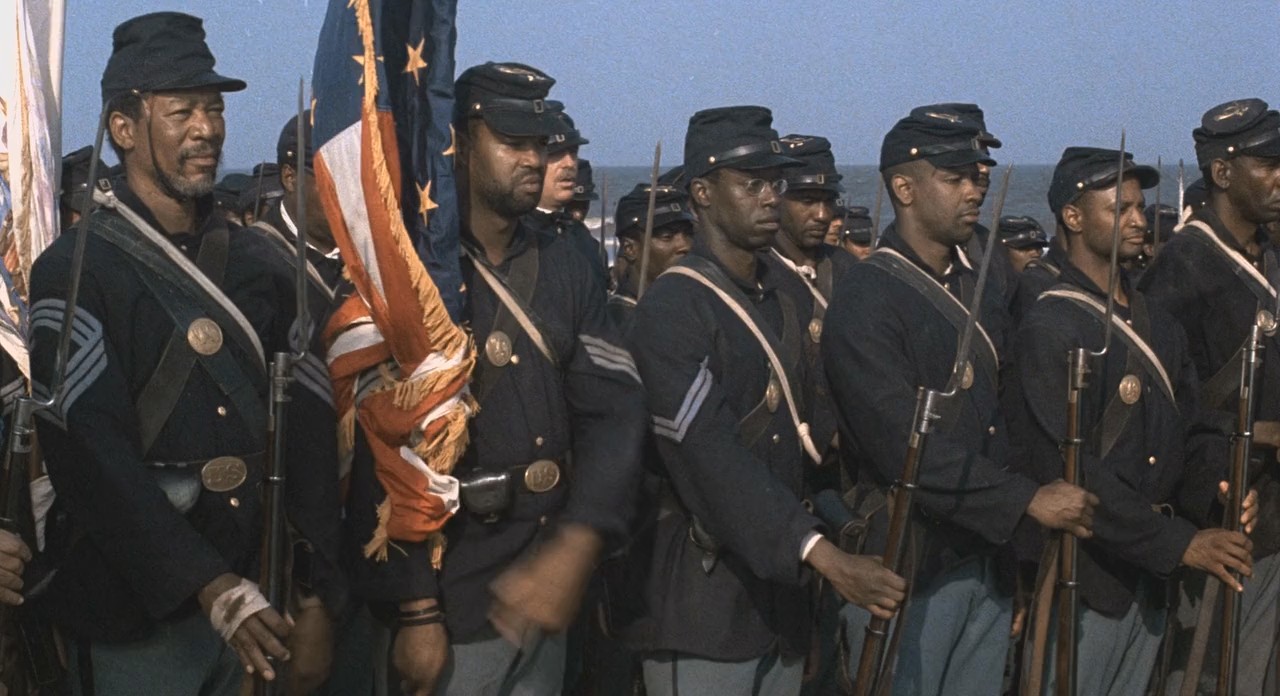
Morgan Freeman and Denzel Washington are among the first black American soldier in Glory

Director: Edward Zwick

Cast: Matthew Broderick (Colonel Robert Gould Shaw), Denzel Washington (Pvt Silas Trip), Cary Elwes (Major Cabot Forbes), Morgan Freeman (Sgt Major John Rawlins), Andre Braugher (Cpl Thomas Searles), Jihmi Kennedy (Pt Jupiter Sharts), Cliff De Young (Colonel James Montgomery), Alan North (Governor John Albion Andrew), John Finn (Sgt Mulcahy), Bob Gunton (General Charles Garrison Harker), Jay O Sanders (General George Crockett Strong)

The American Civil War started over slavery, but it took a long time for either side to admit it was a fight about slavery. Racism abounded on both sides, and it was a fight in which black Americans may have been the subject, but were rarely invited to join. Glory covers this point of history, and specifically the first all-black regiment and its struggle to be recognised as equal to the other regiments in the army. 

Wounded at the Battle of Antietam in September 1862, Robert Gould Shaw (Matthew Broderick) returns home to Massachusetts and accepts command of the first all-black regiment, which is currently being raised by abolitionists in the state. With his friend Cabot Forbes (Cary Elwes) as second-in-command (no one was progressive enough to actually allow black officers for the regiment), he recruits a wide range of black Americans, from free-man and bookish intellectual Thomas Searles (Andre Braugher) – an old friend of Robert and Cabot – to former slaves such as the wise John Rawlins (Morgan Freeman) and the resentful Silas Trip (Denzel Washington). Training is a struggle, with the army denying the regiment supplies and support, and it’s an equal struggle when they reach the front line to be recognised for duties other than looting and latrine digging. Will the Massachusetts 54th be given the chance to prove itself in the front line – and establish a black man can fight as hard and bravely as a white man can?

Edward Zwick’s beautifully filmed, carefully re-created historical epic set the tone for much of his future career. It’s an often overly-sentimental film straining for a very self-conscious sense of importance, weighed down by the pride at the “message” it is carrying. It often does hit the mark with presenting scenes that carry emotional force – but then seeing as it treats nearly every scene as being a “moment” that should move us (with James Horner’s choral manipulation working double time to get us experiencing feelings), it’s no wonder that it succeeds sometimes.

Which is not to say the message it presents isn’t an important one. Black Americans have often been pushed into the margins of American Civil War history. Or worst of all presented as the victims, reliant on the courage and bravery of the abolitionists of the North to save them from slavery in the South. Until Glory it was very rare for anything to push their stories front and centre – or to tell a story where former slaves were allowed to fight their own battles and choose their own destinies. 

It’s one of the strongest marks of the film: these are soldiers unlike any other, who enter battles with less concern about their own survival, and more about having the chance to live as freemen and to make a mark on the world. To show that they, and people like them, could do just as a white man could do. And if they had to die to do that, better to live a day on their feet as freemen then a lifetime on their knees. It’s the principle emotional message of the film, and something Zwick translates with some skill, even if he frequently overeggs the pudding while doing so.

However, with such a strong message, it’s a shame so much of the film is filtered through the experience of its white lead character. For many of the films of the 80s and 90s dealing with these issues – Cry Freedom, the Steve Biko biopic, with Biko as a supporting character to his white South African journalist friend, being perhaps the key example – it was essential to have a white man at the centre, as if worried that audiences couldn’t understand the story they were seeing unless they had it filtered through the perception of someone who looks a bit more like them.

Matthew Broderick takes on the lead role here of Shaw – with the film giving a significant slice of its running time to its coming-of-age theme of Shaw learning to become a leader of men – and while the character is meant to be callow and an unlikely Colonel, it doesn’t help that Broderick lacks the charisma for the part. Perhaps he is a little too lightweight an actor for such an enterprise, for a film that demands greater force of character (you can imagine Tom Cruise doing a much finer job in the role).  Similarly, the familiar beats of a young man learning how to lead feel trivial compared to the life-and-death issues facing his soldiers.

But too often Zwick’s film returns us to Shaw’s point-of-view, the narrative filtering so much of the action through his perceptions and decisions that the black soldiers become supporting actors in their own stories. Broderick is not helped by the soldiers being played by some of the finest American actors of the last 30 years. Braugher is fabulous in the thankless role of the bookish man who must grow a spine. Morgan Freeman established a persona – the wise and level headed older man, who will not let hate and fury define his life and his choices – that would last him for the rest of his career, and is superb (his Oscar nomination for Driving Miss Daisy is probably the only thing that led to him not getting a nod for this film).

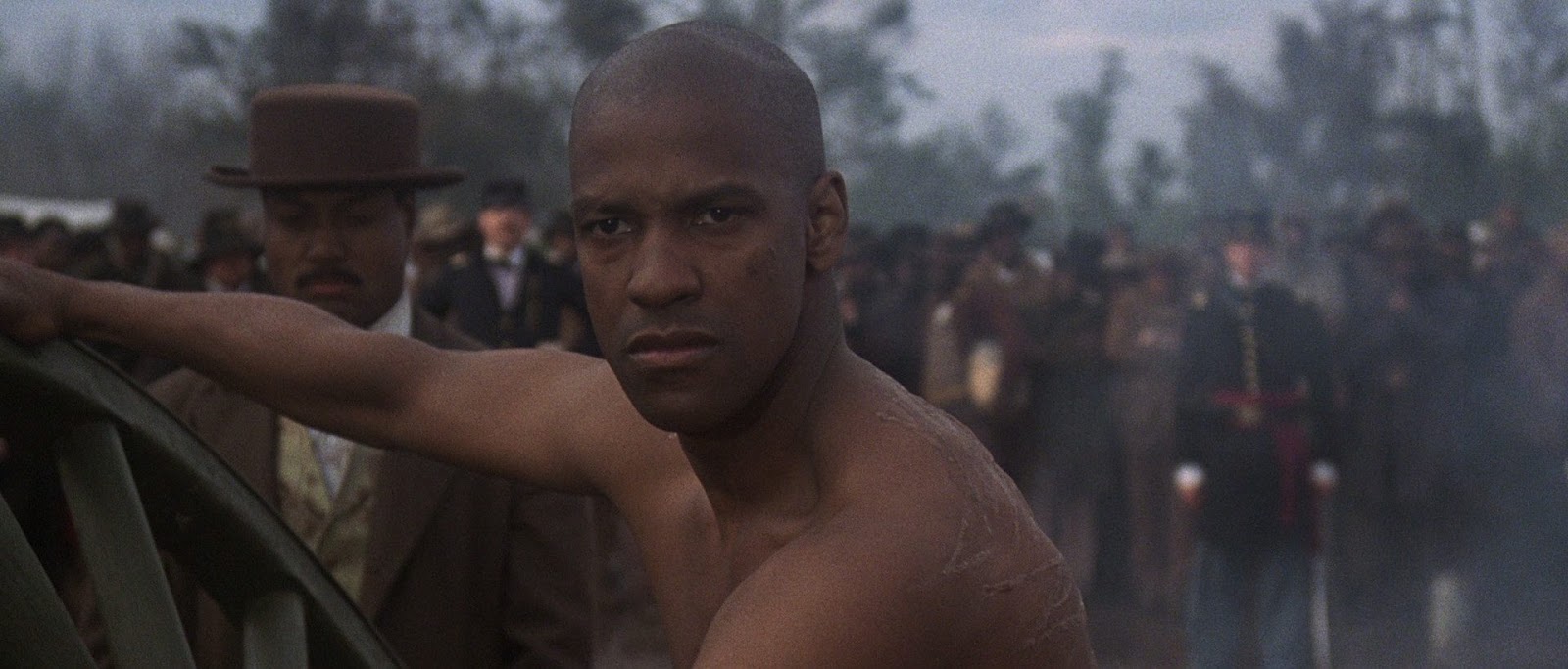
Denzel Washington took home an Oscar as the bitter, angry Trip – and it’s the sort of role an actor seizes with relish. Washington fills every frame with his rage at the system, his inarticulate, indiscriminate anger lashing out in every direction. It’s the fury of a man who has had all his choices taken from him in life, and would rather destroy things than run the risk of allowing himself to become committed to something, or form a bond. Washington probably won the Oscar alone for the astonishing scene where he silently, defiantly accepts a whipping (on a body covered with scars) for missing a curfew. He’s an elemental force of nature in the film.

There is plenty of strong stuff in Zwick’s work, but the film itself overplays its hand frequently. Moments of emotion are played so heavily to the hilt they sometimes fail to have an impact. It wants you to know at every turn that you are watching a film with an important social message – and the speechifying at points put into the mouths of the characters runs dry. While superbly made – veteran photographer Freddie Francis’ work is beautiful (and Oscar winning) – it’s a heavy-handed, overly pleased with itself film that knows all too well that it is about an important subject. While sometimes it lands – often in quieter moments, particularly those where Freeman and Washington are allowed to simply be human without overindulgent music cues hammering home the emotions – at others it comes across as too much.

Platoon (1986)

Charlie Sheen goes to war in Oliver Stone’s Oscar winning Vietnam film Platoon

Director: Oliver Stone

Cast: Charlie Sheen (Chris Taylor), Tom Berenger (Sgt Barnes), Willem Dafoe (Sgt Elias), Kevin Dillon (Bunny), Keith David (King), Forest Whitaker (Big Harold), Mark Moses (Lt Wolfe), John C. McGinley (Sgt O’Neill), Francesco Quinn (Rhah), Reggie Johnson (Junior), Johnny Depp (Lerner)

Vietnam has been a long-standing scar on the American psyche. For over 12 years, American soldiers were rolled into Vietnam to fight for something many of them were pretty unclear about. Vietnam was a bloody shadow boxing match for super powers to indirectly combat each other. American casualties were high, and the country that sees itself as championing justice and the free world ended the war with the blood of millions of Vietnamese and Cambodians on its hands. Is it any wonder the country still struggles to compute this?

Before Platoon there had been films that had dealt with the Vietnamese experience. Apocalypse Now had embraced the druggy, morally confused insanity of the war. The Deer Hunter had effectively shown the traumatic impact the war had on regular blue-collar steel-workers. But Platoon was something different. This was the war on the ground, with privates and sergeants as the focus (many of them poor, working class and also black) – the lower rungs of American society flung into a war they don’t understand, in a country they can’t recognise, fighting an enemy they have no comprehension of. 

Platoon throws the audience into the visceral, cruel, terrifying horror of pointless conflict, with a feeling that the war will never end. Stone pulls off a difficult trick here: the film shows a horrifying picture of war and killing, but combines this with successfully showing the adrenalin rush that comes from conflict – and the excitement of visceral film-making. 

Oliver Stone had fought as a young man in a similar unit, after dropping out of college. Chris Taylor (Charlie Sheen) is effectively a surrogate figure for the director, with the film crafted from Stone’s own experiences and those of his fellow soldiers. The film is a simple, intense experience with a straightforward plot: Taylor is torn between two potential “father figures”. One, Sgt Barnes (Tom Berenger), is a supernaturally ferocious warrior and martinet whom the men hold in awe. The other, St Elias (Willem Dafoe), is an equally fierce fighter, but also a hippy, nearly saint-like protective figure. Which of these two will Taylor side with?

Well okay it’s not a massive surprise really is it? The strength of Oliver Stone’s film is its visceral, bloody, impressive intensity. You are thrown into the midst of a series of terrible battles, interspersed with bored soldiers bickering or taking pot. At no time is the viewer (or the soldiers) given any real idea about what is going on, what the aims of the war are, what is really happening in the battles. Stone plays the film totally from the soldier’s POV. Battles are a confused mess at night. The location of the enemy is frequently unclear. There are no indications of any tactics at all. There is barely any leadership – Mark Moses’ Lt Wolfe is an almost hilariously ineffective moral weakling, who follows the leads of his sergeants. The soldiers (or rather the two sergeants) essentially operate as lone wolves, doing what they think best for any particular circumstance.

The film pivots on a confused raid on a Vietnamese village, as the platoon descends on a village for no very clear reason – apart from seemingly being pissed off that one of their number has been killed in the night. Nominally they are searching for Vietcong fighters. But really it seems like an excuse to let off steam. Platoon must have hit hard in the 1980s, as it doesn’t flinch at all from watching American soldiers committing atrocities. Women are shot, teenagers are beaten to death, a fox hole containing what looks like a child is exploded after a brief warning. The soldiers are all terrified, thrusting guns into Vietnamese faces. Above all Sgt Barnes feels no guilt at all at executing villagers in order to pressure the elders into telling what he thinks they might know about the Vietcong (who equally are largely faceless figures of terror in the distance stalking the platoon).

Where the film is less strong is in its plotting and narrative ideas. These are straightforward in the extreme, with Barnes and Elias almost literally as opposing devil and angel on Taylor’s shoulders. The film is clearly weighted in favour of Elias’ hippie mentality, his desire to preserve innocent lives and his caring attitude to his men. Barnes is presented far more harshly – even though his brutality stems from his own deep-rooted desire to keep his men safe, and his belief that Vietnam is hell and you can’t pussyfoot your way around hell. 

Saying that, it’s hard to argue against Stone’s feelings that compromising your humanity is not worth it no matter the struggles to keep yourself and others alive. But these are (forgive me) rather obvious, even traditional points – and its part of the film being essentially a conventional morality tale with a breath-taking military setting laid over the top. The ideas in this film won’t really challenge you – and in fact the film itself is really more of an experience than something that rewards reflection.

Stone’s direction is extremely good – even though he at times falls too much into the trap of overblown, overly operatic visuals (Taylor’s final confrontation with Barnes in the forest falls heavily into this trap). Stone has never been accused of being the most subtle of directors, and there is no stone (sorry) left unturned here to get the message across. In fact Platoon frequently hits its points so hard and with such unsubtle force, that it actually leaves you very little to think about after its finished – the film does all the work for you, like an angry rant that goes into unbelievable depth of detail.

But the acting has a very healthy commitment to it. Sheen shows why he was an actor of promise before he became a self-destructing punchline. Dafoe is very good as the serene Elias – a man’s man, but one comfortable in his own skin, with a strange campness about him, whose courage extends to doing the right thing no matter what. Tom Berenger is hugely impressive as the cold-edged Barnes, who has had to stamp out his humanity to survive. The rest of the characters split into two rival camps following these different soldiers, and there are some fine performances here from some now far more recognisable actors.

Platoon was garlanded with Oscars, partly because it talked about the American experience in Vietnam in a manner (and from a perspective) that had not been addressed before. It is an important historical landmark of a film, even if it is possibly not a great film. A simple, at times less than subtle anti-war film dressed up as a war film, it will immerse you in the conflict and the horror – but I’m not sure it will give you as much to think about as it thinks it does.

The Last Detail (1973)


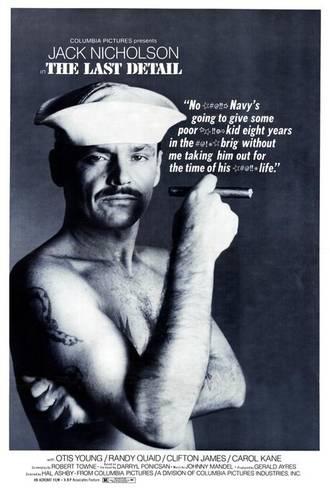
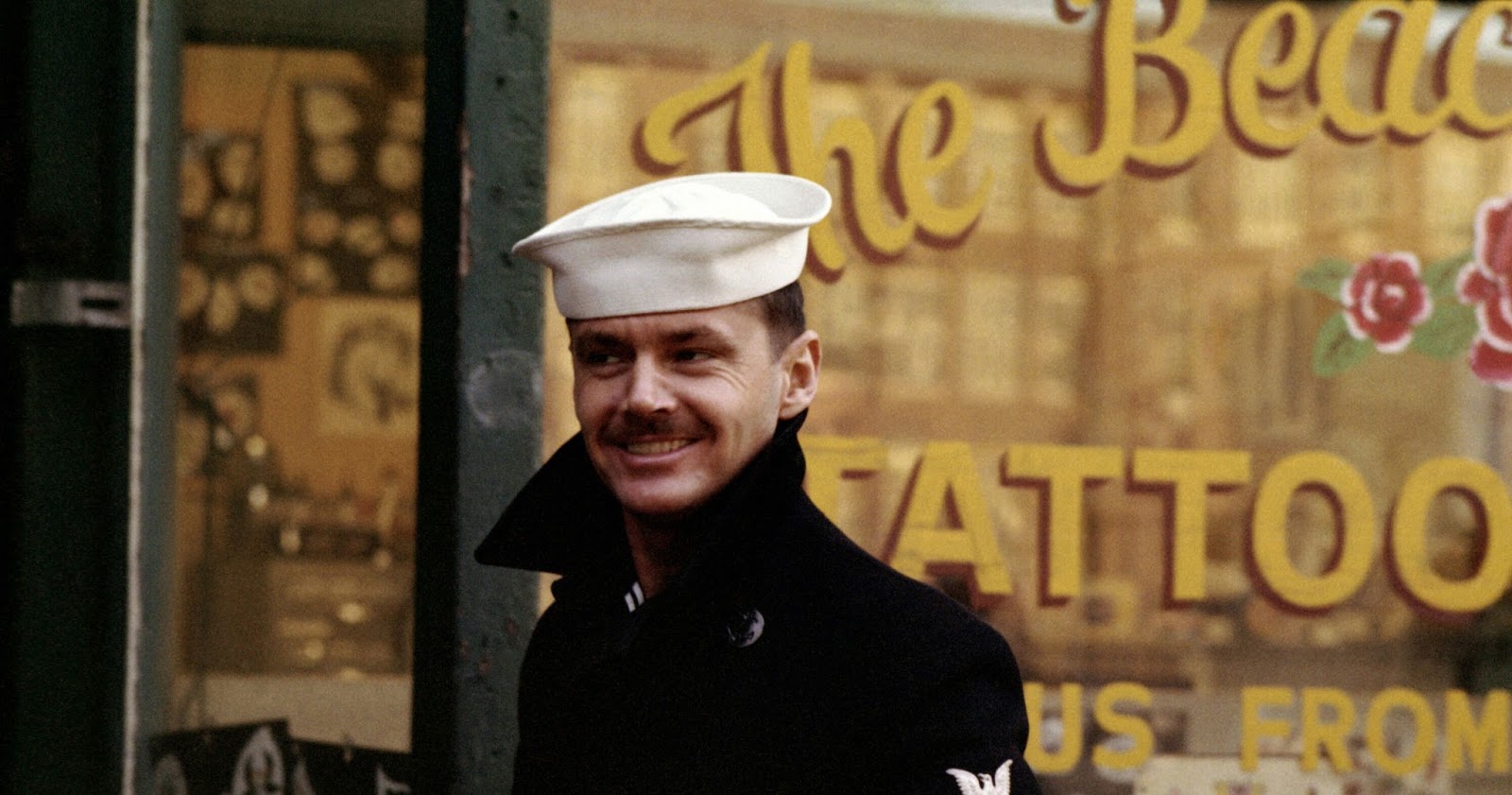
Randy Quaid, Jack Nicholson and Otis Young are sailors on a wild week in the classic The Last Detail

Director: Hal Ashby

Cast: Jack Nicholson (Signalman Billy Buddusky), Otis Young (Gunner’s Mate Richard Mulhall), Randy Quaid (Seaman Laurence Meadows), Clifton James (MAA), Carol Kane (Young Prostitute), Michael Moriarty (Marine Duty Officer), Nancy Allen (Nancy), Luana Anders (Donna)

When you see Jack Nicholson in a film from his late period – basically the 90s onwards – it’s easy to wonder what all the fuss is about. It’s sometimes hard when you see him eating the scenery to remember that in the 1970s Nicholson did a run of such mighty, landmark performances that he basically earned the right to do what he wanted for the rest of his life. The Last Detail is an often overlooked classic from the 1970s – and Nicholson is simply outstanding in it.

Buddusky (Jack Nicholson) and Mulhall (Otis Young) are “lifers”, career sailors who are ordered to take a young sailor, Meadows (Randy Quaid), from Virginia to Portsmouth Naval Prison in Maine. Meadows will serve eight years for stealing $40. Given a week to make the journey, Buddusky and Mulhall at first plan to get Meadows there as soon as possible so they can have a leisurely return and spend their per diems on a blow-out. However, feeling sorry for Meadows’ harsh punishment and lack of life experience, they decide instead to take their time on the journey and show Meadows a good time – including drinking, whoring and general hi-jinks.

The Last Detail is a brilliant slice of 1970s filmmaking, an episodic road movie with a script to die for and a simply superb performance from Nicholson. Hal Ashby’s film is both a celebration of the rebellious attitudes of the 1970s and a sad acceptance of their failure. It’s a heartfelt film where we discover and understand more and more about each character and find out more about the age as well. It’s also a lovely story of bromance – of three men who come together, find themselves developing a very close bond, but are trapped by the rigid organisation they are part of.

The film is completely Nicholson. This is the sort of tour-de-force that cements him in any list of the greatest screen actors ever. It’s just a marvellous performance, near perfect. Buddusky is the ultimate impotent rebel, a man with a natural rough leadership quality over those at his level, but who basically lives within a societal prison that he can’t really imagine breaking free from. Buddusky will let rip – never better than the marvellous sequence where he erupts against a racist barman who also refuses to serve the underage Meadows (“I am the MOTHERFUCKING SHORE PATROL” he suddenly screams, after almost a minute of slow tension build-up) – but he’s also quiet and thoughtful. Watch Nicholson’s reaction shots when he listens to Meadows reminisce on his childhood dreams of being a vet. What a masterclass of quiet acting – Budduksy is enchanted, irritated, sad, bored, confused, moved – all at once and more. 

Buddusky feels a brotherly affection for Meadows – perhaps also, a reflection of his own sense of being trapped. Nicholson alternates between affection and frustration with a touch of self-loathing. At one point during a drunken night at a motel, he demands Meadows punch him out, because he is the one taking him to prison. Meadows refuses – sweetly these guys are the best (only?) friends he’s ever had – Buddusky reacts by punching a cupboard repeatedly in fury. Later, during a fumbled sexual encounter for Meadows with a prostitute, he is kindly and understanding. It’s a fascinating performance of frustration, confusion and unaimed anger. There is nothing he can’t do.

Young is excellent as Mulhall (there is a great sequence where Mulhall berates Buddusky for his risky attitude, revealing Mulhall’s basic conventional outlook), while Quaid’s Meadows is an endearingly innocent figure: a kleptomanic with no friends, a sad family background (a visit to his abandoned family home reveals his mother to be an alcoholic), a sad, lonely boy who (unwisely) looks to a prostitute for emotional connection, and holds an unfulfilled dream of becoming a Master Signalman. He still takes on the others’ confidence through – just watch how Meadows grows in assurance as the film goes on. All three of these actors spark off each other brilliantly.

Ashby’s camera drifts gently, allowing the actors a great deal of freedom. Ashby shot the film in chronological order which works brilliantly – not least in that you see Randy Quaid grow in confidence as an actor just as the character emerges from his shell. Scenes are allowed to loosely continue, often past the point you might expect, which really allows the actors to breathe and the characters to grow: scenes of the characters drinking (rather feebly) in a carpark (as they can’t get into a bar) feel organic and almost improvisational. Ashby uses a lot of dissolves and fades to mark the passage of time – often in the middle of conversations to move us from one point to another – which also work really well.

This works perfectly for Nicholson, as it allows us to learn more about Buddusky’s shallow rebellion. Buddusky may rail against the oppression of the navy but he’s totally reliant on the grounding it gives him. Mulhall is more open about this – as a black man, it has given him some standing and a steady income to support his mother – but Buddusky is adrift in the real world. Watch him flirting with a college girl at a party. He’s hopeless, falling back on how navy work is man’s work, repeating it several times like a mantra before a crude joke. Nicholson’s first introduction is him (hungover) telling a soldier where his superior officer can stick his summons. Next time we see him, he’s arrived to see that officer. Buddusky badmouths everything and boasts of being “a badass” all the time – but every time he’s with an officer Nicholson seems to shrink and clam up. He can rebel only in words, on his downtime. On the clock he just has to fit in with the rest.

Part of the visual genius of the casting is Young and Quaid are both over six feet, making Nicholson look smaller and stunted. It’s a really neat visual metaphor for his sense of rebellion. He and Mulhall may bitch and moan about the injustice of the navy – but there is never really any question that they won’t carry out the task they are doing. Neither man has any real aim or goal in life, nor any particular insight or any plan. They just want not to be told to do things they don’t want to do. Meadows is off to prison – but Mulhall and Buddusky are also “lifers”. They ain’t going nowhere. They might not always like it, but they’d rather do that than drop out – when they meet genuine counter-culture types, none of them can understand or relate to them at all.

But the film is not depressing – it’s actually rather moving and lovable – because the bromance between the men is so well drawn. They grow to care a great deal for each other. They may not always have much in common, but they clearly have a whale of a time in each other’s company. The laughter feels genuine and grows from the actors’ own obvious rapport – I’m pretty sure they are near corpsing a few times – and it’s infectious. There is a dream-like freedom to the film – for its duration, reality is suspended and they can be free. They’re like children allowed out of school for the day. It’s hugely, engrossingly enjoyable and moving.

The Last Detail is a simply brilliant film. Ashby is a partly forgotten film maker, but films like this have a quiet, unflashy poetry to them. Robert Towne’s script is perfect – foul-mouthed and barbed, but full of unexpected emotional depths and beautiful character beats. Young and Quaid are excellent – but oh man Nicholson. He is so good in this film, it has to be seen to be believed. He is a living, breathing force of nature – he burns up the screen, but it never feels like showmanship. He’s sublime – it might be his greatest ever performance. And this is a great film that, in demonstrating the weakness of the rebellious feelings of the 1970s, might just understand that era better than many other films. An overlooked masterpiece – you should make it your mission to seek it out.

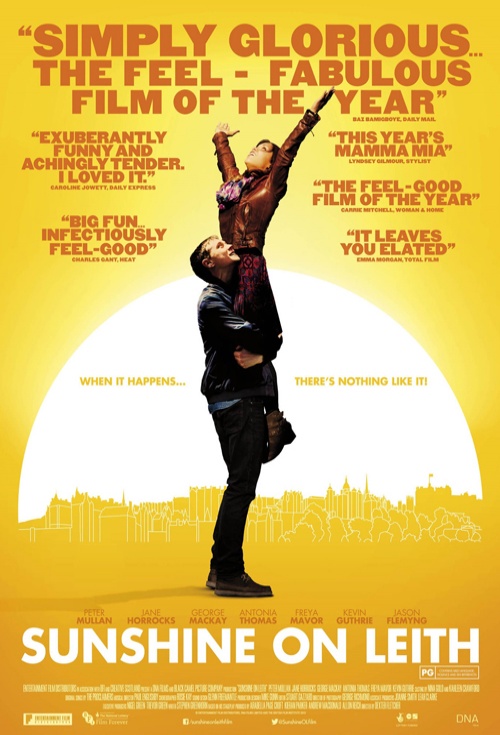
Sunshine on Leith (2013)


Peter Mullan hits the right notes in crowd-pleaser Sunshine on Leith

Director: Dexter Fletcher

Cast: George MacKay (Davy Henshaw), Kevin Guthrie (Ally), Freya Mavor (Liz Henshaw), Antonia Thomas (Yvonne), Jane Horrocks (Jean Henshaw), Peter Mullan (Rab Henshaw), Jason Flemyng (Harry Harper), Sara Vickers (Eilidh)

Sunshine on Leith is a jukebox musical that really works, because its story feels natural, its characters are engaging and the songs don’t feel too shoehorned in (even if, of course, we have a character called Jean to allow Oh Jean to be sung, and another moving to Florida which will of course require a Letter from America). It’s a really good reminder of how many really toe-tappingly, hummable, great songs The Proclaimers came up with. It’s not a masterpiece of course – but as a piece of solid, competent, crowd-pleasing cinema it’s hard to beat. 

The plot follows two soldiers returning from Afghanistan. Davy (George MacKay) is keen to start a new life, Ally (Kevin Guthrie) wants to marry Davy’s nurse sister Liz (Freya Mavor). Davy founds himself drawn to Liz’s colleague Yvonne (Antonia Thomas), while Liz struggles to reconcile her love for Ally with her desire to spread her wings and see more of the world. Meanwhile Davy and Liz’s father Rab (Peter Mullan) discovers, on the eve of his 25th wedding anniversary to Jean (Jane Horrocks), that a brief affair in his early marriage led to the birth of a daughter (Sara Vickers) he never knew he had. Love and family problems play out to a string of Proclaimers hits.

Sweeping camera-work from Dexter Fletcher helps to create a romantic, vibrant image of Edinburgh – you’ll want to book your tickets as soon as the film ends, this is such a good advert for the city – and he draws some wonderful performances from the cast, all of whom I suspect had the time of their lives making this film. How lovely is it to see Peter Mullan moving away from gruff hardmen, to play a man as sensitive and humane as Rab – and also to hear him croon with feeling some top songs? He makes a superb partnership with Jane Horrocks, who not surprisingly is the most accomplished singer, and who channels her natural bubbly mumsiness into a genuinely moving portrayal of a wife dealing with completely unexpected betrayal.

The film keeps the humanity of its characters very much at the centre, never over-complicating the plot or overloading us with extraneous detail or drama. The quietly tense opening sequence of Davy and Ally on tour in Afghanistan (with a rendition of Sky Takes the Soul) swiftly helps us invest in their safety – and sets us up to really feel their release once they return to the safety of civilian life. Nothing hugely unexpected happens in the film at all – it can be pretty accurately predicted from the start – but the whole thing is told with genuine warmth and feeling.

There are some stand-out musical sequences. Over and Done With, told as a pub story-telling session, works really well – it’s wonderful up-beat, vibrant sequence. Jason Flemyng has a great dance cameo during a fun-filled number set in the Scottish National Gallery (Should Have Been Loved). Davy and Ally dance thrillingly down the street to I’m On My Way as they celebrate their discharge. The final number – it’s not a surprise – sees what seems like most of Edinburgh corralled into a massive rendition of a song about walking a very long distance…

George MacKay demonstrates he’s a pretty decent song and dance man – and he also has the every-day ordinariness that makes him a perfect audience surrogate. His chemistry with Antonia Thomas is also fantastic. As the secondary couple, Freya Mavor is headturningly watchable as Liz, while Kevin Guthrie gives a nice air of bemused immaturity to Ally.

Sunshine on Leithis a brilliant crowd-pleaser, and has clearly been made with love and affection for the material and the songs, which seeps off the screen. It’s a perfect advert for everything in it. I would say that I am not sure Fletcher is the perfect film director – he’s afraid to let the camera stand still for too long in the larger dance set-pieces, which means we lose the impact of some of these numbers (or the chance to really appreciate the choreography). But he totally gets the tone of the film, and delivers that in spades.

It’s much pretty guaranteed that you’ll laugh, you’ll cry, you’ll fall in love. And you’ll want to watch it over again.

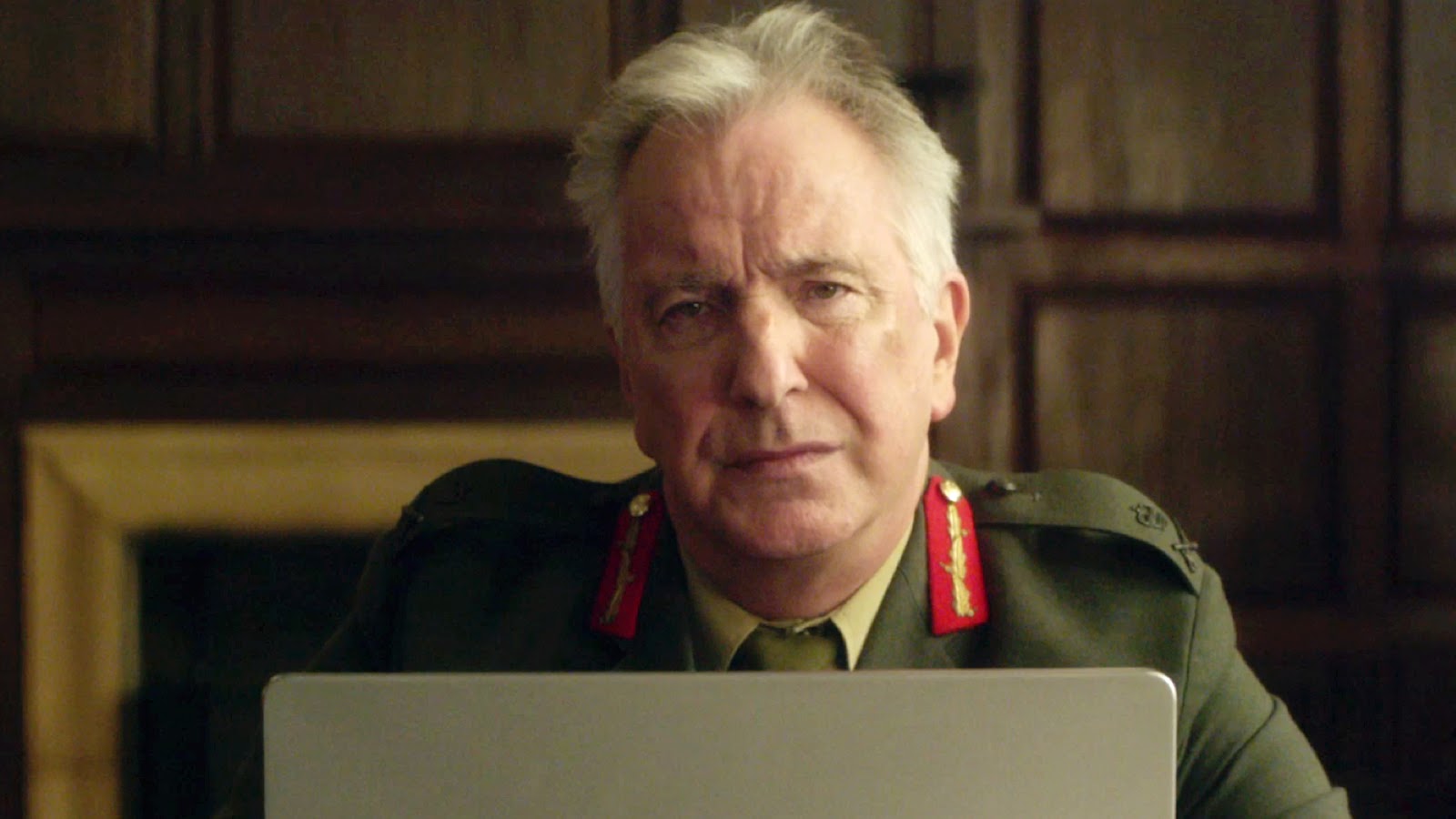
Eye in the Sky (2015)


The great Alan Rickman is an exasperated General, in drone-strike moral fable Eye in the Sky

Director: Gavin Hood

Cast: Helen Mirren (Colonel Katherine Powell), Aaron Paul (Lt. Steve Watts), Alan Rickman (Lt. General Frank Benson), Barkhad Abdi (Jama Farah), Jeremy Northam (Brian Woodale), Iain Glen (Foreign Secretary), Monica Dolan (Angela Northman), Richard McCabe (George Matheson), Phoebe Fox (Carrie Gershon), Babou Ceesay (Sgt. Mushtz Saddiq), John Heffernan (Major Howard Webb)

As Shakespeare said, sometimes we are urged: “to do a great right, do a little wrong”. Eye in the Sky is a film about that dilemma. Numbers 2, 4 and 5 on the terrorist “Most Wanted” list are meeting in a house in Kenya. They are preparing suicide bombers. A series of attacks could be minutes away. A drone strike will probably save hundreds of lives. Seems obvious doesn’t it? Unfortunately, sitting in the fatality zone is an innocent young girl, just trying to sell bread. Take out the bombers and you’ll save dozens of other children – but you’ll almost certainly kill this one child.

Your initial reaction to this sort of situation would probably be “thank goodness that’s not my decision”. Problem is, you get the feeling many of our elective representatives feel the same: as the situation escalates (from capture, to kill, to controlled strike, to a certainty of civilian casualties) so does the buck-passing, from politician to politician all unwilling to make a call.

Guy Hibbert’s well researched and thought-provoking script combined with Gavin Hood’s taut direction make this a gripping conversation thriller about the impossibility of moral debates. Hibbert’s script brilliantly piles moral debate on moral debate – just as we accept the desirability of one action, the circumstances change with bewildering speed. Everything, from a change of travel plans to battery failure on a vital piece of equipment, amps up the pressure and makes the situation more morally unpalatable.

The buck-passing becomes almost a dark farce in this expert script. A put-upon civil servant is repeatedly sent to communicate with a string of senior leaders, from the Foreign Secretary to the Prime Minister. Later a crucial decision takes place over a conference call, with an ever-expanding series of international attendees. It’s like a deadly serious Yes, Minister, with Jeremy Northam’s junior minister a flummoxed and vacillating Jim Hacker.

The military seems equally divided – senior officers focus on the big picture, aware of the evil they must do but seeing it as a necessity to prevent worse acts, but the junior ranks actually executing the strikes push back with increasing distress. Mirren’s colonel pressures a sergeant into effectively falsifying a fatality prediction for the girl, to push her superiors into authorising the strike on this vital target. A shallower film would have played great play of this. But Hood and Hibbert never take that easy route.

The film also explores distance conflict. Nearly all the participants are based thousands of miles away, watching on screens and pushing buttons. Rickman’s General has a knock-out final speech about his first-hand experiences of the horror of suicide bombings – and compares this to the moral objections of the greatest opponent of military action in the film, who has watched it all play out with “coffee and biscuits”. Remote warfare is neither in itself good or bad – and those objecting to actions are not angels, just as those pushing for action have their own moral reasons for doing so, and the film demonstrates that amidst all this, the “right answer” (if there is such a thing) can be almost impossible to identify.

Conversation thrillers like this are dependent on the quality of the actors – so it’s lucky we’ve got a great cast here. A gimlet-eyed Helen Mirren is as tough as you’ve seen her as the field commander who suppresses all doubt in pursuit of the greater good. In his last on-screen role, Alan Rickman gives one of his best performances as a wry, humane general who has come to terms with the hideous moral cost soldiers have to bear. His increased exasperation at the procrastination of his political masters adds some black comedy, but he also gives the character a wonderful humanity (a prologue in which he struggles to buy his grandchild a present is not only wonderfully witty, but humanises the character immediately).

Few actors do tortured conscience under the surface better than Aaron Paul – and his drone pilot turned reluctant killer provides much of the moral force of the film. Paul’s sensitive and anguished divide between following orders and living with the knowledge he’s wilfully condemning a child to death is beautifully done. Barkhard Abdi grounds his field operative not only with much of the film’s more conventional derring-do, but also layers the character with dedication and selflessness.

Eye in the Sky is a marvellous piece of tense and layered film-making. It makes high drama out of moral quandaries, and really makes us pause to stop and think about the impact of our decisions both in a wider context, and a very painful immediate one. The professional military figures – even Mirren’s cold Colonel Powell – are motivated by a painful familiarity with acceptable loss, rather than gung-ho aggression. The politicians struggle to reach a decision not only through reluctance, but with empathy for their potential victims. It overeggs the pudding with its final shots of the young girl who has unwittingly been at the centre of a major international incident, but other than that it hardly puts a foot wrong.

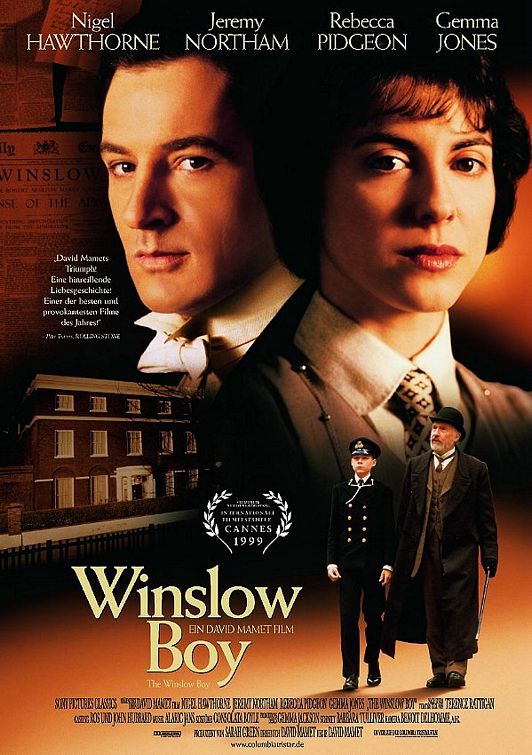
The Winslow Boy (1999)


Nigel Hawthrone will stop at nothing for justice for his son in faithful literary adaptation The Winslow Boy

Director: David Mamet

Cast: Nigel Hawthorne (Arthur Winslow), Rebeccca Pidgeon (Catherine Winslow), Jeremy Northam (Sir Robert Morton), Gemma Jones (Grace Winslow), Guy Edwards (Ronnie Winslow), Matthew Pidgeon (Dickie Winslow), Aden Gillet (John Waterstone), Colin Stinton (Desmond Curry)

David Mamet surprised those who associate him with macho, alpha-male led drama with this sensitive and faithful adaptation of Terence Rattigan’s play. After his young son Ronnie is sent down from naval college for stealing a five shilling postal order, Arthur Winslow (Nigel Hawthorne, terrific) will stop at nothing to clear his name, supported by his suffragette daughter Catherine (Rebecca Pidgeon, excellent in a difficult role). They recruit Sir Robert Morton (an electric Jeremy Northam) to champion Ronnie’s case, as the scandal rocks the nation.

There can’t be many film adaptations of plays that so completely avoid “opening up” the play. The settings and dialogue of Rattigan’s original are kept largely as is. This means that – just as in the play – all the major dramatic events happen off-stage and are reported in dialogue. The campaign to clear Ronnie’s name? Apart from flyers and newspaper prints in Winslow’s home, you’re not seeing that. Morton’s advocacy of the case in the House of Commons? The smallest of scenes. The crowds outside the Winslow home? A faint echo on the soundtrack. The pivotal court case itself? Not a single shot. If ever a production made Rattigan feel more like Chekov, I’m yet to see it.

This theatricality is not necessarily a bad thing. I’ll admit it may create a film a bit too contained and low key for some. But catch this in the right mood and Mamet’s carefully considered staging brings many of its smaller moments and personal interactions into shape. Would a film full of triumphal courtroom scenes have so perfectly captured anti-climax and confusion that can come after an event that has dominated your whole life comes to an end?

This approach also allows the relationships to come front and centre – in particular the growing attraction between Catherine and Morton, treated lightly and subtly but with huge warmth. Catherine here mirrors the main plot. Her suitors are, in turn: an upright military careerist (whom she loves, but we care little for), a gentle non-entity (whom we like but she is bored by) and the imperious Morton – on the surface someone she shares few opinions with but, subconsciously, recognises a deep kinship with. Like the public reaction to the campaign, the attitudes of these people to Catherine represent the wider reactions happening off-camera. The Morton-Catherine story is a beautiful romance in which not a single word of overt, direct affection passes between the two characters, but volumes are increasingly spoken in each glance.

Mamet’s approach also allows plenty of stagy touches to translate really well to film. The film is clearly divided into acts, and each one returns us to the Winslow home, each time in less pomp than before (by the final scene it’s stripped down to bare essentials). Arthur Winslow is less and less sturdy each time we see him, the character shrinking ever closer to old age and infirmity. Each member of the family increasingly pays heavier prices, as their financial security is sacrificed (though Mamet certainly understands the characters’ very British acceptance of these turns in fortune).

The other major benefit is that the acting comes to the fore. I’m not sure Jeremy Northam has been better than he is here: the one downside of not staging the courtroom scenes is that we will never get to see Northam play them! His Morton is a perfectly pitched imperious upper-class professional, whose exterior hides a compassionate and selfless concern for “right”. The film’s most electrifying moment is his hostile examination of Ronnie, a dynamic verbal assault that rips into the film’s quiet austereness, crackling with tension. Northam is so good, at one point I am sure he muffs a line – but he carries it off with such brilliance (the austere man awkwardly burying his feelings) that Mamet keeps it in (take a look around 2:10 here and make up your own mind!). It’s also a beautifully real moment – the man of words, briefly revealed by them. This scene is, by the way, a masterpiece of unspoken emotions and affection (from both actors).


The other main performers are equally strong. Nigel Hawthorne mixes his cuddly avuncular wit with hints of the monomaniacal obsessiveness that leads Winslow to drain his resources, and strength, in pursuit of justice. While the film doesn’t always acknowledge the sometimes self-destructive effects of Winslow’s passion – and only hints at how much Winslow sees the accusation against his son as a personal affront, as if questioning his son’s honesty is questioning his own – Hawthorne keeps the character morally rigid yet sympathetic and understandable.

Rebecca Pidgeon, the director’s wife, is practically an open target for suggestions she only got the part through nepotism. Such views are unjust. While her accent seems a little forced, her performance as the slightly distant, intellectual, prickly and driven Catherine is spot-on. The crusade begins as her father’s obsession, which she shares. Their characters then evolve so naturally that you only realise at the conclusion that she has become the lead character, and the main driver of the crusade, for quite some time.

I’ve seen The Winslow Boy three or four times now. The first time I saw it I was thrown (disappointed) by its staginess, its surface stateliness. However, since then I’ve grown to appreciate its careful, respectful lack of showiness more and more. It’s an intelligent, well-handled adaptation, crammed with wonderful performances. Yes it’s sometimes a little too “Masterpiece Theatre”, but when it can deliver such stirring, and moving, moments as it does – well you could never refuse it a place in your heart. Let Right Be Done.

Battle Los Angeles (2011)


The aliens are coming! Get ready to fight! High-octane nonsense in Battle Los Angeles

Director: Jonathan Liebesman

Cast: Aaron Eckhart (Staff Sgt. Michael Nantz), Michelle Rodriguez (TSgt Elena Santos), Ramon Rodriguez (Lt William Martinez), Bridget Moynahan (Michele), Ne-Yo (Cpl Kevin J. “Specks” Harris), Michael Peña (Joe Rincon), Lucas Till (Cpl Scott Grayston), Adetokumboh M’Cormack (HM3 Jibril A. “Doc” Adukwu)

We are not alone, and the visitors do not come in peace. But then in films like this they rarely do. They don’t even want to be taken to our leaders. They just want to kill us. An alien invasion strikes, and Los Angeles is one of several cities on the frontline against the seemingly indestructible alien hordes. Staff Sgt. Michael Nantz (Aaron Eckhart), a veteran whom many blame for leading members of his platoon to their deaths on his last tour, is hurriedly reassigned to a platoon of fresh recruits and sent into the city to rescue a group of civilians. But they quickly find themselves trapped behind enemy lines, fighting a rear-guard action against the invaders.

Battle Los Angeles has received little love from the critics. It’s not hard to see why. The characters (such as they are) are a collection of ill-defined military types, who give voice only to the purest of clichés. Literally nothing in it is new or original, with Liebesman combining the offcuts of Saving Private Ryan, Black Hawk Down and District 9 into an alien urban shoot-‘em-up cocktail. The plot is so predictable it could be comfortably guessed in advance with only a brief description of the characters. Will Aaron Eckhart’s Distant-but-Dedicated-Haunted-Sergeant win the respect and love of his men? You betcha.

So why, despite this, did I actually quite enjoy this film? Possibly because it has no pretensions at all but solely sets out to entertain. It presents its clichés with such steel-jawed commitment, it makes them fairly entertaining. It has more heart in its affection for its staple characters than a host of other, bigger blockbusters and certainly more fun. It’s a short and high-energy ride. Despite its Michael Bay-ish, fetishistic love for the military, it’s not afraid to present the marines suffering from fear and anxiety. It’s a simple, unbloated story. Sure it’s not very good at all, but it’s not offensively bad, and catch it in the right mood and you’ll enjoy its corny heroics and “man on a mission” dynamic.

Part of this probably comes from Aaron Eckhart’s acting, which is at least several degrees better than the movie deserves. Replace him with an action lunk and it would slip into militaristic tedium, but Eckhart gives his performance a certain humanity – and inspires, I think, some decent, realistic work from his fellow actors. They more than service the “Men/Women gotta do” structure – and rather winningly the film shows all the characters as competent and all willing to go the distance to help each other.

So we get a decent, B-movie cutting of a modern war film, with the frame full of bangs, crashes and chaos. Sure, many of the characters remain indistinguishable and the plot is nothing at all to write home about, but there is an unabashed, unpretentious simplicity about the film I found strangely winning. Liebesman is no artist, but he is a solid craftsman and while he lacks any originality, he does have a schlocky sense of fun that really works here.

It’s not fit to lace the boots of any of the films it’s ripping off (you can chuck in Independence Day, Aliens and almost any war film made this century) but it’s perfectly content with being a bootroom reserve. It wants to entertain you: sit back and let it do so and it probably will. Critical thinking off!

Rules of Engagement (2000)


Our heroes “Can’t Handle The Truth!” That’s okay though they don’t need to deal with it

Director: William Friedkin

Cast: Tommy Lee Jones (Col Hays Lawrence “Hodge” Hodges II), Samuel L. Jackson (Col Terry L. Childers), Guy Pearce (Maj Mark Biggs), Ben Kingsley (Ambassador Mourain), Bruce Greenwood (National Security Advisor Bill Sokal), Anne Archer (Mrs. Mourain), Blair Underwood (Capt Lee)

Jones and Jackson together! At least that was the cry at the time for this morally repugnant military courtroom drama. On a mission to rescue an ambassador from an embassy under siege, after a few marines are wounded (three are announced later as KIA), Jackson’s Colonel fires on a crowd of protesting civilians (a scheduled protest that has gone out of hand) killing 83 and wounding dozens more. Horrified, the suits at home decide to put him on trial for murder. Jones is his alcoholic (for plot reasons) lawyer, who tries to uncover the truth around a missing surveillance video which may (or may not) prove the crowd was armed.

This was a film that I think I’ve hated more and more since I watched it. In its defence: Friedkin directs the opening embassy siege well. The siege itself (denounced as racist at the time) comes across as enormously prescient considering the Arab Spring etc that we’ve seen since. Jones is pretty good, I guess, despite looking far too old for the part (he’s only two years younger than his supposed mother!). Jackson does the fireworks that are asked of him. It’s pretty well filmed in general.

Everything else in this film leaves a taste like three-week-old field rations. The courtroom dynamics are boring. The film doesn’t want Jackson to be a villain so repositions Greenwood and Kingsley’s characters as villains. Despite their best efforts, any sane person watching this film could not defend Jackson’s character’s actions here. The logic of the courtroom is ridiculous: a non-existent video tape overrules all other evidence, including a complete lack of bullet holes from guns from the street direction? I suppose you could argue the film wants us to make our own judgement on subjective recollections: but its stirring music and heroic worship of Jackson tell us firmly who we should be believing here. Basically the message seems to be: Embassies are American soil, raise a gun at them and you deserve everything you got coming.

The film tries to stack the decks overwhelmingly in support of its central character, but it just leaves an unpleasant taste in the mouth. For a start, our hero is cleared on a technicality – “There must be a surveillance tape and that tape might have cleared the Colonel so you should let him off” – that we are meant to cheer, but is in fact exactly the sort of closed ranks, protect-our-own cover-up that the supposedly villainous National Security Adviser denounces in the first place. It’s not even a good argument: all the actual available evidence clearly shows he’s guilty and Jackson even admits it on the witness stand! Ever heard of the Amritsar massacre? It’s a comparable event to this and one of our most shameful colonial actions. On the logic of this film it should be our finest hour.

On top of that, the film asks us to believe that a proportional response to being under fire from gunmen in a crowd full of civilians (including women and children) is to fire automatic weapons directly into the crowd. But that’s fine because Jackson’s character has a dream where he sees the Yemeni civilians all shooting up at him (didn’t see that the first time you showed it Friedkin!) including the photogenic one-legged girl the film has gone back to several times. So you go Samuel! Shoot up that crowd!

I could go on with the wonky morals of this horrible little film. The first thing we see Jackson’s character do on screen was to execute an unarmed prisoner (our hero, ladies and gentlemen!). Naturally the film has to exonerate him for this, so we have the Vietnamese officer who witnessed this turn up at the courtroom and say he would have done the same, then have the two of them tearfully salute each other outside the courtroom. So that’s fine then. It’s just another part of the film’s unpleasant attitude that you can’t even begin to question right or wrong in combat because, man, you weren’t there. Well I’m sorry but that doesn’t wash.

What is the moral of this unpleasant story? Well it seems to be that you can do almost anything you like so long as you can argue you have in someway saved lives (especially if they are American lives). Oh and that by extension, 1 American Marine’s life is worth just about 28 Yemeni lives. Go figure.