Category: Artist biography

Rembrandt (1936)


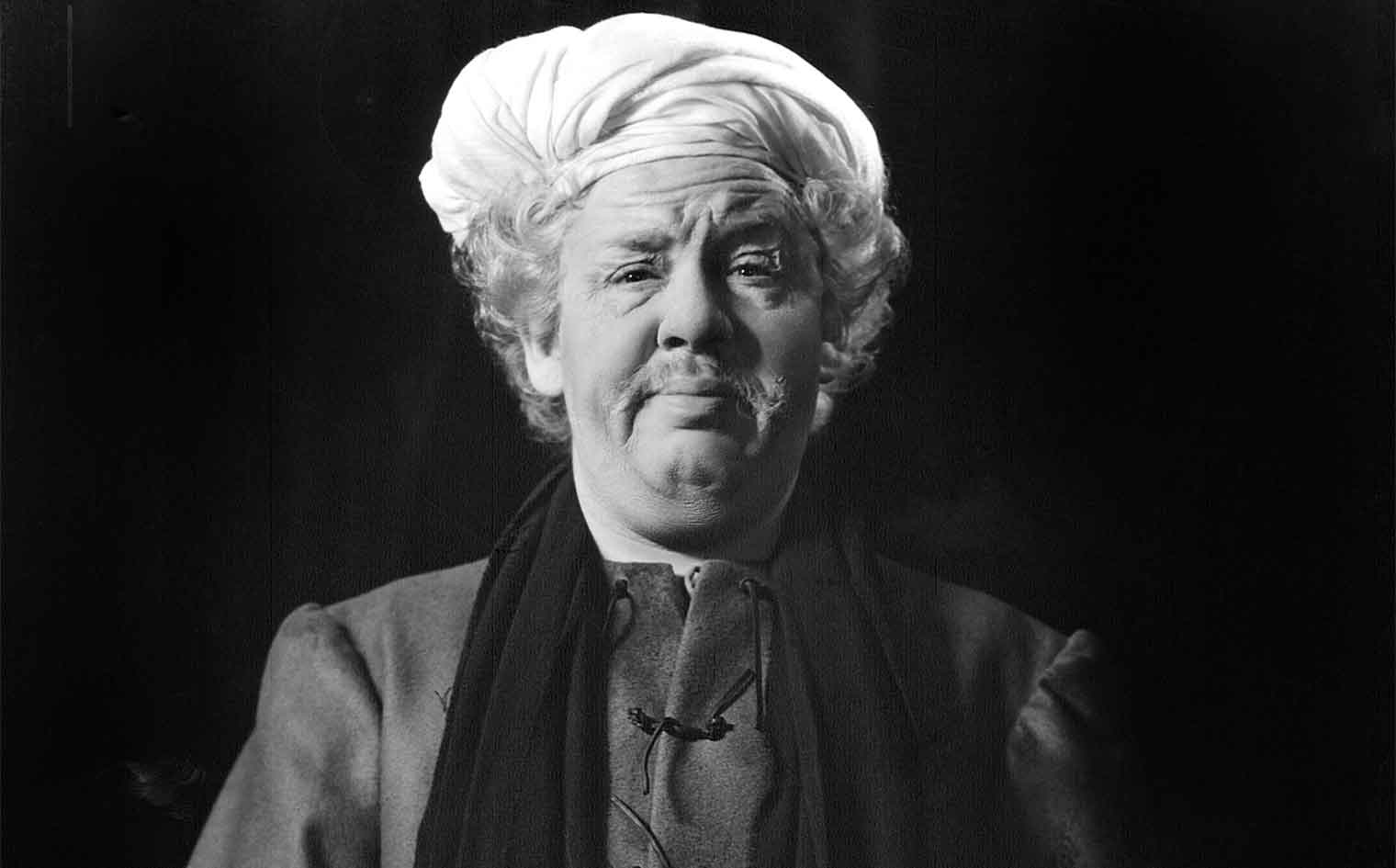
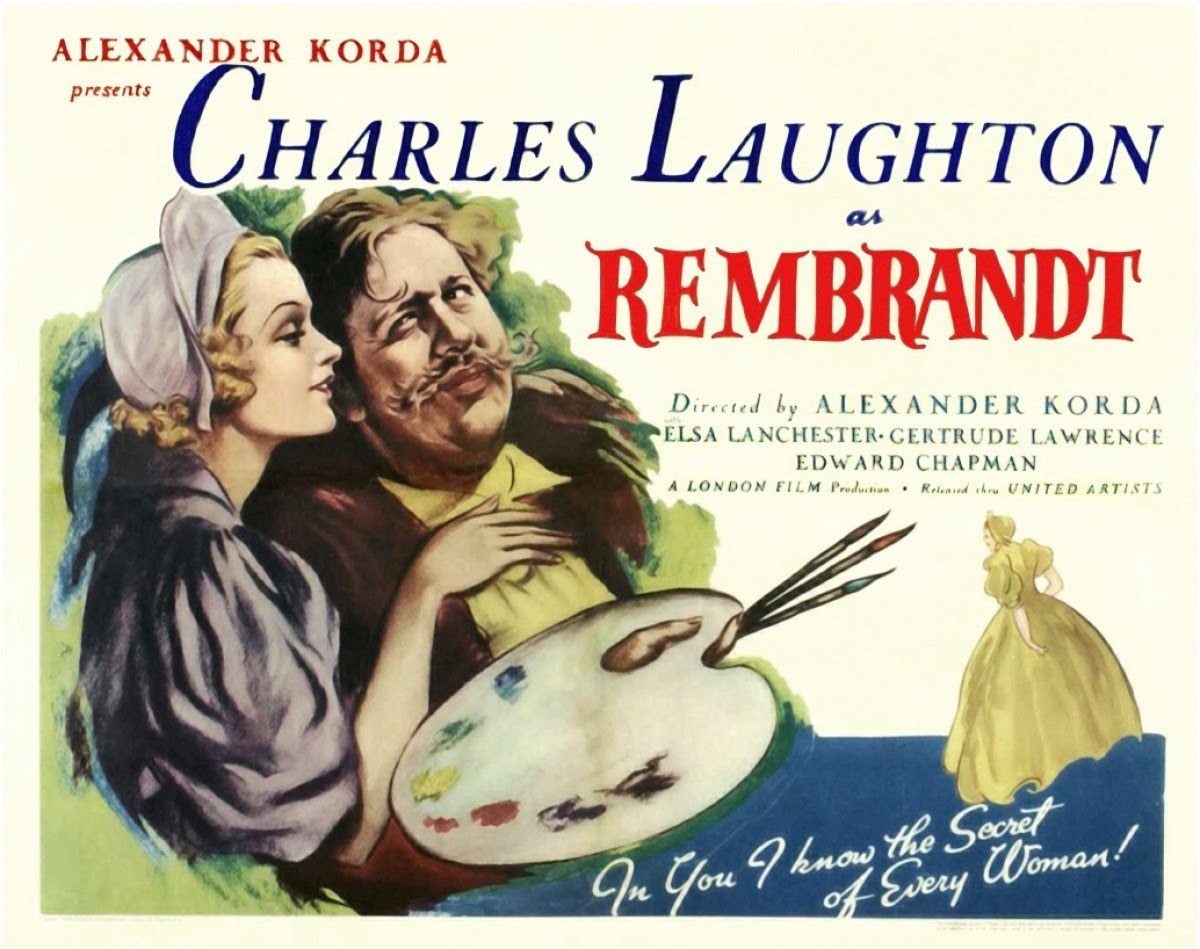
Charles Laughton excels as the great artist Rembrandt

Director: Alexander Korda

Cast: Charles Laughton (Rembrandt van Rijn), Gertrude Lawrence (Geertje Dircx), Elsa Lanchester (Hendrickje Stoffels), Edward Chapman (Carel Fabritius), Walter Hudd (Frans Banning Cocq), Roger Livesey (Beggar Saul), John Bryning (Titus van Rijn), Sam Livesey (Auctioneer), Allan Jeayes (Dr Tulip), John Clements (Govaert Flinck), Raymond Hartley (Ludwick), Abraham Sofaer (Dr Menasseh)

There are many artists I really love, but right near the top is Dutch master Rembrandt van Rijn. Rembrandt is remembered as being misunderstood in his own lifetime – which is sort of true. In fact, Rembrandt’s style fell out of favour and he basically went on a rags-to-riches-back-to-rags story not helped by constantly living outside of his means. Rembrandt actually follows the great man’s life pretty faithfully – and it even dances effectively around Rembrandt’s unusual domestic set-up.

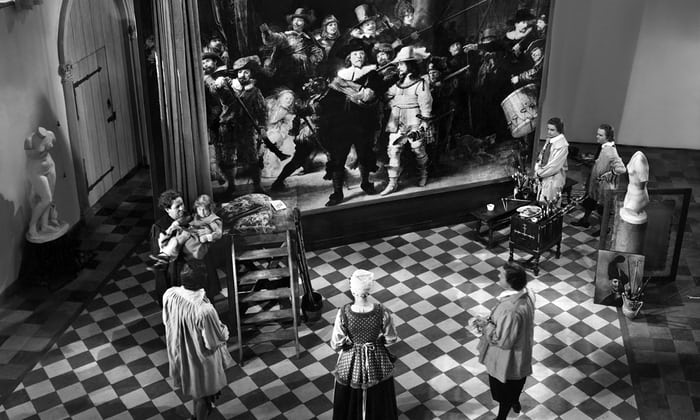
The film begins with the death of the artist’s wife Saskia, and the rejection of The Night Watch by the Amsterdam militia. These events start a slow downward spiral for Rembrandt (Charles Laughton) towards a lack of fashion and an increased poverty. The film covers his consecutive relationships with Geertje Dircx (Gertrude Lawrence) and Hendrickje Stoffels (Elsa Lanchester), before ending shortly before the artist’s death.

The film is dominated by Laughton’s magnificent performance in the lead role. Laughton can effortlessly bring to life the impression of genius. His Rembrandt is an observant, quick-witted and sharply intelligent man, whose eyes observe everything and records it for future use. Of course, for the look of Rembrandt, Laughton had a hell of a lot to go on – few artists did as many self-portraits as Rembrandt. But what Laughton manages here is to capture the essence of the artist – that sense of wry amusement and a slightly bumptious insolence you get from a Rembrandt self-portrait. 

Laughton also gives a warm humanity as well. In a wonderfully naturalistic performance, his Rembrandt is by turns gentle, amused, slightly naughty, wise – but always feels human. Korda’s film focuses on a part of his life, rather than the whole, which allows us to focus on the painter finding a more unique style and some domestic happiness – but only doing so after losing his wife and professional respect. He’s compelling to watch here, like the painter come to life: you can totally believe him, from when he’s berating the Guild for not understanding The Night Watch, to his befuddled hopelessness with money.

Korda’s film focuses on the personal rather than exploration of art – probably a good thing, since the style and grandeur of the original paintings is nearly impossible to capture in black-and-white academy ratio. This however works a charm, as we get two very contrasting lovers for Rembrandt, demonstrating different sides of his personality. Gertrude Lawrence excels as a shrewish, domineering Geertje Dircx, a woman who seems to take control of Rembrandt and his family after his wife’s Saskia’s death as if she is entitled to the role (interestingly Saskia doesn’t even appear in the film). A few weeks after Saskia’s death, Lawrence’s Geertje settles into the embrace of Rembrandt (who drifts into the relationship) with all the entitlement of an heiress.

By contrast Elsa Lanchaster portrays an earthier, gentler Hendrickje Stoffels, younger and more naïve than either Rembrandt or Geertje. If the first relationship saw Rembrandt as a man having his life organised for him, this second sees him sharing the role of parent. Having said that, while he obviously looks on Hendrickje with a loving fondness – and delights in making her happy and contented – it’s Hendrickje who effectively works out a dodge for the broke Rembrandt to keep trading art, and it’s she who takes runs the business for him. It’s a perfect marriage of personalities.

Although of course marriage is the one thing it can never be. Rembrandt was forbidden from re-marriage due to a complex arrangement in Saskia’s will: and a jilted Geertje quickly moves to have Hendrickje branded a whore. Considering it was filmed in the middle of the Hays Decency code, the film takes quite a modern stance on Rembrandt’s two long standing affairs: it’s clear that we are not meant to sympathise with the hypocritical burgomasters who denounce his love life (“It’s not fair. Why should he get away with it?” one of them moans). 

The narrative parallels this pair of romances with the world of art and commerce. Noticeably Rembrandt often seems more comfortable with those of a similar class to himself: he chats amiably with a beggar he hires as a model (a perfect little cameo from Roger Livesey), and similarly flirts with a woman from his home town at a bar with a confidence he never seems to manage with either of his other love interests. The film pivots around this return to Rembrandt’s family home, with the film suggesting the artist used this time to reassess his life and aims – before returning refreshed to shake up both his art and home life. Korda’s film argues that Rembrandt’s own rejections and losses gave him a far greater understanding and appreciation for his craft – and its power – than he otherwise would have had.

Korda films all this with a lushness, with the sets, costumes and visuals constantly reminiscent of the styles of Rembrandt’s own work. Just as Laughton plays Rembrandt as a very grounded, humane character, so the film avoids sweeping melodrama to portray a very low-key and gentle story, that feels sweetly lacking in high-blown artistic intensity. It’s perhaps best summed up by the closing scene, where an ageing Rembrandt – taken for an old nobody by some young bucks in an inn – smiles serenely, enjoying the company and quoting Scripture at them with gentle satisfaction. He’s the contented, humane master – the man who seemed to capture the age and changed painting for ever. And then he borrows money off a friend (who asks him to please spend it on food) and heads straight to the paint shop. A slave to an obsession, but a man who still inspired love and affection – what could be more human than that?

Caravaggio (1986)

Nigel Terry is Caravaggio in Derek Jarman’s extraordinary meditation on art Caravaggio

Director: Derek Jarman

Cast: Nigel Terry (Michelangelo de Caravaggio), Sean Bean (Ranuccio Thomasoni), Tilda Swinton (Lena), Garry Cooper (Davide), Dexter Fletcher (Young Caravaggio), Spencer Leigh (Jerusaleme), Michael Gough (Cardinal del Monte), Nigel Davenport (Giustinani), Robbie Coltrane (Cardinal Scipione Borghese), Dawn Archibald (Pipo), Jonathan Hyde (Baglione), Jack Birkett (Pope)

Derek Jarman started his career as a painter, before he began making his own eccentric, art-house films, shot through with a fascination with visual imagery, colliding time periods, abuse of power and homosexuality. For years, Jarman had sought funding to make a biographical film about Caravaggio – one of his (and my) favourite artists. The film he eventually produced, Caravaggio, is quite simply not like anything you’ve really seen before – partly a masterpiece of striking imagery and inventiveness, partly a groaningly semi-pretentious, self-conscious piece of art cinema. What it never is though is dull.

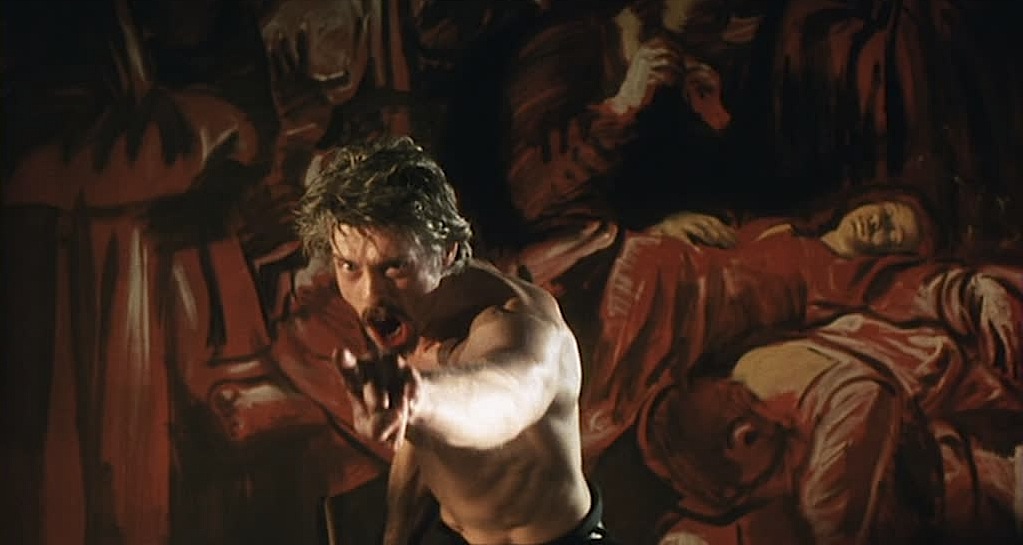
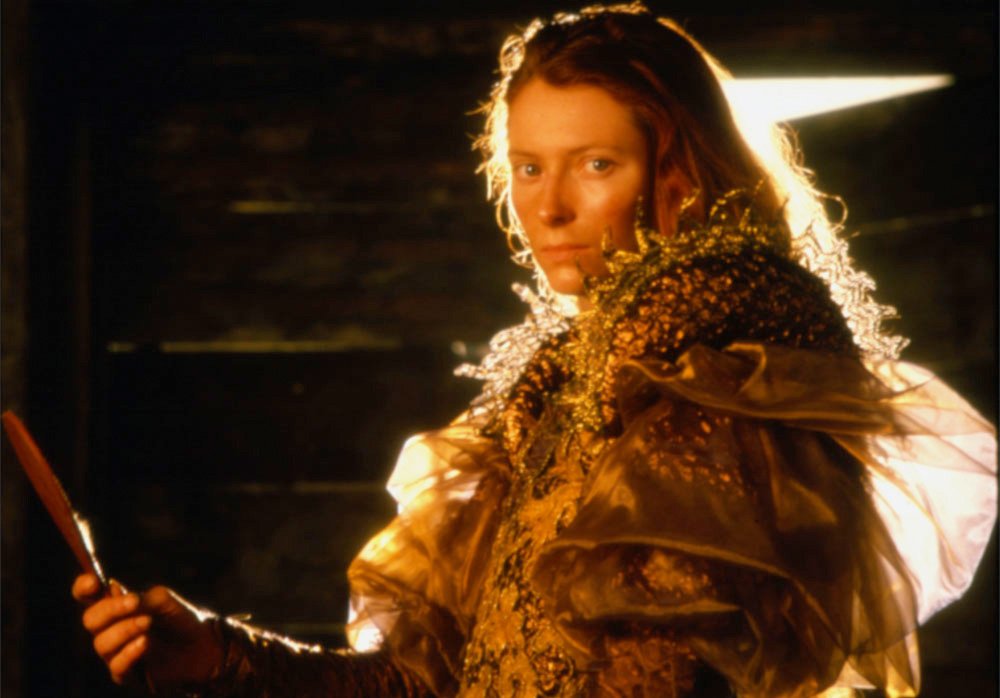
Told in a disjointed series of flashbacks, in which not every scene necessarily connects with the scenes preceding and following it, Caravaggio as a young boy (Dexter Fletcher) is taken under the wing of Cardinal del Monte (an imperiously controlling Michael Gough): creepy part art patron, part pervert. Caravaggio (Nigel Terry) becomes a successful painter, while never losing his taste for the wildness and violence of the streets of Rome. He becomes fascinated by street fighter Ranuccio Thomasoni (Sean Bean) and Thomasoni’s lover Lena (Tilda Swinton), the three of them forming a sensually suggestive menage-a-trois, which eventually leads to tragedy. All this is framed with the dying Caravaggio, remembering in a semi-poetic voiceover feelings and moments from his life.

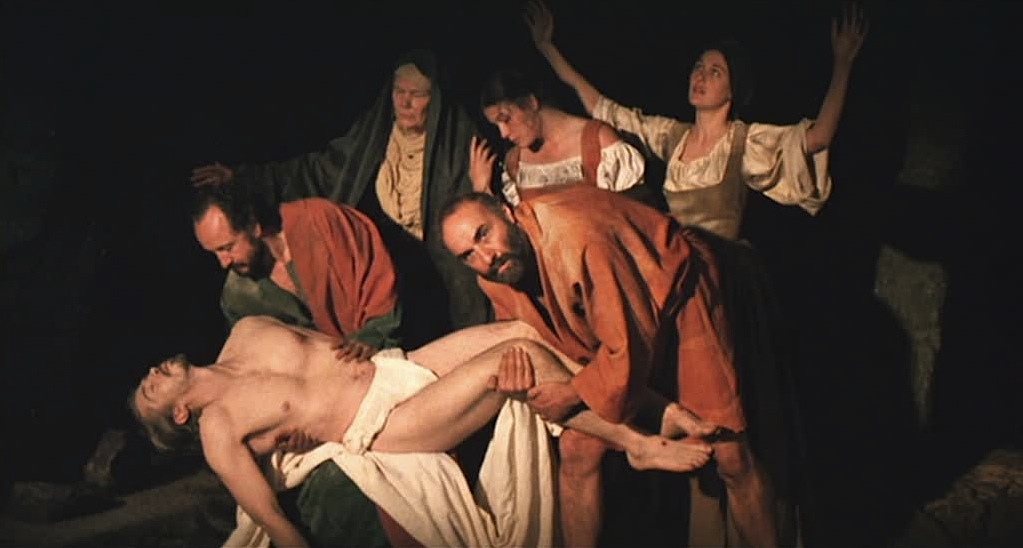
Firstly, for any fan of Caravaggio, this film is a visual treat. Every frame is lit and framed to be as reminiscent as possible of the style of the master. Many scenes are framed either in bare, stone rooms with single windows, or in sets emerging out of an inky blackness. Lighting often strikes diagonally across the frame, just as in Caravaggio’s best work. A number of scenes seem lit from a single source, such as a candle. On top of this, a number of scenes feature either the creation of, or inspiration for, a number of Caravaggio’s most memorable artworks: for those familiar with his work, it’s a delight to see these either recreated in the studio by models, or suggestively composed out of scenes. For an art lover, it’s a visual treat.

Jarman also has an intricate understanding of the creation of art, and when we watch Caravaggio at work it genuinely feels like watching a real artist, engaging with the world, recording images in his mind’s eye, and preparing his next work. The scenes watching Caravaggio create his masterpieces are fascinating in their detail and the careful build-up of paint to create an effect. The effort of models to stay still for the painter is constantly stressed. It’s a tribute to the work that goes into creation, even if the film succumbs to a few pretentious clichés (at one point Caravaggio and Ranuccio fight playfully with knives and Ranuccio cuts Caravaggio: of course Caravaggio smears the blood over Ranucci’s face. That tends to be what artists in films do). 

Jarman, however, makes a film that is deeper and more suggestive than that. This is a fascinating meditation on power and patronage in the world of art. Caravaggio is a genius, but also a tool of the people above him in the pecking order. One of the first things we see is the teenage Caravaggio selling first a painting, then his body, to a pervy art collector. The patrons call the shots here, and if they want to put your work on their wall, or their hands down your pants, the artist just needs to fall into line. Caravaggio himself is little different – the models he works with are treated with a certain warmth, but there is a clear hierarchy here. His relationship with Ranuccio and Lena is rooted initially in power – he can effectively buy them or their bodies, because he controls the money available to them. The renaissance was not a time of equality: everyone is in hock to someone else, and everyone is defined by what they can trade, be that their art, their body or both.

The film has a clear sensual charge to it in every frame, despite not containing a single scene of sex. There are highly suggestive moments of sexual abuse and desire throughout. It’s heavily implied Cardinal del Monte’s interest in the young Caravaggio is not completely innocent, as del Monte sits with him in bed teaching him to read. During their first modelling session, Caravaggio tosses a series of coins at Ranuccio, each of which the man inserts suggestively into his mouth. Every scene with Lena tingles with sensuality – either with Caravaggio, Ranuccio or the mysteriously powerful Cardinal Borghese (a corrupt looking Robbie Coltrane). 

Perhaps the most striking feature of the film though is its highly unique look. Taking his cue from Caravaggio himself – who painted the subjects of his historical pictures in contemporary dress and locations – Jarman and costume designer Sandy Powell dress the cast in a series of shabby, 1940s-1970s clothing (with the exception of a scene in the Vatican, which is established as a fancy dress party). Caravaggio is barely seen without a cigarette in his mouth, and dresses like a bohemian from Montmartre. Plenty of modern props are introduced – a banker fiddles with a pocket calculator, the writer Baglione hammers his criticisms into a typewriter while flicking through a luscious magazine of Caravaggio prints. Ranuccio cleans a motorbike.

All this manages to not only make the film continually visually striking, but also playfully reminds the audience all the time that they are watching a version of a reality – not a true story but a fictionalisation of the painter’s life. It gives Jarman an artistic licence that he exploits to the full, and makes this a film that really sticks in the memory. It’s an inventiveness you wish you saw more in films rather than slavish historical recreation.

Caravaggio is not a masterpiece – it’s a little too self-consciously arty for that. It almost delights at times in being disjointed and hard to follow. Some scenes leap over what seems like years of events. There is no real narrative through-line. The poetic voiceover can start to wear you down – I searched it for meaning, but I’m not sure if there was much there. Saying that, although this is very much a director’s film, there are some fine performances. Terry does a very good job as the artist himself, capturing a sense of the creative spark behind the eyes. Bean is excellent in one of his first roles as the earthy, insecure Ranuccio. Tilda Swinton however steals the film (it’s easy to see why she became Jarman’s muse) as the beguiling and mysterious Lena.

Caravaggio is that rare thing: a film about an artist that seems to understand art, and feel like a work of art itself. It’s unique and eye-catching and memorable as well as having a neat eye for the tragic. I was strangely mesmerised by it throughout. It’s not a perfect film, but it’s a very good one.

Love is the Devil: Study for a Portrait of Francis Bacon (1998)


Derek Jacobi plays way against-type in dark art biography, Love is the Devil

Director: John Maybury

Cast: Derek Jacobi (Francis Bacon), Daniel Craig (George Dyer), Tilda Swinton (Muriel Belcher), Anne Lambton (Isabel Rawsthorne), Adrian Scarborough (Daniel Farson), Karl Johnson (John Deakin), Annabel Brooks (Henrietta Moraes)

Maybury’s film about the relationship between the painter Francis Bacon (a revelatory Derek Jacobi) and his lover, small-time crook George Dyer (Daniel Craig), is an overtly arty piece of cinema. It opens with Bacon mourning Dyer’s death – then flashes back to Dyer literally falling into the picture (Maybury films Craig falling through darkness over the credits) before crashing through Bacon’s skylight during a bungled robbery. Here to rob the joint, he ends up getting invited to bed. So Dyer stays on as live-in lover, model and odd-job man.

Maybury’s plans for making a film about Bacon looked like they had been scuppered early, when the Bacon Estate refused permission for a single Bacon to actually appear in the film (there are a few ersatz Bacons at the edges of frames). Maybury gets around this ingeniously: he effectively turns the entire movie into a massive Bacon painting.

Rarely have fish-eyed lenses been used so much. They are all over scenes here, distorting and ballooning faces. Maybury uses shots through pint glasses and lightbulbs to bend images. The lighting (brilliantly shot by John Mathieson) recreates the visual discomfort of Bacon’s work and his use of block background colours (particularly reds and browns). Famous Bacon flourishes are reproduced – lightbulbs and mirrors appear particularly prominently. We may not see Bacon paint, but we watch him paint himself (brushing his teeth with Vim, using spit to curve his eyelashes), all while staring into a three-surface mirror – becoming his own Triptych.

The tragic Dyer even dreams in Bacon paintings: haunted by a crouching flayed man on a diving board (a dark twist on the paintings Bacon would make of him after his death). Dyer even ends the film literally consumed by Bacon’s work – he exits his hotel room into a dreamy reconstruction of Bacon’s Triptych in Memory of George Dyer, effectively recreating the painting in motion before ending it slumped lifelessly forward. It’s a neat visual image for a theme that runs throughout – the weak, pathetic Dyer is consumed by Bacon so completely, he literally becomes a painting.

Triptych in Memory of George Dyer – the visuals and design of which are brilliantly recreated in the movie

Poor George Dyer. It’s hard not to feel sorry for such a weakling, hopelessly out of his depth. Craig’s performance as an incompetent, strangely innocent (“Do you actually make a living from painting?”) petty crook and alcoholic is perfect – a fine reminder of what a great actor he is. He’s mostly a silent passenger when Bacon socialises with the hoi polloi, but this makes it even sadder to see him attempt to take on Bacon’s “life of the party” expressiveness later when regaling his working-class friends, limply imitating Bacon’s “cheerio” as he downs another glass of champagne.

This film doesn’t shy away from the dark destructiveness of the relationship: or from exploring Bacon’s promiscuous sexual masochism, and his emotional sadism. Several sex scenes are modelled after Bacon’s paintings. The roughness of the sex is constantly at the forefront. If you’ve ever wanted to see a naked James Bond preparing to beat a prone, topless Brother Cadfael with a belt, then this is probably the film you’ve been waiting your whole life to see.

Many of the film’s successes are due to Craig – and to Jacobi, who is a revelation in the best film role of his entire career. Not only is he strikingly physically similar to Bacon, but he attacks the part with a waspish bitterness and cruelty, giving a dominant performance of Bacon’s selfishness and malice. The small moments of painting we see are performed more like fights then acts of creation. However, Jacobi allows enough moments of sensitivity – the hints of sadness and regret he feels after another act of dismissive cruelty, the small touches of affection intermixed with rejections. The film makes clear Bacon was an abusive partner, and Jacobi’s performance projects all the dark charisma you could possibly want.

So why isn’t the film better regarded? The answer is there at the top: this is an overtly arty film, in many ways a commentary on the artist and his work rather than a drama. Its visual dynamism is impressive, but wearing. It’s frequently not subtle – if you were in any doubt about Bacon’s semi-sexual arousal at violence, we get to see his jubilant reaction to blood being sprayed across his face at a boxing match. Later Jacobi waxes lyrical over the beauty of a car crash while the camera pans across twisted bodies. The edgy, distorting style and overbearing dirtiness of the action may be true to much of the tone and style of Bacon’s work – but it’s hardly a bundle of fun to watch.

Love is the Devil may get close to an understanding of what drove Bacon, and what lies underneath his art – but it goes about it a very self-important way, in a film that often feels a little too pleased with itself. Craig is very good, and Jacobi an absolute revelation – but it doesn’t change the fact that the film is almost deliberately alienating and difficult. Few other characters (including an unrecognisable Tilda Swinton) get much of a look in, and the claustrophobic focus finally starts to wear the viewer down. It’s a must for admirers of Bacon (though you’ll be hard pressed to admire the man after viewing this!), but it’s a film that delights a little too much in being difficult to watch.