Category: Charles Dickens

David Copperfield (1935)

David Copperfield header
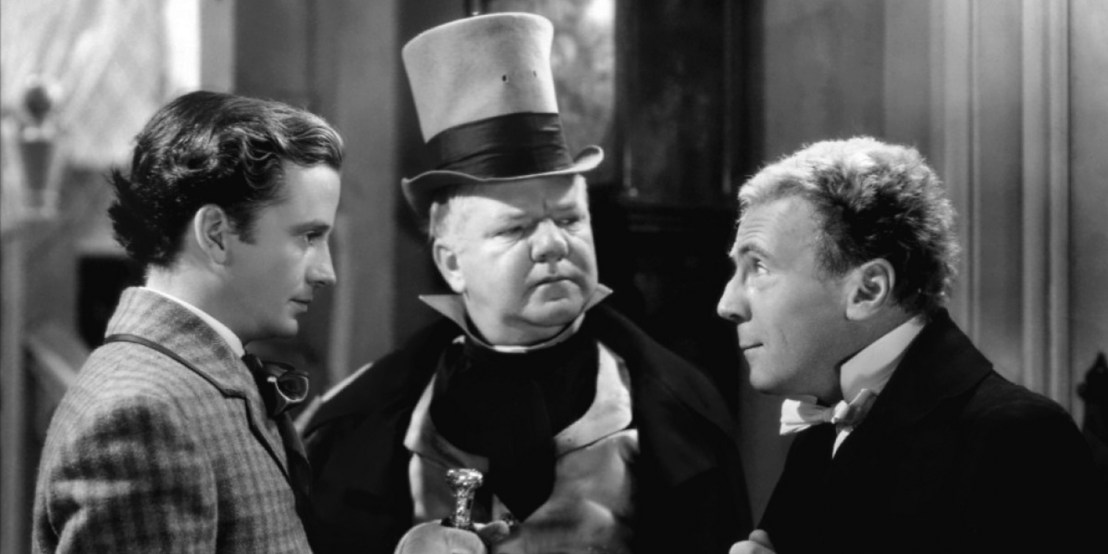
Frank Lawton, WC Fields and Roland Young bring Dickens to life in David Copperfield

Director: George Cukor

Cast: Freddie Bartholomew (Young David Copperfield), Frank Lawston (Old David Copperfield), Edna May Oliver (Betsey Trotwood), Elizabeth Allan (Clara Copperfield), Jessie Ralph (Peggotty), Basil Rathbone (Mr Murdstone), Herbert Mundin (Barkis), Jack Buckler (Ham Peggotty), Una O’Connor (Mrs Gummidge), Lionel Barrymore (Daniel Peggotty), Violet Kmeple Cooper (Jane Murdstone), Elsa Lanchester (Clickett), Jean Cadell (Emma Micawber), WC Fields (Wilkins Micawber), Lennox Pawle (Mr Dick), Lewis Stone (Mr Wickfield), Roland Young (Uriah Heap), Madge Evans (Agnes Wickfield), Hugh Williams (James Steerforth), Maureen O’Sullivan (Dora Spenlow)

You could argue David Copperfield is one of the most influential films ever made. David O Selznick was desperate to bring Dickens’ favourite novel to the screen. But the MGM suits were convinced it couldn’t be done (800 pages in two hours?! Get out of town!) and anyway who would want to come to the cinema when they could read the book at home? They were wrong, wrong, wrong and Selznick proved that classic literature (even if it was a cut-down version of a great book) could be bought to the screen and capture at much of the spirit of the book, even if you couldn’t dramatise all the events. David Copperfield remains very entertaining, not least because it also showed you can’t go to far wrong when you assemble an all-star cast who fit their characters perfectly.

The story of the film pretty much follows the novel (with exceptions, deletions and abridgements). Young David Copperfield (Freddie Bartholomew, growing up into Frank Lawton at the half-way point) grows up loved by his mother (Elizabeth Allan) and nurse Peggotty (Jessie Ralph), but loathed by his step-father Mr Murdstone (Basil Rathbone) who barely waits five minutes after his mother passes away before dispatching David to a factory in London. There David forms a bond with the charming exuberant Mr Micawber (WC Fields) before deciding to walk to Canterbury to seek the protection of his aunt Betsey (Edna May Oliver). Growing into a young man, he faces romantic problems, the schemes of the vile Uriah Heap (Roland Young) and the betrayals of his schoolfriend Steerforth (Hugh Williams). Will all turn out well?

Stylistically, David Copperfield aims to be as true to the novel as impossible. It’s designed to look as much as possible like a series of Phiz sketches bought to life and the actors have clearly studied both novel and illustrations to craft themselves as much as possible into living, breathing representations of their characters. Well scripted by Hugh Walpole (who also cameos early on as a Vicar), the film manages to be faithful without being reverential and tells an engaging story with momentum – even if the pace accelerates a little too much towards the end.

Walpole’s adaptation splits the book into two acts: the childhood of our hero and his life as young man. Giving an idea of how the momentum accelerates towards the end, this basically means the first hour of the film covers the novel’s opening 200 pages, leaving the last hour to hurry through the remaining 600. This means several characters and events are deleted, simplified or removed. However, Walpole still manages to retain all the truly vital information and iconic material, and recognises most of the striking material is found in that first 200 pages.

This childhood story is very well told, partially because Freddie Bartholomew (while he has touches of school play about him) is an affecting and endearing actor, who makes the young David a kid we care about rather than either an insufferable goodie-two-shoes or a syrupy brat. He’s a smart, kind, slightly fragile boy who we end up caring about – and it gives a real emotional impact when his mother dies (a very tender Elizabeth Allan) or to see him misused by Mr Murdstone (a perfectly judged performance of austere coldness by Basil Rathbone). Little touches of joy in his life – like the time he spends at the Peggotty’s converted ship home (a perfect representation of its description in the book) are really heartwarming, because David himself is such an endearing fellow.

It does create an obstacle for Frank Lawton when he takes over, since the audience is asked to try and bond with this new actor having already committed their hearts for just over half the run time to another. Lawton also has to deal with scenes rushing towards the conclusion rather than getting character beats like Bartholomew. Cuts impact his key relations: his school friendship with Steerforth is relayed second hand, meaning Steerforth turns up only to almost instantly let everyone down; Dora Spenlow and Agnes Wickfield get only brief screen time to establish their characters. The schemes of Uriah Heap are barely explained (he’s just a hypocritical wrong ‘un, okay?). It says a lot that the last fifteen minutes rush through the deaths of three major characters, a shipwreck, a dramatic confrontation, David travelling the world and a resolution of romantic tensions. It’s the only point when the film feels like its ticking boxes.

But it doesn’t completely matter (even if a two-part film would have helped no end – particularly allowing Lawton more room to develop a character) since the performances are so good. Expertly marshalled by Cukor – who rarely introduces visual flair, but coaches pin-perfect turns from the entire cast – every role is cast to perfection. None more so than WC Fields, for whom Wilkins Micawber became a signature part. Replacing Charles Laughton mid-filming (he claimed he looked more like he was about to molest the boy), Fields keeps his own accent and some of his own persona, but still fits perfectly into the Dickensian larger-than-life optimism and good will of Micawber. His comic timing is spot-on – watch him climbing over a roof or bantering with David and his family – and he seems like he has just walked off the page. If there had been a Supporting Actor Oscar in 1935, he would almost certainly have won it.

He’s the stand-out of a host of excellent performances. Edna May Oliver is very funny and has a more than a touch of genuine emotion as Betsey Trotwood. Jessie Ralph is excellent as Peggotty. Lennox Pawle makes a very sweet Mr Dick. Roland Young is the very picture of unctuous hypocrisy as Uriah Heap. Only the young women get a little short-changed: despite her best efforts, Madge Evans can’t make Agnes Wickfield interesting and Maureen O’Sullivan is rather cloying as Dora.

But the film itself is pretty much spot-on for the tone of Dickens, even if events are rushed. The impact of the Peggotty/Steerforth story is lost since we are never given the time to get to know any of the parties involved, and certain plot complexities are only thinly sketched out. But Cukor marshals the actors perfectly and throws in at least one striking shot, of Murdstone appearing in the distance as the camera follows a cart bearing David away from his mother. It always looks just right and the characters that do get the time are perfectly played, so much so that a few performances (Fields, Oliver, Young) may even be definitive.

David Copperfield proved you could turn a doorstop novel into a film and, even if you sacrificed some of the complexities (and might need to rush to fit it all in) you could still produce something that felt recognisable and true to the original. So, for that – with the mountain of adaptations that followed – we have a lot to thank it for.

Great Expectations (1946)

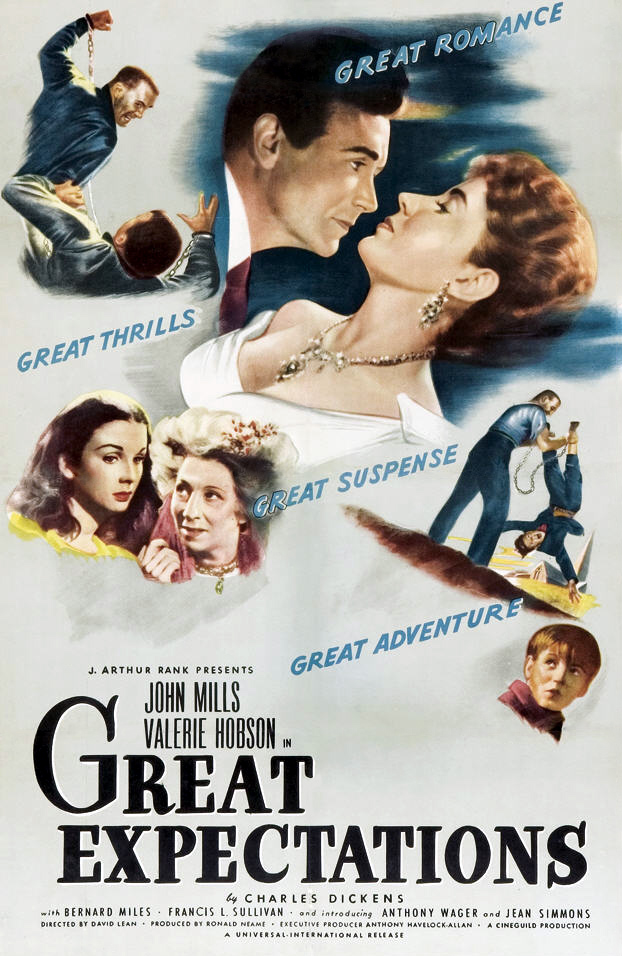
Great Expectations (1946)

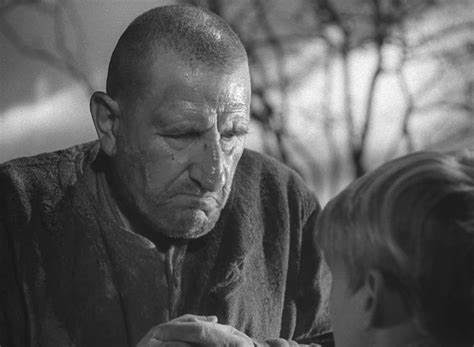
Lean’s masterful adaptation is still one of the finest examples of Dickens on screen

Director: David Lean

Cast: John Mills (Pip), Valerie Hobson (Estella), Bernard Miles (Joe Gargery), Francis L Sullivan (Jaggers), Finlay Currie (Abel Magwich), Martita Hunt (Miss Havisham), Alec Guinness (Herbert Pocket), Jean Simmons (Young Estella), Anthony Wagner (Young Pip), Ivor Barnard (Wemmick), Freda Jackson (Mrs Joe Gargery), Eileen Erskine (Biddy), Torin Thatcher (Bentley Drummle)

Of all Dicken’s books there is perhaps none so popular as Great Expectations – and no Dickens adaptations are more highly regarded than David Lean’s 1946 film. Of course, just under two hours is only time to tell a simplified version of Dicken’s original. But no-one’s taking the book away. What Lean’s film did triumphantly was turn Dicken’s prose into a clear cinematic language and style, without losing the uniqueness of the author’s voice. Lean’s visual mastery is perfectly matched with his experience as an editor of telling a story to produce an endlessly entertaining film.

As a young boy Pip (Anthony Wagner) encounters an escaped convict (Finlay Currie) in a graveyard. Intimidated, Pip brings the convict food and tools to escape his chains – acts which the convict clears him of when he is caught later that day. Weeks later, Pip is invited to the home of rich spinster Miss Havisham (Martita Hunt) to provide her and her adopted daughter Estella (Jean Simmons) with company. The visits continue until Pip’s apprenticeship as a blacksmith to his brother-in-law Joe (Bernard Miles) begins. Imagine Pip’s (now John Mills) surprise six years later when he is informed by lawyer Jaggers (Francis L. Sullivan) that he has come into money – that he has become a gentlemen of “great expectations”. Assuming it is the work of Miss Havisham – and that he is destined to marry Estella (now Valerie Hobson) – he is horrified to discover his life is more complex than he believed.

The film repackages Great Expectations a bit more into a romance. While the relationship between Pip and Estella, and the bond between them, is clear in the novel – and a large part of its plot – its but one thread masterfully woven together into the final storyline. Here this thread is given prominence, at the cost of several others. It’s not a complaint as such, but it makes Great Expectations into a more traditional story: a feeling added to by the film’s more conventional “feel-good” ending (very different from the much more uncertain ending of the novel, that Dicken’s edited back and forth in different editions to increase or decrease its hopefulness). However, it works for creating a film story, even if it loses some of the depth of the novel.

Its also more than balanced by how much the film gets right. Lean brilliantly captures the novel’s atmosphere, its gothic sense of impending dread, the burden of the past and the paranoia of persecution. For decades the opening scenes of the film, with its masterfully shot and edited mist covered graveyard (simultaneously a place of peace and a place of unsettling unknowability ) bursting into life through the grasping hands of Magwich, were practically used as a textbook example of cinematic language. Lean’s work is intensely cinematic. The mis en scene of Expectations is masterful – everything from casting, to camera angles to score comes together to bring Dickens world to life. This is exactly his London as he wrote it. It’s a wonderful expression of a particular author’s style, told using a mastery of cinematic language – from camera angles to editing cuts.

The characters have that perfect sense of eccentricity laced with menace that Dickens invests them with. Francis L Sullivan’s Jaggers is an unknowable legal machine who is part man of business, part fearsome fixer. Alec Guinness (in his film debut) is good-natured kindness to a T as Pip’s faithful friend Herbert (in one lovely scene he politely and gently corrects Pip’s primitive table manners). Finlay Currie’s Magwich captures the sense of danger and threat in the book’s opening that will become a fatherly meekness in the story’s later acts.

Largest of all, Martita Hunt’s gothic Miss Havisham sits like a giant spider at the centre of a decaying web. The design of Satis House – with its rotting wedding cake, sprawling cobwebbed dinner service, the heavy curtains and lack of light – is just one of the many perfect touches in the film. Hunt herself is superb as this outwardly eccentric aunt, who in fact has been nursing a core of bile and hatred that ends up only hurting those closest to her. There is something hugely dreamlike about Miss Havisham’s home – you suspect Lean may have watched some Cocteau – with its strangely angled table and mix of intimate framing and wide-angle crane shots.

Perhaps because we only see, not read, Pip’s actions in this film it’s impossible not notice what an arrogant snob he becomes. John Mills does decent work in the part, but (much as in the book) Pip ends up feeling like a slightly colourless figure. The film doesn’t always explore in detail the negative sides of his character meaning moments like his patronising dismissal of the kindly Joe (a perfectly judged Bernard Miles), don’t do the character much favours. Mills does however make a larger impression than Valerie Hobson, left slightly adrift as Estella. She’s not helped by how outstanding Jean Simmons is as the young and preciously flirtatious Estella, the perfect picture of the little cruelties teenagers inflict on each other. (A braver film might have had her play the role throughout – but then Mills would look even older than he does!)

The film is very strong on the pain caused to these two characters – and that they cause for each other. More than any other version, we get a sense here of how Miss Havisham’s misguided aim to use Estella as a weapon of revenge on all men only manages to hurt Estella herself and Pip (her one true love as presented here). Just as a Pip’s snobbish dismissal of Joe stings. And Lean’s brilliant sense of pace and rhythm means that this plays hand-in-hand with Pip’s ever more desperate attempts in the second half to save Magwich from doom.

Many of the complexities of the plot (from Estella’s parents to Herbert’s marriage to several key characters) are cut out, but it’s striking how the film still manages to feel so faithful to the book. Lean’s understanding of Dickens mix of eccentricity and darkness is communicated in every frame. The major moments and characters from the book are beautifully bought to life, from that opening scene to Satis House. But also because small moments, like Wemmick’s “Aged P” remain in the film. Sure, the canvas has been reduced – and refocused into a love story of sorts – but the picture that emerges is still very much in the style of Dickens.

That’s what makes it one of the greatest adaptations of all time: it’s both an interpretation of the original and a beautifully judged capturing of its spirit and tone. An adaptation twice the length may have caught more plot, but would not have been such a fine movie. Because so much of this film’s imagery and drama sticks in the mind long after it is finished. Lean’s masterstroke here was to understand completely the heart of the book, and to focus the film on that. Brilliantly assembled, designed, shot and acted, it’s still one of the best literary adaptations ever made.

The Personal History of David Copperfield (2019)

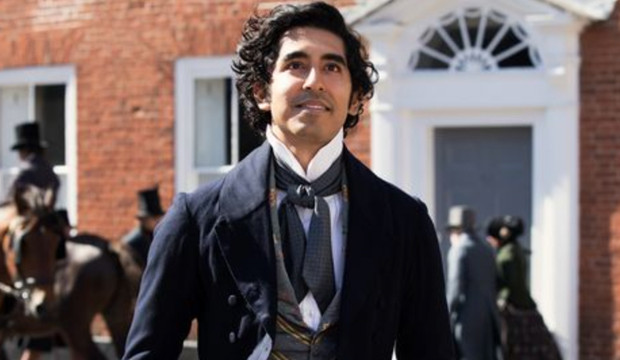
Dev Patel makes a charming lead in this Dickens adaptation that finds the comedy but misses the heart

Dir: Armando Iannucci

Cast: Dev Patel (David Copperfield), Tilda Swinton (Betsey Trotwood), Hugh Laurie (Mr Dick), Peter Capaldi (Mr Micawber), Ben Whishaw (Uriah Heep), Paul Whitehouse (Mr Peggotty), Aneurin Barnard (James Steerforth), Daisy May Cooper (Peggotty), Morfydd Clark (Dora Spenlow/Clara Copperfield), Benedict Wong (Mr Wickfield), Darren Boyd (Mr Murdstone), Gwendoline Christie (Jane Murdstone), Anthony Welsh (Ham Peggotty), Rosalind Eleazar (Agnes Wickfield), Nikki Amuka-Bird (Mrs Steerforth), Anna Maxwell Martin (Mrs Strong)

If Charles Dickens ever had a favourite child, it was probably David Copperfield. His novel – heavily inspired by events in his own life and upbringing – is an epic masterpiece, part coming-of-age story, part heart-warming family saga, part social satire. It’s quite a challenge to boil down its hundreds and hundreds of pages – and multiple plot points and characters – into less than two hours, but that’s the task Armando Iannucci takes on here. Does it work?

Well, to be honest, not quite. There is a lot to admire here, I’ll say that straightaway. And maybe I’m hard on it as I’ve read (or listened to) the novel at least three times. But for me this version drains out the heart of the novel. It zeroes in on the comedy – and there are several scenes and characters that are inarguably funny – but in doing so it removes or peels away anything bittersweet or with even a hint of sadness. It’s funny, but also a strangely empty and unengaging version of the story that it’s hard to get invested in and finally seems to drag.

Iannucci uses a terrific framing device, inspired by Dickens’ own public readings of his work. The film opens with Copperfield (a wonderfully jovial and engaging Dev Patel) publically introducing his novel to a theatre full of people which, with a flourish, disappears as he walks into the scenery and into his own past. Iannucci sprinkles his film with little flourishes like this to remind us of the semi-created nature of what we are watching, from Mr Murdstone’s hand looming into the Peggottys’ boat to pluck Copperfield into the next scene, through to the use of projected imagery at key points to fill in visually backstories the characters in the scene are relating.

The book has been well pruned and structured – and this is in some ways a triumph of compression, since it ticks off nearly all the main storylines of the plot (with some changes) and includes all the main characters. The real purist will decry such things as the loss of Barkis and Mr Micawber’s famous lines, or the translation of Mr Creakle into a factory owner or Rosa Dartworth into Steerforth’s mother. But these are necessities of adaptation and much of the storyline remains the same (if abbreviated). The script punches up the comedy a great deal – Iannucci has been vocal in his feeling that Dickens does not get the appreciation he deserves as a comic writer.

The script also digs up a few gems in the novel – Copperfield’s nervousness in reading, his inability to read to Murdstone’s gaze, is imaginatively reinterpreted as dyslexia. The semi-Freudian longing he feels for the warmth and innocence of his lost childhood is neatly captured by casting Morfydd Clark (very endearing and charmingly ditsy) as both his mother and his first love Dora. There are several laugh-out loud moments and a charmingly freewheeling love for absurdity.

But what doesn’t work is that the heart and soul of the novel has been stripped out. There is, to put it frankly, no pain or difficulty here. The tears in Dev Patel’s eyes at the end of the film as he closes his recital with the audience and reflects on the triumphs and losses of his life feel unearned. Put frankly nothing seems that hard, for all poverty rears its head at time. Even the Murdstones are less fearsome and cruel than they need to be. Worst of all, anything of any real emotional depth or tragedy from the book is removed. The two key tragic deaths of the book are actively reversed here, with both Dora and Ham surviving at the end. The complexities of Copperfield’s feelings for Dora and Agnes are resolved with immense ease for a traditional happy ending in a garden of the heroes surrounded by friends and families (exactly the sort of happy ending that Greta Gerwig gently poked fun at in Little Women). 

It’s all boiled down and told for jokes and the emotional engagement just isn’t there. Dev Patel enters the film too early – Copperfield is a young adult before he even heads to his aunt’s house – meaning the lost, vulnerable sense of sad childhood turning into a happy one is completely lost, and Copperfield’s fragility is too quickly brushed aside. Mr Micawber (a funny turn from Capaldi, but far too wheedling) is played so much for laughs that his essential decency and kindness is lost in favour of a man who spends his life borrowing cash. Too often humour is the first and only port of call, and finally it crushes the heart out of the story.

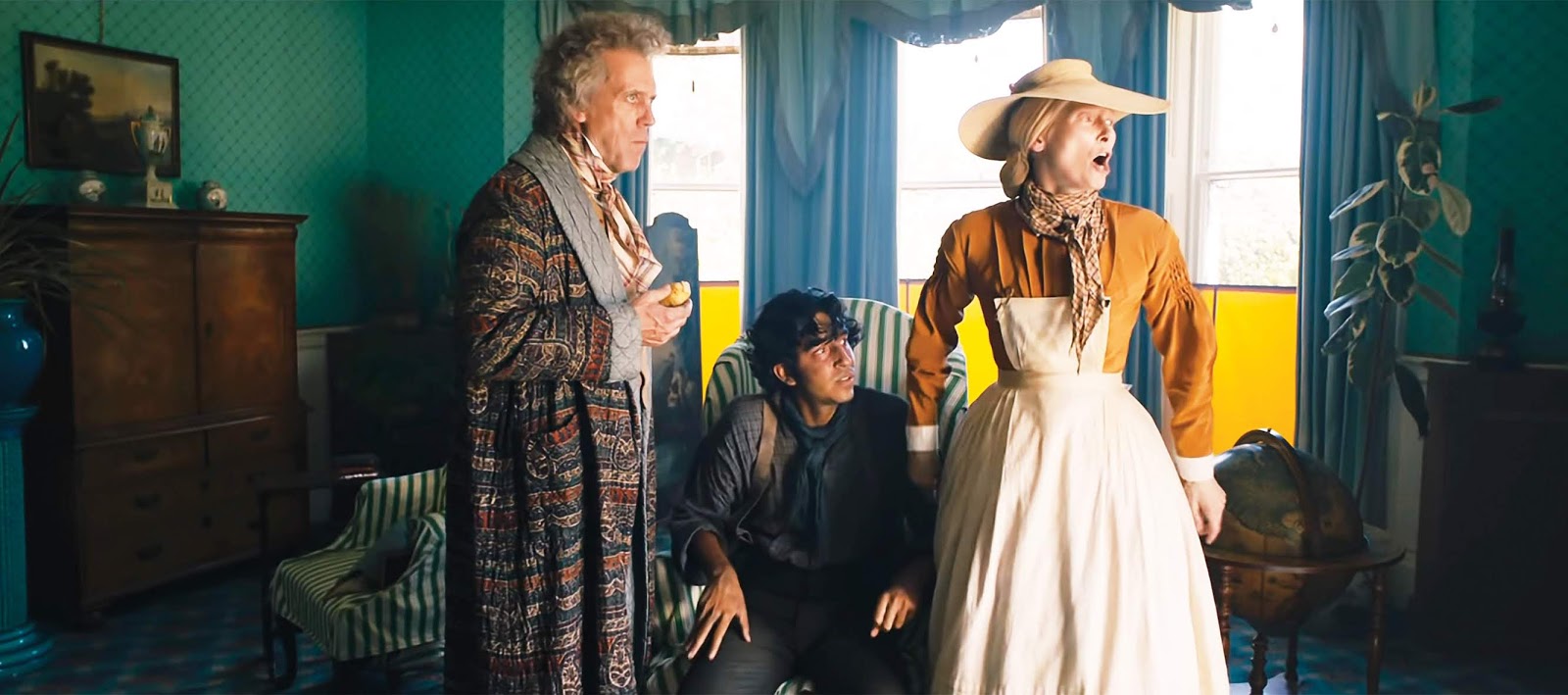
There are triumphs in the film’s cast. Hugh Laurie is simply outstanding as Mr Dick – warm, funny, wise, surreal, eccentric, half a philosopher, half an engaging and excited child – it’s Laurie’s finest performance ever on film. Benedict Wong is very funny as the alcoholic Mr Wicklfield. Tilda Swinton has great fun as a battleaxe but wise Miss Trotwood. Nikki Annuka-Bird could cut glass as Mrs Steerforth. Aneurin Barnard makes for a charmingly dissolute Steerforth. Ben Whishaw is terrific as the unctuous and ambitious Uriah Heep. The colour-blind casting works a treat to bring a range of wonderful actors in.

It’s just a shame the story doesn’t translate as well. There is a theme somewhere in here of Copperfield trying to work out his identity (much prominence is given to his multiple names and nicknames) but it never really takes flight, serving as a fig leaf of an arc rather than an actual arc. It’s a film full of jokes and fine moments – but with no heart, and no real engagement with the audience, it ends up feeling far longer than reading the book.

The Muppet Christmas Carol (1992)


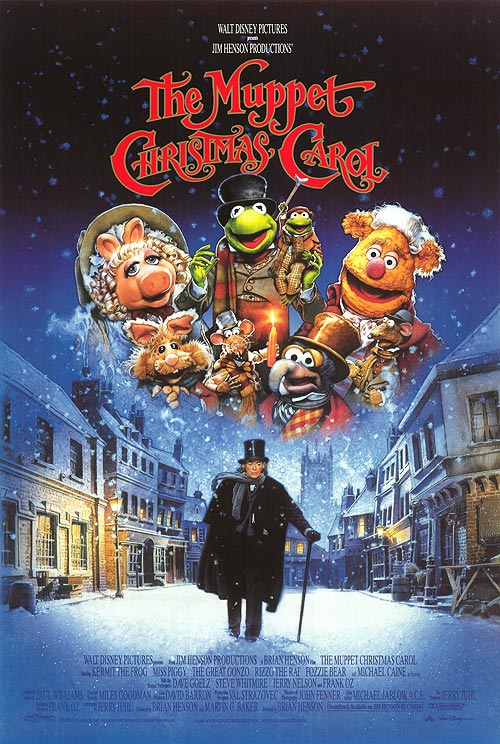
Michael Caine with some of his best ever co-stars in The Muppet Christmas Carol

Director: Brian Henson

Cast: Michael Caine (Ebenezer Scrooge), Kermit (Bill Cratchitt), Miss Piggy (Emily Cratchitt), Gonzo (Charles Dickens), Rizzo the Rat (Himself), Statler and Waldorf (Jacob and Robert Marley), Fozzie Bear (Fozzie Wig), Dr Bunsen Honeydew & Beaker (Charity Collectors), Sam the Eagle (Schoolmaster), Steven Mackintosh (Fred), Meredith Braun (Belle), Robin Weaver (Clara)

There have been many adaptations of Charles Dickens’ beloved novel. Surely few people would disagree – this is the best one. If you don’t love this film I’ll just say it – there is something wrong with you. That’s it. There is no hope for you. Just give up, pack up and go home. Because no Christmas is complete without this film. It’s brilliant. 

It’s also perhaps the version that feels the closest to Dickens’ plot – which is remarkable considering 90% of the parts are played by puppets. But what they do so well here is bring the film back to the roots of the novel – it follows the plot pretty much spot on, the setting and design feel brilliantly Dickensian, and it even introduces Dickens as a character. And who better to play the great Victorian showman than the Great Gonzo? Gonzo anchors the film brilliantly, and is both really funny and delivers an awful lot of text from the original book. This actually feels more like a slice of Dickens than nearly any other adaptation you can think of – I’m sure he would have loved it.

That’s why the film works – it has a mix of brilliant muppet humour in it (and there are some really laugh out loud moments) but it’s also a pretty straight adaptation. There are moments where the fourth wall is leaned on, but the content is never mocked. So you get all the fun moments around the edges, but you still get an extremely strong story that has worked for over 100 years. Thank goodness they pulled away from the original idea of parody and played it straight with a smile!

One of the main reasons it works so well is Michael Caine’s superb performance in the lead role. When Caine agreed to do the movie, he was straightforward about his intentions: “I’m going to play this movie like I’m working with the Royal Shakespeare Company. I will never wink, I will never do anything Muppety. I am going to play Scrooge as if it is an utterly dramatic role and there are no puppets around me.” That is totally what he does. Because Caine walks the balance so well, he plays the moments of comedy with great humour, but also the emotional force of Scrooge’s journey.

Caine so totally believes in and respects the world he is working in, that he brings the entire audience with him. If Caine can, with a totally straight-face, treat talking to a small bunny singing carols with as much integrity as he does sharing a scene with Laurence Olivier, all the rest of us can as well. Just think how the film’s mood would have been wrecked if Caine had winked at the camera, or said something like “I told you to only blow the bloody doors off” – the careful balance of the film would have been wrecked in a moment.

I think you can safely say this is one of Caine’s finest films: he’s got fantastic comic timing – his scowly ill-humour for the first third of the film is a delight – but he makes the later scenes genuinely moving. It almost seems like he inspires the muppets around him – Kermit and Miss Piggy’s later scenes dealing with the death of Tiny Tim are genuinely tear inducing (is this the only production of Christmas Carol where Tiny Tim isn’t insufferable?). The Muppets are all brilliant here (if Caine is going to treat them as real actors, I certainly am as well!).

That’s why the film works – it’s really emotionally moving. The muppets inspire a huge residual affection in everyone, and the film mines this brilliantly. So we get pleasure from seeing them – look there’s Fozzie Bear and Sam the Eagle! – and then feel their pain when they are sad. The film gets the balance just right on the muppets’ essential anarchy: at one point Sam the Eagle needs to be reminded that he is playing a Brit, Rizzo frequently forgets he’s playing a role, Animal seems unable to play the gentle music the script plays for at Fozziewig’s party… The film is crammed with small moments like this.

And it all works because it is held within a fine piece of straight storytelling – a faithful adaptation of Dickens, with a brilliant lead performance. It’s also very well made – inventively shot with a real sense of mood and atmosphere and brings memorable scene after memorable scene. There is barely a frame of the film where there isn’t something delightful, entertaining, thought-provoking or all three to spot. It carries emotional weight, it’s laugh-out-loud funny, you’ll fall in love with the characters. Caine sets the tone brilliantly, and raises the game of everyone involved – it’s an impossibly difficult acting task that no one in a muppet film has ever pulled off as well again. 

It’s one of the greatest Dickens adaptations, one of the sweetest comedies you’ll see, and one of the greatest Christmas movies ever made. On top of that it’s a brilliant musical, with some fantastic hummable songs (though the cutting of Love Is Gone from the DVD edition – too sad apparently –makes you sigh for Disney’s corporate soul). No Christmas would be complete without it. A must-watch classic.

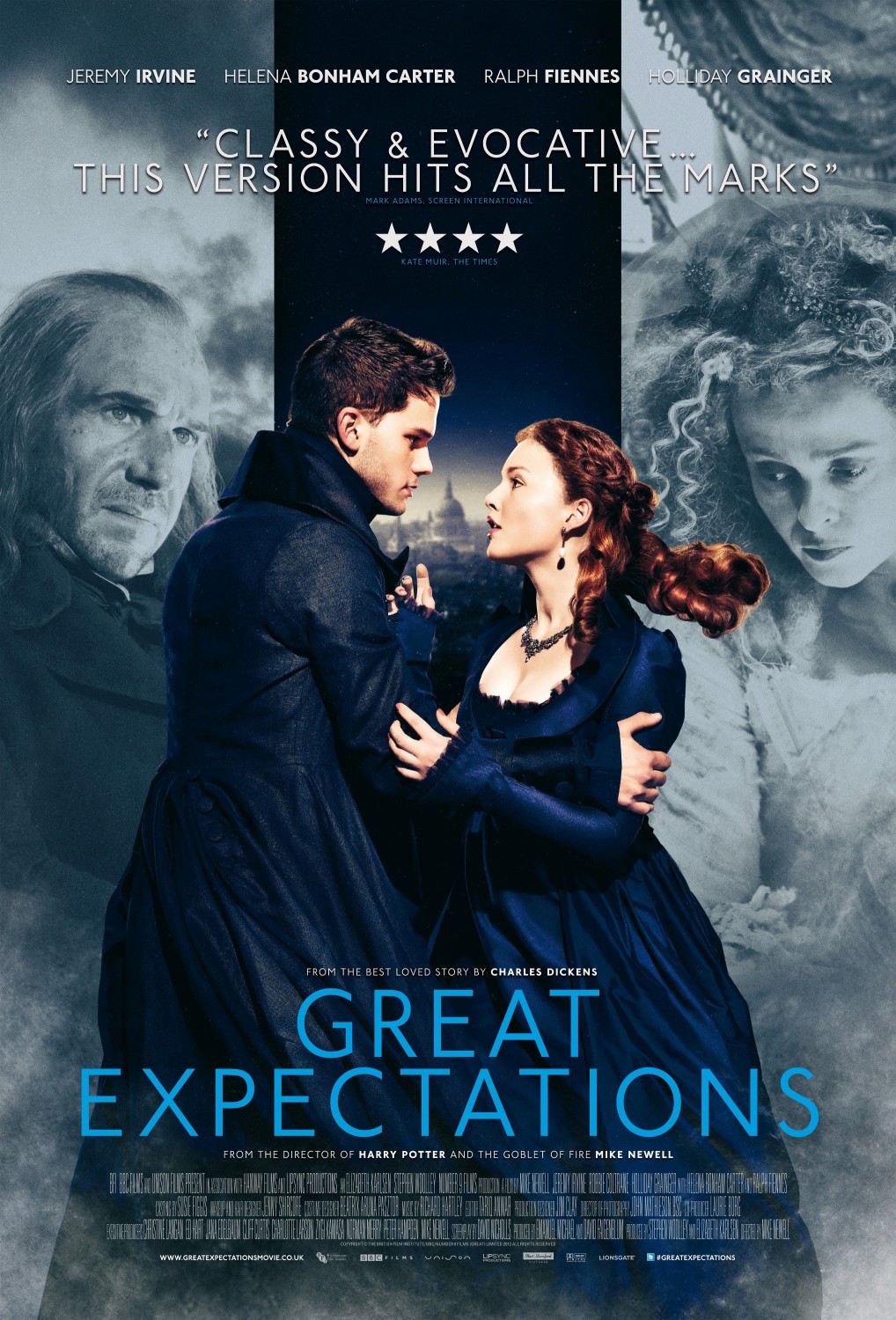
Great Expectations (2012)


Ralph Fiennes is ‘Ungry

Director: Mike Newell

Cast: Jeremy Irvine (Pip), Holliday Grainger (Estella), Helena Bonham-Carter (Miss Havisham), Ralph Fiennes (Magwitch), Robbie Coltrane (Jaggers), Jason Flemyng (Joe Gargery), Ewen Bremner (Wemmick), Sally Hawkins (Mrs. Joe), David Walliams (Pumblechook), Tamzin Outhwaite (Molly), Ben Lloyd-Hughes (Bentley Drummle)

There is one major problem with Mike Newell and screenwriter David Nicholl’s faithful adaptation of Great Expectations, one of Charles Dickens’ best loved novels. It’s such a faithful adaptation that it largely fails to say or do anything unique or interesting with the actual source material itself. Thus it basically joins the parade of adaptations of this novel on film, struggling to define itself from the competition.

For those who don’t know the story: young Pip has two defining encounters in his childhood. One is with escaped convict Magwitch (Ralph Fiennes), to whom he provides some help; the other with eccentric, secluded spinster Miss Havisham (Helena Bonham-Carter), who brings him in as a playfellow for her ward, Estella. As a young man, Pip (Jeremy Irvine) finds himself coming into “great expectations” from a mysterious benefactor, and moves to London where he encounters Estella (Holliday Grainger) once more.

Nicholl’s screenplay is a careful ticking off of all the events you would expect to see from either the book or previous versions: “I’m hungry boy”? Check. Mrs Joe? Check. Boxing with young Herbert Pocket? Check. Jaggers and Molly? Check. Wemmick, the Aged P and the cannon? Check. Bentley Drummle? Check. Joe Gargery in London? Check. Fire? Check. And so on, and so on. What’s really missing from the film is any sense of identity, any sense of a story it wishes to tell, or angle it wants to take on the source material. Instead it’s a picture book accompaniment to the novel. A beautifully filmed one, I will say (John Mathieson’s photography is lavishly good, and brilliantly captures the wide-open spaciousness of Kent compared to the dank, claustrophobic confines of London) but still a picture book.

It’s also decently acted throughout, with Jason Flemyng a stand-out as a decent, kind and loveable Joe (a part I think it’s almost impossible to fail in). Robbie Coltrane makes Jaggers a creepy charmer. Helena Bonham-Carter is, as one reviewer said, “almost too perfect casting” as Miss Havisham – her performance is a bit too familiar as a remix of her parts in Tim Burton films and Bellatrix Lastrange – but she is still very good in this role.

The closest the film gets to putting a twist on the novel is to front and centre the love-story angle between Pip and Estella. Even this, though, is not completely successful, largely due to time. Irvine and Grainger are fine performers (Grainger in particular does an awful lot with what can’t be more than 10-15 minutes of screentime), but adult Pip and Estella don’t have a scene together until halfway through the film. The film also is reluctant to lose anything major from the Gargery or Magwitch plotlines, meaning these get equal weighting with the Estella scenes. It’s possibly the only area where this adaptation is weaker than the BBC adaptation of a few years later, which effectively repositioned the story with a focus on father-son relationships, adding greater prominence to the Pip-Gargery-Magwitch relationships.

Mentioning that BBC adaptation makes a key point about the lack of individuality this production has. Casting my mind back to it, I found it very hard to remember or distinguish the differences between the two – both looked very similar, took similar decisions and featured similar casts. In fact, it became very hard to remember who was in what – an internet search for images for this film throws up plenty of images of Douglas Booth from the mini-series. It’s a small point, but I think captures the lack of uniqueness about this film.

I’ve been very hard on this film, which I feel a bit bad about as it is a very watchable and loyal adaptation and a perfect entry point for Dickens. It also has, in Ralph Fiennes, one superb performance. Of all the versions of Magwitch on screen, this surely has to be the best. Fiennes has the physicality and danger the role needs, but he also has an ethereal, almost child-like quality to him. You can believe this is a dangerous man, but also understand how he can be so passive and easily led. Fiennes’ Magwich takes a delight in the seeing the pleasures of others and has a sweet dedication to his own codes of loyalty. It’s a terrific performance – and actually emerges as the one unique and defining thing the film has to offer.