Category: Cold war films

2010: The Year We Make Contact (1984)

2010: The Year We Make Contact (1984)

Solid film stuck forever in the shadow of a landmark, all answers and no mystery

Director: Peter Hyams

Cast: Roy Scheider (Heywood Floyd), John Lithgow (Walter Curnow), Helen Mirren (Tanya Kirbuk), Bob Balaban (R. Chandra), Keir Dullea (Dave Bowman), Douglas Rain (HAL 9000), Madolyn Smith (Caroline Floyd), Elya Baskin (Maxim Brailovsky), Dana Elcar (Dimitri Moisevitch), James McEachin (Victor Milson), Natasha Shneider (Irina Yakunina), Vladimir Skomarovsky (Yuri Svetlanov), Mary Jo Deschanel (Betty Fernandez)

2010 is the film 2001 could have been. That’s not really a good thing. Where 2001 was invested with such Kubrickian mystique that is has engrossed and bewitched audiences for decades with its elliptical structure, haunting experience and complete lack of definitive answers or interpretations, 2010 is nothing but answers. Don’t get me wrong: 2001 is a tough act to follow, but 2010 is rather like rolling from looking at a Picasso to checking out a talented local artist. One produces art that you would happily hang on your wall – the other produces a priceless, timeless masterpiece that will define its medium for decades to come.

That’s the thankless position for Peter Hyam’s solid and basically perfectly fine science-fiction. In many ways, without the existence of 2001, it’s sensitive exploration of the deep-space thawing of Cold War relations, exploration of how more unites mankind than divides us, musing on questions of what makes us human would have felt quite hefty. 2010 however, forever in comparison to 2001, feels more like a well-made info dump, dedicated to answering any questions left over. As Heywood Floyd (Roy Schieder) takes part in a joint US-USSR mission to find the Discovery we are painstakingly told what the monoliths are, what they were for, what happened to Dave, why HAL went loco, where mankind goes next… all wrapped around a world teetering on nuclear war and the creation of a new star raced through in under two hours so swiftly that barely a scene goes by without breathless exposition.

It’s fine. Although anyone who sat through 2001 and wanted to know the exact science of the monoliths and the exact reasons for HAL’s psychosis may well have missed the point. Hyams film is a solid, decent, noble attempt to follow-up on a landmark that manages to pay a respect to the original (despite cringe worthy touches like a magazine cover in which Clarke and Kubrick cameo as the faces of the superpowers leaders – one of two wonky Kubrick references alongside Mirren’s character’s barely discussed anagram name) without wrecking its legacy. Dutifully the film replicates a few shots and throws in some already iconic sound cues. But it’s done in a way that manages to lift 2010 with some of the haunting poetry of the original, rather than dragging it down.

There is some decent stuff in 2010 a film swimming in Cold War tensions. The US and USSR crews start with an abrasive suspicion of each other, which refreshingly thaws out in a shared sense of team and there being no borders in space (despite the best efforts of their governments). A big part of this is the warmly-drawn relationship (with more than a touch of the romantic) between John Lithgow’s nervous engineer, on his first mission in space, and Elya Baskin’s deeply endearing experienced cosmonaut who takes him under his wing. More time is allowed to let this grow as a human relationship than any other pairing in the film, and it pays off in capturing on a personal level the film’s hopeful sense that tensions between two nations intent on MAD could thaw.

But the film mostly riffs on the original. The haunting presence of Kier Dullea’s Dave Bowman – now something beyond human – is effectively used at several points (a series of appearances to Roy Scheider’s Floyd inevitably sees Dullea rattle from shot-to-shot through every make-up stage he went through in Kubrick’s haunting conclusion to 2001, as 2010 continues to tug its forelock at its progenitor). The Discovery – now a dust covered relic in space – is fairly well re-created (even if the scale of the model is ludicrously off-beam in several shots featuring space-walking astronauts). Bob Balaban – bizarrely playing an Indian scientist, though thankfully without dubious make-up – has several scenes recreating Dullea’s floating in HAL’s innards, slightly undermined by the fact Balaban looks like he’s uncomfortably hanging upside down.

Tension is drawn from whether HAL himself – once again voiced with brilliantly subtle emotion just under his monotone earnestness by Douglas Rain – will once again flip out, but 2010’s generally hopeful alignment along with its ‘no answer left unturned’ attitude does rather undermine this tension. Just as we are never really left in doubt that Helen Mirren’s no-nonsense commander and Roy Scheider’s guilt-laden Floyd (who has had a character transplant from the coldly inhumane bureaucrat of 2001) will find a way to both respect each other and work together. You can however agree that 2010 does find more room for human feeling and interaction than 2001. Nowhere in that film could you imagine the hero sharing his anxiety about a risky space manoeuvre, huddled with an equally fearful Russian cosmonaut. Or 2001s version of Dave visiting his wife, or any of the characters entering into any sort of discussion on the morality or not of sacrificing HAL.

2010 also has some striking imagery among its cascade of answers and facts, But finally it’s only really a sort of epilogue or footnote to something truly ground-breaking. A curiosity of complete competence, which never really does anything wrong but also never really does anything astounding either. You’ve got to respect Hyams guts in even attempting it (I’m sure plenty of other directors flinched at the idea of recreating Kubrick) but you’ve also got to acknowledge that it falls into the traps of conventionality that 2001 avoided doing. 2010 is, at heart, really like a dozen other films rather than something particularly unique. Unfortunately for it, that was never going to be enough.

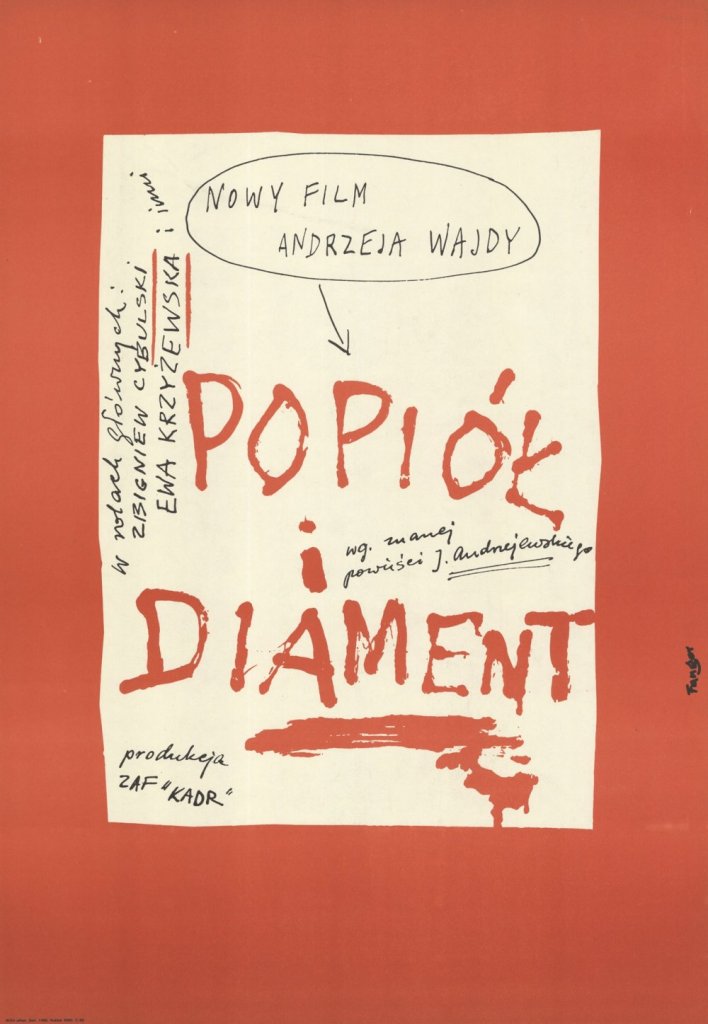
Ashes and Diamonds (1958)

Ashes and Diamonds (1958)

Wajda’s masterpiece of subtle but stinging Soviet criticism and one of the great European films

Director: Andrjez Wajda

Cast: Zbigniew Cybulski (Maciek Chełmicki), Ewa Krzyżewska (Krystyna), Wacław Zastrzeżyński (Szczuka), Adam Pawlikowski (Andrzej), Bogumił Kobiela (Drewnowski), Stanisław Milski (Pieniążek). Ignacy Machowski (Waga)

When the dust settles from the chaos of uncertain, terrible times what will we it leave behind: ashes or a diamond? It’s a question Poland is asking on the final day of the war, 8th May 1945 –what fate will come under Soviet rule? Wajda’s War Trilogy comes to its end and, even considering the quality of the first two films in the series, Ashes and Diamonds is a quantum leap in filmmaking, an extraordinary mix of realism and poetic ambiguity. Wajda captures this turning point in Polish history with a series of encounters between a group of characters in a single location on one night. Ashes and Diamonds can lay claim to being one of the greatest films from Eastern Europe in the twentieth century, a breathtakingly rewarding mix of subtle messaging and tragedy.

Home Army fighters – those paying attention to Wajda’s earlier work will be well aware the Polish government strongly disapproved of these forces loyal to a democratic Polish government – Maciek (Zbigniew Cybulski) and Andrzej (Adam Pawlikowski) attempt to assassinate communist leader Szczuka (Wacław Zastrzeżyński). Instead, they accidentally murder two regular workers. They are ordered to take a second attempt on their target after he attends a celebration with a host of Polish and Soviet dignitaries at a local hotel. But triggerman Maciek is torn, trapped in a cycle of war that has killed his friends, uncertain about whether to continue in the crusade that has consumed his youth or explore a life he glances at with barmaid Krystna (Ewa Krzyżewska). Will Maciek complete his mission or accept Poland’s future lies not with the ‘liberating’ Soviets?

Wajda’s restructuring of Jerzy Andrzejewski’s novel is the culmination of the entire War Trilogy’s style: a careful criticism of Stalinism, buried behind ambiguous characters and images that provide enough of an interpretative fig-leaf that the Polish authorities could convince themselves his work was politically acceptable.  Nearly everything in Ashes and Diamonds is subtly open to interpretation, carefully hiding its message in plain sight: the war is bringing ashes to Poland, not diamonds. Certainly, today, that’s the only interpretation you could take from Wajda’s extraordinary ending: our assassin writhing in painful, fearful death-throws on a rubbish heap while the hotel guests dance slowly and hypnotically into a doorway bathed in light. The beautiful ambiguity though is clear: look, Wajda could say to his political masters, they’re heading into the light while the Home Army soldier literally dies in a pile of rubbish. How more pro-Soviet can you get?

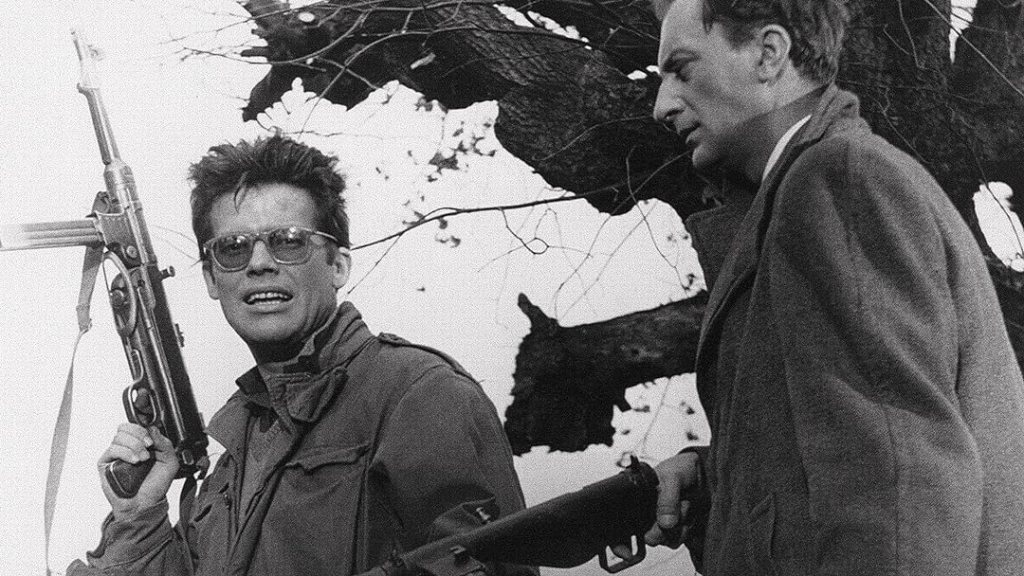
The entire film is a sad poem to a lost Poland with Wajda carefully guiding our sympathy towards Maciek. On paper, there’s plenty to admire in Szczuka, clearly an honest, competent politician – but he’s also uncharismatic and dull, who we may respect but never love. All our sympathies are captured by Zbigniew Cybulski’s extraordinary performance as Maciek. Inspired by James Dean and Marlon Brando (having binged their films while studying in Paris), Cybulski effectively wears his own clothes and gives Maciek the sort of anti-authority cool Dean made his own. Our sympathies lie immediately with this young man turned reluctant warrior, angry and scared.

Cybulski’s performance isn’t just attitude. He makes clear Maciek is deeply traumatised by the things he’s seen and done. Those dark glasses he wears – which make him look both older, cooler and more cocksure (he looks noticeably younger and more vulnerable without them) – are a legacy of damage to his eyesight from the sewers of the Warsaw Uprising. There’s an odd childish vulnerability to him – he’s spooked by ants crawling across his machine gun during their opening botched assassination – along with a surly resentment at the never-ending demands of this war. But he’s also iconoclastic and passionate about the vision he’s been fighting for. All of this is beautifully captured by Cybulski.

Maciek is at the centre of this pained reflection on all that has been lost in the war. Wajda presents this lingering sense with a series of strikingly unforgettable images. Maciek and Andrzej toast their fallen comrades with burning shots of vodka, each lit like a candle as they remember another name. Flames mark death and loss throughout: the innocent man accidentally machine-gunned by Maciek falls with his jacket burning from point-blank gunfire, fireworks fill the sky when Maciek carries out his assassination.

And where is the Church in all this? Ashes and Diamonds come back time and again to the great spiritual guide in Polish lives (before Socialism). The early assassination takes place outside a countryside Church, its locked door failing to save the victims. It’s an ominous sign for a world where God may have fallen silent, or perhaps never spoke at all. In another brilliant touch of Wajda ambiguity, Maciek and Krystyna walk through a bombed-out church, encountering a giant crucifix hanging upside down. This is not only an extraordinary image – the thorns from Jesus’ head either seeming to visually skewer the lovers or pull them in – but also a confirmation or lament for how little God can help Poland. Maciek clearly doesn’t care, since he happily uses altar decorations to fix Krystyna’s shoe. Faith doesn’t matter in this world.

All people have to belief in is what they can muster in themselves. Perhaps that’s why Maciek has filled his life with the longing to keep the good old cause going. He’s lost so much, he can’t actually believe there is anything else he could really do. For all his flirting at the bar, brimming with cocksure cool, does he ever really believe he has any choice but to continue with what he has committed to do? Wajda frames Maciek in his final moments of choice, huddling under stairs, shadows seeming to box and cage him in.

He’s as trapped as the rest of Poland is. Szczuka is a decent man, but he’s also a Socialist fanatic horrified to hear his son fought for the ‘reactionary’ Home Army. Meanwhile, his Soviet paymasters carefully nuzzle themselves into control over the Polish authorities, Wajda presenting them always with a careful political neutrality. Cunningly, all criticism of them is placed in the mouth of a journalist who speaks nothing but the truth about the freedom-crushing Soviets – but he’s made a drunkard sleazeball (more than enough for the censors to dismiss his words).

Ashes and Diamonds is also a beautiful piece of filmmaking, crammed with Wellesian light and shadow. Despite mostly being a film about waiting and decision making, it’s also full of pace, energy and a sense of a world steamrolled out of existence. It has one of the legendary endings, not only the long, lonely death of our hero but also the hypnotic, slow dance of the Polish authorities, disappearing into the sunlight, unknowingly marching into a future that will extinguish them.

Wajda manages to communicate all this in a film which, thanks to its need to slip everything past the censors, is extraordinarily supple and subtle, never over-playing its hand and spreading its humanity. There are no real villains here, only a series of people at a turning point of history, presented with careful even-handedness, but in way that never intrudes on the obvious sympathies of the film. With extraordinary direction and a superb, era-defining performance from Cybulski, it’s a masterpiece of World Cinema.

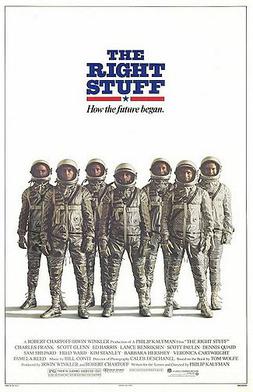
The Right Stuff (1983)

The Right Stuff (1983)

Patriotic heroism subtly retold as shrewd satire – no wonder the film bombed

Director: Philip Kaufman

Cast: Sam Shepard (Chuck Yeager), Scott Glenn (Alan Shepard), Ed Harris (John Glenn), Dennis Quaid (Gordon Cooper), Fred Ward (Gus Grissom), Barbara Hershey (Glennis Yeager), Kim Stanley (Pancho Barnes), Veronica Cartwright (Betty Grissom), Scott Paulin (Deke Slayton), Charles Frank (Scott Carpenter), Lance Henriksen (Wally Schirra), Donald Moffat (Lyndon B Johnson), Levon Helm (Jack Ridley), Mary Jo Deschanel (Annie Glenn), Scott Wilson (Scott Crossfield), Kathy Baker (Louise Shepard), David Clennon (Liaison man), Jeff Goldblum (Recruiter), Harry Shearer (Recruiter)

During the Cold War, the US and Russia had to fight with something – from proxy wars to chess, but most famously with Space: the competition to go further, faster and higher among the stars. The Right Stuff focuses on the Mercury Seven pilots at the centre of the US response to Soviet success including Alan Shepard (Scott Glenn), John Glenn (Ed Harris), Gus Grissom (Fred Ward) and Gordon Cooper (Dennis Quaid), a mix of the cocksure and the confident. But in a space programme where a monkey is an acceptable “pilot” for this human cannonball, do any of them have “the right stuff”? Could any of them match the skill of legendary test pilot Chuck Yeager (Sam Shepard) – one of the guys who scorned this astronaut programme for being “spam in a can”?

The Right Stuff, adapted from Tom Wolfe’s book, seemed destined to become a patriotic smash-hit. Despite its eight Oscar nominations (and four wins) it was, in fact, a catastrophic bomb. Perhaps that was because it subverted its patriotism so well. The Right Stuff is, in fact, a subtle, anti-heroic satire (told at huge length) masquerading as a patriotic yarn. It’s marketing avoided that meaning those most likely to enjoy didn’t go and see it, and those who went for that felt alienated. While largely respecting the astronauts, it suggests space race triumphalism was a sort of mass hysteria, with limited results, inflated into something mythic by political expediency, media spin and industrial might. Not the happy, flag-waving message Reaganite America expected or wanted.

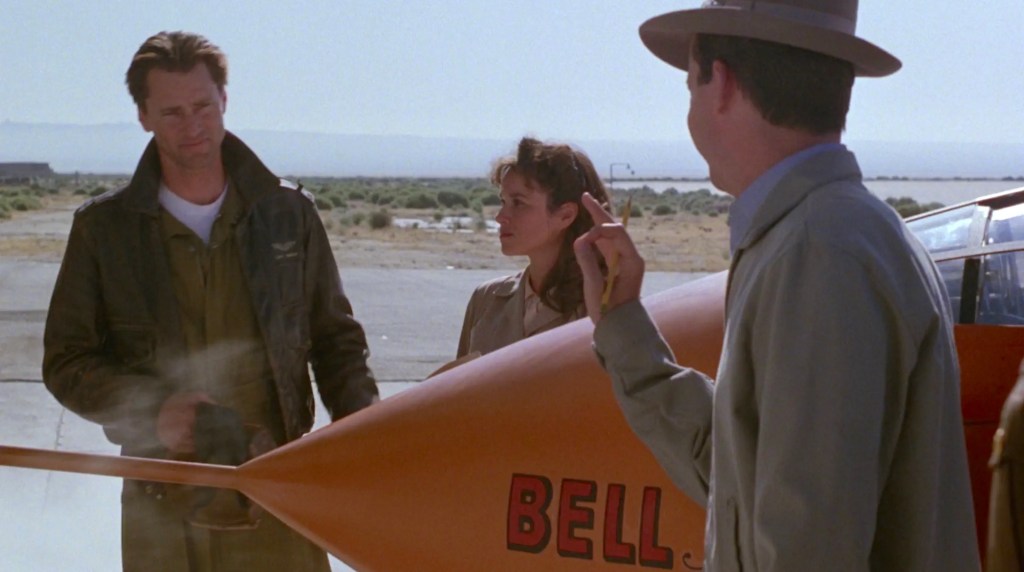
Kaufman’s sympathy instead lies with an older, “truer” America. The Right Stuff is an intensely nostalgic film: but for a completely different time. It is in love with Frontier America, where men-were-men and the daring proved themselves in taming the frontier, in this case the sky itself. Our tamer is Chuck Yeager, played with a monosyllabic Gary-Cooper-charisma by Sam Shepard. Yeager is the last of the cowboys (even introduced riding a horse in the desert), taking to the skies like an old frontiersman hunting down that “demon” who lives at the sound barrier.

This is the sort of America The Right Stuff celebrates, and Yeager is the guy who has it. Unlike the Mercury programme, Yeager isn’t interested in showbiz and self-promotion (his reward for breaking the sound barrier? A free steak and a press embargo), just the quiet satisfaction of having done it. It’s the old, unflappable, quietly masculine confidence of a certain kind of American tradition and it’s totally out of step with the world the media is now celebrating with the astronauts. Instead, these effective passengers in the rocket will be hailed as the great pilots.

Kaufman’s film is a long, carefully disguised, quiet ridicule of many of the aspects of the Mercury programme. It’s conceived, in a darkened room, by a group of politicians so clumsy they can’t even work a projector. It’s head, Lyndon B Johnson (Donald Moffat on panto form) is a ludicrous figure, at one point reduced to an impotent tantrum in a car when he doesn’t get his way. The NASA recruiters are a comedy double act – Goldblum and Shearer sparking wonderfully off each other – who first suggest (in all seriousness) circus acrobats as pilots and then fail to identify Yuri Gargarin. The programme begins with a series of failed launches that travel tiny distances before exploding, culminating in one attempt ending with an impotent pop of the cap at the top of the rocket.

NASA is slightly ramshackle and clueless throughout. Far from the best and brightest, Kaufman is keen for us to remember that many of the scientists fought for the Germans in the war, that decisions were often made entirely based on what the Russians have just done, that the astronaut recruitment tests are a parade of bizarre physical tests because no one has a clue what to test for, and that the final seven selected aren’t even the best just the ones who persevered through the tests and (crucially) were small enough to fit in the capsule. That doesn’t stop the media – played by a San Francisco physical comedy troop – from turning them overnight from jobbing pilots to superstars.

The astronauts status is frequently punctured. Scott Glenn’s granite-faced Shepard is strapped into the cockpit for hours on his first flight, until finally he begs to pee (followed by a montage of coffee being slurped, hose pipes blasting and taps dripping) before being instructed to release his bladder into his suit, meaning he heads into space sitting in a puddle of his own piss. Dennis Quaid’s cocksure Cooper has an over-inflated idea of his skills and is prone to dumb, blow-hard statements (arriving at Yeager’s Air Force base he non-ironically states he’ll soon have his picture up on the deceased pilot’s memorial wall). Fred Ward’s Gus Grissom is a slightly sleazy chancer – controversially The Right Stuff presents him as panicking on re-entry from his first mission, blowing his hatch and sinking his ship, something he categorically denied (and was later proved not to have done).

Even John Glenn, played with a sincerity and decency by Ed Harris (if this had been a hit, Harris’ career of playing hard-heard would have been totally different), is subtly lampooned. So straight-laced he literally can’t swear (his attempt to say ‘fuck’ never gets past a strained Ffff), he’s introduced via a ludicrous TV quiz show and his square-jawed morals frequently tip into puritan self-importance. Undergoing physical tests, Kaufman even cuts from his grimacing face to a grinning chimp on the same test (and who will beat him into space). Compared to Yeager, who can correct a plane on a desperate nose dive and beat the skies into submission (and has the only outright heroic refrain in Bill Conti’s Oscar-winning score), none of them have that right stuff.

Do they get it? In a way: but their triumph is establishing their character, not their skills. Kaufman uses Yeager to point us towards this (his seal of approval is vital for the film): after Grissom’s debacle, he defends him in the bar and praises their courage in essentially sitting on top of a massive bomb.
Tellingly, the astronauts’ most courageous moment in the film isn’t in the cockpit at all: it’s Glenn supporting his stammering wife’s refusal to go on air with LBJ, despite the pressure from NASA bigwigs – and the other astronauts uniting in fury when Glenn is threatened with being dumped from the next flight. The others become more noble through maturing and casting aside fame’s temptations.

In a way they prove their spurs, even if Kaufman’s film makes clear none of them can match Yeager’s traditional values. The film ends with Yeager, maverick to the last, undertaking an unauthorised test flight in a desperate attempt to keep funding for his jet programme going. Even with this final flight – dressed in a bastardised version of a space suit – Yeager shows he’s not lost it, a man so undeniably superhuman in his American resilience that even a bit of fire won’t slow him down.

The Right Stuff celebrates Yeager, but he’s the B-story – and the film frames him as a forgotten figure, left behind by a world obsessed with the bright and shiny. The Right Stuff has to centre the astronauts but it doesn’t focus on the missions (which, apart from Glenn’s, barely receive any screen time – certainly not compared to the time given to Yeager’s flights) or the glory, only quietly implies there was a slight air of pointlessness about the whole thing – that the space race was perhaps just a dick-waggling competition between superpowers. It makes for interesting – if overlong – viewing, but as punch-the-air entertainment, no sir. No wonder it bombed.

The Lives of Others (2006)

The Lives of Others (2006)

Breathtaking, heartfelt and in-the-end deeply moving film which leaves you with a profound sense of hope for humanity

Director: Florian Henckel von Donnersmarck

Cast: Ulrich Mühe (Hauptmann Gerd Wiesler), Sebastian Koch (Georg Dreyman), Martina Gedeck (Christa-Maria Sieland), Ulrich Tukur (Oberstleutnant Anton Grubitz), Thomas Thieme (Minister Bruno Hempf), Hans-Uwe Bauer (Paul Hauser), Volkmar Kleinert (Albert Jerska), Matthias Brenner (Karl Wallner), Herbert Knaup (Gregor Hessenstein), Charly Hübner (Udo Leveh)

For almost half the twentieth century, Germany was a country divided. West Germany was a world we might recognise today. East Germany was one George Orwell would have found eerily familiar, a surveillance state, where neighbour reported on neighbour, conversations and opinions were monitored and controlled, and the Stasi had ultimate power. Everything was designed to undermine personal loyalty, introduce mistrust into every relationship and keep in power apparatchiks who enjoyed privileges beyond the imagination of others. But what happens when humanity comes up against this system? Can the lives of others affect what the system’s agents think and feel?

1985, East Berlin. Gerd Wiesler (Ulrich Mühe) is the perfect cog in the Stasi machine. Emotion isn’t an issue when he interrogates dissidents for hours at a time, or sits overnight listening to every word spoken in a suspect’s bugged house. All that starts to change when Wiesler is ordered to carry out an operation against noted playwright Georg Dreyman (Sebastian Koch). Dreyman appears to be the perfect citizen, but is suspected of dissident sympathies. More dangerously for him, he’s having a relationship with famed actor Christa-Maria Sieland (Martina Gedeck) who has attracted the lascivious attentions of the corpulent and corrupt Minister Hempf (Thomas Thieme). As Wiesler listens to Dreyman and Sieland’s lives, he finds himself deeply affected by exposure to art he has never experienced and begin to question the certainties of his world-view.

The Lives of Others is a moving, humane debut from von Donnersmarck, offering a rich and chilling insight into the horror of living in a country where thoughts are not free and words are strictly monitored. It carries such emotional impact because it gives us hope that, no matter the strictures of the world around us, common humanity and decency can break through and change us – even the most mechanical servants of a regime. The Lives of Others does this with realism and a lack of sentiment, showing life and the after-effects of our decisions in non-romantic detail, while also giving us hope that goodness can shine through no matter the cost.

Shot in a series of cold colours reflecting the featureless surroundings of East Germany, The Lives of Others exposes the beige hopelessness of Soviet life. It opens with Weisler’s long interrogation of “Prisoner 227”, cutting between it and a lecture hall, where Weisler plays tapes of it to teach a class. He shows no emotion of any type in either setting for the distressed, exhausted prisoner he’s talking to, and matter-of-factly marks down the name of a student who questions the ethics of what he’s doing. Weisler’s life is one of quiet exactitude: his apartment is featureless, his meals are bland pasta with ketchup, he has no friends and barely seems able to smile.

He contrasts totally with Geog Dreymon. Played with an ebullient innocence by Sebastian Koch, Dreymon has accommodated himself with the regime’s requirements. Does he believe in socialism? It’s one of the film’s mysteries – Dreymon may have an intellectual romanticism but he’s averse to making pointless protests or stands that will only lead to him being silenced. He is willing to accept the shelving of his director friend, for his works to be pushed into a realist factory-setting by plodding directors. His charm sees him befriend the high and mighty (“it was a gift from Frau Honecker” he tells a Stasi officer who questions his possession of a Western book) and he has boyish innocence, like someone who has never known the Orwellian horrors he lives amidst.

His friends however have. His director friend Jerska (Volkmar Kleinert) is an ‘unperson’ whose presence is an embarrassment at parties. Another is a closet radical who feels he should take a stance. Above all, Christa-Marie (a marvellous Martina Gedeck) lives with the abuse of Minister Thieme. This corrupt man – who orders Stasi investigations against people he doesn’t like and is the only character who looks overfed and well-dressed – fondles Christa-Marie at parties and forces her into sexual encounters in his chauffeured car. Corrupt men run this state – similarly Wiesler’s Stasi superior Grubitz (a wonderfully smug Ulrich Tukur), is interested only in promotion.

The system is propped up by men like Wiesler. But all that changes as listening to Dreymon’s life pulls something out of Wiesler he has never thought about before. What pivots this? Perhaps Wiesler truly listening to the warmth and vibrancy of Dreymon’s home life? Perhaps exposure to art? Von Donnersmarck masterfully shows (with complimentary camera moves between two locations) Wiesler teary, spellbound listening to Dreymon’s playing of a piano sonata. It opens up a new world of artistic and cultural understanding to Wiesler, who is drawn to the books in Dreymon’s apartment and begins turning more than a blind eye to Dreymon’s flirtation with dissidents.

In fact, Wiesler morphs from Dreymon’s dark shadow to his protective guardian angel. He awakens in himself a care for people around him, from the son of a neighbour to Dreymon and Christa-Maria. He conceals Dreymon’s involvement in a scheme to smuggle someone across the border (tragically the plan is a fake, designed to test if Dreymon’s apartment is bugged). He does his best to reassure Christa-Maria, “bumping into her” anonymously to provide her a moment of solace with a stranger and subtle counselling on her relationship with Dreymon. As Dreymon carefully writes an article, to be smuggled to the West, critical of the regime, Wiesler fills his reports with imagined plot details and quotes for the Lenin play Dreymon claims to be writing.

Dreymon is actually writing an article about the suicide rate in East Germany. Suicide becomes a heart-wrenching central theme. An oppressive, domineering regime like East Germany offers only one real escape: death. A state designed to make its own people suspect and turn on each other is designed to grind you into a choice between blank conformism or taking your own life. And we see the effects of this on multiple characters, as people are separated from the things that give their life meaning, stripped of their own identity, or made to betray those they love. For some, this is more than they can bear.

In this world, just displaying humanity is the victory. Ulrich Mühe’s breath-taking performance slowly fills with growing doubts, longings and passions under the surface of an impassive, quiet man who suddenly realises the world is larger and more magical than he ever imagined. Like a butterfly emerging from a chrysalis, he starts burrowing in the bowels of Stasi HQ, his eyes fixed only on what is in front of him. The film’s victory is turning this man into one who makes huge, unrewarded, sacrifices to protect another, the very attitude he quietly deconstructed in the film’s opening. Mühe is superb, the film constantly exploring his face for unspoken depths.

von Donnersmarck’s film ends with an extended coda of life after reunification. Some things are not as triumphant as hoped: Wiesler lives in poverty, the streets are lined with graffiti and tramps, cockroaches like Thieme remain in authority. But it is also a place where hope and friendship are possible, where things can be spoken rather than suppressed. It culminates in the sort of free-publishing Dreymon could never dream of and a tribute that could never have been spoken before.

After the crushing misery and suicidal pressures of the East, a world of possibility and freedom is one where we all could change our stars like Wiesler, to find an inner contentment from doing the right thing for no reward. Brilliantly filmed and deeply moving, The Lives of Others is a masterpiece.

The Russians are Coming, the Russians are Coming (1966)

The Russians are Coming, the Russians are Coming (1966)

Ealingesque farce meets Cold War moralising in this not-quite funny enough farce

Director: Norman Jewison

Cast: Carl Reiner (Walt Whittaker), Eva Marie Saint (Elspeth Whittaker), Alan Arkin (Rozanov), Brian Keith (Link Mattocks), Theodore Bikel (Captain), Jonathan Winters (Norman Jones), Tessie O’Shea (Alice Foss), John Philip Law (Alexei Kolchin), Ben Blue (Luther Grilk), Andrea Dromm (Alison Palmer), Paul Ford (Fendall Hawkins)

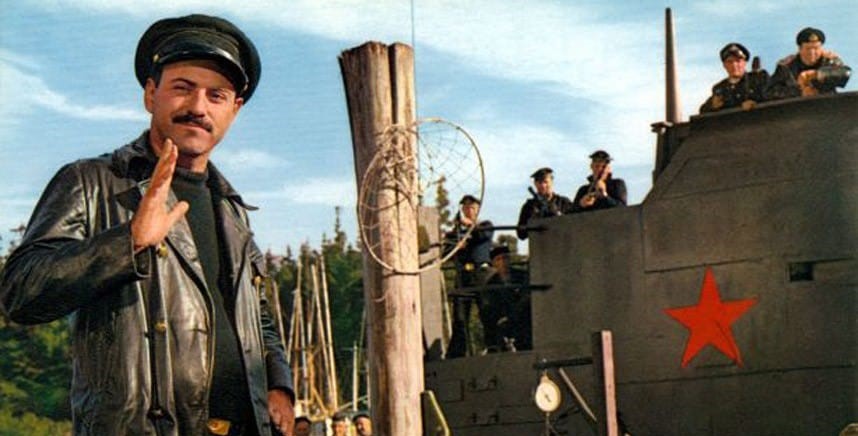
Off the coast of a New England island, a Russian captain (Theodore Bikel) wants to take a quick peek at the US of A. Bad idea. When his sub runs aground, they are forced to send a party ashore led by political officer Rozanov (Alan Arkin) to find a motor launch to get the sub back out to sea. They run into the Whittakers – playwright Walt (Carl Reiner), wife Elspeth (Eva Marie Saint) and their kids – take them hostage, steal their car, cut the telephone lines and try to save themselves. The town quickly hears news of the possible arrival of Russians, and the hysteria grows – just as Walt starts to feel his sympathies grow for the terrified Russian sailors. Can peace be reached across the divide?

The Russians are Coming, the Russians are Coming is basically an Ealing-esque comedy – written by Ealing veteran William Rose – translated not entirely successfully to America. Directed with an epic, widescreen sweep by Norman Jewison that sometimes crushes the life out of a comedy of confusion and coincidence, The Russians are Coming wants to be both a broad farce and carry an earnest message about the Cold War. It’s quite sweet that the film, made four years after Cuba nearly turned the world into an ash pile, wants to focus on what unites as humans rather than divides us, but the message is at times crow-barred in a little too forcibly.

It’s very hard not to see the Ealing influence on every single scene – and I suspect the film would have worked better as 4:3 black-and-white film full of harassed people in offices and homes, rather than the grand panoramas of the town and large crowd scenes. The Ealing influence can be seen in the townsfolk, who become a farcical panicked crowd of have-a-go heroes, making sweeping decisions based on no information at all, led by puffed up self-important, self-elected leaders determined to seize their moments of heroism. Misunderstandings abound, as tiny pieces of evidence balloon the “threat” into a full-blown invasion: the crowd are almost disappointed when they arrive at an airfield to find not a smouldering ruin but an operator blissfully unaware anything is going on.

Similarly, the Russians themselves fit nicely into the Ealing model of ordinary, decent, underdogs up against the system (in this case the townsfolk). In a brave touch, the Russian in the film is never translated – Theodore Bikel doesn’t have a line in English – meaning we only gradually learn what is going on and why, as Arkin’s character explains things to Whittaker in stumbling half-English. Arkin is, by the way, the film’s prize asset, demonstrating excellent comic timing and delivering his dialogue in a parade of Russian and fumbling English (there is a great sequence where he earnestly tutors his men on how to pass as officials clearing the street, teaching them phrases just a few degrees incorrect that will make them stick out like sore thumbs as soon as they open their mouths).

The film is never quite funny enough though and Jewison’s direction neither tight nor taut enough to keep the farcical pace up. There are one too many wrong turns taken by the Russians, one too many narrative cul-de-sacs as townsfolk barrel up and down the streets. The whole film plays out like this, many of its effective comic performers among the townsfolk lost among a sea of people and faces. Arkin and Reiner get the most impact, because their scenes tend to make place in individual rooms in set-ups that let us clearly see their faces and appreciate their comic skills.

The Russians are Coming largely struggles to keep the pace up – the best of the Ealing comedies told their farce-tinged struggles between the little-guy and the system, or confusion between two fundamentally sympathetic groups, in about 90 minutes, and this feels heavily over-stretched at a little over two hours. That’s partly because of the political statements which the film dresses up as a sub-plots. A romance between John Philip Law’s Russian sailor and the Whittakers’ babysitter Tessie O’Shea is all too obviously a plea for using love as bridge-building. The final alliance between the Russians and the townspeople, forged in their joint rescuing of an endangered child, bangs the “we are all the same” drum a little too persistently.

It makes the film today feel a little too much like it’s trying to have its cake and eat it: to be both a farce where Reiner’s playwright gets tied up to a librarian and the two struggle to free themselves in a series of pratfalls, and also a political statement about the bonds that can be built if we just let the Cold War melt a little bit. I won’t deny this must have had more impact in the 1960s, but today it makes for a film that is a little too grandiose where it should be nimble, and a little too lightweight when it should be important.

Tinker, Tailor, Solider, Spy (2011)

Tinker, Tailor, Solider, Spy (2011)

We’re going on a Mole Hunt: Le Carré’s finest book is boiled down into an atmospheric and masterful spy thriller

Director: Tomas Alfredson

Cast: Gary Oldman (George Smiley), Colin Firth (Bill Haydon), Tom Hardy (Ricki Tarr), Mark Strong (Jim Prideaux), Ciaran Hinds (Roy Bland), Benedict Cumberbatch (Peter Guillam), David Dencik (Toby Esterhase), Toby Jones (Percy Alleline), John Hurt (Control), Kathy Burke (Connie Sachs), Roger Lloyd-Pack (Mendel), Svetlana Khodchenkove (Irina), Konstantin Khabensky (Polyakov)

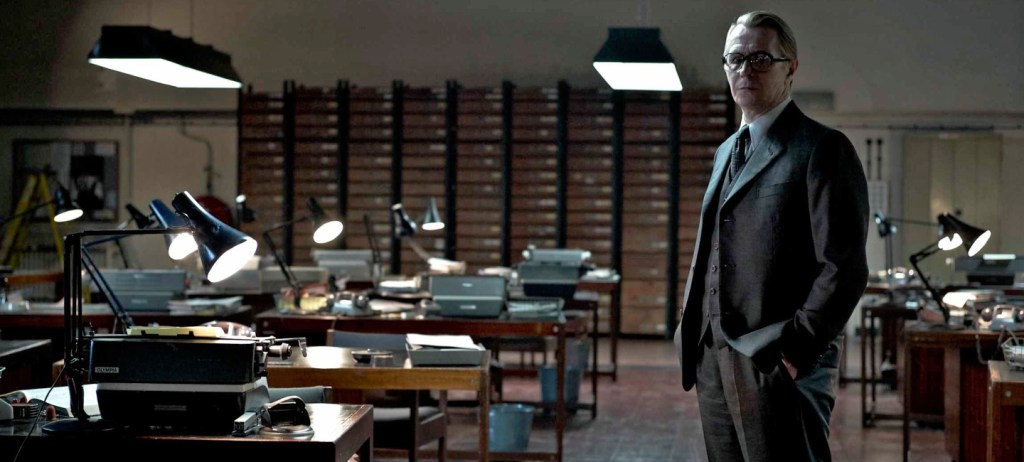
Anyone taking on this, Le Carré’s finest novel faced a tough challenge. After all, arguably the definitive version already exists: the masterful, slow-burn, 1979 TV adaptation (one of my favourite films ever) starring an Alec Guinness so perfect as the rotund, inscrutable spy-master George Smiley that Le Carré stated he could no longer write the character without thinking of him. I’ve long been nuts for Tinker, Tailor: I rushed to the cinema to see this with an equally keen-friend about five days before my wedding (on my wife-to-be’s birthday!) because I was looking forward to it so much. (Despite this the wedding went ahead). It can’t match that Guinness version – but it runs it close.

It’s the height of the Cold War, and the respected head of the British Intelligence Services (‘the Circus’) Control (John Hurt) is forced out, along with his deputy George Smiley (Gary Oldman) after a rogue mission in Hungary goes disastrously wrong. Over a year later, Smiley is secretly recalled to lead a mole hunt. Someone at the top of the service is a Russian agent – but who? New head Percy Alleline (Toby Jones)? Or one of the deputies – Bill Haydon (Colin Firth), Roy Bland (Ciaran Hinds) or Toby Esterhase (David Dencik)?

The first inspiration here is the screenplay. When I heard the film was two hours long I was stunned: the TV series unfolded over nearly seven hours! But the script, by Peter Straughan and the late Bridget O’Connor (who tragically died of cancer during it’s making) is a masterpiece. It brilliantly and skilfully compresses and restructures the novel, boiling down scenes to their core. But yet, it never feels rushed. The script creates composite scenes – most brilliantly a flashback to a Circus Christmas party – which allows a vast range of sub-plots and characters to simultaneously unfold.

Alongside this, the film is superbly, atmospherically directed by Tomas Alfredson. Alfredson brings a sharp, outsider’s view to this public-school nightmare turned espionage hub. These are posh boys, running an exclusive club, which plays by punishing rules. Everyone constantly spies one everyone else and there is no moment of privacy. Alfredsen brilliantly explores the social and emotional impact of spying, trapped within a grim and oppressive 70s mileu of dirt, beige, fear and loneliness.

The film is brilliantly designed, capturing a vast array of 70s designs and shades. The Circus is an industrial office – with its centre piece an orange lined, sound-proof room. Streets are lined with political graffiti – at one point we see “The Future is Female” a nifty comment on the all-male institution we are watching. Communist Hungary is a post-industrial slum, hotel rooms crowded with papers, cigarette smoke and overflowing ash trays.

At the centre is Gary Oldman, simply brilliant as Smiley. Controlled, measured and deploying only as much energy is needed, Smiley adds a hint of Guinness to his voice and always seems in control. But this lugubrious Smiley bubbles with tension, driven by twin demons. The first is Karla, the Russian spy-master Smiley let slip through his fingers years ago, the subject of a maudlin late-night recollection to his assistant Guillam. Even more important is his wife Ann, the betrayer Smiley still loves to distraction, a half-sight of her enough to make him stumble and lose breath. We never see either of these clearly in the film, reflecting their status as the only characters Smiley never understands and can’t make cool, calm, passion-free decisions about.

Cold-eyed reason guides everything else he does. Oldman’s Smiley may be grandfatherly, softly-spoken and controlled, but he’s as ruthless (if not more so) than everyone else. Smiley is precise and patient. There is a beautiful character establishing moment: Smiley, Mendel and Guillam are in a car bothered by a wasp. Guillam and Mendel flap with futile energy: Smiley waits and then lowers the window slightly at the perfect moment to let the wasp fly out. It captures in microcosm Smiley’s investigation. But he’s not afraid to use force: quietly threatening Dencik’s trembling Esterhase with deportation (not even flinching as a plane lands behind him), ruthlessly mining witnesses for evidence and verbally lashing out bitterly at the mole.

Alfredson’s film zeroes in on much of the emotional impact on spying. Smiley is a man slightly lost in the world outside of spying: retired, he seems adrift walking the streets, swims alone, sits at home in his suit. He’s so deactivated he doesn’t even speak for the first 18 minutes of the film, when he is recalled to life. Smiley has suppressed his emotions so completely only the shadow of his wife can move him. His home is a strange shrine, so much so he even keeps the gifts her lover gives her.

Each of the characters suffers under their burdens, and the demands on them for secrecy and isolation. Mark Strong’s Jim Prideaux buries himself in guilt in a caravan and forms a friendship with a young boy he later realises he is crafting into the same secretive man he is. Guillam is quietly ordered by Smiley to end his relationship with his boyfriend and acquiesces in private tears. Connie Sachs lives in retirement like a mad woman in an attic, cradling her memories. Control dies alone in a hospital bed. Later the Mole clings to having “made his mark” to supress his guilt, while a man whose career is ruined walks into oblivion blank faced not even noticing the rain around him.

Tinker, Tailor, Soldier, Spy is full of moments like this, the high-price of dogged, dedicated work like spying. Alfredson’s coolly, beautifully shot film (by Hoyte van Hoytema) with its lyrical score by Alfredo Iglesias is a masterpiece of tone. This is a dark, dangerous world and we are constantly reminded of it, in between the muttered meetings in board rooms and dark corriders. Tom Hardy’s (wonderful) Ricki Tarr and Mark Strong’s deeply emotional Prideaux are spies-on-the-ground, face-to-face with dangers. Theirs is a world of brutal throat-cuts, eviscerations in a bath and sudden executions. The decisions played out in rooms like that orange-lined sound-proof office with its methodical, intricate ship’s clock, lead to death and violence.

The film is stuffed with beautifully composed shots and brilliantly edited (Dino Jonsäter’s cuts frequently carry us over brilliantly over transitions and segues that streamline the narrative perfectly). Despite cutting back and forth over multiple timelines, it’s always clear when we are (an ingenious device sees Smiley change his glasses in retirement, instantly grounding us in the timeline based on the pair he is wearing). The Christmas party scene – exactly the sort of bizarre public-school irreverent piss-up (where spies who fight night and day to destroy the USSR raucously sing communist songs with a Lenin-dressed Santa) is a superb distillation of character and plot beats and becomes, in many ways the emotional pivot of the movie. It’s a very inventive addition.

The film assembles a superb cast. Oldman, of course, leads from the front but there is not a weak turn in the cast. Hardy is gritty, bitter and jumped-up, Cumberbatch holding his tension down under professionalism, Strong drips quiet grief, Firth swaggers with superb, assured insouciance, Hurt is the book’s arch-spy-master come to life, Jones is full of preening pride, Burke lost in memories. If I’d like the film to be longer for any reason, it would be to see more of these actors.

Full of moody, seventies beauty and creeping paranoia, it’s also crammed with beautifully judged lines and incidental moments from the book. Alfredson’s atmospheric film has a profound emotional understanding of the cost of this life of isolation and paranoia. It took a couple of viewings, but this emerges from the shadow of my favourite TV series.

Hell and High Water (1954)

Hell and High Water (1954)

Action below the waves in this dutiful, for-the-money thriller from Samuel Fuller that lacks imagination or freshness

Director: Samuel Fuller

Cast: Richard Widmark (Captain Adam Jones), Bella Darvi (Professor Denise Gerard), Victor Francen (Professor Montel), Cameron Mitchell (“Ski” Brodski), Gene Evans (Chief Holter), David Wayne (Tugboat Walker), Stephen Bekassy (Neumann), Richard Loo (Hakada Fujimori), Wong Artarne (Chin Lee), Henry Kulky (Gunner McCrossin)

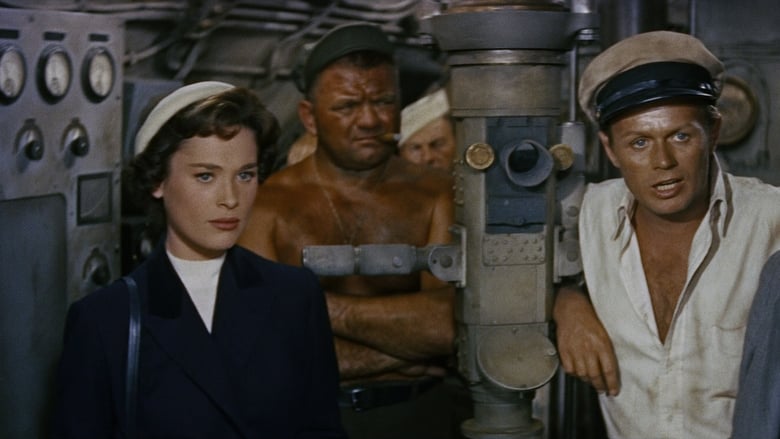
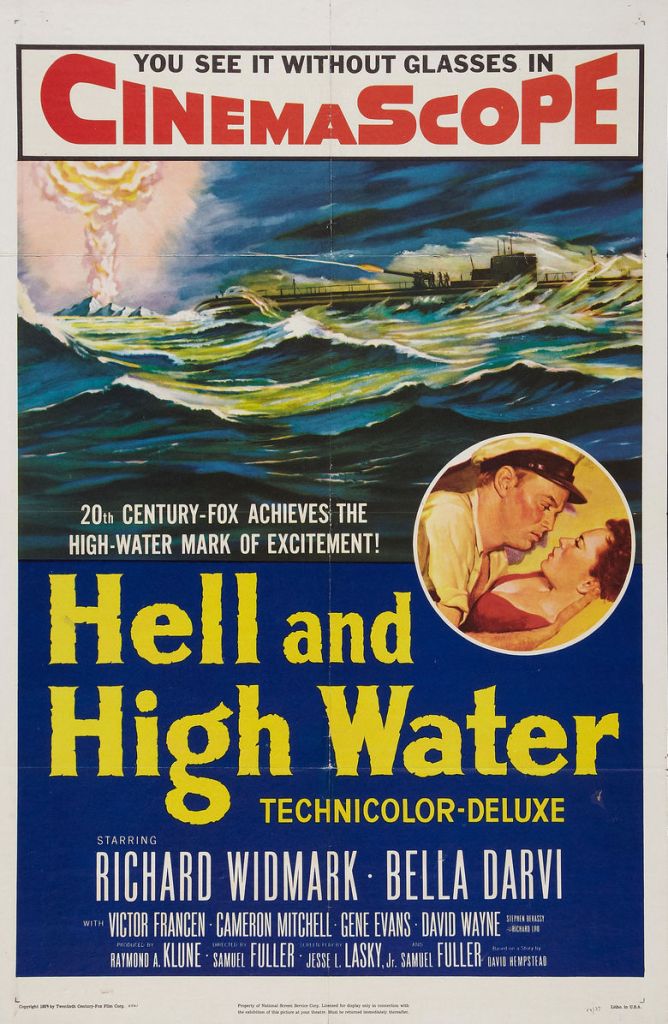
Few films start with a bigger bang than Hell and High Water: a nuclear explosion. What caused it? The film winds back to tell us. Retired submarine captain Adam Jones (Richard Widmark) is hired by a cabal of intellectuals and scientists working to maintain world peace. Somewhere on an island off Japan, the Commies are working on a secret nuclear bomb. Jones – in return for a fee – will shuttle Professors Montel (Victor Francen) and Denise Gerard (Bella Darvi) to investigate. Cue submarine duels, personality clashes, romance and shoot-outs.

To be honest, nothing in Hell and High Water lives up to that bang at the start. Samuel Fuller took on the film as a favour to producer Darryl F Zanuck, but had a low-opinion of the result (labelling it his worst film). Fuller rewrote the script, added a lot of his compulsive drive to the direction and handled it well – but it feels like a “gun for hire” film. Goodness only knows what Fuller made of Spielberg telling him in 1979 he loved it so much he carried a print of it in his car (perhaps “Have you not seen Pickup on South Street?”)

Hell and High Water is a serviceable men-on-a-mission film that sneaks in a few interesting beats, but otherwise goes for well-shot action and predictable events over invention and insight. It’s anchored by a grumpy Richard Widmark (who thought the script was crap and co-star Darvi couldn’t act) as a hard-to-like hero. Never-the-less Jones’ ruthless mercenaryism is the film’s most interesting beat – even if it is a repeat of the same actor’s attitude in Pickup on South Street, right done to mouthing almost the same contemptuous line about ostentatious flag wavers. Jones does his job professionally – and he’s got no truck with his country being dishonoured or attacked by Commies – but his main concern is always the $50,000 fee he’s been promised.

Also paid off are the whole crew who, in the film’s other interesting beat, are a regular united nations all of whom treat each other with equality and respect (the only people not represented here are Black people). We’ve got a German, a Japanese, a Frenchman, several Americans – considering only nine years previously all these nations had been working over-time to kill each other, it’s great to see the team on the ship working as a tension free-unit. We even have a Chinese sailor – who entertains his fellow crew with improvised ditties – becoming a crucial hero.

Fuller also shoots the sub action – a mix of models and trick photography – very well. The angles he uses of the subs underwater, in particular their turns, and the sweaty look of those underwater (and the increasing tensions) influenced several future films. All the submarine lingo you’d expect is trotted out with real commitment (“Right full rudder!”) and every box is carefully ticked, from sinking the bottom, to the costly rush to close a bulkhead. The torpedo fights are well-staged and whenever the film dives it’s at its best.

Where it is less so is whenever the film dwells on its characters. It tries to push the envelope a bit by introducing a female professor who is assured, competent, super-smart and gets stuck in with helping out when things go pear-shaped. She’s played by Bella Darvi, a protégé (and more) of Zanuck, who he was determined to elevate to stardom. Despite Widmark’s criticism, she’s fine here, even if she struggles to convey the charisma the role needs, often falling back on slightly grating over-earnest, head-girl smartness. What fails is the complete lack of chemistry between her and Widmark, their half-hearted, dutiful romance (probably mostly Widmark’s fault).

You’ll feel sorry for her though as the crew – and Jones – eye her up like a piece of meat when she arrives. Of course, this dated sexual leering is par for the course, but is still more than a little uncomfortable. But this is still the era when a sailor taking his top off to push his tattoos into a woman’s face was funny rather than a crime. The film does gives Darvi’s Professor a lot of proactivity and does generally take her side – even if she, inevitably, needs to learn our hero knows best.

Hell and High Water charges through to a decent ending, with just the right mix of self-sacrifice, tension and pay off. Victor Francen gives the films best performance as an illustrious, brave French scientist. But it never feels like anything more than a dutiful, for-the-money film. There is none of Fuller’s fire or feeling here, no real imagination or freshness in the ideas or concepts. It hits all the beats, ties things up with a bow and sends you home – but its very hard to really remember anything distinctive about it when the credits roll.

The Hunt for Red October (1990)

The Hunt for Red October (1990)

Shailing into Hishtory! The Hunt for Red October is the finest Tom Clancy adaptation made

Director: John McTiernan

Cast: Sean Connery (Captain Marko Ramius), Alec Baldwin (Jack Ryan), Joss Ackland (Ambassador Andrei Lysenko), Tim Curry (Dr Petrov), Peter Firth (Ivan Putin), Scott Glenn (Commander Burt Mancuso), James Earl Jones (Admiral James Greer), Jeffrey Jones (Skip Tyler), Richard Jordan (National Security Advisor Jeffrey Pelt), Sam Neill (Captain Vasily Borodin), Stellan Skarsgård (Captain Viktor Tupolev), Fred Dalton Thompson (Rear Admiral Joshua Painter), Courtenay B Vance (PO Jones)

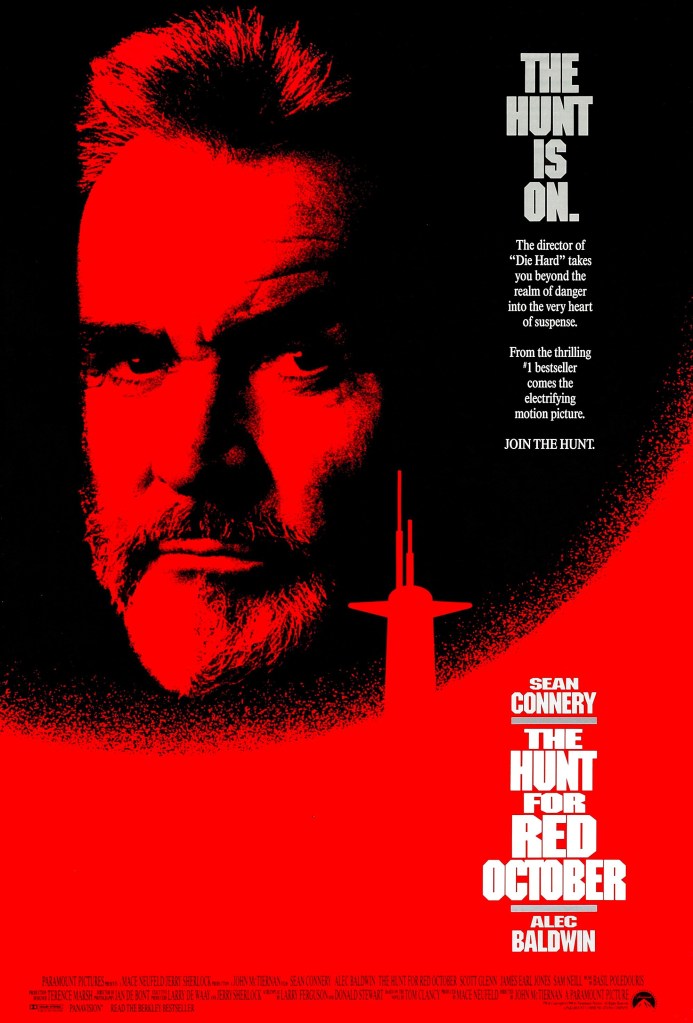
“We shail into Hishtory!” It’s the film that launched a thousand Sean Connery impressions. Only Connery could get away with playing a Soviet submarine captain with the thickest Scottish accent this side of Lithuania. He only took the role – from Klaus Maria Brandauer – at short notice, but he’s a pivotal part of the film’s success. The Hunt for Red October is a superb film, the finest Tom Clancy adaptation ever made and one of the cornerstones of the submarine genre. It expertly mixes beats of conspiracy, espionage, naval adventure and even touches of comedy, into a superbly entertaining cocktail.

Connery is Captain Marko Ramius, the USSR’s finest naval captain, given command of The Red October on its maiden voyage. The Red October is equipped with a technical miracle: a “caterpillar drive” that uses a water powered engine to run silently, making it invisible to sonar. So why is the entire Russian fleet being scrambled to find and sink the submarine? Could it be, as the USSR tells the US, that Ramius has gone mad and plans a nuclear strike? Or is it, as CIA analyst Jack Ryan (Alec Baldwin) argues, because Ramius plans to defect and bring the technological marvel with him?

Of course, we know Connery plans to defect. After all, we’ve already seen him murder shifty political officer Ivan Putin (Peter Firth – to whom alphabetical billing is very kind) and tell his handpicked crew of officers, led by loyal second-in-command Borodin (Sam Neill, so dedicated to affecting a Russian accent it’s as if he felt he needed to do in on behalf of himself and Connery) that there is no turning back. The film’s expert tension – and it rachets it up with all the precision of a well-oiled machine – is working out how. How will Ramius evade the Russian fleet? How will he manage to arrange his defection without communicating with the US? And will he and Ryan – unknowingly working together – persuade the US not to blow The Red October out of the water?

With McTiernan, in his prime, at the helm it’s not a surprise the film is expertly assembled. The parallel plot lines are beautifully intercut. Our two heroes, Ramius and Ryan, face very different obstacles (dodging Soviet torpedoes vs patiently making his case to sceptical superiors mixed with risky long-range travels to far-flung US subs) but somehow seem to be building a bond before they even meet. Ryan is an expert on Ramius and his career, while his thoughtful, good-natured decency is exactly the sort of American Ramius tells his crew they need to meet (as opposed to “some sort of buckaroo” – a word Connery relishes).

McTiernan isn’t just an expert mechanic though. There are lovely touches of invention and magic here. The Hunt for Red October has possibly one of the finest transitions ever. Connery, Neill et al start the film speaking in Russian. Ramius meets with Firth’s Putin (great name) in his quarters to open their orders. The two chat briefly in Russian, then Putin reads from Ramius’ copy of the Book of Revelations. As Firth reads (in fluent, expertly accented Russian), McTiernan slowly zooms in on his lips until he reaches the word “Armageddon” (the same in both languages) – the camera then zooms out and both Firth and Connery continue the scene in English (Firth switching mid-shot from Russian to English without missing a beat). It’s a beautifully done transition, rightly a stand-out moment.

But then it’s a film full of them. Many rely on Connery’s performance, superb as Ramius (this was his career purple patch, where one effortlessly excellent performance followed another). Ramius has a grizzled sea-dog charm and a twinkle in his eye, but he’s also nursing a private grief and pain that motivates his defection. He can be demanding of his men, but also inspires loyalty – that “We Shail into Hishtory!” pep-talk speech is delivered perfectly (and McTiernan makes Soviet sailors singing the Soviet anthem a punch-the-air moment even though (a) we know they are technically the bad guys and (b) we know Ramius is lying through his teeth in his speech). But he is always a commander, Connery investing him with every inch of his movie star cool.

Ramius is also an interesting reflection, in a way, of Ryan. Played with a great deal of young-boy charm by Baldwin (and also wit, Baldwin dropping impersonations of other cast members into the film – including a stand-out Connery), Ryan is brave, determined but also slightly naïve and out-of-his-depth. But like Ramius he respects his “enemy”, is open to negotiation, thinks before he acts and wants to save lives. The two even share similar upbringings. The film triumphantly shows a desk man, spreading his wings and doing stuff he couldn’t imagine: the guy who tells an air hostess in an early scene he can’t sleep on flights due to fear of turbulence, will later have himself dropped into the sea from a perilous helicopter flight, steer a Russian sub and duke it out with the last Soviet hard-liner standing in The Red October’s missile room.

McTiernan shoots Ryan’s conversations like combat scenes: quick reversals and cross shots and even whip pans and zooms. It ratchets up the tension and drama in these sequences – and allows him to play it cooler in the sub shots which (with its more constrained set) where patient studies of tense faces follow sonar reports of the approach of torpedoes or enemy subs. Sound is a triumph in Red October – every ping or sonar shadow is sound edited to perfection, with much of its tension coming from their perfect rising intensity.

It builds towards a superb resolution as several plot threads come together in a dramatic face-off that gives us everything from sub v sub to gunfights, with tragedy and triumph all mixed in. It’s a perfect ending to a film that is a masterpiece of plotting and construction, acted to perfection by the whole cast (Connery and Baldwin, but also Jones, Neill, Glenn – perfect casting as a no-nonsense naval captain – and several reliable players in smaller roles). McTiernan directs with exceptional pace and excitement, it’s sharply scripted and technically without a fault – from its gleaming Soviet sub (with church like missile room) to brilliantly edited sound-design. It’s a joy every time I watch it.

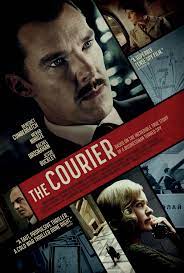
The Courier (2021)

The Courier (2021)

True-life Cold War thrills, as two spies battle to prevent the Cuban Missile crisis

Director: Dominic Cooke

Cast: Benedict Cumberbatch (Greville Wynne), Merab Ninidze (Oleg Penkovsky), Rachel Brosnahan (Helen Talbot), Jessie Buckley (Shelia Wynne), Angus Wright (Dickie Franks), Željko Ivanek (John McClone), Kirill Pirogov (Oleg Gribanov), Anton Lesser (Bertrand), Maria Mironova (Vera)

In October 1962 the world nearly ended, as the USA and the USSR clashed over Soviet missiles in Cuba. The history of this grim month is well known, as the fate of the world hung in the balance. What’s less known is the role Soviet double agent Oleg Penkovsky played in passing information on Soviet capabilities and strategy to the West – and how crucial this was to bringing the crisis to a (world-surviving) end.

The Courier covers – in a pleasingly old-fashioned, Le Carré-ish way – Penkovsky’s (Merab Ninidze) dangerous espionage career, and the relationship he built with British businessman Greville Wynne (Benedict Cumberbatch). Wynne – totally unconnected to the Secret Services – was chosen by MI6 to make initial contact with Penkovsky. He then served as Penkovsky’s courier, carrying secret documents and microfilm back to the West under cover of business trips to the Soviet Union – and the two men became close friends. When the Cuban Missile Crisis increases the risks to Penkovsky, it’s Wynne who pushes for a risky mission to extract him before he is uncovered and killed.

Directed with confident, low-key aplomb by Dominic Cooke, The Courier mixes shady, spy-thriller tropes (secret meetings, scratched signals, one-time pads, secret cameras) with a genuine friendship between two very different people. All taking place in a grim, Soviet environment where the risk of discovery lurks around every corner. Ordinary receptionists and chauffeurs could all be active or potential informants of the KGB, and there is not a single room that cannot be bugged.

It’s a very unusual world fish-out-of-water Wynne finds himself in. Expertly played by Cumberbatch as a stiff-necked people-pleasing fixer (introduced deliberately losing a game of golf to close a business deal with the triumphant winners), Wynne uncovers depths he didn’t suspect in himself. He at first has no interest in spying – or the Soviet Union – and simply wants a quiet life rebuilding trust with his wife (Jessie Buckley making a great deal of a rather thankless part of a woman kept in the dark about her husband’s activities) after a past affair.

He needs brow-beating from MI6 to even carry out his first mission – which he executes with a nervy unease – and reacts with horror at the idea of repeating it. What draws him in is the same quality that will see him take huge risks: his sense of humanity and fair play and the bond of mutual friendship and understanding between him and Penkovsky. Wynne willingly accepts dangers and sacrifices others would blanche at, out of loyalty and a sharply defined sense of right and wrong.

Wonderfully played by Ninidze, The Courier makes clear the huge risks Penkovsky is taking even considering talking to the West. This is a country where a Western spy is executed in the middle of a special staff meeting at his ministry. Whose leader is hell-bent on asserting Russian dominance and devil-take the consequences (sound familiar?). A country taking part in an arms race that could destroy the world, and disregarding the risks that could lead to those weapons being used. A quiet, loving family man, Penkovsky is appalled at the aggressive posturing of his country and how it is endangering his family and millions like them around the world.

It’s the bond between these two men, their sense of duty and their desire to protect, their quiet wit and small acts of thoughtfulness – as well as their capacity for betrayal (Penkovsky of his country, Wynne of his wife) – that draws them together. For Wynne, the selfless risks of Penkovksy create a deep well of respect and admiration, as well as pushing this businessman to develop into a justified-risk-taking moralist with a greater emotional connection to the beauty of life (represented by two contrasting scenes showing the two of them attending a Russian ballet – the second performance moves them both to tears, as if reminding them why they fight).

Around them, shot in a beautifully drained out style that really adds to the sense of terror and danger, plays out a sharp, well-paced spy thriller. Rachel Brosnahan plays Penkovsky’s CIA handler – an invented female agent, allowing the film to take a few shots at the stuffed-shirt unimaginativeness of her superiors – while Angus Wright (all stiff realpolitik) is his MI6 one. The official agencies play a more pragmatic bat, pushing Penkovsky to greater-and-greater calculated risks to improve their access. They also coldly accept any double agent has only a limited shelf-life before discovery, and getting the maximum out of them while they can is essential.

The film’s final act explores the impact of this, as Penkovsky is exposed and Wynne goes to dangerous lengths to try and help him escape. Shifting at this point into something more claustrophobic and hand-held, the film’s final act layers on the grim suffering spies face when uncovered – and includes several moments of genuinely moving suffering.

The Courier is a low-key, efficient, well-made and well-paced true-life espionage story, that feels like the professional, smartly assembled, film-making that often gets squeezed out of cinemas today. Very well acted by a strong cast, every frame has a perfect mixture of 50s/60s style and Cold War paranoia and its final sequence carries a decent emotional punch. A fine retelling of an overlooked story.

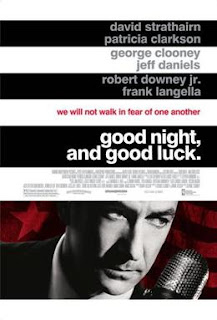
Good Night, and Good Luck (2005)

Good Night, and Good Luck (2005)

The importance of journalism is loudly praised in this engaging but faultlessly liberal Clooney film

Director: George Clooney

Cast: David Strathairn (Edward R Murrow), George Clooney (Fred Friendly), Robert Downey Jnr (Joseph Wershba), Patricia Clarkson (Shirley Wershba), Frank Langella (William Paley), Jeff Daniels (Sig Mickelson), Tate Donovan (Jesse Zousmer), Ray Wise (Don Hollenbeck), Helen Slayton-Hughes (Mary), Alex Borstein (Natalie), Thomas McCarthy (Palmer Williams)

In the early 1950s America seemed to be in the paranoid grip of one man. Senator Joseph McCarthy was the tip of a spear of anti-Communism, targeting every part of American life. To have even had thoughts that might be seen as socialist or communist, was enough for you to be considered an Anti-American and potential enemy of the state. McCarthy led a campaign to unearth Communist spies and sympathisers in the government, military, business, academia and the media. Blacklists and persecution were rife, and the slightest past association could condemn you. It took many years before anyone took a stand against this.

One of the leaders of this stand was renowned journalist Edward R Murrow (David Straithairn). Famous for his broadcasts from London during the Blitz, Murrow hosted an investigative journalist programme See It Now. A passionate believer in the power of television to educate and inform, Murrow and his producer Fred Friendly (George Clooney) are appalled when Air Force officer Milo Radulovich is condemned to be discharged, based on members of his family being communists and a sealed envelope of charges he was never allowed to see. Despite the worries of network CBS, Murrow, Friendly and their team run an episode of the show that exposes McCarthyism and its injustice, the first of several investigating McCarthy. But what price will they pay?

Clooney’s well-made, heartfelt film, is an impeccably liberal piece of film-making that is a very sincere tribute to the potential of television to be more than just an idiot’s lantern. Clooney frames the film with Murrow accepting a lifetime achievement award in 1958: he uses the opportunity to make a speech rebuking the room full of executives and journalists for squandering the potential of television to inform rather than just entertain. Murrow would of course be horrified by what TV became. Good Night, and Good Luck is a rose-tinted view of television journalism at its pioneering best: just as the end result of See It Now being gutted by cuts is a realistic look at where the scales will fall if entertainment and money are balanced with principles and education.

Clooney’s father was a TV journalist, while Clooney himself majored in journalism. The cut-and-thrust of the newsroom is as intrinsic to him, as is a desire to investigate and inform as part of a healthy political debate. Good Night, and Good Luck captures the mood of a newsroom with a convincing confidence. Journalists debate the fine point of stories, editors rush to assemble films and executives balance the pros and cons. It’s all shot in a beautiful monochrome, that exquisitely captures the haze of cigarette smoke all this takes place in. It’s a shot with a handheld urgency, sharply cut, that puts us into this world of cut-and-thrust media decisions.

And it makes clear what TV news can be. Not agenda led, but facts led. Not kowtowing to power, but challenging it to justify itself. Looking into matters that are important, not sensational. Wanting to inform people and expand their understanding, rather than pander to the lowest common denominator. Murrow’s shows are scrupulously fact-checked, and allow full rebuttal from their subject. He comes at story not with a pre-supposed position, but based on where the facts and his editorial judgement leads him.

It all takes place in a TV set that’s really striking in its humbleness, compared to the operatic news sets we see today. The 1950s studio is small, cramped and simple – and by contrast the ideas are large, expansive and complex. Murrow’s set is little more than a chair with a TV monitor. His producer Fred Friendly, literally sits at his feet to hand him notes and cue him in with announcements and VT. The See It Now set contrasts vividly with the more grandiose sets for Murrow’s other show, a series of puff piece interviews with popular stars like Liberace. (While Murrow learns his scripts by heart for See it Now, he professionally reads through a series of cue cards for these for-the-money interviews).

Murrow and Friendly also won’t compromise. They defend their right to make the show to CBS President William Paley (a brilliant performance from Frank Langella), who prides himself on no direct intervention on the news but pushes for a less controversial line. The entire team is consulted on every issue. The newsroom is a place where our better angels can come out.

But it’s still happening in an America where people are careful about what they say and do. A subplot concerns reporters played by Robert Downey Jnr and Patricia Clarkson: secretly married – contrary to CBS policy – like those suffering from McCarthyism, they must live a lie in order to protect what they have. See It Now is in danger of criticism, cancellation and attack. Another CBS anchor, Don Hollenbeck – perfectly played by Ray Wise (and few actors are better at suppressed desperation than Wise) – is dealing with constant media persecution for his perceived communist sympathy. Murrow and Friendly are not perfect: they sometimes dodge the fights they can’t win and Murrow in particular shrugs off or ignores Hollenbeck’s concerns with tragic results.

But, as Clooney makes clear, the good outweighs all the rest. As Murrow, David Straithairn (Oscar-nominated) has never been better. He perfectly captures Murrow’s mannerisms, but mixes it with wonderful measure of honesty and decency, mixed with a degree of pride and self-righteous certainty. He dominates the film (with Clooney as a generous foil) and carries much of the film’s liberal message that smart, intelligent, dedicated men can change the world.

Good Night, and Good Luck might be the most soft-left liberal film made in Hollywood in the last fifteen years. But it is a fine example of film-making craft and the earnest honesty with which it is made in its own way inspiring. It’s Clooney’s finest film and it’s grounded in his strengths: fine actors and writing carrying a sincerely told message.