Category: Crime drama

The White Tiger (2020)

Adarsh Gourav is a willing servant (or is he?) in The White Tiger

Director: Ramin Bahrani

Cast: Adarsh Gourav (Balram Halwai), Priyanka Chopra Jones (Pinky), Rajkummar Rao (Ashok), Mahesh Manjreker (The Stork), Vijay Maurya (Mukesh “The Mongoose”), Kamlesh Gill (Granny), Swaroop Sampat (The Great Socialist)

“India is two countries in one: an India of light, and an India of Darkness”. It’s an idea that’s at the heart of Aravind Adiga’s Booker-prize winning novel, adapted here as a dynamic (if slightly overlong) film by Ramin Bahrani. Those two India’s are rooted in the country’s deeply ingrained class differences, the new caste system being simple: the haves and the have nots.

Balram Halwai (Adarsh Gourav) is very much one of the have nots. A poor young man, who missed out on his chance of a scholarship because his family needed the income he could bring them from breaking up coal. Balram sees his way out through becoming a driver for the son of the local landlord, Ashok (Rajkummar Rao) and his American-Indian wife Pinky (Priyanka Chopra Jones). With the story being recounted by an older Balram, now a successful businessman, we know he finds a way to improve his life. But at what cost? And how many lives have been sacrificed to get him there?

Bahrani’s adaptation is a sharp, cinematic, electric piece of film-making, that makes superb use of montage and dynamic camerawork, particularly in its scene setting opening acts. Bahrani also engages brilliantly with the central themes of the novel, the all-pervading corruption of modern India (financial and spiritual) and the gulf in class and mindset that exists between the rich and poor. The wealthy upper classes see themselves as nothing less than masters of the rest of the population, who they hire and fire at will and frequently mistreat. Meanwhile, Balram argues, many of the poor cannot escape the mindset of servitude (the “chicken coop” as he puts it), unable to imagine any life other than living on the bottom rung.

It’s an idea Bahrani’s film brilliantly reinforces visually. The westernised wealth of the upper classes – living in gated communities and luxurious hotels, driving western cars with no contact with anyone outside other than servants – is contrasted with the slums and poverty of the rest of the population. Their parts of the city are run-down and crumbling. Many live on the streets. Balram himself lives on a mattress in the basement of his master’s hotel – while Ashok resides in a penthouse. You can’t escape the radical inequality – nor the violence (from slapping of servants to the implied threat of murder of your family if you step out of line) that keeps the system in place.

Part of the fascination of this film is wondering half the time, how much Balram is a willing participant in this system and how much he is longing to cast off its shackles. Sure we know, from the framing device of his later life, where he is heading. But is it his aim from the start? How genuine is his humbleness? As he schemes to have a rival driver dismissed, he talks in voiceover of his sadness – but on screen he merely shrugs and downs some sweetmeats. Does his resentment develop over the film, or is it there from the start – or does he only understand it as he realises he lives in a “chicken coop”?

As in the book its rife for interpretation – and Bahrani doesn’t lay on too think the unreliable narration element of Balram. It’s also helped immensely by Adarsh Gourav’s superb, BAFTA nominated performance in the lead role. He seems genuinely naïve and innocent – the very country pumpkin the other drivers at the hotel mock – but there is always an unknowable quality to him under the affable surface Gourav presents, a ruthlessness and also an anger. Watching both these qualities develop across the film – and questioning how well we know him – is a brilliant tight-rope walk, with Gourav maintaining our sympathies even as his actions become ever more ruthless.

He becomes an embodiment of the divide in India itself, between the mindset of being nothing more than a servant and the developing entrepreneurism in the country (represented both by the side jobs the rest of the drivers carry out as well as Balram’s later business success). It’s also fascinating to see the contrasts in his employers. Rajkummar Rao creates a character who is decent enough to know he’s treating people selfishly, while being lazy and immature enough to not bother to change. His wife, very well played by producer Priyanka Chopra Jones, speaks the language of a free America but is perfectly happy to force others to take the rap for her mistakes.

The film’s energy tails off in its second half as the plot catches up with the traffic accident that opens the film. The second half of the film tends to circle around the same issues of rich vs poor and the abuse of power that the first film explores with greater energy and wit. To be honest, you can tell an act of violence or betrayal is on the way – and the film takes too long to get there. A tighter film at an hour and 45 minutes would have been more effective and maintained the drive of the first half (even if it would have meant sacrificing some good individual scenes here and there).

But when the film is on song it works very well. The ideas it tackles around modern India feel very real and vital – and still carry plenty of relevance today. Bahrani balances the dark humour very well with the moral outrage and has a brilliant lead performance from Adarsh Gourav. It would have been better tighter which would have helped keep its pace and energy up, but this is still inventive and urgent film-making, a fine adaptation of an excellent novel.

The League of Gentlemen (1960)

The League of Gentlemen (1960)

Gentlemen don’t get mad: they get even in this fun, well-structured heist movie

Director: Basil Dearden

Cast: Jack Hawkins (Lt Col Norman Hyde), Nigel Patrick (Major Peter Race), Roger Livesey (Captain “Padre” Mycroft), Richard Attenborough (Lt Edward Lexy), Bryan Forbes (Captain Martin Porthill), Kieron Moore (Captain Stevens), Terence Alexander (Major Rupert Rutland-Smith), Norman Bird (Captain Frank Weaver), Robert Coote (Brigadier “Bunny” Weaver), Nanette Newman (Elizabeth Rutland-Smith)

You throw a gentleman on the scrap heap at your peril. After a lifetime of service, Lt Colonel Norman Hyde (Jack Hawkins) has been made redundant – and, to put it bluntly, he’s pissed off. However, a gentleman doesn’t get mad, he gets even. And what better way to do that than using your army training to mastermind the finest bank heist Britain has ever seen? To pull it off, Hyde recruits a team of similarly disgruntled Army officers (all cashiered from the army for a range of offences, from theft to implied sexual demeanours) all of them highly trained specialists. What could possibly go wrong?

The League of Gentlemen was the first film from a short-lived British production company Allied Films. The company was a partnership between Dearden, Hawkins, Attenborough (who did a lot of the producing) and Forbes (who wrote the film’s witty, playful script). The film is a delight, a wonderfully executed heist movie, told with an archness that turns its criminals into sympathetic rogues. It’s really a sort of dry comedy and gets a lot of fun out of British attitudes at the time.

For starters, who would think that gentlemen like this (war heroes for goodness sake!) would ever be involved in anything so naughty as armed robbery? Especially in a country so deferential that – in a cunning raid to pinch guns from a military base – conman “Padre” (Roger Livesey, riffing delightfully on his Blimpish persona, as a conman with a shady past) simply turns up dressed as a superior officer and is instantly accepted as such. Just to complete the satire of prejudices at the time, the members of the team lifting the guns are ordered to speak with Irish accents as after all “We British never give the Irish the benefit of the doubt”, and even the a whiff of an Irish accent will whack the blame straight onto the IRA.

But this also a film having a bit of fun with demobilised fellows who have never quite found their place in civvie street – and may even miss the glamour and excitement of the war. Most of the team are clearly veterans of WW2, and many of them are struggling with demanding landlords, unfaithful wives or dismally dull jobs. How could they resist saddling up for one more grand adventure? Especially when there is a huge suitcase of money waiting for them at the end of it.

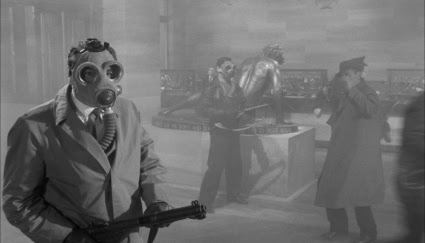
Dearden’s direction is taut, sharp but also gives more than enough room for the character comedy. He stages the heists with a briskness and efficiency that you can imagine Michael Mann being quite pleased with (the gas mask wearing, gun totting soldiers have more than a passing resemblance to the robbers in Heat – enough to make you think Mann may have watched this film somewhere along the line). Dearden’s storytelling is clear, well staged and inventive (the raid on the army base is shown to us without briefing, meaning we work out the plan as it progresses).

He’s helped enormously by Bryan Forbes’ fun and quotable script, that swiftly but skilfully distinguishes the characteristics of each man and their motivations and makes a perfect balance between affectionate comedy and the sharpness of danger (the group make clear they will “do what’s necessary” if pushed, even if they aim is no bloodshed). The film is built around several wonderful set pieces – and has a classic, almost pre-James Bond parody opening as Hawkins emerges from a manhole cover dressed in a dinner suit and climbs into a car.

Hawkins is great here, spoofing the troubled war heroes and authority figures he spent his whole career playing. Here he inverts all this straight-shooting, “Queen and country first” attitude into a man with the outside trappings of decency, but with a bitter heart and cynicism towards the world. He carries most of the film with a deceptive effortlessness, but nails the tone exactly between fun and genuine frustration at the world.

The whole cast follow his lead. Nigel Patrick is very good as a cashiered Major who enjoys mockingly parroting all the eccentric mannerisms of upper-class gentlemen. Livesey enjoys the self-parody almost as much as Hawkins (he spends nearly every seen looking like he’s only a few degrees away from giggling). Attenborough is fun as a chippy junior officer while Terence Alexander is great as a frustrated cuckold lost on civvie street. There isn’t a weak link in the whole cast.

The film is a delight, fun but with more than enough tension. It brilliantly captures a sense of the camaraderie and loyalty between these ex-soldiers, as well as their delight at being used able to use their skills one final time. It’s a film squarely on the side of these criminals thumbing their noses at the system (and who are planning as close as they can get to a victimless crime, albeit at gun point). The film has to give them some sort of comeuppance at the end – but you’ll be sorry to see it, as by then you’ll be invested at pulling off the heist as they are. Well directed, acted and written it’s a perfect entertainment.

Beat the Devil (1953)

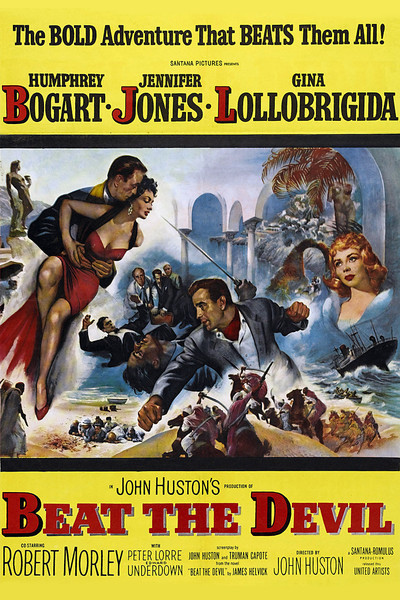
Jennifer Jones, Gina Lollobrigida and Humphrey Bogart in the tongue-in-cheek Beat the Devil

Director: John Huston

Cast: Humphrey Bogart (Billy Dannreuther), Jennifer Jones (Gwendolen Chelm), Gina Lollobrigida (Maria Dannreuther), Robert Morley (Peterson), Peter Lorre (Julius O’Hara), Edward Underdown (Harry Chelm), Ivor Barnard (Major Jack Ross), Marco Tulli (Ravello), Bernard Lee (Inspector Jack Clayton)

Beat the Devil is a curious beast. You could argue it was ahead of its time. Huston and Bogart had started out with the intention of making a straight crime mystery, a sort of Maltese Falcon in Europe. But when they arrived on location, obviously something in the weather got to them and Truman Capote flown in to help redraft the script on a daily basis to turn it into a sort of satirical comedy. For audiences expecting a hard-boiled crime mystery, it left heads scratched and cinema seats empty. Bogart lost a packet on the film – and later claimed to hate it – and it only existed in a badly cut-about version until it was restored in 2016.

The slightly surreal plot hardly really matters. A crowd of unusual people gather in a run-down port in a small Italian town, waiting to take the ship to East Africa. Gwendolen (Jennifer Jones) and Harry Chelm (Edward Underdown) are seemingly upper-class Brits (or are they?). American Billy Dannreuther (Humphrey Bogart) and his European wife Maria (Gina Lollobrigida) might also once have been something, but they sure ain’t now. Peterson (Robert Morley) and his associates the suspiciously un-Irish Julius O’Hara (Peter Lorre), rat-faced bully Major Jack Ross (Ivor Barnard) and nervous Ravello (Marco Tulli) are almost certainly all criminals on their way to a big score in Africa. Thrown together, this unlikely grouping end-up in a heady cocktail of betrayals, schemes, affairs and lies that spools out like a demented shaggy-dog story.

Beat the Devil is really more of an experience, a series of gags and light-hearted scenes played with a grin and a wink. Nothing in it is meant to be taken seriously, and this semi-surreal group of events becomes ever more absurd as it goes on. By the time the cast are abandoning a sinking ship, trudging up a beach to be captured by Arab officials who eventually allow them to row back to port where they find their ship didn’t actually sink…you really should just decide to go with the flow.

Instead the film is about shuffling up familiar tropes from hard-boiled noir with Oscar Wildeish farce. Certainly the Chelms seem to have wandered in from something totally different (not least since Gwendolen’s name is reminiscent of Importance of Being Earnest). Harry (a superbly stiff-upper lipped Edward Underdown) is a blithely unaware would-be English gentleman, pompously aware of his social class and blithely unaware that his wife seems to immediately start an affair with Billy. Gwendolen is the exact sort of character you might expect to see in Wilde, a dreamer tipping into fantasist, who blurts out things she shouldn’t and falls instantly in love with Billy. She’s also whipper-smart – more than capable of defeating Harry at chess without looking (“usually he’s a wonderful loser” she tells Billy, by way of apology for Harry’s strop).

Billy and Gwendolen embark on an immediate affair (although of course, in deference to the Hays Code, its just kept this-side-of-implicit). Mind you the film has a zingy wife-swop feel to it, since it’s pretty clear that Maria is far more interested in the British reserve of Harry (“Emotionally I’m English” she says before eulogising tea and crumpets) than she is in the ordinary-Joe cunning of her husband (although perhaps Harry is just as oblivious to this as everything else around him).

Billy is Bogart deliberately at his most Bogart-ish, channelling every grimy-but-smart dubious-hero the star ever played. Bogart plays the entire film with a grin on his face and delights in lines like “Fat Guys my best friend, and I will not betray him cheaply”. He also sparks delightfully with Jennifer Jones, who seems to having the time of her life as a character so flighty and unpredictable that even she looks like she hasn’t a clue what she is going to do (or feel) from one moment to the next.

The supporting cast of creeps and freaks Dannreuther is conspiring with to make a fortune (its something to do with land and uranium) similarly seem to have walked in from a side-ways Dashiel Hammett universe. For all their dirty deeds – and it seems Petersen had ordered a hit in the UK, although never for a minute would you believe this looking at Robert Morley’s puffed up bluster – they are a rather sweetly naïve and incompetent. Morley’s Petersen, a sort of galloping major, carries no real threat. Peter Lorre is very funny as a suspiciously German sounding Irishman (“Many Germans in Chile have come to be called O’Hara” he comments), prone to flights of verbal fancy and a chronic lack of focus. Ivor Barnard is as close as the film comes to threat as the aggressively incompetent Major Ross, a chippy bully who resents his shortness and eulogises Hitler at the drop of a hat. These heavies are each ridiculous figures.

And it makes sense, since the plot is a great inflated balloon of nonsense. There are chases, sinking ships that stay unsunk, a moment where two major characters are briefly believed dead, obsessive conversations about hot water bottles and reveals that puncture any sense of grandeur for each character. It’s the sort of aimless story you could imagine natural raconteurs like Huston and Capote finding absolutely delightful, and the whole film feels like a dramatization of a dinner-table anecdote.

Take it on those terms and its all rather good fun, even if it makes no sense. The cast look like they are having a whale of a time, and the total lack of seriousness about the whole enterprise generally makes it glide by with ease. Take a couple of drinks, sit back, don’t think about it too much and enjoy the jokes.

They Made Me a Fugitive (1947)

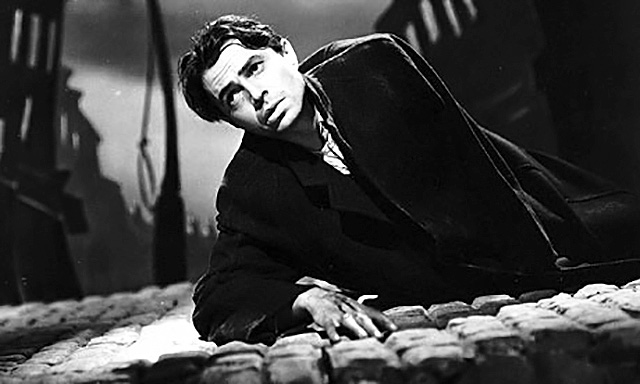
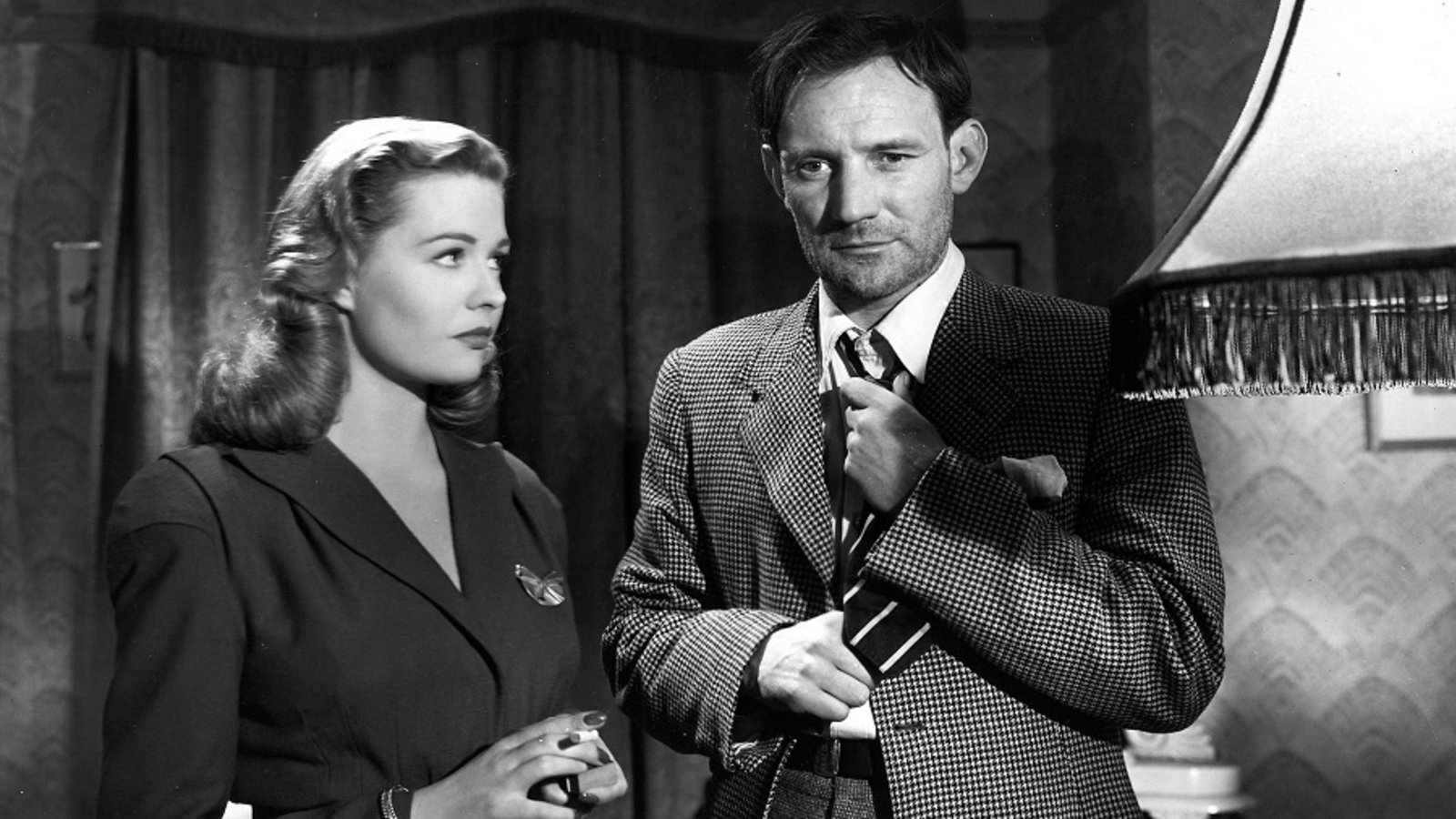
Trevor Howard is on the run in They Made Me a Fugitive

Director: Alberto Cavalcanti

Cast: Trevor Howard (Clem Morgan), Sally Gray (Sally), Griffith Jones (Narcy), René Ray (Cora), Mary Merrall (Aggie), Charles Farrell (Curley), Cyril Smith (Bert), Phyllis Robins (Olga), Vida Hope (Mrs Fanshaw), Eve Ashley (Ellen), Jack McNaughton (Soapy), Maurice Denham (Mr Fenshaw)

The Second World War is over – but the country is awash with ex-servicemen, not sure where they fit in, trained to kill. Clem Morgan (Trevor Howard) is one of them. A former RAF man, who escaped from a POW camp, he doesn’t know what to do with himself on civvie street. So he’s definitely open to an offer to work for black marketeer Narcy (Griffith Jones) – but not so keen once Narcy’s business dealings expand into drug smuggling and violence. Clem gets framed for the killing of a policeman and banged up in Dartmouth – where he receives a visit from Narcy’s mistreated girlfriend Sally (Sally Jones) who needs his help to prove Narcy is the real villain. Clem escapes, a fugitive, looking for, and on the run from, justice.

Cavalcanti’s film is a marvellous mix of noir, early kitchen-sink and faded post-war crime drama. The locations are run-down and dirty, the mood faded and worn out. The film is remarkably bitter, cynical and short on hope. Clem’s encounters take him past a gallery of those struggling in post-war Britain: black marketeers, shallow glamour-pusses, bored policemen, common criminals, vengeance minded housewives and brutal heavies. Everyone is corrupt, has violence or treachery in mind and don’t think twice about putting others through suffering. And to be honest, as a shambling, scruffy drunk, Clem makes a pretty good fit among them, a man whose best days happened somewhere in Germany in the 1940s and who hasn’t had a clue what to do with his life since.

The post-war Britain painted here isn’t nice. No wonder ruthless, thuggish black marketeers like Narcy (short for Narcissus of all things – which manages to be both a commentary on self-obsession, while being an abbreviation that sounds like Nasty or Nazi) are flourishing. Narcy – played with a callous, charismatic black-heartedness by Griffith Jones, in a performance bereft of any trace of morality – has no problem with any criminal act what-so-ever so long as it gets him what he wants. Smuggle drugs? Not a problem. Beat a woman? Line ‘em up. Murder a cold-footed subordinate? As many as needed. Narcy is a perfect emblem for this world, uncaring, brutal, sadistic and enjoying the fact that so many others are desperate.

His kingdom is a subterranean hell, in the basement of a undertakers. (It even has a huge sign reading RIP on the top of the building.) His haunts are foggy docksides, chilling streets and rough pubs. His followers are cowed former servicemen – although even they draw the line at using guns – and the police seem unable to touch him. But then Narcy’s world is pretty similar to the rest of England. The countryside Clem journeys through from Dartmouth to London to get his revenge is equally fog-ridden, cold, dirty and unattractive, full of farmers who shoot at him with buckshot and housewives who blackmail him to carry out their dirty deeds.

The film hinges at the half-way point on this surreal scene. Clem arrives at a home where the woman of the house – played with a sort of hypnotic monotone by  Vida Hope – allows him to wash, gives him new clothes, feeds him – and then hands over a gun and asks him to shoot her husband (a shambling drunk played by Maurice Denham). Clem refuses – he’s killed once in his life, while escaping a POW camp, and has no intentions of doing so again. He makes a run for it – at which point the woman does the deed herself, and places the blame on Clem. It’s a bizarre scene, but strangely magnetic – its a window into this topsy-turvy world. Killing means something different to everyone after years of the world tearing itself apart, and behind the chintz curtains of middle-class Britain, we can’t be certain there doesn’t lurk something dark and dangerous.

Trevor Howard makes a perfect lead for this sort of grimy world. He’s got the “hail well met” stance of Clem down perfectly: but he’s a character who also carries a natural integrity to him, someone who we can trust. No matter how drunken, shambling and untidy he gets when he’s in his cups, there is something decent in him we can trust. It also means we can root for him when the chips are down (which they are for most of the film), and while he finds himself in bizarre and dangerous situations, from being shot at by farmers to struggling to escape the curiosity of lorry drivers.

Howard powers the whole film, even if Griffith Jones perhaps carries it away in the more colourful part of Narcy. Sally Jones makes for a relatable woman of fixed morality (perhaps the only truly moral person in the whole film) who has somehow found herself in a dirty world. Cavalcanti’s world is filthy. He shoots it with a delicate but immersive intensity. It’s a surprisingly violent film. Knifes are used, shots are fired and Narcy beats two women with a viciousness (the first is shot with a whirling camera, which might go a little too far to get us to relate to the dizzying violence).

It’s also a film that seems low on hope. It ends on a downer. The forces of good – like the police – seem distant, uninvolved or, at best, useless in the face of all the crime. The forces of evil are left to effectively police themselves and corrupt but decent men like Clem get stuck in the middle. They Made Me a Fugitive makes for an involving and gripping thriller, a perfectly made little British B movie.

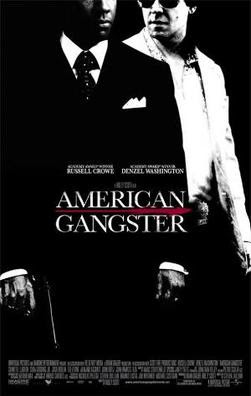
American Gangster (2007)

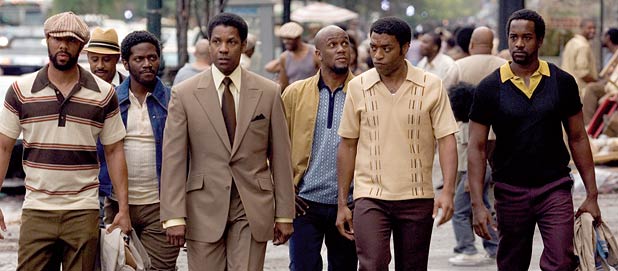
Denzel Washington leads his brothers in a life of crime in American Gangster

Director: Ridley Scott

Cast: Denzel Washington (Frank Lucas), Russell Crowe (Richie Roberts), Chiwetel Ejiofor (Huey Lucas), Josh Brolin (Detective Trupo), Lymari Nadal (Eva), Ted Levine (Captain Lou Toback), Robert Guenveur Smith (Nate), John Hawkes (Freddie Spearman), RZA (Moses Jones), Yul Vazquez (Alfonsa Abruzzo), Malcolm Goodwin (Jimmy Zee), Ruby Dee (Mama Lucas), Ruben Santiago-Hudson (Doc), Carla Gugino (Laura Roberts), John Ortiz (Javier J Rivera), Cuba Gooding Jnr (Nicky Barnes), Armand Assante (Dominic Cattaneo), Joe Morton (Charlie Williams), Idris Elba (Tango), Common (Turner Lucas), Jon Polito (Russo), Ric Young (Chinese General), Clarence Williams III (Bumpy Johnson)

In 1970s New York there was only one organisation that ran crime: the mafia. The idea that anyone else could get a look in was unthinkable: to the cops, the government and the criminals themselves. Frank Lucas (Denzel Washington) was the guy who was going to shake that up: a resident of Harlem and former right-hand man of crime boss “Bumpy” Johnson (Clarence Williams III), Lucas saw an opening to bring in cheap, high-quality drugs from Vietnam (hidden in the temporary coffins of deceased servicemen). With this product he could take over crime in New York – and run it as he thinks it should be run, with the mentality of a FTSE 500 company and a gun. Frank is helped by the fact no one knows who he is. But that is all about to change as honest cop Richie Roberts (Russell Crowe) sets up a task force dedicated to finding, and arresting, the drug kingpins in New York. He’s as surprised as anyone to find the trail leads to Harlem.

Based on a true story, Scott’s American Gangster is assembled with Scott’s usual professionalism and assured touch, using top actors in well-assembled, well-shot scenes. It’s glossy, entertaining and enjoyable. But it’s not quite inspired or stand-out. Despite everything, it doesn’t really show us anything new and lacks either the fire of inspiration or the sort of poetry and energy the likes of Spike Lee, Quentin Tarantino or Steve McQueen could have bought to it. It tells an interesting story, but manages to be pretty much by the numbers – albeit those numbers are flashed up with as much pizzazz, drama and entertainment as you could wish.

The most interesting themes are questions of class and racial politics. The film’s version of Frank Lucas is successful because he runs his crime empire not like a gang but like a company. He dresses plainly and simply, so as not to draw attention (unlike the flamboyant criminals played by Idris Elba and Cuba Gooding Jnr). He talks in terms of supply and demand, brand loyalty and being a chairman. In one particularly well managed scene, he pontificates to his brothers on his ideology of business, excuses himself to walk across the street and shoot a rival in the head, then returns to calmly finish his breakfast. It’s the ideas of Wall Street applied to gangster crime. Lucas is all about bringing a smooth, modern, professional thinking to crime – but with the gun still up his sleeve.

But another reason why Frank Lucas needs to be as professional as he is, is because he’s loathed by all other parts of the criminal system. It’s a system that is racist from top-to-bottom, where black men are unwelcome as anything other than foot-soldiers. The elite criminals – most of them tracing many generations back to Sicily – smile at Frank for his money, but never see him as an equal. Even the government can’t begin to imagine a black man could be running such a huge empire – Robert’s AG boss spews out a racist diatribe, rubbishing any idea that a black man could achieve something the Mafia has failed to do. Frank though is just as wary of the flashy ostentatiousness of most black criminals in New York, telling his brother that the quietest man in the room is the most powerful.

It’s those brothers who Frank relies on – only family can be trusted. They’ll also be his Achilles heel. Because even his most competent brother (played by a sharp Chiwetel Ejiofor) is as much a liability as he is a good lieutenant. His brothers are innocents turned by their brother into tools for his crime empire. Frank hands out beatings to cousins who are unreliable. He’s bitterly disappointed when his nephew chucks in a baseball career because crime looks more fun. As his mother – an impassioned performance from an Oscar-nominated Ruby Dee – tells him, the rest of the family looks to him and follows his lead. There is a clear tension between this family – whose benefactor is also its corrupter – but it doesn’t quite come into focus.

This is partly because the film is covering a lot, and partly because it finds itself falling a bit in love with Frank Lucas. Not surprising when the part is played by Denzel Washington at his most magnetic – if strangely not quite as energised as you might expect. Washington gives Frank a dignity and cool that the real Frank – by all accounts a much cruder, ruder, less able man – never had. The film doesn’t really want to explore the darker side of Frank. Instead it invites us to sympathise with him, as an outsider made good. To feel sorry for him when he makes a fatal error (wearing an ostentatious fur coat to the Ali/Frasier “Fight of the Century” – an act that blows his carefully preserved anonymity). The film doesn’t want us to feel the damage of the drugs Frank is pouring into New York, since it might damage our respect for his triumph against the odds.

The barriers that Frank has to overcome – from arrogant Mafia kingpins, to local crime lords and corrupt cops (Josh Brolin has fun as a prowling bullying detective) – are in the end more interesting than the procedural struggles of Russell Crowe’s Richie Roberts (on solid form). Roberts is also given a rather cliched (and fictional) custody battle that hardly justifies its screentime. The cops definitely get the short end of the stick – and a stronger film might have focused just on Frank Lucas and really explored the struggles of a black man in white crime world, dealing with racism and trying to apply Wall Street ideals to street violence.

American Gangster doesn’t quite succeed with its dark commentary on the American dream – but it’s as entertaining as you could hope and while it lacks in inspiration, it’s also hard to find too much fault with. One of Scott’s most solid works, with a charismatic Washington doing decent work.

Dog Day Afternoon (1975)

Al Pacino takes a bank hostage in Dog Day Afternoon

Director: Sidney Lumet

Cast: Al Pacino (Sonny Wortzik), John Cazale (Sal Naturile), Charles Durning (Sgt Eugene Moretti), Chris Sarandon (Leon Sharmer), James Broderick (Agent Sheldon), Lance Henriksen (Agent Murphy), Penelope Allen (Sylvia), Sully Boyer (Mulvaney), Susan Peretz (Angie Wortzik), Carol Kane (Jenny)

Perhaps only in the 70s could a failed bank robber have been turned over-night into a counter-culture folk-hero. It’s the subject of Sidney Lumet’s thrilling, heist-gone-wrong movie, set on one sweltering day in New York when Sonny Wortzik (Al Pacino) tried to rob a bank to fund the sex-change operation of his boyfriend Leon (Chris Sarandon). He ends up taking the co-operative bank staff hostage while a media and public firestorm takes place outside the bank, mixed in amongst an army of trigger-happy cops. And it’s all based on a true story.

Sonny is far from your hardened criminal. He doesn’t want anyone to get hurt. He takes care of the hostages, who all become immensely fond of him and his less confident partner-in-crime Sal (John Cazale). When the police and media turn up, Sonny is outraged at the trigger-happy police presence and quickly wins the support of the crowd with his honesty, bluntness and quick wit. With the police incapable of controlling the situation, soon he is actively playing to the crowd, taking phone calls from the press in the bank. He becomes a counter-culture icon, sticking it to the man (his famous chant of “Attica!”, refers to the famous prison riots, where prisoners rioted to secure their rights).

It’s the key topic that fascinates Sidney Lumet, in this brilliantly frentic, edgy and dynamic film, that captures the tension in New York, where it felt like the careful balance between law and order could disintegrate any time. Lumet’s improvisational feel with the crowds, the edgy, raw performances – particularly from Pacino and Durning, both of whom are sensational – and the sense that anything could happen at any time. Dog Day Afternoon is about a city on the edge, combined with the ability of the media to turn regular people into stars. There was little faith in the authorities, and even a little bit of nose thumbing in their direction could sway the crowds.

At the centre of all this is Sonny, a fascinatingly flawed person, partly absorbed with being the centre of attention, part desperately trying to work out what his best move is among an increasingly narrowing number of options. Al Pacino nearly didn’t take the role, after suffering a near nervous collapse from the pressure of Godfather Part II – but, after committing to the film, he gave one of his most extraordinary performances of an era he and a small group of actors dominated.

Sonny feels increasingly trapped in his predicament. The robbery of the bank is hilariously cack-handed from the start – one of the robbers bails in minutes and has to be begged not to go home in the get-away car – and it becomes clear that for Sonny this is all a last desperate throw of the dice. Both of his relationships – with his first wife and his second marriage to Leon – are relationships on the brink of disaster, destabilised by Sonny’s desperate need for prove of love and affection. He’s a man uncertain in his own skin, smart enough to know the world isn’t fair, but not smart enough to know what to do with it. Fundamentally decent, but forced into illegal actions. Pacino delivers this with the expected fireworks, but when we see Sonny away from the public gaze, he’s a sad, broken-down, isolated man who genuinely doesn’t know where his life is going.

Dog Day Afternoon was radical at the time for how it deals with homosexuality. Neither Sonny nor Leon are presented – as might have been expected at the time – as limp-wristed or fey, but just regular guys who happen to want different things from life. Chris Sarandon (Oscar nominated) is strikingly tender, low-key and world-weary as a man resigned to what the world is throwing at him, from the emotional pressure of meeting Sonny’s needs for affection, to spending every day feeling trapped in his body and facing suspicious stares from all around him. Pacino presents Sonny as a masculine, dynamic figure whose sexuality is just part of his personality. It’s a film not afraid to acknowledge the love between men, and never considers this anything other than entirely normal – something extremely unlikely in 70s cinema. Indeed, you can see the mood of the time in the way the crowd changes once the motivations behind Sonny’s actions becomes clear. Hostility grows – through many gay rights activists quickly arrive to bolster the crowd. The films normalising of homosexuality, also serves as a critique for the assumptions and reduced options many identifying as gay had at the time.

Of course, this all makes the entire siege even more attractive to the media. The film is a neat satire of the way the press can turn events like this into entertainment. A pizza delivery guy, sent to feed the hostages, can barely contain his excitement, screaming “I’m a star!”. At least two hostages refuse offers to leave the siege – at least partly, it’s suggested, because there is nowhere better to be than at the centre of the show. Pacino’s electric playing to the crowd demonstrates how Sonny’s firecracker sense of the turmoil of the period – the violence of the authorities and the lack of justice for the regular guy – helps feed this. The media’s eagerness to sensationalise the events, do turn them from real life into entertainment – and the way so many characters and on-lookers yearn to be part of a real-life drama – is sharply critiqued, with truth and humanity sacrificed for prime-time ratings (ideas Lumet would explore even more deeply in his next film Network).

It’s also fascinating to watch the cack-handed police inexperience at handling sieges like this, from the lack of central control to the trigger-happy cops, to allowing public and the media to get within a few metres of the bank entrance. Charles Durning is superb as a frazzled police sergeant, out of his depth, unable to control his colleagues and totally lacking the calm and control needed for hostage negotiations. He’s replaced in the operation by FBI agent Sheldon – played with a chilling distance by James Broderick – who represents the other side of the law at the time: ruthless, cold and very ready to switch from negotiation to execution.

Sonny may look is in control of things, but it’s quickly clear no-one really is. Even Sonny feels this, Pacino delivering with a resigned calm a scene where Sonny asks one of the bank tellers to record his final will. Dog Day Afternoon is also a tragedy, with the real victim being Sal, Sonny’s partner in the robbery. He’s played with an almost childish innocence by John Cazale, as a not very-bright man completely out of his depth, whose idea of a foreign country to escape to is Wyoming (a hilarious piece of improvisation by Cazale). While Sonny is the public face of the situation – and someone law officials figure they can work with – Sal becomes a dangerous unknown quantity for them that they feel needs to be disposed with. An offer they openly make to Sonny, who furiously rejects it (but, tellingly perhaps, doesn’t tell Sal about).

Poor Sal sweetly chats with the staff. He quietly warns about the dangers of smoking. He sweats and timidly waits to be told what to do. He bravely tells Sonny that he is completely ready to shoot the hostages, while clearly having no idea about the emotional reality of doing this. He meekly follows instructions and is responds with panic to almost every situation. Cazale’s flawless performance turns him into the real victim here, completely unprepared in every way for the situation he is in (he whiningly complains about being called gay on the news, and is terrified at the idea of flying with the hostages to a foreign country, having never been in a plane before). It’s a wonderful personal tragedy that plays in the background of the film.

Lumet’s film has the dynamic vibe of a fly-on-the-wall documentary turned drama. Pacino is the perfect actor for this, his performance (Oscar-nominated) sensational, high-octane and demonstrative mixed with confused, vulnerable and eventually traumatised and guilt-ridden. The film brilliantly balances questions of politics, media and sexuality, offering seering critiques of attitudes around all three. Wrapped into a fire-cracker film, this is a brilliant piece of social commentary, personal tragedy and street theatre. Overlooked more than it deserved, it’s a masterpiece of 70s film making.

Badlands (1973)

Martin Sheen and Sissy Spacek are killers on the run in Terrence Malick’s masterpiece Badlands

Director: Terrence Malick

Cast: Martin Sheen (Kit Carruthers), Sissy Spacek (Holly), Warren Oates (Father), Ramon Bieri (Cato), Alan Vint (Deputy), Gary Littlejohn (Sheriff), John Carter (Rich man)

If American cinema has a poet, it’s Terrence Malick. His career is the most elliptical of any major American filmmaker. Shunning interviews or any discussion of his work, his mystique is built upon Kubrickian isolation (he took a 20-year gap between his second and third films) and the powerful mystique of his first film – and still his masterpiece – Badlands. A luscious, beautifully filmed, profound piece of film-making, perfectly paced and told with a poetic sensibility, it’s  powerful and brilliant. Nothing Malick has done since has reached the same beautiful balance between story, profundity, poetry and realism.

Kit Carruthers (Martin Sheen) is an aimless young man, recently fired from his job as a garbage collector in South Dakota. His imagination is captured by a teenage girl, Holly (Sissy Spacek), freshly arrived from Texas. He romances the young girl – who is naively swept up in the possibility of Kit’s poetic soul – but her father (Warren Oates) disapproves. So, in a casual confrontation at their home, Kit kills the father, burns down the house and he and Holly head out on the run. Travelling across the country, Kit kills with a casual lack of maliciousness, all the time building in his head his self-image as a James Dean-like hero in his own movie, a poet turned outlaw. Holly narrates the film, her guileless, innocent and often unreliable narrative revealing her own naivety. Sheen is outstanding as Kit, idealistic but empty, while Spacek gives Holly a sublime blankness that makes us never sure how much she understands the situation she is in.

Malick based the film on the killing spree of Charles Starkweather, who carried out a murderous journey across several states in the mid-West with his underage girlfriend in the late 50s. But what Malick found in this story was a fascinating insight into how people can become absorbed by the romanticism of the American pioneer spirit, to try and turn their own lives into something with meaning and depth. So, Kit can be little more than a not particularly bright casual killer, but he builds his own self-image as something part-way between movie star and philosopher poet.

What the film does quite brilliantly is balance the ruthlessness of Kit with this dreamlike poeticism. Much as you shouldn’t, you end up caring a little for Kit and Holly, while deploring their brutality. Perhaps it’s because both of them feel so young. After the murder of her father, they build a cabin in the woods and live off the land, with all the enthusiasm of kids. There is something very vulnerable about both of them, their abilities to really understand the situations they are in and the moral implications of their actions non-existent. In a way they are playing – but with real guns.

Their life has been so filtered through the Hollywood celebrity culture growing around them, that they see their actions like part of a film. Death is as unreal and without impact as it is in Hollywood. Kit twice, early in the film, prods dead animals with nerveless curiosity – the same blankness and lack of reaction that he will later treat dead people with. Holly is briefly shocked by the death of her father, but then builds all Kit’s actions into a narrative of romantic drama.

Kit and Holly build their own narrative the whole time – but with a shallow emptiness that reveals their own pretensions. Both of them are collectors of odds-and-ends – Kit picks up mementos and strange souvenirs from where they have been, treating these as near religious icons that future generations will use to mark his presence. Objects from lamps to paintings to rocks are invested with artistic value by the pair. Kit’s shallowness is clear: early in the film he picks up a large rock from under the tree where they first made love, determined to keep it forever as a memento. After walking a few metres, he drops it and decides to take a lighter rock. Later, when Kit is finally cornered by the police, his main concern is to build a small cairn to mark the location where he was caught.

Kit wants to be more than he is. He is delighted when his physical resemblance to James Dean is noted by the police (his appearance is carefully studied to cultivate this). At a rich man’s house, he decides to record messages for posterity – words so bland, predictable and lacking in depth they reveal the total lack of imagination and original thought in Kit. He is polite, generally kind to his victims (before killing them) and thinks of himself as a sort of poet of the wilderness. Neither he nor Holly understands the horrific finality of death. The couple have a fatally corrupted innocence, a childlike, romantic understanding of the world that becomes a sort of fairy-tale. And you can totally see why a naïve young girl like Holly might see Kit as a romantic figure who can set her free.

Malick’s film wraps this up in a film of dreamlike beauty. In later films, Malick became so obsessed with beautiful images, and increasingly pretentious in his themes, that they became self-important artefacts. But Badlands balances these instincts beautifully with a fascinating and revealing story.

The shooting of the film offers up one beautiful image after another, reflecting the poetic longings of the couple at its heart, while underpinning sharply their blandness. Malick captures the awesome grandness of the Badlands themselves, a dusty stretch of emptiness that goes on forever. Malick shoots moments, like the house-fire, with such grace and perfection that they take on deep psychological meaning (what else is that house fire but the death of Holly’s early life?). Shots of nature – the sort of wildlife photography that would go too far in later films – place the couple in exactly the sort of tranquil independence, free from the burdens of the real world, that they long for. It’s an American dream, the celebration of the pioneer spirit deeply and darkly inverted.

The film is an enigma that avoids ever casting easy judgements on its characters. Their actions may be awful, but how much have they been bent and twisted by the world around them? The film’s eclectic musical choices – Carl Orff to Nat King Cole – bring the film a sense of magic, again a dreamlike mysticism. It’s fitting for a young couple who are living in a dream, with no consequences and no morals. This impressionistic masterpiece, which mixes in moments of shocking realism and casual violence, reflects the inner life of its leads, both yearning to be more than they are, and directing these longings into disastrous ends. Badlands is one of the greatest debut films in history, and still the perfect fusing of Malick’s poetic leanings with narrative film-making.

Uncut Gems (2019)

Adam Sandler is desperate to make a score in Uncut Gems

Director: Benny & Josh Safdie

Cast: Adam Sandler (Howard Ratner), Lakeith Stanfield (Demany), Julia Fox (Julia De Fiore), Kevin Garnett (Himself), Idina Menzel (Dinah Ratner), Eric Bogasian (Arno Moradian), Judd Hirsch (Gooey), Keith Williams Richards (Phil), Jonathan Aranbayev (Eddie Ratner), Noa Fisher (Marcel Ratner)

Howard Ratner (Adam Sandler) is a Jewish jewellery dealer in New York. Addicted to gambling, Ratner has a mountain of debts – mostly to his loan shark brother-in-law Arno (Eric Bogasian). Estranged from his wife Dinah (Idina Menzel) and trying to build a new relationship with girlfriend Julia (Julia Fox), Ratner’s life is a mess. His business depends on colleagues like Demany (Lakeith Stanfield) to bring in high-end clients, such as basketball star Kevin Garnett (playing himself). Ratner hopes an auction for a rare uncut diamond from Ethiopia will get him out of the hole. But, after agreeing to loan the diamond as a “good luck charm” to Garnett, Ratner finds himself in a desperate race to get it back in time for the auction, make enough money to clear his debts – and resist the temptation to throw it all on a big accumulator bet on the next basketball game…

The Safdie brothers’ film is an explosion of frantic energy. Shot with hand-held dynamism and cut with adrenalin-fuelled quickness, every scene has life occurring at hundreds of miles an hour, leaving the viewer struggling to keep up. Like Robert Altman walking in Scorsese land, dialogue frequently overlaps, with the buzz of improvisation and rawness of language. The film rips through events with a headlong force, scenes veering from black comedy, to tragedy to violence with unexpected force.

There is an almost Jonsonian or Moliere sprightliness about the film. Ratner feels like a Volpone, a chancer on the make, trying to keep ahead of his schemes long enough to end out on top. The film plays like a dark farce. Often, at the worst possible moments, Ratner’s opponents or friends appear to ruin his current plan. Ratner’s shop is practically a classic farce set, with its backrooms and magnetically controlled door that doesn’t always open when ordered. But it’s a dark farce, which never lets you forget the threat of genuine physical violence.

The Safdie brothers take a superb chance on casting Adam Sandler. With his gallery of grotesques in a low-brow comedies, it’s easy to forget the commitment and transformational quality Sandler brings to any role. With the film teetering towards dark farce, that energy is perfect. Sandler channels the bombast of Al Pacino by way of the sleaze of Gilbert Gottfried, a raspy voiced would-be-but-never-was, a Del Boy of low-rent crime. It’s a high octane, big performance. But it works because Sandler is aware this is a character always performing, and has taken on a persona of such New York Jewishness (the Safdie brothers have said this was their intention) that it almost feels like his true emotional self has been long buried.

He’s a character who struggles with earnestness and honesty – partly because it brings so few benefits to his world, partly because he’s almost forgotten how to behave other than as the high-octane chancer he presents to the world. In many ways, this is very secure role for Sandler, falling very much into his wheelhouse without the crude gags, but with additional tears. Heavily praised by critics – many of whom perhaps couldn’t bear to sit through his more conventional film work – it’s a strong performance, but not a revelation as many suggested. Ratner is an exaggeration and a tour-de-force, but the real stretch for Sandler is in the smaller, quieter moments (of which there are few) where Ratner has to confront the emotional consequences of his appalling choices.

Moments like this are few and far between, amongst the crazed energy of the bulk of the film, but they carry real impact. It would be easy for this jet-black crime dramedy to overlook its heart, but it’s certainly there. Ratner’s relationship with Julia seems to be a typical gold-digger/older man’s folly, but reveals itself to have far greater depths of emotion than first appears. Similarly, the feud between Ratner and his wife is just part of a wider spectrum of genuine affection between them – even if the idea of continuing the marriage is a joke. Even Ratner and his brother-in-law (a world-weary Eric Bogasian) have moments of genuine affection, for all the threat of violence.

The real villain of the piece, if there is one, is Ratner’s own self-destructive streak. He can’t let the chance of a good score pass him by, and his constant habit of shooting himself in the foot and making the wrong call have led him to the brink of destruction. Not that the film is keen to show us too much of this. Interestingly, for a film about a gambling addict, Ratner’s actual bets have a romantic tendency to come off. In fact, for all that he is clearly in dire straits, the film shies away from showing the real damage that addictive gambling can have.

Perhaps it’s because the Safdie brothers clearly feel very protective towards Ratner. For all his wheeler-dealing desperation, the film lends him a perverted sense of nobility. We can see him lose out on a big deal, get punched in the throat, thrown in a fountain and still he keeps on going (Sandler’s fast talking wildness works wonders here). It’s a flaw in the film for me, that it’s nervous of looking at this self-destructive individual with the cold-eyed clarity that the best of the 1970s film this is partly apeing, would do. It’s a bit like making a film about a drunk, but showing every drinking session as being a whale of a time.

The film culminates in a final wide-eyed bet, mixed with a flurried attempted escape from the crooks. The final act throws in some surprising – and affecting – twists to the tale that stands much of what we have been watching on its head. The film’s frenetic style might, at times, make it a hard-watch – it is so eager to impress that it rarely rests but constantly jumps around like an over-active teenager – but it channels Sandler very effectively, and has the sort of edge too many other films can only dream of. Moments try too hard (the bookending shots that burrow, Fincher like, deep into crevices is a flourish too far), but this is still wire-cracker film-making.

Scarface (1983)

“Shay hell-o to my leetle friend!” Al Pacino puts it all out there in Scarface

Director: Brian de Palma

Cast: Al Pacino (Tony Montana), Steven Bauer (Manny Ray), Michell Pfeiffer (Elvira), Mary Elizabeth Mastrantonio (Gina), Robert Loggia (Frank Lopez), Miram Colon (Mama Montana), F. Murray Abraham (Omar), Paul Shenar (Alejandro Sosa), Harris Yulin (Detective Bernstein), Mark Margolis (Shadow)

Remember when Al Pacino played the softly spoken, chillingly self-contained Michael Corleone? Watching The Godfather, who could have imagined that performance would be the outlier in a career that gleefully embraced the insanely OTT in a way few other great actors have dared. And possibly no other performance in Pacino’s career was as large as in Scarface, a ball of nervous energy, foul-mouthed aggression and drug-fuelled instability, the burning heart at the centre of Brian de Palma’s wildfire of a film. Scarface dials every single thing up to about 11 and then some, becoming the director’s brashest and most enduring work – but it owes everything to Pacino’s furious, unreserved energy at its centre.

Pacino plays Tony Montana, a working-class crook from Cuba dispatched (along with boatloads of undesirables from Castro’s regime) to Miami in the early 80s. There, in refugee camps and the local community, it’s crime and violence that give these guys the best chance of grabbing a share of the American Dream. Montana is no different, graduating from hits to drug deals and swiftly moving up the chain with his determination, gruff no-nonsense attitude, fierce loyalty and ruthless focus. But once you hit the top and the world is yours, there is really only one way to go – back down again, made easier when you are hooked on snorting mountains of your own product, incestuously in love with your sister Gina (Mary Elizabeth Mastrantonio) and your increasing arrogance and unreliability put you on the wrong side of your partners and kingpins in South America.

A remake of the 1932 original by Howard Hawks (the film is dedicated to Hawks and the scriptwriter Ben Hecht), Scarface is a brash, unsettling, nervy and incredibly violent cartoon-style gangster movie that owes almost its entire legacy to Pacino’s snarling wit at the centre. Is Pacino taking the piss here with this performance? Surely, he must have wondered if he could get away with it. This is a whirlwind tour-de-force, Pacino throwing himself into it with nothing left in the locker-room. He delightedly wraps his vocal chords around a thick Cuban accent (turning words like cockroach into a three syllable delight – “Cock-ah-roatch”) and embraces his small stature by turning Tony into a little pressure cooker. Seemingly incapable (bar one scene) of staying still, he’s supremely tense, his shoulders hunched up, his teeth on edge, voice growling.

It gives the film an unpredictable energy, because you don’t know what Pacino the performer will do any more than the characters do. He’ll suddenly throw you off with a moment of silence, just as often as he will blast your eardrums with a roar of anger. Emotionally Tony is a complete mess. His obsession with his sister is obvious, a devotion that Tony seems to only half (if that) understand is sexual in nature. But he also has a slight homoerotic bond with best friend Manny Ray (Steven Bauer – the only actor of Cuban heritage in the film), their closeness and macho-posturing carrying more than a whiff of Top Gun-ish “he protests too much”.

Pacino also invests Tony with strangely sympathetic qualities. Sure he’s a violent and ruthless killer and dedicated criminal, but he’s also got a firm sense of loyalty and certain moral lines he won’t cross. He’s got no time for bullshitters and respects only strength and honesty – watch the scene where he brutally talks over the weasely Omar (F. Murray Abraham – jetting back and forth between shooting this and Amadeus for goodness sake!) during a negotiation with drug lord Sosa – he has no respect or regard for his more politically minded boss, only for straight-talking that makes a deal.

It’s all this that ends up making Tony an anti-hero the viewer sort of ends up liking – even while he dopes himself to the brim with coke and funnels piles of it onto the street (not that we see any of that). Tony is a violent killer, but he’s a sort of honest man, a monster yes but a public one that we enjoy seeing. Tony himself recognises this, calling out a crowd of people in a posh restaurant for treating him as a monster so that they can feel better about themselves (slightly undermined by the fact he’s coked to the eyeballs, incoherent and has brutally ended his marriage a second earlier).

So much is Tony a force of nature that, hilariously, it feels like many of the fans of the film – bling gangsters and wannabe street punks – miss that this film is a brutal satire of the culture of excess and greed. Tony’s life falls apart the more money he gets, his addictions and problems growing as his wealth does. He’s an instinctive, but not wise, man who builds a household of fantastic excess and tasteless ostentation (surely, like Saddam, his taps are gold-plated) but also manages to destroy his business and life in a few months due to his greed, stupidity and self-destructive streak.

The things that made him a high-riser are lost the more Tony surrounds himself with garish status symbols. Inevitable destruction walks hand-in-hand with Tony’s “more is more” attitude. The more he attempts to add class and polish to his life, the more he demonstrates his own lack of both qualities. Also, as he gets more obsessed with pointless status symbols he loses the very skills – honesty, energy, shrewdness – that made him a kingpin in the first place. Instead he becomes a drug-fuelled narcissist, making impulsively stupid decisions and wrecking everything he spent the first half of the film building up. Tony Montana is the face of a certain type of Reagan/Thatcher economics, where private enterprise rolls in and ruthlessly takes and takes, with no regard for the impact on other people and no interest in sustainability.

De Palma captures this pretty well – although he probably ends up making this satire of excess more of a hubristic tragedy. Largely because the film falls so hard for Tony – or rather Pacino – that the fact that Tony is, despite his own moral code, a pretty reprehensible person can be easily lost. Not that de Palma probably cares that much, since his main aim here seems to be to create a hell of a ride. And there are some great set-pieces, and some wonderfully character beats – not least a sequence where Tony seizes control of the empire from weak boss Robert Loggia and sinister corrupt cop Harris Yulin.

The film certainly does that, flying from set-piece to set-piece so swiftly and with such a sense of pace and shark-like momentum, you almost don’t notice that it runs for as long as it does. Every few minutes gives us a scene with stand-out moments of either Pacino grandstanding, shocking violence or both. Scarfaceis a very violent film – everything from chain saws to bullets are used to pull gangster bodies apart – and while it has a sort of moral message (“Excess is bad”) it’s really just an excuse like Cecil B DeMille to make us feel good about ourselves by watching someone pretty bad (but with a few redeeming qualities) dance like a bear for two and a bit hours doing terrible things (entertainingly) before being carved down in a hail of bullets as the devil comes round to collect.

A History of Violence (2005)

Viggo Mortensen: Hero or Villain? A History of Violence

Director: David Cronenberg

Cast: Viggo Mortensen (Tom Stall), Maria Bello (Edie Stall), Ed Harris (Carl Fogarty), William Hurt (Richie Cusack), Ashton Holmes (Jack Stall), Peter MacNeill (Sheriff Sam Carney), Stephen McHattie (Leland Jones), Greg Bryk (Billy Orser), Heidi Hayes (Sarah Stall)

Cronenberg’s films redefined ideas around body horror. And one of his most accessible – and perhaps one of his richest and finest – films takes these ideas to another level by looking at the lasting – and damaging – impact of violence. That’s not just the immediate, visceral impact either – and lord knows Cronenberg doesn’t shirk on that here – but also the intense, long-term psychological impact and how it shapes entire lives. A History of Violence is a brilliantly told and superb piece of film-making that mixes thought-provoking content with a gripping, Western-tinged plot. It’s got a claim to being one of the best American films of the Noughties.

Tom Stall (Viggo Mortensen) is a regular Joe in a very small town in rural America. Running a small café, he lives a blissfully happy life of Americana with his wife Edie (Maria Bello), a lawyer, and their two children Jack (Ashton Holmes) and Sarah (Heidi Hayes). Their world changes forever though when Tom’s diner is held up late at night by two ruthless killers (Stephen McHattie and Billy Orser) and – with an instinctive ruthlessness – Tom ruthlessly dispatches the killers and saves the lives of his co-workers and patrons. His heroism makes him a local hero and brings plenty of excited press attention – but why does Tom seem so uncomfortable with this? Could it be linked to the swift arrival in the town of big-city criminal Carl Fogarty (Ed Harris) who claims Tom is none-other than Joey Cusack, psychopathic hoodlum from Philadelphia who gouged out Fogarty’s eye? Are Tom and Joey one and the same? And how will the doubts affect Tom’s family?

Cronenberg’s film brings brilliant tension to this question of identity, setting it in a very modern-feeling Frontier town, which has more than a sense of a classic John Ford western town, complete with disturbance from murderous figures from outside, shattering the peace. But the film adds that distinct Cronenberg touch by suggesting that, behind the quiet diners and picket fences, the real danger may already be at the heart of the town. Is Tom who he claims to be? Or is he a malignant dark force at the centre of the town (and his family) bringing destruction to everything? What other dark truths, you can’t help but think, might be hiding behind those shutters?

But then that’s what you get with violence. It taints and ruins everything it touches. Innocent lives are shattered. Families and loved ones are left mourning. But it also twists and shapes the personalities of its perpetrators. It marks them and changes them, washing out positive qualities and leaving those who use it the most drained, empty and uncaring. The film opens with a chilling long shot as McHattie and Orser check out of a motel. Cronenberg keeps the camera still and holds the camera still to study the casual body language and chilling lack of engagement of its killers (“Why the delay?” “I had a little trouble with the maid”). The scene continues for an agonising length, making us dread the reveal of what these clearly dangerous, amoral men have done in this motel – the reveal eventually shown with a clinical precision, which serves as an entrée to even greater horrors.

The final killing in the motel is the last time the film will shy away from the immediate horrors of violence. Even Tom’s heroic slaughter of the killers to save lives doesn’t shirk from showing us the impact on the bodies of the killers as Tom dispatches them – bodies torn apart by bullets, with McHattie’s killer left with most of his lower jaw destroyed beyond recognition. Later we’ll see the impact not only of bullets, but also the jerking death spasms of those who have had their noses smashed into their faces, necks snapped or bullets pass through their heads. Never is this glorified – and never are we allowed to simply categorise some killings as good or bad. No matter who it is, the human body will still suffer staggering trauma.

But violence’s impact isn’t only physical. As Tom’s increasing comfort with using his natural propensity for brutal killing (“Have you never asked, why is he so good at killing people?” Fogarty asks an Edie still in denial) grows, so violence takes over his family and starts to shape the actions and decisions of those around him. Arguments become more regular and more visceral. Tom’s gentle son brutally beats his bully at school. The loving father Tom suddenly slaps him across the face. Edie and Tom’s blissful life – we see them playfully making love on a date night – degenerates into conflict, distrust, flashes of violence and finally an angry, intense and passionate sex scene on the stairs that is an exact mirror image of their earlier love scene.

Edie is, for all her horror at Tom, partly excited by finding her husband has such a capacity for danger and brutality. That’s the dark attraction of violence in this film: it reveals secrets about ourselves. Tom seems to subtly shift within conversations from the gentle Tom into the chillingly distant Joey. Worst of all, the more that muscle is stretched the more Tom seems to take comfort and enjoyment in it. Taking what we want, with no regards for the consequences, is liberating and makes us feel strong. No wonder it’s so attractive. And no wonder violence has so shaped and defined humanity’s history. It tends to get people what they want and it can feel good. And it looks cool. Because despite the horrors of the impact of the violence, Cronenberg is also honest enough to admit that it’s exciting.

At the film’s centre is a superb performance of cryptic unknowability from Viggo Mortensen, in possibly his finest role. Mortensen uses micro expressions, small beats and body language that moves between casual and chillingly precise to show two personalities in one body. And Mortensen also demonstrates the struggle between these – between the man he wants to be and the man he might well be. He’s equally matched by Bello, wonderful as a woman who finds her whole life destroyed but can’t shake an unnerving attraction to this man of danger who has suddenly emerged.

The entire cast are pretty much faultless. Ed Harris gets a decent role of gruff menace, but the film is almost lifted in a final act cameo by William Hurt. Oscar nominated for (what amounts to) less than five minutes of screen time, Hurt is simply a force of nature as a Philadelphia crime boss kingpin, purring out his lines with all the fury of a caged lion, mixing a readiness for violence with a darkly comic menace. It relaunched Hurt’s career as a leading character actor – and arguably he should have nabbed the Oscar for it.

Cronenberg’s film engages with ideas of identity throughout. What defines us? The things we’ve done? The choices we’ve made? How many years need to pass before we can say that we’ve changed? What makes us better? And can we decide the sort of people we want to be? It’s impossible to say for sure. If your whole family life is founded on a lie, how do you know what about yourself is true or not? These are fascinating questions and the film offers no easy answers at all. Can Tom return to the life before a violent history shook everything up – perhaps he can, perhaps he can’t. But one thing’s for sure (and Cronenberg makes clear) it won’t be a simple overnight fix and a Hollywood ending. For all the hoodlums Tom dispatches, the real damage is on the workings of his family and the real casualty is the life his family thought they had. And those wounds don’t heal.