Category: Brian de Palma

Scarface (1983)

“Shay hell-o to my leetle friend!” Al Pacino puts it all out there in Scarface

Director: Brian de Palma

Cast: Al Pacino (Tony Montana), Steven Bauer (Manny Ray), Michell Pfeiffer (Elvira), Mary Elizabeth Mastrantonio (Gina), Robert Loggia (Frank Lopez), Miram Colon (Mama Montana), F. Murray Abraham (Omar), Paul Shenar (Alejandro Sosa), Harris Yulin (Detective Bernstein), Mark Margolis (Shadow)

Remember when Al Pacino played the softly spoken, chillingly self-contained Michael Corleone? Watching The Godfather, who could have imagined that performance would be the outlier in a career that gleefully embraced the insanely OTT in a way few other great actors have dared. And possibly no other performance in Pacino’s career was as large as in Scarface, a ball of nervous energy, foul-mouthed aggression and drug-fuelled instability, the burning heart at the centre of Brian de Palma’s wildfire of a film. Scarface dials every single thing up to about 11 and then some, becoming the director’s brashest and most enduring work – but it owes everything to Pacino’s furious, unreserved energy at its centre.

Pacino plays Tony Montana, a working-class crook from Cuba dispatched (along with boatloads of undesirables from Castro’s regime) to Miami in the early 80s. There, in refugee camps and the local community, it’s crime and violence that give these guys the best chance of grabbing a share of the American Dream. Montana is no different, graduating from hits to drug deals and swiftly moving up the chain with his determination, gruff no-nonsense attitude, fierce loyalty and ruthless focus. But once you hit the top and the world is yours, there is really only one way to go – back down again, made easier when you are hooked on snorting mountains of your own product, incestuously in love with your sister Gina (Mary Elizabeth Mastrantonio) and your increasing arrogance and unreliability put you on the wrong side of your partners and kingpins in South America.

A remake of the 1932 original by Howard Hawks (the film is dedicated to Hawks and the scriptwriter Ben Hecht), Scarface is a brash, unsettling, nervy and incredibly violent cartoon-style gangster movie that owes almost its entire legacy to Pacino’s snarling wit at the centre. Is Pacino taking the piss here with this performance? Surely, he must have wondered if he could get away with it. This is a whirlwind tour-de-force, Pacino throwing himself into it with nothing left in the locker-room. He delightedly wraps his vocal chords around a thick Cuban accent (turning words like cockroach into a three syllable delight – “Cock-ah-roatch”) and embraces his small stature by turning Tony into a little pressure cooker. Seemingly incapable (bar one scene) of staying still, he’s supremely tense, his shoulders hunched up, his teeth on edge, voice growling.

It gives the film an unpredictable energy, because you don’t know what Pacino the performer will do any more than the characters do. He’ll suddenly throw you off with a moment of silence, just as often as he will blast your eardrums with a roar of anger. Emotionally Tony is a complete mess. His obsession with his sister is obvious, a devotion that Tony seems to only half (if that) understand is sexual in nature. But he also has a slight homoerotic bond with best friend Manny Ray (Steven Bauer – the only actor of Cuban heritage in the film), their closeness and macho-posturing carrying more than a whiff of Top Gun-ish “he protests too much”.

Pacino also invests Tony with strangely sympathetic qualities. Sure he’s a violent and ruthless killer and dedicated criminal, but he’s also got a firm sense of loyalty and certain moral lines he won’t cross. He’s got no time for bullshitters and respects only strength and honesty – watch the scene where he brutally talks over the weasely Omar (F. Murray Abraham – jetting back and forth between shooting this and Amadeus for goodness sake!) during a negotiation with drug lord Sosa – he has no respect or regard for his more politically minded boss, only for straight-talking that makes a deal.

It’s all this that ends up making Tony an anti-hero the viewer sort of ends up liking – even while he dopes himself to the brim with coke and funnels piles of it onto the street (not that we see any of that). Tony is a violent killer, but he’s a sort of honest man, a monster yes but a public one that we enjoy seeing. Tony himself recognises this, calling out a crowd of people in a posh restaurant for treating him as a monster so that they can feel better about themselves (slightly undermined by the fact he’s coked to the eyeballs, incoherent and has brutally ended his marriage a second earlier).

So much is Tony a force of nature that, hilariously, it feels like many of the fans of the film – bling gangsters and wannabe street punks – miss that this film is a brutal satire of the culture of excess and greed. Tony’s life falls apart the more money he gets, his addictions and problems growing as his wealth does. He’s an instinctive, but not wise, man who builds a household of fantastic excess and tasteless ostentation (surely, like Saddam, his taps are gold-plated) but also manages to destroy his business and life in a few months due to his greed, stupidity and self-destructive streak.

The things that made him a high-riser are lost the more Tony surrounds himself with garish status symbols. Inevitable destruction walks hand-in-hand with Tony’s “more is more” attitude. The more he attempts to add class and polish to his life, the more he demonstrates his own lack of both qualities. Also, as he gets more obsessed with pointless status symbols he loses the very skills – honesty, energy, shrewdness – that made him a kingpin in the first place. Instead he becomes a drug-fuelled narcissist, making impulsively stupid decisions and wrecking everything he spent the first half of the film building up. Tony Montana is the face of a certain type of Reagan/Thatcher economics, where private enterprise rolls in and ruthlessly takes and takes, with no regard for the impact on other people and no interest in sustainability.

De Palma captures this pretty well – although he probably ends up making this satire of excess more of a hubristic tragedy. Largely because the film falls so hard for Tony – or rather Pacino – that the fact that Tony is, despite his own moral code, a pretty reprehensible person can be easily lost. Not that de Palma probably cares that much, since his main aim here seems to be to create a hell of a ride. And there are some great set-pieces, and some wonderfully character beats – not least a sequence where Tony seizes control of the empire from weak boss Robert Loggia and sinister corrupt cop Harris Yulin.

The film certainly does that, flying from set-piece to set-piece so swiftly and with such a sense of pace and shark-like momentum, you almost don’t notice that it runs for as long as it does. Every few minutes gives us a scene with stand-out moments of either Pacino grandstanding, shocking violence or both. Scarfaceis a very violent film – everything from chain saws to bullets are used to pull gangster bodies apart – and while it has a sort of moral message (“Excess is bad”) it’s really just an excuse like Cecil B DeMille to make us feel good about ourselves by watching someone pretty bad (but with a few redeeming qualities) dance like a bear for two and a bit hours doing terrible things (entertainingly) before being carved down in a hail of bullets as the devil comes round to collect.

The Untouchables (1987)

The Untouchables (1987)

Super stylish cops and robbers thriller, as Costner and Connery take on Capone

Director: Brian de Palma

Cast: Kevin Costner (Eliot Ness), Sean Connery (Jimmy Malone), Andy Garcia (George Stone), Robert De Niro (Al Capone), Charles Martin Smith (Oscar Wallace), Patricia Clarkson (Catherine Ness), Billy Drago (Frank Nitti), Richard Bradford (Chief Mike Dorsett), Jack Kehoe (Walter Payne)

“What are you prepared to do!”

It’s the motto of this electric law-enforcement film, one of those all-time classics that provides endlessly quotable lines and moments you can’t forget. It’s crammed with iconic moments, from its brilliantly quotable dialogue from David Mamet, via its wonderful music score, to its artful film literacy and iconic performances. If there is an untouchable film, this one is pretty close. I love it.

It’s 1930, prohibition is in full force and Chicago is ruled by gangland kingpin Al Capone (Robert De Niro). Young Federal Officer Elliot Ness (Kevin Costner) is thrown into Chicago to end Capone’s reign and stamp out the illegal liquor business. Not surprisingly, it’s hard to know who to trust in a town as stinking as this one, until a chance meeting with disillusioned beat cop Jimmy Malone (Sean Connery) helps him find a group of people he can trust – “Untouchables” who aren’t going to go on Capone’s payroll. But to bring Capone down he’s going to have to embrace the “Chicago way” and start to bend his strict moral code. 

Listening to Brian de Palma talk about the making of the movie, you can’t help but suspect he felt he was doing one for the suits rather than one from the heart. Well perhaps he should do that more often, because The Untouchables is a lean, mean, hugely entertaining action-adventure, that plays with genuine ideas and but also nails every single moment. Every scene is shot with a confident, compelling swagger – the sort of thing that reminds you what a conneseur of high-class pulp de Palma can be. The Untouchables plays out like a super-brainy graphic novel adaptation, and every scene sings. There is barely a duff moment in there.

A lot of this comes straight from David Mamet’s brilliant script. Really, with lines like this, moments as well-crafted as this, characters as clearly, brilliantly defined as the ones on show here, you can’t go wrong. Quotable lines fall from the actors’ lips like the gifts they are: “He brings a knife, you bring a gun. He sends one of yours to the hospital, you send one of his to the morgue. That’s the Chicago Way!” It’s dialogue like this that just has ageless appeal, the sort of stuff you find yourself trying to work into day-to-day conversation.

But Mamet’s script is also sharply clever. It swiftly lays out at the start Ness’ moral compass, his code – and then, as the film progresses, it cleverly shows the whys and wherefores for Ness compromising these. Needless to say, the man at the end of the film is totally different from the bright-eyed naïve agent we met at the start. Mamet also brilliantly works shades of grey into all our heroes, while scripting some compelling moments of grandstanding bastardy that an actor as marvellous as De Niro is just waiting to send to the back of the net.

De Niro was of course the inevitable choice as Capone. Bob Hoskins was contracted just in case De Niro said no (when told De Niro would be taking the job but he would get a $20k pay-out for his time, Hoskins told de Palma he’d be thrilled to hear about any other movies de Palma didn’t want him to be in), but it had to be Bobby. The film drops Capone in at key moments: the film opens with the swaggering bully delighted at holding court with English newspapers while being shaved (de Palma’s camera draws down from an overhead shot, like a spider descending from the ceiling, to reveal him in the barber’s chair) – a flash of danger emerges when the barber slips and cuts Capone’s face (de Niro’s flash of fury, followed by his decision to pardon – combined with the barber’s terror – is perfect). Later Capone rages at Ness, hosts a very messy dinner party with a baseball bat, and weeps at the theatre while a key character bleeds to death at his home (a brilliant example of de Palma’s mastery of B-movie cost cutting). He’s the perfect dark heart.

And opposite him you need a white knight – even if it a white knight who is set to be sullied. I’m not sure Kevin Costner ever topped his performance here, in the film that made him a superstar overnight. Looking like the perfect boy scout – his fresh faced earnestness is one of his finest qualities – Costner also has a WASPish hardness under the surface. The burning determination he has to destroy Capone, his disgust at the murder and chaos Capone deals in, is never in doubt – just as his initial naïveté about how to end Capone is all too clear. Costner masterfully shows how each event pushes Ness a step or two further in bending his rules, to fight Capone’s ruthlessness with ruthlessness of his own. “What are you prepared to do!” Malone asks him, and the film is about Ness working out how far his moral compass can stretch. I can’t think of many films that so completely and successfully have the lead character change as much as Costner does here without it feeling rushed or forced. It’s a wonderful performance.

But the film is stolen – and it’s no surprise, as he has the showiest part, most of the best lines, and of course the movie-star cool – by Connery. It’s easy to mock Connery’s blatantly Scottish Irish cop – he gives the accent a go for his first scene, but promptly drops it. What Connery’s performance is really all about is an old dog who never got a chance to do the right thing, finally being given the licence, the support and the inspiration from the younger man to clean up this filthy city. And Connery rages in the film, a force of nature, the perfect mentor, the cop who against all initial expectations is prepared to go through any and all risks to get Capone. He’s the samurai beat cop, and Connery (Oscar-winning) growls through Mamet’s dialogue with all the love of the seasoned pro letting rip. It’s an iconic performance – and led to a five year purple patch of great films and roles for Connery.

But the film works partly because of these great performances and the script, but also because of de Palma’s direction. The pacing is absolutely spot-on, the camera full of moments of flash and invention. Every action sequence has its own distinct tone, from the horse riding hi-jinks of a Canadian border interception of a booze truck, to the dark slaughter late at night of one of the film’s main characters (a masterful, Hitchcockian piece of genius by the way that uses the POV shot to exceptional effect). A late roof chase sizzles with a ruthless energy.

But the real highpoint of the action is of course that famous train-station shoot out. Allegedly the original plans on the day had to be ditched due to budgetary reasons – so cinephile de Palma pulled a sublime Battleship Potemkin homage out of his locker. Shot in near silence, save for gunshots, the bounce of a pram falling down the station stairs (baby on board) and a spare score from Morricone, the sequence is true bravura cinema, both hugely exciting and strangely endearing for all those who know anything about the history of cinema. 

De Palma and Mamet keep the story focused, clear and every scene has a clear purpose and goal. There isn’t a single superfluous character or moment. Everything is perfectly assembled to serve the overall impact of the film. It’s gripping, entertaining and compelling: the sort of film where if you catch it at the right age it has you for life. Ennio Morricone’s operatic score is perfect for the film, underlining and emphasising every moment and effectively sweeping you up. Costner and Connery are superb, De Niro is perfect, the film is a gift that has something new to give every time you see it.

Carlito's Way (1993)


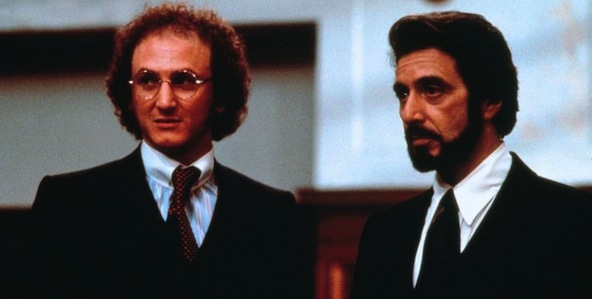
Sean Penn and Al Pacino struggle with the impact of a life of crime in Carlito’s Way

Director: Brian de Palma

Cast: Al Pacino (Carlito Brigante), Sean Penn (David Kleinfeld), Penelope Ann Miller (Gail), John Leguizamo (Benny Blanco), Luiz Guzmán (Pachanga), Jorge Porcel (Saso), James Rebhorn (Bill Norwalk), Joseph Siravo (Vincent Taglialucci), Frank Minucci (“Tony T” Taglialucci), Adrian Pasdar (Frank Taglialucci), Viggo Mortensen (Lalin)

Every so often from the 1990s onwards, Al Pacino actually bothered to act rather than rage in an orgy of self-parody. It’s the films where he does really embrace the challenge, like Carlito’s Way, that reminds you what a damn fine actor he is. Carlito’s Way may also be a reminder of what an overtly flashy director Brian de Palma is, but it’s a fine American gangster thriller.

In 1975, Carlito Brigante (Al Pacino) is released from prison after five years on a legal technicality, exposed by his friend and lawyer Dave Kleinfeld (Sean Penn). Carlito makes a speech at his hearing, claiming he is a reformed man who wants leave his criminal past behind him – and to the shock of Kleinfeld and his colleagues in the underworld, he’s telling the truth. Carlito attempts to go straight, and to rebuild a relationship with Gail (Penelope Ann Miller), the young woman he left behind. Unfortunately, Kleinfeld is not only becoming increasingly unpredictable due to his cocaine addiction, but he is starting to blur the lines between criminal lawyer and plain criminal. His actions continually threaten to drag Carlito back into the crime industry.

Carlito’s Way is a fine semi-morality tale, a modern tragedy of a man who, every time he thinks he’s out, “they pull me back in”. And of course we know that he’s on a hiding to nothing, as the film opens with Pacino gunned down by an unknown assailant and recounting most of the film’s plot (presumably) from beyond the grave. His attempts are doomed largely because, in order to go straight quick and easy, he has to raise money the only way he knows how – working in the very same flashy nightclubs and among the career criminals that he should absolutely be avoiding.

Carlito narrates the film with a weary reluctance, carefully recounting the mistakes he made and why. It’s a device that largely manages to avoid telling us the obvious, and actually gets us closer to, and like, Carlito. It also helps that Pacino’s voice itself has a gruff poetry to it, and he adds a Shakespearean grandeur to this familiar old-school tale of the crook who wants out.

Pacino’s intensity works fantastically for the part. He largely keeps the Pacino fireworks for the moments where they carry the most impact. He and de Palma carefully sketch out a portrait of Carlito as a world-weary man, who (try as he might) can’t leave behind the code and rules that have governed his life as a criminal. He can’t escape the confines of thinking like a criminal. Most terribly, his old-school sense of honour (few actors convey dishevelled personal morality better than Pacino) is what will doom him – he can’t break the code of the streets. It’s a terrific, empathetic performance from Pacino.

Pacino also develops a sweet, loving relationship between him and Penelope Ann Miller’s Gail. In the way of these films, Gail is a stripper – she alternates between sweetly loving and overtly sexually flirtatious as the plot demands – but Miller makes her feel like a real person. She and Pacino have great chemistry (which, rumour has it, also carried over into real life) and de Palma shoots their scenes with an old-school romanticism and a steady camera, which contrasts with the disjointed sweep and Dutch angles he uses elsewhere.

Sometimes these flashy angles get on my nerves. de Palma often feels like he’s trying too hard, rather than stretching his muscles. Saying that, he’s a master of the set-piece. The film has two action set-pieces and both simmer with tension and inventiveness. One involves a bungled drugs deal in a dingy bar. The other a thrilling chase sequence in Grand Central Station, a deliciously shot mixture of great editing and daring extended single shots. Sequences like this bring memories, inevitably, of Scarface and it’s tempting to see Carlito’s Way as a spiritual sequel – as if Tony Montana had been arrested and changed his ways.

Perhaps a testament to how good Carlito’s Way is (or rather how much I enjoy it) is that I even think Sean Penn is terrific in it. Penn is one of those actors I find tryingly self-important (both professionally and personally). But his weaselly lawyer, a hair-trigger addict, nowhere near as smart and adept as he thinks he is, is marvellous. Penn’s performance is a whipper-cracker mix of slimy self-confidence and arrogant blindness, with moments of curiously underplayed vulnerability that makes it make sense why Carlito remains so loyal to him. It’s one of Penn’s best, most controlled performances, a virtuoso performance of whining weakness.

Carlito’s Way is part pulp gangster thriller, part character study humanely outlining the impossible difficulty of changing our stars. Carlito may be ready to jack in the criminal world – but he continues to live the life of the criminal while persuading himself he isn’t. The whole film has a tragic inevitability about it – and would do even without the framing device. Carlito wants out – but he wants to rush to get the investment he needs, and walking the shadow line is the only thing he knows how to do. It’s a great modern tragedy.

Mission: Impossible (1996)


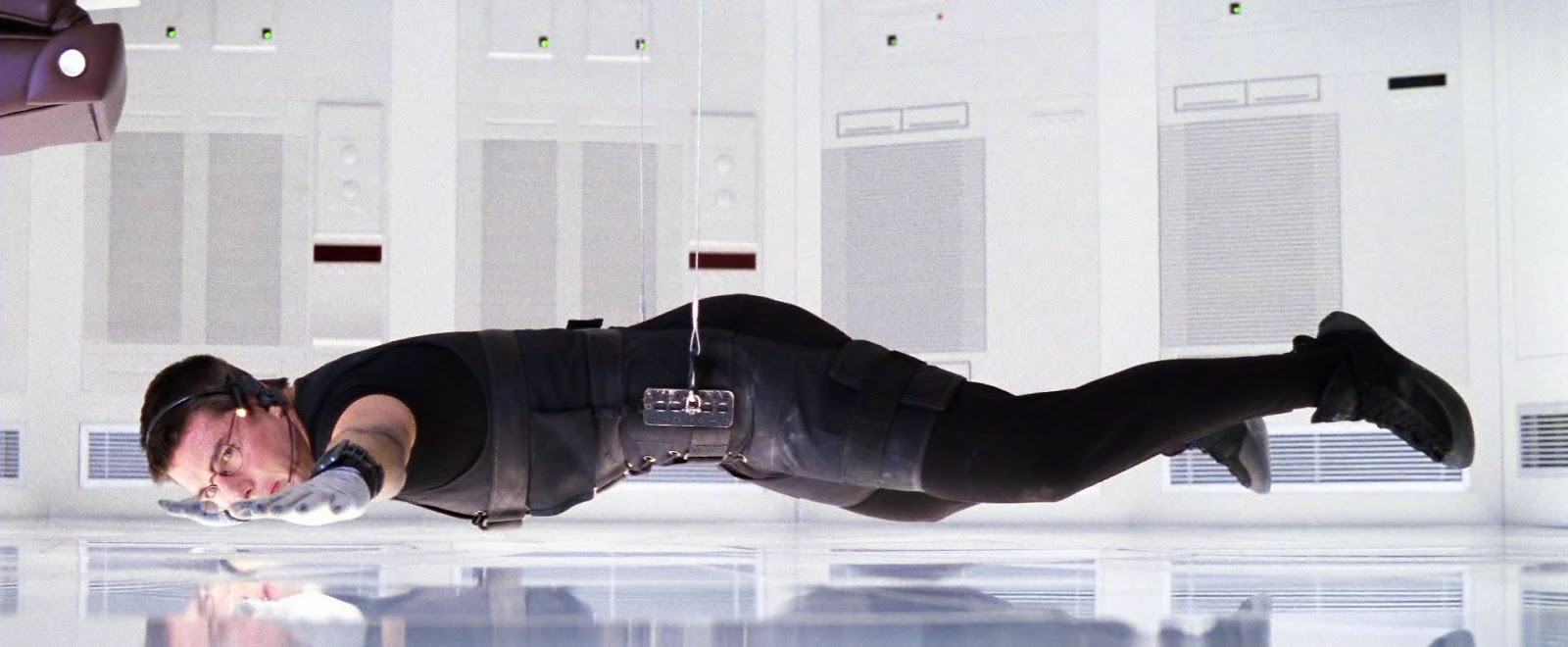
Tom Cruise doesn’t hang about in the most iconic sequence from the first Mission: Impossible

Director: Brian de Palma

Cast: Tom Cruise (Ethan Hunt), Jon Voight (Jim Phelps), Emmanuelle Béart (Claire Phelps), Henry Czerny (Eugene Kittridge), Jean Reno (Franz Kreiger), Ving Rhames (Luther Stickell), Kristin Scott Thomas (Sarah Davies), Vanessa Redgrave (Max), Emilio Estevez (Jack Harmon), Ingeborga Dapkūnaitė (Hannah Williams)

Everyone knows how it goes right? Bum bum bum-ba-bum-bum bum-ba-bum bum… Yup it’s the Mission: Impossible theme tune. Originally a hit TV series, it’s arguably more familiar now as this Tom Cruise-starring film series, a showpiece for his reckless physicality and insane commitment to ever more elaborate stunts.

Ethan Hunt (Tom Cruise) is framed as a traitor after a disastrous mission in Prague. While trying to reclaim a list of agents’ cover names, Cruise and his team are betrayed by a mole within IMF. The rest of his team, including his mentor Jim Phelps (Jon Voight), are killed though Phelps’ wife Claire (Emmanuelle Béart) survives. On the run, he has to steal the real secret list himself to help discover the identity of the traitor.

Who would have thought over 20 years later Tom Cruise would still be heading out on Impossible Missions? The success of the franchise is rooted in this engaging spy thriller. How many times have I seen this film? Countless times. It’s inventive and playful. It’s got a decently intriguing plot that keeps you on your toes.  Above all it’s fun.

At the time of its release people talked about its impenetrable plot, but it’s basically a standard “double cross” film. Someone we think is a hero is basically a wrong ‘un, so our hero has to follow every means in his power to find out who it is – including pretending to be a wrong ‘un himself. Understand that, and the plot is pretty basic. The main reason people find it confusing is the film assumes you’re smart enough to follow what’s going on, without characters sitting down and spelling everything out. Isn’t clumsy exposition the sort of thing we criticise other films for? Isn’t it nice not to have a film that just assumes you can follow the whole thing?

Anyway, the plot and characters are largely there to carry us from one spectacle to another. The film starts with a bang. Can you think of many films that kill off most of the cast (and the recognisable actors) in the opening 15 minutes? It’s such a daring opening it leaves a whiff of peril over everything else – even after we discover some people weren’t actually killed, and despite no other characters dying apart from the baddies.

Killing off the team does mean the film is a bit more “Tom Cruise with some back-up” rather than a team effort – but that doesn’t really matter does it? Wee Tom of course does all his own stunts and looks cracking. Acting wise, he’s “cruising” through his standard turn as a cocky protegee who goes through a steep learning curve. But it doesn’t really matter, because he looks great and everything he does is pretty damn cool. He even manages to mine some real emotional pain when he realise some of the people closest to him have betrayed him.

The film’s centre piece, that famous spiderlike descent from the roof to break into a sealed computer room in Langley, is probably most responsible for making this film a hit. How many times has that scene been spoofed? (So much so people no longer remember its almost completely lifted from 1960s crime caper Topkapi) It carries more impact than the big top-of-the-train scene that ends the film, because we immediately understand the difficulty of what Hunt is trying to do. How many times have we had to balance, played a game where you couldn’t step on something, had to be as quiet as possible, or keep as calm as you can? I’ve never had to balance on top of a speeding train, but I’ve had to do all that stuff. Everyone watching it can relate to the tension of doing this stuff. It’s a little masterpiece scene that also owes a fair deal to Riffi’s silent robbery scene.

The scene also shows what a triumph of style this is. De Palma directs with a breezy lightness and love for the business of spycraft (I suspect he was taking the money big time, as he injects very little of his personality into it, but it works and he has an eye for the memorable shot), Tom Cruise is pretty damn cool. The film understands the simplicity of iconic shots – Cruise jumping away from an exploding aquarium in a restaurant is a simple stunt, but it looks great. The film has a great range of small-scale spycraft as well – from Cruise cracking a bulb and sprinkling the glass outside a door as an early warning detector, to him carefully timing how long to stay on a phone call to allow a trace to go so far.

Of course, some things in the plot make very little sense. The traitor seems rather randomly motivated (he’s basically pissed off at the end of the Cold War, despite earning way more than the average joe and being married to an impossibly attractive younger wife) and his effectiveness and smartness fluctuates according to the demands of the plot (Bond villain-like, he inexplicably leaves Hunt alive at one point for no reason). The idea of a government organisation where missions can be chosen to be accepted or not is in itself rather silly. The use of the internet and e-mail in the film looks hilariously dated today (Hunt basically sends a series of random e-mails to made up addresses – Max@Job314 indeed…).

To be honest, its breakneck pace is probably why some people struggle to keep up with what’s going on, but generally I wouldn’t let it bother you. It helps as well that there is a terrific cast of interesting actors – one of the great strengths of this series has always been its unconventional casting decisions. Would anyone else have thought of Béart and Scott Thomas as secret agents? Each actor has the skill and confidence to invest often paper-thin characters with depth – Rhames plays Luther so well, he stuck around for the rest of the series, despite us learning very little about him here. Voight has a perfect world-weary fixedness as Phelps, Reno is great value as a sociopathic hired gun and Redgrave has a lot of a fun as a cut-glass arms dealer.

Mission: Impossible is, to be frank, tons of fun. It’s basically a simple film disguising itself as a complex one, but it’s rewarding enough that you enjoy working out the plot alongside Hunt. It treats the viewer with a certain rewarding confidence and it’s crammed with distinctive and iconic shots. Is it any wonder Cruise saddled up five more times (and counting) and chose to accept the mission again?