Category: Fritz Lang

Die Nibelungen (1924)

Die Nibelungen (1924)

Wagnerian epic is crammed with gorgeous, dramatic imagery and relentless pace

Director: Fritz Lang

Cast: Paul Richter (King Siegfried of Xanten), Margarete Schön (Kriemhild of Burgund), Hans Adalbert Schlettow (Hagen of Tronje), Theodor Loos (King Gunther of Burgund), Hanna Ralph (Queen Brunhild of Isenland), Rudolf Klein-Rogge (King Attila), Bernhard Goetzke (Volker of Alzey), Rudolf Rittner (Margrave Rüdiger of Bechlarn), Georg John (Mime the Goldsmith/Alberich the Dwarf/Blaodel)

Fritz Lang wanted to create a film that would help a shell-shocked Weimar Germany start to feel proud of its heritage and culture. He would do this with a film of the legend of Siegfried. It’s not really Lang’s fault that this Aryan feel-good stuff, coupled with Lang’s flawless visual compositions dripping with power and authority, would turn into the wet dreams of the Nazi party Lang fled Germany to escape. Die Nibelungen has unfortunate associations, but it stands as a towering pinnacle of Lang’s visual artistry. An adaptation of the legend, not the Wagner operas, Lang created something both mystic but also subtly questioning the idealistic figures it celebrates.

He would do all this in two (epic of course) films, totalling almost five hours. In the first Siegfried, the hero (Paul Richter) overcomes dragons and murderous dwarves to gain powers of almost (that almost is key) total invulnerability, strength and invisibility. Powers he puts to the test to win the weak King Gunther of Burgundy (Theodor Loos) the hand of Brunhild (Hanna Ralph) by invisibly aiding Gunther best this Valkyrie at a series of challenges. He even takes on Gunther’s form to help lead Brunhild to the bridal bed. Brunhild however discovers the truth from the loose lips of Siegfried’s wife (and Gunther’s sister) Kriemhild (Margarete Schön). Brunhild’s tricks Gunther and his loyal heavy Hagen (Hans Adalbert Schlettow) to murder Siegfried via a spear in his one weak spot. In Kriemheld’s Rache, Kriemheld plots the destruction of everyone who conspired in the death of her husband, via a marriage with the warlord Attlia the Hun (Rudolf Klein-Rogge).

The first thing that strikes you about Die Nibelungen – aside from its surprisingly electric pace – is the powerful, undeniable beauty of nearly every single frame. Lang composed each image as if it was a painting, from Siegfried introduced in steaming smoke at the forge, to the formalist imperialism of the castle of Burgandy and the rigid order and symmetry of its soldiers. Locations, from grand castles to mystic forests, underground caverns full of scheming, wicked creatures are superbly bought to life. There is a martial power Lang’s composition of so many of these images, their perfect angles and symmetrical blocking: parts of Die Nibelungen are some of the greatest pageantry displays in movies.

There is a wonderful sense of overblown, geometric, artificiality in all this – Lang deliberately creates a world larger than life and full of the unworldly and impossible. Buildings tower over crowds, courts that hold thousands to view events of grand importance, sieges of burning halls that fill the frame, staircases up impossibly high buildings. The sort of world of medieval excess where Gunther and Kriemheld disembark from a boat by walking across a bridge of shields created by half-submerged knights. Power and magnificence come from every frame.

It’s matched with an impressive creation of the bizarre and magical. Of course Siegfried kills a giant, animatronic dragon (strangely it’s obvious – even then surely – fakeness works in a film where everything is a heightened, from the emotions to the buildings to the costumes). Siegfried trains in something not far off from Vulcan’s forge and the forest feels like a sort of fairy-tale wonderland. Lang pioneered cross-fades and double exposures to make extraordinary effects, as Siegfried disappears under a veil of invisibility and jumps impossible distances. There is an extraordinary shot where Brunhild, still in the midst of her Valkyrie-like super-powers, seems to jump straight into the camera lens at full force. A beautiful edit sees a tree seem to reform itself into a skill in front of the eyes of the grieving Krimhild.

But Die Nibelungen places its world of power and magical forces in an increasingly costly human world of realpolitik and conspiracy, where its mystical but naïve and simple hero is out of step. Even before then, Siegfried’s status as a hero is subtly questioned. The dragon he kills seems a peaceful, inoffensive creature for all is scale, sitting placidly when Siegfried attacks and stabs it in the eye. Lang introduces a lovely touch where it’s dying tail flick will send the leaf that shields a crucial spot of Siegfried’s back from the torrent of invulnerability-granting dragon’s blood he bathes in. Siegfried is easily manipulated by the dwarf Albereich (a Gollum-like, uncomfortably antisemitic in appearance) before a large dose of luck allows him to defeat his opponent and gain the treasure of Nibelungen.

At the court of Burgundy, for all his courage and blunt honesty, Siegfried is at sea among the subtle power dynamics. The kingdom is ruled by chronically indecisive weakling Gunther (a snivelling Theodor Loos), easily manipulated by Wagnerian-costumed Hagen (an imposingly arrogant and faintly psychotic Hans Adalbert Schlettow). Siegfried’s main acts are to trick and then break the resistance of Brunhild (a dynamic Hanna Ralph) while impersonating the weakling – hardly acts to brag about, which doesn’t stop Siegfried doing exactly that to his wife who then blurts it out to Brunhild in a fit of pique. This isn’t a hero covering himself with glory, just as even the formally idealistic Brunhild (much to her later self-disgust) is reduced to scheming and plotting revenge, a far cry from the noble actionee she prided herself on being.

It’s not a surprise to find Part 2 heads into a Götterdämmerung as Kriemhild’s obsessive, destructive desire for revenge against Hagen (her husband’s murderer) meets with Gunther’s own stubborn-short-sighted protection of his controlling vassal. Nearly half of Part 2 is dedicated to the prolonged siege of the King and his followers by the massed armies of Kriemheld’s new husband Attila the Hun, her manipulations of him helped a great deal by Hagen’s arrogant, impulsive violence against Attila’s people. This extended battle sequence is astounding in its scale, violence and excitement – you can see the influence it had on The Two Tower’s Helm’s Deep – and is shot with the same visual mastery as the more stately first half, even as it seeks into bloody desperation.
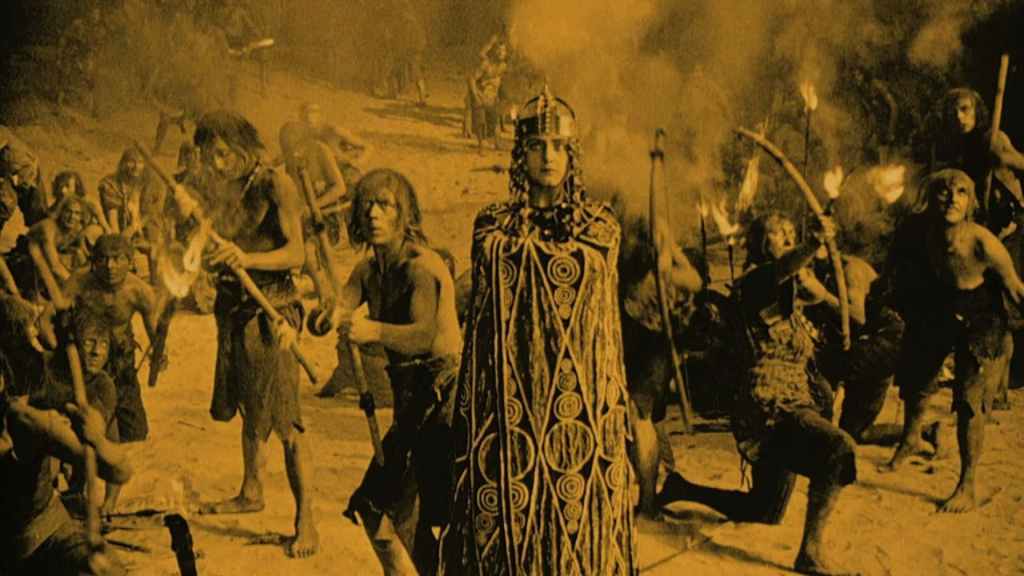
It must be stated that Die Nibelungen does feature more than its share of clumsily presented racism. As mentioned, the hook-nosed, gold-obsessed, murderous dwarf Albereich is a painful antisemitic stereotype. Rudulf Klein-Rogge is caked under layers of make-up as the ugly, Slavic Attila while his Hun army resemble crouching Orc like figures, frequently ripe for the sword edge of the relentless German soldiers. It’s the uncomfortable flip side of the Aryanism idealism and romantic framing given to Siegfried, that these un-German figures are painted so monstrously.

But Die Nibelungen’s subtle criticism of the flaws in its German leads – it would go some to call them heroes – balances this out. From the flawed, empty-headed, foolishness of Siegfried to the increasingly sadistic, unrelenting cruelty of Kriemheld (Margarete Schön’s performance is excellent, going from sweetly retiring to unblinking fanaticism over the course of the film) the Germanic characters are compromised, weak and cruel: Hagen and Gunther are no one’s ideas of admirable figures. Compared to them, for all his clumsy racist appearance, Atilla feels like a reasonable figure, loving his family, caring for his people and refreshingly free of vindictiveness and cruelty.

It makes for an intriguing complex undercurrent in a film which, of course, the Nazis interpretated entirely on surface-appearance as a celebration of Aryan super-might. Or at least they did for Part 1 – even they couldn’t kid themselves that Part 2 didn’t quite fit that bill. Today Die Nibelungen provokes the same interesting thoughts. But above all it’s a visual marvel from a gifted film director, a truly painterly masterpiece that, for all its great length, never flags and offers a new marvel, camera trick or miraculous composition with every frame. This is silent cinema at its best.

The Testament of Dr Mabuse (1933)

The Testament of Dr Mabuse (1933)

Lang’s masterful mix of gangster thriller and supernatural psychological drama is superb

Director: Fritz Lang

Cast: Rudolf Klein-Rogge (Dr Mabuse), Otto Wernicke (Inspector Lohmann), Oskar Beregi Snr (Professor Baum), Gustav Diessl (Thomas Kent), Wera Liessem (Lilli), Karl Meixner (Hofmeister), AE Licho (Dr Hauser), Theo Lingen (Karetzky), Klaus Pohl (Muller), Theodor Loos (Dr Kraum)

Did Fritz Lang invent the concept of the cinematic universe? Or after completing M, did he just wonder what it would be like if his detective Lohmann (Otto Wernicke) took on the dastardly criminal mastermind Dr Mabuse (Rudolf Klein-Rogge) from his earlier epic crime drama. Either way, the hero and the villain from those two very different films face-off in The Testament of Dr Mabuse, a pacey crime melodrama spliced with a spooky ghost story, that rattles its way through a scintillating story tinged with the whiff of the dread of Nazism.

It’s eleven years after Mabuse’s reign of terror ended with him catatonic and under arrest. In a psychiatric hospital under Professor Baum (Oskar Beregi Snr), who sees him as a fascinating case study of deluded genius, Mabuse has not spoken in years instead filling his days with endlessly scribbling a series of blueprints and schemes for the criminal underworld, focused on destabilising the country and corrupting the currency. But, despite being under lock and key, a secret society of criminals is carrying out Mabuse’s scribbles, seemingly under the guidance of the man himself. Can death, when it comes, really take Mabuse? Or are Lohmann’s suspicions that the dread hand of the Great Unknown still controls events, even from beyond the grave, correct?

Lang’s gangster film throws together some of the best elements of all his German films. This is a pulpy gangster thriller, full of action, shoot-outs and explosions mixed with the unsettling double exposure appearance of ghosts and shady, unknown powers manipulating events. It’s Scarface meets A Christmas Carol, with Mabuse as a dreadful Marley’s Ghost causing devastation and chaos even after death. The Testament of Dr Mabuse sees realism meet thriller meet supernatural powers, but brilliantly combines all three up into a propulsive thriller.

And it’s a film, more than any of Lang’s others, about the malign influence of Fascism. For what is Mabuse’s dogmatic lust for chaos and destruction, but a terrible prophecy of the horrors Hitler would unleash. Mabuse, like the Fuhrer, is interested only in destruction wanting to pull the world down to rule over the ashes, to reforge the remains into his ideal vision of reality. His paranoid ramblings – and the spectral, transparent (brilliant use of double exposure at the technical possibilities of cinema, as always from Lang) presence he becomes parroting the same mantra of the nobility of destruction – are about leading the country into a morass of destruction. No wonder The Testament of Dr Mabuse was almost immediately spiked by Goebbels. Hitler’s magnetic powers of persuasion and control were surely the real-world apotheosis of Mabuse’s skills.

Mabuse’s powers are so great that even death can’t slow him down. Today it doesn’t take long to figure out exactly who the real mastermind – or after-death puppet of Mabuse’s – might be. As wardens in the hospital say, even in silence the fixed, controlling glare of Mabuse is enough to bend minds to his will. The rantings of his testament – Mabuse’s Mein Kampf – merely add to the force of his stare. Even the echo of Mabuse’s name will turn former police detective Hofmeister into a gibbering wreck. His power is absolute.

No wonder he appears after death, disfigured post-autopsy, his eyes bulging, to continue to direct his puppets, his ghostly form directing their actions. It’s a wonderful visual expression of the hypnotic control Mabuse had over his victims, that they continue to see his controlling, ranting form – across a desk or guiding them down corridors – even after they’ve gone. Mabuse’s ghostly form will literally emerge out of the body of his underling, crossing to sit opposite him and pour more instructions in his ear.

Ordering his underlings from behind a curtain that hides his true face, Mabuse’s commands are absolute and its threats always delivered. The gang, each a series of cells who work together only when instructed, are nearly all brain-washed fanatics, accepting orders without question. Much like Hitler, Mabuse’s followers cover a vast range, not just common criminals, or trigger-happy loons but also the middle-class and professional, in thrall to the words of a mad man promising a new dawn (sound familiar?) Much like in Mabuse’s hey-day, any deviation from absolute loyalty is met with swift, fatal punishment. What chance does Thomas Kent (Gustav Diessl – a spitting image for the young George Sanders) have when he decides the gang life is too risky for his girlfriend?

Up against this, Lang places his hero from M and his accustomed detailed fascination with the mechanics of investigation. The Testament of Dr Mabuse mixes this analysis of things like the forensic translation of scratches on a windowpane, with this outré pulpy set-up of Wizard of Oz-like criminal masterminds. The world of Lohmann is one of order and methodical investigation, grounded in realism and detail. It’s an adjustment for Lohmann who, in M, was more the jovial face of a failing institution – here he’s the last bastion of reasonable authority.

The Testament of Dr Mabuse is full of shrewd political observations – but it’s also a supremely entertaining film. Few directors were as good at crime drama set-ups than Lang. The film’s opening sequence, showing Hofmeister tracking the gang through a warehouse, is a masterclass of the tension of imminent discovery, then of explosive (literally) violence during a chase. A gorgeously inventive bomb sequence – where a flooded room is the best chance of safety – is another masterpiece of slow burn tension, while the insidious threat of Mabuse’s voice creates a miasma of terror.

That sequence plays beautifully into Lang’s increasing comfort with, and mastery of, sound. The film opens with a pounding heart-beat on the soundtrack as freelance investigator Hofmeister hides in the factory where Mabuse’s men assemble their latest schemes, capturing the fear as he constantly ducks and hides to (unsuccessfully) avoid detection. The sound of machinery grows to overwhelm the film and, as Hofmeister flees, his barracked by the sounds of engines and rolling oil-filled barrels that burst into flames. Sound skilfully stresses mood and bridges scenes, controlling mood and atmosphere and adding to the air of distrust and disturbance.

The technique shines out of several stunning set-pieces. A traffic light assassination – another masterpiece of sound – is a brilliant piece of gangster-ish business, the gangsters using a crescendo of car horns to cover a fatal shot. Watching its slow build-up and the carefully paced release of information to the audience (the presence of the killers, the gun, the tension of the wait) you can see why Lang often felt Hitchcock got a lot of credit for things he had invented.

Fast-paced and thrilling, it’s a perfect extension of both Lang’s previous films, a brilliantly unsettling and disturbing drama wrapped up in a gangster package. It’s supernatural touches are just the right side of psychological drama, a portrait of obsession and a fractured mind. A perfect expression of Lang’s mastery of mixing the high and low brow into an engaging, thought-provoking and thrilling package.

Dr Mabuse, der Spieler (1923)

Dr Mabuse, der Spieler (1923)

Lang’s crime drama is a sprawling silent mini-series, still gripping today

Director: Fritz Lang

Cast: Rudolf Klein-Rogge (Dr Mabuse), Bernhard Goetzke (State Prosecutor von Wenk), Aud Aged Nissen (Cara Carozza), Gertrude Welker (Countess Dusy Told), Alfred Abel (Count Told), Paul Richter (Edgar Hull), Robert Forster-Larringa (Spoebri), Hans Adalbert von Schlettow (Georg), Georg John (Pesch), Karl Huszar (Hawasch), Grete Berger (Fine)

In a world before television, there were only two places for long-form stories – and Fritz Lang wasn’t a novelist. His four-and-a-hour epic Dr Mabuse der Spieler is really a sort of gargantuan mini-series, a rollicking action-adventure about a conscience-free conman wiling to go to any lengths to get the things he wants. It’s pulled together as a pacey, episodic yarn – each reel is basically an individual act (or episode) and filmed with such visionary vividness that it remains compelling today. Whether you decide to settle in for the long haul or split its parts and acts over a series of nights (and why not, the film was released in two parts, months apart) it won’t fail to entertain.

It was based on Norbert Jacques novel, a publishing sensation (so much so this was rushed into production while Jacques novel was still being serialised). At its heart: Dr Mabuse (Rudolf Klein-Rogge), practically the dictionary definition of an omnipotent, amoral villain. Mabuse is a practiced liar, master-of-disguise, ruthless murderer, conman and has such demonic will power he is capable of extraordinary levels of hypnotic control, whose gang of acolytes switch between terror and outright worship of him. He can manipulate the rich into handing over their money as easily as he can the collapse of businesses on the stock exchange. No one knows who this malign spider is. But State Prosecutor von Wenk (Bernhard Goetzke) will make it his business to know.

Lang’s film is a gorgeous mix of the sort of urban realism he mastered in M and little touches of mystical realism more reminiscent of The Cabinet of Dr Caligari, wrapped up in the sort of action that inspired everything from The Sting to Mission: Impossible. It’s opening section is a brilliant example of both. Essentially a twenty-minute prologue to introduce Mabuse’s nefarious genius, it sees our anti-hero masterfully execute a plot mixing heist, disguise, manipulation and brazen self-confidence to make a fortune on the stock exchange. The theft of a secret commercial contract from a train involves the sort of disguises and split-second timing (to throw the contract from a train passing over a bridge into a car passing under it) which would make Ethan Hunt’s heart race.

It’s a perfect entrée to our villainous lead, Mabuse. First introduced rifling through photos of the many expert disguises he will effortlessly assume during the film – he becomes everything from banker to magician, psychologist to hypnotist, tramp to member of high society – Mabuse has no moral code what-so-ever other than the accumulation of things. That ranges from wealth, to an obsessive desire for ownership over attractive women (and his desire for Gertrude Welker’s Countess Told eventually contributes to his undoing) to simply the having power over the wills of weaker men. Rudolf Klein-Rogge is magnetic as this monster of the dark, ruthlessly calm but equally wild-eyed, unflappable but willing to go to any lengths.

Spieler is often translated as “gambler” – but it’s German meaning is richer than that and many have commented a better translation might well be “player”. Mabuse is certainly that. He is a master actor, who can be lose himself in different roles, undetectable to others. He weaves elaborate games around his victims, where only he knows the rules (and, often, only he knows a game is even being played). Other people are pawns to moved and gambled with. He’s a monster, but one born from disillusion of the end of the First World War, part of the hedonistic self-regard of dissolute Weimar. We can see touches of this environment throughout Lang’s film, in its hedonistic gambling dens and the casual thoughtlessness of the rich. Mabuse flourishes because he is the rash an age has come out in. (Retrospectively, you can detect the shadow of Hitler in this ruthlessly power-mad monster who hides in plain sight but demands absolute control).

Mabuse is “the Great Unknown” and the natural target of methodical if uncharismatic von Wenk, played with a stolidness by Bernhard Goetzke, balancing Klein-Rogge’s larger-than-life portrayal perfectly. The duel between these two moves from gambling rooms to elaborate houses, from the streets to the jails of the city, taking in chases, bombs, shootings, kidnappings and all sorts of attempted moves and counter-moves, culminating in a shoot-out that surely inspired countless Hollywood gangster movies.

Through it all Lang directs with astonishing freshness and invention. Dr Mabuse der Speiler throws a slice of cinematic visual inventiveness into almost every scene. Lang makes extensive use of superimpositions, cross-fading, location shooting, fast-paced editing and brilliantly evocative lighting to create a world both highly realistic and also dancing to the tune of its demonic lead. Some of this has become such a part of cinematic language that it’s unlikely to draw comment from modern viewers today – we are unlikely to be wowed by night-time footage of Wenk pursing Mabuse in a car, but to viewers at the time such scenes of photorealism taken in darkness were unheard of.

There is plenty that will continue to thrill audiences. Lang’s visual portrayal of Mabuse’s hypnotic powers is superb. In his first confrontation with von Wenk (both men are disguised at the time – this really is a game of move and counter-move), Mabuse attempts to implant a hypnotic suggestion in von Wenk. Lang demonstrates with an astonishing use of lighting which slowly concentrates the light into a small pool on Mabuse’s face before his face seems to grow to fill the frame (technical effects like this were a small miracle in 1923). On a second attempt, the hypnotically suggestive words are imposed on the screen as a set of animated letters which loom over von Wenk and later seem to be almost leading him (in his car) to the clifftop Mabuse has suggested he drive off. It’s a superb way of showing the power of Mabuse, building on the intimidating cross-fade from our stock-exchange opening that briefly shows Mabuse’s face super-imposed over the clutter-filed room.

Lang mixes this imaginative dynamism with some superbly done realist scenes that help make Dr Mabuse der Spieler a gripping crime thriller. That stock-exchange opening is followed by car chases and murders – one character is dispatched in the streets after dark with a brutal suddenness. Lang creates a series of locations, all perfectly detailed but instantly recognisable, from the distinctive look of each gambling den (from art deco lined walls to a strange rotating gambling pit filled with cards and erotic dangers) to the objet d’Art packed rooms of Mabuse’s mark Count Told (a gloriously ineffective Alfred Abel – unrecognisable from the world controller he would become in Metropolis) to the white-lined jails and careful detailed offices of von Wenk’s police headquarters.

Dr Mabuse der Spieler uses these real locations to constantly remind us that, underneath the Moriarty genius of its lead, this is also a tragedy of real people caught in the web of an uncaring spider. Mabuse cares nothing for his underlings, sacrificing them as readily as pawns. None more so than Cara Carozza, beautifully played by Aud Aged Nissen, a seducer in love with Mabuse who dedicates her life to him, at the cost of her own. She makes a dark mirror for Countess Told, drawn into Mabuse’s web but drawing strength from her admiration of Cara who is, in her own way, deeply principled. Mabuse’s victims are prodded, pushed and outright shoved into punishing and often self-destructive behaviours, their lives flourishing or ending according to his whims.

As a sort of epic mini-series, Dr Mabuse der Speiler is sublime entertainment. Each act follows its own clear arc and the culmination in a brutal shoot-out throws in a nightmare of surrealist imagery at its close as a crucial character tips, under pressure, into madness and delusion. (This series of horrors, the ghosts of fallen characters arising to torment him, is a masterclass in ghostly horror). It gripped audiences then and its surprisingly brisk pace and pulpy sensibility still do now.

M (1931)

M (1931)

Lang’s masterpiece, a thrilling and complex crime drama that explores the horrors of crime and mob justice

Director: Fritz Lang

Cast: Peter Lorre (Hans Breckett), Gustaf Gründgens (Safecracker), Otto Wernicke (Inspector Lohmann), Ellen Widmann (Mother Beckmann), Inge Landgut (Elsie Beckmann), Theodor Loos (Inspector Groeber), Friedrich Gnaß (Franz, the burglar), Fritz Odemar (Cheater), Paul Kemp (Pickpocket), Theo Lingen (Conman), Rudolf Blümner (Beckert’s defender)

A murderer prowls Berlin’s streets. For weeks children have been murdered and the citizens are at fever pitch. The police are desperately trying every weapon in their investigative arsenal. The heightened police presence on the streets hampers the lives of regular criminals: they too decide to take matters into their own hands, pooling their resources to catch the killer. And the killer himself? Not a mastermind, but a peculiar, timid man (Peter Lorre), a slave to uncontrollable impulses.

All this forms Fritz Lang’s masterpiece, his first sound film and one of the greatest German films of all time. A rich, psychologically detailed procedural thriller it is a stunning indictment of mob violence, a detailed look at the flawed assumptions of the official forces and an unflinching look at the horrific personal impact of crime. Lang’s film is extraordinary, a brilliant mix of impressionistic insight and documentary realism covered in an all-revealing social tapestry. It’s gripping and extraordinary.

Lang’s film was heavily inspired by real-life cases, most notably Peter Kürten (“the Vampire of Dusseldorf”) and the structure of the Weimar police department. Just like the real Berlin, his fictional one has a criminal underworld governed by a sort of German mafia, the Ringvereine, who a bizarre social set of rules among criminals. M tied into debates around the death penalty: was it right to take a life, even for unspeakable crimes? Is a life in a psychiatric prison fair for the murderer of several children? M is fascinating as it provides enough ambiguity to support either side (Goebbels claimed, when watching it, that it was a sure sign that Lang would become “one of us”).

This stems from Lang’s superbly detailed, anthropological filming style, which throws the viewer into the centre of a world that feels extremely real. Streets are lined with beggars and an array of adverts, posters and political messages. The camera prowls down streets and over tenement blocks, catching shadows and gets lost in cigarette smoke. It captures every detail of the Berlin police department: forensic labs that breakdown fingerprints, annotated maps, criminal psychologists pontificating on the intellectual make-up of the killer based on his handwritten notes to newspapers. Detective Lohmann (an increasingly harried Otto Wernicke) puffs cigars, pulls together facts and fails to make any real progress, looking increasingly buffeted by events rather than controlling them.

It’s one of the film’s subtle criticisms of the political situation at its time. The official forces have every resource going, but seem powerless. Instead, Lang contrasts them ever more closely with the criminal underworld or use brute, uncontrolled, unordered force to tackle the problem. Is it my imagination, or is there the stench of Nazism in this group? Their nameless leader (Gustaf Gründgens) strides, with a leather-clad firmness, emotionlessly forward, fixated on the end result – despite, with at least three murders on his score card, arguably not being that different from the man he’s chasing killer. He instructs the criminals to effectively throw a dictatorial cordon around the city, their solution being stamping out freedom and taking unilateral action.

Lang’s film is sharply critical of the kneejerk horrors of this mob justice. Crowds are whipped up by press coverage (which they excitedly read, the papers hitting the streets with a special edition after every murder) into a mob desperate to lash out, crowding around posters offering rewards for catching the killer. A man giving the time to a child in the street is nearly lynched, a raised camera angle reducing him to a tiny figure compared to his aggressor towering over him. A group of people playing cards in a bar descend into blows after one accuses the other of behaving suspiciously. The criminal put together a show trial (with a token, powerless defence counsel) where the killer is allowed a few brief words before his pre-ordained lynching (no legality with Nazism).

Again, it’s hard not to consider the growth of street violence in Germany in 1931, an atmosphere where justice was slowly dying as the Nazi party argued people had the right to take violent action against those who they see as enemies of the state. The criminal organisation here are worryingly efficient and organised. Lang brilliantly intercuts between two meetings, both in smoke-filled rooms, as the police and the criminals plan their operations. Sentences started in one location are finished in another. Complementary camera angles echo each other. In the police meeting there are also calls for unilateral action. Lang criticises the authorities who are active but ineffective (and some sympathetic to the criminal’s viewpoint), as much as the brutal mob justice of the criminals.

And the killer himself? Brilliantly played by Peter Lorre (who resembles a perpetually frightened paedophilic toad), Hans Breckett is weak, feeble, as scared of himself as he is of others, unable to understand or control his urges. He is driven by a whistling tune of In the Hall of the Mountain King for Grieg (a whistling that he sometimes produces, at others seems to hear around him) and consumes the things he desires – be they apples, drinks or children – with an impulsive immediacy. His letters to the papers suggest he is desperate to be seen. But when he is, chased by the crowds, he’s weak, terrified and utterly unimposing, trembling amongst the flotsam of a factory almost indistinguishable from the debris around him. At his trial he attempts to vindicate himself with a whining desperation. But, as Lang quietly suggests, do we have the right to kill him?

After all, Breckett is almost certainly a war veteran. He shares that with several other characters – as we are reminded by beggars with wooden limbs. Maybe his split personality – perhaps that’s why he stares with curiosity at his own face in the mirror, as if he doesn’t recognise himself – is a relic of a conflict where men were encouraged to kill, then returned back into society where expected to do the opposite. Perhaps the same feelings also lie behind the ease so many people have with mob justice – and also those in the criminal jury who show some sympathy for Breckett’s forbidden urges.

As well as balancing these complex ideas, Lang’s film is also a masterpiece of visual and aural technique. A child’s death is suggested by a newly orphaned ball rolling into frame. A gorgeous hand-held camera shot wanders through the beggar’s bar, where beggars gather used cigars, rescued sandwich fillings and sign up to be the criminal’s eyes on the street. Sound transitions between scenes are handled with an extraordinary confidence. The silence of armies of policeman walking through the streets turning into burst of noise as they move through raids. The Grieg leitmotif is used to brilliant effect.

Lang’s film though never forgets the victims. we start and end with the parents. The mother of the film’s first victim, Elsie Beckmann, waits with increasing panic in her apartment, each knock of the door promising her daughter’s return but disappointing (we’ve already seen Elsie disappear, hand-in-hand, with Breckett’s whistling shadow). It’s to her the film returns to her at the end, her tear-stained face telling us no sentence will bring back the dead. Appearing over a wordless scene of Beckett’s actual trial (the result of which we never discover), its Lang’s subtle reminder that mob justice brings only false satisfaction, that killing never heals the wounds of loss and our effort would be better directed to protection rather than revenge. It’s a message that feels particularly poignant in a German film made in the final years before Nazism would lead the country into devastation.

Filled with stunning film-making confidence, mixing documentary realism and brilliantly confident visual and audio mastery, Lang’s M could be argued to be one of the greatest film noir detective dramas ever made – and also a brilliantly insightful look at human and social nature. M is a masterpiece, as gripping and relevant today as it was Lang filmed it.

Metropolis (1927)

Metropolis (1927)

Lang’s sometimes flawed science fiction epic is one of the most influential films ever made

Director: Fritz Lang

Cast: Brigitte Helm (Maria/The Machine), Alfred Abel (Joh Frederson), Gustav Frölich (Freder), Rudolf Klein-Rogge (Rotwang), Fritz Rasp (The Thin Man), Theodor Loos (Josaphat), Heinrich George (Grot), Erwin Biswanger (11811/Geogry)

It’s 1927 and for too long Hollywood had held sway over the movies. But there were plans in Germany to change that. The booming Weimar film community, arguably the artistic hub of World Cinema, felt they had a shot at claiming the sort of global success Hollywood had made its own. No expense would be spared to bring Fritz Lang’s science-fiction spectacular, Metropolis to the screen. It was met with such a muted reaction, that the original epic cut was sliced to ribbons, parts of the film lost for all time, and for decades it lived only in a mutilated form. But it was visionary and extraordinary enough to inspire virtually every single science fiction film that followed it.

Metropolis is a sprawling future city state, run by Joh Frederson (Alfred Abel). In it the rich live a gilded life in mighty skyscrapers, with private gardens, luxurious apartments and raucous parties. Beneath them – literally so – are the workers, living a Morlock-like life of drudgery in the factories and power stations that keep the lights burning. But all that could change: below ground Maria (Brigitte Helm) preaches hope for change, above ground Frederson’s son Freder (Gustav Frölich) falls in love with Maria and rejects his father’s way for the life of a prole. Frederson has a scheme of his own: to use a robot (Helm again) built by old friend (and one time rival for the affection of his late wife) the one-handed scientist Rotwang (Rudolf Klein-Rogge) to replace Maria and sow discord among a potential worker’s rebellion. But does Rotwang and his creation have a game of their own?

Lang had a brief to create a film that would be a box-office hit in America. No stone was left unturned in creating his epic. Metropolis took a staggering 17 months to film, running almost three times over its initial budget. It’s extended shooting schedule was a godsend for many of its extras, struggling to make ends meet while the Weimar Republic thrashed through the after-effects of hyperinflation. It’s a magnificent monument to Lang’s superb visual styling, marrying shadow filled expressionism with sweeping epic magnificence.

Metropolis’ strengths all lie in its stunning, inventive and breath-taking design work. That has been so inspiring, it has permeated vast swathes of our culture. Filmic visions of imposing, neon-lit, skyscraper packed modern Babels (Frederer’s headquarters is an art-deco reimagining of Brueghel’s Tower of Babel) all find their roots here: from Burton’s Batman to Scott’s Blade Runner. Any robot in the movies can chase its lineage back to Rotwang’s man-machine, as any mad scientist ancestor is  Rotwang (from Dr Strangelove to Back to the Future’s Doc Brown). It’s the film that invented steam-punk, with its piston-filled machines, staffed by boiler-suited workers (it’s inspiration for a zillion music videos is not surprising). Everywhere you look in Metropolis it might feel like you are seeing something familiar, when in fact you are witnessing its original generation.

Metropolis is a cat’s cradle of differing moods and designs, woven masterfully into a whole. Frederson controls the city from a penthouse suite, while his immediate staff and family live in swish, very 1920s apartments. This contrasts sharply with the industrial-punk of the factories, cathedrals of technological movement, full of gears, levers and men performing tasks with a robotic, convey-belt repetition under a series of clocks. There are real cathedrals, legacies of an old world, where God has been left behind by the new Gods of work and efficiency. Under the ground, the workers live in personality free tenement blocks and chiselled out caves, which echo churches. Rotwang works in a laboratory part Frankenstein’s layer, part bizarre lecture theatre, all seemingly housed in a ramshackle house that wouldn’t look out of place in a Hans Christian Anderson fairy tale.

A fairy tale is perhaps what Metropolis is, underneath all the astonishing technical sheen and directorial mastery. We follow a hero who exiles himself to live among the poor, eventually becoming their champion, with a damsel-in-distress he must rescue from a crazed wizard. The wizard even produces a magic imposter, who threatens to bring disaster. Metropolis’ plot often proceeds with the illogical progression of a fairy tale, with characters frequently making veering changes in allegiance or unveiling dastardly schemes that appear from nowhere or make little sense.

It’s similar in Metropolis biggest weakness: it’s simplistic plot, wrapped up in a casually naïve politically theory that attempts to find a balance between left and right, but essentially boils down to “why can’t we all just get along”. It’s loud proclamation that “The Mediator Between the Head and the Hands Must Be the Heart” is so vague that it allowed the film to be embraced by the left as a proto-socialist film supporting worker’s rights and the right as a film that revealed the workers as a mob and the fate of the world best left in the hands of elites who know what they are doing.

It’s part of the simplistic view the film largely takes of character and story, which frequently feels like an after-thought behind the film’s sumptuous production values and Lang’s expressive camera work. It’s also not helped by some of the acting which, particularly in the case of Gustav Frölich’s hand-claspingly camp performance, mines the depths of silent-movie ostentatiousness. Saying that Brigitte Helm is chillingly, wickedly artificial and physically disjointed as the fake Maria (a far cry from her more simpering ‘good’ self) and Abel underplays effectively as Frederson. Klein-Rogge’s insane glare and conflicting lusts also make a strong impression.

But none so strong as Lang’s mastery of visual symbolism. Freder’s terrified vision of the ‘heart machine’ that sits at the centre of the city’s power, transformed into a terrible Moloch with workers literally fed into its gaping, firey maw. Those same workers from the film’s opening with Lang’s brilliant visual conceit of shuffling, shoulder-drooping figures lurching into a gigantic elevator that lowers them into the ground. Rotwang’s birth of the fake Maria is a masterclass in light and cross-cutting, as is the simmering eroticism of the fake Maria’s dance at an orgiastic night-club, the screen filling with the slathering faces of the man she has enchanted.

It mixes with the Gothic power Lang brings the film in its closing sequence, seemingly inspired by mystery plays with their deep-rooted sins bubbling to the surface to condemn those alive today. There are echoes back to this in Freder’s dreams of Metropolis as a modern Babylon (hammered home, once, by the lost scene of a monk preaching in the cathedral) and in Maria’s Joan of Arc like status among the working classes – a mantle taken to its logical conclusion by her metallic replacement who leads a doomed insurrection. Again, all these concepts and influences are effortlessly held together into one magnificent whole by Lang’s fluidic, beautifully paced direction.

Metropolis lives today as a monument to creative science fiction film-making – it is the most ambitious and most influential science-fiction film ever, except perhaps 2001 and (in a very different way) Star Wars. It may be politically simple and its story may veer in unplanned directions and strange cul-de-sacs, but as a piece of visionary cinema it is nearly unparalleled. Even its existence today as a reconstructed, corrupted version of itself (after hours of footage were considered lost for decades) doesn’t not dim or diminish its mastery.

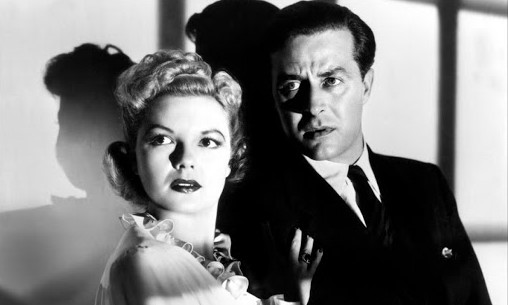
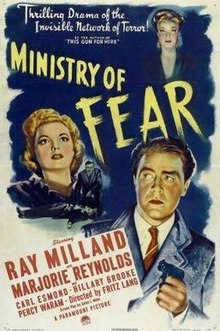
Ministry of Fear (1944)

Ray Milland and Marjorie Reynolds take on Nazi agents in Ministry of Fear

Director: Fritz Lang

Cast: Ray Milland (Stephen Neale), Marjorie Reynolds (Carla Hilfe), Carl Esmond (Willi Hilfe), Hillary Brooke (Second Mrs Bellane), Percy Waram (Inspector Prentice), Dan Duryea (Cost/Travers), Alan Napier (Dr Forrester), Erskine Sanford (George Rennit)

Neither Fritz Lang nor Graham Greene (the author of the original book) cared much for Ministry of Fear. Both of them thought that the film they ended up with was only a shadow of the original novel, with both of them largely blaming the script by Seton I Miller and the producers for turning Greene’s novel into a more simplistic B-movie. And yes the film is at heart just a B-movie, that races through a conspiracy thriller – and you’d have no idea that it ever came from Greene-land unless you were told so – but it’s put together with such professionalism that you admire its skill, even while it’s no Third Man.

At the height of the Blitz Stephen Neale (Ray Milland) is released from an asylum only to find himself immediately embroiled in a load of shady goings-on with suspicious séances, hidden microfilm and Nazi sympathisers. Can the fragile Stephen get to the heart of it?

Ministry of Fear has a slightly dream like quality to it – probably because it’s a fragmented narrative that makes quick jumps from event to event, sometimes with very few links between them. Stephen emerges from an asylum straight into a charity fete, hence to a train, the centre of London and a séance, with all the speed of a logic-skipping dream. Everything is swift and somewhat low in logic. The plot of the film becomes sheer B-movie fluff, with the typical spy hijinks you might expect, lacking any of the complexity of the book. 

Greene was particularly disappointed by the deletion of the guilt Stephen feels around the death of his wife – and the film indeed skims over this very swiftly, leaving the reasons for Stephen’s being in an asylum in the first place largely unexplored and dispatched as swiftly from the film as possible. It’s not a film that has the time to explore the complexity of personalities of characters – instead it’s all about turning the content of the novel as much as possible into a high-flung spy thriller.

It’s why Lang was so disappointed with the script – and he became more and more dismissive of the film as he got older, claiming it to be bad film that he fell asleep in during a later showing – but he still bought to it a visual magic. The film is crammed with beautiful expressionistic images, present right at the start with Stephen watching a ticking pendulum through to some of its beautiful later images, in particular a shooting through a door that allows a beam of light to shine through a bullet hole in a door. Lang crams the film with striking images that help lift it above its B-movie roots.

Which is just as well because the general drift of the plot isn’t always that special, playing like the off-cuts from several Hitchcock films. Despite the artistry with which Lang presents it, he can’t hide the basically generic stuff that Greene’s book has been turned into. And its fast pace and logic jumps can perhaps find their root in the general contempt Lang had for the material he had to work with. Nothing in this feels particularly right – the England it presents is laughably wrong on several counts – while as always much of the mystery is reduced from the small cast list and tiny selection of possible suspects. 

There are some good sequences, don’t get me wrong. A séance is beautifully made and carries a fair degree of tension. The final confrontation with the architect of the misdeeds makes for a decent scene. It’s just a shame it’s counterbalanced with clumsy “this is what’s going on” scenes, such as Stephen’s briefing from British Intelligence. 

There are some good performances among the cast. Milland gives a well-judged performance of vulnerability, confusion and growing strength. He has just the right good-looking-but-not-drop-dead-handsome look to him to make him someone you can sympathise with but not completely trust (if the film hadn’t dropped some of the more interesting questions around Stephen’s guilt or innocence for past crimes this casting would have really worked to strengthen that). But he gives a fine performance. The array of suspicious characters around him are confidently performed, with Hillary Brooke a particular stand-out as a manipulative, seductive medium.

But Lang’s film is a covering of class and technique other soil that isn’t rich enough. The complexities of Greene has been lost and the film’s general plot and content doesn’t give much more than the sort of cheap thrills you could expect from a well-made B movie. With those involved this could have been more, but it never becomes a classic.

The Big Heat (1953)

Lee Marvin, Gloria Grahame and Glenn Ford feel The Big Heat coming on

Director: Fritz Lang

Cast: Glenn Ford (Det Sgt Dave Bannion), Gloria Grahame (Debby Marsh), Lee Marvin (Vince Stone), Jeanette Nolan (Bertha Duncan), Alexander Scourby (Mike Lagana), Jocelyn Brando (Katie Bannion), Adam Williams (Larry Gordon), Kathyn Eames (Marge), Willis Bouchey (Lt Ted Wilks)

Films like Fritz Lang’s The Big Heat were generally seen at the time as easy-to-overlook pulp thrillers. Today however, they are seen as classics and few look as ahead of their time as The Big Heat, a skilfully constructed, almost nihilistic, revenge thriller that turns its view of America into that of a land big, grim and full of corruption.

Detective Sergeant Dave Bannion (Glenn Ford) is called in when a senior policeman is found to have committed suicide. All is not what it seems though: the wife Bertha (Jeanette Duncan) doesn’t seem as sad as she should, there are conflicting reports that the death might be suicide and the dead man’s possible lover is found brutally killed shortly after Bannion talks to her. Bannion is a stubborn, bull-in-a-China-shop type, so he quickly assumes smooth local gangster Mike Lagana (Alexander Scourby) is connected up in all this, not least after his wife Katie (Jocelyn Brando) receives a threatening phone call. But Bannion’s methods lead to tragedy, and he soon finds himself going rogue to find justice, with the eventual help of Debby Marsh (Gloria Grahame), gangster’s moll of brutal sadist and Langana lieutenant Vince Stone (Lee Marvin).

Lang’s film is a strikingly un-rose tinted view of America. The very first shot of the movie is a gun, and violence is endemic in this corrupt world, where justice is for sale. We barely see a character who doesn’t have some whiff of corruption. Bannion finds cops doing guard duty outside Lagana’s home while he throws a party and half the higher-ups in the department are either in the pocket of the gangsters, or determined to do as little as possible to rock the boat. The lives of the families of those causing trouble for this system don’t account for much either, with any unpalatable truths brushed firmly under the carpet.

Thown into the middle of this is Glenn Ford’s Detective Bannion. At first glance Bannion looks like exactly the hero we would want – a straight-down-the-line type who says what he thinks, and determined to let nothing stand in the way of, or water down, his investigation. Better known for comedies, Glenn Ford is very good as this bullish man, who very clearly thinks of himself as “the only good cop in town”, and whose determination to stop at nothing very soon tips over into recklessness. Because reckless is what he is: Bannion is fixated on revenge after a tragic attack on his family, and he has no compunction – or even it seems moral awareness – that this path causes danger and consequences for other people around him.

Bannion’s situation is largely self-inflicted – is it sensible going straight to the house of a leading local gangster and threatening and humiliating him? – and Bannion turns out to be largely a destructive force for those who meet him. Most affected are the four female characters he interacts with in the film. A mixture of innocent, corrupt, in denial and cruel, all four of these women find themselves thrown into often mortal danger, with Bannion barely stopping to consider the risks to them. Bannion, it becomes clear, is the ultimate ends-justify-the-means kind of guy, willing to accept collateral damage of almost any kind if it means he can take down the bad guys who have done him wrong. It makes for an intriguing anti-hero at the film’s centre, with Bannion increasingly resembling a sort of proto-type Dirty Harry, the hard-boiled cop who’ll do things his way and damn the consequences.

Mind you, it doesn’t mean he isn’t right about the corruption in this damn dirty town. Preening gangster Mike Lagana (played with a wispy arrogance by Alexander Scourby) has everyone in his pocket, and couldn’t give tuppence for any small fry causing him problems. First introduced lazily in bed setting in chain events that will cover up the reason for the suicide of a leading policeman, he has fingers in every pie. He’s also – the film economically suggests – sexually indiscriminate and a bit of a mummy’s boy to boot, sure signs of cadism in any 1950s detective story. His decadent home and personal cowardice (for all his speed in ordering deaths) make his corruption probably even more galling for straight-shooter Bannion.

In fact, I’m not sure Bannion can even accept Lagana as a “worthy foe” and he increasingly zeroes in on Lagana’s number two, the brutish Vince Stone as the man he intends to take down. Played with a star-making swagger by Lee Marvin, Stone is a force of nature, an act-first-think-next-week kind of guy, who terrorises people around him and will resort to anything from fists to pots of boiling coffee to exact obedience. Marvin scowls and prowls his way through the film like a caged bear, constantly on the verge of violence. It’s a brilliant performance.

It also makes clear why he’s pushed Debby – played with a wonderful fragility behind all her femme fatale looks by Gloria Grahame – so far under his thumb. As she says, why intercede against anything he does when she could be next to take a beating. Grahame is excellent as a woman who has suppressed her conscience about what is going on around her, and learned to use her sexuality as a tool for getting what she wants. Watching her slowly begin to come to life as a moral force provides one of the film’s finest stories – her desire to do the right thing and get revenge, a firm contrast with Bannion’s more hardline goals.

All of this is packaged neatly and without fuss by Lang into a superb indictment of America. Every official is at least shady, if not outright bent. Every scene bubbles with the possibility of violence and danger. The innocent are swiftly trampled and the heroes need to bring themselves down to the same brutal, intimidating rough and tumble as the villains to have any chance of cracking the crime. Bodies pile up, lives are ruined, but at the end you still wonder if any of it will have any lasting impact. For Lang it feels like America is a constant spiral of danger and corruption that begins and end with a gun. Either way The Big Heat is a true classic.

Hangmen Also Die! (1943)


Brian Donley on the run in Fritz Lang’s Nazi occupation thriller

Director: Fritz Lang

Cast: Hans Heinrich von Twardowski (Reinhard Heydrich), Brian Donlevy (Dr Franticek Svoboda), Walter Brennan (Professor Stephen Novotny), Anna Lee (Mascha Novotny), Gene Lockhart (Emil Czaka), Dennis O’Keefe (Jan Horak), Nana Bryant (Hellie Novotny), Margaret Wycherly (Ludmilla Novotny), Tonio Selwart (Chief of Gestapo Kurt Haas), Alexander Granach (Inspector Alois Gruber), Reinhold Schünzel (Inspector Ritter), Jonathan Hale (Dedic)

Film dramas “ripped from the headlines” have a mixed track record. Making a drama about an event that happened so recently the dust has hardly settled leaves you open to making decisions in your film that could later be exposed as mistakes. Few films in history are more headline-ripping though than Hangmen Must Die!, a film about the assassination of Heydrich, the planning of which must have started almost immediately after the news broke.

Dr Svoboda (Brian Donlevy) is on the run in Prague after shooting dead Reinhard Heydrich, Hitler’s deputy in occupied Czechoslovakia. After a chance meeting, he pleads with Mascha Novotny (Anna Lee) for shelter – but this only serves to endanger her family, particularly her father Professor Novotny (Walter Brennan), in the affair. Meanwhile the Gestapo, led by Alois Gruber (Alexander Granach) investigates and the Nazis take hundreds of Czech notables, including Novotny, into custody as hostages. The Germans promise to execute hostages until the assassin is handed over.

First things first: unlike 2016’s Anthropoid, this film is a complete work of fiction. It is first and foremost a film made by European exiles in the middle of World War II to sing the praises of those defying the march of fascism. Heydrich only appears at the start of the film, played with a sinister, mincing campness by von Twardowski (a notable German socialist exile). Despite this, the arrogance and cruelty of Heydrich is hammered home, with his lines delivered in a bullying, untranslated German. The film uses a dark humour to stress his villainy, Heydrich nonchalantly strolls down a crowded meeting room, forcing those in attendance to remain saluting, swivelling to follow Heydrich, until he finally settles and returns the salute allowing them to relax. It’s a neat little joke and perhaps one of the clear signs of the hand of co-writer Bertolt Brecht. Take a look at the sequence (and rest of the movie as well!) here:

That’s one of the film’s other claims to fame: noted director Fritz Lang worked with fellow exile Brecht to craft the script. As such, the film is a slightly unusual mix between the left-wing, idealist politics of Brecht and the film noir style of Lang. The primary aim is to serve as a propaganda tool, and the courage and bravery of the Czech people is repeatedly stressed. With a few key exceptions, the Czechs are loyal, honest and willing to make huge sacrifices. Lang films this with a stirring simplicity, low angle shots, skilful use of light, and dynamically involving crowd scenes, bringing this courage visually to life. Brechtian touches, such as a crowd of Prague locals confronting Mascha (with increasing menace) when she considers betraying the assassin to save her father’s life, are perfectly complemented by Lang’s skilful film making. The film’s final tribute to the heroes of Europe, with the people of Prague joining together to sing a hymn to the fallen hostages, surges with a left-wing Brechtian political outrage.

What’s most unusual about the film – and one of its problems – is the curious mixture of tones. Perhaps because of its film noir styles, perhaps because of the American accents of many of the Czech characters (interestingly, the exiles overwhelmingly play villainous Germans), this film becomes a sort of behind-the-lines 1930s hard boiled gangster thriller – with the difference that the cops are the baddies. The Gestapo go about their jobs like gangster gumshoes from Hollywood movies. The Czech people, for all their gumption, look and act like streetwise New Yorkers. It’s an odd tone that takes some getting used to.

On top of that, the film shows several hostages (including characters we get to know) shot due to the refusal to hand over the assassin. I can’t watch this without thinking about how little it gets near the true horror of Nazism. The Gestapo here are relative pussycats, compared to the brutal lengths they went to in real life: the Gestapo chief even prudishly talks about a need for evidence. Compared to the thousands of civilians killed in real life, this is nothing. The Germans even essentially “give up” in a coda and accept a defeat. This makes terrific propaganda of course, but it just ties into the sense that this film doesn’t even begin to touch the villainy of the occupation. It makes for better entertainment, but it’s strange to watch today.

Finally, the last problem with the film is the rather mixed performers. Put simply, Brian Donlevy is totally miscast as the assassin, a B-movie actor who is far too American for the part, and incapable of giving the role the depth it needs. Svobada just isn’t interesting or sympathetic. Anna Lee is similarly bland, while the less said about O’Keefe as her fiancée, the better. Not one of the American actors is completely convincing in their role, although Walter Brennan is close to an exception, effectively gentle and wise as the brave Novotny. The best performances are from the exiles, with Graucher in particular excellent as a shrewd, soulless, corrupt detective, with no guilt about the means he uses.

The film culminates in a rather hard-to-follow and far-fetched attempt by the resistance to frame a collaborator (played with weaselly self-importance by Gene Lockhart) for the crime. This plot tends to meander, but there are several very good scenes showing the Czech resistance, including a wonderful sequence in a restaurant that goes from a sit-down, to an unveiling, to a shootout. Lang skilfully builds the tension throughout, and the creeping relentlessness of hostage executions and Svoboda’s attempts to run from the Gestapo are very well done. Sequences such as Svobda ducking into a movie cinema, only to find a keen collaborator inside, sizzle with excitement.

In fact there are many excellent moments in the film. It is beautifully filmed, with a gorgeous use of expressionist shadow and camera angles to create a claustrophobic, doom laden world. Lang’s strength of plotting by-and-large works very well. Though it can’t bring across the full horror of Nazi occupation, the dread of the Gestapo is clear in the movie. “Enhanced interrogation” is underplayed, but it is sinisterly embodied in the fate that befalls an arthritic shopkeeper. We see him exhausted, but not broken, in a prison cell, forced to constantly pick up a chair under interrogation with her weakened hands. Later, a character throws himself out of a window rather than risk being interrogated to reveal information about the resistance. The hostages are brutally dispatched, with the level of panic, fear, collaboration or defiance having no impact on their fates.

It’s a fractured film, overlong but very well filmed, which creates a brilliant tribute to the strength of the Czech people. Trim 20 minutes off it and I think this could have been a great thriller.  It’s a strange mix of acting styles, but the marriage of Brecht and Lang works very well (it’s a real shame Brecht never made another film) and the drama of the film carries it over the strange bumps in the road. Brecht, by the way, spent the rest of his life rubbishing Lang, as he couldn’t understand why Lang put all the plot and character into a movie Brecht saw as being purely political.

It’s in many ways a strange historical monument – perhaps its makers couldn’t imagine the depths of Nazi atrocities, perhaps Hollywood wasn’t willing to bring such horrors to the screen. It’s not perfect, but in its own way, it’s a piece of cinematic history.