
Category: Jean-Luc Godard

Le Mépris (1963)

Le Mépris (1963)

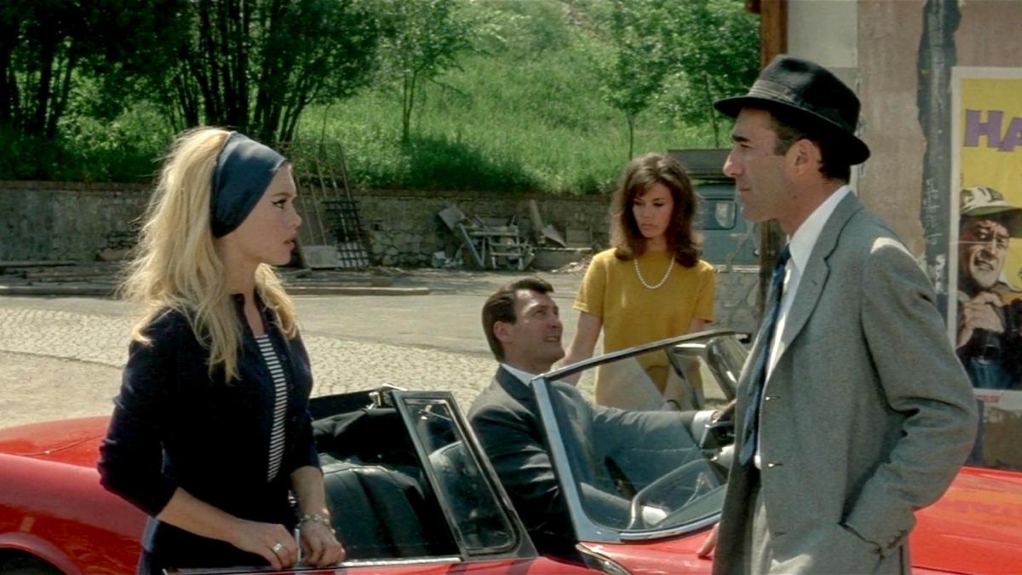
Godard’s film mixes virtuoso film-making with what feels a hard contempt for audience and characte

Director: Jean-Luc Godard

Cast: Brigitte Bardot (Camille Javal), Michel Piccoli (as Paul Javal), Jack Palance (Jeremiah Prokosch), Giorgia Moll (Francesca Vanini), Fritz Lang (Himself), Jean-Luc Godard (Lang’s assistant director), Linda Veras (Siren)

The title translates as Contempt and, to be honest, it’s hard not to feel a bit of the contempt when watching. Of all the Great Directors, the one I find the hardest to like is Godard. When you settle down to watch Godard, it’s hard not to escape the feeling you are steeling yourself to be looked down on. Godard wants you to know he’s watched more, read more and thought more than you about everything. Godard is playing out his fantasy of being a Hollywood director and a Great Artiste and wants you to know it. In fact, the further you move away from his debut À Bout de Souffle, the more his films become (for me) overly pleased-with-themselves statements rather than actual films.

Paul Javal (Michel Piccoli) is a writer, who wishes he could be producing great novels or plays, but is actually banging out crapola dialogue to fill American producer Jeremiah Prokosch’s (Jack Palance) Odyssey-opus, a film its director (Fritz Lang, one of Godard’s idols, playing himself) is trying to turn into art rather than the cheap sword-and-sandals epic Prokosch wants. But by taking the shilling, Paul earns the contempt of his glamourous wife Camille (Brigitte Bardot), who sleepwalks her way into an affair with Prokosch. Things come to head (as such) at Prokosch’s villa on Capri.

It was shot with a larger budget and a more controlling producer than any previous (or subsequent Godard film). God alone knows what they made of this – one suspects them reacting rather like Palance’s tantrum-filled producer when he inspects the arty dailies of statues and coastlines Lang has shot (“You lied to me Fritz!”). On some level Le Mépris is Godard playing a joke on his money men. The want a steamy relationship film, with plenty of Bardot on display? Have a slow series of elliptical conversations, a languid (but wonderfully filmed) argument scene in which Piccoli takes both a bath and a crap, and here are some deliberately functional shots of Bardot’s naked back on the bed while she and Piccoli intone empty dialogue. For a film that involves extra-marital sex, groping, a gun and a fatal car crash it’s deliberately unsensational – as if Godard was showing the money men he could ram anything they demanded into the film and still make it feels like a ticking-off.

To be honest, there’s also in Le Mépris a bit of Godard’s contempt for himself for selling out, as if he realised part way through he’d made a terrible mistake by taking the money and wanted everyone to know it. You can see it in the film’s visuals, that turn the demanded cinemascope wideness (which Godard loathed) into a series of pan-and-scan shots and tight close-ups that wipe-out the impact of the grand visuals. Godard may appear in the film himself, but is real substitute is his hero Lang, here a visionary polygot (the only person who can speak the full hodgepodge of languages the characters communicate in), who gives voice to Godard’s most closely held views about cinema and the only person completely assured and comfortable with what he is doing.

Not that there isn’t an awful lot to admire in Godard’s work here. As fits a director steeped in a love of film, Le Mépris drips with homages to cinema technique. Godard speaks the credits – Welles in Magnificent Amberson’s style – over an opening shot which is itself of an opening shot filming a crew filming the opening tracking shot of Le Mépris. There are touches of Ford, Hawks and Lang in the stylistic love of Godard’s heroes. Paul dresses like a mix of Sam Spade and Dean Martin and loves chatter about old movies (he’s very excited about the prospect of catching an old Hawks film). The tattered film studio is lined with film posters (including those depicting Godard’s former wife Anna Karina). We see the intricate procedures of film-making and post-production and Bardot even reads books about cinema in her downtime.

There is some astonishing film-making – Godard may be self-important, but he can shoot a film with grace. The tracking shots through the seemingly abandoned Cinecittà studios in Italy are beautifully done, as is the intriguing framework of the unique Capri villa and its striking staircase. The film’s highlight (and finest sequence by far, as well as its most human) is its middle act, a virtuoso choreographed sequence in the Javal’s under construction apartment (including French doors without glass, bathrooms without doors and intermittent furniture). The camera moves, brilliantly at a distance, to constantly frame these two characters interspersed between doorways, or kept apart by walls in the centre of the frame, barely ever managing to ever be in the frame together, the disjointed visual language perfect for communicating a conversation where they are never on the same page. It’s a superb way of filming partly an argument, partly a drifting out of love, partly a fumbling attempt to find common ground. There is a real emotional reality to this scene, something that isn’t present anywhere else in the film.

Even there though, it works because of its distance. Le Mépris is a strikingly distant film, Godard presenting a deliberately cold, hostile film that lacks any real warmth, empathy, wit or lightness, like he’s challenging us to swallow down this filmic medicine of cinematic inspiration and beautiful framing. Le Mépris also seems to despise its characters. Palance’s film producer (and this is a deeply uncomfortable performance from Palance, who constantly looks like he’s woken up suddenly and doesn’t know where he is) is a boorish philistine and an idiot. Piccoli’s writer is a shallow, preening  lightweight who wants to be a Godard but is a hack with pretensions.
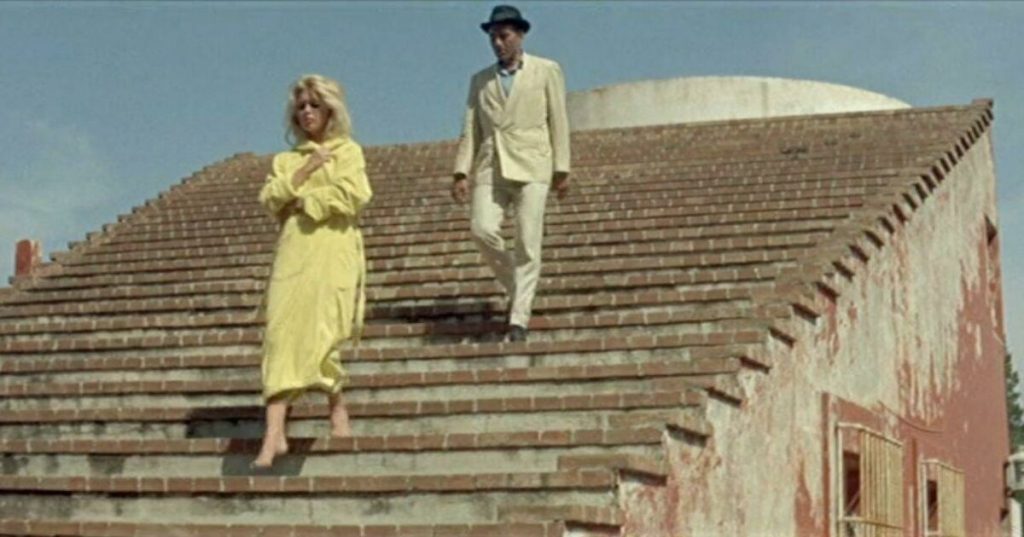
Interestingly the most intriguing character in it is Bardot – but she remains elliptical, perhaps because part of Godard can only see her as some sort of trophy or status symbol, something Paul fails to ‘deserve’ because he can’t maintain his principles. Her motivations remain a mystery and one wonders if there is much place for them in Godard’s masculine view of the world, where women are either secretaries or muses. Camille herself seems to see herself as sort of property, suspecting her husband of pimping her to a producer but then seemingly embracing that in any case (despite her contempt for Prokosch). There is an air in Le Mépris that Godard can’t really imagine either Bardot or Giorgia Moll’s Francesca (a striking presence, who has the best running joke with her rudimentary translations of Javal’s dialogue for Prokosch) as collaborators or equals to either the brutish producer or the tortured men, but people who can only be defined by their attitudes towards them.

Above all, Le Mépris wants you to know your place when watching it. To admire it, but also to know that you wishes for something more dramatic or humane are shallow, base desires. That really you should be seeking out the sort of arty stuff Fritz Lang is shooting on the island, not the page-turning nonsense the executives wanted. It’s an attitude that pours out of the film, and after a while its one that makes you want to spend your time elsewhere. Godard may be a clever guy, but he can be very poor company.
À Bout de Souffle (1960)

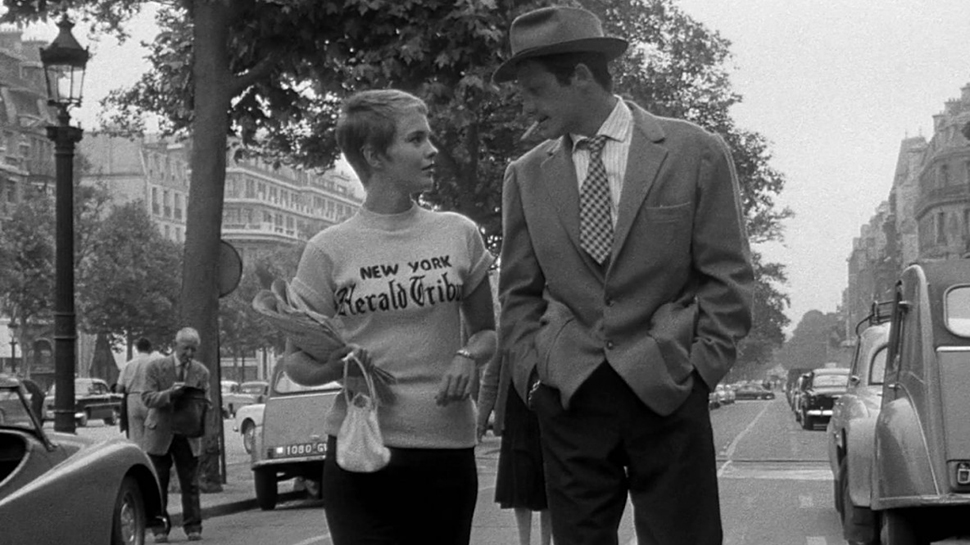
Jean Seberg and Jean-Paul Belmondo get obsessed with their own images in À Bout de Souffle

Director: Jean-Luc Godard

Cast: Jean-Paul Belmondo (Michael Poiccard), Jean Seberg (Patricia Franchini), Daniel Boulanger (Police Inspector Vital), Henri-Jacques Huet (Antonio Berruti), Roger Hanin (Carl Zumbach), Jean-Pierre Melville (Parvulesco), Liliane David (Lilane)

The French New Wave emerged from a group of film critics from influential magazine Cahiers du cinema in the 1960s, led by Francois Truffaut (who contributed a four page story outline to this film, although Godard later minimised his contribution as much as possible). The movement believed the director was the “author” of the film, stamping their personality on it. Packed with references to classic Hollywood movies, the films were shot with an improvisational lack of formality (that often hid brilliant cinematic technique) inspired by Italian neo-realism.

Breathless, Jean-luc Godard’s revolutionary masterpiece, was one of the central films in this school of filmmaking. It followed the last few days of Michael Poiccard (Jean-Paul Belmondo). A young man drifting through a life of petty crime, who idealises Humphrey Bogart’s style, he one day steals a car; it happens to have a gun in it, and in a moment of casual indifference he shoots a policeman trying to arrest him and flees. In Paris, while being hunted by the police, he reunites with his girlfriend, American student Patricia Franchini (Jean Seberg), and their self-absorbed relationship plays out under the shadow of the police net getting tighter and tighter.

Jean-Luc Godard’s film was hugely influential, as it seemed to re-write the rules of how films were to be made. Godard’s film is down and dirty, it’s almost guerrilla, but filmed with a wonderful, improvisational beauty. Shots are hand-held and dynamic, the action is all filmed on location, the framing is rough and ready, the camera gets up close and personal with the actors, throwing us in with them with an overwhelming sense of realism. The whole film feels irreverent, casual and cool, and gets a wonderful sense of urban Paris. It magnifies and reflects the very qualities the lead characters believe they have themselves.

Godard’s most influential touch was the use of jump cuts within scenes, with action jumping from moment to moment within a scene seemingly spontaneously, giving an impression of constant movement and ripping out the sense of time between actions. It also gives a sense of the film always driving forward, bouncing from beat to beat. According to rumour, this influential use of editing was a happy accident. The original cut of the film was well over two hours, and the distributors wanted something less than 90 minutes. Rather than cut whole scenes, Godard cut the small moments of movement or peace in scenes, giving the film a jagged freshness.

The whole film is full of these moments, the jumps over silences and conversational gaps, jumps in time lags between walking from point A to point B. It really works as well. The exterior scenes buzz with an exciting freshness. The long second act, basically nothing more than a conversation in a bedroom between the two leads, is edited almost like an action scene in a modern film – perfect for the self-dramatising energy the two characters are leading their lives with.

It’s those two leads who really help to make the film. Seberg picked up a quarter of the film’s budget to be the “name” lead, and she brings the film a soulful but distant sense of coolness. Belmondo was the real find, turning himself overnight into a mega star. In the sixties these were the people that your cool student wanted to be. Belmondo nailed his sense of iconoclastic cool in the opening moments – particularly when turning casually to the camera while driving his stolen car, to involve us personally in the story of his own life that he is constructing.

You can see how the performances (and characters) of the two leads had such impact on filmmaking. Energetic but also listless, contemptuous of authority and certain that whatever the world has in store for them it is definitely something more, self-absorbed and selfish, immature and convinced that their lives are more important that the average people around them – they are the predecessors of Bonnie and Clyde, of the young killers in Badlands. And nothing seemed to capture the counter-culture cool than Belmondo with a cigarette dangling from this mouth, apeing Bogart. 

But both lovers are equally selfish and obsessed with their own stories. Or rather, self-consciously living their lives like they are in a narrative – in fact you could say that the film predicts the self-obsession of the social media age. Michael lives a life that is all an entirely constructed front. He’s a would-be gangster, with a carefully studied front of gritty cool. He spends endless time making sure that his look, his clothes, his postures, his manners are always spot-on. He constantly keeps up a stream of consciousness narrative about his own life and situation, positioning himself as the sort of representative of modern American hip.

And Patricia is the same. Although at first she seems the more natural and grounded of the two, it’s clear her self-obsession is just as profound (if not more so) than Michael’s. Patricia constantly reviews and rebuilds the narrative of her own life, discussing her romantic life like it was a carefully constructed fiction, or some sort of hyper-cool Mills and Boon. “Do I love you? Should I love you? Can I make myself not love you?” Patricia’s construction of her own narrative – and her desire to shape and control it completely – makes her as completely artificial as Michael is. 

She’s so determined to construct her own narrative, that she shrugs off a string of revelations about Michael as if they didn’t exist. He’s a killer? Okay. He’s got at least two names? Hardly matters. He’s married? Nobody’s perfect. When deciding to betray Michael to the authorities, the action seems almost motiveless, but it quickly becomes clear that it is led by her latest review of the life situation and deciding it’s not what she wanted. Surrendering Michael to the law is her chance to say “No, I shape the story here – and I get to control who I feel love for, no one else”. By betraying Michael she is cutting a part of a life narrative out like she was removing a tattoo, something that she is not sure she wants any more but finds hard to remove.

One area where I do struggle with the film now is the attitude it has to its heroes. I think it wants us to kind of admire Michael – for all his faults – as some sort of unconventional hero looking to lead his life. I struggle to feel the engagement with a guy who is literally a murderer as much as the film wants me to – but I think this is the result of a major change from the more rebellious 1960s, to our changed times today. But then I’m also not sure that the film has as much heart as it wants to have – its characters are so consciously artificial that you never really get a sense of them as human beings. They are always characters, never people – and the film is always focused on their constructed images rather than anything real for you to invest in. There is much to admire, and not much to love.

And that doesn’t change the influential nature of the film. While it’s easier to admire the film than to love it – for all the strength of the performances, the characters are selfish fantasists – and its technical achievements sometimes distance as much as they throw us into the action, it’s still brilliantly put together. It’s masterfully made, and while I’m not sure it really has any heart, it’s got enough energy, force and urgency to make dozens of films.