Category: Jonathan Glazer

Sexy Beast (2001)

Sexy Beast (2001)

Superb acting motors a gangster film that’s also a nightmare house-guest comedy

Director: Jonathan Glazer

Cast: Ray Winstone (Gal Dove), Ben Kingsley (Don Logan), Ian McShane (Teddy Bass), Amanda Redman (DeeDee Gove), James Fox (Harry), Cavan Kendall (Aitch), Julianne White (Jackie), Álvaro Monje (Enrique)

Gal Dove (Ray Winstone) has got it made. He’s baked bronze by the pool in his home on the Costa del Sol, earned after a life as a top safe cracker in London, alongside wife DeeDee (Amanda Redman), best friend (and fellow ex-crook) Aitch (Cavan Kendall) and glamourous Jackie (Julianne White). All that changes when an unexpected visitor turns up: Don Logan (Ben Kingsley). A tightly-wound, terrifyingly unpredictable sociopath, Logan has a job offer to which the only acceptable answer is yes: joining a team to break into a top London bank for crime king-pin Teddy Bass (Ian McShane). How’s Gal going to get himself out of this one?

Sexy Beast seems at points it might settle for being a standard British gangster drama. But Glazer’s becomes a hugely enjoyable mix of that and bizarre black comedy. A houseguest from hell comedy, like a psychotically foul-mouthed The Man Who Came to Dinner, with the added sprinkle of playful psychological theory and touches of darkly sexual content (James Fox brings back memories of The Servant and Performance). There is even an element of Greek drama: Gal really should be paying attention to the parade of ill-events preceding Don’s arrival, not least the boulder that tumbles down a mountain into his swimming pool nearly squashing Gal en route.

That boulder is, it turns out, far less of a danger than Don. If there is one thing that dominates perceptions of Sexy Beast, it’s the intimidating, witty danger of Ben Kingsley. For an actor best known at the time as Gandhi, to say this was a change of pace was an understatement. Kingsley arguably changed his whole career here with this stunningly intense, hilarious, performance. Shirt tucked in, head shaved, Logan might look physically unassuming but the pulsing vein in his head is a sign of him being a tightly wound ball of unprocessed anger and fury. Kingsley makes him superbly unpredictable – snapping on a sixpence from quiet to rabid fury with a terrifying capacity for sudden violence.

Glazer throws him into Gal’s Spanish heaven like a ticking timebomb. There is a great deal of wit in how Glazer shoots Logan, often sitting or standing in a domineering position in rooms while the other characters awkwardly shuffle, uncertain of where to look, hugging the margins. This comedy carries across into Logan’s utter disregard for social rules or niceties – all captured in his blackly hilarious calm refusal to extinguish his cigarette on a plane, followed by his ranting ejection (“I hope this crashes!”) – which sparks shocked laughs. It’s not funny for those around him as Logan sprays matter-of-fact slurs about his hosts, deliberately urinates on their bathroom floor and calmly discusses the time he had sex with Jackie in front of her husband.

There is a strange immaturity about Don, like a maladjusted child who has never grown up, superbly contrasted with Gal’s calm, contented mellowness. Don lacks any emotional maturity and sounds like a sulky teenager. He’s the sort of playschool bully who psyches himself up in the mirror and parrots word-for-word the instructions he’s received about the planned heist from the ‘bigger boys’. He seems to have no friends and a teenage romantic obsession with Jackie (who I would bet money was his only ever sexual experience). This is all captured superbly by Kingsley’s surprisingly complex performance full of terrifying childish unpredictability alongside its dark humour.

The dominance of Kingsley makes it easy to overlook Winstone’s equally fine performance. Any doubts about the power of Kingsley to intimidate is squashed by Winstone’s subtle terror at the former Gandhi. Winstone plays up his more loveable aspects, as an honest man (despite his profession), keen to make the lives of those around him better. He’s completely unsuited now for the life of violence and crime he has left behind. Mumbling, downward looking, Winstone gives Gal some nice hints of the submissive surrender of a life-long victim to his bully.

Glazer skilfully presents these characters as two sides of the same psychological coin. While Don is certainly real, viewers can have fun tying themselves into knots on theories where he is Gal’s terrifying id, an embodiment of the hardened, dangerous criminal he possibly used to be. This makes Don’s intimidating take-over of Gal’s home a visual representation of the repressed violence in Gal. It’s a feeling added to by Gal’s dreams of a satanic satyr figure (who sort of resembles Don). Sexy Beast uses this vibe to subtly suggest the real danger might be Gal’s deeply suppressed criminal psychology. It makes for a neat suggestive undertone, which Glazer carefully never overplays.

Sexy Beast makes an impressive calling card for Glazer’s skill. It’s smartly edited – a Logan monologue explaining the heist’s background is skilfully intercut both with Logan being told of the scheme and Teddy formulating the plan. Glazer mixes interesting camera angles – there are some neat shots where cameras appear to be attached to doors in particular a revolving bank door – and impressive simplicity, not least a quietly staged scene that uses a single shot to track Logan going from calm to berserk in Gal’s kitchen. It’s a sign of the flair and imagination of a consummate visual stylist.

He also stages the heist – masterminded by a dead-eyed and chillingly calm Ian McShane – with an impressive confidence. While Kingsley’s character so dominates the film that it’s hard to get as interested in the crime itself, it offers visual panache and – in the blundering of several of the criminals in a flooded bank vault and their clumsy celebrations afterwards – further sly commentary of the immature dumbness of criminals. The sexually fluid upper class orgy where the crime is born is also staged with a refreshing lack of salaciousness and the bursts of violence, when they come, carry a matter-of-fact brutality that’s much worse than all-out gore.

If Sexy Beast has a major fault, it is that the power and fascination of Kingsley’s character unbalances the film in his favour. Its final act feels like an anti-climax – probably the only time gun-laden, underwater antics have been less exciting than a classically-trained actor spraying f-bombs and the c-word like there’s no tomorrow – but that’s also a tribute to its early power. The first two acts speak to us because, beneath all the gangster shenanigans, we’ve all had to deal with the nightmare of an uninvited house guest from your past and we can all sort of relate to the dark humour of egg-shell tip-toeing the rest of the characters do around the simmering Kingsley-volcano.

It’s why Sexy Beast works best as a black-comedy confined play (a theatrical adaptation, not a TV prequel series, is what it really needs). When it focuses on the superb interplay of Winstone and Kingsley, the film flies. It’s also proof that Glazer, even at the start of his career, could turn familiar tropes into something strikingly different, original and unique in tone. A gangster film like few others.
The Zone of Interest (2023)

The Zone of Interest (2023)

Chilling Holocaust film, its unseen horrors only overheard give it supreme power

Director: Jonathan Glazer

Cast: Christian Friedel (Rudolf Höss), Sandra Hüller (Hedwig Höss), Ralph Herforth (Oswald Pohl), Daniel Holzberg (Gerard Maurer), Sascha Maaz (Arthur Liebehenschel), Freya Kreutzkam (Elenore Pohl), Imogen Kogge (Linna Hensel), Johann Karthaus (Klaus Höss), Lilli Falk (Heidetraut Höss), Louis Noah Wite (Hans-Jurgen Höss)

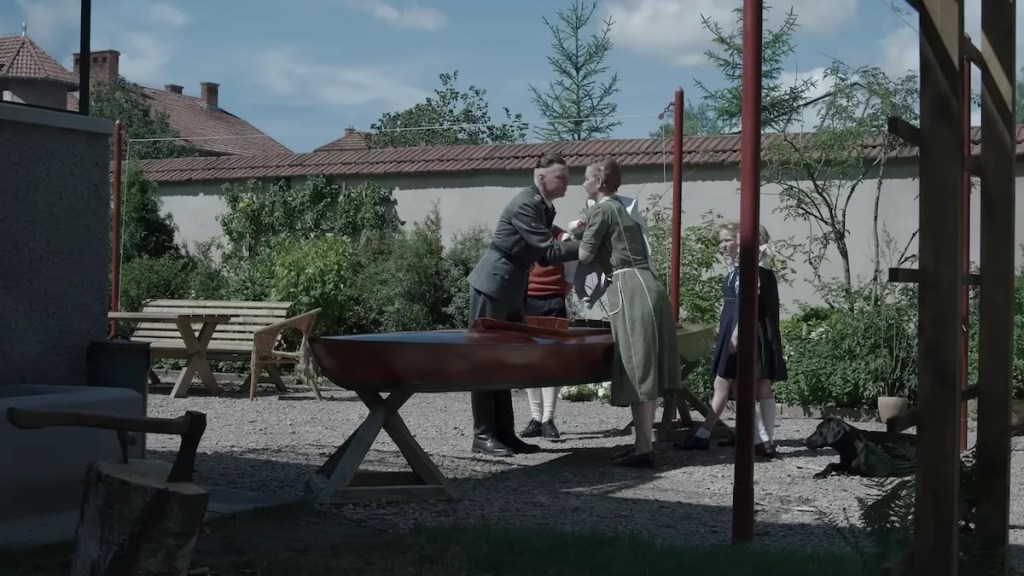
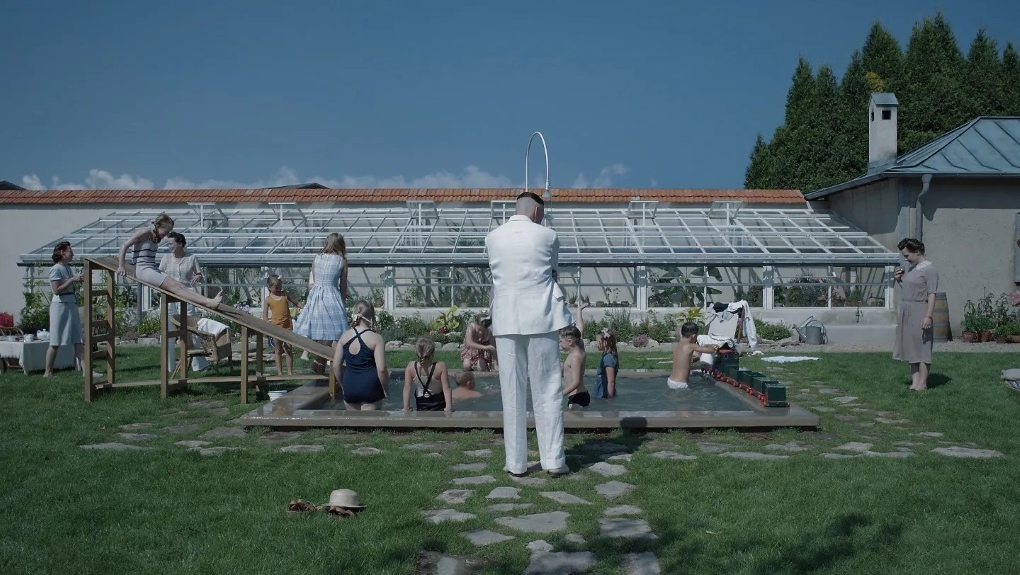
A family enjoys the delights of a summer day beside the river. They laugh, splash each other with water and amble home to their villa, next to where father works. They tune out the all-too-familiar sounds of that workplace to enjoy a family dinner. They are living the dream, out of the city, with a home and beautiful, landscaped garden. The family is Rudolf Höss’. The workplace is Auschwitz. The sounds are of the unimaginable horrors that make their life possible.

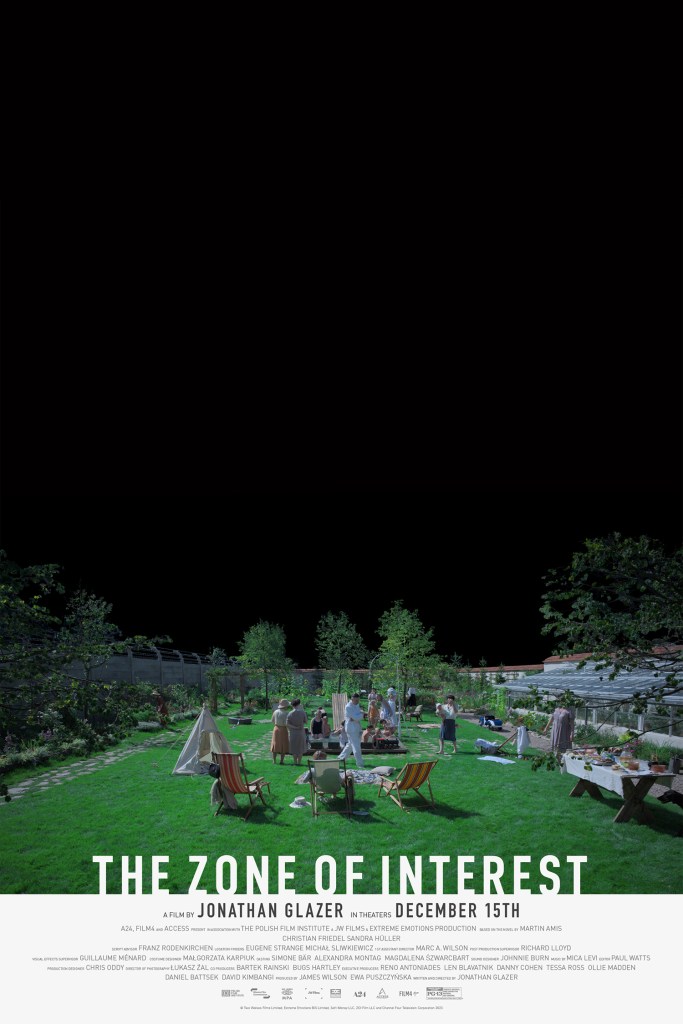
Jonathan Glazer’s Holocaust movie is unlike any other ever made. Taking a Martin Amis novel as inspiration, Glazer creates a hauntingly observant film where the plot is simple (Höss works at Auschwitz, the family enjoys a series of everyday events, Höss gets re-posted, his wife remains in their home, Höss later returns to continue his work) but every single frame implies never-seen horrifying events. While the family are indifferent to the distant sounds of trains arriving, industrial churn, gunshots and screams, we can’t be. The only thing that separates the Höss’ heaven of their intricate garden and charming home from the hell of Auschwitz is a single wall.

Glazer’s film never leaves the house for the camp, meaning what we hear is our only clue to what is happening. The Zone of Interest uses sound like almost no other film I’ve seen. Sound designer Johnnie Burns creates an overwhelming soundscape that suggests horrors. The low rumble of industrial sound, the background hum of screams and cracks of gunshot, ignored by the family as white noise. It’s brilliant and sickeningly immersive that never for an instant lets you forget where we are. Glazer complements this with half-seen sights, the most striking the steam of a train arriving visible over the wall of the house, that add to our grim knowledge of what’s happening out of shot.

Glazer lets events play out with a chilling naturalism. Shot on concealed digital cameras with no artificial lighting, there is very little studied here at all. Instead, everything plays out with a terrifyingly low-key sense of reality. Conversations are at times mumbled, movements have a mix of casual and procedural and everything is kept determinedly undramatic. What emerges is the mundane, character-less nature of the Hösses. These people are evil in the sense that the wickedness of their deeds hasn’t even crossed their minds. Two sociopaths who pride themselves on their respectability, presiding over an industrial killing machine.

The film brilliantly balances a lack of overt events with acres of horrific implication. Fishing with his children, Höss steps on a half-seen jaw-bone and suddenly plucks them from the lake, running home with them to practically bleach them clean with the servants left to scrub the bathroom – it’s never stated that human remains are being washed from them, but the look on the face of these servants speaks volumes. (Höss later records a coded memo chastising his team for their lack of care, like a middle manager furious at an untidy storage room.) Hedwig’s mother wakes at night with her room flooded with red light. Opening a curtain to investigate, the camera sees her look of horror, a handkerchief covering her nose, while we only see the faint reflection of flames on the window. Moments like this fill the film, the implications of horrors out of shot.

At its heart, Zone of Interest brings startlingly to life Rudolf Höss, a man who admitted to murdering millions but wanted it known he did not tolerate overt cruelty to his victims. Played with a precise blankness by Christian Friedel, you realise if Hitler had charged him with organising the Reich’s stationary he would have gone about it with the same commitment and passion-free precision as he does mass murder. Does Höss have any idea, deep down, of his vileness? As he carefully, obsessively marches around the house every night shutting off lights and closing doors, is he subconsciously trying to defend his family and shut out reality, bury his knowledge of his evil in household procedure, or is he just as obsessive about this as he is in everything else?

His wife, played with a middle-class, aspirational coldness by Sandra Hüller, seems to have convinced herself she can enjoy all the benefits of the life of an Auschwitz camp commandant, without needing to think seriously about where it comes from. She tries on luscious clothing, brought to her from the camp, and obsessively tends and cares for her garden. Not that it stops her from lashing out at her servants like a petty tyrant. So devoted to her home is she, she refuses to leave it on Höss’ transfer back to Berlin, believing it to be the perfect place to raise her children.

It’s the children that subtly bear the brunt. As the film progresses, the damage to them becomes more and more clear, especially after Höss is reassigned and his attempts to control the environment are ignored by his successor. The daughter who cannot sleep at night, constantly walking the house. The younger son who overhears the forced drowning of a victim and mimics the guard’s cruel authoritarian “humour”. The older son who locks his brother in the greenhouse and mimics the hissing noise of gas. The Höss family are laying the roots to destroy their family in their obsessive desire to build a blinkered perfect home for them.

There is only one note of true kindness in The Zone of Interest. During his research, Glazer discovered a young Polish girl made it her mission to leave fruit at night for the inmates, hidden throughout the camp. Glazer captures this with thermal imaging cameras (eager to maintain his “rule” of no artificial light), giving this girl a sort of mystical, fairy-tale quality (we once even see her while hearing Höss read to his children at night). However, even this act of kindness is corrupted – the forced drowning is caused by a fight over an apple, presumably left by this child.

The Zone of Interest does lose some of its impact when it follows Höss to Berlin – it’s a film that flourishes best as a claustrophobic piece, focused on the house and its grounds. You could argue that The Zone of Interest is effectively a short film, expanded into feature length, making the same point over again. But, on reflection, part of the point is the power of the thudding repetition of that message, the overwhelming impact of people indifferently carrying on in the face of pure evil.

Does Höss realise this on some level? The Zone of Interest concludes with Höss dry-retching on the stairs – he’s such a shell he doesn’t even have enough in him to vomit up – before seeming to stare right out at us into the darkness. Glazer then finally takes us into the camp – to see the museum it is today, quiet, still, tended to with care by the staff. Höss’ life’s work is to create a memorial to his barbarity, where dedicated staff will make sure the picture of evil remains unblemished by dirt. It’s the first-time sound really drains out of the film and it makes for a powerful moment.

The Zone of Interest really lingers with the viewer. Glazer’s subtle and unflashy work builds the film into a powerful experience piece that leaves a lasting impact. It’s a film that grows even more powerful as you unpack the subtleties of its exploration of the banal nature of cruelty and the lasting impact of inhumanity on ourselves and others. A truly unique and important film.