
Category: Kathryn Bigelow

A House of Dynamite (2025)

A House of Dynamite (2025)

Terrifying, compelling and gripping it-could-happen drama about the madness of nuclear war

Director: Kathryn Bigelow

Cast: Rebecca Ferguson (Captain Olivia Walker), Idris Elba (President), Gabriel Basso (Deputy NSA Jake Baerington), Jared Harris (Secretary Baker), Tracy Letts (General Anthony Brady), Anthony Ramos (Major Daniel Gonzalez), Moses Ingram (Cathy Rogers), Jonah Hauer-King (Lt Commander Robert Reeves), Greta Lee (Ana Park), Jason Clarke (Admiral Mark Miller), Malachi Beasley (SCPO William Davis), Brian Tee (SAIC Ken Cho), Renée Elise Goldsberry (First Lady), Kaitlyn Dever (Caroline Baker)
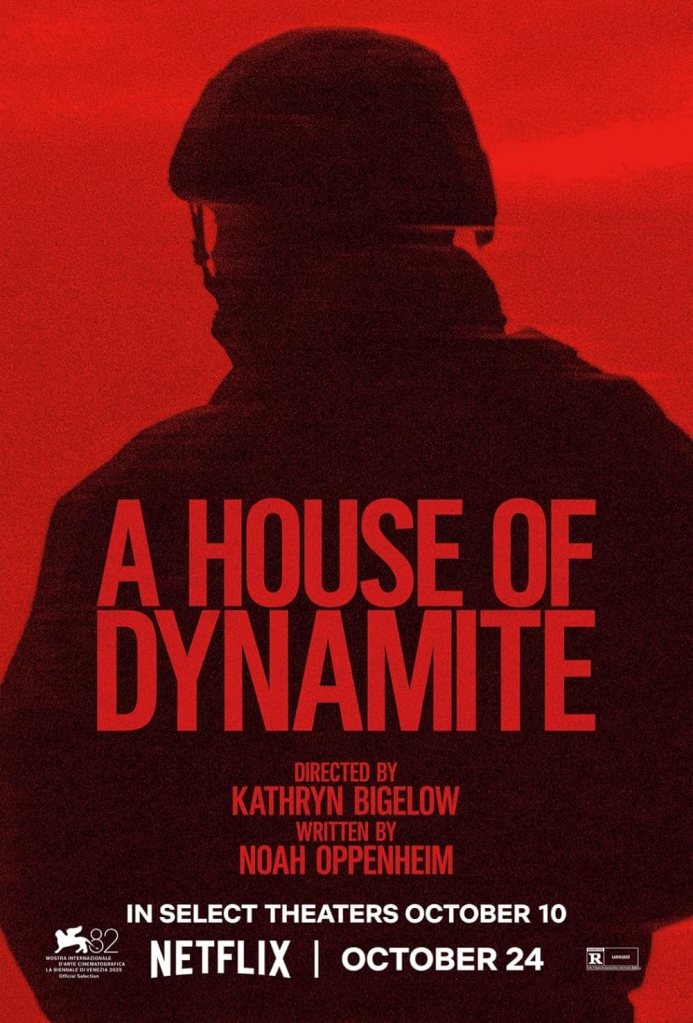
“That’s what $50 billion buys us? A fucking coin toss?” the Secretary of Defence (Jared Harris) plaintively wails as he discovers yet another weakness in the USA’s defence infrastructure. It’s one of many grim realisations filling A House of Dynamite, a relentlessly horrifying look at what might actually happen if a nuclear missile was launched at the United States: and how, in less time than it takes to watch an episode of Friends, the US President (Idris Elba) can go from shooting hoops at a charity event to flicking through menu-style list of world-ending options, being told he has a three minute window to make a decision that could be final for all of us. House of Dynamite makes clear to us all: the fate of the whole world effectively rests on a series of coin tosses we have no influence over.

Bigelow’s intense, brilliantly shot and edited film, plays out the same eighteen-minute scenario from different perspectives. A glitch in the USA’s satellite network misses the launch of an ICBM, somewhere off the coast of Asia, heading for Chicago. Disbelief and panic swiftly sets in at every level of the US administration. Anti-missile defence systems miss (that’s the coin toss, as we’re told it only has a 61% success rate in tests). A decision needs to be taken whether to follow policy and launch a counter-attack before the nuke hits. It plays out from three primary perspectives: Captain Olivia Walker (Rebecca Ferguson), senior officer on duty in the Situation Room; Jake Baerington (Gabriel Basso), deputy NSA covering for his under-anaesthetic boss, begging Russia to stand-down their forces as the US goes to DEFCON1; and finally the President (Elba), out-of-his-depth in a nightmare where he feels powerless and totally unprepared.

Powerless and unprepared become the guiding feelings in US defence, as people slowly release the best cast scenario is only losing 10 million people in Chicago and their worst (most likely) case is everyone dying in a nuclear conflagration. Bigelow’s film, shot with the hand-held intensity of a combat film, grabs you with a vice like grip as it plays out this nuclear nightmare. A House of Dynamite only ever gives us the same information as the fictional administration trying to make impossible choices. Like them we never find out who launched the missile, if it’s the first of a wave or even if it’s fully armed ICBM. All we know is the strike on Chicago quickly becomes inevitable and, with that fact, the world as we know it is over. Bigelow’s film (although it is not as clear in its clarification of US launch policy as it could be) places the system (which offers few choices and no alternatives) as the antagonist.

It also makes clear that nuclear war can happen at a time totally not of our choosing. Here it unfolds on a regular morning. The President is at an inconsequential publicity event, reduced to dialling into a world-shaking video call from a mobile: and he’s barely a month into his administration. The National Security advisor is in an operating studio and his unknown assistant is reduced into running through gridlocked traffic to get into the office. A designated FEMA expert (Moses Ingram) has just been appointed and at first believes the whole thing is a drill. The NSA North Korea expert (Greta Lee) is at a Gettysburg reconstruction with her young son. The Situation Room is undergoing maintenance and the Premiers of Russia and China can’t be raised on the phone.

A House of Dynamite doesn’t land cheap shots: it’s portrait of the members of the administration and the US defence infrastructure stresses their level-headedness and professionalism. Indeed, their competence makes the complete lack of control they have all the more alarming. Tracy Lett’s STRATCOM General keeps a professional level-headedness, even as he dutiful advises sticking to a nuclear policy which will effectively end the world. Rebecca Ferguson’s composed, calm and collected Naval captain finds herself increasingly aghast but only allows herself a few moments of tears after a goodbye phone call to her husband, clutching a toy dinosaur gift from her son. Anthony Ramos’ missile base commander reassures his staff this is what they have trained for: right up until the point where their interceptor missile misses and he slips into near catatonic shock as he realises that life’s training was for nothing.

Politicians are similarly portrayed as decent, but fundamentally unprepared for the situation. Idris Elba’s suave president looks every inch the confident leader, but it’s revealed he’s uncertain, hesitant, terrified of looking weak and his skills of schmoozing the public utterly useless for this situation. Jared Harris’ Defence secretary is only marginally more on-top of his brief (he reveals the nuclear war briefing is less than half an hour because it was seen as so unlikely to happen) and, for all his competence, becomes increasingly distracted at the thought of his estranged daughter (Kaitlyn Dever) facing death in Chicago. Gabriel Basso’s Deputy NSA seems at first absurd, but grows in statue as he desperately tries to salvage global survival.

Bigelow’s film makes clear this is a lose-lose situation. It’s a film about the constricting pressure of panic. Panic leaves assured professionals weeping or vomiting. Superpowers plan world-ending retaliation out of fear that they might be wiped out before they get a chance to fire their nukes. The President becomes overwhelmed, asking the junior aide carrying the nuclear football (Jonah Hauer-King) what he should do. (Hauer-King’s character, acknowledging the way the War Book looks like a nightmare menu, wryly confesses he calls the world-ending options rare, medium and well-done). The Deputy NSA tries everything, including begging, to get Russia to stand down, only for them to refusing to do so until US meet Russia’s own un-meetable conditions.

What we are left with is the realisation that there is no winner here. Many viewers, I feel are missing the point. Who fired the missile, who (or if) America hits back, if Chicago goes up in inferno or not, is not the point. Just firing the starting trigger in this race means you lose, because when the nuclear buttons is pressed by anyone there is no turning back, no way of unringing that bell. This is the chilling message of Bigelow’s compelling film – made all the more chilling as she finds so much humanity in the people forced to make these terrible calls.

What we end up with is a different type of coin toss: one man, in most cases with almost no preparation what-so-ever, making a decision that could go either way on virtually no conclusive information at all, in an impossibly small window, about whether to risk ending the world or not. What A House of Dynamite makes clear is that’s all nuclear deterrent really is: a coin toss for individuals who feel they have to always call heads. That’s possibly the most terrifying about it.
The Hurt Locker (2009)

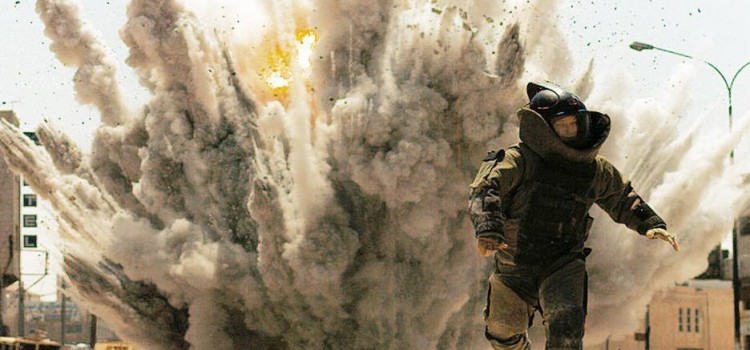
Danger awaits round every corner in the shocking The Hurt Locker

Director: Kathryn Bigelow

Cast: Jeremy Renner (Sgt William James), Anthony Mackie (Sgt JT Sanborn), Brian Geraghty (Specialist Owen Eldridge), Guy Pearce (Staff Sgt Matthew Thompson), Christian Camargo (Lt Colonel John Cambridge), David Morse (Colonel Reed), Ralph Fiennes (British Mercenary), Evangeline Lilly (Connie James), Sam Spruell (Contractor Charlie)

There have been few wars in history as controversial as the Iraq war. Despite this, it’s hard to think of a film that really has nailed the complex social, political and military causes behind the war – or managed to engage with the deep unease much of the Western world feels for the campaign. While there have been great films about Vietnam, that other opinion-dividing conflict of the last 50 years, there hasn’t been one about Iraq yet – perhaps because the wound is still so fresh. The Hurt Locker gets closest by far – largely because it is a film that makes war its subject, not Iraq; it could just as easily be set in the fields of France as the streets of Baghdad.

After the death of their Staff Sergeant (Guy Pearce) while defusing an IED in Baghdad, Explosive Ordnance Disposal (EOD) unit members Sgt Sanborn (Anthony Mackie) and Specialist Eldridge (Brian Geraghty) are joined by a new team leader Sgt William James (Jeremy Renner). However, they both – particularly the by-the-book Sanborn – grow increasingly concerned about James’ maverick methods and willingness to take personal risks to defuse bombs. Slowly, tensions rise in the team.

The Hurt Locker makes no comment whatsoever on the controversy behind the decision to intervene in Iraq. Instead, its focus is entirely on the psychology of those who go to war, and the sorts of personalities it can attract, from those with a keen desire to do their duty to others who get a certain “buzz” from risk and conflict that they cannot find elsewhere in their lives. As the film’s opening words say, “War is a Drug”. And there are few characters more afflicted by an addiction to that drug than Sgt William James.

Not that James is a villain. One of the film’s many strengths is that he is far from a lunatic. Played with a career-defining charisma and intensity by a then almost-unknown Jeremy Renner, James takes personal risks (defusing bombs without the huge rubber safety suits, turning off his comms to concentrate, returning to bombsites to collect trophies or lost items) but he also shows concern and empathy for his fellow soldiers and (largely) avoids putting them in danger. With the team pinned down by snipers in the desert, he calmly reassures Eldridge and talks Sanborn quietly through taking down the snipers. He develops bonds with people and later in the film shows great compassion and willingness to put himself in danger to save a man unwillingly attached to a suicide vest.

James’ struggles are to deal with the modern world and its shallow obsessions compared to the thrill of putting your life on the line (as the film brilliantly illustrates with a final vignette of James back home at the end of rotation, staring blankly at a wall of cereal boxes in a supermarket). On campaign, he talks dismissively of his child and claims to not know or understand his relationship with his wife. But this is a front – it’s clear his family life is far more settled than he suggests – and is actually more connected to his guilt at enjoying his time on military posting more than he does the neutered warmth of family life. Renner excels at all this complex psychology, crafting a man who is aware of his addiction, can’t combat it but feels a deep guilt for it.

The Hurt Locker is about how this rush of war can be more compelling and life-affirming than hearth and home. It’s also perhaps a commentary on how we ourselves get a rush from watching action and war films – that it’s only a few steps from enjoying watching the excitement of conflict, to enjoying being in the middle of that kind of action. Is James really that bad? Defusing bombs is a difficult and demanding job – and James knows (rightly) that he is one of the best at doing it. And shouldn’t a man enjoy his job? Renner’s glee at a job well done is balanced by guilty awareness that he shouldn’t be enjoying himself as much as this.

Kathryn Bigelow is in her element directing this burst of male testosterone, assembling a film that is gripping, tense and hugely exciting. It’s essentially constructed around a series of set-pieces, each of them more unsettling than the one before. Bigelow’s direction is impeccable, as each of these sequences is both unique in tone and utterly compelling. Bigelow became the first woman to win Best Director at the Oscars – and her acute understanding of men enamoured with the buzz of adrenalin is what gives the film much of its narrative force.

It also helps that the film she has assembled here is a technical marvel, brilliantly shot by Barry Ackroyd with a scintillating display of hand-held cameras, cleverly focused details and immersive story telling. The Hurt Locker is a film both drenched in sun and darkness, with burning yellows and oppressive greys. It’s a film that captures the incredibly alien, heat-stoked insanity of Iraq, and the journalistic style and camerawork make everything we watch feel even more immediate.

In the middle of this, the psychological drama between the maverick James and the cautious, procedure-led Sanborn (played by an equally impressive Anthony Mackie, whose every moment buzzes with frustration and anger at the dangers he sees James inflict on them) plays out wonderfully. Bigelow has an immediate understanding of how the adrenalin and testosterone of combat quickly bubble up into violence and aggression off the battlefield, with these two men often becoming like rutting stags, struggling to place their own supremacy on the team – with Brian Geraghty’s weaker Eldridge the pawn between the two.

The Hurt Locker does what it does so well that it’s easy to overlook its flaws. Its narrative is so pure that you regret it gives barely a second to addressing the issues in Iraq or how the behaviour and attitude of the soldiers there (mostly angry and abusive towards the local population) may be contributing to the problems. It also struggles to add much narrative originality to the story, beyond its set-pieces – in particular James’ friendship with a young Iraqi boy seems like the forced stuff of movie convention in a film that prides itself on reality. When dialogue takes over from action, many of the psychological points it raises have been seen in countless films past. You could argue that the film is largely at its weakest when it tackles any questions of plot at all, and that what Bigelow has really done here is make one of the finest boots-on-the-ground immersions you are going to see.

And if The Hurt Locker is just that then, you know what, that’s fine too. Because when it does this it’s one of the best in the game. Brilliantly assembled, shot and edited (those many Oscars were well deserved) it’s a gripping war film that relies a little too much on some of the conventions of war and combat films, while also focusing very intently on how war affects the psychology of the men at the sharp end. It gives a truly unique perspective of the dangers (in every sense) and is brought to life by a series of fine performances, with Renner and Mackie outstanding. Wonderfully directed, and smashingly tense, it’s a worthy contender in the upper echelons of any list made of great war films.

Zero Dark Thirty (2012)


Zero Dark Thirty tries to raise questions and views, but dodges many of them

Director: Kathryn Bigelow

Cast: Jessica Chastain (Maya), Jason Clarke (Dan), Jennifer Ehle (Jessica), Mark Strong (George), Kyle Chandler (Joseph Bradley), James Gandolfini (CIA Director), Stephen Dillane (National Security Advisor), Harold Perrineau (Jack), Mark Duplass (Steve), John Barrowman (Jeremy), Joel Edgerton (Patrick), Chris Pratt (Justin)

Zero Dark Thirty is a deeply troubling film: a journalistic investigation into the hunt for Bin Laden, shot with an action thriller film ethos. It wears its factual accuracy and research with an ostentatious pride on its sleeve, but ducks out of making any judgement on the issues it presents, as if afraid to pollute the events it displays with editorialising. But some events demand discussion and a point of view: as one critic said, you wouldn’t make a film about slavery that focuses on the cotton output. Similarly, a film that drives us towards the killing of the vile Bin Laden should also challenge us more about the methods used to capture him, the extent to which we “became what we hunted”.

And I don’t buy that the film is challenging us to recognise this ourselves. It starts with recordings from the 9/11 flights (a moment which made me feel uneasy to say the least and many family members were also unhappy with), its lead character Maya is caught up in two bombings and an assassination attempt, her best friend (well played by Jennifer Ehle) is killed in a suicide bombing. All of this, along with the film’s omission of any exploration of the terrorists themselves, is encouraging us to look at a particular side of the argument. Cementing this is the end of the film which, despite caveats, has a “mission accomplished” feeling – it may not be flag waving, but it does want us to feel the professionalism of a job well done, reinforced by the tearful release of 12 years of tension from Maya. We are not being encouraged to question the attitudes or assumptions of the characters in front of us; we are being steered towards a particular view of these characters and events. Without an explicit endorsement, but implicit suggestions that ends may well have justified means.

Of course, 9/11 was an abomination – but setting the deck the way the film does means it makes it easier to condone the terrible things that the CIA do in this film to get the results it got. That’s the problem with the film’s “stanceless stance” – its patting itself on the back for not taking sides means it doesn’t acknowledge any depths to its facts, it gives no context. There are many, many issues and motivations, from both sides, behind the events we see here – but we don’t learn anything about any of them. Instead the film is like a Wikipedia page with brilliant photography and editing: a skilfully presented PPT deck that shows us what happens, but doesn’t feel like it tells us anything about why or how it happened.

Torture is of course the main issue here. The film opens with a gruelling extended torture sequence of almost 25 minutes. The information it yields directly is questionable, but it does eventually lead to a crucial name, which is backed up later by Maya watching videos of others undergoing “extreme interrogation” and saying the same name. Now, torture in something like 24 feels different: there at least (a) the whole world was a cartoon, (b) the danger was immediate (“a nuclear bomb will go off in thirty minutes dammit!”) and (c) there was a sense of conflict in its perpetrators. Neither is the case here.

That’s not a defence of 24, but here it’s full on psychological and physical assault over a sustained period of time with no identified imminent threat and no real sense that the torturers feel they are doing anything wrong (I guess the film is suggesting they have become deadened to it, but still would it hurt to say something along those lines?). And it actually happened, and not just to bombers and terrorist kingpins, but (in this film) to couriers and bankers. Surely that demands some sort of acknowledgement in the film that it was wrong? Instead the film fudges this and the torture of suspects is shown to contribute in some way to the successful delivery of Bin Laden; there is no real questioning of whether the value of the information it directly obtained justified its use.

Part of the problem of the film is that it was originally commissioned as a film about the hunt for Bin Laden – the US actually finding him rather screwed up the narrative. There are elements of that original film in there: a hunt for a chimera, an obsession with one man that blinds us all to the bigger picture: “You’re chasing a ghost while the whole fucking network grows all around you” Kyle Chandler’s character cries out with frustration at one point. Maya (and the film) slaps him down – it never questions whether Bin Laden was worth the focus and expense. But it hints at the repurposed nature of the film, which would have had to tackle this question head on before Bin Laden was found. Was this the best use of their efforts? Was there a benefit to the war on terror outside of the satisfaction of punishing Bin Laden? How in control was Bin Laden of the jihad by then?

It feels to me that this film is two films uneasily mixed together. One film wants to explore the nature of obsession, and wants to question if it’s worth catching one man at the cost of diverting attention from hundreds of others. The other film is a triumphant story of patience and dedication rewarded. You can’t help but feel that a film released prior to Bin Laden’s killing might have been a more interesting and profound piece of work, which could have looked at the nature and cost of obsession. Instead, history itself pushes the film into saying “well it had ups and downs but the ends justified the means eventually”.

None of this doubt about the final film is of course an apology for the appalling crimes of Bin Laden and his followers. And Zero Dark Thirty is, however you cut it, a very well made film and Bigelow is an extremely good director. Jessica Chastain invests a character almost devoid of personality, about whom we learn almost nothing, with an emblematic depth that makes her feel like a profound embodiment of American determination and will, like some sort of morally conflicted female Gary Cooper. The film also does feel like it has something to tell us about an America under siege – although again, by shying away from editorialising, it loses the chance to present a specific commentary on how 9/11 affected the country, and its sudden sense of vulnerability and unease in the world.

It’s a troubling film, a film that seems to be dodging taking a moral stand on areas. It could still have said “some of things that were done were bad but the end result was good”: that would have been fine. But by not making any statement at all, it feels like it’s dodging the issue, not challenging us.