Category: Directors

The Player (1992)

Tim Robbins is the ultimate heartless Hollywood exec in Altman’s vicious satire The Player

Director: Robert Altman

Cast: Tim Robbins (Griffin Mill), Greta Scacchi (June Gudmundsdottir), Fred Ward (Walter Stuckel), Whoopi Goldberg (Detective Susan Avery), Peter Gallagher (Larry Levy), Brion James (Joel Levison), Cynthia Stevenson (Bonnie Sherow), Vincent D’Onofrio (David Kahane), Dean Stockwell (Andy Sivella), Richard E. Grant (Tom Oakley), Sydney Pollack (Dick Mellon), Lyle Lovett (Detective Paul DeLongpre), Gina Gershon (Whitney Gersh), Jeremy Piven (Steve Reeves)

Hollywood: it’s a hell of a place. Sharks ain’t got nothing on studio power-brokers, hunting product to sell. After all, not a single letter of “Art” appears in “Hollywood”. Griffin Mill (Tim Robbins) hears 50,000 pitches a year and gives the green light to ten or twelve. Mill is plagued with death threats. Confronting the writer (Vincent D’Onofrio) he believes responsible, he kills him in a fight. Can he get away with murder and successfully romance the writer’s artist girlfriend June (Greta Scacchi)? And, even more importantly, can he protect his job from hotshot executive Larry Levy (Peter Gallagher)?

Robert Altman had been working outside of the studios for well over two decades after negative experiences creating his critically acclaimed but hard-to-digest masterpieces (including McCabe and Mrs Miller and The Long Goodbye, the sort of films only Altman could make). His career had drifted during the 1980s, as his edgy, ‘disciplined ill-discipline’ approach (with overlapping sound and roving cameras) moved out of fashion. The Player was not only his payback expose on the studio system, with the exec a sociopath, but also his triumphant comeback to the frontline of film-making (he earned several awards, including a nomination for Best Director).

The Player is nominally a comedy, but in the way of Altman it also fits half a dozen other labels: from film noir to corporate satire. Above all it’s a maverick’s view of a system designed to produce product (Mill constantly speak of his films like this – he would love our modern age of “content”). The studio’s offices are lined with posters from classic Hollywood – but the studio produces the most crowd-pleasing cookie cutter movies you can imagine. It’s all about squeezing in all the ideal elements a film must have: “Suspense, laughter, violence. Hope, heart, nudity, sex. Happy endings. Mainly happy endings.” (In a neat subversive twist, these are of course all present in The Player – but then it’s to be expected when what we are seeing might actually be a film within a film).

Film pitches all have an air of desperation, every idea boiled down to simple, easily digestible slogans. It’s nearly always a combination of two other films – “Out of Africa meets Pretty Woman!” – or involves the biggest stars (“Julia” and “Bruce” were those two stars – and both actors hilariously spoof themselves in the film’s climactic sequence). Ahead of its time, the film even features a pitch (from a cameoing Buck Henry) for The Graduate 2, a nostalgia tinted exploitation of the IP with all the original cast, that basically sounds like the sort of thing they’d actually make today.

There is no place for film-making as an art – any idea that can’t be compressed into 30 seconds is worthless. Mill’s knowledge of film is patchy at best, his attempt to make small talk about Bicycle Thieves boiling down to “Perhaps we should remake it?”. The film (possibly the film within a film within a film), Habeas Corpus, pitched by Richard E Grant’s pretentious writer (“No stars! No pat Hollywood endings!”) is only attractive because it has the wisp of Oscar about it (and Oscars mean Big Bucks). Even then, Mill plans to rework the whole film into exactly the sort of pat-Hollywood romantic thriller Grant’s character claims to hate (no character will support this decision more than Grant’s sellout writer). The only person who seems to actually watch films is Fred Ward’s studio head-of-security – and at least half of his references are met with blank incomprehension. When Griffin makes a speech donating the studio’s old films to a cultural library, his words about art and culture are incredibly hollow.

This vicious satire of the shallow culture of Hollywood – Larry Levy’s up and coming executive attends AA solely to network, not because he has a drink problem – is wrapped up in a beautiful noir framework, that’s brilliantly a few degrees off reality (for reasons that later become clear). Deluged by death threats from (he surmises) a disgruntled writer, Griffin meets the man he suspects – a pretentious holier-than-thou wannabe, played with chippy fury by Vincent D’Onofrio – who he beats to death in a neon-lit carpark, after a dig too far about Mill’s job security (as nothing threatens these guys more than the prospect of being drummed out of town).

Altman’s film wonderfully echoes the neon lit shadows of classic noir, while building a homage filled trap around Mill, desperate to escape punishment. Mill of course has killed the wrong man – and his stalker knows it – and his own heartless-but-effortlessly-cool business dealings are contrasted with his efforts to avoid the dogged pursuit of a police department (led, in a curious but just-about-effective piece of casting, by Whoopi Goldberg) correctly convinced he is guilty. The film asks, how much does morality intrude on Mill, when he’s led his whole life trampling people: isn’t literally killing someone only the next step up from all that metaphorical killing he’s been doing?

His one weakness is falling in love with his victim’s girlfriend, an artist played with a breezy sexiness by Greta Scacchi. Scacchi’s June is intriguingly unknowable – how much does she suspect Mill, and how much does she even care? – and the dance of seduction and suspicion between them is highly effective, culminating in a tastefully, imaginatively but highly sensually shot sex scene (built from Scacchi’s refusal to do a nude scene – instead the nudity comes from a full frontal of Robbins emerging from a mud bath).

Scacchi’s June feels like halfway between a real person and a movie construct – and that’s a deliberate effect in a film which, the ending suggests, may well have been a movie within a movie. Mill takes a pitch in the final moments from his actual blackmailer, who outlines the very film we have been watching, a pitch Mill accepts on condition the film (he?) gets a happy ending: cue Mill arriving home to June and the two of them using the same pat Hollywood pay-off lines to greet each other, we just saw Bruce Willis and Julia Roberts mouth in Mill’s happy-ending for Habeas Corpus. Apply the logic of a film to all the action and it suddenly makes sense on a whole new level, as a beautifully judged exploration of the very crowd-pleasing elements Mills praises, repackaged in a sharp and bitter satire.

Tim Robbins performance of restrained amorality is vital to the film’s success. In his career, any weakness is deadly – a mantra he applies to his interactions with the police and with June. Mill is so eerily controlled – fear is the only emotion he categorically shows, guilt never crosses his mind – you start to wonder if he even has a real personality. But, in the movie’s structure, he’s both a real person and also a construct whose life echoes scenes from the movies whose posters fill his office.

Altman balances these ideas of truth and reality perfectly within the studio satire. The film is astonishingly well-made, all Altman’s trademarks of overlapping dialogue and roving camera present and correct. It opens with a hugely confident seven-minute tracking shot around the studio, which feels like a real “I’m back!” statement – and is beautifully and wittily done. The film is crammed with dozens of celebrities playing themselves (they were given no dialogue and encouraged to improvise scenes), all of them keen to show they were in on the joke.

The Player is dark, witty and very clever, one of Altman’s sharpest and most enjoyable films. Crammed with echoes of film noir and a brutal expose of Hollywood business practice, it’s very well performed and keeps just enough lightness and humanity (it encourages to empathise, but not sympathise, with Mill, for all his amorality) to also be entertaining. One of the great films about Hollywood.

Unforgiven (1992)

Clint Eastwood rediscovers the dangers of killing in classic Western Unforgiven

Director: Clint Eastwood

Cast: Clint Eastwood (William Munny), Gene Hackman (Sheriff Little Bill Daggett), Morgan Freeman (Ned Logan), Richard Harris (English Bob), Jaimz Woolvett (The Schofield Kid), Saul Rubinek (WW Beauchamp), Frances Fisher (Strawberry Alice), Anna Thomson (Delilah Fitzgerald), David Mucci (Quick Mike), Rob Campbell (Davey Bunting), Anthony James (Skinny Dubois)

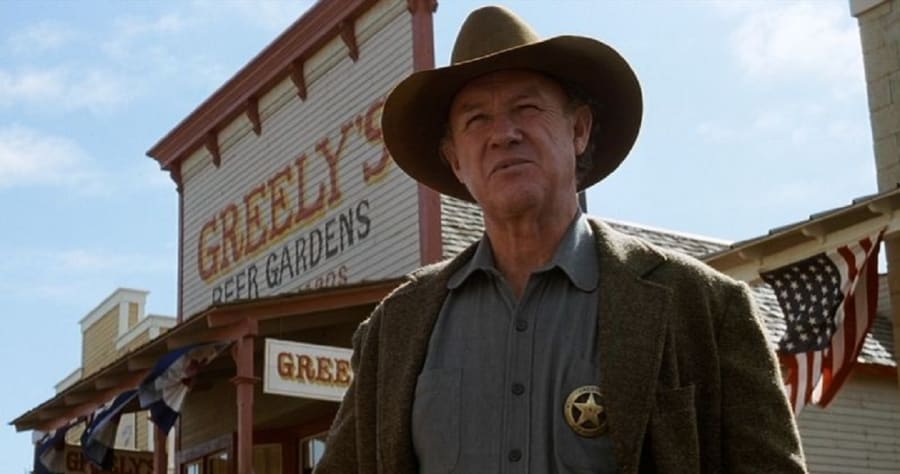
The Western has a reputation for “white hats” and “black hats” – goodies and baddies, with sheriffs taking on ruthless killers with the backdrop of civilisation hewn out of the wildness of the West. It had passed out of fashion by 1992, and this memory is largely what remained. That helps describe the impact of Unforgiven. A great revisionist Western, searingly honest about the brutality of the West, it was made by an actor more associated with the Western than almost any other since Wayne, Clint Eastwood. Articulate, sensitive, intelligent and superbly made, it marked the transition of Eastwood from star to Hollywood artist. It’s still his greatest movie.

In 1880 in Big Whiskey, Wyoming, the face of prostitute Delilah (Anna Thomson) is slashed with a knife after she sniggers at a customer’s unimpressive manhood. The two cowboys responsible are ordered to compensate her pimp by sheriff “Little Bill” Daggett (Gene Hackman). Disgusted, the other prostitutes chip in for a $1000 bounty on the men responsible. A young man calling himself ‘The Schofield Kid’ (Jamiz Woolvett) seeks out famed gunslinger William Munny (Clint Eastwood) to help claim the bounty. Once a brutal killer, Munny is now a repentant widower raising two children – and desperate for money. Recruiting old friend Ned Logan (Morgan Freeman), Munny rides to Big Whiskey – but will he return to his violent ways?

Unforgiven explodes the romantic mythology of the West, in a way that really made people sit up and notice. In truth, revisionist Westerns had been made for decades before 1992 – Eastwood himself had already directed at least two – but as the public hadn’t flocked to see films like McCabe and Mrs Miller (wrongly!) the main memory of the Western was of the (excellent) likes of High Noon, Shane and John Wayne (but not the Wayne of Red River). Nearly every classic Western, to be frank, has a dark heart and questions the mythology. But few films so starkly exposed the violence, ruthlessness, cruelty and empty morality of the West – or more viciously attacked the romanticism built up around it.

In Unforgiven characters – particularly Munny – are constantly haunted by their past killings. The violence described is always cheap, pointless and brutal, fuelled by huge amounts of booze. Munny never seems to remember why he even did something – be it blowing a man’s face off to killing women and children. Whenever we hear about the past, it is a parade of short-tempered, violent, pissed men using the gun as a first-and-last resort, and never thinking of the consequences. The real ‘heroes’ of the West kill without batting an eyelid and, no matter how charming they might seem, have a terrifying capacity for sadism and violence. Place Munny back into this environment, and it isn’t long before his long-hardened ease with killing emerges once again.

It’s men like this the bounty will draw to Big Whiskey – and Little Bill knows it. Little Bill is superbly played by Gene Hackman (he won every award going), full of bonhomie and charisma matched only by a ruthless “end-justifies-the-means” philosophy that sees this law-giver carry out increasingly brutal and sadistic acts to preserve order. Brutally beating gunslingers – and worse – are justified in his mind, to prevent the chaos and slaughter they bring. And he mocks the pretensions of gunslingers fancying themselves romantic heroes, but doesn’t half enjoy telling tales of his own of exploits.

It’s not a surprise that the film’s face of law-and-order is shown to be just as at ease with violence as the killers he is protecting the town from. It’s part of Unforgiven’s intriguing study of morality. When, if ever, is violence justified? Do the ends justify the means, or is killing never acceptable? Or is it fine if you are convinced the cause is right or the target deserving? How long before you’ve slid so far down this slippery slope, that questions of right-and-wrong don’t even enter your head before you pick up a gun?

There couldn’t be a better face for this than Eastwood. Clint looks old, ravaged and tired, just as Munny is, haunted by the screams of men he no longer even remembers. He’s soulful enough to know he has no soul, capable of understanding he needs to change, but also able to revert to dealing out murder. Eastwood deconstructs his own screen personae of “the man with no name” into an old man who can’t face his past and is filled with regrets. As the film progresses, more and more Munny rebuilds his ease with killing – eventually exacting a revenge that leaves a trail of bodies behind.

There is nothing romantic about any of this: despite the best efforts of journalist WW Beauchamp (played with wide-eyed gusto and energy by Saul Rubinek) to inject it. Beauchamp has made a living turning the adventures of gunslingers into romantic best sellers – and is the films’ clearest attack on Hollywood itself for romanticising an era of violence and mayhem. Beauchamp is the biographer of genteel killer English Bob, who has made his money “shooting Chinamen” for the railroads. Played with a self-important grandness by Richard Harris (one of his finest performances), English Bob (actually a working-class oik masquerading as a gentleman) is living his own press release as a gentleman gunslinger. The fact that – as Little Bill delightedly reveals – he is just as much an alcoholic murderer with no principles is just another example of how little reality and fiction meet.

At least Munny accepts he’s a bad man. Perhaps that’s why his late wife shocked her mother by marrying him – he has enough self-knowledge to want to change even if he can’t. But of his three companions – Morgan Freeman is brilliant as the jovial Ned who has lost his taste for killing – only he lasts the course. That’s not a good thing. When we finally see a fully reverted Munny, downing a bottle of whiskey and shooting up a saloon he’s terrifying: brutally efficient with shooting, in a way that panicked shooters can never compete with.

In Unforgiven violence comes with a cost. A shot man takes a long time to die. The women who called most for violence, are left speechless by meeting the reality of it. A man’s soul is marked forever by taking life – “It’s a hell of thing killing a man. You take away everything he’s got and everything he’s ever going to have”. It’s a responsibility only a fool takes on lightly – or sober. Munny and Little Bill are they only ones we see who have come to terms with it in some way, one as a necessary evil, the other as an evil he can switch on and off like a tap. Their ruthless coldness is hardly an advert for wanting to be part of this world.

Eastwood’s masterpiece tackles all these ideas with gusto, while telling an engrossing story powered by brilliant performances – Hackman in particular, Freeman and Eastwood are all stunning – and asks you to take a deep look at what we admire so much about violence. It does this in a subtle, autumnal way (with a haunting score), its muted colours helping to drain any further romance from the West. Gripping, thought-provoking and engrossing, Unforgiven is one of the greatest of Westerns.

The Philadelphia Story (1940)

The Philadelphia Story (1940)

Three stars are at the top of their game in this classic screwball-style comedy

Director: George Cukor

Cast: Katharine Hepburn (Tracy Lord), Cary Grant (C.K. Dexter Haven), James Stewart (Mike Connor), Ruth Hussey (Elizabeth Imbrie), John Howard (George Kittredge), Roland Young (Uncle Willie), John Halliday (Seth Lord), Mary Nash (Margaret Lord), Virginia Weidler (Dinah Lord), Henry Daniell (Sidney Kidd)

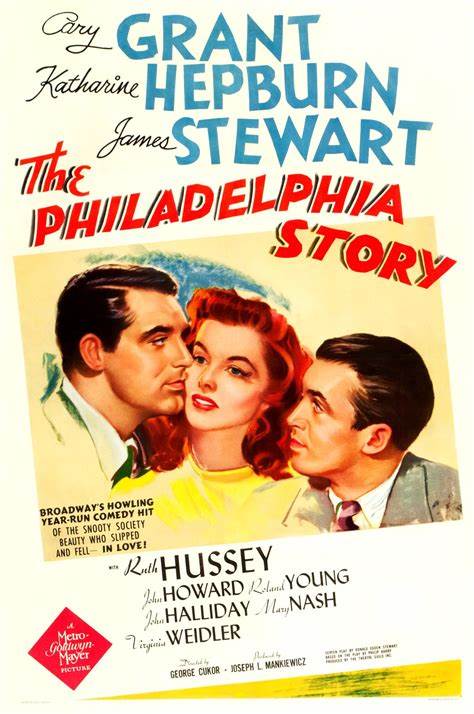
In 1938 Katharine Hepburn’s career was over. After the flop of some now forgotten (wait, hang on…) screwball comedy called Bringing Up Baby, she took centre place on the Independent Theatre Owners list of “Box Office Poison”. Flops after flop hit Hepburn (all of them are classics today of course), and the studios did their damnedest to drop her. So, Hepburn returned to the stage, developing The Philadelphia Story with Philip Barry – and creating a lead role for herself that would play to all her strengths and help win back public affection. And which (with a little help from Howard Hughes) she would own the rights for: so, if and when they wanted to make a film, she could insist she starred. The rest is history.

The Philadelphia Story is perhaps the best example of the Code-approved genre, the “remarriage comedy” (because the code wouldn’t countenance the idea of a couple cheating). Daughter of a rich Philadelphia family, Tracy Lord (Katharine Hepburn) is to marry her dull fiancée George Kittredge (John Howard). George’s main attraction is he’s the complete opposite of her charismatic ex-husband C.K. Dexter Haven (Cary Grant). Dexter crashes the build-up to the wedding, bringing along reluctant society journalist (he’s really a renowned short-story writer) Mike Connor (James Stewart) and press photographer Elizabeth (Ruth Hussey), promising to introduce them as distant friends of the family so they can report on the wedding. But then Tracy finds herself drawn to Dexter and Mike and George as well – who will she end-up walking down the aisle with?

Perhaps the best thing about The Philadelphia Story is that you really don’t know who it will be – and the film successfully keeps the question both up-in-the-air and deeply entertaining. There even seems a chance (unlikely as it is) that Tracy really will stick with George (a tedious nouveau riche businessman with priggish middle-class morals who can’t even mount a house – imagine!). Directed with the sort of unfussy smoothness Cukor excelled in – and helped get the best out of actors – it’s a superb comic treat, with a sparkling adaptation by Donald Ogden Stewart.

At the heart of it, Hepburn is superb in a role that riffs considerably off her own public personality. Hepburn was smart enough to know most audiences saw her as far too clever by half. Her sharpness, acidity and no-nonsense unwillingness to suffer fools had made her hard to relate to. Quite correctly, she felt she needed a role where she could “fall flat on her face”. Which , by the way, is more or less the first thing she does – a hilarious prat fall while throwing Cary Grant’s Dexter out, him responding to her snapping his golf clubs by gently putting his hand on her face and pushing her off-balance (only Grant could have got away with that by the way).

Tracy Lord is a version of the Hepburn many people felt they knew. Tracy genuinely believes she’s smarter and better than anyone else, with unquestionable judgment and superior morals. The film is a gentle exercise in pricking her balloon, showing her she is as prone to mistakes, prejudice and, above all, getting giddy and silly in love, as anyone else. This is a fiercely practical woman, who sets high standards for those around her, suddenly finding herself falling in love with three men at once. It’s the exact flighty lack of commitment she spent years condemning her estranged father for.

This is all scintillatingly played by Hepburn, at her absolute best. The rat-a-tat dialogue (with its classic, Wildean comedy of errors and mis-identification) is under her complete control. She’s delightful when, under the influence, she flirts with Mike – Hepburn showing the world (clearly they missed it in Bringing Up Baby) that she could be as silly and vulnerable as the next girl. Hepburn knew people wanted to see her personae deconstructed, and for her character to learn that (in the words of another comedy) nobody’s perfect. It works a treat – and this remained one of her greatest (and funniest) performances.

It helps she had two of the greatest to riff off. Cary Grant is at his light-comedic best here, turning Dexter – a manipulative reformed alcoholic it would be easy to dislike – into the embodiment of sophistication, charm and playful wit, who we adore as much Tracy’s family does. James Stewart won an Oscar and matches Grant gag-for-gag in a comedic masterclass. He’s a master of hilarious comedic and physical reactions – and lovable enough to turn a chippy newspaperman into a sort of hilariously droll sage. His ‘drunk’ acting is also some of the funniest you’ll see on film (even Grant can be spotted cracking up just a little as Stewart hiccups his way through a scene).

Hepburn’s chemistry with both actors is sublime. Her romancing scenes – both the worst for wear for drink, but also empowered to say things they’ve clearly been burying all day – with Stewart are not hugely romantic, but also rather sexy (Cukor’s direction here is also exquisitely spot-on). It’s a masterclass in on-screen flirtation – and you can see why George gets as pissed off as he is. Hepburn and Grant meanwhile bicker and taunt each other with all the chemistry of a match and a fire.

Each scene has a bounce that teeters between heart-felt and farcical. The set-ups are frequently silly – but they work because they hinge on characters that feel immensely real. Every performer is spot on – credit also goes to a superb Ruth Hussey, one of the few grown-ups in this weekend of flirting, feuding children. Set in a sumptuously rich Philadelphian mansion, for all of Mike’s chippy criticism it’s a celebration of the smooth upper classes over hard-working, dull prigs like George. Its sole fault might be it’s too long (at just under 2 hours, a few scenes and set-ups outstay their welcome). But, as a classic Hollywood comedy, it’s pretty much the top of the class. Box-office poison no more.

The Last Emperor (1987)

Bernardo Bertolucci directs the epic, intriguing but slightly hollow The Last Emperor

Director: Bernardo Bertolucci

Cast: John Lone (Puyi), Joan Chen (Wanrong), Peter O’Toole (Reginald Johnston), Ying Roucheng (Prison Camp Governor), Victor Wong (Chen Baochen), Dennis Dun (Big Li), Ryuichi Sakamoto (Masahiko Amakasu), Maggie Han (Yoshiko Kawashima), Ric Young (Interrogator), Wu Junmei (Wenxiu), Cary-Hiroyuki Tagawa (Chang), Jade Go (Ar Mo), Henry O (Lord Chamberlain)

In 1908 a toddler, Puyi, became the last Emperor of China – but in 1912, revolution made China  a Republic and he was reduced to only being Emperor of The Forbidden City, a place he has never left since 1908 and will not leave until 1924 when he is expelled from the city. As an adult Puyi (John Lone) remains a puppet, becoming Emperor of the Japanese puppet state of Manchukuo, where he is again largely confined to his palace, his Empress Wanrong (Joan Chen) becoming an opium addict. After World War II, Puyi is imprisoned for ten years by the Maoist government, being re-educated into becoming an ordinary citizen of China.

Bertolucci’s film explores the life of this slight historical figure. I say slight, as Puyi is always and forever a puppet, buffeted by history. He owes whatever prominence he has to a quirk of fate, but never truly learns who he is or his purpose, only slowly realising his power is an illusion. It’s the main flaw of The Last Emperor – otherwise a sumptuous epic – that it is such a grand film about such a shallow person. Puyi is not particularly interesting in himself, and the film largely fails to turn him into an intriguing enigma. The Last Emperor – which hoovered up 9 Oscars, including Best Picture – is brilliantly made, frequently fascinating and breath-taking, but also strangely lifeless.

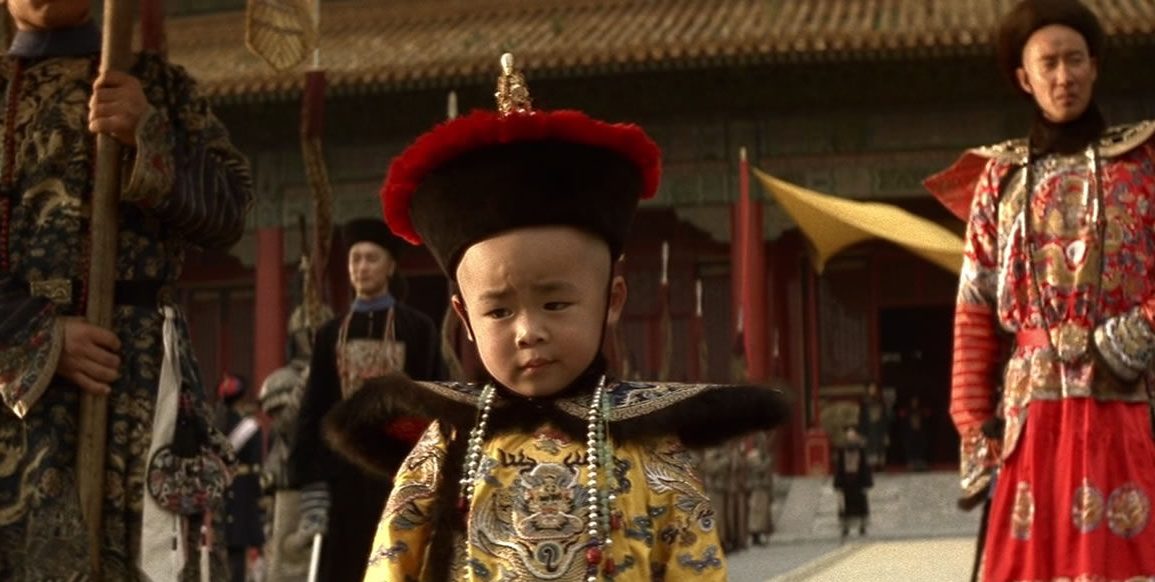
Bertolucci and producer Jeremy Thomas spent years raising the money and negotiating with the Chinese government to have unrestricted, exclusive access to the Forbidden City. It’s that which really makes the film effective. The first half of the film is set almost exclusively in The Forbidden City (flash forwards see the adult Puyi in post-war captivity, being questioned by his guards). The scale is stunning and is shot by Vittoro Storaro with a breath-taking opulence and fascinating eye for Chinese culture. Storaro also carefully distinguishes with colours each section of Puyi’s life, from the reds and golds of his childhood to the washed-out greens of his adulthood. The impact of this on screen remains impressive today – and Chinese co-operation produced almost 19,000 extras to populate it.

These early sections are the film’s strongest. Bertolucci was frequently intrigued with complex coming-of-age tales, balanced with leftish politics. The film is fascinated with the power/non-power of this child. He leads a strange dance of being a puppet and figurehead, who can still order his servants to obey his every whim. It’s an upbringing that would pervert any child – and Bertolucci shows it creates a man who lacks any sense of emotional awareness and maturity; not cruel as such, but unable to fully understand what it is to be human because he has never known anyone who is an equal.

His ‘power’ expresses itself in petulance, selfishness and sometimes acts of cruelty – and he becomes a man drifting through life, aware that he should feel more of a connection with people, but lacking the emotional self-awareness forming connections with people requires. It’s not helped by Puyi’s weak personality. Growing up effectively imprisoned – but all-powerful – in a single city means he constantly gravitates towards similar situations, be that a puppet ruler signing whatever he is told to in Manchukuo or expecting his servants to continue to dress him in prison (how is prison different really from the rest of his life?)

Bertolucci films this with an acute emotional understanding that counterpoints the wonderfully luscious scale of the film. All those expansive costumes, the gorgeous filming and the awe-inspiring location shooting helps us to understand the smallness and meekness of Puyi and his stunted emotional world. Only the arrival of an English tutor – played with an expressive playfulness by Peter O’Toole – shakes up this world and offers Puyi the chance of some sort of personality development. Sadly, his influence is all too short – and Puyi seems to take mostly the wrong lessons from it, of English exceptionalism and ‘doing your duty’ that convince him he’s got to try and maintain his position.

The first half of the film is breath-takingly, with Bertolucci carefully interweaving grace notes around Puyi’s lack of true parental love (his beloved wet nurse is expelled), his growing sexual awakening – from suckling at a late age to taking both a wife and a consort (and, for Bertolucci, the inevitable threesome scene – tastefully done). The bizarreness of this world, a tiny kingdom with its own rules and an empty figurehead living in a fantasy land are striking.

It’s after Puyi leaves that the film weakens. Perhaps knowing the Forbidden City sequences were the finest – and most gorgeous – parts of the film, most of Puyi’s life after is shunted into the final hour. This makes for rushed scenes and a number of “tell not show” moments, where characters bluntly (and swiftly) fill in various political and social events or openly state their thoughts and feelings. Puyi’s reasons for becoming Emperor of Manchukuo are only briefly sketched, but not as briefly of the characters of his new Japanese masters (Ryuichi Sakamoto – also the Oscar-winning composer – and Maggie Han, a seductive collaborator) as scenes race by as the film rushes towards its conclusion.

Perhaps also not surprisingly for an old Marxist (and with that need to secure the Chinese co-operation) the Maoist government gets a fairly easy ride, with the main representative of Maoist authority being a genial, supportive chap and the re-education camp treated as a genuine programme of self-improvement rather than indoctrination. But then you can also say it’s a sign of the film’s relative even-handedness – and it does touch on the Cultural Revolution (and its random denunciations) late, albeit with a gentle eye.

It’s a shame the second half of the film doesn’t hold up as well as the first half (a longer Director’s Cut fixes some of these problems), but the first half is intriguing, dynamically made and full of emotional insight. John Lone does a fine job in a rather thanklessly bland role as Puyi and Joan Chen moves from austere to depressed as his wife, but to be honest few other members of the cast make an impact (it’s one of the few modern Best Picture winners with no acting nominations).

Bertolucci’s film is superbly made, beautiful to look at, intriguing – and you can see its influence on Farewell My Concubine among others (Chen Kaige has a small role in the film, as does Zhang Yimou) – but it suffers slightly from being about such a non-person. You wonder how it might have worked better if it had kept a tighter focus – or skimmed over more of Puyi’s life rather than hurriedly trying to cover the whole lot – but what we end up with mixes the rushed with the extraordinary.

How the West Was Won (1963)

James Stewart helps us see How the West Was Won

Director: Henry Hathaway, John Ford, George Marshall

Cast: Spencer Tracy (Narrator), Carroll Baker (Eve Prescott Rawlings), Walter Brennan (Colonel Jeb Hawkins), Lee J Cobb (Marshal Lou Ramsey), Henry Fonda (Jethro Stuart), Carolyn Jones (Julie Rawlings), Karl Malden (Zebulon Prescott), Raymond Massey (Abraham Lincoln), Agnes Moorehead (Rebecca Prescott), Harry Morgan (Ulysses S Grant), Gregory Peck (Cleve van Valen), George Peppard (Zeb Rawlings), Robert Preston (Roger Morgan), Debbie Reynolds (Lilith Prescott van Valen), Thelma Ritter (Agatha Clegg), James Stewart (Linus Rawlings), Rus Tamblyn (Confederate deserter), Eli Wallach (Charlie Grant), John Wayne (William Sherman), Richard Widmark (Mike King)

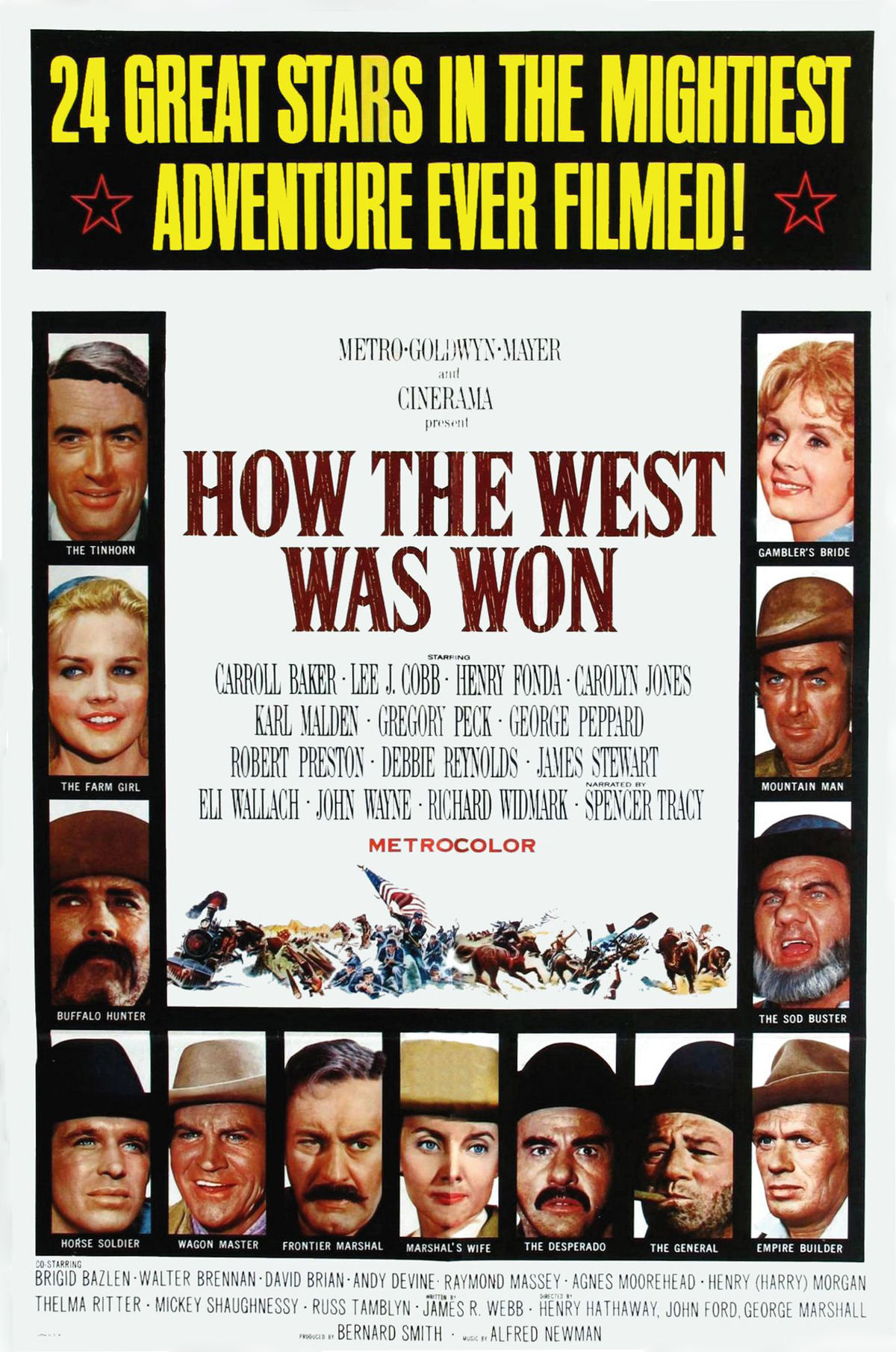
How the West Was Won was the Avengers: Endgame of its day: every star of the biggest box-office genre in America coming together for one epic adventure that would stretch over generations. Stewart! Fonda! Peck! Wayne! Together for the first time (only of course they are not, none of them appearing the in same scene). Even more than that, How the West Was Won would be filmed in Cinerama, a three-screen shooting method producing a panoramic image. All this would make How the West Was Won the biggest, grandest, largest film ever made. It was a massive box-office success, nominated for eight Oscars (including Best Picture) and wowed audiences.

Plot wise though, it’s basically a series of short films cobbled together into a single film. The stories are basically self-contained, although some actors cross over (especially George Peppard and Debbie Reynolds). The first episode The Rivers covers the migration west, down the river, of the Prescott family, taking on river pirates and allying with James Stewart (looking at least twenty years too old as a young drifter). The Plains sees Debbie Reynolds, daughter of the Prescott family, migrate further West and eventually marry gambler Gregory Peck. The Civil War sees Stewart’s son George Peppard caught up in the war. In The Railroad, Peppard reluctantly runs security for ruthless railway builder Richard Widmark. Finally, in The Outlaws an older Peppard attempts to retire, but not before one final shoot out with old enemy Eli Wallach during an attempted train heist.

All these short stories – each about 30-45 minutes in length – are entertaining. So entertaining that you won’t mind at the end that you have no idea how the west was actually won (I assume it’s something to do with progress and the law) or that the characters are basically actors riffing off their own personas rather than fully realised individuals. Despite the attempt to build the story around one  family (the Prescott-Rawlings), the stories are so disconnected and the characters so lightly sketched, with such huge time jumps, each story might as well be about completely new characters.

Not that there is anything particularly wrong with that. But it boils down to the key issue with How the West Was Won, a very flabbily constructed film that lacks any real sense of guiding narrative or vision behind it. It’s a series of set pieces, which are all about scale – the river rapids, the battles of the Civil War, the final train-set shoot out – in which some loosely defined characters live their lives. There are some decent performances – Debbie Reynolds does a very good job anchoring a couple of stories (plus we get to see her do some song-and-dance routines), while Peck (a smooth operator) and Fonda (a gruff woodsman) have the best parts among the stars. Others, like Wayne, pop up for but a few seconds.

They needed all these stars to fill the frame. How the West Was Won’s main problem is also its principle reason to exist. It was designed to showcase the wideness of Cinerama, one of only two films to use the technique. Designed to be projected into curved screens, the technique essentially used one massive camera to produce an image so large it needed three synchronised projectors to screen it. This led to an impossible wide frame to fill, with two clear joins in the middle. The challenge of shooting this was not an enjoyable one for the directors.

To cover the visible joins, nearly every scene in the film sees an object placed one-third and two-thirds of the way through the image (usually a tree or a post). The actors stand carefully on their marks in their assigned third of the image. Close ups involved flying the massive camera almost into the faces of the actors (and even then it only produced an image from the waist up). Awkward compositions abound – either with actors standing rock still in front of huge scenery, or actors standing in carefully assigned rows, standing on marks they never move from.

The sweeping shots of the American west look impressive, but in a National Geographic way – it’s simply fitting as much of the imagery of the countryside in as possible. It was a hugely difficult job for the directors. It was not helped by two of them being competent journeymen and all three of them having done their best work in 4:3. Quite frankly I don’t think any of them have a clue about how to fill a frame this mighty. Instead, the film for all its grandeur is frequently visually conservative and unimaginative to look at. It’s got huge landscapes, but no real inspiration.

How the West Was Won is an enjoyable curiosity. It is very rarely, if ever, seen as it was intended on a Cinerama screen (the version I watched on a large television, still showed the slight fish-eye effect at points of a curved image flattened). Telling five short stories, each of them entertaining enough, it keeps the interest. It has a lusciously beautiful (famous) score by Alfred Newman that captures the spirit of the West. But, for all its grandness, it’s a strangely small experience.

Mrs Miniver (1942)

Greer Garson and Walter Pidgeon hold the homefront together in Mrs Miniver

Director: William Wyler

Cast: Greer Garson (Kay Miniver), Walter Pidgeon (Clem Miniver), Teresa Wright (Carol Beldon), Dame May Whitty (Lady Beldon), Reginald Owen (Foley), Henry Travers (Mr Ballard), Richard Ney (Vin Miniver), Henry Wilcoxon (Vicar), Christopher Severen (Toby Miniver), Brenda Forbes (Gladys), Clare Sanders (Judy Miniver), Helmut Dantine (German pilot)

Mrs Miniver was made when history was in flux: conceived at the height of the Blitz, shot and then parts re-shot either side of Pearl Harbor and released in 1942 after America had entered the war. A patriotic flag-waver, designed to build American sympathy for a Britain standing alone, it was a huge hit, won Best Picture and had a profound impact on Allied morale (Churchill called it more help to the War effort than a flotilla of battleships). It still carries an inspiring, cockle-warming charm and a hefty emotional punch, made even more affecting by the stoic determination (rather than hand-wringing emotion) every setback is met with.

In a small village just outside London, lives the Miniver family. Kay Miniver (Greer Garson) cares for her family in a large country house. She has three children with architect husband Clem (Walter Pidgeon). Their life is contented – and then war breaks out. Oldest son Vin (Richard Ney) joins the RAF – after falling in love with Carol (Teresa Wright), niece of the local grandee Lady Beldon (May Whitty). Clem joins the ships travelling to Dunkirk. Kay holds the domestic fort, protecting her family from air raids, facing down a German pilot and helping shepherd her small village through the trauma of air raids to something approaching a normal life.

Mrs Miniver is all about that stoic, British stiff-upper-lip attitude, of doing your duty uncomplainingly and quietly. As they said “Britain Can Take It”, and the film is a celebration of the nobility of perseverance. It’s designed to inspire and it does: it’s melodrama played with a low-key reserve, which is genuine and heart-felt. There is a reason Goebbels (and he would know) called this a “refined powerful propagandistic [tool]” – it makes you completely emphasise and relate to its characters. We share their moments of joy just as much as the profound tragedy of their losses.

And there is a lot of loss in Mrs Miniver – way more than you might expect, with the film’s final act throwing at least two painful gut punches you don’t expect. Tragedy touches all of us and war carries away the innocent and undeserving with as much eagerness as it does the militaristic. There seems to be no reason or justice to it – but instead the difficult acceptance of fate and the necessity of being part of a struggle larger than ourselves.

In a powerful speech that concludes the film, the vicar stands in the bombed-out ruins of his local church. It mirrors a scene near the beginning, as he regretfully but with quiet reserve announces the outbreak of war. Now he gives a rousing speech that this is war of all the people, against the tyranny that threatens us, where the dead our mourned but not forgotten. It’s a powerful speech (brilliantly delivered by Henry Wilcoxon), of the painful necessity of duty at the time of war that still stirs (it was distributed nationally by Roosevelt’s insistence).

The stoic, good-natured, supportive community, who protect each other and desperately try to maintain hope and nobility when death could strike at any time, contrasts firmly with the only German we see. A wounded pilot who gains entrance to Kay’s home at gunpoint. Kay calmly disarms him, feeds him and tends to his wounds (after all he is the same age as Vin) – he responds with a vicious speech of violent hate, bragging at the deaths the Luftwaffe have inflicted on Europe. It’s the only time her reserve really breaks, as she slaps him – and even for a moment seems to consider dispatching him. Her delayed shock is clear later when she casually smokes one of Clem’s cigarettes – a mixture of restrained shock, relief, horror and confusion across her face. It’s the closest direct danger comes – and the closest she comes to openly expressing rage and anger at the hand the world has dealt her.

The film revolves around Greer Garson’s (Oscar-winning) performance. Though it’s easy to see Kay as a sort of saint, that’s underestimating the huge burden Garson had: she effectively embodies an entire Homefront of scared people doing their duty. It’s a performance of stiff-upper-lipped warmth, her desperation, fear and protective nature clear in every beat. You can see it in her mix of distracted fear and pride when Vin announces he has joined the RAF, and the front of “everything will be alright” she puts on for the children during an air raid that tears her house apart.

Of course, that disaster is met with a “I always wanted to redo that dining room” fortitude by her husband, Clem. Pidgeon and Garson forged a partnership that would run through several movies here, and spark off each other wonderfully. Pidgeon gives a solid grounding to Garson, while she helps find warmth and humanity in an otherwise distant actor (Pidgeon lacks Peck’s – who he resembles in many ways – ability to convey warmth under reserved dignity). Pidgeon’s stirring sense of duty excels, not least during the Dunkirk sequence.

That sequence is very well executed, a small series of boats gradually growing in size until they fill the Thames. When duty calls, people respond with gusto and pride. Alongside this, normal life continues as much as possible: not even the war will stop the flower show. This remains a heart-warming centre piece – pinched for an episode of Downton Abbey – as Lady Beldon overrules the sycophantic judges and gives the prize to the deserving winner, local station manager Mr Ballard (Henry Travers, sweet but receiving a generous Oscar nomination).

The acting is pretty much spot on. Teresa Wright (Oscar winning) is endearingly genuine and vibrant as Vin’s wife to be (and Lady Beldon’s niece) Carol. May Whitty, channelling those grande-old-dames-with-hearts-of-gold, gets every beat right, from comedy to tragedy, Wilcoxon is marvellous. It’s all so heartfelt and earnest you can overlook the fact most of the (largely American and Canadian) cast go for cod-Brit accents or cliched working class vowels – just as you do the fact that neither the towns or countryside in the film looks particularly British (an opening sequence in London looks plain wrong in every sense).

And you can’t fail be stirred by its celebration of quiet determination and unshowy self-sacrifice. You can certainly argue that it’s not a work of art, like other films nominated that year for Best Picture. But, none of them would have (or continue to have) the emotional impact this has. Sure, it feeds off an American nostalgia for English-country-village life – but it does so with a noble cause. Well-acted, very well directed, it still inspires and continues to provoke pride today.

Out of Africa (1985)

Robert Redford and Meryl Streep in this sweepingly empty romance Out of Africa

Director: Sydney Pollack

Cast: Robert Redford (Denys Finch Hatton), Meryl Streep (Karen von Blixen), Klaus Maria Brandauer (Bror von Blixen), Michael Kitchen (Berkeley Cole), Michael Gough (Lord Delamere), Suzanne Hamilton (Felicity Spurway), Rachel Kempson (Lady Belfield), Shane Rimmer (Belknap), Malick Bowens (Farah Aden), Joseph Thiaka (Kamante), Donal McCann (Doctor), Leslie Phillips (Sir Joseph Byrne)

In the 1980s Hollywood faced an identity crisis. Throughout the 1970s, the films the Oscars honoured and those that topped the box office were often one and the same. The industry saw itself as the purveyor of classy, intelligent, popular entertainment. But in the 1980s, people flocked to see the latest Rocky or Rambo film, instead of the likes of Kramer vs Kramer. Hollywood wanted to carry on feeling good about itself: so it honoured as “Best Picture” the sort of sumptuous, prestige products it wanted to shout from the rooftops about, even if people weren’t flocking to see them at the cinema in the same way. So something as mundane, average, tasteful and empty as Out of Africa hoovered up eight Oscars.

Based on Karen Blixen’s memoir of her 17 years (from 1913) owning and running a coffee farm among the British community in Kenya, the film reorganises a deliberately non-linear memoir (full of impressions and reflections, thematically arranged) into a simpler narrative, and throws in content from at least two biographies of Blixen (played by Meryl Streep). As such, the film charts her life, specifically her relationship with philandering and unreliable husband Bror (Klaus Maria Brandauer) and love affair with British game-hunter Denys Finch Hatton (Robert Redford).

Pollack directs this epic with a clean, smooth, professional and lifeless tastefulness that makes it a long film full of pretty things, but a fundamentally empty experience. At the film’s conclusion, Karen is invited into the Men Only club for a drink where she is toasted. It feels like it should be the culmination of plot threads running throughout the film. But instead, its under-explored and unfocused, struggling for any attention. Rather than a culmination of a nearly three-hour experience, the moment feels unearned.

That’s about par for the course for a film ticking all the boxes of “prestige” movie making, but which tells us nothing at all. It’s clear Pollack has only a limited understanding of the intricate rules of the British upper-class community. We learn nothing about Africa, or the role of Empire there or the impact this had on the Kenyan people. Instead, the Kenyan people are seen as exotics or charming superstitious eccentrics.

The film is only interested in how beautiful colonial Britain was – the lovely clothes, the sumptuous set-design, the detailed props – and the gorgeous scenery. There is some focus given to the Kenyans – particularly Karen’s relationship with her servant Farah, very well played by a stern but wise Malick Bowens – but it is always defined as Karen visiting them, encouraging their education and pleading for their rights. There is more than a touch of the white saviour, and the film fails to really give us a sense of Karen gaining an understanding of the Kenyan people on their own terms, rather than hers.

That might be because the film is determined to turn the story into a straight-forward romance, giving most of its focus to Karen’s relationship with Denys. This is the root cause of most of the film’s problems, as Pollack casts two fundamentally unconnected actors. Streep gives a performance of such technical detail, you find yourself admiring the work while never really connecting with the character. Her Danish accent is perfectly studied, she has clearly read everything on Blixen she can find, and every single beat is perfectly observed. You can’t miss she is acting in every frame: there is nothing relaxed or truly intimate in the performance. It’s the work of a master craftsman.

This detailed excellence literally feels like it is happening in a different movie to the one Redford is in. Redford looks like he just stepped off the plane and started shooting. Pollack was convinced no English actor could play Denys in the sweeping romance he had in mind (Charles Dance anyone? Michael Kitchen – very good as Denys’ best friend – is far closer to what the part actually required, and would have been excellent). Redford was parachuted in and encouraged to play the role with his natural accent (is he still meant to be British? No idea).

The two performances never click together, and Redford’s Californian approach feels totally wrong for the Houseman-quoting, Mozart-playing, Great White Hunter he is meant to be. Not for one second can you forget this is the Sundance Kid – making it nearly impossible to buy into this relationship the film is trying to sell you, as well as making Streep’s Danish accent sound out of place (I mean why is she going to so much trouble when Redford can’t be arsed?).

All the romantic hair washing in the world can’t make these two stop being a chemistry free, jarring couple. Take away the sort of epic romance the film needs – the sort of thing The English Patient would do so right 11 years later – and all you really have left are two handsome actors in a very picturesque setting. Out of Africa looks lovely – but in a National Geographic way. The African Plains look wonderful, you’d have to do a poor job to make them look bad. Really the film is visually dull.

Pollack’s limitations as a director are revealed – he can’t give this the sweep and sense of the epic it needs and he can’t find depth in this canvas. Instead, everything is painted in the broadest brush strokes and any sense of romance it gets is from John Barry’s exquisite, luscious score. The film crams in as many shots of Africa as possible – but is bored witless by the story-telling and poetry that are supposed to be at the heart of Denys and Karen’s relationship. It rips the heart out of these two characters and their romance.

Out of Africa won all those Oscars – but feels like a box-tick exercise. Like the voters just thought everything in it musthave been Oscar-worthy. 1985 was a poor year for movies – perhaps only Ran, Brazil and Back to the Future have really grown in stature – but Out of Africa feels like the emptiest, least interesting, least effective prestige picture that ever scooped the Oscar. Nothing sticks in the memory – other than the repeated “I had a farm in Africa” line in Streep’s tongue rolling accent. Kitchen, Suzanne Hamilton and Brandaurer (charming and likeable as Blixen’s husband, despite playing a complete shit) are good, but nearly nothing else really works beneath its surface impact. Middle-brow, tasteful and pointless.

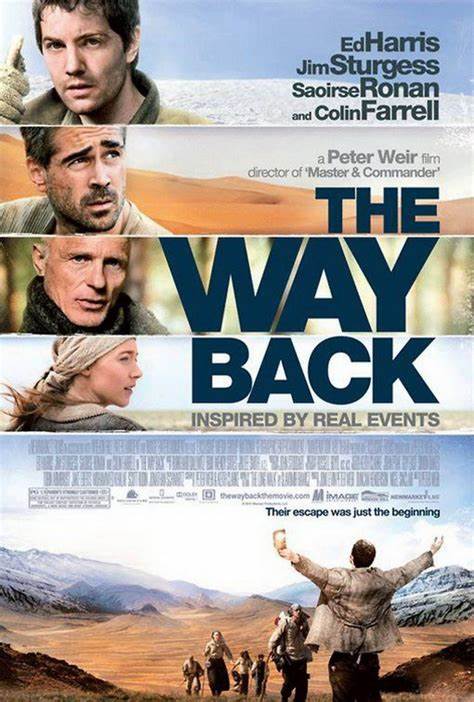
The Way Back (2010)

Harris, Sturgess and Farrell cross a great distance in Peter Weir’s The Way Back

Director: Peter Weir

Cast: Jim Sturgess (Janusz Wierszczek), Ed Harris (Mr Smith), Saoirse Ronan (Irena Zielinska), Colin Farrell (Valka), Dragos Bucor (Zoran), Alexandru Potocean (Tomasz), Gustaf Skarsgard (Andrejs), Sebastian Urzendowsky (Kazik), Mark Strong (Andrei Khabarov)

During the Second World War, Stalin spent almost as much time rounding up potential enemies of the state as he did fighting the Nazis. This was also his exclusive focus during the early years of the war when, in league with Nazi Germany, Russia invaded half of Poland. Polish officers were rounded up – many were massacred but Katyn, but some were sent to the gulags of Siberia. Among that number is Janusz (Jim Sturgess). But he is desperate to get home – so, with a collection of fellow prisoners, including American Mr Smith (Ed Harris) and hardened criminal (and pro-Stalinist) Valka (Colin Farrell) he escapes. Trouble is freedom is over 4000 miles away – through Siberia, Mongolia, the Gobi Desert and the Himalayas. To even contemplate the walk is staggering.

Which is more than you can say about the film. I never thought I would see a Peter Weir film that left me cold, but I now I have. How did Weir manage to make a compelling survival story into a film at times so unengaging you feel you have done the walk in real time? The real problem is the lack of characters. Halfway through the film the group encounters a young woman (played by Saoirse Ronan). She asks them what their background is – and they tell her (off-camera). And she tells them to Ed Harris. And he tells her his backstory off camera – and she tells it to Jim Sturgess. And there is the problem in a nutshell.

We’ve spent nearly an hour with this lot by then – and in that hour you’d struggle to know their names and certainly don’t know anything personal about them. We have no idea where they came from, what they lost or what they are yearning to return to. An hour during which it was hard to tell them apart (except for the more famous actors) but the film still wants me to invest in them fighting against the elements. Now, I know for many people, this isn’t be a problem. But for me it was an insurmountable obstacle.

I can admire the work that has gone into location shooting, make-up and costumes that show the ravages of this impossible journey. But, at the end of the day, if I know nothing about these characters and have no reason to invest in their fate, all the skill in the world won’t make this into a film I can invest in. Look at the great survival films – from The Flight of the Phoenix to another true-life (more of that later) story Apollo 13 – what makes them work is the dread that something awful might happen to the characters we care about. Without that feeling, it’s just pictures, nothing more. Weir’s mistake is to focus so much on how the Gulag crushes personalities and creates alliances of convenience, that he gives us no reason to bond with the characters.

The wispy, thin script gives very little for the actors to work with. Colin Farrell has the best part as a blackly comedic man of violence (and he drops out well before the end of the film). Mark Strong makes a big impact from a few short scenes as a prisoner who is all talk but no trousers. The others make little impression. Ed Harris does his trademark gravel, Saoirse Ronan adds much needed warmth (and provides a hugely needed audience surrogate figure – again far too late) but Jim Sturgess lacks the presence or force of character to carry the film. Force of character is missing throughout – you don’t get the sense of the strength of will needed to even undertake this, not to mention the psychological impact of this level of hardship.

It’s also oddly paced – you really lose track of how far or how long they have been travelling. Big time jumps take us from the first day of the escape to a cave in the forest which (we assume) they have spent weeks travelling to, reaching the edge of starvation. Then, before we know it they are at the border, then Mongolia. The film gets lost in a huge sequence in the Gobi Desert (for some reasons the characters always walk in the day and rest at night, the exact opposite of what anyone would do) – emerging with 12 minutes to go, bounding over the Himalayas in about 30 seconds (was it too difficult to film there?). The film caps with a bizarre “he walked forever” sequence, with superimposed walking feet over newsreel footage – a failed attempt to hammer home that Janusz needed to wait until the end of the Cold War before he could get home.

It’s nominally based on a true story. The author of the book it is based on is believed to have either invented or stolen the story from someone else and there is huge debate about whether it happened or not and if so who did it. This should have given Weir some freedom – but instead it seems to have given him too little to build on. Most damning in it I can’t find any reason in it to care whether they make it to freedom or not, instead the time dragging as much as the characters swollen feet. A terrible missed opportunity – and a rare misfire from a great director.

Saving Private Ryan (1998)

Tom Hanks leads a platoon of men through incredible sacrifice in Spielberg’s landmark Saving Private Ryan

Director: Steven Spielberg

Cast: Tom Hanks (Captain John Miller), Edward Burns (Pvt Richard Reiben), Matt Damon (Pvt James Francis Ryan), Tom Sizemore (Sgt Mike Horvath), Jeremy Davies (Cpl Timothy Upham), Vin Diesel (Pvt Adrian Caparzo), Adam Goldberg (Pvt Stanley Mellish), Berry Pepper (Pvt Daniel Jackson), Giovanni Ribisi (Medic Irwin Wade), Dennis Farina (Lt Col Anderson), Ted Danson (Cpt Fred Hamill), Harve Presnell (General George Marshall), Bryan Cranston (Colonel), Paul Giamatti (Sgt William Hill), Nathan Fillion (“Minnesota” Ryan)

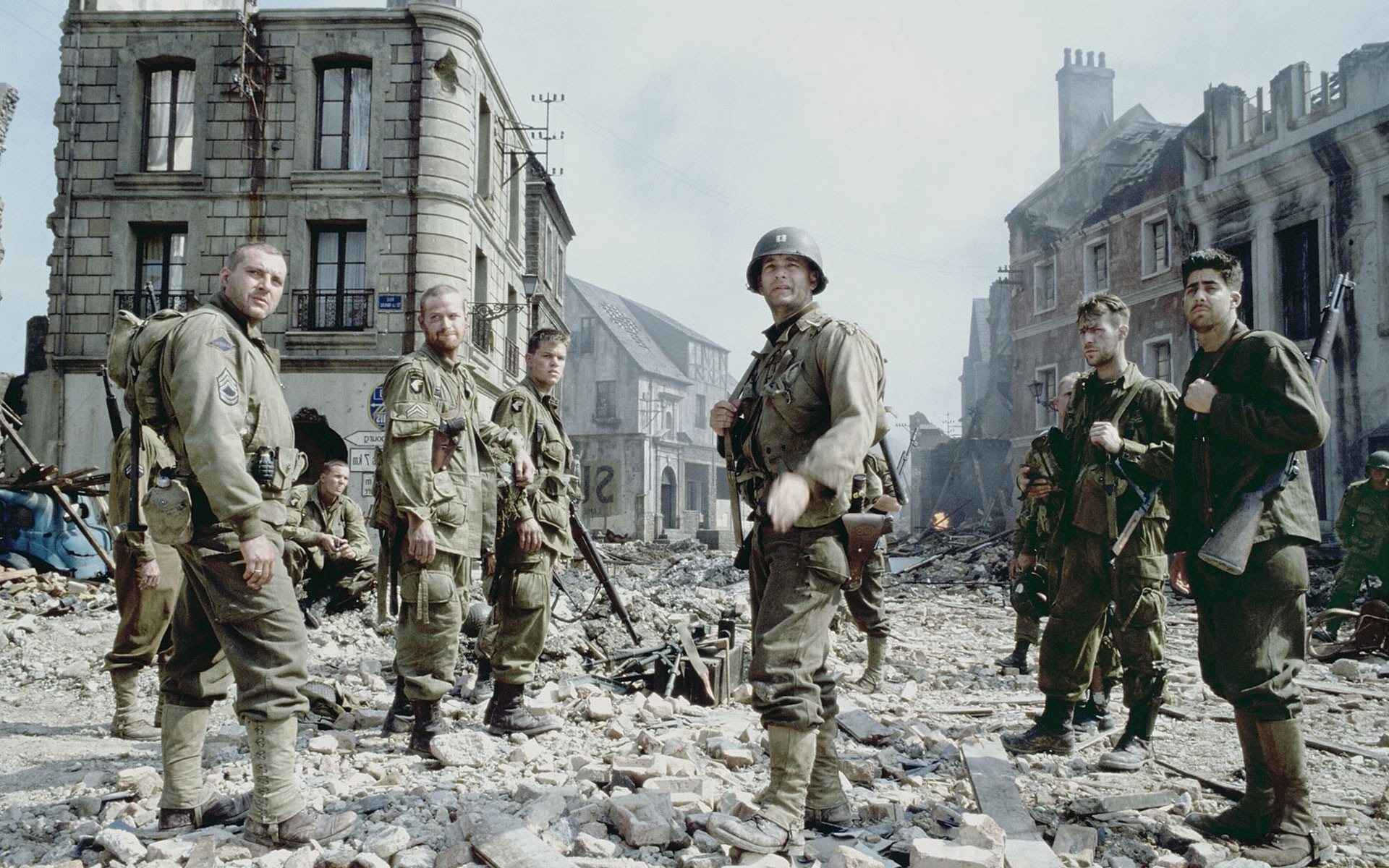
There are few films you can categorically point to as changing cinema. Saving Private Ryan is one of those films. Before it, there had never been a war film like it: afterwards there would not be war film uninfluenced by it. Spielberg turned the Second World War from the picturesque setting for an all-star epic, into something immediate, ground-level and utterly, terrifyingly all-consuming. The “boots on the ground” vision of war, that didn’t shirk once from capturing the horrific cost and terror of war and had no suggestion of adventure. Hollywood would look at war differently ever more.

From landing at Omaha beach on D-Day, the film follows a single week in the lives of Captain John Miller (Tom Hanks) and a platoon of soldiers, sent on a ‘public relations’ mission. Three brothers have all been killed in action, with their mother receiving notification of their deaths all on the same day. The top brass decide she has suffered enough and that her last remaining son James (Matt Damon) should be bought home. Problem is, he’s a member of the 101st Parachute Airborne – and no one is quite sure where he’s been dropped. Miller and his men are to find Ryan and bring him home – despite the resentment of his men that their lives at being put at risk to save one man.

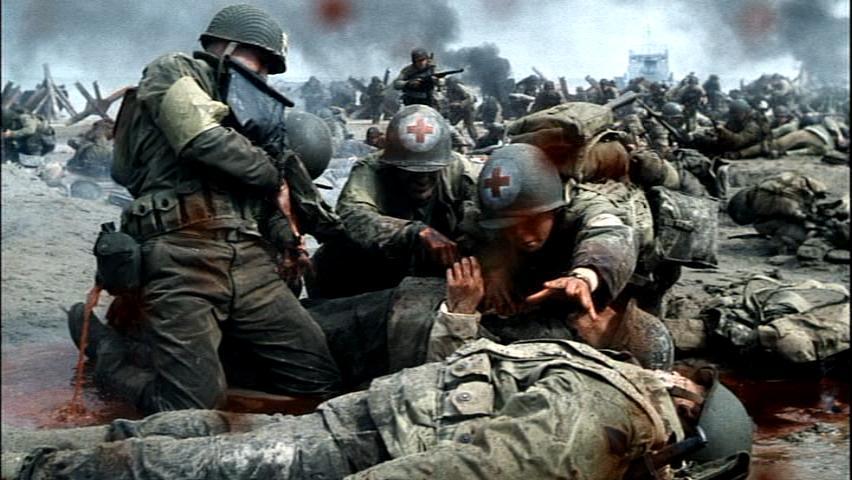
Any discussion of Saving Private Ryan begins with that Omaha beach sequence.  It’s hard to even begin to understand the impact this sequence had on audiences in 1998. Quite simply, we’d never seen anything like it. Expectations before its release was that Spielberg was producing a crowd-pleasing, Dirty Dozen style men-on-a-mission film. No one expected a savage, brutally realistic vision of what warfare actually meant, with its brutal, swift and random death.

The sequence starts with Spielberg panning across the faces of soldiers in the landing craft Miller and his company are riding to the beach. He lingers on these faces – only for them to be promptly ripped to pieces by machine-gun fire the second the doors open. Omaha beach is a savage nightmare, the closest thing you can image to hell on earth. Machine gun bullets rip down relentlessly on the pinned down soldiers – and the camera throws us right in there with them.

With drained out colours, hand-held camerawork (some of it operated by Spielberg himself), mud, blood and sand spraying up into the lens, it’s all-consuming. The film’s sound design is awe-inspiringly good, every single sound (the splatter of sand, the thud of bullets ripping through flesh, the snap of rifles) builds into a shatteringly immersive crescendo with no respite. Spielberg doesn’t shy away from the horror. Bodies are mutilated by bullets. Heads are caved in. A soldiers walks the beach, carrying his own severed arm. Medics treat soldiers drowning in their own blood, crying for their mothers. Bullets claim the brave and scared alike.

You watch and you can’t believe anyone emerged from this alive. The cost of getting off the beach is seismic. The visceral horror doesn’t let up over the first 25 minutes as Miller’s company – suffering huge losses – struggles from landing craft, to beach, to storming the German defences. Our ear drums are assaulted by bullet sound effects, and every single step shows us some new horror. There are no long-shots, no cut aways and the only peace we get is when we share with Miller his tinnitus from narrow-escape explosions. The brutality is even-handed – after the massacre on the beach, the US soldiers show no mercy to the Germans (two of whom are gunned down surrendering and begging for mercy), officers urging their men to “let ‘em burn” as on-fire Germans fall from incinerated machine gun banks.

It’s extraordinary – and sets the tone. Combat is immediate, visceral, terrifying, brutal and always carries a heavy cost. The human body is infinitely fragile and every death – high or low – is met with fear, loneliness and regret. Veterans had to leave the cinema during screenings to compose themselves, and viewers were stunned into silence. You could watch Saving Private Ryan and feel you never even began to understand what war was until then – and that even with this taste you can still never understand it. It’s a brutal zero-sum game with only losers.

Any film would struggle to follow that: but Saving Private Ryan does a fabulous job of maintaining the dramatic force of its opening sequence before its book-end final battle, as the remains of the platoon join Ryan’s unit in a seemingly-hopeless defence of a vital bridge in a bombed out town (another grim, gripping and stunning slice of war with the added kick to the guts of watching people we have spent the entire film with being blown away and ripped apart by bullets).

Spielberg’s film explores what makes the cost of this worth it. It’s a film about the power of sacrifice: the sacrifices the men make to find Ryan, but on a larger scale the sacrifices this whole generation made for those that were to come. When Miller urges Ryan to “earn this”, he’s speaking to us all. Men like him died to give us the chance to make the world a better place. The sacrifices of this platoon for one man is all part of the same price this entire generation made for the ones that were to come.

And one of the things sacrificed is the rules of humanity. Prisoners are shot, unarmed men are killed – if you play this game, you play to win. Thrown into Omaha, the audience understand this – meaning we feel as little patience with translator Upham (a fine performance of out-of-his-depth-fear from Jeremy Davies), who whines about right-and-wrong, as his colleagues, who understand living-and-dying is the only issue out here anyone cares about.

Understanding this depends on relating to the soldiers – and the cast has been hand-picked for that. None more so than Tom Hanks, channelling his relatability into a home-spun, ordinary man forced into extraordinary and brutal situations that have left a shattering mark on him. With an intermittent tremor in his hand, Hanks embodies the stoic sacrifice of a generation. It’s a landmark performance. There are many fine performances in the film, Tom Sizemore (battling drug addiction and a promise of instant dismissal if he relapsed) perhaps the stand-out as his hardened sergeant.

If Saving Private Ryan has a fault, it’s that it falls into Spielberg’s sentimentality trap. Sometimes the man can’t help himself. The film is bookended by an old man visiting war graves – someone we discover at the film’s end is Ryan himself. As if somehow still not trusting us to get the message about sacrifice and horror the film has so effectively communicated, old-man-Ryan explicitly tell us, tearily asking his wife if he has led a “good life”. It’s a hammer-home the film doesn’t need and dents its final impact. (I’d also say the film has endless empathy for US Joes, but sees all the Germans as a ruthless swarm fighting an evil cause, although many of them were also as scared).

But these are quibbles in a film that does so much right – and which reinvented an entire genre. It’s one of Spielberg’s masterpieces, a stunning display of directorial skill and immersive film-making, and its impact never seems to lessen. It gets as close as any film can to showing us war – and yet it is still a million miles further away than most of us (thankfully) will ever have to get.

From Here to Eternity (1953)

From Here to Eternity (1953)

Glorious romance goes up against military discipline in this sweeping, entertaining Oscar-winner

Director: Fred Zinnemann

Cast: Burt Lancaster (First Sergeant Milton Warden), Montgomery Clift (Private Robert E. Lee Prewitt), Deborah Kerr (Karen Holmes), Donna Reed (Alma Burke/Lorene), Frank Sinatra (Private Angelo Maggio), Philip Ober (Captain Dana Holmes), Mickey Shaughnessy (Sergeant Leva), Harry Bellaver (Private Mazzioli), Ernest Borgnine (Staff Sergeant James “Fatso” Judson), Jack Warden (Corporal Buckley)

Dominating the 1953 Oscars, From Here to Eternity is exactly the sort of sweeping, highly-professional studio epic Hollywood at its best produced in its Golden Years. Everything turned out pretty much right, with iconic imagery and characters, and skilled production and acting turning a soapy story into something quite profound. From Here to Eternity is entertainment-as-art, a sharply intelligent film that sails along smoothly. It feels like a generational progression from Casablanca – it may not quite hit those heights, but it deserves to be in the same conversation.

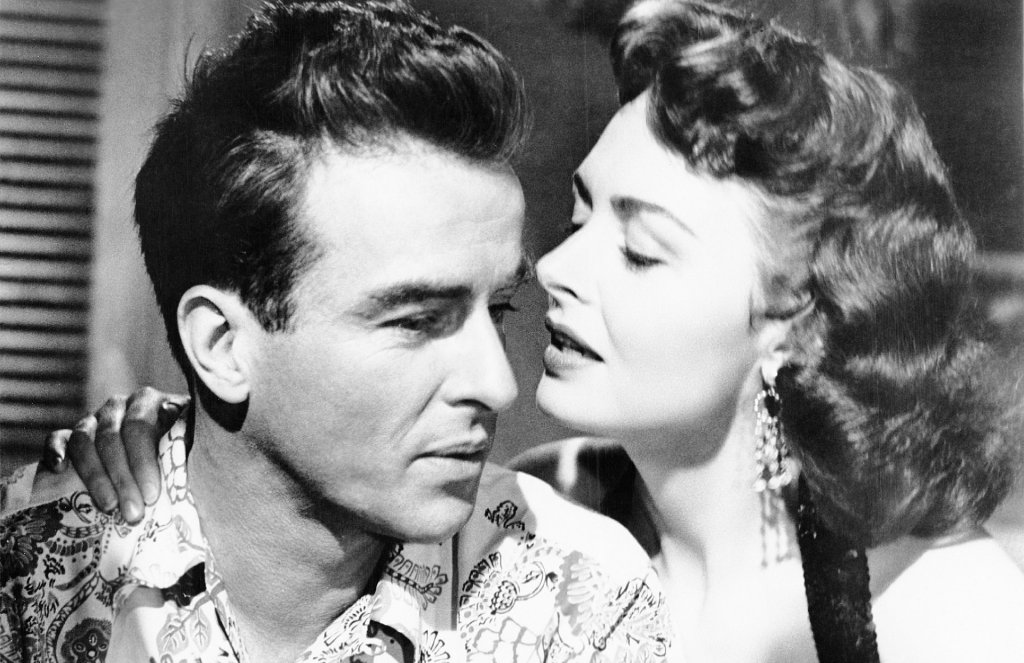
It’s 1941 at Pearl Harbour and three soldiers discover going their own way, rather than conforming to rules and expectations, causes no end of trouble. Private Prewitt (Montgomery Clift) is repeatedly hazed by his comrades (with the support of his CO) for refusing to join the boxing team. A champion boxer, Prewitt retired after accidentally blinding an opponent and nothing will persuade him to go back. His only comfort is with local social club ‘hostess’ Lorene (Donna Reed). First Sergeant Warden (Burt Lancaster) is persuaded to try for officer – because otherwise he risks prison for his love affair with the CO’s unloved wife Karen (Deborah Kerr). Private Maggio (Frank Sinatra), Prewitt’s only friend, is a loyal wild-card who can’t stick to the rules and is targeted by brutal stockade sergeant “Fatso” Judson (Ernest Borgnine).

From Here to Eternity sounds like a great big soap, a sort of 1980s glossy TV mini-series made before its time (it was later remade exactly as that). It’s got that in its DNA, but is made with such luscious, professional, old-school Hollywood excellence it becomes something special. Superb craftsmen work in every position to produce a classic melodrama with touches of romance, thriller, war drama and tragedy. With excellent performances across the board (Sinatra and Reed both won Oscars, while Lancaster, Clift and Kerr were all nominated), FHtE tells emotive, empathetic stories about genuine characters trapped in situations beyond their control.

The film is a masterclass in adaptation. The original novel – a popular tome of its day – tells a story crammed full of sex, STDs, homosexuality, bad language and violence across its 800+ pages. No wonder it was a hit – and no wonder, under the Production Code, it was thought impossible to adapt it into a film. Screenwriter Daniel Taradash carefully reworked and ‘hinted’ at several things that could not be explicitly said (for example, no one calls Lorene a prostitute, but you’d have to be pretty dense not to realise she is doing more than pouring drinks in that bar). Restraint, as it often did, demanded invention and bought out the best (and subtle work) in people. The film’s requirement to focus on dialogue and character rather than controversy hugely works to its benefit.

Zinnemann was the perfect director for the material. Drawing wonderful performances from the actors, he also keep the film intimate, drawing us closer to the characters over scale, despite the temptations of the film’s location shooting in Hawaii (Zinnemann pushed strongly against shooting in technicolour and widescreen). The film also fits perfectly with one of Zinnemann’s key pre-occupations: the struggle of principled men (most strikingly Prewitt) in a society that demands them to say or do something against those principles. Just as the townspeople wanted Marshal to run and the Tudor court wanted More to swear allegiance, so our characters buck against conforming with the roles they are expected to play.

You can see why the military – after supporting the project – were less happy when they saw the film. The individual is championed at the cost of the machine. Prewitt’s principles are praised, while his regiment is hopelessly corrupted by his incompetent and careerist commander. The hazing is endemic, and supported from above – and no one even notices or cares that Fatso is also abusing his position to brutalize Maggio. The CO is so useless – as well as ruining his wife’s life, rendering her infertile and cheating on her all over town – that the company is effectively run by First Sergeant Warden, the only NCO with the courage of his principles. Under pressure from their army sponsors, the film does see the chain of command cashier the CO (a scene Zinnemann hated) – but the sympathy is with the individual rather than the system.

From Here to Eternity is also a highly effective romance. Its most famous image will always be the clinch between Lancaster and Kerr, kissing and embracing while the turf washes up around them. But the film is also realistic – its why it remains so effective. Warden and Karen are made as miserable by their growing love as they are happy (they even comment on this). Relationships are never an easy ride, and demand constant dedication. Lorene and Prewitt’s relationship is far from rose-tinted, with the two of them constantly forced apart by their own mistakes and choices.

It’s melodrama told with emotional intelligence and realism – and Zinnemann gets great performances from great actors. Lancaster brings immense strength and purpose to Warden, but also a concealed vulnerability and decency. Kerr – revitalising her career after a string of “good wives” – brilliantly conveys Karen’s desperation and misery, along with her wary hope her life could change. That moment on the beach, the surf washing around them as they make-out is a rare moment of relaxed happiness. Other than that, its one tough conversation after another – stolen moments in bars or cars, where the two of them confront the difficulty of their situation, but also their need for each other. That’s old school romance for you – unavoidable, but never-endingly difficult and even a little painful.

Sinatra (in the role that changed his career – and the debate around how he got the role inspired that horse’s head in The Godfather) brings charm, cheek and tragedy to Maggio. How did Maggio end up in this man’s army? He’s quietly fun loving, but bucks the rules like almost no other character in the film. Sure he’s an upstanding guy – the only one who sticks by Prewit and defends him – but he can’t follow a simple order. Mostly because he’s not really disciplined enough. Plus he makes enemies – worst of all Borgnine’s bruising sergeant. He’d be so much happier running a bar for soldiers than he ever is being a soldier himself.

This makes him very different from Clift’s Prewit. Clift gives one of his finest performances as this fully-realised tragic hero. Prewit is a man of principle who, for the best reasons, makes choices that have a terrible impact on him. He’ll stand by his decision not to box, even though it opens up a bucket load of unpleasantness for him and Maggio. If that leaves him with one friend and no supporters, so be it. He may not look like a boxer (the studio wanted a more muscular lead), but he is every inch the emotionally conflicted, guilt-plagued and confused GI, stubborn but profoundly sincere, with the strength of character to stand alone, but the vulnerability to need affection from Lorene (and respond like a lovesick kid when he thinks she has spurned him). It’s a complex, mature and excellent performance.

All these events are eventually dwarfed by the outbreak of war. If there is one thing that Zinnemann will accept is bigger than the individual, it’s world war. The film quietly counts down to the attack on Pearl Harbor (without the characters realising it), sneaking us peaks at calendars and reports to let us know how close we are to the fateful day. When it comes, it reveals the characters of the people we’ve been following. Warden takes command in a way his CO never could. Prewit, hiding out with Lorene (Reed by the way is marvellous, her investing Lorene with a real world-weary sadness), decides its his mission to return from AWOL, despite the dangers this will cause him. The attack is grippingly but simply filmed.

From Here to Eternity is a complex film, made with real professional skill, and a rewarding character study. Zinnemann gets the tone right at almost every single point and draws out brilliant performances from a very strong cast. As an example of Hollywood Studio film making, it’s hard to beat.