Category: Directors

The Firm (1993)

“He can’t handle the truth!” Tom Cruise takes on The Firm. We lose.

Director: Sydney Pollack

Cast: Tom Cruise (Mitch McDeere), Jeanne Tripplehorn (Abby McDeere), Gene Hackman (Avery Tolar), Holly Hunter (Tammy Hemphill), Ed Harris (FBI Agent Wayne Tarrance), Hal Holbrook (Oliver Lambert), Jerry Hardin (Royce McKnight), David Strathairn (Ray McDeere), Terry Kinney (Lamar Quinn), Wilfrid Brimley (Bill DeVasher), Gary Busey (Eddie Lomax), Paul Sorvino (Tony Morolto)
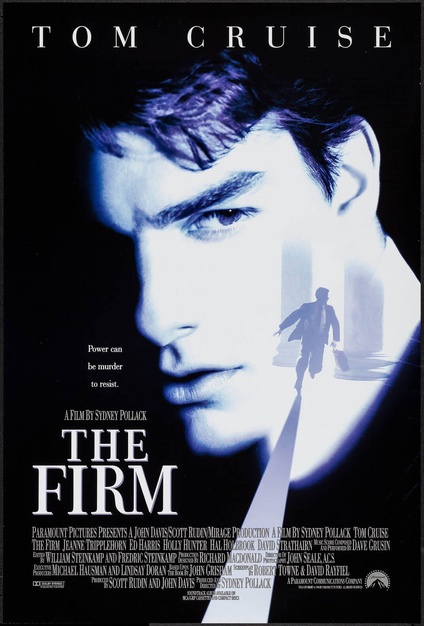
Mitch McDeere (Tom Cruise) is graduating top-of-his-class from Harvard Law. A plucky kid who’s worked for everything he has – and who wants to provide the best he can for wife Abby (Jeanne Tripplehorn) – Mitch has lots of offers but is seduced by a perk-filled offer from a law firm in Memphis. Everything goes wonderfully at first. But then associates at the firm start to die under suspicious circumstances and Mitch discovers no-one everleaves the firm except in a wooden box. Maybe all that off-shore tax-dodging isn’t quite as innocent as it seems – and those big-city clients with Italian-sounding names aren’t so friendly after all…

Adapted from a best-selling novel by John Grisham at the height of his airport-novel flogging days, The Firm is bought to the screen by Sydney Pollack. And what a complete dog’s dinner he makes of it. The Firm is a dreadful film: long, slow and dull with a plot that stretches right through elaborate and comes out the other side as confusing. By the time Mitch is tearing through Memphis, briefcase flapping behind him, you’ll have long-since ceased caring about anything involved in the film at all. Because for a film of such great length, very little seems to happen in it – and what little does happen is wrapped up in a mixture of legalese and curiously flat chase sequences.

Cruise plays Mitch at his most gung-ho, cocky, shit-eating grinnish. He’s preppy, super-smart, arrogant but also loyal, brave and principled. Aside from a brief temptation by money – and that because he wants the best for his family! – and of course a dalliance with a honey-trap on a beach (but it was a set-up, so not his fault!), he’s practically perfect in every way. He’s even a decent athlete, playfully taking part in back-flipping competitions with a break-dancing pre-teen busker (one of the most clumsy and bizarre introductions of a Chekov’s skill in the movies).

To put it bluntly, Mitch is an irritating character and watching him (very slowly) decide to do the right thing doesn’t make gripping viewing. Around him a host of experienced character actors do their thing, none of them stretching themselves. Tripplehorn does her best with the thankless part of “wife”, though she does at least get to do something a little proactive at the end. Hackman grins and coasts as Cruise’s mentor with the lost conscience. Hunter pouts and wisecracks (Oscar-nominated) as Grisham’s twist on an Eve-Ardenish secretary. Holbrook and Brimley scowl behind smiles as high-ups at the Firm. Harris shouts a lot as a permanently angry FBI agent with a heart of gold. Sorvino breaks out his Mob Boss 101.

Pollack marshals all these forces together with minimal effort and then ticks the boxes of all Grisham-cliches. The only thing missing are some courtroom dynamics, but we get the next best thing with wee-Tommy playing the FBI, the Mafia and the Firm off against each other in a desperate attempt to stay one step ahead of the game. I can’t stress enough how turgid and dull this film is. However scintillating you feel the set-up you might be, as the film clocks into the second hour (with 30 minutes still to go), you’ll be amazed how little sense of peril or threat there is.

There is nothing sharp, pointed or pacey about this film. “It has to happen fast” Tom announces at one point, as he kicks his impenetrable plan into gear. “Good luck in this film” my wife commented. She’s spot-on. Pollack fails to bring any sense of pace or peril to the film. For all we are repeatedly told Cruise’s life is at risk, it never really feels like it.

A big part of this massive failure is the terrible musical score that covers every single second of the film. Provided by an Oscar-nominated Dave Grusin (beating out Michael Nyman’s score for The Piano from even being nominated, one of the most inexplicable oversights at the Oscars from the 90s), every single second of the film is overlaid with a plinky-plonky piano score that would not sound out of place in a second-rate jazz bar or a hotel lift. Rather than bring you to edge of your seat, the score actually makes you feel like you should be resting back in it with a large cocktail in hand and a fuzzy sense of upcoming sleepiness clouding your brain. Which to be honest might work: pissed and half-asleep is probably the only way to get anything from the movie.
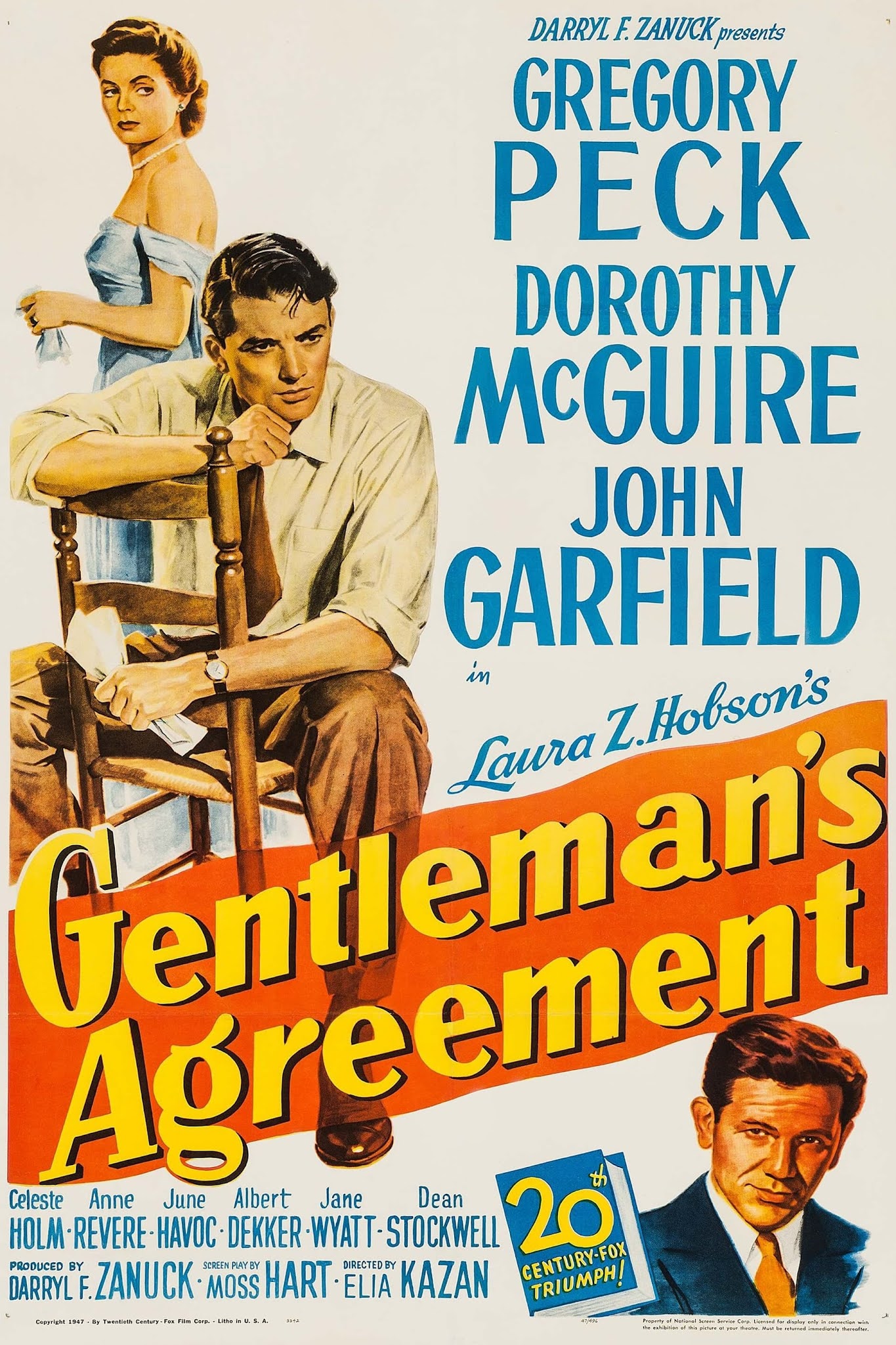
Gentleman's Agreement (1947)

Gregory Peck takes on anti-Semitic prejudice in Gentleman’s Agreement

Director: Elia Kazan

Cast: Gregory Peck (Philip Schuyler Green), Dorothy McGuire (Kathy Lacey), John Garfield (Dave Goldman), Celeste Holm (Anne Dettrey), Anne Revere (Mrs Green), June Havoc (Elaine Wales), Albert Dekker (John Minify), Jane Wyatt (Jane), Dean Stockwell (Tommy Green), Sam Jaffe (Professor Fred Lieberman)

What was daring 60 years ago, often seems tame today. In 1947, Gentleman’s Agreement, an expose of anti-Semitism in America, was a potential career-ending risk for its stars. It won three Oscars, including the Big One (beating the similarly themed Crossfire, an anti-Semitic murder mystery – and better, more entertaining film). Today, Gentleman’s Agreement seems like a time capsule on celluloid: extremely earnest Hollywood movie-making at its most socially responsible – and only scratches the surface of prejudice and its dangers, capping everything with a neat happy ending.

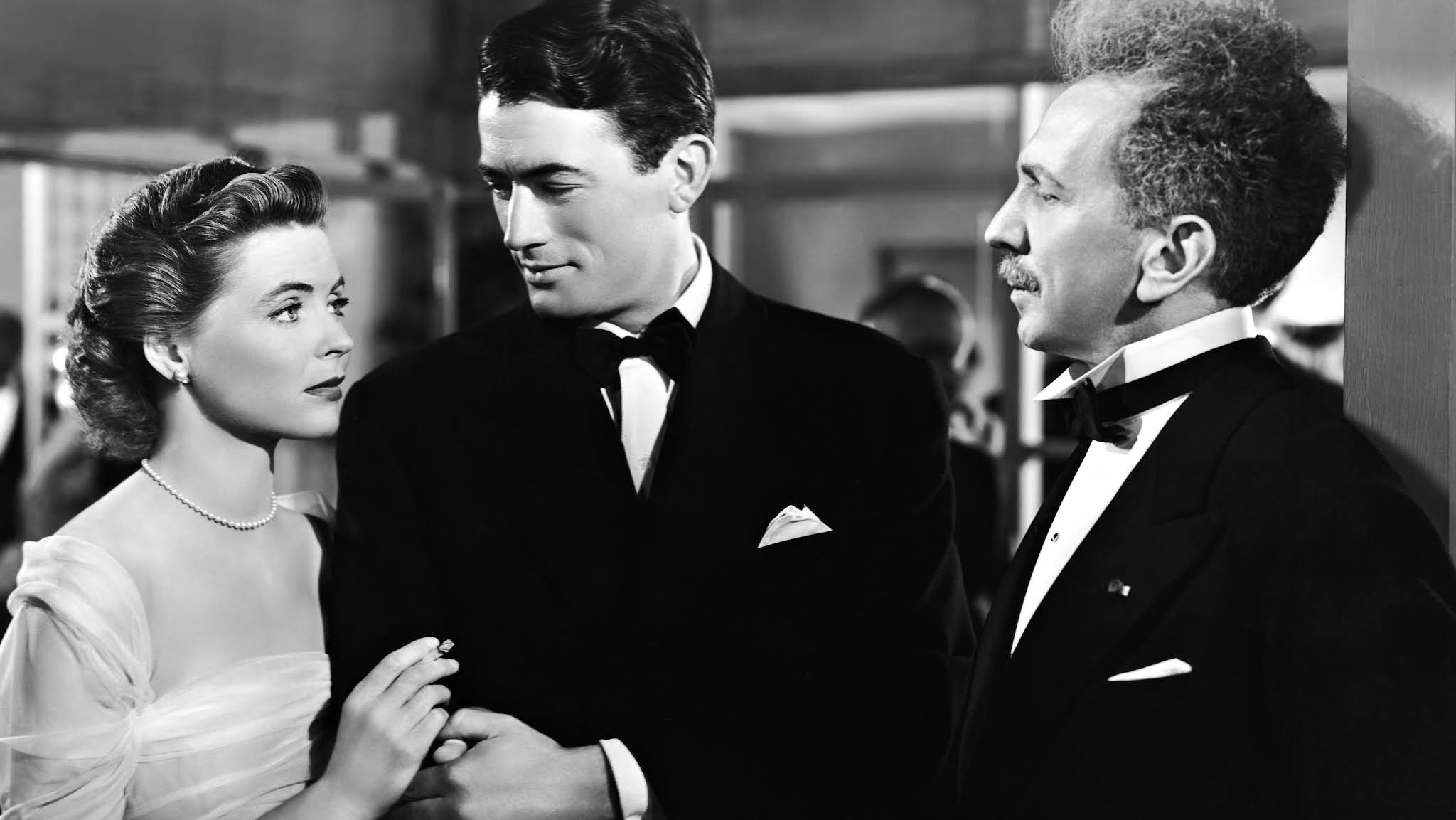
Journalist Philip Schuyler Green (Gregory Peck) is commissioned to write a series of expose pieces on anti-Semitism. His editor doesn’t want the “cold facts”, he wants the sort of unique “angle” that’s Green’s specialism. Phil decides to pass himself off as a Jew so he can find out what it’s really like. Only Phil’s fiancée Kathy (Dorothy McGuire) will know the truth. Phil finds out first-hand the knee-jerk prejudice and barriers Jews in New York face – something hammered home as he begins to relate to the experiences of his Jewish school-friend-turned-war-hero Dave Goldman (John Garfield). Phil starts to realise even Kathy may talk the talk of opposing prejudice, but doesn’t always walk the walk.

Gentleman’s Agreement is an extraordinarily earnest piece of film-making, that doesn’t just wear its liberal heart on its sleeve, it stretches it across its entire shirt. The plot frequently halts for someone to deliver a set-piece speech on the evils of prejudice, and Phil’s son (well played by a young Dean Stockwell) serves as an audience surrogate for Peck to fill us in on how prejudice is the enemy-within. There is no doubting, watching the film, everyone passionately believes in its importance (Garfield, a Jew born in Brooklyn, took a huge pay cut to be involved). It’s just a shame that the film itself is to flat, overburdened by its own sense of importance.

It’s as least as interesting for what it doesn’t say. There is something damning about the fact Hollywood only felt comfortable making films about anti-Semitism after the Holocaust. A Jewish character objects to the Phil’s article with the standard line used by Hollywood Jewish studio owners – drawing attention to it only makes the problem worse (remember all references to Jewishness was removed from The Life of Emile Zola). Additionally, there are only passing references (if that) to sexism or any other form of racism or prejudice, and virtually every character we see is white, WASPY and middle-class. Hollywood could only handle one prejudice at a time, apparently.

Gentleman’s Agreement is strong on the everyday nature of prejudice – off-hand remarks about money and facial characteristics, a character protesting “that some of my best friends…” and so on. But, considering it was made in the shadow of one of the worst racially-motivated atrocities in history (the closest reference to the Holocaust is Peck refering to anti-Semitism being not just happening “far away in some dark place with low-class morons”), the film could (and should) have gone further on the dangers of prejudice. Saying that, this was still a big step for Hollywood. And while the film frequently appears preachy, po-faced and stodgy today, it was still a brave piece of film-making, even if it’s gingerly taking kid-steps towards confronting a problem.

Phil’s investigation of anti-Semitism is unfocused and vague. He speaks to only three Jews – a schoolfriend, an atheist Einstein figure (played by Sam Jaffe) he bumps into at a dinner party, and a secretary ashamed of her heritage who despises “the wrong sort” of Jew. Never once do we see him go to a Synagogue, visit a Jewish community or step outside the bounds of his world of country clubs, posh hotels and gated communities. The story may be about how prejudice exists in places we wouldn’t expect, but a film on anti-Jewish prejudice really should have a place in it for more than this, rather than Jewishness being a label Phil puts on and shrugs off later with a “ta da, gotcha!”

The film’s heart is in showing how “someone like us” could be prejudiced, sometimes without even realising it. Phil’s fiancée Kathy (a decent performance in a thankless part by Dorothy McGuire) turns out to have more than a few anti-Semitic bones in her body. Kathy is the classic liberal, believing every word of her own press about equal opportunities, while quietly urging people to fit in and be like her (gentile) friends. The film slowly exposes Kathy’s subconscious unease, her willingness to accept certain inequalities to avoid confronting the status quo. Watching today, it’s hard not to see Kathy as a pretty dreadful, hypocritical person. But while Gentleman’s Agreement wants to shake us, it still wants a happy ending – so she repents and learns her lesson.

It’s a shame, as this rather dull love plot is the film’s weakest thread. Far more interesting would have been seeing Phil actually out in the real world (Kazan’s immersive location shooting, which he used for Panic on the Streets and On the Waterfront, would have improved this film ten-fold). It’s also unfortunate Phil’s colleague Anne (played with Oscar-winning charisma by Celeste Holm) not only seems better suited to Phil, but a much nicer, braver person – it’s hard not to watch the whole film rooting for Phil to dump the tiresome Kathy for the engaging Anne.

Gentleman’s Agreement’s study of prejudice seems very tame, but its heart is in the right place. For even tackling the issue it deserves praise, even if it’s rather stunted dramatically. Kazan’s direction is as earnest (and at times lifeless) as the film, but he does fine work with actors. Peck is at his most morally certain, with a great sense of affronted liberalism, McGuire is very good, Garfield wonderfully humane, Holm marvellous, Anne Revere excellent as Phil’s drily witty mum. A braver film could (and should) have been made – and Crossfire makes all the same points, but quicker and with a lot more dramatic interest. Gentleman’s Agreement sometimes feels like a rather self-important bore at a dinner party, but at least you know it has conviction and means well.

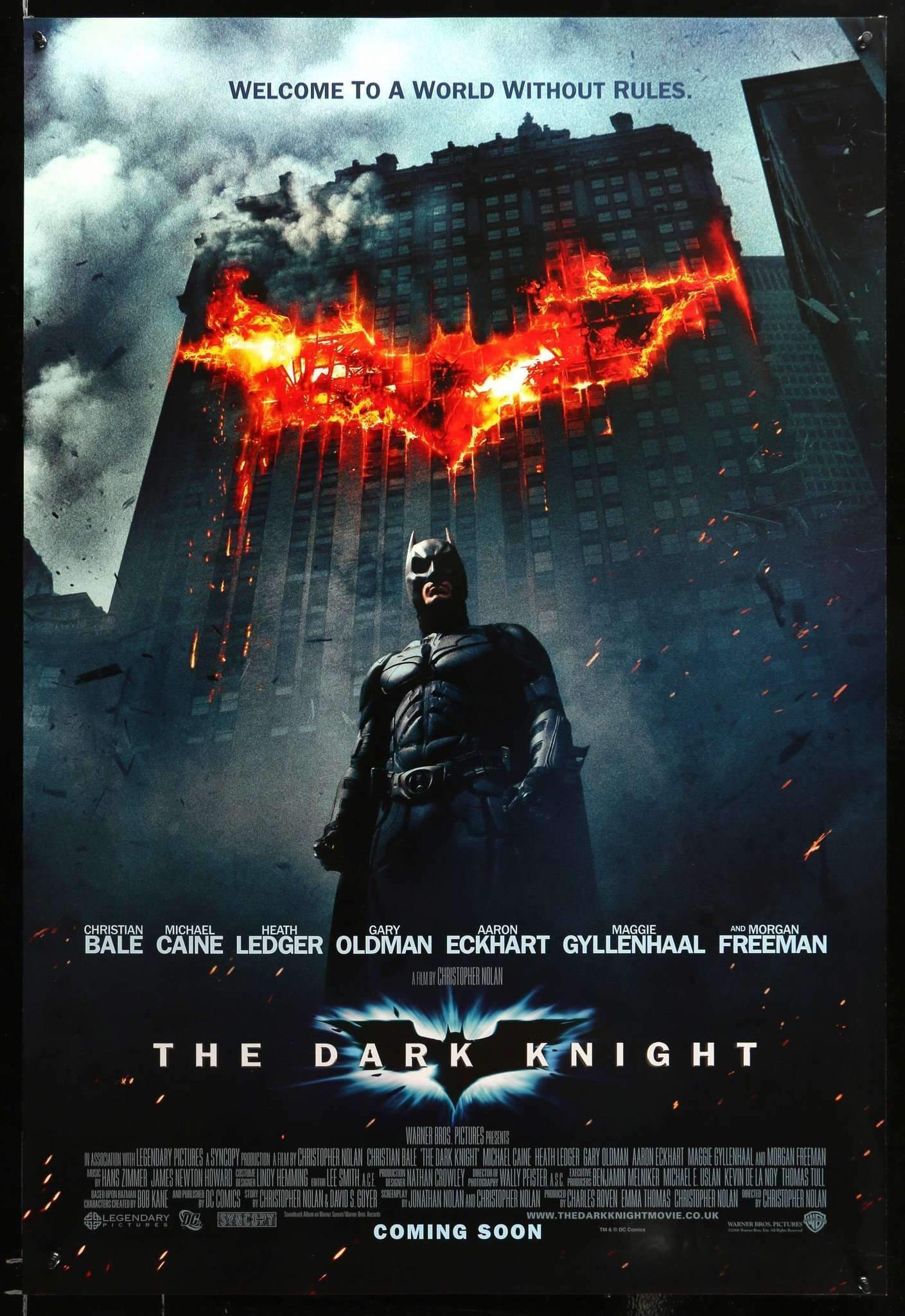
The Dark Knight (2008)

Heath Ledger leaves a great legacy as The Joker in The Dark Knight

Director: Christopher Nolan

Cast: Christian Bale (Bruce Wayne/Batman), Michael Caine (Alfred Pennyworth), Heath Ledger (The Joker), Gary Oldman (Lt James Gordon), Aaron Eckhart (Harvey Dent), Maggie Gyllenhaal (Rachel Dawes), Morgan Freeman (Lucius Fox), Eric Roberts (Sal Maroni), Monique Gabriela Curnen (Detective Ramirez), Ng Chn Han (Lau), Ritchie Oster (The Chechan), Colin McFarlane (Commissioner Loeb) Anthony Michael Hall (Mike Engel), Joshua Harto (Coleman Reese), Cillian Murphy (Scarecrow)

Christopher Nolan’s Batman Begins reset the table for superhero films. The Dark Knight took that table, picked it up, overturned it and rebuilt it from scratch. This influential film is certainly the greatest superhero film ever made and the calling card Nolan will carry for the rest of his life. Its exclusion from the 2008 Best Picture list at the Oscars (and Nolan’s snubbing for Best Director) was so widely condemned as snobbery (especially as the slot went to the atrocious awards-bait The Reader, a film even Oscar-host Hugh Jackman quipped he hadn’t seen) it led to the Oscars doubling the number of Best Picture Nominees (something benefiting several genre films inferior to this one). The Dark Knight declared forever superhero films could be proper films with characters, intriguing stories and interesting things to say.

It’s been a year or so since Bruce Wayne (Christian Bale) began his caped crusade as Batman, wiping out organised crime in the city. District Attorney Harvey Dent (Aaron Eckhart) – working closely with Bruce’s childhood sweetheart Rachael Dawes (Maggie Gyllenhaal) – has launched his own tough on crime crusade that has led to many mobsters landing behind bars. In the police force, Lt James Gordon (Gary Oldman – superb as a man whose good intentions lead to great harm) is straightening out the most bent police force on record. Now the gangs are desperate and in retreat – so desperate that they turn to the sort of dangerous, anarchic freak they would never usually countenance working with: a man known only as The Joker (Heath Ledger). The Joker though has his own plans for the city, for Batman and his own crazed ideas of social anarchy.

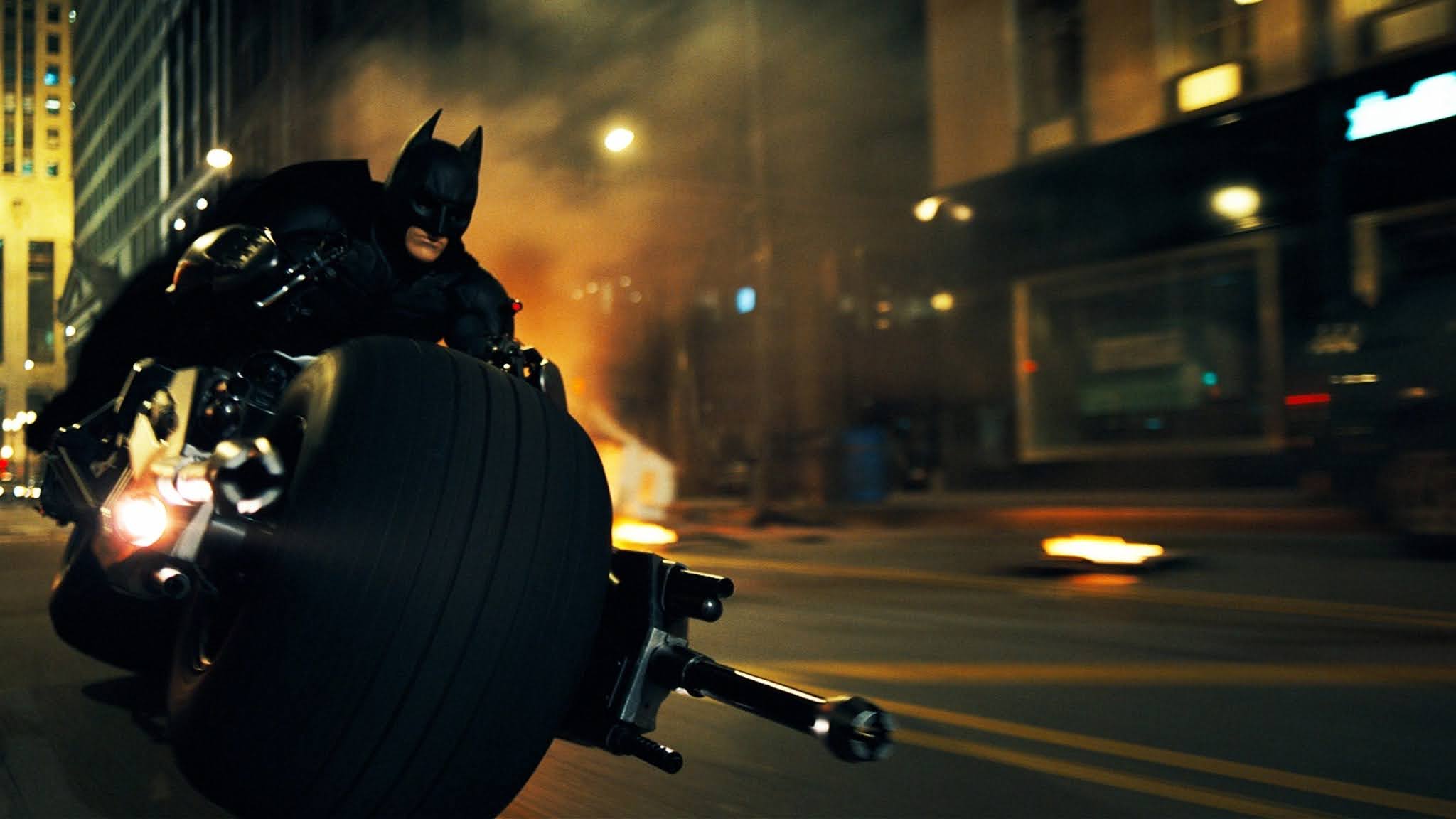
The Dark Knight is told on a huge scale: but Nolan never once loses sense of the fact this is an adventure film, while making sure that it explores ideas around society and humanity that leaves most high-brow films standing. Sumptuously made, a technical marvel it has set-pieces that stand with the greatest in cinema, dialogue that is crisp and brimming with intelligence and every performance in it excels. Nolan’s cinematic verve creates a film that always feels fresh.

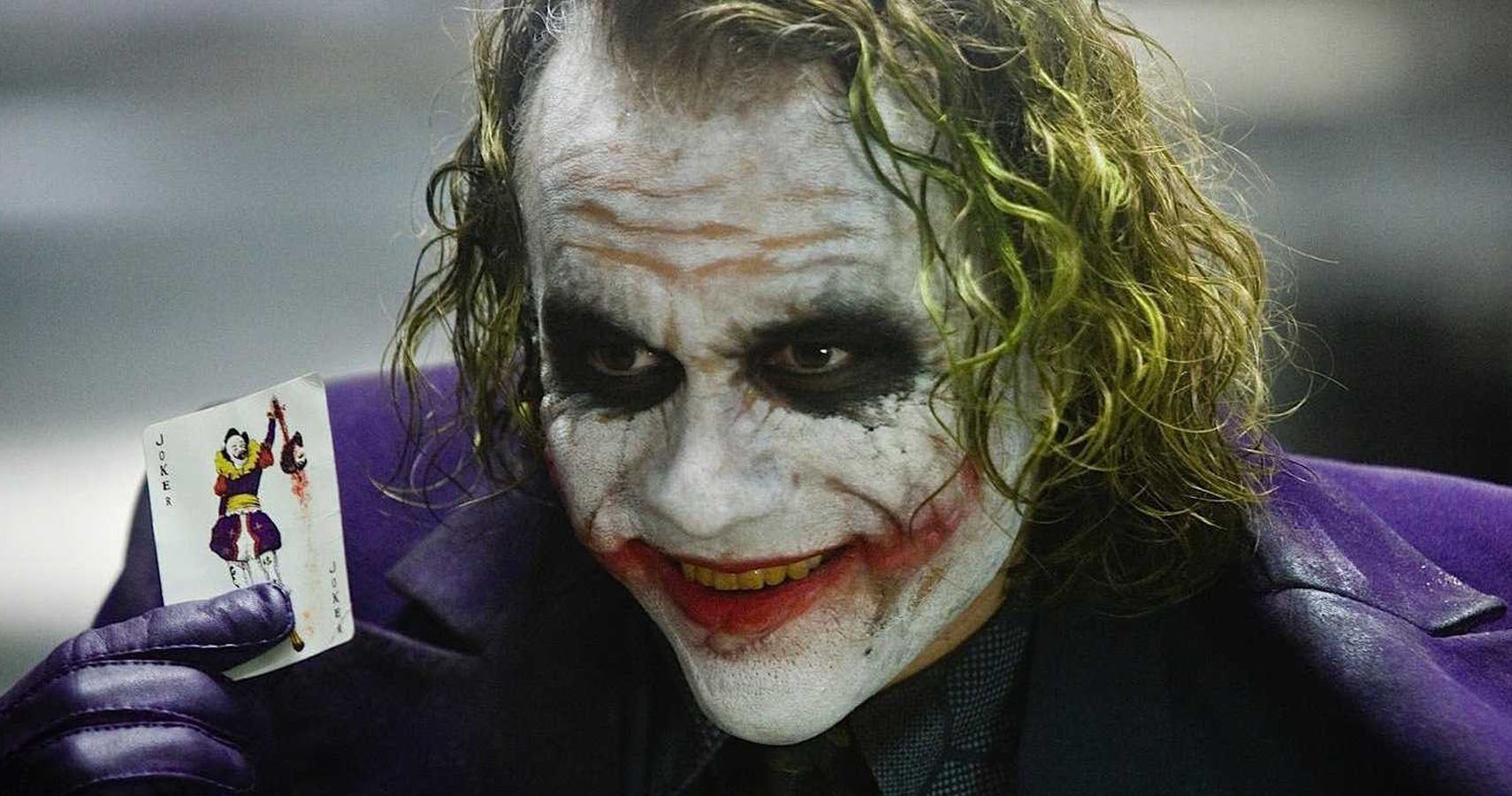
It’s hard not to reflect on the film without remembering the tragic death of Heath Ledger. A controversial choice for the Joker – despite Brokeback Mountain he was seen by many as a lightweight actor – Ledger’s performance is astounding. He radically redefines the character, giving every scene an eerie edge somewhere between violence and black comedy. His Joker has the bowed head and animalistic prowling of a hyena (along with the laugh), a snake-like licking exploration of his facial wounds, a voice that switches from a deep baritone to a high-pitched giggle.

He’s dangerously, psychotically violent, with a dark, demonic delight in mayhem, a wickedness that is not funny so much as unsettlingly comic and an unpredictability laced with a sharp and intimidating intelligence. Ledger essentially redefined a character who had existed for decades. It’s an extraordinary performance, winning numerous awards, that stands as the definitive interpretation of the character as a scuzzy, streetwise hood with the willingness to do anything at all.

The Joker is the channel Nolan’s film uses to explore fascinating ideas around order and chaos, and the clash between anarchy and rules. Nolan understands that, for all his confused psyche – heading out to beat up criminals for his nightly activities – Batman is a bastion of law and order and moral righteousness. He’s a fiercely ordered and meticulous man, who plans several steps ahead of his enemies, holds rigidly to a moral code and has the confidence (arrogance?) to believe he is best placed to make the big calls for the many. They are personally traits he shares with all the films heroes: he, Gordon and Dent are all men who harvest long-term plans to deliver mass benefits.

Standing against them is their antithesis. The Joker believes principles are bunkum, with life motivated by randomness and selfishness. These are polar opposite theories of life being explored here – and the Joker’s plans (such as they are) are to show that mankind is, at heart, an awful, terrible thing that can only destroy. But the schemes of our heroes also smack of arrogance and control – a sense of almost divine certainty in their righteousness.

Basically, what we get here is a discussion on our fear of anarchy. Deep down we all like conspiracy theories, because it shows someone is in charge. Randomness is terrifying. We all like to feel there is an organising force behind events – no one wants to meet their end by the toss of coin. We feel comforted by being part of an overall plan – even if it’s a plan for our demise. The Joker’s power comes not from his skills in themselves, but his willingness to break all rules and destroy anything and anyone at any time for any reason. There is no protecting against this. And it’s terrifying.

Nolan introduces the concept – and the character’s warped way of thinking – from the very start. The stunning opening sequence features a bank heist (with a neat cameo from Heat veteran William Fichtner – a deliberate homage) where the Joker has devised a ragged, but brutal plan which involves each member of the gang offing each other in turn (not that they are aware of that!). It’s a blazingly, triumphantly cinematic opening and a brilliant entrée to Nolan’s superbly directed, engrossing film.

While juggling intelligent ideas it’s also a brilliant, edge-of-the-seat ride crammed with jaw-dropping set-pieces. Each of them is underpinned by that rich psychological clash. Bruce Wayne is trapped in tactics utterly unsuited for his opponent, his assumption that criminals are simple people motivated by greed. Even worse, the Joker delights in identifying the clear lines Batman won’t cross, and dances right across them, wiping out the psychological advantages that Batman has over other criminals: once the Joker establishes Batman will never kill him, he forever knows he has the upper-hand.

Bravely the film ends not with a bang, but a character-driven, personal three-way confrontation between its three heroes (Batman, Gordon and Dent), low-key but bubbling with resentments, fury and pain. It’s a perfect cap – and a capturing of the film’s argument that the greatest damage people like the Joker can cause is not to our property but to our souls.

It’s easy in all this to overlook Christian Bale, but he is wonderful as Wayne (and again this is a film that is as much, if not more, about Wayne than Batman). Increasingly distancing himself from people – his last links to human warmth being Alfred (Michael Caine, again in wonderful mentor form) and Rachel Dawes (re-cast to terrific effect with Maggie Gyllenhaal, who brings wonderful depth and complexity to the role) – Wayne carries a martyr complex, damaging to his psyche.

Nolan’s film is a dense and rich thematic exploration of chaos and certainty which expertly combines thills and actions with a character driven plot. Superbly acted, wonderfully paced, rich and intelligent – with a genre defining performance by Ledger – this is truly great film-making, one of the greatest blockbusters of all time.

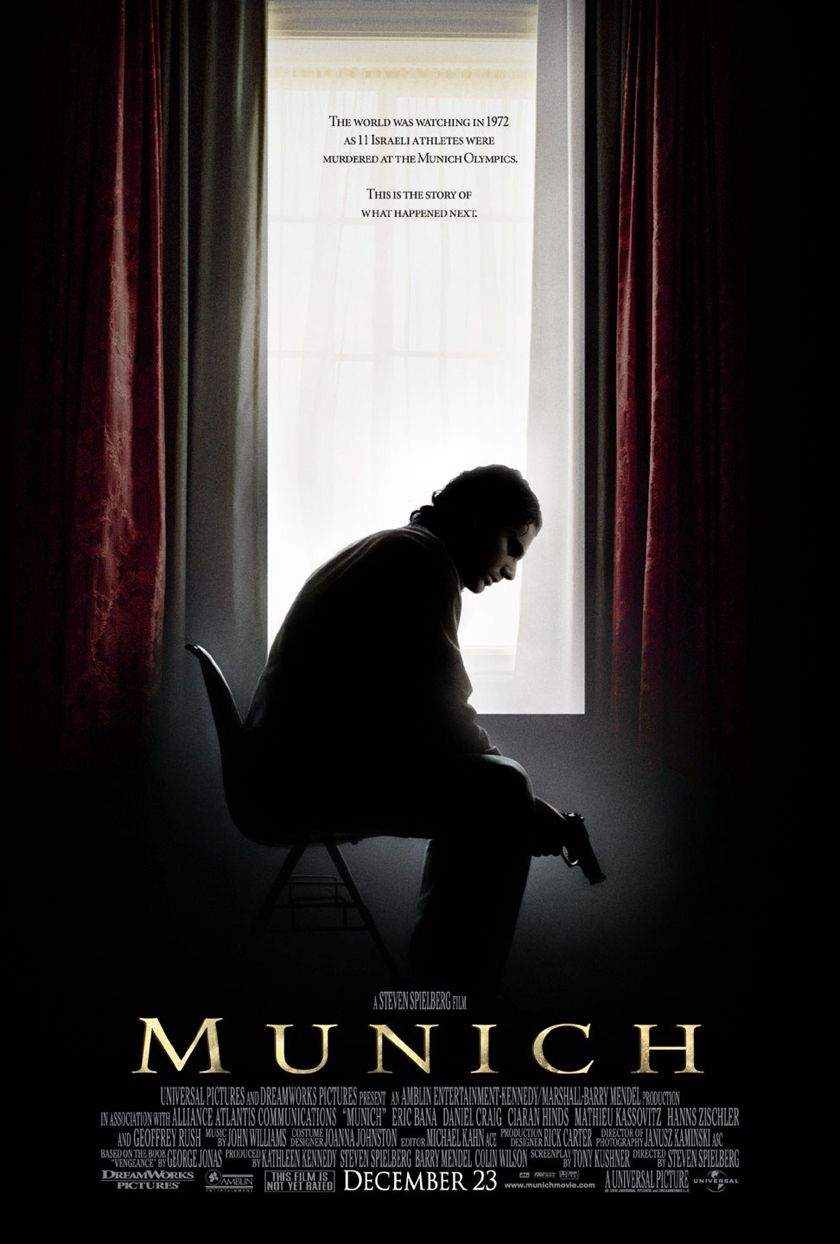
Munich (2005)

Eric Bana leads a team of Mossad agents in Spielberg’s uneven terrorism drama Munich

Director: Steven Spielberg

Cast: Eric Bana (Avner Kaufman), Daniel Craig (Steve), Ciarán Hinds (Carl), Mathieu Kassovitz (Robert), Hanns Zischler (Hans), Geoffrey Rush (Ephraim), Ayelet Zurer (Daphna Kaufman), Mathieu Amalric (Louis), Michael Lonsdale (Papa), Marie-Josée Croze (Jeanette), Lynn Cohen (Golda Meir)

At the 1972 Munich Summer Olympics, 11 members of the Israeli Olympic team were murdered by a Palestinian terrorist cell, Black September. The world was shocked and appalled. Israel responded with a hard-line anti-terrorist campaign, that saw Mossad teams traversing the globe, assassinating Palestinian leaders involved with Black September. They learned not only was terrorism a hydra, but that the moral high-ground erodes quickly when the shooting starts. Can terrorism be defeated by violence? Munich argues not: instead suggesting violence is a beast that feeds itself – an argument that, in 2005 in the fourth year of the War on Terror (the film ends with a shot of the World Trade Centre) was increasingly relevant to another country, traumatised by the slaughter of innocents.

Adapted by Tony Kurshner and Eric Roth, it’s based on a book Vengeance by George Jones about the man who claimed to be the leader of the Mossad cell (whether that is true or not is debated). He’s fictionalised here (to side-step that issue) as Avner Kaufman (Eric Bana). His team consists of driver Steve (Daniel Craig), explosives expert Robert (Mathieu Kassovitz), forger Hans (Hanns Zischler) and clean-up man Carl (Ciarán Hinds) with Ephraim (Geoffrey Rush) as their handler. The team hunt down and eliminate their targets – but as the mission goes on they pay a heavy cost, both in their eroding of their own moral certainties and in blood as they become targets for repercussions.

Spielberg’s film is his least flashy, least sentimental and (I suppose) most mature film, a cold-eyed, even-handed look at the Middle East conflict that acknowledges faults and consequences on all sides, draped in the muted colours and bleached out photography of 1970s conspiracy thrillers. It’s also a very long and very self-consciously important film, that makes mis-steps and at times is crudely obvious as well as being more interested in posing questions than presenting any answers. Where it is at its best, is demonstrating how campaigns like this are tasks worth of Sisyphus.

Munich takes a long, hard look at the cost of violence – both on its victims and its perpetrators. Death in this film is slow, painful and frequently disturbing. Shot people stagger and slump in drunken shock, dying slowly. Bomb victims are ripped apart, recognisable limps left hanging from walls and ceilings. Machine gun bursts tear bodies apart. The cost of inflicting this violence leaves increasingly deep psychological violence on the team (we don’t get to see if it does on the Palestinians, a limit to the films even handedness), as it becomes harder and harder to treat those they kill as faceless monsters, rather than men with families of their own.

Spielberg reconstructs the horror of the killings in Munich with a documentary realism, not shying away from the horror. It follows the appalling opening moments of the attack, with the athletes taken hostage and the shocked world media reaction. Spielberg returns later in the film to restage the final murder of the athletes at the Munich airport with sickening detail (perhaps too much – but more of this scene later).

Showing the impact of violence from both sides, Munich strains at always being even-handed (despite this both sides attacked it for bias). It’s an Israeli story so we mostly see the psychological impact of carrying out the violence on the Israeli team, and little of the Palestinian perspective. But the film throws in a chance meeting between Avner and what-could-be his Palestinian equivalent, where Avner is brutally told that, when fighting for their home, the Palestinians will never give up, and consider any price worth paying – attitudes he can’t help but recognise as he fights for his own home. The film has clear sympathy with the sufferings of the Jewish people, and their need for a home of their own – but wonders if this is the right way to defend it. Spielberg is a friend to Israel – but wants to be an honest one.

What starts out as clear and simple (a campaign against terror) becomes morally complex. The team’s first targets are sympathetic, family men. When Avner talks to a later bomb victim, he’s friendly and welcoming. A Palestinian cell they (accidentally or maliciously) end up sharing a safe house with, thanks to their mutual French contacts, are surprisingly relatable. The mission’s accomplishments are unclear – the targets are killed, but all that happens is more people take their place. Worse, those that do are only more infuriated by the campaign of violence.

That’s the question – how do you fight terrorism? It breeds on a belief of injustice and persecution – and Spielberg’s film suggests, all the campaign does is pour petrol on that fire. Avner becomes a paranoid psychological wreck by the end of the film, plagued with a loss of moral certainty. The film argues that the only result of all this has been the price he and other have made – an end to the violence is further away than it was at the operation’s beginning.

Spielberg’s film is strong on showing the pointlessness of this campaign. What it’s less strong on is answers. In many ways, the film boils down to a simple “deep down we are all the same, why don’t we just get along” message. While handsomely filmed and daring in its questioning about the futility of anti-terrorist (and indeed terrorist) action, it’s a simplistic film, largely lacking nuance. The characters are ciphers – Bana, for all his skill, plays a shell of a character, designed to make statements, who is alternately ruthless or questioning as the plot demands. Because the film strives so hard to remain even-handed, it brings little to the table itself in terms of proposed solutions, merely focusing on telling us what we know: an eye for an eye eventually makes his all blind.

It’s also a film that has more than its fair share of clumsy mis-steps. It’s view of the world is picture post-card in is simplicity. First thing we see in Paris, is a shot of the Eiffel Tower. Go to London and it rains. First shot in Holland is our characters on bikes. Its characters are largely plot devices, well played but rarely fleshed out in people who feel like human beings, more like mouthpieces to express viewpoints.

Most atrocious of all, the film concludes with a penultimate sequence staggering in its misjudgement. Retired and living in America, Avner makes focused, vigorous love to his wife intercut with the showing of the final deaths of the athletes in brutal detail. It’s tasteless, ill-judged and horrendously unclear. I suppose we are meant to think Avner is purging himself of his burden of guilt – but the scene is so appallingly done, so grossly detailed it comes across as both offensive and insultingly twee in using the deaths of real people (staged in detail) to help our lead character feel better about himself. When Spielberg does sex, he invariably gets it wrong – and does again here.

Munich is a very worthy film, but it’s too-long, dramatically simple, for all its daring commentary on the war on terror. It’s well-acted – Michael Lonsdale and Matthieu Almaric are very good as Avner’s French contacts, while Hinds is a stand-out among the team – but the characters are ill-formed and the entire film takes a very long time to make a very simple point. Well-made but a film trying a little too hard to always be profound.

Seven Days in May (1964)

Burt Lancaster and Kirk Douglas find themselves on opposite sides of a military coup in Seven Days in May

Director: John Frankenheimer

Cast: Burt Lancaster (General James Mattoon Scott), Kirk Douglas (Colonel Jiggs Casey), Fredric March (President Jordan Lyman), Ava Gardner (Eleanor Holbrook), Edmond O’Brien (Senator Ray Clark), Martin Balsam (Paul Girard), Andrew Duggan (Colonel Mutt Henderson), George Macready (Secretary of the Treasury), Whit Bissell (Senator Fred Prentice), John Houseman (Admiral Barnswell)

President Jordan Lynman (Fredric March) has completed his signature policy: a nuclear disarmament treatment with the USSR. Some are thrilled, others are horrified. In the latter camp are the Joint Chiefs of Staff, none more so than chairman General James Mattoon Scott (Burt Lancaster). General Scott has a plan: a coup to be launched in seven days time, during a training op. But word leaks to his assistant Colonel Casey (Kirk Douglas) who, however much he admires Scott, won’t be party to treason. Casey warns the President – and a race against time begins to stop the coup.

Seven Days in May opens with documentary style footage of clashing crowds outside the White House (one pushing for peace, the other for war) and then carefully balances that style with an unsettling sense of paranoia throughout. People suddenly disappear (once from frame to frame), most of the action takes place in confined spaces. When characters do head outside, they constantly seem to be looking over their shoulder, with the camera watching like a distant observer. The lack of music all adds the eerie feeling that this could just happen.

And, of course you, feel it could. Because we’ve not lost a tingling sense of unease at an over-powerful military. It’s a shame therefore that Seven Days in May doesn’t grip quite as much as it should. I think a large part of that is because the plot is exposed very early – and when Casey goes to the authorities with his suspicions, they are instantly acted on. Thrillers like this often work best with a “one man stands alone” vibe – it’s missing here, and instead we get the President and the cabinet laboriously investigating different elements of this conspiracy looking to turn up enough evidence to prevent the coup before it starts.

The drop in tension could have been counter-balanced if the film had more successfully explored the conflicts and contradictions in America. This is after all a country priding itself as being the home of freedom and democracy – but since George Washington, has had a fondness for installing military men in a job role pointedly called “Commander-in-Chief”. This is a film that could have explored how different parts of American society might admire either an Adlai-Stevenson-style intellectual or a blood-and-guts ‘simple’ soldier. But the film dodges this – and works hard to stress both men act within what they define as honour and the needs of the country. The film is to nervous about any suggestion that Scott’s coup could lead to a proto-dictator vetoing the electorate.

There is also a naivety about the film. A long subplot (not particularly interesting) features Casey being side-lined into uncovering evidence of Scott’s long-term affair. Ava Gardner does her best with a largely thankless part as the woman in question, but there is a touching faith that evidence of this will be enough to destroy Scott. It’s a faith in the system: while the public might be shaken slightly in their belief that Scott is like King Arthur reborn, finding out he’s actually Lancelot is hardly going to weaken his hold over many of his followers – or his military machine.  For a conspiracy film, Seven Days believes conspiracies are a relatively simple matter to defeat.

What’s best about the film – not surprisingly since it’s largely a chamber piece – is the strength of the acting. Produced by Douglas (who generously cast himself in the most thankless role as the decent-but-dull Casey), a cast of stars was assembled. Lancaster was perhaps the only choice as the holier-than-thou Scott, arrogant, morally-superior, cold, distant but capable of inspiring immense loyalty – it’s the perfect role for him and he plays it to the hilt.

The film’s finest sequence is a late confrontation between Scott – Lancaster oozing moral superiority and unhidden contempt – and Fredric March’s intellectual President. March is brilliant, a born negotiator and compromiser – all the skills you need to be a successful politician – with just the right edge of irritation, arrogance and pride for you to know that, even if he is right, he’s no saint. March also gives Lyman an old-school sense of honour and moral principle that makes him unable to cross lines Scott can leave behind him, while still be jittery and waspish to colleagues and friends.

Filling out the cast, O’Brien gives a wonderful (Oscar-nominated) turn as a hard-drinking, good-old-boy Senator who turns out to have principles of iron and the guts to match. Martin Balsam delivers one of his patented put-upon functionaries, struggling to keep stress at bay. Macready is great value as a bombastic cabinet member while Houseman glides above it all as an Admiral to smart to say anything certain either way.

Acting is eventually what powers Seven Days in May and if it never becomes the white-knuckle conspiracy thriller or the insightful political commentary it should be, it just about has enough entertaining scenes to keep you watching.

Birdman of Alcatraz (1962)

Burt Lancaster excels in prison drama Birdman of Alcatraz

Director: John Frankenheimer

Cast: Burt Lancaster (Robert Stroud), Karl Malden (Harvey Shoemaker), Thelma Ritter (Elizabeth Stroud), Neville Brand (Bull Ransom), Betty Field (Stella Johnson), Telly Savalas (Feto Gomez), Edmond O’Brien (Thomas E Gaddis)

What is prison for? Is it just a cage – or should it offer reform and self-improvement? Debates like this have existed from the moment the first mass-prison opened. Birdman of Alcatraz taps into this, presenting a romanticised image of the life serving time of Robert Stroud (Burt Lancaster), a double convicted murderer (including killing a guard in prison) who narrowly escapes a death sentence, sentenced to a lifetime in solitary confinement. Stroud develops a passion for ornithology, eventually becoming one of the world’s experts on avian disease – all while confined to his cell.

Front and centre in Birdman of Alcatraz is Burt Lancaster. Made by his production company, and hand-picked director (after firing Charles Chrichton), Lancaster’s prickly persona and patrician distance is wonderfully re-directed as a man who, for much of the film, carries a strong whiff of danger and violence. Surly, bitter and unrepentant, Lancaster brilliantly captures Stroud’s monomania which blossoms into a realisation his own life has been wasted. Oscar-nominated, Lancaster makes Stroud hard-to-like, but one who we slowly relate to as his brutality into a sort of recognisable humanity, however sharp-edged and un-appealing he can be.

Frankenheimer’s well-made film – it’s strikingly less flashy than much of his early work, instead using a restrained sense of documentary realism – is one I found both entertaining and involving, but also strangely troubling. But first the positive: there is no doubt this is a great “prison” movie, perfectly capturing the monotony and boredom long-term solitary confinement brings. It reduces the world into something small and oppressive – Stroud has a cell, a corridor and an exercise yard – and Frankenheimer pours on the sympathy for prisoners who are caged in a system that removes any individuality from them to turn them into docile drones.

Stroud faces a permanent struggle to win the right to keep and study his birds – including going into business selling his bird illness remedies – in the face of a system that wants him to sit in his silently in his cell. It’s hard not to be engaged with Stroud, and the lengths he must go to sustain the new hobby that has given him a reason for living. A birdcage is fashioned out of a crate after months of work. Endless variations on cures are attempted to deal with an outbreak of disease. There is even a bureaucrat warden – well played by Karl Malden as a functionary who is all duty and no imagination – who strongly believes indulging this nonsense is letting him off lightly. And maybe he’s right.

And it’s that issue which I find troubling at a film. This is a conscious attempt to turn Stroud into a sort of Mandela of Ornithology. But, scratch the surface of researching the film, and you discover Stroud was a man repeatedly diagnosed as a psychopath, who committed acts of brutal murder. This is a film that asks us to look at a man and sympathise with him, based on his passion for his hobby – like a Herman Goering biopic that focuses on his love for art. Reflecting real life, in the film Stroud never expresses a jot of regret or remorse for his crimes. The film argues his work with birds shows he has been rehabilitated – but I would argue his utter inability to recognise any moral responsibility for his actions, shows he is in no-way suitable for release.

Let this idea trip into your head and then, no matter how well made the film is made – or how well acted or engaging the story is – you suddenly twig this is a film about a man who forms stronger relationships with birds than he does with other human beings. Stroud will slave for months to save his bird – but barely bat an eyelid at the death of a man. His closest bond seems to be his antagonistic relationship with Malden’s warden, while even his closest prisoner companion (an Oscar-nominated Telly Savalas) is someone who passes out of his life for years at a time with no reaction from Stroud, and who seems capable of more regret and reflection than Stroud.

Fitting his sociopathic profile, Stroud’s only real human contact is formed with his mother. And, like White Heat’s Cody Jarrett, they have the same all-encompassing (and damagingly facilitating) relationship. His mother – played with a skilful sense of control and emotional manipulation by Thelma Ritter – constantly excuses her son’s sins, while demanding she remain his principle (ideally only) personal contact. To her, all other people – especially women – are a dangerous corrupting influence. This is not a healthy relationship, but the film doesn’t explore it, other than positioning the mother as a beast, who furiously drops her son when he decides to marry (for convenience so she can visit him) a fellow ornithologist, played by Betty Field.

In real life, Stroud was a brutal killer – not the rogueish old man he becomes by the film’s end, charming journalists – but his personality is re-positioned to take a stance on the ethics of prison reform. The film has, not surprisingly, an optimistic 1960s feeling that free-will and independence should be prioritised and that the system only crushes those feelings. Life isn’t as simple as that, however much Birdman of Alcatraz wants it to be. However, it shows you can still hugely enjoy a film that you disagree with. I guess that’s the sort of oddity that makes us human.

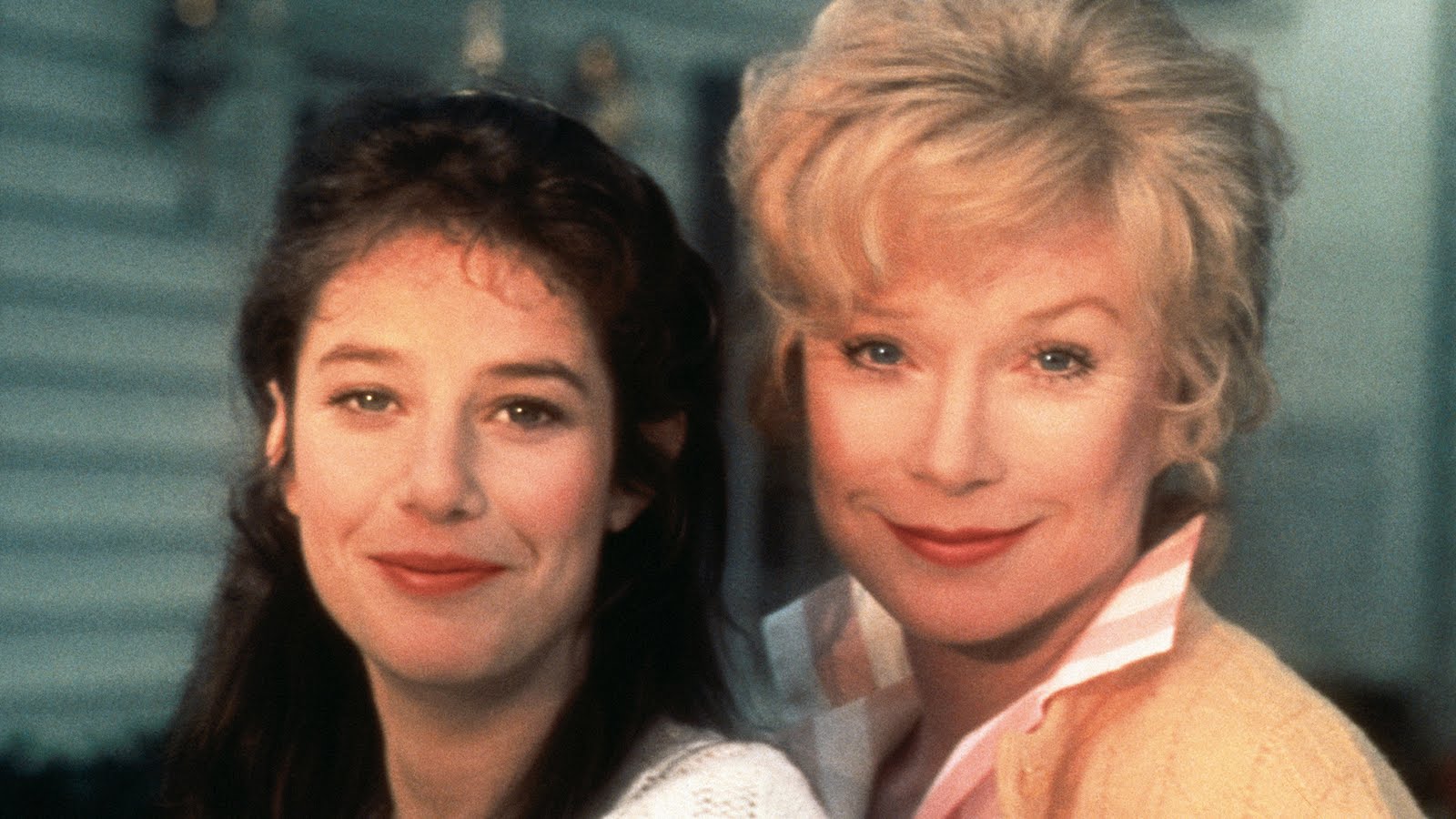
Terms of Endearment (1983)

Debra Winger and Shirley MacLaine are tempestuous but loving mother and daughter in Terms of Endearment

Director: James L Brooks

Cast: Shirley MacLaine (Aurora Greenway), Debra Winger (Emma Greenway-Horton), Jack Nicholson (Garrett Breedlove), Jeff Daniels (Flap Horton), John Lithgow (Sam Burns), Lisa Hart Carroll (Patsy Clark), Danny De Vito (Vernon Dalhart)

Spoilers: If you can spoil one of the most famous tear-jerkers of all time.

I think its fair to say 1983 was a weak year at the Oscars. The finest film of the year, Ingmar Bergman’s Fanny and Alexander, was a four-hour Swedish saga (and arguably a TV series anyway), wasn’t nominated. The most lasting films of the year, Flashdance, ScarfaceWar Games and Return of the Jedi, were never Oscar bait. Terms of Endearment motored through to hoover up five Oscars – beating out The Big Chill (cut from a similar soapy cloth), The Dresser (a British stage adaptation), The Right Stuff (a slightly cold Mercury programme saga box office flop) and Tender Mercies (a low-key character drama about a Country-and-Western singer that won Robert Duvall an Oscar). By any measure that’s not a list for the ages.

And Terms of Endearment had the added bonus of being the second biggest hit of the year, after Jedi (yes, I know!). It’s a surprise, as this sort of female led drama rarely scoops the big prize – so at least it makes a pleasant change. Terms spools out a collage of scenes (there are sometimes time jumps of years between scenes), chronicling the lives of over-protective, domineering mother-and-free-spirit Aurora (Shirley MacLaine) and her daughter, defiant, at times highly-strung, Emma (Debra Winger). The two have a difficult, though loving relationship, often depending on each other for emotional support – especially in their relationships: Emma’s with feckless philandering English Professor ‘Flap’ Horton (Jeff Daniels) and Aurora’s with playboy retired astronaut Garrett Breedlove (Jack Nicholson). But both come together when tragedy and illness strike.

Watching Terms of Endearment today, it’s often hard to see what the fuss was about. Although it wasn’t the first film to jerk tears via last-act illness (see Love Story), this started a wave of films where illness to a key member of the family (usually a mother) has a devastating, tear-jerking (but often eventually heart-warming) effect on the rest of the family (especially young children). Terms of Endearmentprobably does this better than those that followed, but watching it today its hard not to see it as something a little more familiar than it might have felt at the time.

Brooks’ background was in TV (he had several successful shows on his resume, from The Mary Taylor Moore Show to Taxi – so he certainly knew what the masses liked) and this, his first film, often feels like a cut-down mini-series. It matches exactly the sort of soapy, family saga of several TV epics of the time, and Brooks shoots the film with an unfussy, visually flat series of TV angles (aside from his skill with actors, his directing Oscar is a travesty). With each scene effectively standing alone – its collage effect means the film covers at least 14 years minimum with often only the age of the children any indication that time has passed – it also has a slightly bitty air of something assembled for cutting into episodes or advert breaks.

Not that there is anything particularly wrong with this. But, it does mean the film feels like it meanders along through a series of small crises, designed to be easily digestible. The film has a whimsical lack of directness – not helped by its overbearing (and dated) musical score. It relies strongly on sparky dialogue delivered by a cast who all look like they are having a good time (although, allegedly, they really weren’t with Winger and MacLaine in particular barely on speaking terms when the cameras weren’t rolling).

The main dramas are romantic. Aurora doesn’t quite know how to respond to her feelings for gnarled playboy Garrett. An early date between them hilariously contrasts her ludicrously over-formal clothes and his scruffy indifference. Its a difficult dance between two people who, for various reasons, are scared of commitment. But then Emma has made her own mistakes. She’s married Flip (is there a worse name in cinema?) for independence, but really they have nothing in common – and Flip’s eye quickly goes roving. Emma responds in a way her mother would understand: a potentially ‘first strike’ affair with John Lithgow’s meek bank manager (Lithgow and Winger have a wonderful scene at a diner, where he is almost too scared to touch her hand). You can see both mother and daughter teeing themselves up to make the same mistakes: the generations never learn from each other.

At the heart of the film is the mother-daughter relationship. But for me, this often lacks focus and never really coalesces into something that feels real or emotionally coherent. Now you could say that’s like life – and that’s a fair point – but several of the events feel heightened (particularly those featuring Aurora) and the characters are mutually dependent when the story demands it, and barely in touch when the opposite is needed. It’s easy to feel some connecting thread is being lost in those massive time-jumps. I found it hard to escape the feeling several times that people behave like this in the movies but never in real life.

But then, you get the final thirty minutes which revolves around the cancer diagnosis and eventual death of Debra Winger’s character. Here is where Brook’s flat, unobtrusive style comes into its own, his simple, restrained staging of these scenes making them surprisingly moving and affecting – especially considering the artificiality of some of what we’ve seen so far. For the first time, emotion, truth and earnestness – without too much blatant heart-string tugging – comes into play, and these simple scenes of two mothers saying goodbye to their children and each other end up having real emotional impact – as do the slightly stunned scenes of grief of those left behind.

It’s a shame then that most of the rest of the film before that doesn’t quite connect with me. The film was festooned with Oscars, but naturally the person most responsible for it working – Debra Winger – missed out. Winger is superb here, the only character who feels genuinely true, tender and also flawed in natural ways. She is slightly impulsive but also frightened of change, a character who can shout and rage but also is weak and dependent on emotional bonds. She’s totally believable and I would have loved to see more on her troubled relationships with her kids, and how her eccentric mother has impacted her ability to form bonds with her kids. The film doesn’t go there.

The Oscar went through to Shirley MacLaine who gives a big, showy performance as Aurora – and nabs the “Oscar Clip” moment as she bellows at nurses to give her daughter her medication. MacLaine’s Aurora never for one moment feels like a real person, but instead a novelistic invention of an eccentric mother, thrown on screen. MacLaine plays her to the hilt, but it’s a performance that feels mannered. But she gets the film’s fun moments – and gets to spark off Jack Nicholson who coasted to another Oscar as the sort of horny scoundrel he would play again and again for the much of the next thirty years on screen.

Terms of Endearment has enough in it that, if you like this sort of thing, you’ll love it. Perhaps it does mean more to mothers-and-daughters. I found it at times overly twee and laboured. But I can forgive it a fair bit for how effectively it displays grief – and how brilliant Debra Winger is in it. Over honoured? Sure. But, for its genre, a high point.

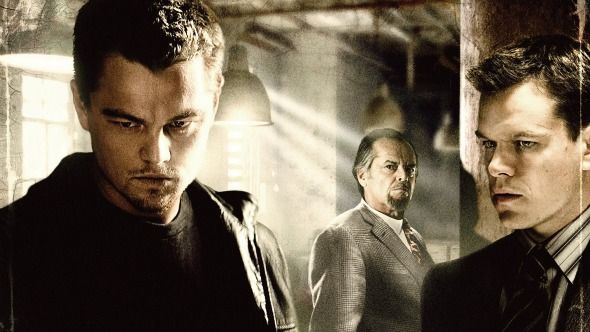
The Departed (2006)

DiCaprio, Nicholson and Damon runaround in Scorsese’s cartoonish Oscar-winner The Departed

Director: Martin Scorsese

Cast: Leonardo DiCaprio (Billy Costigan), Matt Damon (Colin Sullivan), Jack Nicholson (Frank Costello), Mark Wahlberg (Sean Dignam), Martin Sheen (Captain Queenan), Ray Winstone (Mr French), Vera Farmiga (Dr Madolyn Madden), Alec Baldwin (Captain Ellerby), Anthony Anderson (Trooper Brown), James Badge Dale (Trooper Barrigan), David O’Hara (Fitzy), Mark Rolston (Tim Delahunt)

It’s one of those historical oddities that Scorsese finally won his Oscar for his lightest (comparatively speaking) most out-right entertaining film. I’ll confess I’ve never been a huge fan of The Departed. It won Best Picture in a year without a clear front runner, with the Academy feeling an overwhelming sense that Scorsese was ‘due a win’. The Departed is certainly entertaining, but as a great big, violent cartoon which feels like a different universe from the director’s real gangster masterpieces, such as Goodfellas, Mean Streets and Casino. The Departed also can’t hold a candle to Raging Bull, Taxi Driver and The Aviator (I know that last one is controversial). Still it may be just a bit of fun, but at least it is fun.

Boston is a city where the Irish community is split, between cops and robbers. Crime lord Frank Costello (Jack Nicholson) gets a man on the inside by pushing his protégé Colin Sullivan (Matt Damon) to train as a police officer so he can get tips from the inside. Simultaneously, Captain Queenan (Martin Sheen) recruits officer trainee Billy Costigan (Leonardo DiCaprio), an honest young man with a dodgy family, to go under cover in Costello’s gang. Both moles feed information on their ‘side’ to the other – but the stakes heighten as they both become aware of the others existence and race to unmask the other’s identity.

Based on a Hong Kong action film, Infernal Affairs (which has the same plot, but tells the story in about half the time). The Departed takes the basic template and ratchets almost everything up to an even more frenzied pitch. Scorsese throws in fast-cutting visual flair, makes effective use of montage and lays The Rolling Stones over the soundtrack (he really does love Gimme Shelter doesn’t he?). It’s hard to tell, watching The Departed, how much Scorsese’s tongue was in his cheek. This could very easily be a parody piss-take of Casino, with its bright-lights, extreme violence, effing and jeffing and toxic masculinity.

What is clear is that The Departed has all the logic of a playground game. Nothing ever feels particularly real, all emotions and personalities are dialled up to eleven. Big name actors have fun with big, chewable dialogue fully of sweary one-liners. There is barely any sense of a wider world, The Departed really being a chamber piece involving a few key characters, played out in a graphic novel style. In real life both Costigan and Sullivan would have been uncovered in seconds (it makes Line of Dutylook like a fly-on-the-wall documentary). If it has links to any Scorsese film, it’s probably Cape Fear, which was a similar heightened pastiche (of Hitchcock). Don’t get me wrong, there is a lot of fun in watching Scorsese essentially take himself off, and it’s nice to see him having fun, but the film’s constant resorting to foul-mouthed, cartoonish action means depths are missed.

For starters, the film touches on but never really dives into the complex divided loyalties Costigan and Sullivan feel for their sides. After years (at least I think its years, there is very little sense of timeline in the film) pretending to serve one master while actually serving another, you’d expect an exploration of loyalty being increasingly torn between these two masters. It’s not a sense that comes across in the film. Instead, both of them feel fear of their false master and resentment to the true master. Both want to retire – seemingly to the same (lawful) side. The film spends time on the psychological impact of the constant stress of living a lie – but its analysis of this is skin-deep, trauma exhibiting as a bubbling, unpredictable temper (especially with DiCaprio’s Costigan) rather than really giving us an understanding of the psychological trauma. All the final shots in the world of a rat crawling across a railing in front of the court house, doesn’t translate into insight.

The film also misses the mark in exploring the dangerous masculinity of this world. The intense male attitudes here – with the macho posturing and the constant use of sexual and homophobic slurs – are obviously part and parcel of this world. But you feel a smarter film would have unpacked this more, rather than using it for punchlines and chuckles. There’s only really one woman here – a female psychiatrist who (obviously) becomes involved with both men – and you feel more could have been made of how the destructive bloodshed of this film is at least partly powered by overgrown schoolboys on both sides burning the world down to prove their manliness.

But this film is designed as an entertainment, not the sort of insightful character study Scorsese has delivered in the past. And with its primary colour pallet and shots – like a character falling from a building, and low-angle Dutch angle shots of characters checking phones – that seem inspired by graphic novels, it’s clear that we are not meant to take things too seriously here.

That carries across to the performances, many of which are Grand Guignal in their excess. None more so than Jack Nicholson in a performance of such flamboyant “Jack-ness” that it will either delight you or make you wonder whether Scorsese gave him any limits at all. The cast is roughly split between the OTT and the method. Mark Wahlberg follows Nicholson’s lead as a foul-mouthed, permanently angry cop, with rigid morals (he was Oscar-nominated and gets most of the film’s funniest lines) while Baldwin showboats amusingly on the chewy dialogue. At the other end, Sheen brings a fatherly warmth to Queenan while Winstone mumbles a lot as Costello’s number two.

In the leads, DiCaprio brings an edgy, firecracker intensity to Costigan, a man who seems constantly on the edge of a nervous breakdown. Damon, by contrast, underplays rather effectively as the seemingly straight-laced Sullivan, letting the Boston accent roll around his tongue and riffing effectively off his “boy next door” looks. Vera Farmiga does decent work as the woman caught in the middle – even if she’s not 1% convincing as a trained trauma psychologist.

That doesn’t matter though in the heightened, cartoony posturing, blazing gun battles and operatic shouting that makes up the crazy world of The Departed. Scorsese lifting the Oscar for this is rather like David Hockney winning the Turner Prize for a doodle. I enjoyed it a lot more this time around, but it’s still a big, crude, graphic novel, something that looks and sounds clever., but is only a B-movie imitation of Scorsese’s finest work. The Departed is frothy but misses the mark when it aims for true thematic or character exploration.

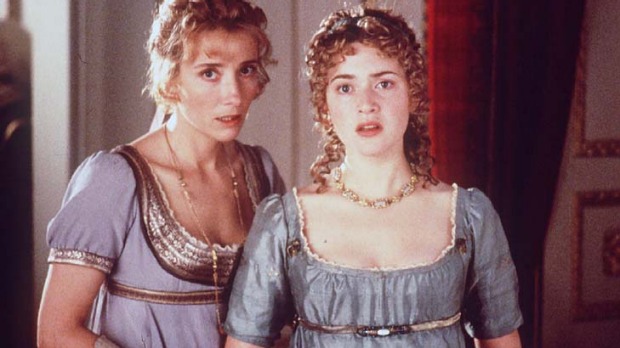
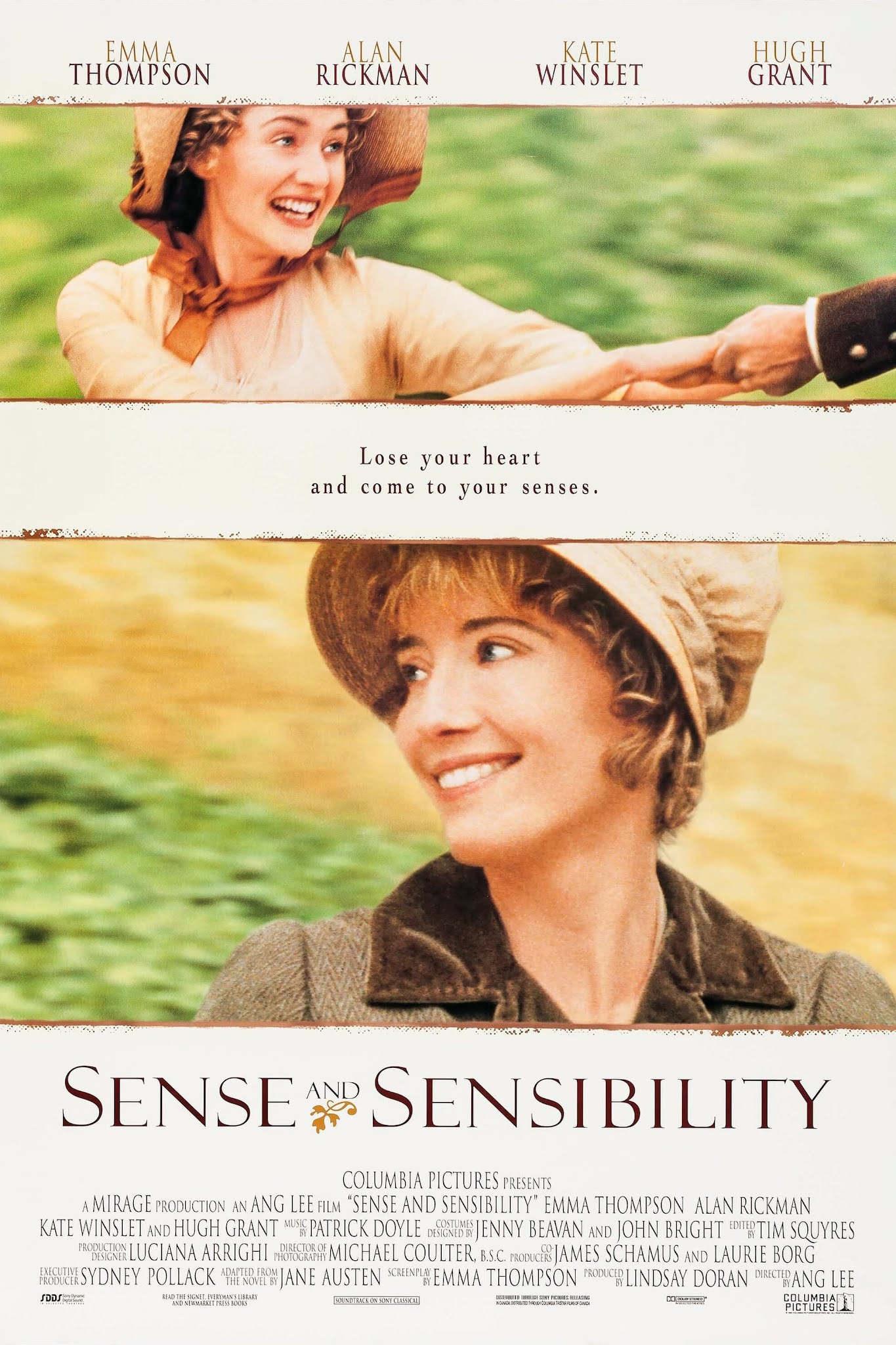
Sense and Sensibility (1995)

Emma Thompson and Kate Winslet are superb in probably the greatest Austen adaptation on film, Sense and Sensibility

Director: Ang Lee

Cast: Emma Thompson (Elinor Dashwood), Kate Winslet (Marianne Dashwood), Alan Rickman (Colonel Brandon), Hugh Grant (Edward Ferrars), Greg Wise (John Willoughby), Gemma Jones (Mrs Dashwood), Harriet Walter (Fanny Dashwood), James Fleet (John Dashwood), Robert Hardy (Sir John Middleton), Elizabeth Spriggs (Mrs Jennings), Imogen Stubbs (Lucy Steele), Hugh Laurie (Mr Palmer), Imelda Staunton (Mrs Palmer), Emilie Francoise (Margaret Dashwood), Tom Wilkinson (Mr Dashwood)

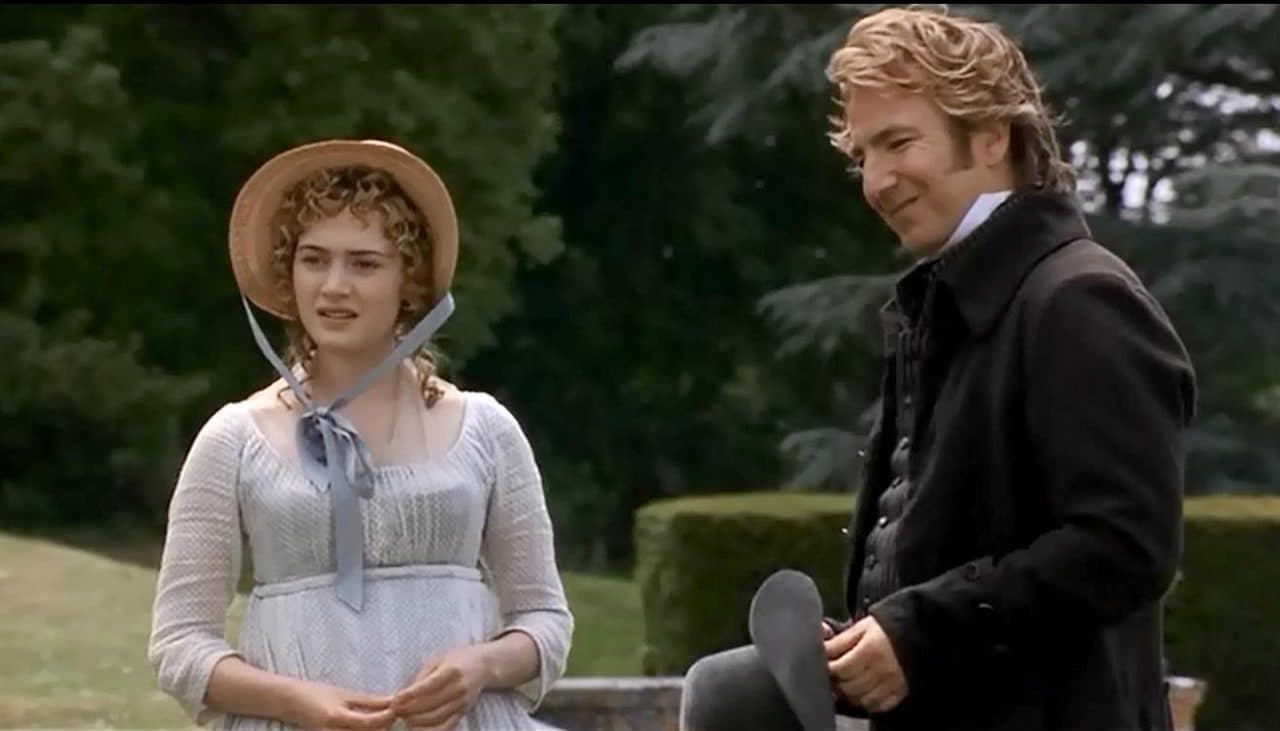
The world of Austen adaptations stands on two pillars – and both of them date from 1995. One is the BBC Pride and Prejudice, the other this luminous adaptation of Austen’s first novel, written by and starring Emma Thompson. It’s hard to pull together a review when a film pretty much plays its hand perfectly: and that’s exactly what Sense and Sensibility does. The film is a complete delight, in which Thompson takes surprisingly large liberties with many of the details of the novel, but brings to the screen a version that never once loses the spirit and heart of Austen’s work. It’s an immensely impressive achievement, and one of the finest literary adaptations ever made.

After the death of Mr Dashwood (Tom Wilkinson), the Dashwood estate passes into the hands of his son John (James Fleet) and John’s ambitious wife Fanny (Harriet Walter), leaving his second wife (Gemma Jones) and their daughters sensible Elinor (Emma Thompson), passionate Marianne (Kate Winslet) and giddy schoolgirl Margaret (Emilie Francoise) suddenly homeless. However, this does bring Fanny’s gentle and kind brother Edward Ferrars (Hugh Grant) into Elinor’s life, and an unspoken romance builds between the pair. There is passion in the air for Marianne at their new home, when she is rescued from a fall in the rain by the dashing Willoughby (Greg Wise). But are there secrets in the pasts of both men that could threaten the sisters’ happiness? And how did Willoughby’s life intersect with the reserved Colonel Brandon (Alan Rickman)?

Thompson’s superbly written script is a faultless adaptation that makes not a single poor choice, and expands and enriches several characters (in particular the three men) to great effect. Thompson not only brings much of the humour and wit in Austen to the fore – the film is frequently very funny – she also understands here truth and tenderness. Which is why the film is so beloved: it’s a film overflowing with empathy and heart for its characters which builds the emotional investment as skilfully as it does the comedy. It culminates in a proposal scene which I don’t think has ever not placed a lump in my throat.

To list all the excellent adaptation ideas would take forever so I’ll use one example. The film wisely expands much of the early character interactions, in particular deepening and exploring the early meeting between Elinor and Edward. A section that takes up barely one of the book’s (very short) chapters here fills the first 20 minutes of the film. It’s vital as it superbly establishes the natural warmth and intimacy between these two, and their perfectly complementing personalities.

It also allows Grant – in one of his most romantically winning performances – to display some deeply endearing light comedy, as well as establishing Edward as a thoughtful, sympathetic and decent man, who forms bonds quickly with all the family (especially young Margaret) through his genuineness. It also keeps us rooting for a relationship – and for a character – who the film often has to leave off screen for vast stretches, and leaves us in no doubt that his (later revealed) engagement to Lucy Steele (a woman he does not love, and who is interested in him solely for his position) comes from the same motives of decency, duty and the desire to do the right thing.

If that’s an example of one of Thompson’s most successful changes in her adaptation, she also unerringly identifies the things it’s most important to keep. Just like the novel, the film places the warmth of the sisters’ relationship at its heart. Helped by the natural chemistry and ease between Thompson and Winslet, the film carefully contrasts the personalities of these two sisters (one sensible and reserved, the other spontaneous and passionate) but takes no sides and also shows the sisters themselves are united by their love for each other. The film frequently features scenes of confidence and intimacy between the two, and continually brings us back to each other as the key relationship in their lives. It also shows how both need to meet in the middle ground: Elinor needs some of Marianne’s sensibility, just as Marianne needs to take on some of Elinor’s sense.

Although sense would not have necessarily helped Marianne uncover the dangerous selfishness of Willoughby. Perhaps the only wrong call in the BBC Pride and Prejudice (like most adaptations of that novel), is that it makes the rogueish Wickham insufficiently handsome and too blatantly smarmy from the start, tipping the audience the wink that this man can’t be trusted. Not so here, with Greg Wise giving Willoughby so much charm, regency handsomeness, dash and warmth that you would not imagine for a moment he could be anything but what he seems. He makes a clear contrast with Marianne’s other suitor, the older, more distant Brandon – superbly played by Alan Rickman – whose qualities of kindness and decency are hidden behind his coolness and lack of flash (Rickman is, again, wonderful here as a man hoping against hope for  a second chance at love).

But then the film is filled with perfectly cast actors. Thompson is a brilliant and natural fit for Elinor (even if she is too old for the part, something she acknowledged herself) giving her acres of emotional torment under an exterior she must keep calm and controlled for the sake of her family. Winslet became a star for her enchantingly free-spirited performance, grounded by a warmth and desire for the best for others that keeps the character from ever becoming irritating or overbearing.

Among the rest, there isn’t a bum note. Walter is hilarious as the washpish Fanny, Hardy full of bonhomie as Sir John. Elizabeth Spriggs is perfect as a gossipy old maid who is a pillar of strength when her friends are ill-treated. Hugh Laurie is hilarious in a gift of a part as the dry, cynical Mr Palmer whose nearly every line is laugh-out-loud funny, but who also proves his nobility in a crisis. Staunton is equally good as his flighty, mismatched wife. Imogen Stubbs brings out the simpering manipulative scheming of Lucy Steele perfectly.

The whole is bought together expertly by wonderfully paced and constructed directing by Ang Lee, whom it’s surprisingly easy to over-look. Lee was a considered an odd choice for the film – he barely spoke English at the time and was a stranger to Austen. But the film is an inspired match for him, tapping into his sensitivity, the warm eye he brings to families and their dramas, and also the observer’s wit he brings to social comedy and dynamics. Lee also brings an outsider’s eye to England – it’s a film that looks wonderful, but not simply romantic, with Lee not afraid of a stormy sky or a muddy street. Interiors are shot with a candlelit beauty, and there is a sense throughout of all this taking place in a real world. Patrick Doyle’s perfectly judged score also works wonders to help create the mood.

Sense and Sensibility is a masterful film and a, perfect adaptation of Austen. It’s hard to imagine that it will be bettered for some time. Indeed, like the BBC Pride and Prejudice, it feels like it has made all other adaptations of the book redundant. With a brilliant adaptation, superb acting, sensitive and insightful direction and a true understanding of the spirit and heart of Austen, this is one of the greatest adaptations ever made.

The Greatest Show on Earth (1952)

Charlton Heston and James Stewart in the infamous (and rightly so) The Greatest Show on Earth

Director: Cecil B De Mille

Cast: Betty Hutton (Holly), Cornel Wilde (The Great Sebastian), Charlton Heston (Brad Braden), James Stewart (Buttons), Dorothy Lamour (Phyllis), Gloria Grahame (Angel), Henry Wilcoxon (Agent Gregory), Lawrence Tierney (Henderson), Lyle Bettiger (Klaus)

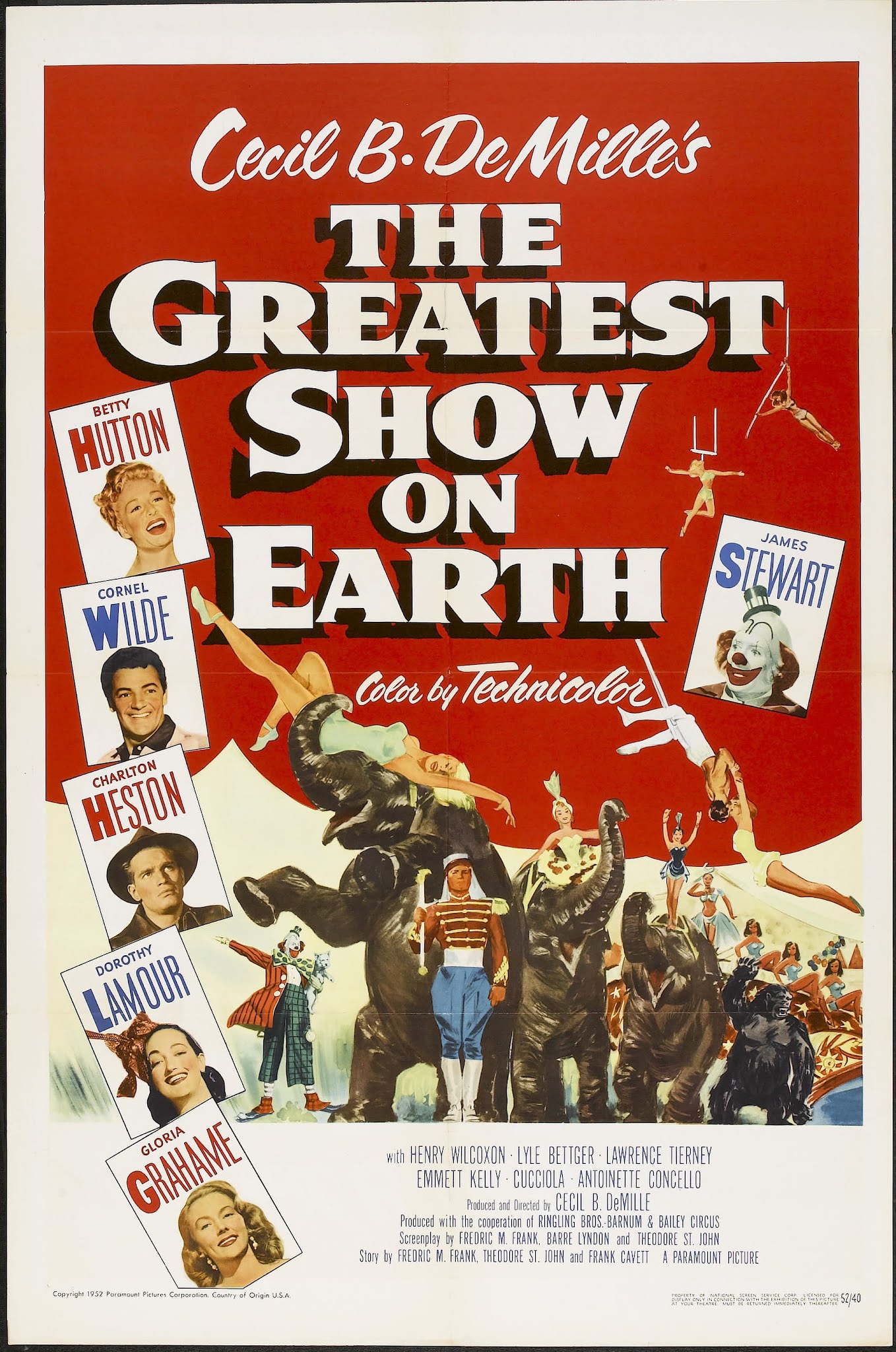
When Crash was named Best Picture, did The Greatest Show on Earth do a backflip of celebration? Finally, when the topic “What is the worst Best Picture winner of all time?” came up, the answer would no longer immediately be “Well The Greatest Show on Earth of course”. Now, there could be an actual debate. Hard to believe but this film was the biggest hit of 1952. Its reputation has been shredded since: it’s proof that winning Best Picture can destroy a film’s reputation as much as it can raise it. Greatest Show is, of course, a pretty bad film. But it’s not catastrophically atrocious. It’s merely pretty bloody awful.

Anyway, it’s all set in a Ringwood circus. Manager Brad Braden (Charlton Heston) is so in love with the circus, he has “sawdust in his blood” (drink every time some variation of this phrase comes up, and you’ll be pissed by the hour mark – which might be the best way to watch the rest). To bring in the crowds he hires famed acrobat The Great Sebastian (Cornel Wilde) – which means shunting previous acrobat star (and Brad’s girlfriend) Holly (Betty Hutton) to support act. It’s a rivalry – but wouldn’t you know it, sparks fly and a love triangle forms. In fact, it quickly becomes a love pentagon as elephant artiste Angel (Gloria Grahame) has past with Sebastian, is in love with Brad (who’s interested) and is fending off the interests of fellow elephant artiste Klaus (Lyle Bettiger). Oh, and James Stewart plays a clown who never removes his make-up because he is actually a doctor in hiding for euthanising his wife (“He killed the thing he loved!” a newspaper headline screams).

All this is packaged together with the puffed-up self-important portentousness that DeMille bought to his Biblical epics. Cecil himself even delivers a grand voiceover at life-changing events like the raising of the big top and the loading of a train. It’s packaged together with endless stagings of assorted circus acts (this film is very slim in plot, but very long in runtime), all accompanied by continual cuts to the circus audience “oohing” and “aahing” as appropriate, or asking such inane questions as “What’s going to happen next?” (a question no one watching the film is likely to be interested in asking). It makes The Greatest Show even more of a museum piece, a recording of a certain type of grand entertainment that doesn’t really exist anymore.

Away from the big budget and long filming of circus acts, we have a dull, derivative and tedious soapy plotline where ridiculous cliches abound and barely a line of dialogue escapes clunking to the floor with the same heaviness as the Great Sebastian when he (inevitably) falls from the trapeze. No single opportunity for heavy-handed foreshadowing is missed, from that accident to the film’s big train-wreck ending, to the numerous hints dropped about Buttons’ tragic background. It’s all packed into a crude series of homages to the glories of small town America (who appreciate the delights of the circus in the way the big city suits never can) and the glorious romance of not even letting death and a train wreck get in the way of the show going on.

At the centre you get the tedious love pentagon. The central figures of this – Hutton, Heston and Wilde – seem to be involved in a private competition for who can give the worst performance. Heston (in a very early role) is wooden beyond belief, the granite self-importance that made him a perfect Moses ridiculously overbearing for the job of circus manager. He and Hutton play most of their scenes with an absurd energy, throwing themselves into poses. Hutton’s performance is bubbly, chirpy and endlessly irritating. Betty is the worst kind of simpering mess, which culminates in her holding herself responsible for Sebastian’s decision to perform without a net. Wilde is saddled with a bizarre accent (where is he meant to be from? I guess “Europe”), and acts with all the comfort and skill of a vertigo-suffering acrobat.

But then to be honest pretty much everyone in this film is awful. I’ll cut a bit of slack for Gloria Grahame, who gives Angel more charm than all three of the leads put together, and James Stewart who can play the melodramatic crap he’s saddled with standing on his head. But literally everyone else in this film is dire: hammy, over-blown, cartoonish and mugging. There is not a single moment of performance or story-telling that is remotely memorable, and everyone is introduced with a clunky, trailer-friendly line of dialogue.

Nothing will remotely surprise you about the plotline – other than that they manage to stretch something as insipid and uninspired as this out for nearly 150 minutes. Though of course most of that is circus acts, or watching circus marches, or listening to Betty Hutton or Dorothy Lamour sing. (In what passes for wit in the film, while Lamour sings the camera cuts to Crosby and Hope, her old co-stars, watching in the stands hammily chewing popcorn.) There is a certain academic interest in watching these circus acts (performed by real circus artistes – although the actors trained so they could get involved), but after a while you are only reminded that it’s not as interesting or exciting as actually being there.

Maybe that’s why the plot becomes so overblown to try and compensate. Love triangles! Falls from a great height! Gangsters muscling in on the circus! A clown on the run from the cops, meeting his mother during the show once every year! A spurned lover who decides to destroy the circus in revenge! No wonder, after the opening scenes focus on the cost of staging the show and importance of staying in profit to continue the tour, our initial set-up, never gets mentioned again. How could it compete with this bizarre parade of nonsense?

It culminates in a train wreck – and of course Buttons is given “the terrible choice” of letting a man die or revealing his medical knowledge (and identity) to save his life. The train wreck has some decent model work. DeMille certainly looks happier dealing with that than attempting to make anything among his romantic sub-plots feel light, fun or natural.

The Greatest Show on Earth is all about show – and whenever it tries to do anything intimate, it invariably falls flat on its face. There are worse films out there, but attaching the mantle of “Best Picture” to this makes it feel worse than it actually is – and its pretty bad on its own merits. When all is said and done, still possibly the worst Best Picture winner ever.