Category: Directors

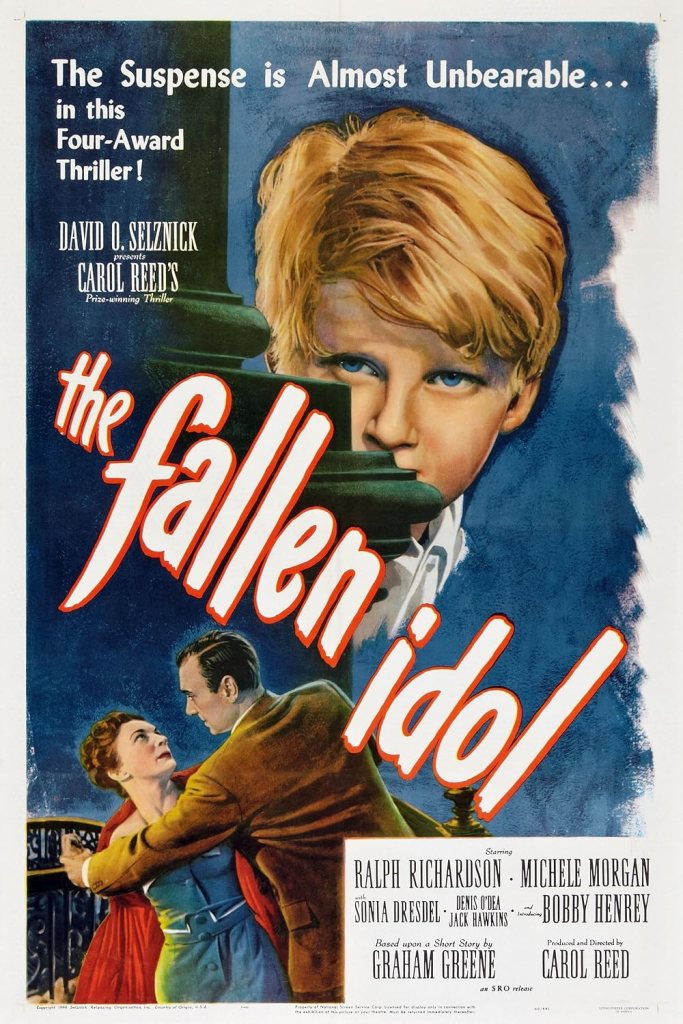
The Fallen Idol (1948)

The Fallen Idol (1948)

Brilliant thriller about how hard the world is for a child to understand

Director: Carol Reed

Cast: Ralph Richardson (Baines), Michèle Morgan (Julie), Sonia Dresdel (Mrs Baines), Bobby Henrey (Philippe), Denis O’Dea (Chief Inspector Crowe), Jack Hawkins (Detective Amos), Walter Fitzgerald (Dr Fenton), Dandy Nichols (Mrs Patterson), Geoffrey Keen (Detective Inspector Davis), Bernard Lee (Inspector Hart), Dora Bryan (Rose), Karel Stepanek (First Secretary), Torin Thatcher (Constable)

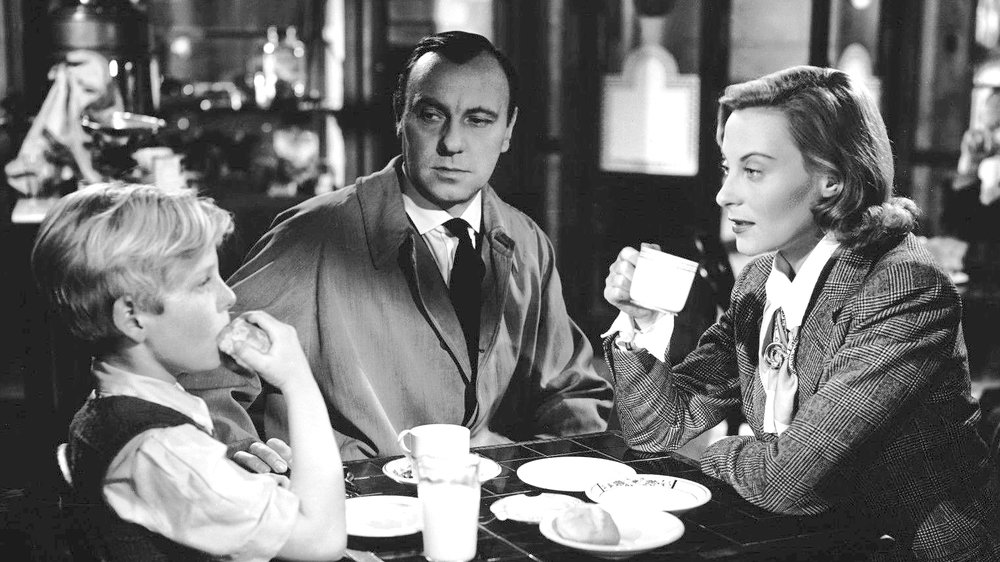
We’ve all had heroes we worship haven’t we? Few hero worships burn as brightly as a child’s. Eight-year-old Philippe (Bobby Henrey), son of a foreign ambassador in London, is awe-struck by the embassies English butler Baines (Ralph Richardson), a kind, decent man with a twinkle in his eye who enjoys spinning stories for Phil about his exciting life in India. The highlight of Phil’s day is spending time in Baines’ parlour. For Baines though, his highlights are the snatched moments of release from his domineering, unloving wife (a masterfully tough-to-like Sonia Dresdel) that he spends with embassy secretary Julie (Michèle Morgan).

The affair is obvious to us in seconds. But Phil – from whose perspective we see large amounts (but, crucially, not all) of the film play-out – is of course oblivious, readily accepting Baines awkward assurance Julie is just his niece. The Fallen Idol – the middle film in Reed’s astonishingly high-quality run of films that includes Odd Man Out and The Third Man – is a brilliantly tense, very moving story of how adrift children feel in the adult world, how easily they misinterpret signals and misread social cues. Superbly filmed, with a wonderful script by Graham Greene (from his own novel) it’s a masterclass in how the simplest situation can lead to the most intense drama.

It revolves around a fatal trap for Baines. Believing his wife is away for the weekend (she has in fact concealed herself in the embassy mansion), Baines treats himself to a day and night with Julie. Discovered, the confrontation leads to Mrs Baines dead at the bottom of the stairs. The argument is partially witnessed by Phil – but crucially, only glimpses of it as he runs down the exterior fire escape, peering in through windows as he goes – but in full by the viewer. It’s clearly a terrible accident, taking place after Baines had left. But Phil is convinced he has witnessed a murder – and so passionate is his hero worship of Baines (and loathing of Mrs Baines), he decides to do everything he can to protect the butler.

The genius of Reed’s The Fallen Idol is that we are always know more than any of the characters. Just as we can tell immediately from witnessing Baines and Julie’s whispered, Brief Encounter-ish meeting in a London coffee shop that they are in the midst of a passionate affair, so we also know much faster than any character that Mrs Baines is still in the house and that her death is a clumsy accident. We can also see, in ways Phil cannot, that his desperate lies only undermine Baines honest version of events. We know all the details well ahead of the police, watching them misinterpret clues and behaviour in the worst possible light. The entire film shows how damning circumstances and coincidences can fold up into a vice-like trap from which there is almost no escape.

The Fallen Idol is a film awash with lies. In many ways it’s a heartbreaking reveal of how quickly the compromises and selfishness of the adult world corrupts the child’s. At the heart of these lies is Baines himself. The role is beautifully played by Ralph Richardson, utilising his eccentric cuddliness to exceptional effect, but also perfectly capturing the selfishness, weakness and cowardice of Baines. Because Baines is a liar – not only to his wife, but also to Julie (he spectacularly lacks the guts to ask his wife for a divorce, despite what he tells Julie) and, walking Phil back after he has crashed Baines’ tea-time meeting with Julie, urgently instructs him to lie if he is ever asked about what happened that afternoon. Baines doubles down on his duplicity by using the unwitting Phil as a shield to cover a zoo-trip date with Julie, and even his adventure stories to Phil are all slightly self-aggrandizing tall tales.

One of the toughest things about The Fallen Idol is that hero-worship is a confused one-way street, especially when children are involved. Baines is fond of Phil but often treats him with distracted affection out-of-kilter with the earnest, devoted adoration Phil pours on him. This devotion from Phil is so great, even his belief that his hero is a murderer makes no impact on him. Having taken his idol’s lessons to heart, about what to do when questioned about anything to do with Julie, Phil lies and lies to the investigating officers, corrupting himself (he believes, after all, he is helping a killer) while also making the innocent Baines seem guiltier-and-guiltier with every word.

Carol Reed draws a superbly natural performance from Bobby Henrey, in a performance utterly lacking in childish, mannered acting tricks. It’s a hugely natural performance, over-flowing with innocence making Phil a character we end up deeply caring for. The early half of the film throws us perfectly into the excited world of a child with a whole mansion to run around in, cuddling his pet snake close to his chest. Reed also brilliantly captures how a moment of trauma confuses and terrifies an innocent into not knowing what action to take. Fleeing the house barefoot – clearly terrified and heartbroken – immediately after the death, Phil is petrified when he encounters a policeman not because he is intimidated, but because he fears inadvertently betraying his idol.

Reed superbly captures the desperate vulnerability of children, the nightmare of not having your voice listened to as adults talk over and around you. The Fallen Idol (with its careful use of disjointed angles and God-like, wide-angle shots from above) has a superb sense of the horror of being caught in a situation you neither fully understand or can influence. It’s echoed perfectly by Baines’ increasingly defensive panic as each denial falls on all-too-obviously deaf ears. Phil also misinterprets almost everything he is told in the film, right up to when the sympathetic Julie (a lovely, warm performance from Michèle Morgan) begs him that only the truth can help Baines.

The Fallen Idol spices this up with superb moments of comedy. Dora Bryan has a delicious cameo as a ‘lady of the night’, called upon to by the flummoxed policemen at the station Phil has fled to, to try and draw some words out of the stubbornly silent child – and who can only fall back on the cliches of her profession (‘Can I take you home dearie?’). An Inspector (a lovely cameo from Bernard Lee) called in to translate in the embassy is begged by the first secretary to drop his inept schoolboy French. A tense interrogation of Baines is interrupted when a pedantic embassy staffer insists he must be allowed to check the clocks in the room (Reed wittily shows the characters revolving, clockwork like, impatiently on the spot in the background while this interminable check goes on).

But the great strength of The Fallen Idol is how it captures the joyful innocence of childhood and the Kafkaesque confusion the adult world can have on a child. Poor Phil never really understands anything that goes on (although the film ends with a sweet irony of Phil being the only person who perhaps understands a vital ‘clue’ only to be completely ignored) while we are always in complete understanding. Reed’s direction is faultless, both from his work with actors to his masterful use of camerawork and editing to really capture the confusing, unreadable adult-world from a child’s perspective. It’s a masterful, gripping, heart-rending film – a small scale classic that perfectly mixes tension and wit.

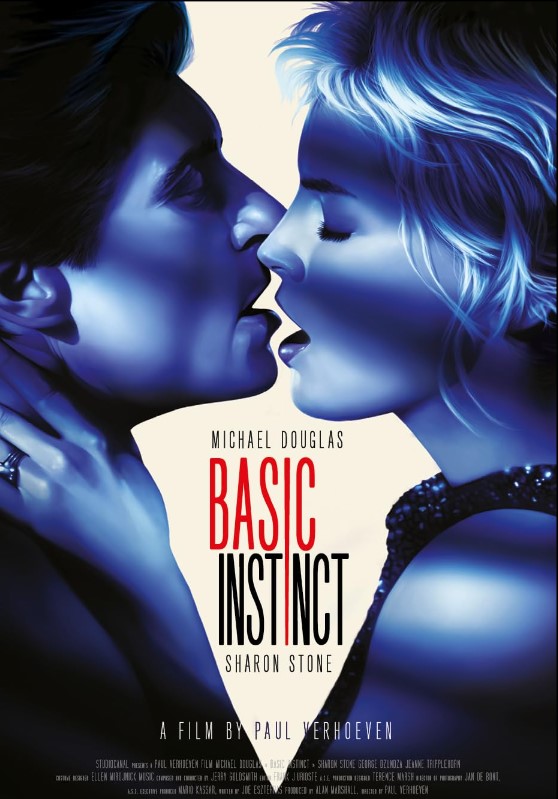
Basic Instinct (1992)

Basic Instinct (1992)

A sensationalist hit, this Trashy Hitchcock-pastiches looks very pleased with its own naughtiness today

Director: Paul Verhoeven

Cast: Michael Douglas (Detective Nick Curran), Sharon Stone (Catherine Tramell), George Dzundza (Detective Gus Moran), Jeanne Tripplehorn (Dr Beth Garner), Dorothy Malone (Hazel Dobkins), Denis Arndt (Lt Philip Walker), Leilani Sarelle (Roxy Hardy), Bruce A Young (Detective Sam Andrews), Chelcie Ross (Captain Talcott), Wayne Knight (Assistant DA John Correli), Stephen Tobolowsky (Dr Lamott)

If there is one thing Basic Instinct proves for sure, it’s that Paul Verhoeven is a very naughty boy. A sensational smash hit in 1992, largely because of the instant iconic status of that scene (you know which one), Basic Instinct remixes Hitchcock (especially Vertigo and Psycho) with lashings of explicit sex and violence, a touch of The Silence of the Lambs and a dollop of Fatal Attraction. It’s a deeply silly, dirty film that was a sort of Fifty Shades of its day: vanilla porn for those who feel too self-conscious to actually go and watch a real one.

Catherine Trammell (Sharon Stone) is number one suspect for the murder of her boyfriend (or rather as she describes him “the guy I was fucking”) for two reasons: one she published a novel a few weeks earlier where she explicitly described the crime in detail and two she’s an obvious Hannibal Lector-ish genius psychopath. Doesn’t stop weak-willed detective Nick Curran (Michael Douglas) from becoming obsessed with her, sucked into a wild sexual affair. But is Catherine a misunderstood unlucky victim, or the genius manipulator her old college rival Dr Beth Garner (Jeanne Tripplehorn) – also Nick’s on-and-off girlfriend and psychiatrist – says she is?

Basic Instinct was the most expensive script ever sold, earning Joe Eszterhas $3million for what he claimed was fourteen days’ work. And you can see why – it’s got everything audiences could need for an addictive, trashy bit of fun. A femme fatale who is also a genius psychopath! A handsome macho cop! Brutal murders! A puzzle interesting enough to keep ticking over but obvious enough that you don’t need to think about it too much! And of course, lots and lots and lots of sex! And then even more sex! No wonder people saw dollar bills – at the very worst they had a chance at a so-bad-its-good box office smash.

But the good stuff. Basic Instinct’s comic-book Hitchcock pastiche actually works rather well, helped enormously by a marvellous Oscar-nominated score by Jerry Goldsmith, which brilliantly channels Bernard Herrmann’s luscious Vertigo strings. It’s no exaggeration to say Goldsmith’s score dramatically improves the film, from adding tension to a drawn-out elevator trip to adding a film noir lyricism to Catherine and Nick’s rather forced sexualised banter. Verhoeven also really knows his business: the film’s famous interrogation scene works as well as it does through his skilful editing between wide angles, close-ups and POV shots, aided by the striking uplighting from cinematographer Jan de Bont.

That scene – and the film – also works because of Sharon Stone. Taking on a role turned down by almost every single woman in Hollywood, Stone seizes hold of a part she knew was a once in a lifetime opportunity. Nick may be the lead – and Douglas, in the middle of his run of weak modern American men bewitched by strong women, may have been the high-paid star ($14 million to Stone’s $550k) – but both knew this was Catherine’s movie. Stone plays the role with a playful, sensual confidence and arrogant defiance, knowing full well she can seduce anyone. Despite the clunky dialogue, she makes Catherine sexy, smart and just about vulnerable enough to make some viewers doubt whether she’s the killer or not. (I mean she blatantly is, the film doesn’t really try and pretend otherwise. Most of the fun is seeing how shamelessly she can parade it and still get away with it.)

Away from that though, Basic Instinct is a terribly silly film, a well-made pandering to our lowest desires. Opening with an extremely graphic post-coitus stabbing frenzy (with blood spray everywhere and a nose skewered by an ice pick) – it then teases us three times that it will repeat this again after nearly every explosive session of rumpy-pumpy. Ah yes, the rumpy-pumpy. Basic Instinct slows at the half-way mark for an almost five-minute extended multi-angled, orgasm packed bit of horizontal jogging that Nick then rather pathetically spends most of the rest film bragging about being “the fuck of the century”.

But then Nick is a pathetic figure. Somehow keeping hold of his badge, despite gunning down two tourists while high on cocaine, he’s got such an addictive personality he makes Lloyd Bridges’ (“I picked the wrong week to quit sniffing glue!”) air traffic controller in Airplane look like a model of restraint. After internal affairs-mandated therapy (how’s that for a slap on the wrist) – hilariously compromised by Jeanne Tripplehorn’s Dr Garner crossing all ethical lines by repeatedly shagging him – Nick has proudly quit drugs, drink, smoking, and shooting before asking questions. Needless to say, under Catherine’s influence, he embraces all of these again, all while still managing to be the sort of middle-aged loser who wears a pullover to nightclub.

Eszterhas’ script mixes awful “tough” dialogue (“Looks like he got off before he got offed” Nick’s partner jokes over a victim) with clumsy psychological insight (my favourite is Tobolowsky’s consultant who confidently states two options: Trammel either did or didn’t do it – inevitably this childishly empty insight is met with the manly ‘tecs muttering “In English Doc!”) and blunt statements of the obvious (“She’s brilliant! And Evil!” screams poor Tripplehorn). The flirty banter is largely sold by Sharon Stone’s confidence, since the lines (“I’m not wearing underwear”) are hardly Double Indemnity. The film’s mystery is so irrelevant to its appeal (and, in many ways, plot), it merrily gets bogged down in several off-screen murders of characters we’ve never met.

Today Basic Instinct feels like a bizarre museum piece. George Dzundza’s sidekick cop is intended as comic-relief but comes across like a little ball of toxic masculinity. An early sex scene between Nick and Beth is pretty much impossible to watch today without thinking “yeah that’s rape”. The film uses bisexuality (though we only, of course, get girl-on-girl – Douglas made it clear he ain’t gonna kiss no man) as raw titillation, an entre for the soft porn of Douglas and Stone noisily going at it for about 10% of the film’s run time. Even the famous scene is uncomfortable to watch, since Stone has since made it clear she didn’t consent to that shot.

Basic Instinct is a deeply silly piece of trash. But then that was its appeal back then – no one felt they were actually watching Hitchcock when they sat down to this rip-off of the master (in fact Basic Instinct makes you feel it’s probably a relief the production code meant Hitchcock couldn’t give into his Verhoevenish instincts). Today most like to think of it as a sort of well played card trick. However, it’s hard not to feel a bit for Sharon Stone to whom it became a millstone (which she eventually exploited for a terrible belated sequel for which she pocketed $13.5million), despite being the person possibly most responsible for its success. So maybe Nick won in the end after all.

Evil Does Not Exist (2024)

Evil Does Not Exist (2024)

Haunting, enigmatic parable on nature and modern society that leaves a lingering impression

Director: Ryusuke Hamaguchi

Cast: Hitoshi Omika (Takumi Yasumura), Ryo Nishikawa (Hana Yasumura), Ryuji Kosaka (Takahashi Keisuke), Ayaka Shibutani (Mayuzumi Yuuko), Hazuki Kikuchi (Sachi Minemura), Hiroyuki Miura (Kazuo Minemura), Yûto Torii (Tatsuki Sakamoto), Takako Yamamura (Yoshiko Kizaki), Takuma Nagao (Tomonori Hasegawa), Yoshinori Miyata (Akira Horiguchi, Takahashi), Taijirô Tamura (Ippei Suruga)

Imagine a beautiful Japanese mountain village, where the water is so clean, jugs of are taken straight from the stream to the local restaurant where its unique taste adds to the food’s beauty. Everything here is in careful harmony. Until a corporation reckons it’s the perfect site – keen to exploit, while it can, lingering Covid subsidies – to build a glamping site with a 95% effective septic tank (because that’s fine with government regulations). The corporation hosts a charade of a consultation where the plans are rejected by the community, unconvinced by the ‘trickle down’ wealth promised and more concerned with that 5% sewage being tipped into their gloriously pure water supply.

Perhaps the point of Evil Does Not Exist is that there is no real malevolence here. The corporation that wants to effectively shatter the harmony of this community isn’t doing it because they are cruel, they’re just doing what they do to create profits. And they genuinely don’t really see the problem because with a classic lack of empathy they’re convinced what is good for them is good for everyone. And that deep-down everyone shares their outlook. The villagers are just angling for a bigger pay-outa and they don’t really need to fix the septic tank because it falls within the rules and the water will still be okay with a little bit of sewage in it.

Evil Does Not Exist it seems, because most of the bad stuff happening in the world is because of empathy-free systems, people not really caring about impact of their actions and a general lack of interest in long-term impacts over short-term gain. Hamaguchi’s beautifully filmed, Godard-inspired (from title fonts, to shooting-style to Hamaguchi’s use of non-professional actors) environmental parable carefully and subtly deconstructs a world where the beauty of nature can be rinsed away simply out of a sense of inevitability and quick-buck expediency.

Originally envisioned as a short film that would showpiece the beautiful orchestrations of its composer Eiko Ishibashi, Hamaguchi expanded it as he shot more and more material, eventually developing it into a fascinating and open-ended parable about our relationship with nature. Nature here is an elemental and unknowable force: the first five minutes of the film is a sustained tracking shot through the trees, the only sounds we hear being Ishibashi’s music. It’s almost ten minutes before we hear any dialogue. The village’s ‘odd-job man’ Takumi (Hitoshi Omika) is very much one with the natural world around him, taking only what he needs and living in gentle, stoic harmony with the environment.

Hamaguchi’s film – utilising his careful, Ozu-inspired camerawork and Godardian love of realist observation – creates a natural world which is both beautiful and hauntingly mysterious. In the film’s calm shots of nature, the forest becomes a haven but one strangely inhuman. There is a feeling of unknowable, unrelatable forces in this world, an organic Gaia understanding that the villagers are unconsciously plugged into, which governs the ‘rules’ of existence. It’s an understanding utterly inaccessible to those who arrive from the city and want to pave paradise and put up a parking lot.

Evil Does Not Exist pivots around its consultation meeting, which takes place in a town hall, chaired by initially bored consultants going through the motions with a slide deck they don’t understand and a ring-binder of notes they are unfamiliar with. As the villagers quickly discover (their adroit questioning taking the under-prepared consultants off guard), this consultation is a sham – anyone with any control over the fate of the project isn’t there and the glamping site is happening regardless of anyone’s feelings. All this meeting is about (as the head of the company later says, dialling in to chat to his consultants on a video call) is demonstrating the company has ‘listened’ and to tweak a few token issues (it’s telling that the head of the company describes the disastrous meeting as a complete success). None of this is evil of course: it’s just the bureaucratic acquisitiveness of the modern world, which values procedures and rules over impacts and end results.

Both consultants however find themselves taken with the village. But Hamaguchi demonstrates this is always rooted in a patronising sentimentality that’s as much about themselves as it is the actual village. Takahashi (Ryuji Kosaka) in particular, a disaffected company drone, spontaneously decides he can just jack it all in and become a skilled man of the wilderness like Takumi. Takahashi comes across as an embarrassing romantic, identical in many ways to the likely glamping customers (who want a sense of the nature without actually living there). He’s hideously clueless about the fauna of the forest and his practical skills (captured in a hilariously awkward attempt to chop wood) are woefully inadequate. None of this stops him from assuming he can fit right in on a whim with no preparation or training. Takumi’s just an odd-job man, how hard can that be to pick-up?

It doesn’t kid Takumi, who stares at him with an impassive face that hints at a range of emotions from contempt to humorous indulgence. Perhaps he’s aware that Takashi (again patronisingly) sees him less as an individual and more as his personal Yoda, placed on earth to mentor Takashi’s personal growth: to the outsiders the village and its inhabitants are always filtered through what they can do for them. Takashi’s patronising expectation that Takumi will welcome a ‘student’ isn’t wildly different from the company’s view that Takumi can be won over to supporting the project because they’ve offered him a job and a semi-decent salary.

This all culminates in a mysterious, open-ended conclusion which sees Hamaguchi lean into hints of folk-horror. Does the conclusion of Evil Does Not Exist show the dangerous consequences of mankind’s interference of nature on the most innocent? Does Takami represent a resentful natural world biting back? Questions hang over the film’s cryptic ending, which has been neatly foreshadowed throughout.

Evil Does Not Exist has a quietly hypnotic quality to it, but also a haunting chill behind its beautiful imagery. But it also asks subtle but intriguing questions about our link to nature and how a myopic focus on our own interests and needs inadvertently damages the world far more than actively ‘evil’ acts ever could.

Megalopolis (2024)

Megalopolis (2024)

Coppola’s ambitious epic commits the cardinal sins – boring, hard to follow and immensely tedious

Director: Francis Ford Coppola

Cast: Adam Driver (Cesar Catilina), Giancarlo Esposito (Mayor Franklyn Cicero), Nathalie Emmanuel (Julia Cicero), Aubrey Plaza (Wow Platinum), Shia LaBeouf (Clodio Pulcher), Jon Voight (Hamilton Crassus III), Laurence Fishburne (Fundi Romaine), Jason Schwartzman (Jason Zanderz), Kathryn Hunter (Teresa Cicero), Dustin Hoffman (Nush Berman), Talia Shire (Constance Crassus Catilina)

I wanted to like it. Honestly I did. I really respect that Coppola was so passionate about this dream project that he pumped $120 million of his own money into it to make it come true. You can’t deny the ambition about a film that remixes modern American and Ancient Roman history, within a sci-fi dystopia. But Megalopolis is a truly terrible film. Coppola wanted to return to the spirit of 1970s film-making: unfortunately what he’s produced is one of the era’s self-indulgent, overtly arty, unrestrained and pretentious auteur follies where an all-powerful director throws everything at the screen without ever thinking about whether the result is interesting or enjoyable.

In New Rome (basically New York), Cesar Catilina (Adam Driver) is a visionary architect and inventor, who created ‘megalon’, a sort of magic liquid metal. His vision is to use it make a glorious new Rome. He’s opposed by Mayor Cicero (Giancarlo Esposito) who wants to focus spend on practicalities rather than castles-in-the-sky. This leads to a series of increasingly dirty political flights between Catilina, Cicero and Catilina’s cousin Clodio Pulcher (Shia LaBeouf) the degenerately populist nephew of super-wealthy banker Crassus (Jon Voight), who is married to TV star and ambitious social climber (and Catiline’s former girlfriend) Wow Platinum (Aubrey Plaza). Catilina is also in a tentative relationship with Cicero’s daughter Julia (Nathalie Emmanuel). Or yes and he can mysteriously stop time. Somehow. Even he doesn’t know how.

The film is a sympathetic portrait of Catiline, a powerful Roman who (probably) caused a scandal by shagging a Vestal Virgin then attempted to mount a coup with a heavily pandering populist set of promises which led to his suicide (after defeat in battle) and his followers being executed by then-consul Cicero. Megalopolis’ version mixes this with elements of Caesar’s career and remixes Cicero, Claudius Pulcher and Crassus into versions of their historical forbears. It’s a neat idea, but it’s utterly bungled in delivery. Megalopolis is a film practically drowning in pretension, bombast and self-importance, its script stuffed with faux-philosophy and clumsy political points, its Roman history crude and obvious.

It feels pretty clear Megalopolis should be three to four hours and has been sliced down to two and a quarter. The problem is it feels like it goes on for four hours and practically the last thing I could imagine wanting as the credits roll was watching yet more of this nonsense. The most striking thing about Megalopolis is how boring it is (I nearly dropped off twice – and I was in an early evening showing). It hurtles through a series of impressive-looking-but-dramatically-empty set-pieces that often make no real narrative sense and carry very little emotional force. Characters are introduced with fanfare and then abruptly disappear (Dustin Hoffman’s fixer gets a big moment then literally has a building dropped on him) and the final forty minutes is so sliced down it loses all narrative sense.

Megalopolis feels like a bizarre art project, a collage of influences, opinions, concepts and inspirations, as if Coppola had been collecting ideas in a scrapbook for forty years and then put them all in. His heavily-penned script forces clunkingly artificial lines into its character mouths, frequently feeling like a chance to show off his reading list. Marcus Aureilus, Goethe, Rousseau and Shakespeare among others showily pop-up, alongside speeches from the real Cicero. Driver even does a (to be fair pretty good) rendition of Hamlet’s ‘To be or not to be’ soliloquy, though it’s a sign of the film’s self-satisfied literariness that I can’t for the life of me work out why he launches into this at a press conference. Laurence Fishburne delivers the occasional narration with such poetic clarity, you almost forget it’s full of dull, gnomic rubbish, straining at adding depth to bland, fortune-cookie level statements.

It’s not just literary influences. The film is awash with pleased-with-itself cinematic references. Most obviously, Metropolis homages abound in its design, while Coppola’s breaking the film up with stone-carved chapter headings is a silent-film inspired touch. As well as Lang, there are clear nods-of-the-head to Abel Gance’s Napoleon (most obviously in its troika shots) while the smorgasbord of influences checks off everything from Ben-Hur to Vertigo to The Greatest Show on Earth (and damningly not as good as any of those, even DeMille’s clunker). All of this is combined with a wild mix of cross-fades, double exposures, sixties-style drug-induced fantasies and half a dozen other filmic techniques that are all very impressive but feel like a young buck looking to impress, rather than providing a coherent visual language for the film. Catiline’s time-stop abilities are some sort of clumsy stand-in for the powers of the film director – calling cut whenever he wants – but what we are supposed to make of the point of this in a film as randomly chaotic as this I have no idea.

The entire tone is all over the place. A scene of tragic maudlin grief will immediately be followed by sex farce. An attempted murder by a Buster Keaton inspired pratfall. A speech so overburdened with philosophical and literary allusions it practically strangles the person speaking it will lead into a joke about boners. The cast splits into two halves: one seems to have been told this is a serious film which requires deathly sombre, middle-distance-starring pontificating; the other half that they are making a flatulent satire. The random mix of acting styles has the worst possible effect: it makes those in the first camp seem portentous and dull; and those in the second like stars of an end-of-pier adult pantomime.

Driver makes a decent fist of holding this together, even if Catiline is an enigmatic, hard-to-understand character whose aims and motivations seem as much a mystery to Coppola as they do to the poor souls watching. But he can deliver a speech with conviction and seems comfortable mixing soul-searching with goofy dancing. Nathalie Emmanuel, though, is utterly constrained by taking the whole thing so painfully seriously that the life drains out of her. On the other side, Aubrey Plaza is the most enjoyable to watch by going for out-right-comedy as a vampish, power-hungry woman who uses her body to dominate men. Shia LaBeouf also goes so ludicrously overtop as a faithful version of the seriously weird Claudius Pulcher – he engages in cross-dressing, murder, incest and drums up crowds by quoting Trump and Mussolini – that it’s either daring or just as much of an unbearably self-satisified art project as the rest of the film depending on your taste.

But the main problem with Megalopolis is that its smug, pat-on-the-back, aren’t-I-clever artistic self-indulgence makes the film painfully slow and terrifically boring. How could a film that features riots, assassination attempts, orgies, murders, an actual meteor strike and magic time-stopping be as dull as this? When everything is thrown together without no emotional coherence whatever. Characters we don’t relate to or understand, who are either po-faced ciphers or flamboyant cartoons, stand around and quote literature at each other, while the director tries a host of flashy tricks he’s liked from other movies and never gives us an honest-to-God reason to give a single, solitary fuck about anything that’s actually happening at any point to anyone in the film.

It is perhaps the ultimate auteur folly. A director creating something that only appeals to him, at huge expense (and I suppose at least he paid for it himself rather than wrecking a studio) where no one was allowed to say at any point “this makes no sense” or “this is heavy-handed” or “this scene doesn’t mesh at all with the one before it”. Instead, it throws a thousand Coppola ideas at the screen, in a film designed to appeal to pretentious lovers of art-house cinema who like to tell themselves Heaven’s Gate is the greatest film ever made or the artform peaked with Melieres and it was all down-hill from there.

To approach the film in its own overblown style: whenever an auteur crafts, Jove plays dice with the Fates to decide on the cut of the cloth for Destiny’s Loom: should it come up sixes, the Muses smile, but should it be Snake Eyes, Pluto himself shall claim his due from those who would seize Promethean fire.

That makes as much sense as chunks of the film.

Yojimbo (1961)

Yojimbo (1961)

Kurosawa’s dust-filled samurai actioner is a very Japanese Western and huge fun

Director: Akira Kurosawa

Cast: Toshiro Mifune (“Kuwabatake Sanjuro”), Eijirō Tōno (Gonji), Tatsuya Nakadai (Unosuke), Seizaburo Kawazu (Seibei), Kyū Sazanka (Ushitora), Isuzu Yamada (Orin), Daisuke Katō (Inokichi), Takashi Shimura (Tokuemon), Hiroshi Tachikawa (Yoichiro), Yosuke Natsuki (Farmer’s Son), Kamatari Fujiwara (Tazaemon), Atsushi Watanabe (Coffin maker)

An unknown stranger arrives in a dust-filled border town and finds himself stuck in the middle of a long-running feud between two gangs with only his wits and skill with his weapon for any advantage. If you had any doubt about the influence American Westerns had on Akira Kurosawa, look no further than Yojimbo. Perhaps the most purely enjoyable movie Kurosawa ever made, Yojimbo can also lay claim to being one of the greatest Westerns ever made, given greater depth with Kurosawa’s subtle social satire on Japanese samurai culture. This is Kurosawa at his best: stripped-back and dynamic with a weight behind the fun.

Our unnamed samurai is (Toshiro Mifune), now a wandering ronin. The gangs: on one side Seibei (Seizaburo Kawazu) the town’s long-term boss, whose ruthless wife Orin (Isuzu Yamada) is the power behind a throne she intends to pass to their timid son Yoichiro (Hiroshi Tachikawa). On the other: Ushitora (Kyū Sazanka), Seibei’s former number two furious at being passed over as heir apparent, backed by his brothers, dim but strong Inokichi (Daisuke Katō) and would-be gunslinger Unosuko (Tatsuya Nakadai). The rivalry has bought the town to the edge of ruin and our unnamed samurai – giving himself the spontaneous pseudonym “Kuwabatake Sanjuro” (literally “Mulberry Field aged Thirty”) – use his wit and ingenuity to play both sides against each other to get rid of them.

The Western influences in Yojimbo are immediately obvious. The town looks like a Fordian dustboal frontier towns, Kurosawa delighting in the widescreen, windswept streets the site of so many slow-burn face-offs. Rivals meet on main street, facing each other at opposite ends, like High Noon. Seibei operates out of a worn-out brothel, Sanjuro stays in a saloon run by a weary old-timer, a local sheriff is a hopelessly inept foreluck-tugger, Sanjuro has the same gruff excellence with a sword as John Wayne and Alan Ladd had with a gun. By the time Unosuko turns up clutching the town’s only gun and preening like Jack Palace in Shane, it’s impossible to miss we are in the Old Japanese West.

This is a town in total breakdown, where the coffin-maker makes a huge income creating piles of tombs for the rival gangsters who fall in constant duels. Both gangs are in, their way, pathetic. Far from intimidating, Seibei (a hilariously whiny Seizaburo Kawazu) is a puffed-up old man, easily brow-beaten by his wife. Unosake has more swagger and guts, but he’s as cluelessly inept as Seibei. Both gangsters have crews stuffed with fighters but lack almost anyone with any actual skill. When the gangsters are first manipulated into facing-off, they posture and feint at each other like blow-hard school bullies then seem relieved when the arrival of a local official leads to a sudden ceasefire.

Parodying the old Samurai class, Sanjuro is a million miles from the sort of elite honour-bound soldier we expect. In one of his finest performances, Toshiro Mifune is scruffy, cynical and works very hard to give the impression he’s more interested in his immediate needs than any higher purpose. Mifune is gruff, constantly scratching or chewing: he’s a prototype Clint Eastwood (and Yojimbo was ripped off by Leone for A Fistful of Dollars, leading to a Toho Studios legal case), a morally ambiguous figure who does the right thing when it coincides with his own interests. His motives are unknowable. Why does he set-out to destroy both gangs? Is it sympathy for the mess of the town, or is it because he sees a chance to make a quick buck from the mess? Is it because he’s bored (and eventually annoyed) and does it for his own amusement?

The brilliance of Mifune’s shaggy-dog performance is that it could be all or none of these things. Sanjuro does just one, unmistakeably, decent, selfless thing in the film: saving Ushitora’s unwilling mistress and her downtrodden family. What does it get him? Their near suicidal deference and ostentatious gratitude drives him nearly to distraction and leads to a near-fatal beating. But it really rankles Sanjuro because it’s possible he despises the idea of decency in himself, an intriguing insight into what could be unknown darknesses in his past. Does he know selfless acts can become the only chink in your armour?

Aside from that, his mastery of the situation is hugely entertaining. Never mind two steps, he seems a marathon ahead of the rest. Provoking a pointless early clash with Ushitora’s heavies, he bests them in seconds with a series of lightning fast sword strokes (Star Wars Mos Eisley-based Kenobi swordplaywas clearly inspired by this), establishing in seconds he’s the alpha both sides need to compete over. When action kicks in, Sanjuro is unmatched by the Dickensian collection of street thugs both sides have amassed, his swift reflexes and expert slices reducing even a hideously outnumbered fight into a curb-stomp clash. You can see Kurosawa’s influence over Leone here: clashes in Yojimbo have long build-ups and explosive, sometimes violently bloody outcomes (an arm severed here, a spray of blood there, characters bleeding out).

But Sanjuro’s other skill is his ability to appraise rivals instantly. None of them disappoint in their transparent greed and shortsightedness. Kurosawa visually embodies Sanjuro’s shrewdness by frequently having him climb up a tower platform on the main street to literally look down on the results of his manipulations. No one can match him. Orin – a pleasing twist on her Throne of Blood role as an ineffective Lady Macbeth by Isuzu Yamada – thinks she’s smart enough to double-cross him, but her brains only look impressive matched against the mediocrities of the town. Daisuke Katō’s Inokichi – so dim he can’t even count with the aid of his fingers – literally believes anything he’s told by the last person who spoke to him. Only Tatsuya Nakadai’s smug Unosuke is in anyway threat, but he’s a preening show-off whose only qualification for being the toughest guy in town is because he owns the only gun (which he can’t help fetishistically stroking at every opportunity).

The gun is another sign of a culture at crossroads – the major threat to Sanjuro comes not from any human, but from a distance-killing tool that could wipe out his vastly superior tactical and fighting ability in a second. Yojimbo is showing us a Japan tipping over the edge into a future where ruthless gangs, with more brawn than brain, will drive towns like this into the ground – but our hero, a symbol of a bygone age of heroics, isn’t traditionally heroic either: he’s a scruffy, self-interested loner, who despises nobility. Our other samurai, Seibei’s pet-trainer, is hardly a great advert for samurai either, peddling his skills for cash and huffily walking out when his value is not recognised.

All this is wrapped up in a film that is undeniably hugely entertaining. The action, when it comes, is truly exciting. Mifune is superb, charismatic, likeable with a wry charm and scruffy smile. Kurosawa’s dust-blown pseudo-western is brilliantly assembled, and its wry social satire on an increasingly disorganised Japan falling into chaos (with a golden age that wasn’t that golden behind it) never buries the thrills and spills of his masterfully constructed action drama. Yojimbo is certainly his most purely entertaining film, stripped back and avoiding the overindulgence and bombast of his less successful films. It’s a treat.

Das Boot (1982)

Das Boot (1982)

Perhaps the definitive submarine film, a terrifying masterpiece of claustrophobia and suspense

Director: Wolfgang Petersen

Cast: Jürgen Prochnow (Kapitänleutnant), Herbert Grönemeyer (Leutnant Werner), Klaus Wennemann (Chief engineer), Hubertus Bengsch (First watch officer), Martin Semmelrogge (Second watch officer), Bernd Tauber (Chief HelmsmanKriechbaum), Erwin Leder (Chief Mechanic Johann), Martin May (Ullmann), Heinz Hoenig (Hinrich), Uwe Ochsenknecht (Boatswain Lamprecht), Claude-Oliver Rudolph (Ario), Jan Fedder (Pilgrim), Ralf Richter (Frenssen)

In the annals of submarine movies, few have taken such a hold of the imagination than Das Boot. This is particularly remarkable since it follows the struggles not of Allied sailors but members of the German Kriegsmarine, the U-Boats who patrolled the Atlantic to sink as many merchant ships as they could, all in the service of aiding the Nazi war effort. But the sea knows no flags and holds no allegiances: to the watery deep, men are just men, and a small, rusty metal box is fragile at 280 metres no matter who sails in it. And the men sailing U-96 are just ordinary, regular men, with wives, girlfriends and regrets back home who above all just want to survive to see them again.

Wolfgang Petersen’s is a masterclass in immersing us in a claustrophobic world. The crew of U-96­ are led by the captain (Jürgen Prochnow), a hardened, cynical veteran is out here to do a job, not fight for radical cause he has little time for. Instead, his concern is to preserve the lives of his men, all younger (in most cases almost twenty years so) than him, during their time at sea where days (and even weeks) of bored inaction are interspersed with interludes of sheer terror as the submarine desperately runs from depth charges and dodges Allied destroyers.

Das Boot was filmed over almost a year, in chronological order. The actors practically lived in their confined set (deafened by the sound of its mechanics), their hair growing out to match their characters and their skin taking on a pallor from not enough time in the sun. For hours at a time we never leave the confines of the submarine – if you don’t count the odd trip to the ship’s bridge, where those lucky enough to venture up-top are lashed with salty sea water from near constant Atlantic storms. Aside from that, they are in what is effectively a 60m metal corridor, a specially designed camera operated by cinematographer Jost Vacano, tracking swiftly behind the frenetic pace of the sailors as they dive through hatches and pound along dripping quarters.

It’s a film where you cannot escape the tight confines of this boat, the sound track filled with groans and shudders as the boat cracks under the weight of water or buckles from high-pressure depth charges. When under attack, bolts burst out of pipes like machine gun bullets and water (which is obviously freezing) gushes through opened valves. It mixes with the sweat in the characters tension-filled faces. There is no comfort and no privacy under the water, bunks positioned on the edges of the ship’s corridor. The only food is whatever was taken aboard last time the ship was at shore – and if that means cutting layers of green mould off weeks-old bread, so be it.

Petersen’s capturing of this sense of a tiny, pressure-filled world is superb and he succeeds masterfully in getting the audience to feel the character’ stress and fear. When the film opened in America, crowds cheered an opening caption which details the losses the Kriegsmarine suffered during the war: at the end, the same audiences were reported stunned into sympathetic silence. None of these men are detestable Nazis. One man writes never-ending letters to his French fiancée. Another is a devout Christian. The Chief Engineer clasps tight photos of a skiing holiday with the wife he has not seen in months. Another is frustrated at radio reports of his football team losing a key match. All of them are haggard, unshaven and scruffy. None of them feel safe for a moment.

Only the first watch officer utters anything approaching true believe in the Nazi regime (he is also the only man to try and maintain some semblance of military smartness – at an encounter with a German merchant ship, he is inevitably mistaken for the captain). But his belief comes from naïve optimism: he has no wider idea of the world around him and his statements of trust in the regime noticeably dry up over time. For the rest: who has the time for ideology when you could be crushed by a mountain of water at any time? Captain Thomson (Otto Sander) opens the film by making a drunken speech at the launch of U-96, lambasting Hitler – a speech that is met with shocked silence because its being said rather than because of the content.

The sea also builds subconscious bonds for those who share its dangers, even with enemies. After returning later at night to the scene of a sinking ship (their only successful operation throughout the whole film), the Captain and his officers are horrified to find the Allied ship has not had its crew evacuated – a fact they notice too late, having already sent two more torpedoes into the water to finish the ship off. Haunted, the Captain orders U-96 to back off: after all, he knows (as we do) it will be impossible to take any survivors aboard his tiny boat. Even this successful mission is tinged with horror: the rest of their encounters mostly feature desperate attempts to dodge British destroyers.

It’s relentless. Life under water is dull, but inescapable but could be broken at any moment by life-threatening terror, perhaps hours of shaking and leaking under depth charges explode around them. Even the most experienced can crack – Johann, the ship’s chief mechanic, at one-point breaking under the pressure, his wide-eyes desperately searching for some escape as he ignores orders. War correspondent Lt Werner (Herbert Grönemeyer) goes through the same experiences we do: his assumptions about brave soldiers and ice-cold professionals, breaking down as he and we realise these are ordinary people just trying to stay alive.

Their lives are the principle concern of the Captain, superbly played by a stoic Jürgen Prochnow, as a man who keeps his emotions on a tight leash because letting them slip may see them never getting under his control again. The Captain is a default father to his men, concerned above all with preserving their lives, over and above the war he is bitter and cynical about. Now of course, you can argue Petersen is stacking the deck by presenting a German crew with not a (determined) advocate for Nazism among them: but so superbly does the film bring-to-life the pressures, risks and terror of U-96, you fail to be surprised that they would come to focus overwhelmingly on their own survival rather than the gnomic ideology of the murderous dictator who started the whole thing.

By the time the film has send U-96 to the near bottom of the ocean, forcing the crew to battle against the odds to restore power and save it from sinking (it’s the golden rule of all submarine films, that the recommended depth should be exceeded and for the ship to sink like a stone), you will be rooting for these pressured-but-capable professionals to save themselves. The overall feeling you take from Das Boot is the futile, pointlessness of it all: months at sea almost for nothing, acts of extreme bravery rendered moot by flashes of ill luck and chance, the utter lack of having any to show for it when the boat returns to port. Das Boot understands the futile horror, the grim pressure and punishing impact of war, placing people into terrible situations for no real purpose. It’s that which helps make it one of the defining war films – and the great submarine film.

Fanny and Alexander (1982)

Fanny and Alexander (1982)

Bergman’s gorgeous final film, a sublime family saga, that leaves you thinking for days

Director: Ingmar Bergman

Cast: Bertil Guve (Alexander Ekdahl), Pernilla Allwin (Fanny Ekdahl), Ewa Fröling (Emilie Ekdahl), Jan Malmsjö (Bishop Edvard Vergérus), Gunn Wållgren (Helena Ekdahl), Erland Josephson (Isak Jacobi), Jarl Kulle (Gustav Adolf Ekdahl), Allan Edwall (Oscar Ekdahl), Pernilla August (Maj), Mona Malm (Alma Ekdahl), Börje Ahlstedt (Carl Ekdahl), Christina Schollin (Lydia Ekdahl), Harriet Andersson (Justina), Stina Ekblad (Ismael Retzinsky), Mats Bergman (Aron Retzinsky), Gunnar Björnstrand (Filip Landahl)

After many years (and masterpieces) Bergman wanted to move on from film: but before he went, there was time for one more magnum opus, a sprawling family saga that would throw a host of his interests (death, family, sexual openness, God, theatre, infidelity, the unknowable) onto one grand, sprawling canvas. Fanny and Alexander would be a truly personal film, featuring a young protagonist with more than a passing resemblance to Bergman himself. Despite this it’s an irony Bergman might like that the finest version of this film we have is actually a five-hour recut for television (the limits of run-time from distributors being one of many things Bergman was tired of). That version is a beautiful, life-affirming, gorgeous piece of film-making, an extraordinarily humane story tinged with the supernatural told on a luscious, Visconti-like scale. It’s a fitting sign-off from a master.

In 1907, the wealthy Ekdahl family live in a luxurious apartment block, their rooms filled with the rich detail of their love of art and culture. Ten-year-old Alexander’s (Bertil Guve) father Oscar (Allan Edwall) and mother Emilie (Ewa Fröling) run the Ekhdal theatre, where his wealthy grandmother Helena (Gunn Wållgren) once performed. After a fabulous Christmas celebration, Oscar dies after a stroke while rehearsing the role of the Ghost in Hamlet. After a period of mourning, Emilie remarries to the older Bishop Edvard Vergérus (Jan Malmsjö), who turns out to be a domestic tyrant, obsessed with the letter of religious and family law. Will Alexander, his younger sister Fanny (Pernilla Allwin) and their mother escape from Vergérus’ controlling clutches?

What really strikes you first and foremost about Fanny and Alexander is its gorgeous warmth – hardly the first quality you traditionally associate with Bergman. It opens with a prolonged (over an hour) Christmas celebration, with the family and their servants eating, laughing, telling stories and dancing through their gorgeously furnished apartment. It should feel indulgent (and I suppose it is), but this warm reconstruction of an at-times-flawed, but fundamentally loving and vibrant family is actually deeply moving and heart-warming.

The Ekdahls have a bohemian freedom, with their love of theatre and art (only Uncle Carl, a manic depressive businessman, feels slightly out-of-place and even he takes the children to one-side during the festivities to entertain them by blowing out candles with his farts). Their house is charmingly egalitarian, with the servants treated as part of the family, loyalty they return. The theatre troupe (led by Bergman regular Gunnar Björnstrand in his final, small, role) – are equally part of this extended family, the theatre a second magical home where the children take small roles in various productions and delight in the stagecraft and costumes behind-the-scenes.

Fitting a Bergman family (and the Ekdahl’s share some elements with parts of Bergman’s family) they are extremely forward-looking in their morality. Uncle Gustav Adolf (played with bombastic, gentle charm by Jarl Kulle) is a notorious ladies man, but goes about it with such innocence and near-childish openness his patient wife Alma (Mona Malm) indulges him because in all other respects he’s a loving husband and father, and his overall fidelity to her is never in doubt. Alma restricts herself to a single slap of his new lover, maid Maj, but otherwise treats her like a sister. Pernilla August is hugely endearing as this caring young woman, swiftly absorbed into the wider Ekdahl family who value her care for others. The Ekdahl’s have no time for conventional morality, led from the front by matriarch Helena (Gunn Wållgren is fantastic as this wordly-wise, ideal grandmother figure) who has lived a life of sexual openness with her husband and values people not societal conventions.

Oscar, their father (wonderfully played by Allan Edwall as a bashfully mediocre actor and a quietly shy but warm man) takes his role as the leader of this company very seriously, but with a light touch (modestly bemoaning his lack of statue compared to his father). Bergman uses a myriad of small moments to make this father an ideal parent, not least a late-night fantastical story he improvises for the children, spun around their nursery room chair, one of the most tender moments of parent-child bonding in the movies. (This despite hints that Oscar, who has allowed the younger, more sensual Emilie to conduct her own affairs, might not be their true father).

The stunning production and costume design (which won Oscars for Anna Asp and Marik Vos-Lundh) are essential for creating this immersive, rich and vibrant life: one which will be exploded in Dickensian tragedy by the death of Oscar and the arrival of the Murdstone-like Edvard Vergérus (played with chilling, smug hypocrisy by Jan Malmsjö under a fake smile) who is everything the Ekdahls are not. Where they are warm and egalitarian, he is cool and elitist, he is a prude with no regard for art and his home is in bleached-out puritan stone, devoid of personal touches – it literally looks like a different world to that we’ve spent the first few hours in, full of untrustworthy people (like Vergérus’ maid played by a wonderfully two-faced Harriet Andersson).

Vergérus is all about control, something we suspect from the start with his aggressively tender manhandling of Alexander, his hand slamming into the back of his neck. He worms his way into the affections of Emilie – a woman who, with her earth-shattering wails over the body of Oscar, is clearly vulnerable in her raw grief (Ewa Fröling is extraordinary as this gentle figure, prone to appalling judgement and unexpected strength of character) – and then sets out their marriage terms with controlling agendas, not least that in arriving in his house, she and her children must shed every inch of their previous life, from personal connections to the knick-knacks they have grown to love. He’s a poor advert for a God Alexander is already cursing for taking his father (his attic, filled with crumbling religious symbols, feels of a part of Bergman’s world where God is at best a passive observer, at worst a near malicious presence).

Bergman makes clear Vergérus is a man who genuinely believes he is doing the best for his family and that the moral lessons he hands out, at the end of a cane, to Alexander are essential. A weak man who mistakes bullying for strength. In many ways the fact he is not vindictive just weak and convinced of his own moral certainty (re-enforced by his fawning family, who treat him like a sort of prophet). Sure, he’s capable of anger, anti-Semitic slurs and little acts of cruelty, but Malmsjö shows him as a man who is trying, in his own wrong-headed way, to win the love of his adopted wife and children and can’t understand why he is not met with gratitude and love.

Perhaps it’s this sudden dropping into a cold world (one not dissimilar from Bergman’s own troubled relationship with his priest father – in fact you leave Fanny and Alexander wondering if Bergman hated his own father as much as Alexander who literally prays for his death) that so sparks Alexander’s own links to a mystic world around him. There is a rich vein of something other throughout Fanny and Alexander, from the statues Alexander watches move in the opening sequence (not to mention the haunting spectre of Death he witnesses in the same moment), to Oscar constantly appearing to Alexander like Hamlet’s Ghost. Is this haunting Alexander’s guilt at this failure to face his dying father on his deathbed, or a link to a world beyond our understanding?

After all Oscar’s Ghost greets Helena at one point, the two entering into a loving conversation. And he’s not the only supernatural touch around Fanny and Alexander. Family friend (and Helena’s lover) the Jew Isak (a rich performance by Bergman regular Erland Josephson) lives in a house full of mystic puppets that might be able to breath and walk. Isak perhaps uses magic to help smuggle the children out of Vergérus’ house (making them appear in two places at once), while his androgenous son Ismael (played by a woman, Stina Ekbad) is implied to having the spiritual power to channel Alexander’s hatred of Vergérus into actual supernatural revenge in the real world (another classic literary touch, that plays on spirituality and the Mad Woman in the Attic in Jane Eyre).

Fanny and Alexander is an extraordinary film, I feel I have only begun to scratch its surface here. It’s both a Dickensian family fable and a semi-benevolent Ghost story. It’s a family saga and a careful look at a particular time and place. It’s funny and moving. It really feels like one final mighty effort from a master.

Seven (1995)

Seven (1995)

Darkly, unrelentingly unsettling, Fincher’s true-debut is an outstanding psychological thriller

Director: David Fincher

Cast: Brad Pitt (Detective David Mills), Morgan Freeman (Detective William Somerset), Gwyneth Paltrow (Tracy Mills), Richard Roundtree (DA Talbot), R. Lee Ermey (Police captain), John C McGinley (‘California’), Julie Araskog (Mrs Gould), Mark Boone Jnr (FBI man), John Cassini (Officer Davis), Reginald E. Cathey (Dr Santiago), Richard Schiff (Mark Swarr), Kevin Spacey (John Doe)

Set in a city where decency and humanity goes to die, daylight is a stranger and everything is covered with constant rainfall, Seven covers the most chilling week-in-the-life of two detectives. One, disillusioned William Somerset (Morgan Freeman), is counting down to his early retirement. The other, his cocksure replacement David Mills (Brad Pitt) thinks he’s unbeatable and indestructible. But they are going up against someone who will shake them to their core, a calculating serial killer dispatching victims he judges guilty of the seven deadly scenes, framing their bodies in grotesque rituals. Can they track him down before he completes his terrible work?

Seven is one of the finest, and most influential, of all serial killer films. Dark, haunting and relentless, it’s a perfect package of grim foreboding and nihilistic terror, expertly directed by David Fincher. Seven is very careful about what it shows you, trusting far more in the horror of suggestion and witnessing the reactions of the characters – you come out of it convinced you have seen more than you have. It never lets you relax for a moment, always dreading the worst – yet so many people never saw coming its infamous final act with its unexpected, horrifying, reveals and darkly, hope-free conclusion. Seven offers almost no comfort and never pets you at ease only a despairing look at how terrible the world can be and how desperate the struggle for goodness can be.

In a visual design that’s reminiscent of Blade Runner, the world of Seven is almost permanently dark, dingy and rain-soaked, the crime scenes filthy, terrifying haunted houses of grimness. The chaotic sounds of the city, mechanical and uncaring, are everywhere: Somerset even sleeps with a metronome ticking in an attempt to impose sone order on his world. The score uses base beats and near-industrial sound, the editing mixes smooth classic cuts and sudden shocks, the camera work is awash with tones from the green of greed to the blood red of lust. Not there there is any comfort in daylight, since the brightest, most open sequence of this claustrophobic film (even the Mills’ apartment violently shakes from passing trains, a subtle hint no where is safe) takes place in a pylon-stuffed field and it’s the most horrific, nihilistic of the lot.

Seven though is also darkly seductive: it plays on our fascination with the dark ‘genius’ of Hollywood killers, their love of patterns and the twisted purity of their quest for perfection. The film’s opening sequence, showing the killer’s preparations in a series of jagged, disorienting cuts, even places us in his perspective. When he is revealed, he mixes prissy politeness with dark, obsessive love for his work. Seven understands out fascination with the pattern killer – just as we were obsessed with Hannibal Lector and the Terminator, the guy in control is intriguing. It punishes us for this by stressing the horrific impact of his crimes and the traumatic impact on the survivors, is nihilistic ending even more effective for all the dark enjoyment the viewer has taken out of Seven’s grim momentum.

It’s also benefits hugely from its play on the conventions of the odd-couple detective pairing. Somerset and Mills are chalk-and-cheese: Somerset is calm, methodical and professionally distant, Mills is volcanic, lacks focus and becomes terribly personally invested. One of the films few touches of humanity and hope is the growing friendship between these two – slow-burning to say the least – that sees them go from butting heads to sharing jokes and supporting each other’s calls.

The performances are excellent. Brad Pitt (whose clout helped ensure producers couldn’t neuter the film’s shocking ending) is full of jittery energy masking his insecurity, doubt and fear; so worried about looking weak he resorts constantly to anger. Lacking patience (hilariously he can’t bring himself to read Dante and Chaucer, as Somerset recommends, instead resorting to hiding Cliff Notes books in his desk) he investigates the crimes with gusto, focused on the exterior not the interior. He can’t only see the killer as a lunatic, an under-estimation that makes him easy to manipulate.

The moral centre is Morgan Freeman’s Somerset, a superb performance. Somerset is completely disillusioned, convinced any trace of goodness in the world has disappeared. Despite this, events prove him wise (but not above terrible errors) and determined with a strong moral centre. He’s empathetic about crime in ways Mills isn’t (at an early crime scene, one of his first questions is if the victim’s kid has seen the body, a question dismissed as irrelevant by his colleagues) and investigates from inside the killer’s psyche, seeking to understand his motives. Perhaps no other film than Seven has given Freeman so perfect a vehicle, his expressive eyes full of sorrow and regret, his careful decency a mask of detachment that he slowly lets slip to Mills and his wife.

As that wife, Gwyneth Paltrow gives a striking, endearing and perfectly judged performance in a small but crucial role. Tracy Mills is the one unquestionably decent person in this crap-sack world, perhaps why she and Somerset are drawn together. Seven has a wonderfully quiet, humane moment in all this horror, when the two meet to discuss parenthood, a beautifully played exploration of doubt and fear from Paltrow and quiet semi-regret from Freeman. It’s a role pivotal for the film, Paltrow leaving a deeply tender impression on the viewer.

It’s vital for the film’s final act pay-off. Seven is perfectly constructed, both in its pacing of the murders and in not dragging out the mystery of the motive too long (it knows, of course, that everyone watching the film is ahead of the detectives on that score). It’s crammed with stand-out sequences: a SWAT team house storming promises drama but turns into a dark twist on the wrong-door routine; a chase sequence after a chance encounter with the unseen killer gives a perfect shot of adrenalin. It’s all unbalancing us for a shockingly unexpected move by the killer (the actor’s identity carefully kept a secret in advance, meaning his reveal is a genuine shock for the uninitiated) leading to its horrifically nihilistic ending that I defy anyone to anticipate (except its now probably as famous as the identity of Rosebud or Keyser Soze).

Seven is astonishingly brave in all its pulsating thrills and perfectly judged tension for offering very little hope. This is a film where good is essentially powerless against evil: Somerset is too detached to beat evil, Mills so invested in his own black-and-white world he’s easy prey for the coldly manipulative. The film’s conclusion is a punch to the gut, but logical in a film where we’ve seen ordinary people indifferent to the worst of humanity and evil being so devilishly determined and ingenious in its actions no one stands a chance to beat it. You can criticise Seven for its small beats of misogyny: while Tracy is pure, like a fairy-tale princess, the two female victims are a shallow, preening model while the lust victim is not the man who uses prostitutes but the prostitute herself – an attitude we shouldn’t be surprised the killer has, but is unquestioned by any of the (all-male) investigators. (I was uncomfortable with this when I first saw it in the nineties, and time hasn’t changed my mind).

But aside from that, Seven is a darkly compelling masterpiece, a brilliantly unsettling film from David Fincher, at last allowed to deliver a film that exactly matched his vision (in a way Alien 3 did not). The battle to keep its nihilistic dark and shocking ending was a battle well-won, and it makes for a film that is a chilling exploration of evil in the world as well as a compelling, darkly-bloody film noir set in a world of unrelenting hopelessness. One of the greatest serial killer films ever made.

The Hidden Fortress (1958)

The Hidden Fortress (1958)

Kurosawa’s samurai entertainment is overlong but has just enough action and adventure

Director: Akira Kurosawa

Cast: Toshiro Mifune (General Rokurota Makabe), Minoru Chiaki (Tahei), Kamatari Fujiwara (Matashichi), Susumu Fujita (General Hyoe Tadokoro), Takashi Shimura (General Izumi Nagakura), Misa Uehara (Princess Yuki), Eiko Miyoshi (Yuki’s lady-in-waiting), Toshiko Higuchi (Prostitute)

A princess hides in a castle from the wicked forces who have captured her kingdom. Her only hope is a noble general who has concealed the kingdom’s gold in bundles of wood, hidden in a lake at a mysterious castle. The general needs to get the gold and the princess through miles of hostile territory, with only a pair of greedy, incompetent peasants to help. This fairy tale structure is spun by Kurosawa into a samurai action-adventure with Mifune (inevitably) as the general, Misa Uehara as the Princess and Minoru Chiaki and Kamatari Fujiwara as the peasants. It’s good fun, overlong, but an entertaining ride – and one now best known now for its influence over Star Wars.

Kurosawa, after pouring his heart and soul into Throne of Blood, needed to relax. He decided it was time for an entertainment, something to please the crowds. The Hidden Fortress is certainly that, Kurosawa’s first film shot on impressive widescreen Tohoscope, with plenty of horse-bound action and swordplay. It’s really a Kurosawa Westerns, with heroes on the trail on a mission with bad guys to foil. But, as is sometimes the case with Kurosawa, it’s length and scope frequently makes it feel slightly indulgent, while it’s mix of comedy and drama doesn’t always sit comfortably together.

The Hidden Fortress is though highly cinematic. As well as Kurosawa’s enjoyment of the wide-angle lens – soaking up the slopes of Mount Fuji, often rolling in a beautiful mist – it frequently employs Kurosawa’s love of fast-editing tricks, in particular fast wipes to move us seamlessly from one place and time to another (one of many flourishes that influenced George Lucas who made these Kurosawa wipes internationally famous). A horse charge, where General Makabe chases down the samurai hunting them, is a grippingly frenetic with its pace and energy.

Kurosawa mixes this with comedy, though his unusual POV characters. In another move cited by Lucas’ as the inspiration for C3PO and R2D2, much of The Hidden Fortress takes place from the perspective of its peasant sidekicks. But, unlike the genial droids, Tahei and Matashichi are greedy, cowardly and selfish, frequently proving themselves untrustworthy. But, then in a touch of social commentary, perhaps they don’t owe anything to a general who treats them as slaves and (initially) plans to kill them once they are no longer useful. They are played with energetic larger-than-life force by Minoru Chiaki and Kamatari Fujiwara that contrasts neatly with the gruff authority of Mifune.  

It’s them we follow from the start, feuding over robbing the body of a slain samurai before being flung into the slave mines of the Princess’ former kingdom. One of Hidden Fortress’ gently played themes is the class difference between these two sons-of-the-soil and the upper-classes they (reluctantly) serve. For starters, that service comes with no choice – it never occurs to Makabe that they have a say in the matter – and they are told almost nothing about the purpose of their journey. They are instead tools for a higher purpose, just as the Princess’ similar-looking maid is sent to town to be captured and executed, to help protect the bloodline of the royal family.

It’s an attitude the Princess – well played by Misa Uehara as a stubborn young woman, full of righteous indignation at her restrictive office – comes to deplore. She, unlike anyone else among the elite, questions the idea of the poor as unimportant puppets for their betters, and it is she who is drawn to protect people, including a mis-treated prostitute who she insists Makabe buys the freedom of. It’s also she – more than anyone else, including the two peasants – drawn towards the anarchic Fire Festival they encounter, with its dismissal of worldly goods and embracing of enjoying life. But, perhaps Kurosawa’s point is it’s only the wealthy who can afford to indulge themselves with such thoughts: peasants have far fewer options and no choice but to scrabble in the dirt for coins.

This social commentary would perhaps be more widely discussed if the film had kept Kurosawa’s original title, Three Bad Men in a Hidden Fortress: a title that tips Tahei, Matashichi and Makabe into the same morally ambiguous pot, all obsessed with worldly needs (money or the continuation of the royal house) over any concerns about those around them. But, somehow, it’s easier to focus on the wheedling greed of the peasants, and overlook the lofty cold distance of the general, because he’s a noble guy, brave and daring who spares his opponent after a fair duel.

It’s also because The Hidden Fortress is less focused on these elements – Seven Samurai did the snobbery of the samurai class and the mixed motives of the working classes more effectively in any case – and more on being a rollicking, road-movie entertainment. It’s Western-style (in both ways) misfit band adventures, features expertly filmed action set-pieces. Best of all the previously mentioned chase, and a gripping one-on-one duel between Rakabe and his rival General Tadokoro (a fine performance of quiet dignity from Susumu Fujita), that is edge-of-the-seat in its mix of graceful camera work and exciting sword play.

The Hidden Fortress is entertaining, but it’s hard to escape the feeling there is too much of it. Despite not being as long as Seven Samurai, it feels less forceful narratively, largely features less compelling characters and is less well balanced between depth and action. Its plot feels almost deliberately lightweight and the resolution feels rushed. The film’s fairy-tale simplicity really needs a relatable hero at its heart – but the focus on the sometimes irritating peasants means we don’t get that. Fundamentally, The Hidden Fortress is an adventure story from a director, taking a rest from more complex work. It entertains, but feels like it lives in the shadow of other films, even before its connection to Star Wars turned it into a footnote in another film’s story.

Titanic (1997)

Titanic (1997)

Cameron’s film is easy to knock, but is a triumph of romance, scale and real-life tragedy

Director: James Cameron

Cast: Leonardo DiCaprio (Jack Dawson), Kate Winslet (Rose DeWitt Bukater), Billy Zane (Cal Hockley), Frances Fisher (Ruth DeWitt Bukater), Kathy Bates (Molly Brown), Gloria Stuart (Old Rose), Bill Paxton (Brock Lovett), Suzy Amis (Lizzy Calvert), David Warner (Spicer Lovejoy), Danny Nucci (Fabrizio De Rossi), Victor Garber (Thomas Andrews), Bernard Hill (Captain Smith), Jonathan Hyde (J Bruce Ismay)

Get on any ship, and I guarantee you’ll see two people at the bow standing, one in front of the other, with their arms stretched out. If that doesn’t tell you something about the lasting impact of Titanic nothing will. Titanic was a sensation: top of the box office for months with the sort of repeat-viewing producers dream of; My Heart Will Go On went platinum and half the world was in love with Leonardo DiCaprio. It won 11 Oscars, made a billion dollars and is a film everyone knows even if (hard to believe) they ain’t seen it. James Cameron took an enormous punt on TitanicRomeo and Juliet meets disaster movie on legendary ship – and it paid off in spades. Because, no matter your cynicism, you can’t deny he created a film millions of people invested in to an extraordinary scale, staged with the epic sweep, gorgeous detail and pounding disaster thrills that channelled David Lean, Luchino Visconti and Irwin Allen all at once.

Rose DeWitt Bukater (Kate Winslet) is destined for a life of dutiful, unimaginative marriage with spoilt millionaire Cal Hockley (Billy Zane) when she boards Titanic as a first-class passenger in Liverpool on 10 April 1912. Also boarding the ship (but in steerage) is drifter and would-be artist Jack Dawson (Leonardo DiCaprio). When he saves her from taking her own life by jumping from the ship, they form a bond which flourishes into a love that will change both their lives. But not as much as the iceberg the ship is ploughing relentlessly towards across the Atlantic.

It’s very easy to take a pop at Titanic. Its romance sometimes succumbs to Mills and Boon cliché and Cameron’s script has more than its fair share of clunky lines (it’s one of those rare Best Picture winners with no screenplay nomination). Plenty of people hated it in a fit of inverted snobbery as a whole generation took this modern romance to its heart. But Titanic reveals the truth of the magic of movies: it uses a traditional romance to build our emotional investment in the sinking and the lives of ordinary passengers, more successfully than any other Titanicfilm had before or since.

Cameron knew the mountain he had to overcome. After all, this was the most famous disaster since Pompeii: where was the tension? So, he opens with a modern-day setting, a treasure hunt among the real ship’s ruins, with the hilariously named Brock Lovett (a game Bill Paxton in a thankless role) searching for a priceless diamond, the Heart of the Ocean. His only link: the older Rose (a plucked-from-retirement performance of charm and hidden fire from 87-year-old Gloria Stuart), who becomes our window to the past. This allows the audience to be told the geekily excited “ain’t it cool” details of the sinking with the same sort of distance we’re used to thinking about it. The film then becomes a lesson in making us learn, like Brock, this wasn’t an anecdote but a horrific disaster that killed 1,500 real people (made worse because we know exactly what’s going to happen to this ship every step of the way). The MacGuffin is intended to look as trivial as it does by the film’s end.

His key tool for this was his Romeo and Juliet love story told, for all its airport-novel lack of originality, with a vibrant, earnest intensity. Helped by fantastic chemistry between two talented actors, you have to work hard not to care for Rose and Jack (no accident those initials). And through their eyes, the whole ship comes to life, Just as the special effects camera sweep through the ruins, turns it from a ghost shop into a living breathing place, where ordinary, real-life dramas play out in every corner. It’s a perfectly judged entry point for bringing history to compelling life, playing on emotions we’ve all felt: love and fear of death.

The film splits neatly into two acts. The first is the romance and, whatever you say, it’s a cinematic romance for the ages in its old-school sweep. As we watch them bounce round the ship, make each other laugh, dance and fall in love, the utter lack of cynicism is really winning. It’s so overwhelmingly genuine and heartfelt, you can’t help feeling it yourself. Both help each other find new depths: for Rose, the willingness to embrace her own choices, for Jack a maturity and responsibility he’s lacked. Bathed in golden cinematic light and backed by James Horner’s superb score, they become two people we really invest in being together. It’s so earnest and honest it even gets away with otherwise ridiculous scenes like “draw me like one of your French girls Jack”.

Both the leads carry-off it off superbly. No mean feat considering the challenge of making the film – not least being submerged for weeks in freezing cold water during night shoots. Kate Winslet makes Rose burst with life from the depths of fear and doubt, effortlessly carrying much of the movie. It’s often overlooked that Rose drives much of the pace of the romance, as well as clearly being the more sexually and romantically experienced partner. Leonardo DiCaprio – who found it a burden for years, as it turned him from proto-DeNiro to heartthrob pin-up – gives an infectious energy to Jack’s fortune-cookie mantras, while growing in authority as the film progresses towards disaster.

Cameron fills his golden-hued recreated Titanic with the sort of detail we’ve not seen since The Leopard. Sure, his view of the haves and have-nots is hardly subtle (from ruthlessly posh, heartless Brits to plucky, happy-go-lucky Irish working-class), but it makes it very easy to relate to the injustice, bullying and casual snobbery. In Rose’s fiancée Cal, Billy Zane unselfishly plays an utter rotter: a coward, a snob who mocks Picasso and has never heard of Freud, a bully who treats Rose like a pet dog and puts his own needs (and safety) first at every turn. Titanic might be a ship of goodies and baddies (most egregiously in its clumsy slandering of First Officer Murdoch, a clumsy mis-step Cameron later apologised to Murdoch’s family for), but it’s undeniably alive.

It’s that quality of life which makes the sinking of the ship so horrifyingly intense. Cameron’s extraordinary second-half of the film – effectively a souped-up, horrifying remake of A Night to Remember (including quoting shots from that film) – never lets us treat this like a historical curiosity. Instead, it hammers home in intense, tragic detail, the shocking loss of life and the desperate, futile attempts of so many people to survive. Told in close to real-time, superbly edited and practically dripping in freezing water, it’s terrifying in its unstoppable intensity. Suddenly the scale of this mighty ship shrinks into an ever smaller world of fear. Events advance with horrifying speed, as the ship slowly then terribly quickly, disappears, made worse by our knowing in advance every step.

Cameron breathes life into dozens of small tragedies that surround Titanic. The band that played on. The Irish mother who puts her children to bed, knowing they cannot escape. The wealthy elderly couple who lie together while the water washes up around them. The hysterical children separated from their weeping father who remains on board. The priest who spends his dying moments comforting his flock. The camera catches moments of terror in the eyes of people we have seen fleetingly in the film. Titanic drains any sense of perverse excitement at the disaster from you. By the time the survivors are pleading for rescue in the freezing Atlantic, you’ll be as shell-shocked and shaken as the witnesses in the lifeboats.

Watch Titanic with your cynicism parked, and it is an extraordinary piece of epic, romantic film-making. The cinematography, production design, costumes and editing are all perfect and James Horner’s inspiring score takes the film’s slightly mushy romance to a higher level. There are great performances from the likes of Kathy Bates and Victor Garber. And the second half grips like a horrific vice, never letting go. There’s a reason this film gripped the hearts of the whole world in 1997: it knows exactly what it is trying to do and excels at doing it. And never, in any film, has a historical disaster hit a viewer with as much punch as Titanic does.