Category: Pier Paolo Pasolini

The Decameron (1971)

The Decameron (1971)

Pasolini’s naughty-boy Boccaccio adaptation, aims for political but in loves with cheek

Director: Pier Paolo Pasolini

Cast: Franco Citti (Ciappelletto of Prato), Ninetto Davoli (Andreuccio), Vincenzo Amato (Masetto), Maria Gabriella Maione (Madonna Fiordaliso), Angela Luce (Peronella), Giuseppe Zigaina (German Monk), Pier Paolo Pasolini (Giotto’s Pupil), Giacomo Rizzo (Friend of Giotto’s Pupil), Guido Alberti (Musciatto), Elisabetta Genovese (Caterina), Giorgio Iovine (Lizio)
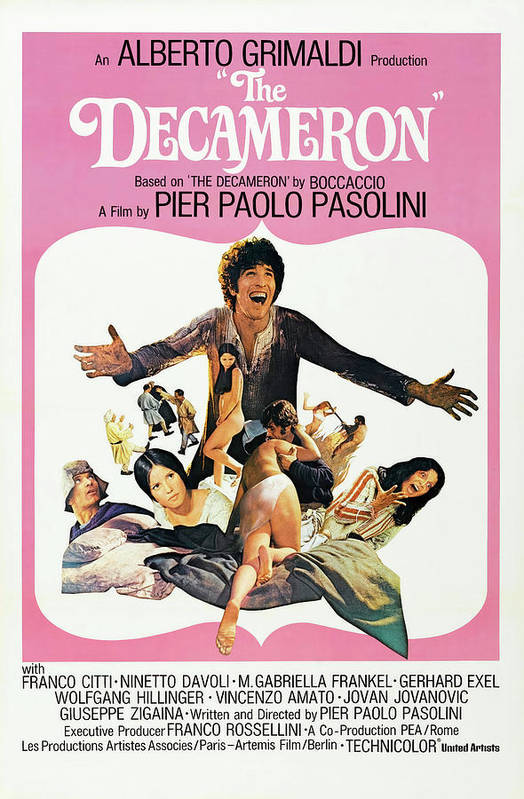
The Decameron is a collection of a hundred tales written by Boccaccio in the 14th century, which offers a rich mosaic of Italian life from the tragic to the comic. But it also has a reputation for a lot of bawdy naughtiness – and perhaps part of that comes from Pasolini’s cheeky, sex-filled adaptation, with its playful lingering on some of the most rumpy-pumpy filled yarns. Scholars of Boccaccio were appalled in 1971; it’s a gag that I think Boccaccio might have appreciated that today Pasolini’s film is required viewing on Boccaccio courses.

Much like with The Gospel According to Matthew, Pasolini shifted the location to fit his themes. Here most of the tales take place in Southern Italy – Neapolitan accents and dialect abound – and the new underlying theme explore the exploitations of simple, honest peasants by cannier, ruthless people from the richer north. Roughly linking the tales together is a pupil of Giotto – played by Pasolini himself – preparing a fresco in a monastery, inspired (it becomes clear) by the stories which may in turn be inspired by ordinary people he sees on the streets. The Decameron is aiming to be a playful musing on the chicken-and-egg nature of artistic inspiration and the way different artists in different genres can inspire and motivate each other to ever greater heights.

Or at least those themes are there. But they can be hard-to-spot beneath the surface, since The Decameron mostly delights in its array of sexual goings-on, which pretty much tick-offs every taste and inclination you can imagine from masturbation to orgies, as well as darker content like rape and paedophilia. To be honest, for all that Pasolini is an artist thinking earnestly about the classics, he’s also a very naughty boy eager to get a few erect penises into mainstream film-making (and The Decameron was a huge hit in Italy and played in arthouse cinemas the world over). The Decameron, for all its pretentions about art, is also a bit of end-of-pier soft-porn – or a hard-core Carry On.

There is something deliberately amateurish about The Decameron in its scatological humour and the bumpy, rushed nature of its film-making. In common with many Euro films at the time, it makes no effort (either in its Italian or English dubs) to match the words we hear with the movement of the actors’ mouths, with most of the sound having a muffled post-recording session feel to it. The camerawork and editing are frequently jolted and rushed, adding to the bawdy sense of things being thrown together, Pasolini using sped-up film and punch-line jumpcuts to keep up the improvisational energy. It makes the film feel at times like a student revue.

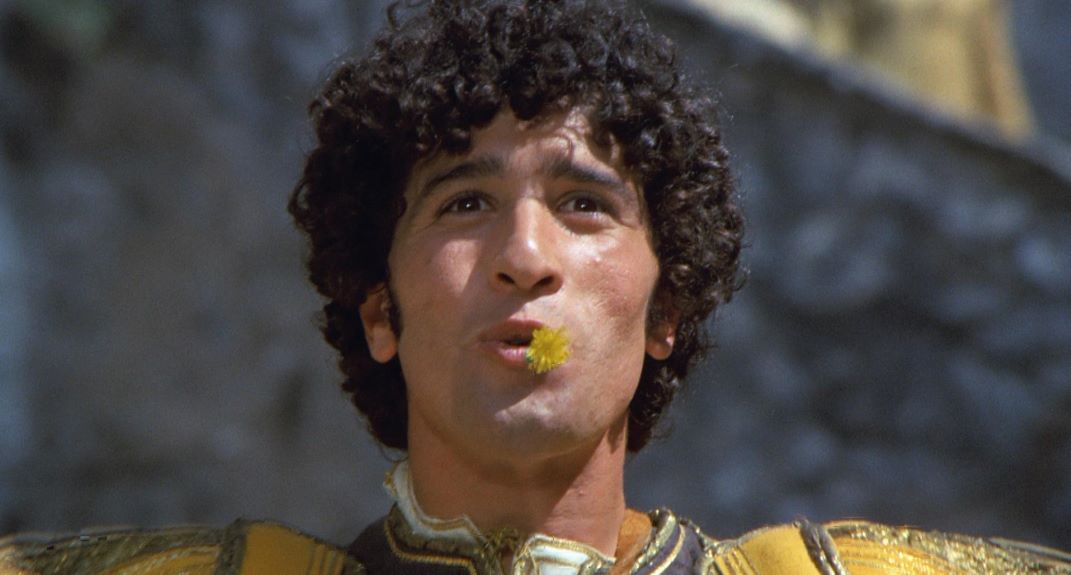
Pasolini shot the film entirely on location, with a cast of actors who were mostly unprofessional. As with many of his films, much of the casting seems to be based on people’s appearances more than anything else. The Decameron has a superfluity of striking faces. Toothy grins or missing teeth, hooded eyes, vacant grins, these faces look like they could have stumbled in from a Brueghel painting. Everyone looks distinctive and this parade of striking faces adds to the film’s wild energy.

It also makes everyone in this Boccaccio cheek and smut stand out. Pasolini’s trick was to argue that the medieval era, in many ways, wasn’t that different from today. He didn’t present it as a high-blown time of men in tights speaking poetry, but one where people were obsessed with money and sex (usually the latter) and showed no shame in chasing it. An era where the medieval world looked dirty, shabby and slightly sordid, rather than what the poets would have us believe.

This informed his choice of stories. When you start with a naïve young man nearly drowned in a pool of shit, you can tell that this isn’t exactly going to be Hollywood medieval epic. Pasolini’s chosen tales involve: a well-endowed gardener pretending to be mute so he can shag a convent full of nuns, a woman boffing her lover while her husband inspects the insides of a large pot, a dying sinner (who we’ve already seen proposition a child for sex) claiming to be a saint, a girl and her lover shagging naked on a rooftop, a monk tricking a man into allowing him to have sex with the man’s wife, and concludes with a man receiving a visit from the ghost of a dead friend telling him that sex is no sin and the angels of heaven say he should certainly give his girlfriend a good pre-marriage seeing to.

Throughout, Pasolini aims to show a world where simple pleasures mix with the exploitation by the rich and powerful of the simple, poor and naïve. It’s a not a theme that comes out all that much, especially since few people are going to remember the political message when we are all much more inclined to focus on the constant in-and-out. The Decameron might want to think it is a grand statement, but its really a great big joke, told by a director who is sort of laughing at us while he does it. It’s a rather juvenile piece of titillation, passing itself off as political statement.

Perhaps that’s why Pasolini felt a bit embarrassed about it all later. After a parade of knock-offs, he effectively disowned the film, claiming low-quality imitators that dialled up the sex even more had missed the point and buried the anti-capitalist message of his own film. Since I can imagine several people watching The Decameron and completely missing the point in the first place, I can’t help but feel he has only himself to blame.
The Gospel According to Matthew (1964)

The Gospel According to Matthew (1964)

Pasolini’s neo-realist Biblical epic is quite unlike any other retelling ever made

Director: Pier Paolo Pasolini

Cast: Enrique Irazoqui (Jesus Christ), Margherita Caruso (Mary), Susanna Pasolini (Older Mary), Marcello Morante (Joseph), Mario Socrate (John the Baptist), Settimio Di Porto (Peter), Alfonso Gatto (Andrew), Luigi Barbini (James), Giacomo Morante (John), Rosario Migale (Thomas), Ferruccio Nuzzo (Matthew), Otello Sestili (Judas), Rodolfo Wilcock (Caiaphas), Rossana Di Rocco (Angel)

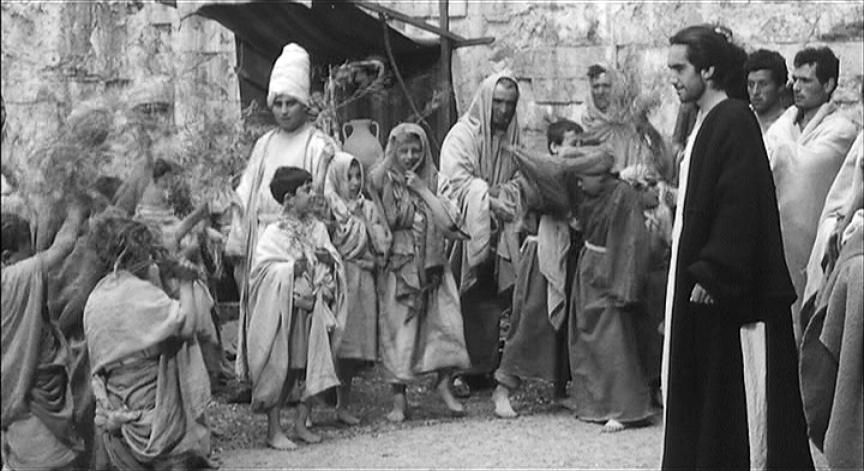
Pasoloni seems a strange choice for a film about Jesus. A Marxist-atheist intellectual? Pasolini had even been jailed briefly for blasphemy after featuring Jesus in his short film La ricotta. But he was fascinated by questions of faith and was a passionate admirer of the classics, from the Greeks to Boccaccio via the New Testament. Pope John XXIII made it one of his missions to reach out to non-Catholic artists (the film is dedicated to him) and Pasolini’s interaction with the Church made him interested in bringing the life of Jesus to the screen.

But on his own terms. Pasolini didn’t want a reverential epic, but something real and human amonf the divine. After scouting the Holy Land and concluding it no longer matched the ideal look required, he would set the film in South Italy. In this he followed in the footsteps of the classic artists, who had frequently transposed events from the Bible to the homelands of their patrons. (And, after all, as Pasolini surely reasoned, not all of the great Renaissance artists could have been passionate believers themselves).

Pasolini also chose his source carefully. Unlike other Bible stories, he would not use all the gospels. Instead he would exclusively dramatise St Matthew’s. Going even further, he would remove the “St” from the title. This was to be one man’s personal view of the story of Christ, featuring only events he reported where the only dialogue spoken would be the words he wrote down. There would be no clumsy modern dialogue, suggested motivations, omnipotent narrator or small talk. The film would play out often in silence, jump from event-to-event and the dialogue would faithfully reproduce the Gospel. There hadn’t been a Biblical epic like it.

It would also serve as a commentary of sorts on generations of artistic interpretations of the Gospels. The costumes and many of the compositions would reflect different eras of artwork, from Fra Angelina and El Greco onwards. The Romans and Herod’s guards would be dressed in a faux-medieval garb, the Apostles in more Byzantine robes. The execution of John the Baptist looks straight from Caravaggio, the massacre of the innocents like something from Brughel. The sprawling crowd scenes of the great artists would be reflected as much as the smaller intimate moments. The score would be a sea of different religious music, from Bach to Odetta (especially Sometimes I feel like a Motherless Child) via African gospel choir and Blind Willie Johnson.

Pasolini was presenting a reporting of Jesus’ life, that also subtly commented on and absorbed thousands of years of artistic discussion on the same subject. It used visual and aural analogy to convey its story and any question of the “truth” or not was put to one side. It was not a chronicle, but an artistic exploration, where the subjective view removed any theological clashes and implied many more versions were available of the same story.

Pasolini was drawn to Matthew’s gospel as he engaged more with its energy and passion. It carries across here with a Jesus full of contradictions. He can be warm but also angry and passionate. He marches across plains, by turns preaching at and berating his followers, shouting homilies at bewildered farmers. He has the magnetism of a born leader. Fascinatingly, the Sermon on the Mount is filmed in extreme, lonely close-up (with Jesus framed in a Raphael-style pool of light) but his more energetic words against the priests or calling for something near revolution are shown to attract vast crowds (Pasolini’s version of Matthew’s Jesus is perhaps a revolutionary).

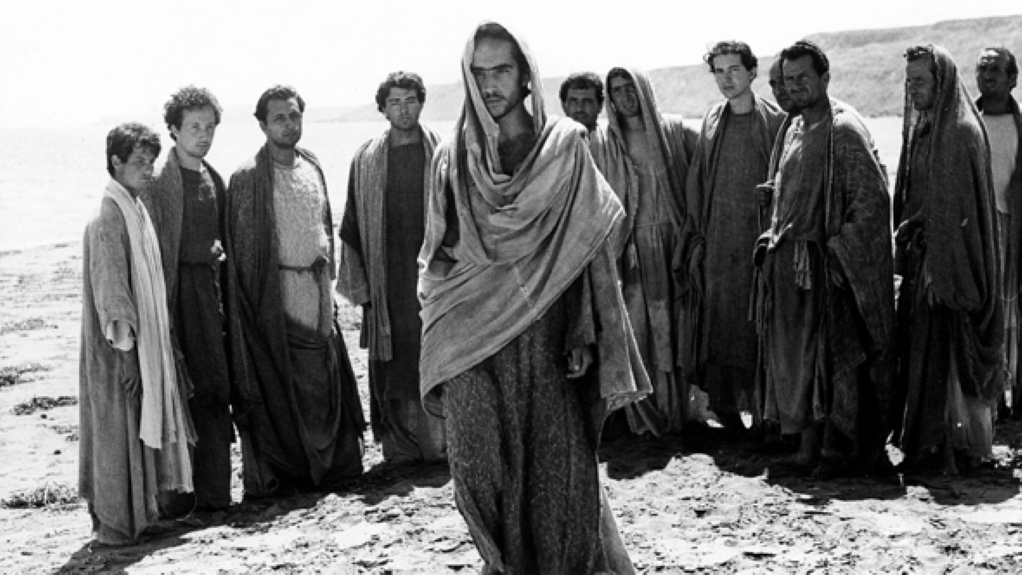
The Gospel According to Matthew dug deep into neo-realist Italian film-making traditions. As well as being shot on location, Pasolini recruited a cast of non-professional actors. Jesus would be played by a philosophy student. The rest of the cast would be made up of a sea of professions, from peasants to intellectuals. Unlike Bresson, who drilled his amateur casts mercilessly, they were encouraged to express the wonders their characters witnessed on their faces. Faces of course being Pasolini’s interest – few directors could recruit such a striking range of visages as he could.

Pasolini’s camera-work and film-making style also evolved. The film starts with a series of shot-reverse-shots as a pregnant Mary confronts Joseph. Much of the Nativity plays out in close-up, before the frantic burst of violent energy that is the massacre of the innocents. But as the film progresses, Pasolini mixes his style considerably. Jesus march through the plains is full of something approaching whip-pans. When Jesus preaches, the camera searches for the apostle’s faces with the odd roving mis-turn as if it was searching for them as well.

Shot-reverse-shot is used for the miracles (the element Pasoloini was most uncomfortable about – and embarrassed to bring to the screen), but as the film progresses a more mobile, immersive camera is used. From the Garden of Gethsemane on, the camera becomes almost a face-in-the-crowd, witnessing Jesus’ trial by the priests and Pilate through a sea of crowded heads and moving alongside Jesus through the streets. It follows Judas in a helter-skelter sprint through the plains to his suicide and avoids aerial shots for throwing us in amongst the action. While tipping the hat to art of the past, it is also a hand-held, edgy piece of cinema, putting us in the dirt.

There is much to admire in The Gospel According to Matthew but, it has to be said, the film is also rather slow (the section covering Jesus’ mission and preaching, including the performance of the miracles, in particular drags). The decision to use only the text of the Gospel frequently means the film lacks the sort of drive that spoken dialogue and character can bring. It would almost be superior as a wordless film that made use of captions since much of the dialogue scenes are rigid and the visually least-interesting moments. It’s a film that’s easier to admire than perhaps really love.

But it’s also a very true, fair and intriguing vision of the Gospels, that presents the ‘facts’ as they are and works hard to avoid prejudice and interpretation. Difficult as it may be, at times, to watch it is also challenging and thought-provoking. A melange of interesting filming styles and creative decisions, it has its flaws but many virtues too.