Category: Robert Eggers

Nosferatu (2024)

Nosferatu (2024)

Eggers’ wonderfully atmospheric remake is creepy, haunting and quite extraordinary

Director: Robert Eggers

Cast: Bill Skarsgård (Count Orlock), Lily-Rose Depp (Ellen Hutter), Nicholas Hoult (Thomas Hutter), Aaron Taylor-Johnson (Friedrich Harding), Willem Dafoe (Professor Albin Eberhart von Franz), Emma Corrin (Anna Harding), Ralph Ineson (Dr Wilhelm Sievers), Simon McBurney (Herr Knock)
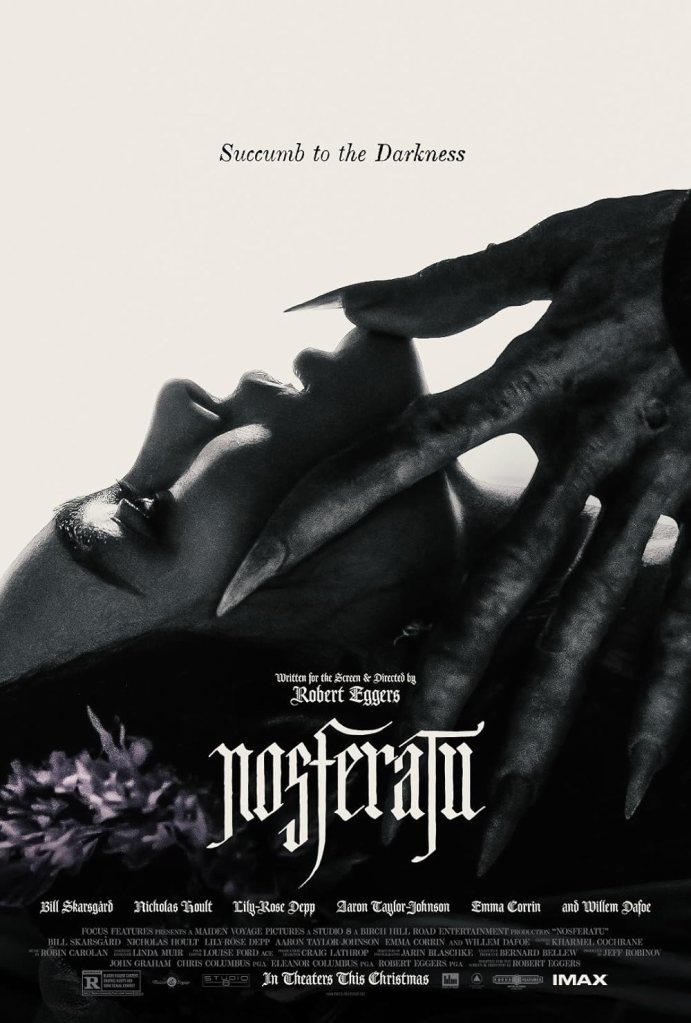
Robert Eggers dreamed so long of his own version of FW Murnau’s seminal vampire film (and Bram Stoker copyright infringement) Nosferatu, it was originally announced as his second film. We had to wait a bit longer, but it was well worth it. Eggers’ experience helped him create a film infinitely richer than I suspect he would have made ten years earlier. Nosferatu is an astonishing, darkly gothic, richly rewarding film, glorious to look at and a fiercely sharp exploration of the subtexts of both sources. It can never match the original’s seminal impact, but celebrates and elaborates it.

The story hasn’t changed dramatically from the one Murnau ripped off from Stoker. In Wisborg, junior solicitor Thomas Hutter (Nicholas Hoult) leaves his beloved wife Ellen (Lily-Rose Depp) for Transylvania and a lucrative land deal with the mysterious Orlock (Bill Skarsgård) that could lead to a comfortable life for him and his new wife. Unfortunately, there are three things he doesn’t know: firstly, the Orlock is a ravenously cruel vampire, with extraordinary supernatural powers; second his employer Knock (Simon McBurney) is an occultist worshiper of Orlock; thirdly, Orlock has used his mental powers for years to terrorise and groom Ellen from afar and Hutter’s presence is the final step in his scheme to control her. It won’t be long until a deadly curse plagues Wisborg.

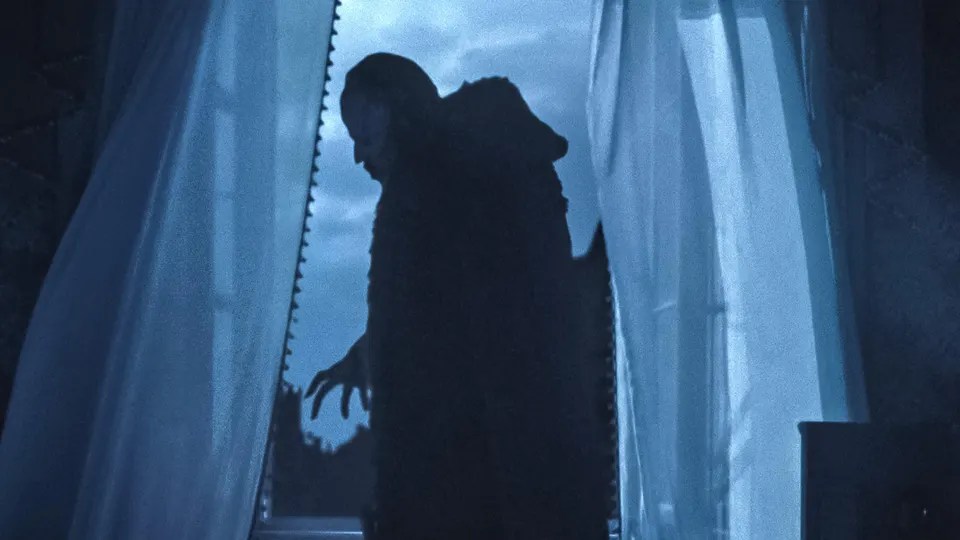
Egger’s dark (but extremely beautiful) gothic film drips with atmosphere, gloomy shadows rolling over its elaborate sets, the drained out night-time shots reminiscent of the tinted black-and-white beauty of the original. The entire film is soaked in love for silent-era horror, with homages to Murnau, Dreyer, Sjöström and so many others I couldn’t begin to spot them all – though I loved Orlock’s gigantic shadowy hand creeping Murnau’s Faustus-like over Wisborg. The film drowns in folk horror, from its snow-capped Transylvanian countryside dripping in unspeakable hidden evils to the unreadable motives of a mysterious Transylvanian village.

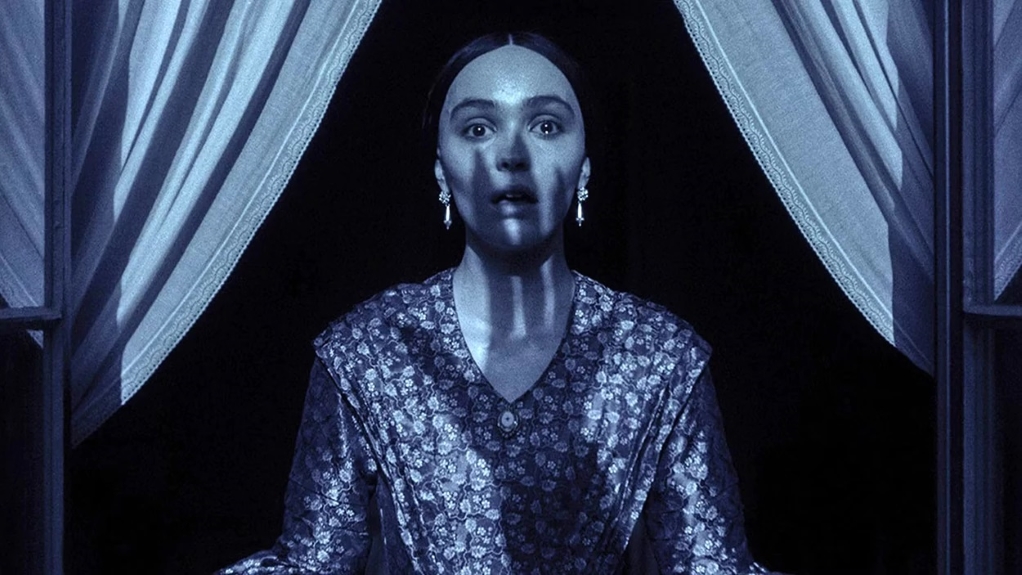
At its heart is an exploration of the sexual undertones of the vampire legend. Orlock’s assaults leave his victims are overwhelmingly sexual, with Orlock’s body thrusting forward while he drains the blood of his groaning victims. That’s not to mention Orlock’s revolting sexual manipulation of Ellen. Nosferatu leans heavily into Stoker’s dark sexual awakening subtext. Orlock’s psychological manipulation has left Ellen traumatised, torn between dark sexual desires and romance with Hutter. Nosferatu opens with a dark (dream?) sequence, as Ellen rises with sensual sighs from sleep, drawn towards Orlock’s seductive shadow in sheet curtains, before joining him outside for something that looks an awful lot like sex before Eggers cuts with a jump scare shot, our first glimpse of Orlock.

This is an Orlock radically different from Max Schreck’s original. While he shares his long nails and angular posture, here he is no-more-or-less than a decayed, rotting corpse. His body is covered in sores of decayed skin, with everything (including his penis) halfway to the compost heap, his bony legs and hips positively skeletal. There are homages to his Vlad the Impaler roots, from his fur-lined uniform coat (that like the rest of him has seen better days) to his surprisingly well-groomed moustache. But there isn’t a trace of the handsomeness of so many Draculas – this Orlock is possibly even more repulsive to look at than the rat-faced monstrosity of the original.

Skarsgård’s make Orlock a truly ruthless figure, delighting in his natural cruelty. With Hutter his looming, shadowy menace offers not a jot of home comforts, working to terrify a man who he sees as a perverse romantic rival. (His hallucinatory blood-sucking assault on Hutter is filmed in a manner reminiscent of rape). Throughout, he treats almost everyone he encounters with contempt and lofty disgust and takes a sadistic delight in torturing Ellen’s friend Emma Harding’s family, culminating in a truly shocking scene of grizzly horror. While the original Orlock was almost feral, like his rats, this one is a monstrous decayed sorcerer with a never-ending hunger and sadistic desire to play with his food.
He also has something the original never had: a voice. Skarsgård spent weeks in training to develop this (digitally unaltered) vocal range, a rolling bass-rumble which wraps itself around a raft of Dacian dialogue. Eggers’ gives him immense supernatural skills, in a film dripping with occult magic. Simon McBurney’s Knock (a remarkable performance) is a lunatic drowning in it: covered with dark markings, biting the heads of pigeons and communicating with Orlock by sitting naked in a Pentecostal star. His brain has been flushed out by Orlock’s mental power (who treats him like dirt) and the vampire’s hypnotic voice overwhelms the senses: just a few sentences drains Hutter of willpower (Nicholas Hoult’s fear is so palpable here you could almost touch it). Orlock’s malign influence can twist people or make them suddenly ‘wake’ with no idea of where they’ve been.

The power of his influence twists and distorts emotionally and physically. Lily-Rose Depp captures all this in a remarkable physical and vocal performance, as Ellen falls victim to Orlock’s mental manipulations. Depp throws herself into the most violent fits since Linda Blair: her body spasming, her voice distorted into an Orlock-mirroring gurgle, her eyes rolling back, her inhibitions falling away and blood weeping from deeply disgusting places, especially her eyes. Depp’s performance is extraordinarily committed, her fear and self-disgust at her manipulated sexuality (eekily from childhood) by the Count as tender as he hatred of him is sharp and all-consuming.

It’s never clear how far the vampire wants to screw Ellen, and how far he wants to consume her (Eggers even suggests, towards the end, that Orlock may even welcome his own destruction – perhaps the rapacious hunger is too much?). What is different from the original is Orlock and the plague he brings with him are different. While the original was a destructive force of dark nature, this Orlock is focused exclusively on punishing Ellen, with a literal plague striking down Wisborg.

In the face of this beast, the powers of science and reason are powerless (as Aaron Taylor-Johnson’s delicately performed Harding discovers, refusing to believe until its far too late). Like Murnau’s original, the powers of science and reason (such a key weapon against the vampire in Stoker) are useless. Even rationalist Dr Sievers (a fine performance by Ralph Ineson, channeling Peter Cushing and Michael Hordern) – a man so calm even the insanity of Knock can’t flap him – chucks in the towel and calls in Willem Dafoe’s barnstorming Professor von Franz (here considerably more effective than his counterpart), a scientist turned alchemist with deep occult knowledge.

But it can’t change the fact this is not a war between two sides, but a deeply personal struggle between Orlock and Ellen, with Hutter torn between them. Eggers’ focus on this personal story at the heart of a dark twisted legend adds a genuine freshness – and makes a superb counter-balance to the lashings of gothic horror the film soaks in. It makes for a superb remake that contrasts and comments on the original while telling its own story of dark, corrupted manipulation. Eggers’ direction is faultless in its atmospheric unease and there are superb performances from Skarsgård, Depp, Hoult and the rest. It’s a powerful work, overflowing with silent horror atmosphere while also feeling very modern that has the potential to haunt our nightmares as much as the original.

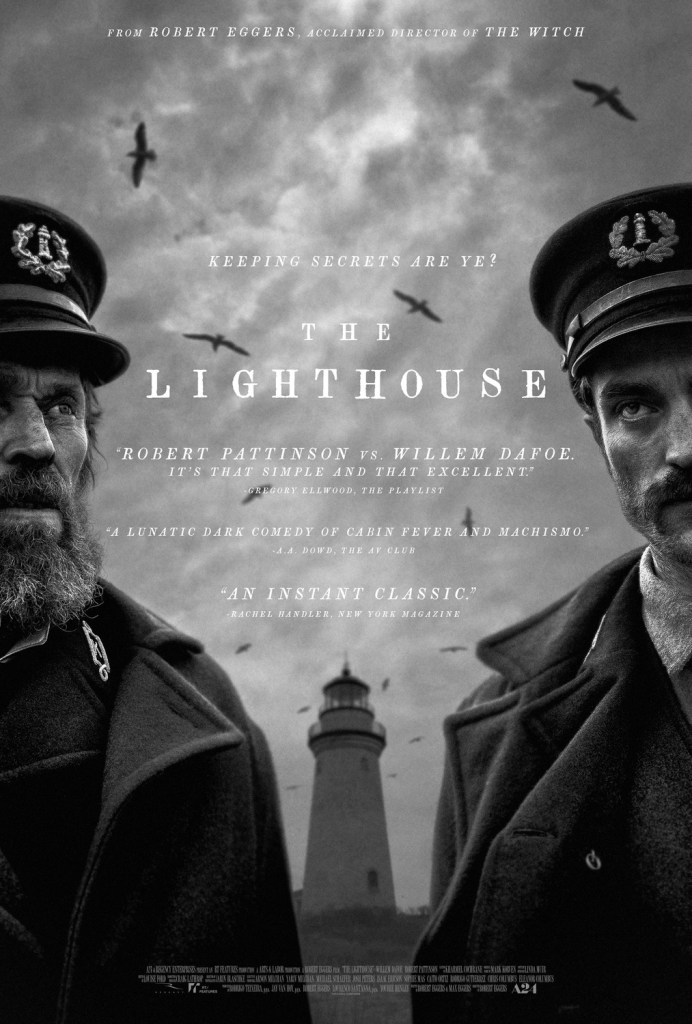
The Lighthouse (2019)

The Lighthouse (2019)

Undefinable, haunting madness in Robert Egger’s mesmeric film that defies categorisation

Director: Robert Eggers

Cast: Robert Pattinson (Ephraim Winslow), Willem Dafoe (Thomas Wake)

Who’d want to be a lighthouse keeper? Weeks on end, stuck on a rock, with nothing but sea gulls and your fellow keepers for company. The cabin fever might well start to make you feel your grip on reality shifting. You’d definitely think it was a strong chance watching Robert Eggers’ mesmeric, enthralling and undefinable masterpiece, a mix of everything from Victorian shlock to Greek Mythology via MR James and Edgar Allen Poe, by way of Freud and Jung. It’s impossible to work out, horrifyingly clear and deeply, unsettlingly brilliant.

Two ‘wickies’ (lighthouse keepers) in 1890s arrive on an island off the coast of New England. Thomas Wake (Willem Dafoe) is a (self-proclaimed?) salty-sea-dog and veteran wickie. He tends the light. His assistant, Ephraim Winslow (Robert Pattinson), is a former woodworker working on contract, seemingly on the run from something. He is the island’s dogsbody and tends the mechanisms that keep the light on and turning and the island’s fog-horn blaring. These two live cheek-by-jowl, a relationship that oscillates between distrust, resentment and strange warmth.

Things take an increasing turn for the bizarre, as a storm cuts them off from their scheduled relief. Slowly the isolation, supplies failure (gin and beans are seemingly the only food sources left) tap into the psychological flaws in the men themselves. Ephraim becomes ever more consumed by visions of a horrific but sensual mermaid. Wake obsessively guards his sole access to the lighthouse tower – and, Ephraim suspects, the mysteries it contains. Their relationship crosses boundaries of longing, violence and anger.

The Lighthouse is somewhere between parable, modern myth and psychological study. You could call it a horror film – I see it more as a classic ghost story – but you could just as easily call it a survivalist film, a character study or a psychological thriller. Egger’s insidiously unsettling film-making and the sublime acting from the two leads combine to make a film ripe for interpretation, and intensely rewarding on rewatch. It’s an explosion of artistic brilliance.

Shot in a superbly atmospheric black and white – and a claustrophobic academy ratio 4:3 – it’s a film that presents one striking, chilling, unforgettable visual image after another. Inspired by silent cinema – in particular Murnau, Lang and von Sternberg, although I spotted elements of Keaton – but as if moody German expressionism was used to shoot a Rorschach test. The inky blacks, and overwhelming bursts of blinding white light, suggest unimaginable horrors lurking out of sight, while its impressionistic imagery constantly pushes us to question the reality of the film.

It all builds on the superb feeling of isolation Eggers invokes. Rooms are small and crowded with furniture. The island is a bleak rock, shorn of any vegetation. The only wildlife is an army of seagulls. The blare of the island’s foghorn is continuous – sounding like a doom-laden rumble from Hell – that seeping into the viewer’s soul. Every corner of the lighthouse station becomes achingly familiar to the viewer and somewhere you can imagine not wanting to spend a second longer than you have to.

Stretching their vocal muscles around a script (written by Eggers and his brother Max) full of rich, chewy, Victoriania dialogue by way of Beckett and Pinter (in one compellingly funny sequence, the two actors basically shout “what” at each other over and over again) both are superb. Dafoe walks a fine line expertly between realism and Robert-Newton-esque parody, as the saltiest sea-dog imaginable, who can oscillate between surly admonitions and flights of myth-filled, metaphorical fancy. Pattinson dives head first into a man who we are never sure we fully understand: is he a frustrated time-server, a violent monster, a delusional schizophrenic, a little-boy lost? Either way it’s a truly brilliant performance of Day-Lewis level commitment and immersion.

You could have a lot of fun arguing that perhaps both men are two halves of the same fractured psyche (as if Wake is a future version of Ephraim, almost as if the film is him witnessing his own origins story). Certainly, as their film progresses, their personalities and histories begin to merge. It would help explain the curious emotional bond between them: at times they seem to almost hate each other, at another a drunken fight is only inches away from a sexual encounter. They laugh at and loath each other, are mutually dependent, plot each other’s destruction but then pathetically look at each other for reassurance and praise (Wake is heartbroken when Ephraim criticises his cooking, while Ephraim both resents and worships this hard-taskmaster father figure).

It’s a suspicion that could also be incited by the all-pervading weirdness on the island. Ephraim –carrying the burden of secret crimes on the mainland – see visions of a mermaid among logs, in which sexual encounters are mixed with the mermaid’s murderous attempts to drown him. His first-day searches of the house unearth a carving of a mermaid, which seems to fascinate and repel him – he takes to masturbating (joylessly) over it in the workshop. He seems to spy Wake worshiping, naked, the light during his long-night vigils up the tower (suspicious fluids drip down from here, along with half glimpses of mermaid tentacles). In any case, Wake guards his access to the light like a jealous lover, while his faith in sea mythology becomes increasingly less of a mantra and more of a framework to understand the world.

How much is real? Or is it a sign of Ephraim’s fractured, guilty, conscious? We see most of the events through his eyes – a man we know is a thief and, most likely, a killer. There is more than enough evidence that Ephraim is lying about his past as much to himself as he is Wake. Wake too is a liar – telling at least two versions of how he ended up with a gammy leg, enough to make you wonder how much his claims of being a sea-dog are true. As isolation and constant drink – the two spend most of the second half in various states of inebriation first from gin then turpentine – kick in, and they and their surroundings become increasingly dishevelled and fart-stenched.

There are dark powers at work on this island. Echoes of Greek Myths loom – Ephraim has traits of Prometheus, fascinated by a light horded by the Gods, the very light that Wake, Proteus like, is determined to keep to himself. Wake stresses that the gulls carry the souls of dead sailors – and the unsettling persistence these pester Ephraim with, is surpassed only by the violence with which he responds to them. Elements of Victorian ghost stories, hypnotism and gothic fiction combine in every corner of a film where we see very little but get a lot implied (powerful, Eisenstein and Bunuel-style, close-ups of faces and eyes imply powerful horrors out of shot).

The Lighthouse reminds me in many ways of the best of the BBC Ghost Stories of the 1970s in their unsettling, MR James-style unexplained (even unstated) horrors. There is a palpable air of horrific tension around the film, of an unexplained, unknowable force that could somewhere destroy both men – and has perhaps unsettled their minds. The film culminates in a superb, haunting shot as Ephraim comes face-to-face with something unknown that is pure MR James: we never see what caused the horror, only its terrible results. (It’s as terrifying as Whistle and I’ll Come to You or A Warning to the Curious where blind, over-confident curiosity leads to dreadful outcomes).

Eggers film is not a conventional horror film: I believe thinking of it as a deeply unsettling exploration of man’s vulnerability and weakness, ala MR James, is key. This is a story of unseen, imagined, unsettling horrors – but also a claustrophobic relationship drama, playing out like a psychological thriller as two men dance around destroying and seducing each other. It’s a complex Rubrik’s cube that rewards constant thought and attention. Beautifully filmed, superbly acted, compelling in every frame, it can claim to be one of the most unique and powerful American films of the 2010s.

The Northman (2022)

The Northman (2022)

A viking tears through flesh and blood in quest for revenge in this bizarre, fascinating Viking epic

Director: Robert Eggers

Cast: Alexander Skarsgård (Amleth), Nicole Kidman (Queen Gudrún), Claes Bang (Fjölnir the Brotherless), Anya Taylor-Joy (Olga of the Birch Forest), Ethan Hawke (King Aurvandill War-Raven), Björk (The Seeress), Willem Dafoe (Heimir), Oscar Novak (Young Amleth), Gustav Lindh (Thorir), Ingvar Eggert Sigurðsson (He-Witch), Kate Dickie (Halldora), Ralph Ineson (Captain Volodymyr)

Ask people about Hamlet, and they picture a poetic Prince, plagued with doubt and vulnerability, talking to skulls rather than carrying out his mission of revenge. What you probably don’t think about are Vikings on a Berserker rage, slaughtering left, right and centre. But Hamlet has its roots in a bloody Scandinavian legend, where remorseless death is handed out by a ruthless killer. That’s the side of Hamlet, Eggers takes for inspiration in his bloody, bold and resolute Viking film, a blood-soaked acid trip it’s hard to imagine anyone else making.

It’s 895 and King Aurvandill (Ethan Hawke) returns from conquest to his wife Gudrún (Nicole Kidman) and young son Amleth (Oscar Novak). Amleth takes his vows of manhood with his father, guided by a demented He-witch (Willem Dafoe) – only for his father to be almost immediately killed by his half-brother Fjölnir (Claes Bangs), who seizes his throne and wife. Amleth escapes – and years later has grown into a berserker Viking warrior (and Alexander Skarsgård). He sees his chance for revenge when he disguises himself as a slave, and joins a shipment traveling to Fjölnir’s village (Fjölnir having lost his throne). There he forms an alliance with Russian slave Olga (Anya Taylor-Joy) and works to undermine and terrify Fjölnir, before he can enact his revenge and save his mother.

The Northman is, possibly above all, a shocking, absorbing deep-dive into Viking Culture. Eggers doesn’t shirk for a second from the bloody, ruthless mayhem of Viking life. Our introduction to the adult Amleth sees him first whipping himself (and others) into a (possibly magic mushroom fuelled) Berserker rage, dressed as wolves and howling at the fireside, before launching an unbelievably ruthless attack on a Russian village. The desperate peasants are butchered with savage fury (and blood lust). In the aftermath, rape, murder and other horrors occur uncommented on in the background, while those not seen fit for slavery are herded into a barn to be casually burned alive.

Amleth, at no point, expresses a jot of regret for his actions (as a Viking wouldn’t), and even after passing for a slave never questions the institution. His revenge uses the same ruthless, blood-dripping fury as his ravaging and his only passing moment of pause is about directly killing Viking women and children (he gets over it). In all this he is in no way different from the rest – in fact he’s even one of the more sympathetic – Vikings. Fjölnir – revealed as otherwise a wise and generous leader – ruthlessly murders and rapes his slave as he fancies and a weekend’s entertainment for all is watching two teams of slaves beat themselves to death in a no-holds-barred version of hockey.

Eggers leaves you in no doubt that, for all the grim fascination, this is a brutal and savage civilisation that you would in no way want to encounter. Saying that, despite Eggers’ clear intentions, with the film’s cast modelling a sort of chiselled, gym-trained super-human Aryanism, sweeping away Slavic peasants and enforcing a triumph of Nordic culture, parts of this film are surely being channelled into the wet dreams of elements of the right-wing.

The film doesn’t just explore violence. Family bonds are demonstrated to be all important to Vikings – Amleth and Fjölnir are dedicated to their families and go to huge ends to protect and mourn them. (A funeral of one warrior features elaborate blood-letting, as the deceased’s horse is decapitated and his favourite slave willingly butchered so both can join him on the journey to the afterlife). There is a mutual regard and affection between warriors – even opponents – in a culture that puts itself above others. Honoured slaves are respected – though told they can never be equal. Licensed fools and mystics are given a great deal of freedom – Willem Dafoe’s crazed He-witch at Aurvandill’s court mocks all and sundry with no repercussions. There is a huge faith placed in wise men and women who inspire awe and fear – even a slave, such as Olga, with possible mystic powers is treated with caution. Bonds and duties across generations and to the next life are revered. Prophecies and destinies are respected. Poetry and storytelling is highly valued.

For all the killing, there are elements of a rich culture here and strong family bonds. All these combine in the person of Amleth, who will not be shaken from his destiny but will enact it in his own time, in line with the prophecies he of a seeress (an unrecognisable Björk). Eventually it doesn’t matter if Amleth’s idealised memory of his parents turns out to be not the whole story, or if he has a chance to build a new life. Destiny is, in fact, all.

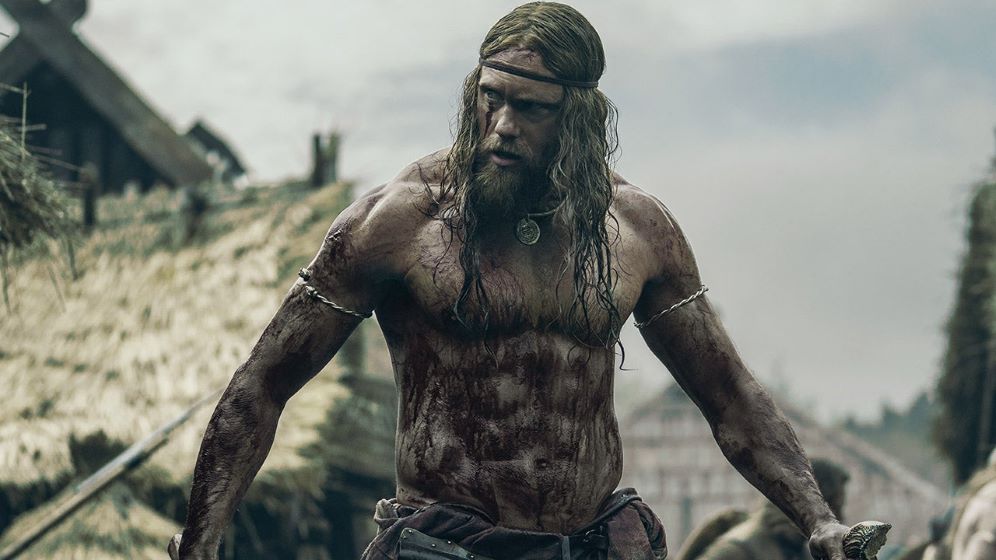
Eggers’ film takes place in what almost a state of heightened, fevered excitement. Beautifully shot by Jarin Blaschke, it mixes expressionistic near-black-and-white, with drained-out shots of violence and flame-lit moments of psychological and body horror. Visions shot in a piercing mix of blues, greys and icey chilliness puncture the film, with strange compositions of characters, Valkyries, Valhalla and the Gods. Supernatural elements pepper the film, with Amleth’s father influencing events in the shape of a raven and Amleth completing a quest for a fateful sword. These moments of hyper-reality are perfectly executed and in a visually unique, blood-drenched nightmare.

Where The Northman is less successful is exploring the inner-depth of its characters. Skarsgård is charismatic and physically perfect, but doesn’t give much inner-life to Amleth. Moments of doubt or uncertainty in Amleth never quite convince and he feels more a force of nature than a person. There are richer performances from others, Kidman in particular a revelation as a cryptic, unknowable woman with a mid-film encounter of heightened emotional (and sexual) tension between her Skarsgård. Bangs’ Fjölnir is strangely sympathetic. Anya Taylor-Joy carries a dominant, mystical force in her performance that helps make her character a bridge between multiple worlds.

All these combine into a film of shocking violence, jaw-dropping beauty and troubling emotional and psychological horror. There is no doubt the film is overlong – there are probably one too many deeply odd segues into drug-induced ravings of various prophets and seers – but as an exploration of a culture so uniquely alien, its sublime. As a piece of work from a truly distinctive and unmatchable director, it’s superb. You look it The Northman and can’t believe anyone else could have made it. If nothing else, that makes it a film worthy of your time.