
Category: Spike Lee

Do the Right Thing (1989)

Do the Right Thing (1989)

Spike Lee’s masterpiece is still frighteningly relevant today – and stunning film-making

Director: Spike Lee

Cast: Spike Lee (Mookie), Danny Aiello (Sal), Ossie Davis (Da Mayor), Ruby Dee (Mother Sister), Giancarlo Esposito (Buggin’ Out), Bill Nunn (Radio Raheem), John Turturro (Pino), Richard Edson (Vito), Roger Guenveur Smith (Smiley), Rosie Perez (Tina), Joie Lee (Jade), Steve White (Ahmad), Martin Lawrence (Cee), Leonard L. Thomas (Punchy), Christa Rivers (Ella), Robin Harris (Sweet Dick Willie), Paul Benjamin (ML), Frankie Faison (Coconut Sid), Samuel L. Jackson (Mr Señor Love Daddy)

When it was released in 1989 it was like a punch in the solar plexus. Spike Lee’s third joint was a powerful, dynamic and deeply thought-provoking and challenging piece of cinema. This demanded you sat up, took notice and understood that underneath the happy lies America tells itself, the country was deeply divided and a tinderbox waiting for a spark. Perhaps the most painful – and shocking – thing about Do the Right Thing is how little has changed. You could make the same points today and the film’s tragic ending in police brutality, violence and uneasy truce could be repeated in the headlines as readily tomorrow as it was in 1989.

Set on one swelteringly hot day in New York City, Lee’s film is a kaleidoscope of diverse lives in the predominately Black neighbourhood of Bedford–Stuyvesant in Brooklyn. Just about the only people here not Black are Pizzeria owner Sal (Danny Aiello) and his sons Pino (John Turturro) and Vito (Richard Edson). Working for Sal is Mookie (Spike Lee), drifting through life but determined to get paid, who has a son with Tina (Rosie Perez). In this neighbourhood anything could be a spark. Perhaps it will be Buggin’ Out’s (Giancarlo Esposito) objection to Sal’s pizza parlour ‘wall of fame’ being exclusively Italian? Perhaps the bored kids schlepping around the street? Maybe imposing Radio Raheem’s (Bill Nunn) ghetto blaster constantly pumping out ‘Fight the Power’? Or will it because of the Korean convenience store owners, or the police officers who ride into the neighbourhood like it’s a war zone?

What’s really striking about Spike Lee’s film is it is neither polemic nor hand-wringing exercise. Perhaps what really outraged people in 1989 when it was released – let’s not forget it’s the year the vaguely similarly themed but deeply reassuring Driving Miss Daisy won Best Picture – was that it offered no answers. Instead, it holds a mirror up to America for a long, uncomfortable, look. While other films presented racism as a journey towards peace, Do the Right Thing shows it as a systemic problem with no easy solutions. Any reconcilement is tentative or grudging at best, few lessons are learned and there is very little sign that this won’t all happen again.

Lee’s film is an electrically confident piece of film-making. It’s also amazing what a glorious mish-mash of styles Do the Right Thing is. You get everything from music video to action set-piece, kitchen-sink drama to comic book dutch angles, soft porn to comedy, odd-couple romance… Almost every scene as it moves around its smorgasbord of characters takes an influence from a different genre, held loosely together by Samuel L Jackson’s 24/7 DJ Mr Señor Love Daddy. But never once does one scene jar up against another or does the general impact of the film feel blunted.

Perhaps it works because the entire film is awash in the messy unpredictability of life and the simmering resentments hidden below the surface. Sal and his sons are awkward fits in the neighbourhood, legacies of a bygone age – a whole other generation of usurped immigrants – keeping an uneasy truce with their customers. Not that there are obvious lines drawn here: John Turturro (in an excellent performance of great depth) plays a racially aggressive man, fascinated with Black culture. Sal, superbly played by Danny Aiello, balances genuine affection for some customers with baseball-grabbing antagonism for others.

It’s sometimes hard to tell what they might face, as the Black community is widely disparate in its feelings. (Spike Lee has written critically of the tendency by some to lump “Black people” together into a homogenous lump). There are stark generational. Da Mayor – a superb Ossie Davis, stumbling, well-spoken and ineffective – and Mother Sister (a sensational Ruby Dee), the neighbourhood matriarch, belong to an older era of Civil Rights, Malcolm X and MLK. The younger generations – those kids bombing loudly around the neighbourhood, including a young Martin Lawrence – don’t give a toss about their legacies and are barely interested in the world around them. Others, like Buggin’ Out (a firecracker Esposito), speak a semi-coherent collection of political phrases, mixed in with righteous but largely pointless anger about trivial events, that most people ignore.

In the middle of all of this, Lee himself plays Mookie, an everyman character for Black America, young, drifting, uncertain about where he is going. Mookie shirks fatherly duties – Tina literally has to order a pizza from Sal to get him to visit – and often does little more than punch-clock. But he also offers a fine, level-headed understanding of the various personal and community clashes around him. He’s an effective sounding board for every character, listening carefully and constantly torn about what doing the right thing might mean.

There is a sort of brilliantly brave ambiguity around Do the Right Thing. There are no heroes, only people, warts and all. Casual fights are picked but not seen through – like Buggin’ Out confronting John Savage’s well-to-do commuter for scuffing his trainers. The kids demean Da Mayor as a drunk wash-out who never made anything of his life (perhaps, subconsciously, worried his present is their future). Racial prejudice works every way – in one of Lee’s many flourishes, several characters (Mookie, Pino, a Hispanic man, a police officer and Sonny the Korean shop-owner) break the foruth wall to speak a flurry of racial insults to Italians, Blacks, Hispanics, Asians and white Americans, giving vent to private feelings, but also showing how close these are to the surface.

Do the Right Thing is made up of a series of brilliantly sketched vignettes as its many characters mix and mingle over the long day, some sharing insights, some butting heads. The film zigs as much as it zags – Mookie confronts Pino’s racism not with anger but calm, reasoned discussion. Our three breeze-shooting old timers are as irritated at the loud and brash kids as they resent the cops. Heavy-set Radio Raheem (a stoic Bill Nunn) puts aside his ghetto-blaster to talk about love beating hate. That ghetto blaster will exact a heavy toll.

It’s at the heart of the explosion of violence that caps the film. It’s tragic that the police violence which ends the film – and the resulting riot – is still no stranger today. A troublemaker meets a death far exceeding their crime by being effectively lynched by the police in a choke hold (Lee cuts to his feet twitching in the air, as he is lifted by a truncheon around the neck). This police murder (and the police flee the scene, taking the body – and the evidence – with them) slams the political message home. People are flawed, tensions are high – but no one does anything even vaguely approaching deserving death, and the fact the authorities ‘resolve’ problems through brutal force is everything that’s wrong with America.

But Lee is not one to excuse all violence. The mob – and it becomes a mob, with Lee not afraid to show cash tills being looted as well as furious, righteous anger – nearly turns on the Korean shop next, seemingly for no other offence than being foreign. People we would never expect, scream passionately for the world to burn. But then, Lee also makes the key point: when the world is as unjust and dangerous as this, isn’t the right thing sometimes to let out a primal scream. After all, what is a building when weighed against a man’s life?

What is the right thing to do? It’s a complex message the film grapples with. Mookie arguably starts the riot – or at least directs its anger – with a window smash. But by doing so, he also side with his community. In many ways it is the right thing to do. After all, Sal started the spiral by responding to intense, loud baiting with a flurry of racism. Mookie is, in some ways, a fixed labourer – Sal, for all his affection for Mookie, can’t imagine a world where Mookie won’t be working in his pizza parlour – and siding with the crowd is a defiant assertion of his independence and identity.

It’s just a flavour of the complex and challenging ideas in a film that avoids easy answers. As Sal and Mookie, the next day, stand in the ashes neither of them willing to forgive and forget, but also neither of them wanting to return to violence, they stand like representatives of America, struggling to process its race-related history. It’s a million miles away from the easy messages and gentle fixes of liberal Hollywood. Tension here settles for coexistence – but acknowledges that explosions of rage and anger are an inevitable part of that. That’s not a message America wanted to hear in 1989 – hell its barely one it wants to hear today – but it’s a powerful part of this landmark masterpiece.

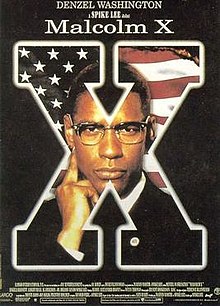
Malcolm X (1992)

Denzel Washington dominates in Spike Lee’s masterpiece Malcolm X

Director: Spike Lee

Cast: Denzel Washington (Malcolm X), Angela Bassett (Betty Shabazz), Albert Hall (Brother Baines), Al Freeman Jnr (Elijah Muhammad), Delroy Lindo (West Indian Archie), Spike Lee (Shorty), Roger Guenveur Smith (Rudy), Theresa Randal (Laura), Kate Vernon (Sophia), Lonette McKee (Louise Little), Tommy Hollis (Earl Little), James McDaniel (Brother Earl), Steve White (Brother Johnson), Ernest Lee Thomas (Sidney), Christopher Plummer (Prison Chaplin Gill), Peter Boyle (NYPD Captain Green)

In the early 1990s, Norman Jewison was attached to direct a biopic of Malcolm X, the powerful African-American activist, tragically assassinated in 1965. It was the project of Spike Lee’s dreams – and Jewison conceded he did not have the vision for the film that Lee clearly had. Lee stepped in – and thank goodness, as this is perhaps a film only he could have made. It splices together Lee’s customary political savvy and (accurate) sense of the injustice Black Americans have faced with a surprisingly adept use of the cinematic language of David Lean and other sweeping epics. In bringing these together, he created a superb biography, a great piece of epic cinema and a vital piece of American film-making.

The film covers the life of Malcolm X in three clear stages. Firstly his young days as a tearaway in Harlem, with drug addiction and crime, all with best friend Shorty (Spike Lee), a local gangster whom he admires (Delroy Lindo) and white girlfriend Sophia (Kate Vernon). The second act is his conversion to Islam under the guidance of (fictional) Brother Baines (Albert Hall) and his rise as an incendiary speaker with the Nation of Islam under the influence of its leader Elijah Muhammad (Al Freeman Jnr). The final act covers his disillusionment and departure from that organisation after a host of scandals and political disagreements, his pilgrimage to Mecca and his return looking to work with other civil rights movements before his assassination by former members of the Nation of Islam.

It’s hard to know whose film to call this, because Spike Lee and Denzel Washington both invest this film with so much passion, director and actor working in perfect synchronicity, that it’s impossible to imagine the film without one or other of them. Washington’s performance is quite simply extraordinary. He spent over a year of focused preparation on the film, and every pore of his body seems to have soaked in the mood, manners and attitudes of Malcolm X. It’s a transformative performance of purest emotional commitment: impassioned, empowering and enthralling, charismatic in the extreme. He never shies away from the anger and the faults of Malcolm X, but so engrossingly human is his work that he brings to life in a way few people had before Malcolm’s humanity, his generosity, his love, his decency. It’s a performance that seems to have transformed the actor into the man and the film works so well because Washington completely involves you in his story. 

Washington should have won the Oscar that year – it went instead to Al Pacino – and Malcolm X also should have been nominated for Best Picture and Best Director, far more so than Scent of a Woman nominated in both categories. It’s a film that builds its audience’s empathy so successfully with its lead character, and so clearly understands what Malcolm was trying to do, that you come away from it full of respect and admiration for the man. Even when the film was made, many people saw Malcolm X as a divisive, even dangerous figure – but watching the film you forget that and invest in him as a man.

It’s also inarguable – as n-words and racial bias from many whites in the film litter the screen – that it opened the eyes of many people as to exactly how harsh living in America was at the time if you were black. Put simply, it was a country labouring constantly under injustice, persecution and suffering where a black life was worth less than a white one. It’s a theme that Lee has returned to time and again in his work – and quite rightly – and it’s the sort of masterclass of simmering political anger that powers the best of his work. Would any other director under the sun have chosen to open this film with footage of the Rodney King beating? Would anyone else have thought of ending it with a coda in South Africa, as Nelson Mandela (yes the real Nelson Mandela) addresses a classroom full of children about the importance and power of Malcolm’s vision of black people taking pride in themselves and their heritage – a pride beaten out of them still today, as Lee’s Rodney King footage shows.

Lee’s direction is quite simply superb, a wonderful fusion of his own styles with a classical sweep of David Lean, spiced with the textual play of Oliver Stone. The photography from Ernest Dickerson is wonderful, the film is beautifully cut and assembled and the recreation of period detail from set to costume is remarkable. Lee’s style is sublime, from a riotously fun Harlem song and dance routine (really impressive) with Malcolm others dancing a superb Lindy Hop, to the harshness of prison, through to the intelligent and acute analysis of growing divisions in the Nation of Islam (Al Freeman Jnr is fabulous as Elijah Muhammed) and Malcolm’s developing political stance.

Lee’s film is even-handed on the whole – Malcolm’s real opponents are ideological disagreements, the film dramatizes a moment Malcolm considered a great regret where he rudely brushed aside a white college student keen to help his cause, and the film makes a lot of play over his controversial opinions on Kennedy’s assassination (essentially that he deserved it). But it also builds a superb sense of Malcolm’s personal life alongside, and the film is crammed with moments of quiet intimacy and a wonderfully developed performance of supportive love from Angela Bassett as Betty.

But the Lee touch is in that sense of anger. The politics and fury of Malcolm’s speeches and his message to black people today to save themselves and find pride in themselves carry through the whole film. Lee was sick and tired of the “white saviour” film and he triumphantly made here a film that was by black people, about black people but had something for all to hear. Malcolm X is a superb piece of biography cinema that leaves you with justifiable admiration for a man it’s easy to misjudge, engrosses you in a complex and disturbing era, angers you at racism and its impact, and also leaves you entertained. In many ways the most classical of Lee’s films – but a reminder that he is a unique and compelling voice. He thought he was the only one that could tell this story. He was right.

BlacKkKlansman (2018)

Adam Driver and John David Washington infiltrate the KKK in Spike Lee’s brilliant, thought-provoking, political message film BlacKkKlansman

Director: Spike Lee

Cast: John David Washington (Detective Ron Stallworth), Adam Driver (Detective Philip Zimmerman), Laura Harrier (Patrice Dumas), Topher Grace (David Duke), Jasper Pääkkönen (Felix Kendrickson), Ryan Eggold (Walter Breachway), Paul Walter Hauser (Ivanhoe), Ashlie Atkinson (Connie Kendrickson), Corey Hawkins (Kwame Ture), Michael Buscemi (Jimmy Creek), Robert John Burke (Chief Bridges), Fred Weller (Patrolman Andy Landers), Harry Belafonte (Jerome Turner)

BlacKkKlansman feels like it would make great material for a comedy film. The true story of the first black cop in Colorado, who in the 1970s tricked the Ku Klux Klan (over the phone) to give him membership of the party, working with a white colleague for face-to-face meetings. Hard to believe but, as this film says, “Dis Joint is based on some fo’ real, fo’ real shit”. And the film has more than its share of comic beats. But Spike Lee is far smarter, and far more worried about where America is going, to simply make a film that turns the KKK into a gang of idiots. Instead this becomes a dark, terrifying vision not just of what America was but what it is.

Ron Stallworth (John David Washington) is that first black cop. Ambitious and keen to do his bit, he points out that he is perfect for some undercover work – and after first investigating some of the civil rights movement (and falling for Black Student Union Leader Patrice Dumas, played by Laura Harrier) he is motivated to turn his attention to the Klan. Cold calling local organiser Walter (Ryan Eggold), he quickly finds himself welcomed to the Klan (who are of course completely unaware of his race). Working with fellow undercover detective Zimmerman (Adam Driver), a more relaxed Jewish cop, who can handle the face-to-face meetings, Stallworth opens an investigation into extremism in the far right, with their main target being Grand Wizard David Duke (Topher Grace).

Spike Lee’s film starts as a clever balance between exploring the central comedy of this set-up – the black cop busting the KKK – and an exploration of the racial tensions that were barely concealed in America in the 1970s. Stallworth experiences a parade of suspicion and resentment of the police from his fellow African-Americans, while some of the responses from the police officers range from suspicion to outright racist distrust. It’s his brilliant handling and understanding of the racial tensions in America that power the movie – and give it the impact and importance it undoubtedly has.

The comic timing in much of Washington’s phone calls with various hard-right racists is spot on, and the film gets laughs from the gullibility and foolishness of the Klan (Duke talks at length about how he can always tell the difference vocally between a white man and a black man). But Lee knows that extremism like this fundamentally isn’t a joke – and it’s certainly not in this film, which wraps up a part cop-caper, part undercover thriller with a sharp political message.

Because no matter how stupid the KKK are, we are left in no doubt about how dangerous, violent and vile they truly are. The racist language, the repeated use over and over again of every insulting term imaginable for African Americans and Jews, the prolonged fantasy talk about lynchings and murders, the amount of guns these people have available to them, the mix of suave “public face” racists and the violence-as-a-first-resort hicks and hillbillies that follow them… It’s beyond alarming, its’ terrifying. And Lee is quite clear – give any of these people even the slightest piece of endorsement and encouragement, and they would gleefully enact another Holocaust. There ain’t nothing funny about that. 

Instead, scene after scene of Adam Driver’s undercover cop interacting with this human slime shows no amount of humanity or empathy can be found at all among this appalling crowd of people. You feel the terror of these people and Lee fills every scene with a mounting tension and horror that slowly strangles (fittingly) the initial comedy of the set-up. But then that is part of Lee’s extraordinary work on this film, an angry blast of politically motivated invective wrapped up in an entertaining story. Lee makes it clear that we are kidding ourselves if we think racism is a problem of the past, or something that can be easily wrapped up (it’s easy to see why he was so pissed off that Green Book, a far more cosy, reassuring and hopeful film about racism, scooped best picture). The film ends with an alarming flash forward to shots from Charlottesville, reactions to the murder of Heather Heyer and shots of Trump mindlessly talking about “very fine people on both sides”. The message “America First” is shouted as proudly in the 1970s plotline as it is in the real life footage of 2017.  Hammering home Lee’s fears that the KKK have never had a warmer environment to work in than they do today.

Lee’s film does struggle when it comes to the plot that he builds around the events of the film. The film makes clear that in many ways the whole investigation was for nothing and produced no lasting results: it unearthed KKK sympathisers in key government departments (all of whom were “sent to Alaska” in the words of Stallworth) but was then abruptly closed down. While this real target is referenced in a throwaway scene or two, a late fictionalised bomb plot by the KKK – which of course revolves around Stallworth’s fictional black power girlfriend – doesn’t quite ring true and feels slightly out of place.

But the real aim of the film is Lee’s political message, and on that score this film is powerful, sticks in the mind and leaves a lasting impression. Lee’s direction is also a brilliant mixture of flash and sensitively filmed set-pieces. There are superb cameos from Harry Belafonte (in a heartfelt speech) telling a story of historic lynching, and Corey Hawkins as articulate, passionate activist Kwame Ture. Both these sequences stand out, with Lee’s controlled direction knowing when to move the camera and when to hold it and let the power of the words and emotions do the work.

The cast all give outstanding performances. Driver is chameleonic (and Oscar nominated) as the cop who moves naturally between his own liberal views and his easy approximation of racism. Washington is brilliant in the lead role as the dedicated lawman, willing to prove himself among the racists of his own department. Grace and Eggold stand out as two different types of the face of “acceptable” KKK. Lee’s film builds on these performances with his own passion to create a truly lasting and important piece of filmmaking. Never believe the world has changed: this film reminds us immediately that cozy stories that talk of “how far we’ve come” are fairy tale fantasies that distract us from the danger of a racial lynching being just round the corner.