Category: Terry Gilliam

Monty Python and the Holy Grail (1975)

Monty Python and the Holy Grail (1975)

The Python’s finest hour is a hit-a-minute medieval comedy that I never fail to laugh at

Director: Terry Gilliam, Terry Jones

Cast: Graham Chapman (King Arthur), John Cleese (Sir Lancelot/The Black Knight/French Taunter/Tim the Enchanter), Terry Gilliam (Patsy/ Soothsaying Bridgekeeper/The Green Knight/Sir Bors), Eric Idle (Sir Robin the-not-quite-so-brave-as-Sir-Lancelot/Concorde, Dead collector/Roger the Shrubber/Brother Maynard), Terry Jones (Sir Bedevere the Wise/Prince Herbert/Dennis’ mother), Michael Palin (Sir Galahad the Pure/Leader of the Knights Who Say Ni/Lord of Swamp Castle/Dennis), Connie Booth (Miss Islington), Carol Cleveland (Zoot/Dingo)

I’ve sometimes found the surreal, satirical and sometimes plain silly humour of the Monty Python troupe hit-and-miss. But when it lands, it really lands and Monty Python and the Holy Grail may well just be their finest hour. Essentially a series of sketches loosely worked together into a sort-of-plot, but never taking itself too seriously, it’s an often-inspired collection of highly influential gags delivered by a troupe of performers at the top-of-their-game (it’s hard to believe that they have all said shooting the film was a tough, punishing and exhausting process).

What Python got right here is how easy – and hilarious – it is to poke fun at something so very po-faced and serious as medievalism had a tendency to take itself back then. In fact, it’s perhaps a lasting tribute to the film that no-one has ever been able to take it quite as seriously since. Monty Python and the Holy Grail also lines up shots at the arthouse high-brow seriousness of films like Andrei Rublev and, most famously, The Seventh Seal (those hilarious, moose-obsessed, opening credits are a flawless take-down of Bergman’s portentous opening) but also a dismantling of the likes of Bresson’s Lancelot du Lac (no-one can watch that film’s opening now without picturing the Black Knight protesting ‘It’s a only a flesh wound!’ as crimson spray flows freely).

I love Holy Grail. It’s practically designed for undergraduates to sit around and watch, while getting slowly pissed and then spend ages quoting at each other. Many of its jokes lean into bizarre surrealism and funny sounding words – “shrubbery!” just sounds funny, even more so when it’s squeaked out by a giant Michael Palin in a ridiculous helmet affecting a rhotacism. And the Pythons knew how to turn problems into genre-defining gags: thank God they couldn’t afford horses, so instead came up with the frankly genius idea to just mime the knights riding horses to the sound of two coconut halves being visibly tapped together by their squires.

And then to have the comic presence of mind to riff on enforced ideas like this so much (just how did coconuts turn up in medieval Britain?) that for generations, fans will ram their tongues earnestly into their cheeks debating the migratory habits and air speeds of laden and unladen swallows. It’s all part of a superbly written script, which get just the right balance between Thomas Mallory-esque medieval rhythms laced with nonsese ( “The swallow may fly south with the sun or the house martin or the plover may seek warmer climes in winter, yet these are not strangers to our land”) and a mix of anachronistic casualism and simmering middle-class frustration. All the time in Monty Python and the Holy Grail there are traces of the sort of serious, played-dead-straight, medieval film this could be, making the constant punctuation of surreal, fourth-wall leaning, silliness all the more hilarious.

A lot of this also comes down the highly skilled comic playing of the troupe. Graham Chapman, in particular, has the seemingly dull job of playing the straight-man. But his ability to play, even the most ridiculous encounters, with complete earnestness is crucial to the film’s success. Arthur is, really, a ludicrous figure, but Chapman knows he can never acknowledge this for the joke to work. Hilariously, the legendary king here becomes a sort of put-upon middle-manager, constantly frustrated while going about his day job, dumb enough to be unaware of how absurd he is, but smart enough to get frustrated at the increasingly dim antics of his followers.

It also allows the rest of the troupe to let rip with broader comic performances, all of whom have a whale of a time. John Cleese’s pompous bossiness and control-freak mania is perfect for the psychotic Sir Lancelot while his latent comic cruelty, combined with a passion for silly accents and walking, is perfect for the famed French taunter (the funniest Frenchman on screen). Palin’s goodie-two-shoes decency is great for the tempted Sir Galahad while his brilliant capacity for deluded self-importance nails the Lord of Swamp Castle – and who else could have taken such an impish delight in the Trotskyist mantras of the socialist peasant Dennis? For the rest of the troupe, Eric Idle’s mix of cheek, dressed-up poshness and wimpy weakness is expertly used while Terry Jones mocks academia as Sir Bedevere and whines brilliantly as Herbert. And no-one does dirty better than Terry Gilliam.

Gilliam and Jones also directed, allegedly not always harmoniously neither quite agreeing if this was a film or whether it was a comic show. But the presence of Gilliam behind the camera probably accounts for why this is the most visually striking Monty Python film, with mists rolling over the hills and the Scottish locations given a mythic power which makes the silly jokes that happen all around them even funnier – while Jones’ medievalist background surely helped define the film’s surprisingly authentic (and therefore even funnier) feel. Holy Grail also very successfully disguises that it was effectively all shot in one or two locations (Doune Castle is shot from so many angles it becomes about a dozen different locations).

But what really makes Holy Grail work is the quality of the jokes. And it opens with a run of gags of such consistent quality they are perhaps unparalleled in Python’s work. The Swallow debate. Bring Out Your Dead. Peasants nailing the ‘self-perpetuating autocracy’. The flesh wounds of the Black Knight. The witch trial. The French Taunter (“Your mother was a hamster and your father smelled of elderberries!”). The Trojan Rabbit. Camelot being a silly place. The opening half of the film is one piece of solid comic gold and if the second half doesn’t have quite the same hit rate, it’s still more than funny enough.

And funny is what it is all about. You can say ‘it doesn’t have as good a plot as Life of Brian’. You can say it just ends, as if the troupe ran out of ideas. You can say it loses a steam. But it doesn’t matter when you laugh and laugh time and time again at its best bits. And you really do. And people who encounter it at the right age, will go on laughing at it for the rest of their lives., for decades to come.
12 Monkeys (1995)

12 Monkeys (1995)

A world-ending-virus can only be cured through the power of time-travel in Gilliam’s twisty, paradox time loop

Director: Terry Gilliam

Cast: Bruce Willis (James Cole), Madeleine Stowe (Dr Kathryn Railly), Brad Pitt (Jeffrey Goines), Christopher Plummer (Dr Leland Goines), David Morse (Dr Peters), Jon Seda (Jose), Christopher Meloni (Lt Halperin), Frank Gorshin (Dr Fletcher), Bob Adrian (Geologist), Simon Jones (Zoologist), Carol Florence (Astrophysicist), Bill Raymon (Microbiologist)

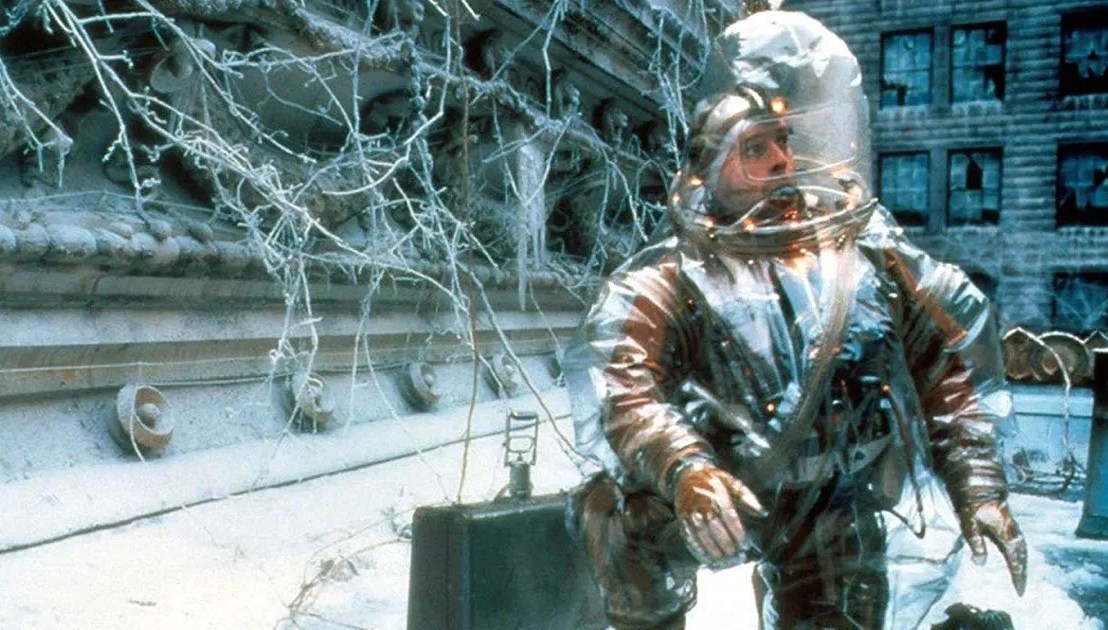
2035 and the world is a plastic-coated hell, where what remains of mankind huddle below the Earth in rudimentary, environmentally controlled, airtight refuges. The surface is a dream, now home to a deadly virus that wiped out 99% of the population. That virus was unleashed in Philadelphia in 1996: nothing can stop that. But time travel can help the scientists of 2035 gain a sample of the original pre-mutation virus. They believe it was unleashed by an organisation called “The 12 Monkeys”. Track the organisation in the past and find an original sample of the virus. Easy right?

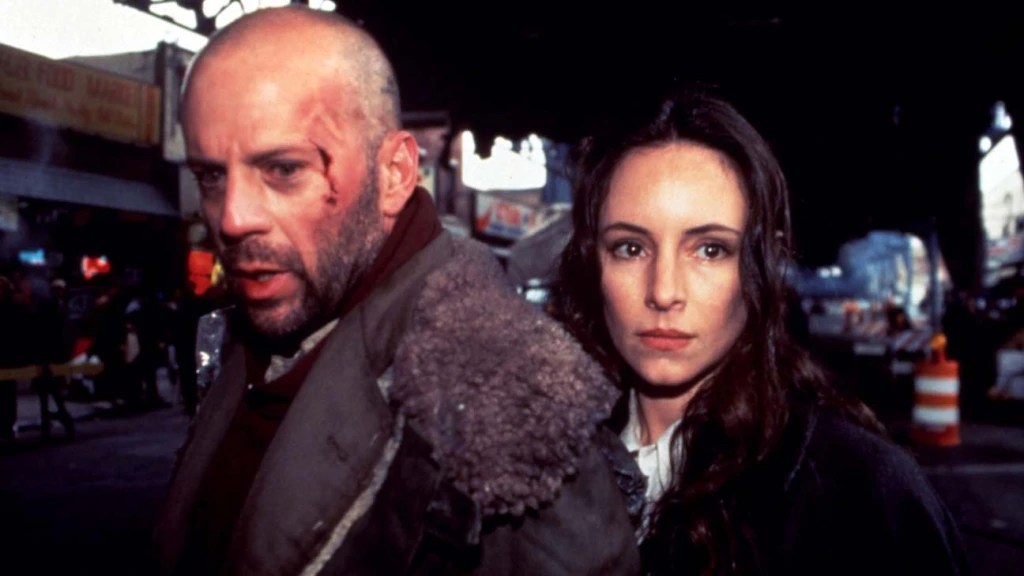
Wrong. Time travel messes with your mind, making it hard to tell what’s real and what’s not. The travellers are penal “volunteers”. James Cole (Bruce Willis) is selected as he has a photographic memory and a strong memory from 1996 of witnessing a Philadelphia airport shooting, that will help send him back. However, he’s flung back to 1990 and thrown into an asylum, treated by Dr Kathryn Railly (Madeleine Stowe) and sharing a room with environmentalist Jeffrey Goines (Brad Pitt). Rescued and correctly sent to 1996, can Cole convince Railly he’s telling the truth and track Goines who has become the leader of the 12 Monkeys?

12 Monkeys is one of the most intriguing time-travel films ever made – and its future, ripped apart with plague, seems chillingly closer today. It puts a vulnerable, scared person at its centre – and makes him a dangerous, inarticulate Cassandra who reacts with violence when no-one listens him (which they never do). It repeatedly tells us things cannot end well, but still gets us hoping they might anyway. It presents puzzles that provoke debate and stretch the imagination.

Gilliam’s most main-stream film is an eccentric, unsettling, tricksy film that juggles time travel and paradoxes, as well as mental health and the nature of reality. Shot with a Dutch-angle infused oddness – reflecting its hero’s mental unbalance – and scored with a French-inflected whirly-gig musical theme that is reminiscent of the demented street people that pepper the film (and may, or may not, be other unbalanced time travellers), it constantly puts you on edge and unsettles.

This extends to its casting, which takes two Hollywood superstars – Willis and Pitt – and deglamorises them to a shocking degree. As Cole, Willis is shambling, vulnerable, scared and struggling to distinguish between reality and fantasy. An 8-year-old boy when the virus destroyed the world, in a way he’s never grown up. He looks around the world of the past with a wide-eyed wonder (he adores the sun and the feel of the soil beneath his feet) but has the stroppy impulsiveness of a maladjusted teenager. He’s so twitchy and insecure, you start wondering if he is the mentally disturbed man who imagines he’s from the future, that his doctors think he is. It’s Willis’ least-Willis performance ever and one of his finest.

Similarly, Pitt pushes himself as the disturbed, aggressive Goines. Prone to obsessive rambling, that stretches Pitt’s languorous vocal register (he trained for months to improve his vocal range), Pitt’s performance is wide-eyed, unpredictable and unsettlingly dangerous. With a single eye swollen and askew, it’s a performance that plays with being OTT but manages to work because he mostly avoids actorly showing off. Madeline Stowe, by contrast, has the most difficult role as the ‘normal person’, a sceptical psychiatrist becoming more and more convinced Cole is telling the truth.

Of course, despite the film’s efforts to play with reality, the audience are always pretty certain he isn’t wrong about the future. But, with the sight of fellow deranged time travellers, not to mention Willis’ vulnerable performance, that Cole could still be crazy. Even if you are right, doesn’t mean you are sane.

Gilliam’s surrealist future helps with this. Every time Cole is pulled back to 2035, the world becomes ever more deranged. Is his grip on reality eroding, as he is feared it is. Design wise the future is a triumph – but it also seems eerily similar to the 1990 asylum Cole is in. Has the building, and the things in it, been repurposed in 2035? Or, as the scientists of 2035 become ever more surreal (including serenading Cole at one point in a Dennis-Potteresque fantasy), questioning Cole via a circular floating series of TV screens while he sits in a suspended chair, is Cole’s grip on reality gone?

It keeps the tension up in the ‘past’ plotline, even as the things Cole has seen in the future – strange messages on walls, photos, voicemail messages – accumulate. 12 Monkeys is a fascinating time-travel movie, that establishes from the very first moment it is impossible to change the past (something the audience, like the characters, get sucked into forgetting). After all, if the plague was stopped, then time travel would never be invented in the first place. All Cole, and the other travellers, can do is collect information.

But that doesn’t stop the future influencing the past. Goines decides to form the 12 Monkeys based on a conversation with Cole in 1990. Dr Railly becomes fascinated with apocalyptic predictions – writing a book that will influence the man planning viral annihilation in 1996 – only because she meets Cole. And, above all, 2035 Cole’s presence in 1996 leads to that strong childhood memory happening in the first placce. The final reveal of the meaning behind Cole’s recurring memory-dream is the perfect example of a time-loop closing (so much so the scientists in the future bend over backwards, giving Cole a doomed mission, to ensure it happens).

It also explains why he is drawn towards Stowe’s Railly, who resembles (with the exception of her lack of Hitchcock Blonde hair) the woman in his dream. The relationship between Cole and Railly develops into a slightly forced romance (it feels like a script requirement, for all Gilliam’s taking the characters to watch Vertigo to hammer home the obvious contrasts). But when it focuses on two people drawn together for reasons they can’t quite understand (and there are hints of predestination) it just about works. That and the commitment of both actors to the roles.

12 Monkeys is about 15 minutes too long (it’s 1990 section outstays its welcome), especially as the audience is never in doubt that the plague is real (after all this is a movie). But Gilliam keeps us on our toes with how confident we feel in Cole: we’re repeatedly shown he’s violent, inarticulate and impulsive. The final half of the film, where the origins behind events we have been shown or heard in the first half, is fascinating. The tragic turns of the film’s paradoxical temporal loop is brilliantly executed and haunting. Gilliam’s film is quirky, unsettling and a design triumph: but it also tells a fascinating story. It’s his most accessible and crowd-pleasing film.

The Fisher King (1991)

Robin Williams and Jeff Bridges go on a quest in Terry Gilliam’s decent but overlong The Fisher King

Director: Terry Gilliam

Cast: Robin Williams (Parry), Jeff Bridges (Jack Lucas), Mercedes Ruehl (Anne Napolitano), Amanda Plummer (Lydia Sinclair), Michael Jeter (Homeless Cabaret Singer), David Hyde Pierce (Lou Rosen), Lara Harris (Sondra), Harry Shearer (Sitcom actor), John de Lancie (TV Executive), Tom Waits (Veteran)

In 1991 Terry Gilliam was seriously worried he might be unemployable. After the famous feud with his producers over the editing of Brazil, his follow-up The Adventures of Baron Munchausen had flown over budget and bombed at the box-office. For Hollywood Gilliam was the worst kind of maverick – trouble with no record of financial success to give him the licence to do what he wanted. So he was thrilled to be offered the chance to direct The Fisher King, his first ever “for hire” job, a sentimental but surreal romantic buddy movie. It’s financial and critical success almost certainly saved his career.

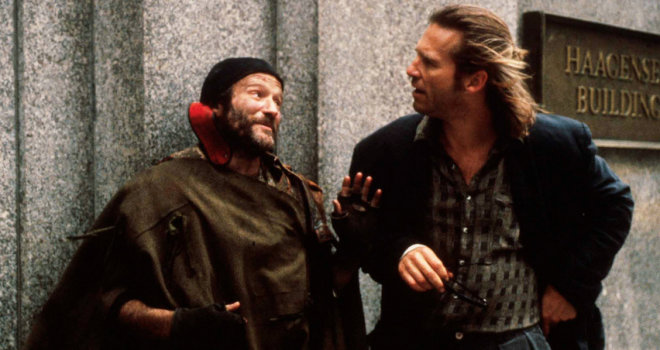
Jack Lucas (Jeff Bridges) is a New York radio shock jock, whose show accidentally provokes a lonely and confused man to massacre the customers at a late night bar. Three years later and Jack’s career is over and he is working as a co-owner of a video rental star (and live-in lover) with Anne Napolitano (Mercedes Ruehl). One day – drunken and suicidal – he is saved from a gang of young thugs by eccentric homeless man Parry (Robin Williams). Jack discovers three years ago that Parry was a respected professor of English literature, whose life fell apart after his wife was killed in the same bar massacre that ruined Jack’s career. The two men are drawn together – but can they save each other?

The film is based on the myth of the Fisher King, the king charged with finding the Holy Grail but could not find it for years – only for a fool to present it to the king full of water to drink, revealing it was there in the King’s possession the whole time. The fool helps because he is “purer” than those more worldly around him. The idea that Richard LaGravenese’s screenplay is leaning on is that these two characters – Jack and Parry – alternate between them the roles of Fisher King and Fool, both slowly doing things for each other that change their personalities and allow them to adjust back into the world and become comfortable with the people they are.

Reading that it should become clear that this is a sentimental film – and it certainly is. It’s also hellishly overlong for such a slight story of tragedy leading to overcoming personal crisis. We know watching the film from the start that Jack Lucas is a bad guy – and Gilliam shoots his opening scenes of Radio presenting with great skill, using high angles, extreme close-ups and shots that prevent us getting any real sight of Jack, making him as impersonal and contemptable as possible in his shallowness, pride and thoughtless cruelty. It’s not a mystery to expect that we are due to watch a triumph of the human spirit film, in which Jack becomes a better man. The film takes a very long time making this simplistic point.

The catalyst is Robin Williams, in a role tailor made for him as a hyper-active, manic personality mixed with tragedy and depression. To be honest Williams is frequently over indulged in the role – despite his Oscar nomination – heading over the top too often, and often over-egging the pudding both in Parry’s energetic enthusiasm and also in his moments of tragic depression. Parry is given a romantic sub plot with Amanda Plummer’s nervous office worker (a character who is little more than a collection of quirks than a personality, and it’s a shame it’s led to Plummer being typecast in such eccentric roles) that is almost insultingly slight and one-sided (he comes across a bit like a stalker) and lacks any of the charm needed for the story to work.

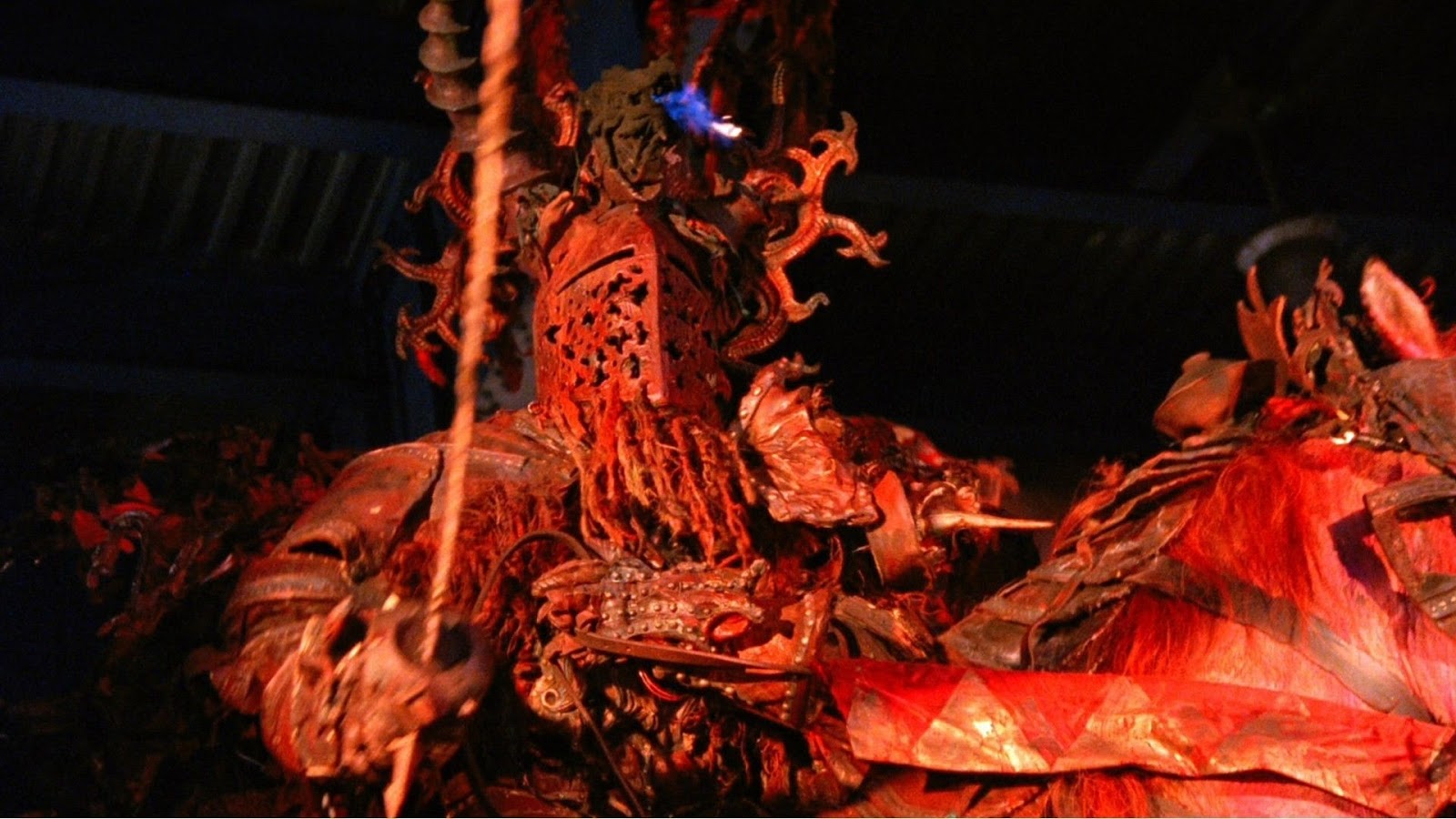
Parry is used to tie the film into further Arthurian flourishes with his obsessions with the legend. Parry visualises a sinister Red Knight – a mental expression of his grief and horror at his wife’s death, which takes the form of the appearance of his wife’s blood splattered face – which chases him through the city. Parry is also obsessed with the discovery of the Holy Grail, which he claims can be found in a millionaire’s faux medieval castle in the centre of Manhattan. This Arthurian stuff is often rather crow-barred in, but holds more interest than traditional plot-lines of people rediscovering their humanity and capability of bonding with others.

Jeff Bridges actually takes on the far harder role as Jack Lucas, a character who has to go on a firm development from start to finish. While Parry is a deliberately eccentric figure, Jack is the one who must journey from arrogance and pride to selflessness and humanity. Bridges does it very well, with a neat line in under playing and an ability to suggest the warmth, shame and self-disgust that Jack works hard to cover up. He’s also blessed to share scenes with Mercedes Ruehl who is outstanding (and Oscar winning) as his girlfriend, the most humane, engaging and real character in the film, a woman who seems at first blowsy and cheap (Jack clearly believes she is beneath him) but reveals more and more depths and capacity for honesty, love and generosity.

Gilliam has a sharp eye for the huge gap between wealth in poverty in 90’s New York, and how the two worlds are geographically only a width of a piece of paper, despite being worlds apart. His direction uses many of his flourishes with great effect. Fish eyed lens POV shots, low angles, stylistic dream sequences, a dream sequence where Grand Central station is full of dancing travellers like a mighty ballroom – many of the sort of things you see in his films are here. To be honest, I found some of the flourishes a bit overwhelming in a story that is so slight and so grounded in just four people’s interactions and quests for salvations. But it works, and Gilliam gets some moments of romantic and platonic love that really work. But it’s still a slight film that goes on far too long, and it eventually loses the viewer in its time-consuming journey towards expected heart-warming moments.