Category: Yorgos Lanthimos

Bugonia (2025)

Bugonia (2025)

Satire, kidnap drama, politics and more combine in Lanthimos’ partially successful thriller

Director: Yorgos Lanthimos

Cast: Emma Stone (Michelle Fuller), Jesse Plemons (Teddy Gatz), Aidan Delbris (Don), Stavros Halkias (Casey), Alicia Silverstone (Sandy Gatz)
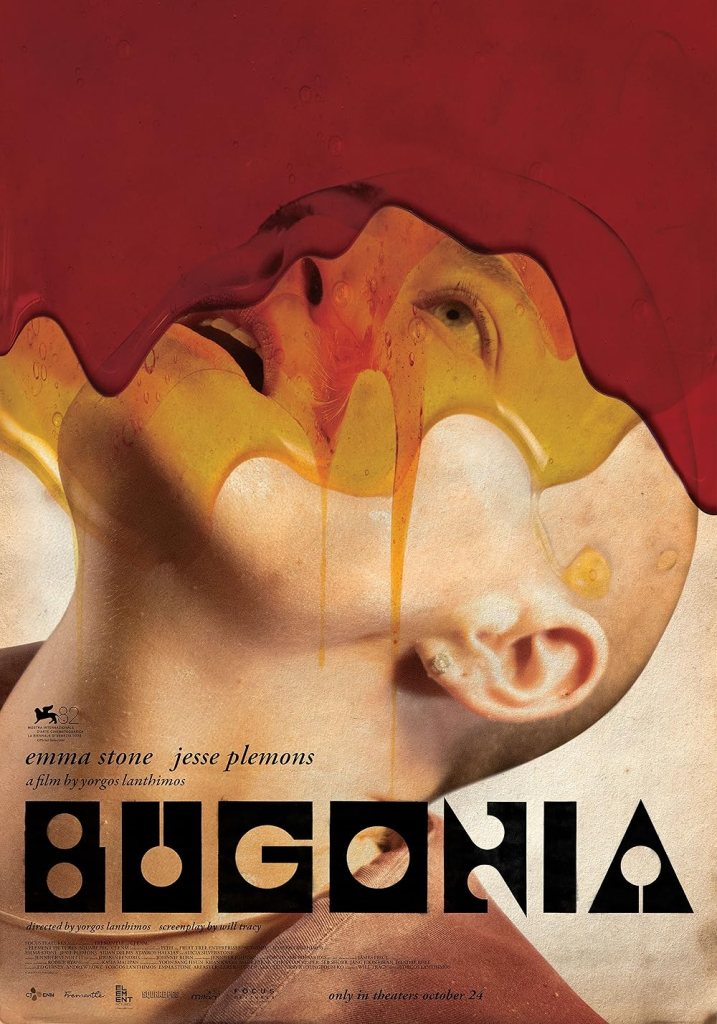
The world sometimes feels like its racing towards hell in a handcart And those on the bottom surely can’t help but look at the super-rich and wonder what on Earth do I have in common with them? But some, maybe particularly beaten down by life, may conclude something different: I’ve got nothing in common with the super-rich, because they are literally not of this Earth. That they are mysterious aliens who walk among us, planning to wipe us out. Bugonia takes a deep dive into the troubled, damaged psyche that can embrace the worm-hole of conspiracy theory, as well as the uncaring platitudes of the mega-companies that (maybe) rule the world.

Michelle Fuller (Emma Stone) is the CEO of Auxolith, an all-powerful pharmaceutical company that operates (at times) right on the fringes of legal. She becomes the target of beaten-down beekeeper Teddy Gatz (Jesse Plemons) and his loyal learning-disabled cousin Don (Aidan Delbris). Teddy is certain Michelle is from the planet Andromeda, that she can contact her mothership through her hair and that her mission is to wipe out mankind. Locking her in the basement of his farm-house, they enter into a mix of interrogation, battle of wills and wits and fluctuating power balances. Is Teddy deranged, vulnerable or misguided? Is Michelle scared victim, arch-manipulator or heartless CEO?

All this plays out, often in tight close-up, in Lanthimos’ jet-black comedy, which is two parts social satire to one part blisteringly nihilistic view of humanity and our future. As Burgonia’s carefully oscillates from one side to another, its political views and stances can be hard-to-perceive, but it certainly suggests Lanthimos has hardly the highest hopes for future. This helps make the film fresh, engaging and challenging. It’s constant cuts from one ‘side’ to the other, also means these two rivals rarely share the same frame, visually imposing their distance and rivalry – Lanthimos even uses non-complementary framing to place them awkwardly together, two people with no common ground.

While Teddy nominally holds the cards as the kidnapper, he’s so clearly such a weak, scared, vulnerable character (often framed weakly within the film) it’s hard not to feel sorry for him. Similarly, Michelle may go through some truly ghastly treatment as Teddy tries to unmask her ‘secret identity’, but remains such a forceful, dominant character (“I’m a winner and you are a fucking loser” she rants at Teddy at one point), framed with such utter assurance, her bland corporate indifference to others and willingness to manipulate the fault-lines in her kidnappers relationships (especially the gentle, child-like Don) never make her feel like a victim but just as dangerous as Teddy.

Teddy’s crazy, flat-Earth-mindset (and Lanthimos punctures each chapter with a view of an increasingly flat Earth, which is at first a darkly comic hat tip and then takes on a second chilling meaning late on) ranting and raving is presented as both darkly funny and also unsettling in how he can use it to justify any violence. Sure, it’s funny that he shaves Michelle’s head and covers her with cream to ‘weaken her influence’, or with gentle earnestness stresses he leads the human resistance to Andromeda (membership currently two). Slightly less funny that he insists he and Don chemically castrate themselves so as not to be seduced, or that pumps Michelle full of over 400 volts to try and unmark her (all while insisting her is a humanitarian, but as an alien Michelle technically has no human rights).

But then Michelle’s corporate coldness is rarely absent. She may remember all her staff’s name with a practised efficiency, but there is a degree of empathy missing in her, replaced with pragmatic hardness. As it becomes clear Teddy’s selection of her is (perhaps) more connected to her drugs companies treatment of his mother (Alicia Silverstone), her blasé assurances that everything was done legally and lack of any real guilt speaks volumes.

Lanthimos always keeps us guessing with Michelle: at moments she will switch from fear and vulnerability, to suddenly snapping back with utter authority, absorbing all the power in the room from the frequently hapless Teddy. Teddy in fact increasingly resembles a lost little boy (he even cycles through town with the relentless pedal-turning speed of a toddler), way-out-of-his-depth and at times all but deferring to Michelle’s advice about her own kidnapping.

Bugonia becomes a dance, not only between truth and fiction, but between two strikingly very different people, one so accustomed to power than even when in a nominally powerless situation they don’t feel anything but a winner, the other a desperate, scraggy haired loser who seems unable to really process what he should do to win a hand where he seems to hold all the aces. To make it work you need two electric actors: Lanthimos has this in spades with two trusted collaborators.

Stone’s ability to switch between corporate fear, desperate negotiation and earnest insincerity are as striking as her ability to keep her character so utterly, eventually terrifyingly, unknowable. In every second of Bugonia you can never be certain exactly what sort of person Stone is playing, her sociopathic assurance both understandable in the situation but also deeply unsettling. Plemons’ gives Teddy a child-like earnestness and desire to do the right thing that underpins his unhinged, ludicrous conspiracy theories, making him someone we both pity and understand is capable of doing terrible things for reasons he can justify to himself. Credit also goes to Aidan Delbris’ affecting performance as the gentle, easily-led Don.

Bugonia may well over-play its hands at points. It’s hard not to expect some sort of twist coming our way – I’m not sure how many people will be surprised by how the film plays out. It’s nihilistic ending feels a little too hard-edged and pointed for a film that hasn’t, until that point, embraced that level of flat-out cynicism. A clumsy introduction of a cop with a shady past is thrown in merely (it seems) to give us another reason to feel sorry for Teddy. Lanthimos’ at points engages, not always successfully, in a level of body horror that wouldn’t feel out of place in the excesses of Cronenberg. But then there are moments of real wit: the paralleled cuts of both Teddy/Don and Michelle going through their fitness regimes, a painfully uncomfortable bolognaise meal that tips into a full-out barney between the two stars, it’s unsettling near-finale in Michelle’s office and the playful realisation that much of the truth was there from the start, but hidden.

Bugonia might be a little too scatter-gun and self-consciously crazy to be a really effective satire, but with two terrific performances and an unsettlingly tense shooting style from Lanthimos (with echoes of everything from Dreyer to Hitchcock) there is enough of interest there to keep your mind bubbling even after it’s hard-hittingly sour ending.

Poor Things (2023)

Poor Things (2023)

Distinctive, challenging and hilarious film that mixes social issues with quotable dialogue

Director: Yorgos Lanthimos

Cast: Emma Stone (Bella Baxter/Victoria Blessington), Mark Ruffalo (Duncan Wedderburn), Willem Dafoe (Dr Godwin Baxter), Ramy Youssef (Max McCandles), Christopher Abbott (Alfie Blessington), Kathryn Hunter (Madame Swiney), Jerrod Carmichael (Harry Astley), Hanna Schygulla (Martha von Kurtzroc), Margaret Qualley (Felicity), Vicki Pepperdine (Mrs Prim), Suzy Bemba (Toinette)

“It’s Alive!” cries Frankenstein as his creation is sparked to life before abandoning it to become a revenging monster. Yorgos Lanthimos’ Poor Things imagines a different creature – nurtured (admittedly as part of an eccentric experiment), maturing at an accelerated rate, discovering physical and intellectual stimulation and deciding they can’t get enough of either of them. Adapted from Alastair Gray’s novel, Poor Things is a vibrant and challenging film that, for all its sex, is a feminism-tinged Frankenstein that says no to societally enforced ideas of shame and conformity.

In Victorian London, Bella Baxter (Emma Stone) is the creature, a stumbling, barely articulate young woman when she is introduced to trainee doctor Max McCandles (Ramy Youssef) by her guardian (her “God”) Dr Godwin Baxter (Willem Dafoe). “Bella” is resurrected corpse – the body of a suicidal pregnant woman, the brain of the child she carried. Developing at an accelerated rate, Bella is both Godwin’s experiment and his surrogate child. But as Bella discovers the pleasures of the body and the wonders of the world around her, she wants to experience life outside of the house. Eloping – with the agreement of her guardian – with roguish lawyer Duncan Wedderburn (Mark Ruffalo), Bella discovers not only sensual pleasures but deeply engaging intellectual pleasures across Europe, determined to become her own woman defined by no-one.

Poor Things is practically a dictionary definition of a Lanthimos epic (fish-eyed lenses, spidery text captions, a jarring mix of period and modern) and is almost impossible to categorise. It is, in turn, serious and thought-provoking, laugh-out-loud funny, uncomfortable and challenging. Shot in a deliberately artificial manner, its cinematography and sets reminiscent of Bram Stoker’s Dracula, it’s Victorian but also a remix of everything from Metropolis to the mansion at the heart of Sunset Boulevard, here turned into a Dr Moreau style den of freakishly spliced animals. It makes for something wildly, unpredictably unique visually, a smorgasbord of the real, the overblown and plain weird.

With a sharp script by Tony MacNamara, crammed with quotable lines (sometimes Lanthimos has a bit too much of an eye on creating GIF moments) Poor Things reinvents itself as constantly as its hero. Opening in rich black-and-white to chronicle Bella’s early years, it explodes into a gorgeously expressive Powell and Pressburger colours as she experiences the world. It superbly mixes the real with the weird, shaping its collection of bizarre characters into living-breathing people while keeping the world around them a melting-pot of styles and genres.

Poor Things has been attacked by some as semi-pornographic or exploitative. In fact, it’s a complex and daring look at female empowerment. On first discovering the pleasures of, well, self-pleasure (with a selection of vegetables), Bella is immediately told such things are not done in polite society. But Bella refuses to see “furious jumping” as shameful, but just a source of pleasure and experience like any other. If she takes pleasure in the act with someone, why should be ashamed? And if she makes all the decisions about what does and doesn’t happen with her body, who should judge her?

Bella is a curious hybrid her whole life: the body and feelings of an adult, with a swiftly developing brain, absorbing understanding of the world around her swiftly. Like a child she lashes out at the rules Godwin and his protégé Max place over her (partly for her protection, partly to continue their psychological development experiment). But this comes from her increasing frustration at having her horizons limited by these men, deciding what and who she can see. Lanthimos takes clear from the start Bella can take as much sensual pleasure in feeling fallen leaves under her body or watching fireworks in the sky as anything else and doesn’t feel she should be denied it.

Poor Things sees Bella demanding, and then making, her own decisions – and to hell with expectations. Whether throwing plates at dinner because she wants to leave or choosing to run away to Europe with caddish Duncan for the experience of it, she shall make her own choices. Decisions being made for her, infuriate her: Max’s refusal to let her leave or Duncan’s decision to take her, unannounced, on a cruise. Bella will talk to who she wants and experience anything she finds curious. If she decides to go on the game in Paris in a high-class brothel (on the basis that she enjoys sex, the hours are short and it pays well) who gives a damn if Duncan is appalled. He doesn’t – for all he might like to think so – own her.

These are complex and challenging ideas, as Bella jokes she has become “the means of her own production”. But Bella believes the only thing in the world should make us ashamed is the suffering of others: witnessing a slum in Alexandria she is moved to tears at the indifference that lets children die in poverty, with only platitudes for these “poor things”. And you can see her point: why flinch at personal misconduct but not even blush at the idea of others dying because of our inaction. That’s why she doesn’t want to be constrained by societies ideal, be that enjoying sex, reading Marxism, dancing all night long or wanting to punch a baby that won’t stop crying in a restaurant.

All these complex ideas are brilliantly captured in Emma Stone’s extraordinary performance. It is, of course, a physical marvel, her body slowly, jerkily, developing, but also a rivetingly complex embodiment of a hugely complex personality, absorbing everything around her, processing it and then shaping it into her own world view. It’s reflected in the gorgeous eccentricity of her dialogue – she is “a changeable feast” of views, peppering her sentences with astute (and funny) unique metaphors “finding being alive fascinating”. She makes Bella determined, naïve, exceptionally wise and insightful, uncertain, kind and unforgiving. It sits perfectly at the heart of a film about a woman refusing to be ashamed and determined to better the world around her. It’s a brilliant creation.

One of many in the film. Godwin, a hideously disfigured famous surgeon, was the subject of his own father’s experiments (Godwin describes with matter-of-fact scientific curiosity a series of repugnant surgical experiments, including the removal of organs to discover if the body needs them – “turns out we do”). Godwin seems at first a blinkered mad scientist, but in Dafoe’s brilliantly layered performance, a humanitarian with a sense of fair play is revealed, who genuinely cares for his creation and refuses to stand in her way. Although she calls him “God” he is far from a messianic tyrant, instead refusing to repeat the mistakes of his own tyrannical parent.

He contrasts neatly with Ruffalo’s rake. Ruffalo has a whale of a time in a ‘leave nothing in the locker room’ performance of comedic excess. Duncan seems at first a threatening rake, but becomes infatuated with the mysterious Bella (something she finds more and more wearing), crumbling from worldly-wise playboy to a spoilt schoolboy whining about things he can’t have. Ruffalo inverts Bella’s development: as she becomes more mature, he degenerates into a dependent child.

Which fits because Poor Things is a Frankenstein-in-reverse story of a woman not being defined by men. Those who try fail, left to choose either to support her or flail against her rights. Lanthimos’ work is striking, original and hugely dynamic, brilliantly mixing striking visuals with searching questions. Why shouldn’t women feel the same lack of shame in their bodies and accomplishments as Bella does? It’s an urgent question – that’s getting lost in discussions about the films. Often as wildly funny as it is freakily weird, its deliberate artificiality and anachronisms help create a film that is a playground of ideas. I’m still working out what I feel about it all now – and how refreshing to have a film as bold as that to consider?

The Favourite (2018)

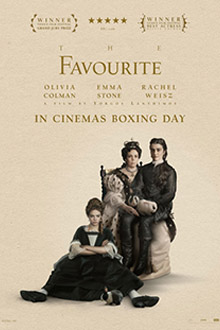
Olivia Colman is at the centre of a complex rivalry in The Favourite

Director: Yorgos Lanthimos

Cast: Olivia Colman (Queen Anne), Emma Stone (Abigail Hill), Rachel Weisz (Sarah Churchill, Duchess of Marlborough), Nicholas Hoult (Lord Robert Harley), Joe Alwyn (Colonel Lord Masham), Mark Gatiss (Lord Marlborough), James Smith (Lord Godolphin)

Looking around the cinema, I couldn’t help but wonder how many of the audience were expecting The Favourite to be a Sunday night-style costume drama about Queen Anne. Goodness only knows what they made of this skittishly filmed, acidic, sharp-tongued, very rude drama about squabbles in the court of Queen Anne. The Crown it ain’t.

In 1708, the court of Queen Anne (Olivia Colman) is dominated completely by her head of household, chief advisor, secret lover and domineering best friend Sarah Churchill, Duchess of Marlborough (Rachel Weisz). But Sarah’s control over Queen Anne is set to be challenged by the arrival in court of seemingly charming, but in fact ruthlessly ambitious, cousin Abigail Hill (Emma Stone), a former aristocrat who has fallen on hard times. Soon Sarah and Abigail find themselves in the middle of a bitter, ruthless clash for control over Anne – who, seemingly weak-willed and disinterested in government, in fact takes an eager pleasure from the rivalry of the two women.

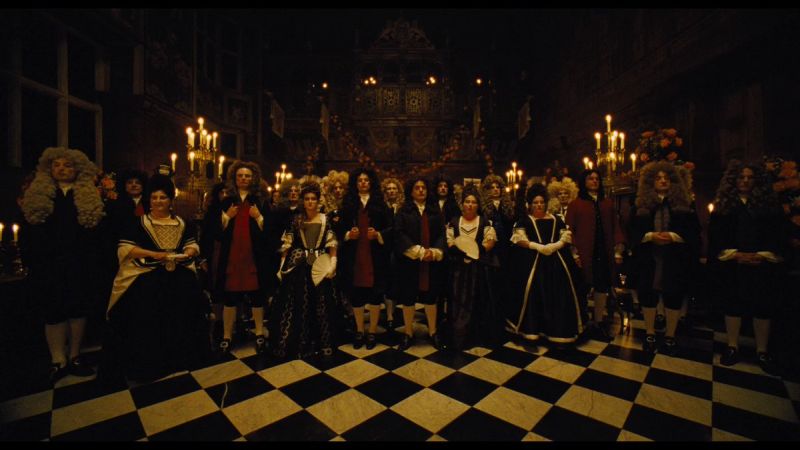
The Favourite is a brilliant, acerbic, very dark comedy that treats its period setting with a hilarious lack of reverence. It’s a frequently laugh-out loud comedy, with its often foul-mouthed dialogue just on the edge of being anachronistic (a trait that also comes into the hilarious non-period dancing). It takes a moment to tune up, but leans just enough on the fourth wall to work. Lanthimos’ film doubles down on the insane pressure bowl of Anne’s courts, turning the court of the 1700s into a bizarre, semi-surreal state where you have no idea what insanity you might see around the corner – from racing ducks, to rabbits roaming free, to a naked man being pelted with oranges. 

But then this is the sort of bizarreness that stems from the top, and Olivia Colman’s Queen Anne is a domineering eccentric. In a film-career-making performance from Colman, her Queen Anne is part infantalised puppet, part needy insecure lover, part bitter control freak. Anne will change from scene to scene from a furious, knee-jerk rage to a weeping vulnerability. Her interest in actually ruling the kingdom has been largely beaten out of her, but she still needs to feel that she holds the power. With her body raddled with gout, Anne alternates between demanding independence and being wheeled from place to place. Colman’s performance bravely skits between temper tantrums and a desperate, panicked loneliness and sadness – it’s a terrific performance.

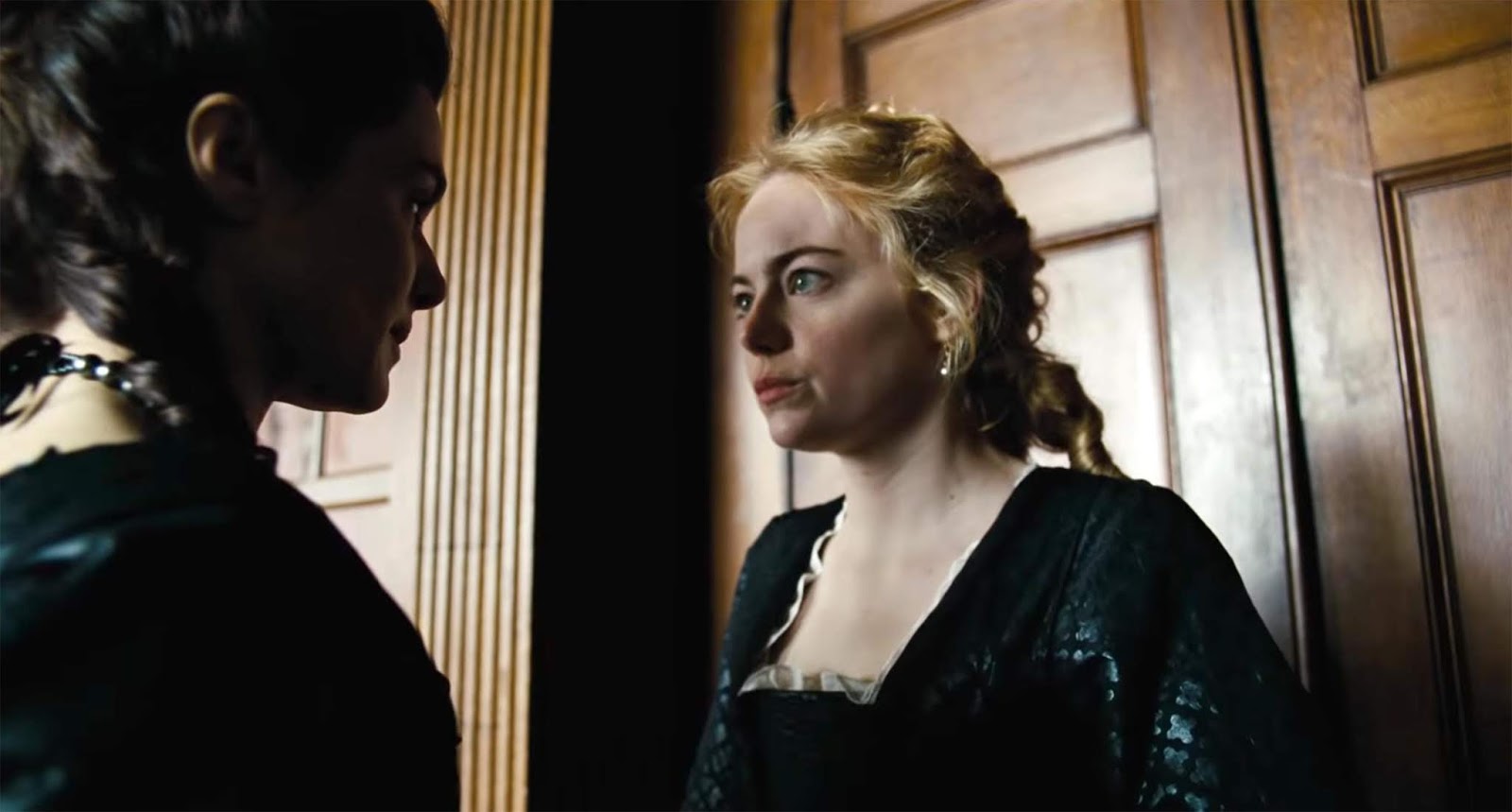
A woman as uncertain and unhappy in herself as Anne is basically pretty ripe for control and manipulation. History has not been kind to Sarah Churchill, who is often seen as a ruthless, power-hungry manipulator only out for what she can get, obsessed with the power her role brings her. This film takes a different, more interesting slant, thanks in part to Rachel Weisz’s superb performance. Weisz plays Churchill as a strong-minded, hard to like woman, who has a genuine bond with Anne, but honestly believes she is better suited to execute the powers of royalty than her lover. But that doesn’t stop her having feelings for her – or priding herself on refusing to lie to Anne about anything (from her appearance to her behaviour). But this doesn’t stop Sarah from ruthlessly bullying Anne or threatening her – though she’s equally happy to climb into bed with her when required.

But Sarah Churchill here is doing the things she is doing because she honestly believes that it is what is best for the kingdom and (by extension) Anne, and the moments of shared remembrance between Anne and Sarah have a genuine warmth and feeling to them. Which makes her totally different from the ruthless Abigail, played with a stunning brilliance by Emma Stone. Abigail doesn’t give a damn about anything or anyone but herself: something the rest of the servants in the household seem to recognise instinctively as soon as she arrives, but a danger Sarah doesn’t detect until too late. Abigail’s every action is to promote her own wealth and prestige, and she’ll do whatever it takes to do that, from crawling through the mud for herbs to crawling between the sheets to pleasure Anne at night. Stone’s Abigail is ruthless, self-obsessed, uncaring and on the make in another terrific performance.

The film focuses in large part on the see-sawing fortunes of these two rivals for the role of favourite – with Anne as the fulcrum in the middle. The film is split into eight chapters, each of which is opened by a quirky quote from the chapter itself. It neatly structures the film, and also gives it a slight off-the-wall quality. The film is packed with electric scenes, as the women wear the trousers in the court (often literally, in Sarah Churchill’s case), riding and shooting in their spare time and slapping down the assorted politicians and lords desperately trying to promote their interests on the edge of the court. This battle of wits and wills is a fabulous, increasingly no-holds barred, rivalry that motors the film brilliantly.

Lanthimos loves every moment of scheming and double crossing the film supplies. He shoots the film with a selection of low-angle and fisheye lenses, which make the palace settings seem as imposing, large and domineering as possible – and also distorts the world just as the feud between the two women is doing. The film looks fabulous, with its intricate design and it’s candle lit lighting. Lanthimos’ court always looks gloomy and secretive, with only a few spots of orange warmth.

Lanthimos also understands that there is very little room for sentiment or feeling here, and the flashes of it we get are never allowed time to really grow. That’s not a negative of course, as this sharp comic drama is also an arch commentary on some of the selfishness and distortion of events that lies under politics (sound familiar?), with the interests of the ordinary people of the realm raising very little interest from any side on the political divide. And Anne is such a bizarre character, so pulled between pillar and post, so desperately unhappy so much of the time, so utterly spoilt the rest, that you understand how she has become such a chew toy for court faction, and why she is happy to tacitly encourage this world where her every whim is played to for advantage.

I laughed out loud several times during The Favourite. It’s obvious to say that it feels like a film for the #metoo era – but it certainly has three fabulous, brilliant, hilarious and strangely heartfelt performances from its three female leads, three of the best actresses in the business. Wonderfully directed, beautifully written and fabulously designed, this is properly fantastic cinema.