Category: Family drama

Beginners (2010)

Christopher Plummer and Ewan McGregor are a father and son building a bond in quirky fable Beginners

Director: Mike Mills

Cast: Ewan McGregor (Oliver Fields), Christopher Plummer (Hal Fields), Mélanie Laurent (Anna Wallace), Goran Višnjić(Andy), Mary Page Keller (Georgia Fields), Kai Lennox (Elliot), China Shavers (Shauna)
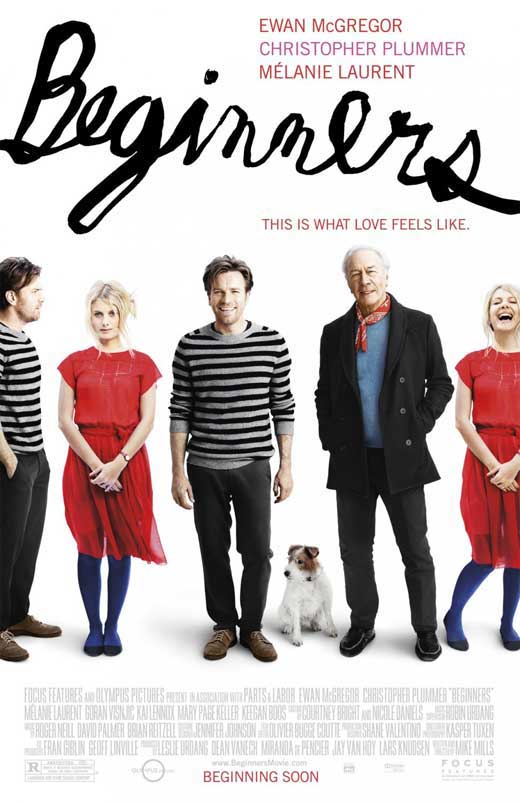
Oliver Fields (Ewan McGregor) is a reserved man who has struggled to hold a relationship down because of his own emotional distance. His world is shaken when his father Hal (Christopher Plummer) comes out at the age of 75, after the death of his mother, and proceeds to lead an active life in the gay scene of LA, including taking on a boyfriend, Andy (Goran Višnjić). After his father’s death, reflecting on Hal’s love of life and increasing emotional honesty makes Oliver consider his own life and start to tentatively consider a relationship with a French actress, Anna (Mélanie Laurent).

This heavily auto-biographical film was based on the life and experiences of writer-director Mike Mills. It has moments of genuine sweetness and light, occasionally undermined by the slightly smug quirkiness that creeps into the story at several points. Mills sometimes tries a little too hard as a director, using montages of stock footage to place years into context and to add a quirky sheen to the drama.

In fact it’s that quirk that often gets in the way of the drama in the film, Mills relying too often on meet-cutes, a dialogue Oliver has (in subtitles) with his dog, jolly picture montages, the cartoons Oliver draws on themes like “The History of Sadness”, the achingly clever-clever graffiti Oliver sprays on walls etc. etc. Maybe I am just cold of heart but this sort of stuff gets on my nerves rather than awakening my warmer feelings. Clearly I’m getting old.

Someone who isn’t getting old is Hal. Played with Oscar-winning bravado and joie de vivre by Christopher Plummer, the film gets most (if not all) its emotional mileage out of Hal’s embracing of life and his equally profound regret at the years of concealment and emotional distance he inflicted on others. One tearful moment sees the extremely sick Hal holding Oliver’s hand on a bed, sadly reflecting he wanted to do this throughout Oliver’s childhood but didn’t feel he could. 

The film carefully positions Hal’s late acceptance of his personality and explosion of embracing life as an inspiration, and contrasts it with Oliver’s buttoned up repression. To be honest, someone as repressed and traditional as Oliver might well have taken slightly longer (you suspect) to deal with the fact that his dad comes out after the death of his mother – but then this is basically a father-son romance, so you can’t blame Mills for trimming down this expected drama. 

Instead the story focuses largely on Oliver learning to open his heart to a relationship with Melanie Laurent’s French actress (a relationship by the way so impossibly quirky the two of them meet at a fancy dress party – he’s dressed as Freud, she can only communicate through writing notes because she has laryngitis. To be fair it’s marginally less irritating than it sounds). This story is cross-cut with flashbacks to Hal’s last few years that illustrate different lessons Oliver learned from his dad.

This is all rather artfully and gently done, but very traditionally structured. The flashback material with Hal is far stronger and Christopher Plummer’s mix of playfully raging against the dying of the light and gentle emotion and sadness overwhelms the modern plotline. It’s hard to get wrapped up in Oliver’s stumbling shoot-yourself-in-the-foot courtship of Anna, when you have Plummer ripping through a beautiful monologue on how he was desperate not to be as distant as his own father. Even the jokes get overwhelmed – nothing in Oliver’s storyline is as amusing as Hal raving over garage music.

The real interest to be honest is in the relationship between Hal and Oliver, and the late blooming of emotional honesty and love between them (Oliver claims he can barely remember Hal from his childhood, and flashbacks confirm this). Even this however could have had more impact if the film had allowed more of this distance to be seen in the film, as we then lose the impact of the two characters starting to bond. 

In fact I’d love to have seen more of Hal and Oliver together, perhaps more intercut with flash-forwards about Oliver learning to accept love and joy into his life in the same way Hal did in his final years. Reversing the format, effectively. The warmest bond in the story is between Hal and Oliver and this seems a little lost. Ewan McGregor does his best, but he feels slightly constrained by the role, as if aware that he had the pressure of playing the director’s own life story. Melanie Laurent is adorable as Anna, but she feels like the sort of character one only meets in movies – beautiful, sexy, cute, showing the sort of incredible patience for the timid, confused, difficult Oliver that never happens in real life (in my experience).

Such a format change would also mean more Christopher Plummer, which is never a bad thing – and certainly wouldn’t be here, in one of Plummer’s finest performances: fun, witty, warm, kind, sad and gentle with a very touching relationship with his much younger lover (played very well by a sweetly naïve Goran Višnjić). It’s Plummer’s film and he rides above a story that often seems a little too unoriginal and quirky than you might have expected.

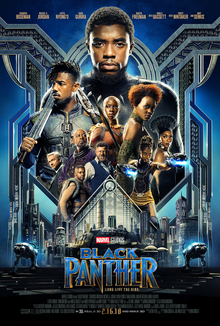
Black Panther (2018)

Chadwick Boseman is the legendary Black Panther in Marvel’s solid comic book outing

Director: Ryan Coogler

Cast: Chadwick Boseman (T’Challa/Black Panther), Michael B. Jordan (N’Jadaka/Erik Kilmonger Stevens), Lupita Nyong’o (Nakia), Danai Gurira (Okoye), Martin Freeman (Everett K Ross), Daniel Kaluuya (W’Kabi), Letitia Wright (Shuri), Winston Duke (M’Baku), Angela Bassett (Ramonda), Forest Whitaker (Zuri), Andy Serkis (Ulysses Klaue), John Kani (T’Chaka)

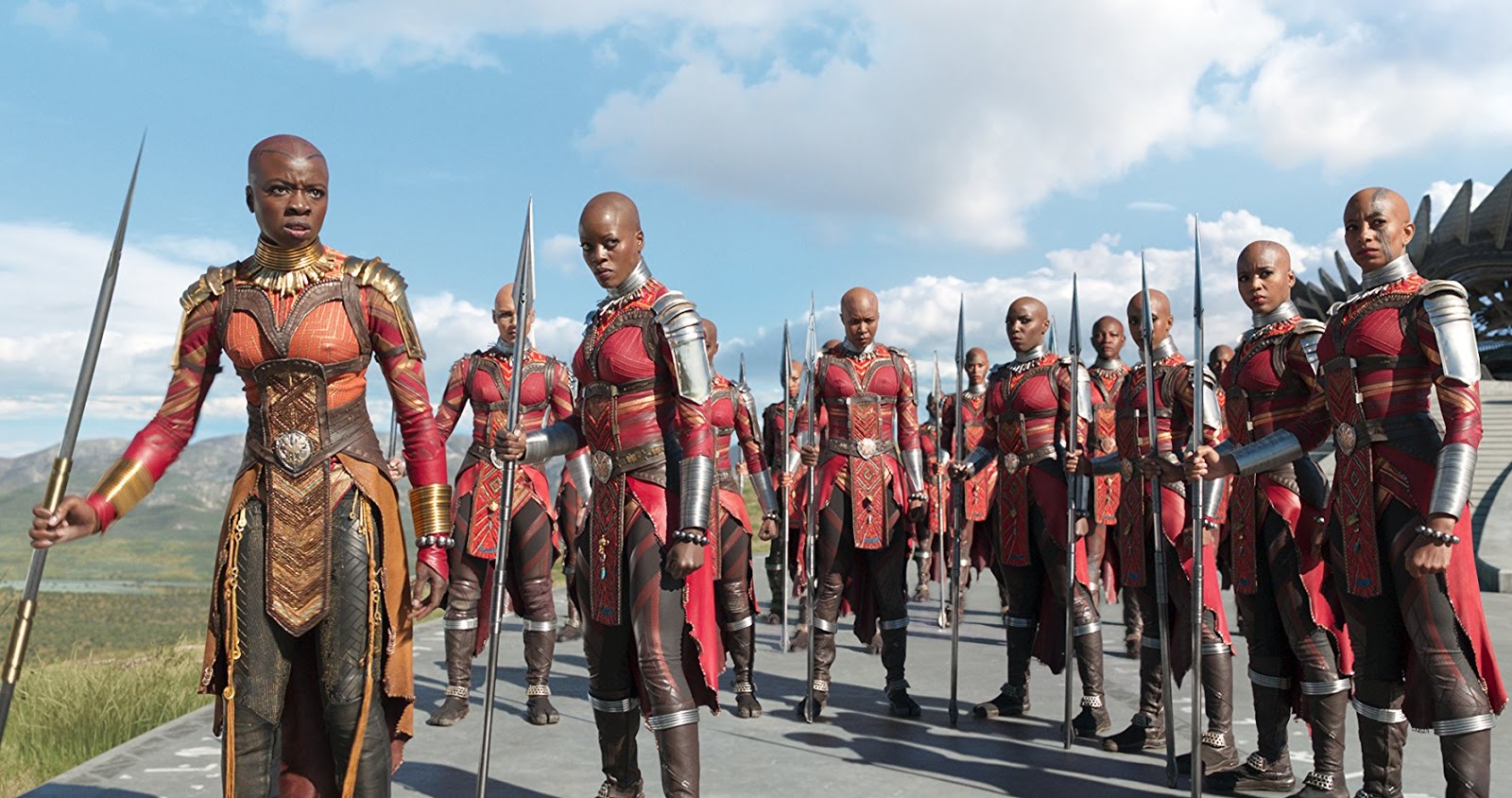
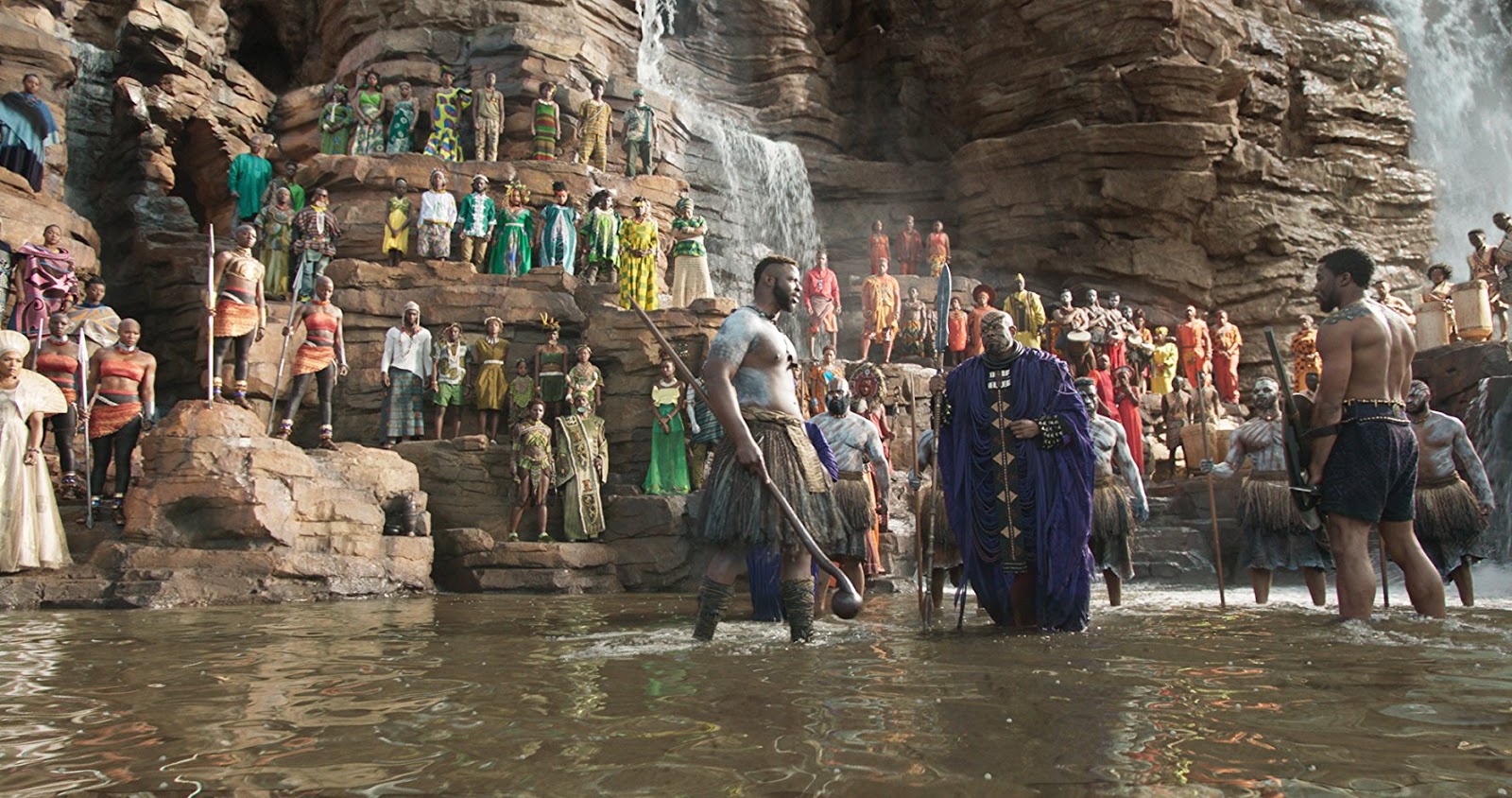
Marvel’s comic book world is now so stuffed with characters, worlds and dimensions that it is remarkable how many of its heroes are white and male. Black Panther does something completely different, giving us a set of African heroes and placing the common framework of a Marvel film within a very proud, and distinct, African heritage. So you can pretty much guarantee you ain’t seen a comic book film quite like this one.

After the death of his father (in Captain America: Civil War), T’Challa (Chadwick Boseman) becomes king of the secretive nation of Wakanda. Camouflaging itself as a poor and unadvanced nation in order to avoid interaction with the rest of the world, Wakanda has in fact for centuries been mining a remarkable metal, vibranium, that has helped the nation become hugely technologically advanced. Its king also bears the responsibility of being the “Black Panther”, ingesting a vibranium-infused herb to gain superhuman speed and strength. However, others have their eye on the throne, not least Erik “Kilmonger” Stevens (Michael B Jordan), who wants to turn Wakanda into a force that could protect the black people of the world from their historical oppressors and avenge centuries of slavery.

Black Panther never fails to be entertaining. The film is shot with a genuinely vibrant excitement, and I love the way it proudly embraces a comic book twist on African tribal heritage. In fact the film’s depiction of an African nation which is secretly the most powerful and advanced nation in the world is really quite an impressive political statement.

Ryan Coogler directs the film with flashy brilliance and comes up with a few ways of presenting what are (essentially) action sequences we’ve seen many times before in unique new ways. The stand-out is an early action scene in a Korean bar, filmed to appear as an immersive single take around a large set, the camera dipping and zooming from character to character. Coogler also brings a fair amount of visual wit to the fights while not losing the emotional and character depth the story is aiming for.

The film also has some fine performances, with Boseman dripping dignity, nobility and decency as T’Challa. Regular Coogler collaborator Michael B. Jordan gives a great contrast as bitter LA slums kid turned misguided would-be dictator Kilmonger. Danai Gurira stands out as proud general Okoye, torn between duty and personal loyalties. Hell even Forest Whitaker – clearly loving every moment of this OTT Marvel world – gets some weight and dignity out of his typical grandstanding style.

It’s another mark for the film that the world of Wakanda is so effectively gender neutral. Kings of Wakanda have a Praetorian Guard of female warriors, most of the leading voices on its council are women, and its technical genius is T’Challa’s sister Shuri (played by Letitia Wright in a charming, star-making performance). Sure it doesn’t feel like the role of Black Panther himself is up for grabs for anyone lacking a penis, but this is a world where women are equal, if not leading, partners in the action.

The film also addresses issues of post-colonial struggle, not least attitudes towards slavery and oppression handed out to Africa over centuries. Kilmonger’s fiendish plot is, in many ways, actually quite sympathetic – he wants to use Wakanda’s resources to protect those of African descent across the world. Jordan gets some good moments from his speeches laced with anger at the historical treatment of Afro-Caribbeans and, to be honest, it’s hard not to see his point. So hard in fact that the film has to drop hints that Kilmonger is a potential tyrant to stop him from seeing too reasonable. 

This is where the film’s plot starts to get slightly hazy. The character arc of T’Challa himself is pretty unclear. Traditionally in these films, the character must embrace his destiny. Problem is, a lot of this arc was covered in Captain America: Civil War. The writers are unable to give him a truly compelling replacement arc here. T’Challa drops a few references early on to not feeling ready – but basically swiftly embraces it. He never outlines a real alternative agenda to Kilmonger – there are characters in the film who argue “Wakanda doesn’t get involved in the world”, but he isn’t one of them, so there is no journey towards engagement with the outside world (on far more humanitarian terms than Kilmonger advocates). 

Frankly, Okoye is given a better character arc than T’Challa, beginning by advocating “we must serve the throne and respect our traditions even if we doubt them”, and learning later to follow her own conscience. T’Challa, in contrast, is no discernibly different at the end of the film to how he was at the beginning. 

T’Challa’s journey is basically getting something, losing it and then getting it back. Strip away Boseman’s performance and the character is basically pretty dull. He partly suffers, as does the rest of the film, from an overstuffed cast spreading the focus of the film far too thinly and leading to character arcs and interconnections feeling rushed. Kilmonger’s connection with T’Challa is forced – they only know each other for at best two days! – and there is a superfluity of villains. There’s not only decoy antagonist Klaue (and his gang) hanging about for a good chunk of the film, but also Daniel Kaluuya’s ill-defined best friend turned opponent, W’Kabi. Combining Kilmonger and W’Kabi would have helped no end, allowing two different, divergent agendas to develop and cause a relationship rift between two friends (Kaluuya is instead totally wasted in a nothing part, whose allegiances change depending on the demands of the plot). 

The good guys fare no better: Lupita Nyong’o is completely wasted as a love interest who feels stuffed into the movie because, y’know, these films gotta have one. She does nothing in the film that could not be easily done by another character, and nearly all of T’Challa’s emotional scenes – and personal motivation – are tied into his sister rather than this are-they-aren’t-they-a-couple. 

It’s all part of the traditionalism that underlies the film. Its structure is familiar and, like many Marvel origin films, the villain is a dark reflection of the hero with similar skills. The final battle is traditional and a little dull (and feels very similar to Avengers: Infinity War). The film avoids showing T’Challa torn between isolation and intervention – he in fact advocates both in the first 15 minutes – and doesn’t really make much of the prospect of a hero changing his mind or developing his views to embrace a wider world.

But it stands out because it is different. And it deserves no end of praise for making such a film so full of love and respect for its heritage. It walks a very difficult line between enjoying the bright exotic colours while not making the film patronising or overly “other-worldly”. How many other Hollywood films have, at best, two white characters (well played in both cases by Martin Freeman and Andy Serkis)? How many others would dare have the villain make a defiant, sizzling and emotionally inspirational speech about racial oppression and the hypocrisy of the West (though the film goes easy on America, with the speech taking place at the hilarious “Museum of Great Britain”. Where is this place – please get my tickets!).

That it slightly dodges and fudges the implication of these themes in its plotting and the conception of its hero – who is basically a dull character played by a charismatic actor – doesn’t reduce its pleasure at doing something different. I’m not sure it will stand up to repeated viewings – look past the setting and it does little new – but it’s a worthy entrance in a crowded universe.

About Schmidt (2002)

Jack Nicholson is superb as beaten down Warren Schmidt in About Schmidt

Director: Alexander Payne

Cast: Jack Nicholson (Warren R Schmidt), Kathy Bates (Roberta Hertzel), Hope Davis (Jeannie Schmidt), Dermot Mulroney (Randall Hertzel), June Squibb (Helen Schmidt), Howard Hesseman (Larry Hertzel), Len Cariou (Ray Nichols)

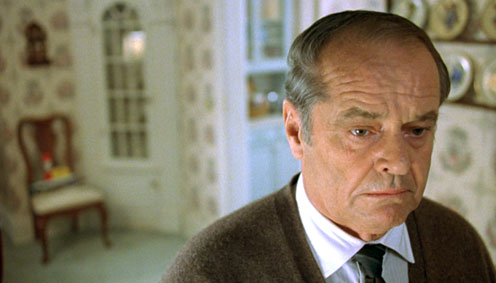
When you think about About Schmidt, it’s almost impossible not to think about Jack Nicholson. For so long Nicholson has been JACK, a personality so large, so present in the public conscious as the ultimate raging lothario, that most of his performances have been unable to escape it. He has blasted through so many films as a force of nature that what’s almost most surprising about About Schmidt is that Nicholson is so feeble, worn-out, uncharismatic and beaten down in the lead role. Did I also mention he was brilliant?

Nicholson is Warren R Schmidt, a recently retired actuary with an Insurance company in Omaha. As a young man he dreamed of a golden future, but his life has been one of crushing mundanity and boredom (albeit, I will say, clearly very well paid!). Schmidt has become a cowed, average, hollow man – the sort of man who urinates sitting down because his wife insists he does so and whose idea of defiance is to pop out for a milkshake. After his wife (June Squibb) suddenly dies, he is forced to deal with the fact that he is actually largely estranged from his idealised daughter Jeannie (Hope Davis) and that he despises her decent-but-no-hoper fiancée Randall (Dermot Mulroney). Can he make her abandon the wedding?

Alexander Payne has excelled in this style of film: a slightly off-centre social comedy with a mix of a lemony sharpness, satirical wit and genuine warmth for its characters. He perfectly captures the hopes and dreams of small-town America and the trap of mediocrity and disappointment that these sort of suburban, unremarkable lives can have. About Schmidt does this brilliantly, by counterpoising the Schmidt’s feelings of depression and being trapped with the clearly empty dreams of his daughter’s would-be husband. Not to mention taking shots at the overbearing try-too-hard irritability of Randall’s bohemian family (who seem to celebrate the very failures Warren believes his life has been made of).

Payne works in perfect synchronicity with Nicholson, keeping all the actor’s OTT gestures and mannerisms well in check and pushing him to create a quiet, timid, worn-out man who is beginning to reflect (with some bitterness) on what his life has been and been to suspect (with some dread) what it might be for his daughter. Nicholson’s comic timing and his sense of empathetic sadness are both absolutely perfect. The film uses a brilliant device to let us hear Schmidt’s inner monologue via his writing a series of letters to the African child Ndugo he is sponsoring (hilarious in that he unleashes on this no doubt uncomprehending young boy a series of bitter, reflective and sad cries from the heart).

The film is about the disappointments of life, but each point is told with a dark or wry humour. From Schmidt’s retirement party (an event that everyone seems to attend only out of duty) to the death of his wife (who collapses mid hoovering) there is a dark sense of humour throughout. Nicholson plays these moments with a world-weary sadness that keeps the character grounded. At other moments, he can let rip with a more overt comic touch as he struggles with the distaste and alarm he is far too polite to show as he stays with Randall’s bohemian family (Kathy Bates is very good as the matriarch of this clan, a woman whose laissez-faire attitude is a front for her tyranny).

The film’s plot is brilliantly simple, and is fundamentally about how far Schmidt can go in re-evaluating and re-claiming his life, giving his final years (with his actuary head on he believes he has between 10-12 years left) some sense of individuality. These attempts rotate from sad starry-night imagined conversations with his late wife to awkwardly comedic encounters with a nice couple at a camping site, whose signals he completely misreads. Schmidt is angry – and those moments when it bursts out to Ndugo are hilarious – but as much with himself as anyone else. After all, who do we have to blame more than ourselves? 

Schmidt isn’t even a bad guy. He’s spot on about Randall, a decent enough guy but a hopeless businessman and incompetent chancer. A large chunk of the film’s final act hinges on us knowing that Schmidt is right, knowing that is daughter is making a huge mistake, but also knowing that we’d be as powerless about it as Schmidt is. Because the film, in its darkly comic way, is saying that nearly all of us are on this treadmill – and that nearly all of us can see that others are as well – but we can’t do anything about it or help them get off. We can only watch the gears shifting on.

It’s a brilliant, thought-provoking film, very funny in places – and Jack Nicholson gets to remind us all that he a marvellous, clever and subtle actor, in one of his finest performances since the 1970s. Nicholson’s control and likeability are vital to making Schmidt someone whom we warm to and pity, even while he frustrates. And Payne’s wonderfully directed, empathetic story illustrates a life of tragedy without meaning and dreams, but never scoffs at those who lead them – instead it’s only wistfully sad for what might have been.

Rain Man (1988)

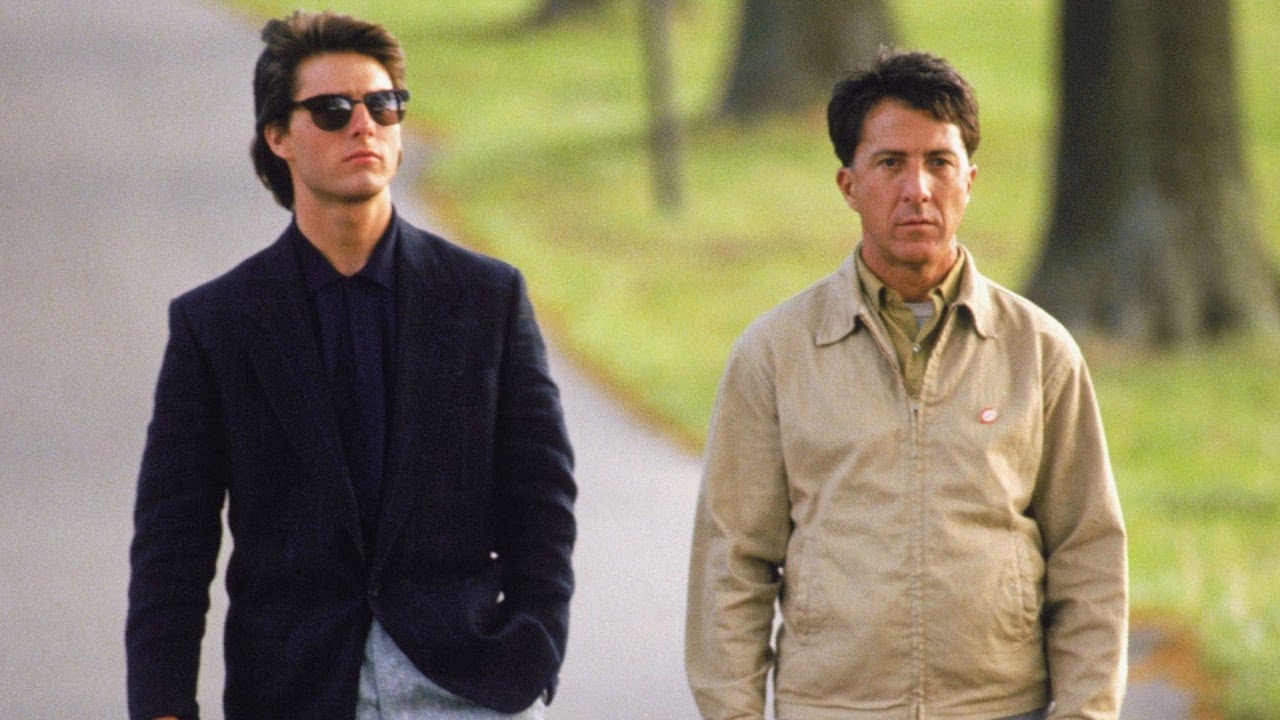
Tom Cruise and Dustin Hoffman go on a road journey of personal discovery in Rain Man

Director: Barry Levinson

Cast: Dustin Hoffman (Raymond Babbitt), Tom Cruise (Charlie Babbitt), Valeria Golino (Susanna). Jerry Molen (Dr Bruner), Ralph Seymour (Lenny), Michael D Roberts (Vern), Bonnie Hunt (Sally Dibbs)

Rain Man poster1988 wasn’t a vintage year at the Oscars, so perhaps that explains why this functional film ended up scooping several major awards (Picture, Director, Actor and Screenplay). Rain Man is by no means a bad film, just an average one that, for all its moments of subtlety and its avoidance of obvious answers, still wallows in clichés.
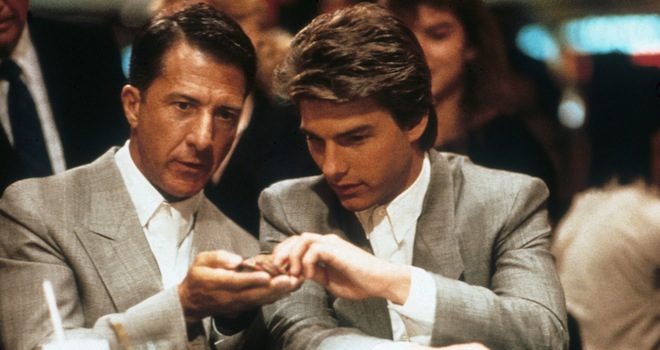
Charlie Babbitt (Tom Cruise) is a cocksure car dealer (he’s Cruise to the max) whose latest deal is spiralling down the toilet when he hears his father has died. Charlie had long since cut all links to his father, so he’s not surprised to be left only a car. But he is intrigued the money has been placed into a trust – and is shocked and furious to discover he has an autistic brother Raymond (Dustin Hoffman) he never knew about. After essentially kidnapping Raymond in order to claim his share of his father’s fortune, the two end up in a cross country road trip where Charlie slowly learns more about Raymond and their shared past and begins to soften in his view of his brother.

Rain Man is basically the sort of movie where two characters go on a road trip and have a personal journey of discovery, offering the sort of twists and character developments that are only really going to be surprising to someone who has never seen a movie before. But despite that, it does do something interesting, avoiding the standard Hollywood cliché of Raymond discovering depths or learning to overcome part of his condition: he is basically the same at the end of the film as at the beginning.

Instead all the change and journey is in Charlie Babbitt. The film carefully and unobtrusively develops Charlie over the course of the film so that he evolves away from the selfish, greedy yuppie we first encounter, who seems incapable of building emotional links with the people around him. Instead, as he learns to care (in every way) for another person, he also discovers reserves of love and a yearning for connection in himself that he never knew he had before. 

This all sparks off his interaction with Raymond – and his growing acceptance of Raymond for who he actually is, rather than who he wants him to be. This happens slowly – and Charlie can intermix tenderly teaching Raymond to dance with using him to count cards in Las Vegas – but you can plainly see the difference in his character from his reactions when he says hello to his girlfriend earlier (flirtatious but distant) with how he greets her when they reunite later in the film (warm, loving and open). It’s a gradual but very natural development shift that is the real heart of the film.

This works due to a terrific performance from Tom Cruise. Cruise has possibly never been better than he is here. His role is not about glamour or flash, but about carrying the narrative and emotion of the story. Cruise is sensational, quietly carving out a gradual and intelligent character development over a period of time that avoids all the flashy tricks and obvious “emotional” moments you expect. Cruise isn’t afraid to be unlikeable either at points in the story.

That’s what the real emotional connection with the viewer is in this story, and that’s the real arc that the film captures. However it’s Dustin Hoffman who attracted the real plaudits for his performance as the autistic Raymond. Interestingly Hoffman was initially tapped for the role of Charlie, but quickly worked out Raymond was the flashier part. 

Hoffman’s performance is a masterpiece of virtuoso transformation, and his capturing of the quirks and mannerisms of an autistic man are perfectly done. He convinces utterly. But, by the nature of the character, there is no real emotional or character work here. The performance is one that is largely a collection of extremely successful mannerisms. It’s rather like watching an expert juggler successfully juggle twenty things for over two hours. Hoffman doesn’t drop a single thing, but it’s a series of actor tricks rather than a complex acting performance of emotion and character. 

Rain Man did give an insight into autism for many in the 1980s for the first time. Its influence may perhaps have been too great – it’s now become almost standard for an autistic savant in movies to be a maths genius with amazing memory – but in the film, it’s carefully structured to serve as a starting point for Charlie to begin to see Raymond as a human being rather than an object. The film itself sets out a similar stall, encouraging the viewers to see those with autism as people with their own feelings – however much they struggle to understand or express these, as Raymond does. 

What it does very well is to subtly and sensitively explore Raymond’s situation. The medical professionals in the film are never demonised (as they so easily could have been) but are as concerned about Raymond as Charlie becomes. Raymond and Charlie discover they have a closer bond that both seem barely able to express – even Raymond seems to become, at least, used to Charlie’s presence enough to let him touch him. The film shows Raymond however can only progress so far – there is no miracle cure, and no out of character outburst of empathy. 

Rain Man works best when it focuses on subtlety – and has an outstanding performance from Tom Cruise – and it has a well filmed simplicity to it. But it is a slight tale, directed with a functional professionalism by Barry Levinson that never really manages to stand out from several other movies very similar to it. It has a certain warmth and emotionality to it, but deep down it’s nothing really that special – just a more subtle version of a story we have seen several times before.

Suite Française (2015)

Matthias Schoenaerts and Michelle Williams love across the divide in this disappointing French Occupation epic

Director: Saul Dibb

Cast: Michelle Williams (Lucile Angellier), Kristin Scott Thomas (Madame Angellier), Matthias Schoenaerts (Oberleutnant Bruno van Falk), Sam Riley (Benoit), Ruth Wilson (Madeleine), Margot Robbie (Celine), Lambert Wilson (Viscount de Montmort), Harriet Walter (Viscountess de Montmort), Clare Holman (Marthe), Alexandra Maria Lara (Leah), Tom Schilling (Oberleutnant Kurt Bonnet), Eric Godon (Monsieur Joseph), Deborah Findlay (Madame Joseph)

The story behind the writing of Suite Française is compelling. Living in Nazi-occupied France, Irène Némirovsky began work on a five-novel series, Suite Française, which she intended to depict life in her homeland under German rule. She had only written two of the five books when she was arrested by the Gestapo as a Jew, and tragically died in Auschwitz. The books were written in a small notebook and kept by Némirovsky’s daughter while she moved from hiding place to hiding place evading the Nazis. Sixty years later, donating her mother’s papers to an archive, she deciphered the notebook and discovered the novels. They were published as a single volume to great success in 2004, regarded as an accomplished piece of literary fiction and a remarkable work of contemporary witness. 

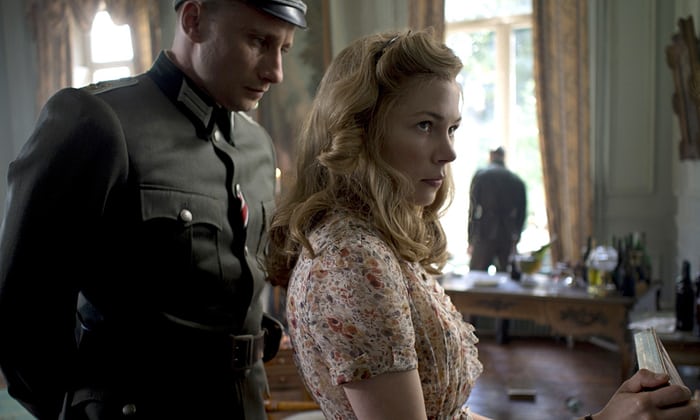
The short summary of the novel’s richness and complexity provided by this film can’t really compete. Based on the second of the two novels, the story takes place in a small French village in 1940. Following the arrival of the Germans, officers are billeted in people’s homes: Lucile Angellier (Michelle Williams) and her mother-in-law (Kristin Scott-Thomas) are assigned sensitive musician Bruno van Falk (Matthias Schoenaerts), while their neighbours, farmers Benoit and Madeleine (Sam Riley and Ruth Wilson), are forced to accommodate bullying officer Kurt Bonnet (Tom Schilling). As hostilities between the French residents and the German occupiers grow, so does the attraction between Lucile and Bruno, but Bonnet’s pursuit of Madeleine threatens to ignite the simmering tensions in the community.

Suite Française manages to turn its promising material into a conventional, chocolate box wartime romance – you can’t help but think that it does a great deal of disservice to the original novel. It’s filmed in an unremarkable style (there are at best 1-2 imaginatively done shots and sequences) and poorly paced. With its short runtime (barely more than an hour and a half), it constantly feels rushed. Quite simply it’s a story about simmering tensions in a confined environment – it needed more time for us to get a sense of the drama building, of the resentments between the Germans and the French growing. Because the film is so short we don’t get that at all.

Most notably, in a film about a romance between a French woman and a German officer, there is no sense at all of the risks that French women who started relationships with German officers were running. Besides a few small throw away lines, there is no sense of the physical danger and the social stigma that would be applied to these women. Instead, the tension of Lucile falling for Bruno seems to be based more on whether her mother-in-law will discover that she’s considering cheating on her (absent, unfaithful) husband. Even Celine the promiscuous farmgirl (a wasted Margot Robbie in a terrible wig) doesn’t seem to be running any risks of reprisals from the villagers when she’s banging a German officer in the woods.

This, however, is where the film’s rushing undermines it. If it had allowed us to develop a sense of the resentment, shame and loathing the occupied French felt for their German oppressors, a feeling of the whole town being willing to close doors on anyone they perceive as being too close to the  Germans, we could have felt a real danger for Lucile in flirting with a dalliance with Bruno. As well as giving the situation a bit of stakes, it would have made it a lot more emotionally engaging too. We could have witnessed her inner conflict at considering a romance with the enemy, and the emerging feelings between them would have had the conflict of a forbidden love. Instead the film rushes us as quickly as it can towards getting Bruno and Lucile into a passionate clinch, at times taking giant unsupported leaps forward in their relationship, so when it arrives it packs no punch.

This passionate clinch undermines the film. If it wasn’t going to take the time to really build the relationship through lingering glances and brief moments, convincingly charting the journey from hostility and suspicion to a forbidden attraction, it should have cut the relationship down to being something that tempts them both but which they cannot express. Have these two recognise a deep bond between them, a bond that in another time would have brought them together but cannot in the time of war. It’s a film where the only physical contact between them should feel like a window on what might have been – not a passionate locking of lips and sexy fondle or two. Think how much more affecting that might have been.

It would also have fit the structure of the film far better. As Lucile finally finds herself having to choose a side – deciding whether to help a renegade hunted by the Germans or not – her decision to sacrifice her chance of love with Bruno might have worked much better. Similarly, Bruno having to revert to the soldier taking responsibility for the growing persecution of the villagers would have been more affecting. (It further doesn’t help that the film doesn’t give time for Williams and Schoenaerts to build up an effective chemistry.) By chucking them into a clinch as soon as it can, the film undermines its message and also manages to make itself feel more like “Mills and Boon in Occupied France” than the serious tragedy it could have been.

When the film finally focuses on the battles between the French and Germans in its final third, it’s much more interesting than the slightly tired romance. Here we get tensions, stakes, drama – and finally a sense of the danger that being in this situation could have. After the rather soft focus romance that comes before, it really seizes the attention.

Williams does a decent job as Lucile, Scott Thomas could play her austere mother-in-law with hidden depths standing on her head (the film fumbles the unexpected alliance between these characters late on). Schoenaerts is a bit wasted in an underwritten role but does good work. The best performances largely come from the second tier: Lambert Wilson is excellent as the local Viscount who wants to try and work with the Germans but quickly finds himself out of his depth. Harriet Walter is similarly strong as his wife, as is Ruth Wilson.

But Suite Française could have been so much better than the movie that it actually becomes. A film that focused on the dangers of occupation and the tensions of a small community would have been great. A film that rushes through a Romeo and Juliet style romance, without building the sense of forbidden love, is a film that just doesn’t work.

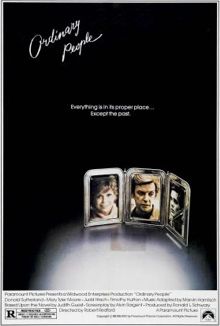
Ordinary People (1980)


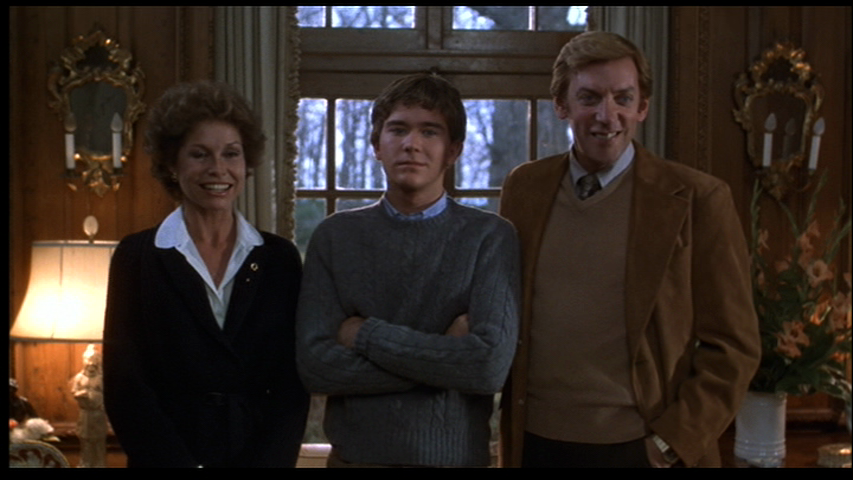
Mary Taylor Moore, Timothy Hutton and Donald Sutherland pose for an awkward picture in family troubles drama Ordinary People

Director: Robert Redford

Cast: Donald Sutherland (Calvin Jarrett), Mary Taylor Moore (Beth Jarrett), Timothy Hutton (Conrad Jarrett), Judd Hirsch (Dr Tyrone Berger), Elizabeth McGovern (Jeannine Pratt), M. Emmet Walsh (Coash Salan), Dinah Manoff (Karen Aldrich), Fredric Lehne (Joe Lazenby), James B Sikking (Roy Hanley)

In 1980, Robert Redford became the first big Hollywood stars to parlay acting success into producing and directing small scale, independent films that otherwise might never have been made. Ordinary People was the first of these – with Redford focusing on staying behind the camera – and it was a big success. It even won four Oscars – best picture, screenplay, supporting actor for Timothy Hutton (despite the fact Hutton is really the lead) and best director for Redford himself (beating out David Lynch for The Elephant Man and Martin Scorsese for Raging Bull). It was a great story for 1980 – the matinee idol turned artist. But is Ordinary People that great a film?

The film covers the emotional collapse of a wealthy middle-class American family after the eldest son Bucky is killed in a boating accident. Younger son Conrad (Timothy Hutton) has had trouble coming to terms with the accident, which he survived, and has only just left an institution after a suicide attempt. His father Calvin (Donald Sutherland) is desperate to try and relate to his son again, while his mother Beth (Mary Taylor Moore) remains emotionally distant attempting to put the accident behind them. Conrad starts seeing psychiatrist Dr Berger (Judd Hirsch), to adjust – but the after effects of Bucky’s death continue to tear the family apart.

Nobody really talks about Ordinary People any more do they? Out of all the 1980s Best Picture winners it’s perhaps the most easy to overlook (except maybe for Terms of Endearment). Why is this? Well truth be told it’s just a pretty ordinary picture. There really isn’t much to it. The story it tells of a wealthy family (only a millionaire like Redford could consider these loaded people ordinary) suffering emotional trauma and psychiatry finding the answer has been told so many times before, and since, that there isn’t anything particularly unique or interesting about it. 

In fact Ordinary People is exactly the sort of small-scale, quiet, middle-brow independent film that awards ceremonies slather over and a few years later (never mind over 30!) people struggle to see what the fuss was about. Redford directs the film with a quiet professionalism – the sort of competent craftsmanship and skill with actors that dozens of other directors could have done just as well. His Oscar for best director is especially galling when you consider the artistry and imagination of Scorsese’s direction of Raging Bull, or the unbearable sadness and tragedy Lynch gave The Elephant Man. It’s the sort of direction a non-famous director wouldn’t even have been nominated for.

This film uses shot-reverse-shot like it’s going out of fashion, most of the scenes are conversations across tables that are weighted down so heavily with meaning you start to lose interest in them. The score uses Pachelbel’s music in such an overwhelming style, it makes that sound as anodyne as much of the rest of the movie. Maybe it’s just because this is such well-trodden ground, but the revelations towards the end of the movie are so blindingly obvious you wonder why it takes so long to get to them (the son blames himself, the mother blames the son and doesn’t love him as much as the dead son, the father wants the two to kiss and make-up). 

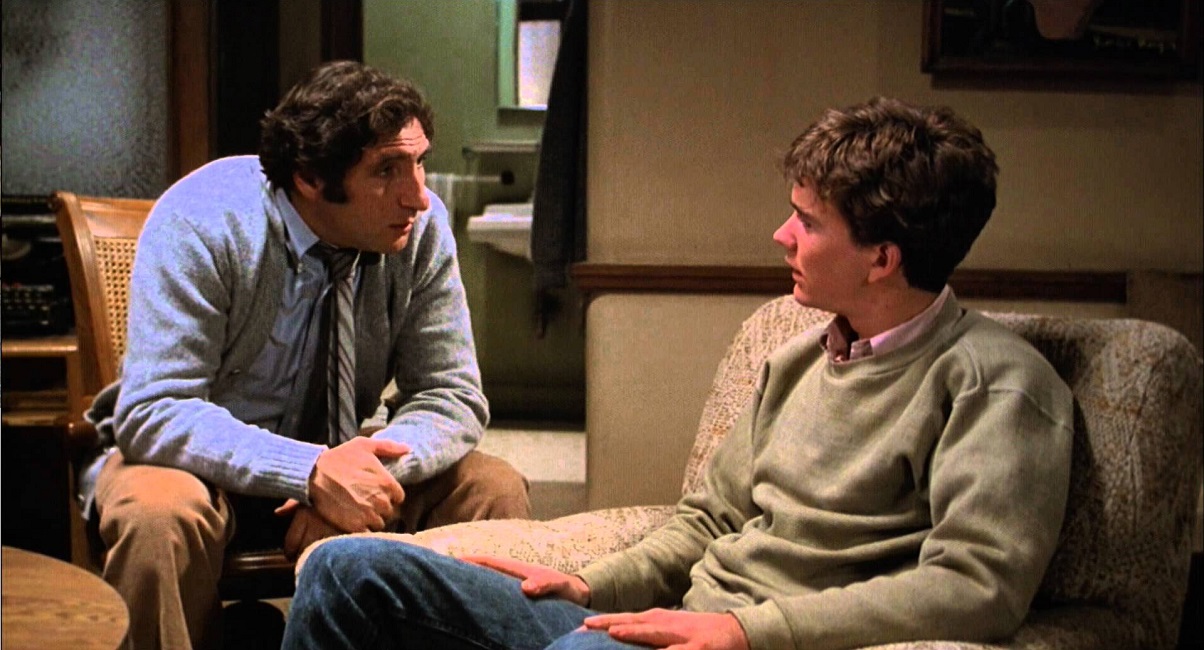
This rotates around a series of psychiatrist scenes which at least have the feeling of actual sessions, even if Judd Hirsch (good as he is here) basically plays the sort of revelation inspiring psychiatrist that only appears in movies. The film has a touching faith in the power of analysis being able to solve all problems, and spends so long luxuriating in scenes like this it virtually forgets to put actual living, breathing characters in the middle of them. With the possible exception of the father, none of these characters feel particularly real – they are just mouthpieces for the plot.

Not that it’s badly acted at all. Timothy Hutton made his film debut here and he brings a real fire and passion to the role, as well as a moving emotional vulnerability and anger directed only at himself. The supporting actor Oscar feels a bit of a cheat, as he’s clearly the lead, but he’s very good here as Conrad, struggling to express himself, bottling up his feelings and lashing out at those around him. It’s a part that feels drawn together from bits and pieces of plot requirement, but Hutton plays it to the hilt – it just doesn’t feel like a really real person, more a collection of sad traits.

Mary Taylor Moore is in a similar situation as a mother so cold and distant from her son, so repressed and controlling her distance starts damaging the entire family. She’s unable to process what has happened so almost wants to pretend nothing has (and blames her son for not doing that same), that it again feels like something from a psychiatric case-study rather than real person. Moore gained particular attention at the time as she was best known for comedy (much like Judd Hirsch, famous for the sitcom Taxi) – so the performance at the time might have looked stronger than it actually was.

The best performance might well come from Donald Sutherland in the least flashy role as the father trying to puzzle out what is going on – and trying to work out his own feelings. It’s the only character that feels less like a construct and more a genuine person, whose answers aren’t easily worked out by a bit of psychology study. Sutherland is low-key, tender, gentle and carries all his emotion on the inside – it’s a subtle and excellent performance, overlooked way too much. 

Redford essentially directed an actor’s film here (it’s all about the big moments of acting) so it’s not a surprise that it seized the attention of the Academy (largely made-up of actors) but really it’s not that far away from a well-made “movie of the week”,  with its obvious beats and not particularly surprising revelations. Perhaps it’s the point that the family’s problems seem a lot more apparent to the viewer than they do to the characters – and there is some interesting development of perceptions, not least from Sutherland’s father who starts to come to profound realisations about his wife and son. 

But Ordinary Peopleis an uninspiring and even rather tame drama, that today looks even more low-key and insubstantial. While it tries to break free from the confines of “social drama” it actually wants to tie everything up with a neat bow psychologically – and despite the fact it has an ending that suggests not everything is perfect, it really concludes with a safe full stop. There is a reason why it’s surely one of the best pictures which has been most forgotten about.