
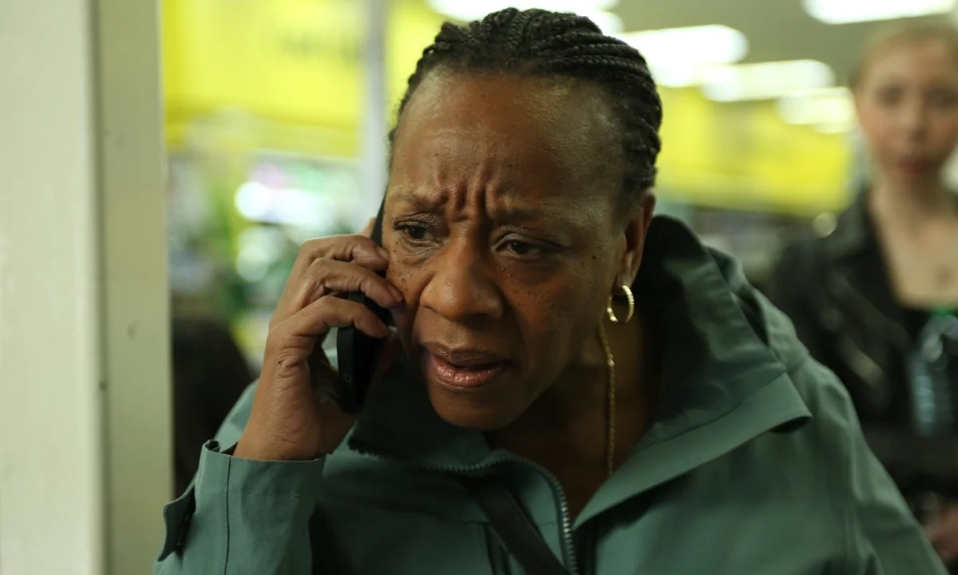
Leigh encourages us to take a deeper, more considered look at the people around us
Director: Mike Leigh
Cast: Marianne Jean-Baptiste (Pansy), Michele Austin (Chantelle), David Webber (Curtley), Tuwaine Barrett (Moses), Ani Nelson (Kayla), Sophia Brown (Aleisha), Jonathan Livingstone (Virgil)

Sometimes the world all gets too much for all of us. But it’s pretty much always too much for Pansy (Marianne Jean-Baptiste). A stay-at-home wife to plumber Curtley (David Webber), mother to shy, unambitious Moses (Tuwaine Barrett), pretty much everything enrages Pansy, who responds to virtually everything around her with unbridled rage and accusatory rants. She’s completely different to her sister Chantelle (Michele Austin), a motherly hairdresser with two ambitious daughters Kayla (Ani Nelson) and Aleisha (Sophia Brown) with whom she has a warm loving relationship. What made one sister easy-going and the other someone who could literally pick a fight in an empty room?
The sharpest part of Mike Leigh’s small-scale, but deeply engaging, family story is encouraging us to take a longer look at a person who, at first, is almost unbearable. To find in them vulnerabilities and fears that makes us understand and feel sorry for them. But, make no mistake, Pansy is a tough person to spend time with. Brought to life in an astonishing, visceral, deeply raw performance by Marianne Jean-Baptiste, most of the film’s opening half hour is spent establishing Pansy’s kneejerk aggression which she uses to deal with everything around her.
Jean-Baptiste launches into these furious rants with the sort of all-consuming energy that feels like you’ve been punched back in your seat, while her all-in commitment even raises a chuckle or two at the unadjusted fury of Pansy’s words. Every encounter ends in Pansy either letting rip or almost deliberately escalating everyday moments into confrontations. She tears a strip off a shop assistant in a furniture store, seemingly for no reason. She confronts a shopping till assistant and two other people in a supermarket queue. She begins a slanging match with another driver over a parking space. At dinner she barely gets a fork-full of food into her mouth, so intent is she on condemning the rest of the neighbourhood while her husband and son keep their heads down and silently eat the meal she prepared. Compared to Chantelle’s warm home life and bubbly, chatty interaction with her customers, our sympathies lie with those who have to deal with Pansy.
But the brilliant thing in here, and in Jean-Baptiste’s fragile desperation and terror just under the surface, is that Leigh’s film unpacks this to make clear it stems from an inability to deal with the world: a fear that has turned Pansy into someone who instinctively attacks first before when she feels threatened (which is all the time). Pansy clearly suffers from some sort of deep anxiety mixed with OCD. She’s terrified of germs, barely able to touch items she hasn’t personally cleaned. Her house is antiseptic, devoid of personal items. She seems totally at a loss with how to talk to people, interpreting every approach as an implicit threat and is deeply lonely under her aggression. This is the anger of someone who is scared literally all the time, who can’t deal with the pressures of the world and has retreated into a defensive cocoon to drive everyone away.
Jean-Baptiste’s performance grows, deepens and peels away layers of Pansy to become richer and richer as Leigh’s perfectly placed, deceptively slight film gently spreads itself out. Pansy is convinced the world is dangerous, certain that everyone hates her, only married her husband (who gives her no emotional support what-so-ever and silently expects meals when he gets home) because she was afraid of dying alone. She can’t sit in a room without cleaning it, can’t bring herself to put on dentist goggles someone else might have used and is nearly paralysed with fear at the thought of touching a bunch of shop wrapped flowers. To her the world is a continuing, never-ending, terrifying struggle and it has turned Pansy into a woman constantly desperate and scared. Worst of all, Pansy knows this isn’t ‘normal’, that things which incapacitate her with fear don’t even cause other people to bat an eye – and she doesn’t understand why she is like this. This emotion pours out of Jean-Baptiste in a riveting, hugely affecting second act, playing out like a deeply moving emotional breakdown.
The catalyst is the mother’s day commemoration she and Chantelle share for their mother, a woman Chantelle remembers with deep fondness and love: but whom Pansy remembers only as a woman who expected Pansy to sacrifice her own education and interests to look after Chantelle and bring money into the home. Pansy references a childhood love of mathematics that was never encouraged – the sort of natural skill you can imagine someone somewhere on a spectrum like Pansy is would have had a real passion for – which for her summarises how opportunities were never meant for.
Our sympathies slowly, but noticeably shift. Pansy can’t do what the rest of do, put aside or forget the things that upset us. Hard Truths suggests sometimes we do that too easily: Chantelle’s daughters experience tough, unpleasant days at work but come together for drinks to say how great their careers are. Others deal with painful encounters – like the bullying Moses endures – by retreating into silence. Pansy though is aware she cannot deal with situations, cannot understand herself or why she is the way that she is – and, it’s clear, doesn’t like herself either. More and more we agree with Chantelle, who can’t understand why she married the unsupportive, monosyllabic Curtley (who treats his eager apprentice with dismissive disinterest and barely acknowledges Chantelle’s family showing its not fear of Pansy that keeps him sullen and silent at home).
It’s a masterful part of this wonderful, small-scale but deeply heart felt film from Leigh. Jean-Baptiste’s performance is one of the ages, but Michele Austin gives a highly emotive performance with a charm that hides an inner steel. It’s a beautifully assembled, wonderfully acted, highly intelligent film from an accomplished director who encourages the viewers to look as closely at characters – their complexities and virtues as well as their flaws – with the same patience and regard as he has spent his career doing.










 Movie Musings