Category: Fantasy film

Thor: Ragnarok (2017)


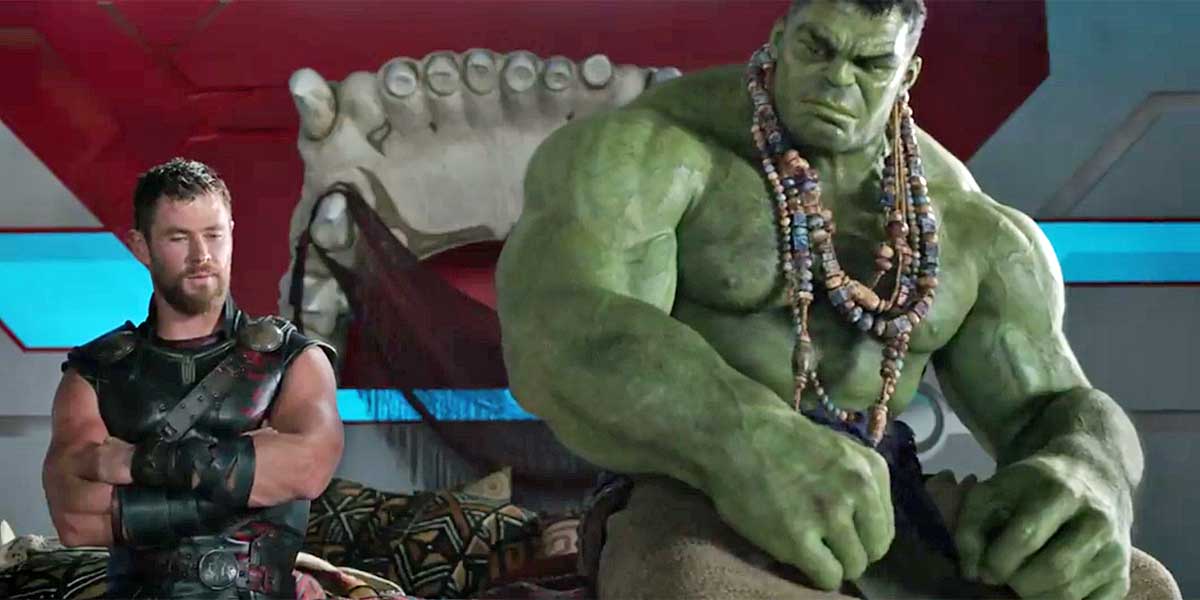
Thor and Hulk: It’s the buddy movie you’ve been waiting for

Director: Taika Waititi

Cast: Chris Hemsworth (Thor), Tom Hiddleston (Loki), Cate Blanchett (Hela), Idris Elba (Heimdall), Jeff Goldblum (Grandmaster), Tessa Thompson (Valkyrie), Karl Urban (Skurge), Mark Ruffalo (Bruce Banner/Hulk), Anthony Hopkins (Odin), Benedict Cumberbatch (Doctor Strange), Rachel House (Topaz), Taika Waititi (Korg)

The Marvel franchise is now on to 17 films. That’s 17 films all in the same universe, with at least three more to come in the next year or so. The weight of franchise backstory has started to feel overbearing, with so many other films to tie into and characters to set up that the individual film itself is left with barely any identity or purpose. How refreshing then to have a film that cuts loose and takes a slightly different tone: a genuine action comedy. Thor: Ragnarok is so tonally different from the other Thor films (let alone the other films in the series) it actually manages to feel like its own beast – it’s as close to a director-led vision as the franchise has got.

Thor (Chris Hemsworth) has been all over the universe, working to stop Ragnarok (the prophesised end of Asgard). Returning to Asgard, he unmasks his troublesome step-brother Loki (Tom Hiddleston) who has been disguised as Odin (Anthony Hopkins). Travelling to Earth to rescue their dying father, they arrive in time to see his death. Unfortunately, this releases their elder sister Hela, Goddess of Death (Cate Blanchett). While Hela ruthlessly conquers Asgard, Thor is trapped on the planet Sakaar and forced to enter a deadly gladiatorial contest – against his Avenger ally the Hulk (Mark Ruffalo) – all while trying to escape back to Asgard to stop Hela.

Thor: Ragnarok has a plot that ambles at points rather than sprints. But this hardly matters, as its main focus is on entertaining the audience. Waititi creates a sort of punk 1980s wildness, mixed with a fun-loving wit. The result is a film with action, and high stakes – but never takes itself too seriously. It perfectly understands how to puncture grandeur or pomposity of the Asgardian gods with a neat one-liner or a bit of everyday conversational inanity (a lot of the latter comes from Waititi himself, hilariously playing chilled out rock gladiator Korg).

Waititi also allows Hemsworth to let rip with his comic timing rip in a way he’s scarcely been allowed to do since Branagh’s original. It drops the faux-Shakespearean seriousness of Thor: The Dark World, and Hemsworth repositions the character in a more relaxed and charming style. From his opening introduction, undercutting the monologing of a fire demon with a dry series of puns while dangling from a ceiling in chains, he finds a neat balance between seriousness and charisma. Waititi is also (like Branagh) not afraid to let Asgard’s mightiest warrior be the butt of a few sight gags – one laugh out loud moment involving a very strong window is a stand out. Hemsworth demonstrates here he’s a far more accomplished comedian (physically and verbally) than he gets credit for.

This more relaxed Thor is perfect for the rock-and-roll feel of the film. Expertly scored (there is particularly fine use of Led Zeppelin’s Immigrant Song) it has a groovy, 1980s feel. The planet Sakaar is a primary-coloured, odd-alien filled, campy explosion of energy and vibrant punky fun. Said planet is run by the Grandmaster, played by Jeff Goldblum at his most Jeff Goldblumiest ever – if you can picture that you’ve got the tone of the whole planet. This neon lit style is reminiscent of everything from Flash Gordon to The Last Starfighter

The film’s loose comic style also allows a series of fun match-ups, from Thor and Loki (a wonderfully weaselly, fun Tom Hiddleston – still one of the best things in this whole franchise), to Thor and Strange (a lovely cameo from Cumberbatch), Thor and Valkyrie (a neat mixture of drunken self-loathing and female Thor-ness from Tessa Thompson) and lastly Thor and Hulk. The latter provides a lot of the film’s comic gold, the Hulk finally turned into some sort of character with achildish vulnerability and swagger (though the film still finds time for a Hulk penis gag). Waititi also throws in some nice call-backs to previous films – the bunch here set themselves up as the Revengers, while there are multiple references to the mantra used to calm the Hulk in Avengers: Age of Ultron – without making it feel in-jokey. 

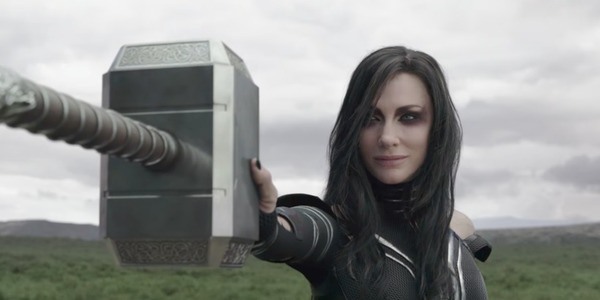
There is so much fun in the film, you almost forget the main plot of the film is fairly heavy-going, end-of-the-world stuff. For a Marvel film there is a large body count of recurring characters (at least four bite the bullet here), while Hela’s plot encompasses mass slaughter and destruction. Scenes with Hela are kept short (structurally the film effectively strands her on Asgard to contain her invincibility), so it’s just as well the part is played with such charismatic dryness and imperious arrogance by Cate Blanchett (easily the best Marvel villain since Loki). She’s ably backed up by Karl Urban, adding a lot of complexity to reluctant cowardly turncoat Skurge. Waititi shoots Hela’s rampage of destruction with an exciting dynamism – it’s an action scene that feels different, no mean feat in a franchise that has had so many fights.

In fact most of the action feels very fresh, the fights never out-stay their welcome, and there are some brilliant visual flourishes – the final battle in particular throws in some almost painterly images as Thor and his allies take on Hela’s zombie army. The arena fight between Hulk and Thor is about a million times more interesting than the dull Hulkbuster battle between Iron Man and Hulk in the past Avengers film as Watiti keeps the focus on character rather than pummelling. The film also manages to keep the stakes high – there are always innocent people our heroes fight to protect.

Thor: Ragnarok might well be the most entertaining, fun film Marvel has produced. It’s almost certainly the best Thor film. While The Dark World failed dismally to build on the mixture of earnestness and comedy in Branagh’s original, this one feels like a natural progression of the first, amping everything up into a vibrant, 1980s styled cocktail of action and fun. It’s terrifically entertaining, well paced, anchored in characters we care about, and it just wants to entertain the viewer. You’d have to be pretty cold for it not to succeed.

Stardust (2007)

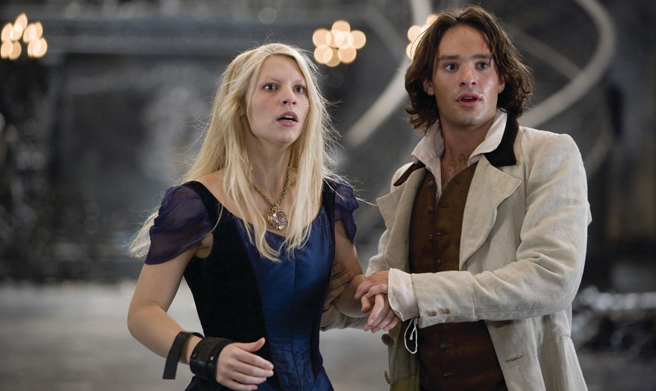
Claire Danes plays a star and Charlie Cox a village boy in charming adventure fairy-tale Stardust

Director: Matthew Vaughn

Cast: Claire Danes (Yvaine), Charlie Cox (Tristan), Michelle Pfeiffer (Lamia), Mark Strong (Prince Septimus), Robert De Niro (Captain Shakespeare), Sienna Miller (Victoria Forester), Jason Flemyng (Prince Primus), Rupert Everett (Prince Secundus), Kate Magowan (Una), Ricky Gervais (Ferdy), Peter O’Toole (King of Stormhold), Joanna Scanlan (Mormo), Sarah Alexander (Empusa), Nathaniel Parker (Dunstan Thorn), Henry Cavill (Humphrey), Dexter Fletcher (Skinny Pirate), Ian McKellen (Narrator)

Stardust is loosely adapted from Neil Gaiman’s novel of the same name, an adult fairy tale refashioned into a crowd pleasing family film: a warm and genuine adventure story, stuffed with romance, excitement and drama.

Tristan (Charlie Cox) is a dreamy young man in the village of Wall, which neighbours the mystical and forbidden world of Stormhold. In love with the selfish Victoria (Sienna Miller), Tristan vows to travel to Stormhold and bring her back a fallen star. However, the star has landed in the form of a beautiful young woman, Yvaine (Claire Danes), and the two of them find themselves on a difficult journey to return to Wall. Along the way they must dodge the witch Lamia (Michelle Pfeiffer) who wishes to sacrifice Yvaine to regain her beauty, and the surviving sons of the late king of Stormhold, particularly the ruthless Septimus (Mark Strong), who need Yvaine’s necklace to claim the throne.

What works about Stardust is that it has an air of whimsy about it, without ever feeling whimsical or corny. It’s a grown-up fairy tale, in the sense that it has some black humour and acknowledgement of sex, but really it’s more of a charming adventure story in a fantasy setting, which manages to keep its tongue in its cheek and not take itself too seriously. Matthew Vaughn’s direction has a very light touch and never allows this soufflé of a film to either puff itself up too much, or to deflate. Instead it rolls along with a giddy charm, with a delightful odd-couple love story at the centre. It’s a film that totally gets its tone spot-on, helped by confident direction and a wonderful score.

Charlie Cox plays romantic lead Tristan with a great deal of charm and really captures the romance at his centre. He also manages that extremely difficult task of being likeable – you can’t help but warm to him despite the fact that his self-awareness is completely off for a large chunk of the film. Claire Danes is equally good as the prickly Yvaine, hiding a great capacity for emotion and longing under a defensive exterior. Their romance is of course highly traditional – they bicker because they love each other! – but both actors carry it off with a great deal of style. You can’t help but want them to get over their problems and get together.

The romantic plotline is also never overwhelmed by the faintly Pythonesque comedy that surrounds it, particularly from the ghostly chorus of deceased Princes of Stormhold. Vaughn produces a great cast of comic actors for this group, while entrusting Mark Strong with the lion’s share of the screentime as the dashing decoy antagonist. In fact, the construction of the film’s narrative is rather neatly done, as this plotline of the inheritance of Stormhold is largely kept separate narratively from the romantic Tristan/Yvaine storyline, with the intersections only occurring at key points.

The real antagonist of the film however is Michelle Pfeiffer’s witch Lamia, Pfeiffer offering a neat portrait of vanity intermixed with cruelty. It’s a very decent inversion of a “movie star” glamour performance, and Pfeiffer’s heartless ruthlessness is a very nice contrast with Tristan’s altruistic openness. In fact Pfeiffer is very good in this film: she gets the balance so right that Lamia constantly keeps you on your toes as to how villainous or not she may be. I’m not quite sure that the film quite manages to completely bring the two characters plot lines together to provide a really effective narrative drive to the film, but she certainly works as an effective antagonist.

The film’s structure is a combination shaggy dog story and classic quest structure, which allows each sequence to take on its tone and structure, from thriller to comedy, depending on the characters involved. What threads this together is the growing (and very sweetly structured) love story between Tristan and Yvain which keeps the momentum up as the film moves from location to location, with cameo roles sprinkled throughout, without the film losing momentum (though it is probably 15 minutes too long). The film’s comfort with letting it sequences expand is clear with Robert De Niro’s Captain Shakespeare, a feared cloud pirate whose secret desires are not so secret as he might think. The film delights in essentially extended jokes like this – but it gets away with it because these jokes manage to be quite funny (De Niro in particular turns in a very good comic performance).

It’s a film that manages to remain distinctive and original, while appealing to a wide audience, which is quite some trick to pull off. It also manages to do this without losing its distinctive rhythm, which is both endearing and enjoyable. The “rules” of its world are clearly established, and while many of the actors are slightly tongue in cheek, they never laugh at their characters but only gently tip the wink at the audience. This freedom largely comes from the conviction and honesty Danes and Cox endow the central characters with, to ground the film. It alsohas a great sense of emotional intelligence to it, and brings a lot of depth to the characters. It also helps that it’s brilliantly designed, looks ravishing and is full of several delightful performances.

There’s lots of terrific stuff in this film, with a very sweet story at its centre. In fact this sweetness is probably the secret of its success: it never takes itself very seriously, it dances lightly from scene to scene and never allows itself to become too overblown. It’s got a terrific cast and is well directed, with a snappy bounce. At moments it does feel a little long, and some sequences overstay their welcome a bit too much – but the central characters are so winningly played that you don’t really mind. Sure this is not a masterpiece, but it has a sort of magic about it, the charm, excitement, adventure and romance, all mixed together with such confidence that it’s a pleasure to watch.

Beauty and the Beast (1991)


The original and the best: Disney’s animated classic Beauty and the Beast

Directors: Gary Trousdale, Kirk Wise

Cast: Paige O’Hara (Belle), Robby Benson (The Beast), Richard White (Gaston), Jerry Orbach (Lumière), David Ogden Stiers (Cogsworth), Angela Lansbury (Mrs Potts), Bradley Pierce (Chip), Rex Everhart (Maurice), Jesse Conti (Le Fou)

After decades of average or forgettable films, in the early 90s Disney had a sudden renaissance. From 1989 to 1998, the studio was a veritable hit factory, with films from The Little Mermaid to Mulan, via classics like The Lion King and new ideas like Hercules all being lapped up by audiences. Perhaps the most widely loved (and maybe even the best!) of this era was Beauty and the Beast.

Like all the best Disney films, the story is traditional with a modern twist. Belle (wonderfully voiced by Paige O’Hara) is a young woman in a small provincial town who wants so much more than spending her time dodging the unwanted attentions of handsome local hero Gaston. When her eccentric father Maurice is imprisoned in a mystical castle by a terrifying Beast (Robby Benson, who combines sensitivity and ferocity), she agrees to take his place, while the Beast (and his enchanted servants) all hope she might break the spell placed on them by falling in love with him.

This was the first animated film to ever be nominated for Best Picture, back in the days of only five nominees and it was hard to sneak onto the list if you weren’t a heavy-going “important” piece of film-making. If that’s not a testament to its greatness, I’m not sure what is. It’s one of the best mixes of Disney magic: charming, delightful, sweet, funny and exciting. It has a heroine who feels real, independent and relatable and a hero you empathise with, even while he behaves badly. It’s got a villain who first seems an arrogant blow-hard before his real brutishness is revealed. All this in a very romantic, engrossing storyline, with a host of supporting characters it’s impossible not to like.

So why does this work so well? It’s sweepingly, lusciously drawn and it drips romance and humanity. Everything stems from those central characters, and the amount of empathy we feel for them. Like all great films, this knows without characters we invest in, nothing else works – no matter how many great numbers and funny lines there are (and there are plenty of both!).

Belle could have easily been either a flighty romantic or an aloof autodidact, but the film crafts her into a grounded romantic, dreaming of more but knuckling down and dealing with the hand life has dealt her. Facing a life of captivity she resolves to do what she can to make her life bearable. She’s determined and independent and exhibits genuine intellectual curiosity alongside her empathy. She feels real, and you invest in her reactions to things because those reactions feel normal.

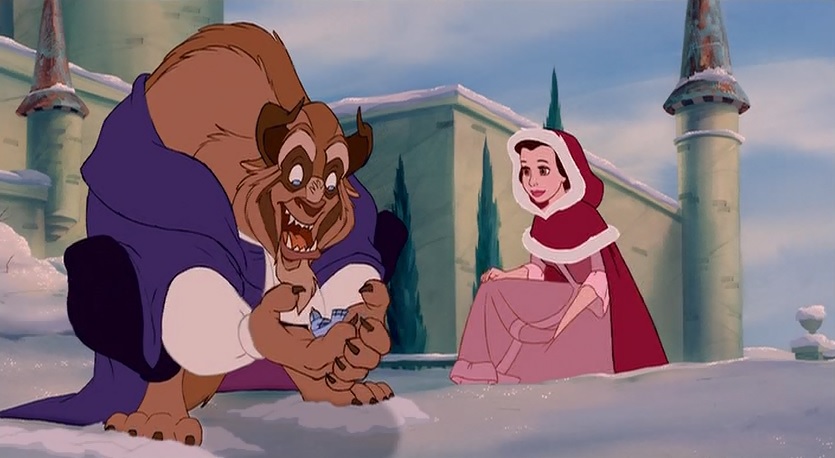
An even bigger challenge is the Beast, but it’s triumphant in the handling of this tricky character. He is ferocious, but the film quickly and efficiently makes clear his anger is based in pain and vulnerability, and intense isolation. Careful shots establish his self-loathing – his slashing of a painting of his pre-transformation face couldn’t be much clearer. Even at his most furious, we gets quiet moments of vulnerability. The animation of the Beast is perfect – his face is fierce, but his eyes are wonderfully expressive. His facial features at key moments relax and fold in to show someone far more gentle. He’s like everyone on a first date, scared to express his deeper feelings. The animators marvellously capture both his power and surprising delicacy. His boyish enthusiasm is infectious – his excitement in gifting Belle the library is heartwarming. In fact he’s so endearing and engaging a character, I think everyone feels a twinge of disappointment when he is replaced by a human being in the final scenes!

Revolving around these two is a wonderful cast of engaging characters. The primary servants in the plot – Lumière, Cogsworth and Mrs Potts – are all strong, unique and three-dimensional characters with more than enough depth to eschew their basic character traits (Cogsworth’s name even rhymes with jobsworth, Lumière is a charming rogue and Mrs Potts a motherly matron) to become characters we end up caring deeply for, that feel real.

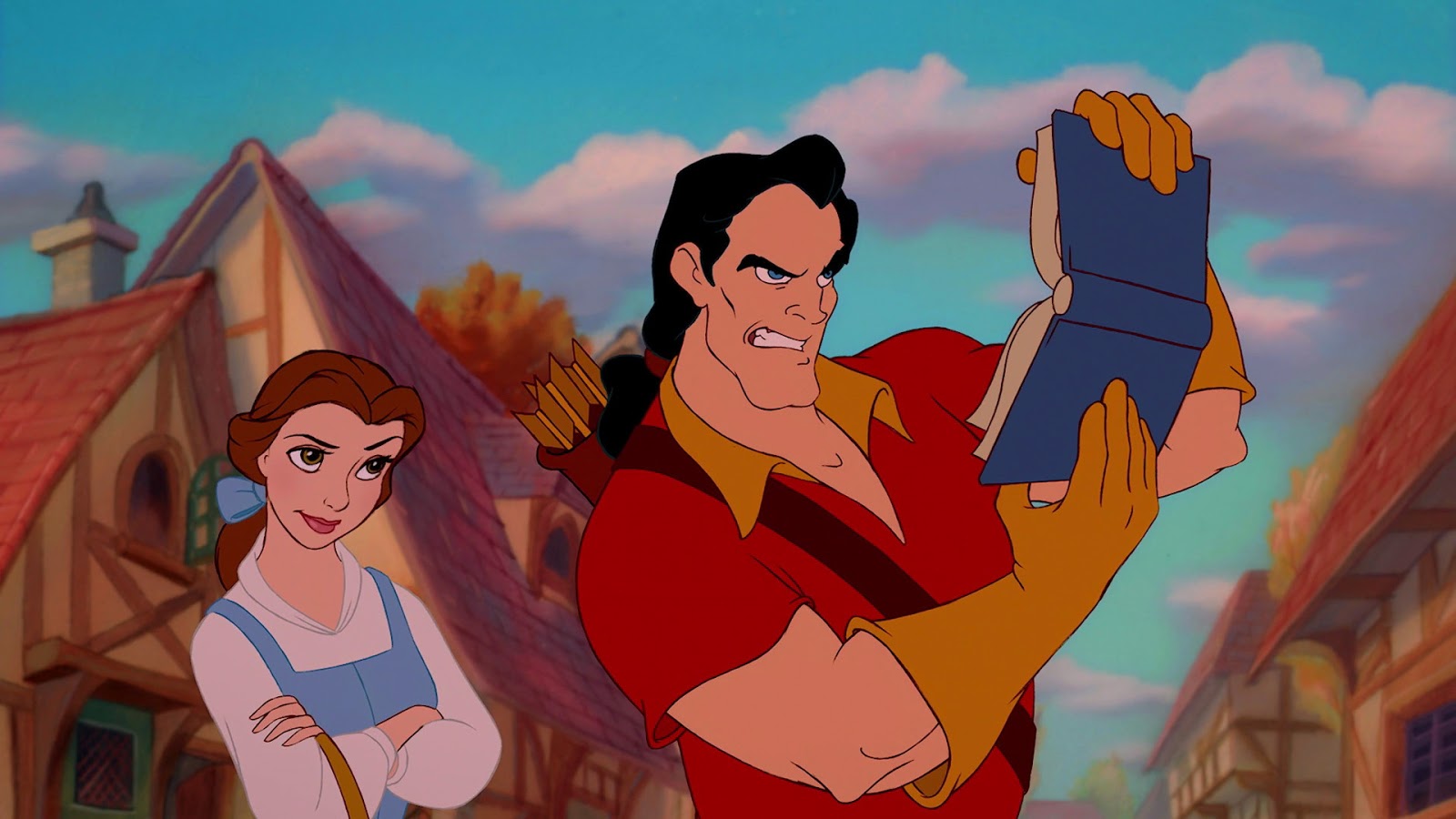
The film also borrows from Jean Cocteau’s La Belle et la Bete to create the character of Gaston, possibly one of the most interesting villains in Disney. Drawn with a certain conventional handsomeness (although he looks smug enough for you know he’s a wrong ‘un from the start), Gaston is a character who questions many of the assumptions made linking popularity and handsomeness with goodness. He’s also a character who grows measurably darker through the film due to his own choices, rather than being inherently villainous from the start.

It’s all part of the richness of the world the film creates – everything feels natural and all the characters real and understandable. Maybe that’s partly why it works so well – it’s a film that is animated, rather than a cartoon. With a tight plot, good pacing and a clear focus, it’s focus is on emotion and characterisation, and it avoids cheap laughs, with comedy growing organically. Because the characters themselves are so compelling, the events carry huge dramatic force – when Belle is threatened by wolves, we genuinely fear for her; when the heartbroken Beast can barely rouse himself to fight Gaston we are overwhelmed with pity and concern.

Warmth and humanity in the drawing of the characters, makes their stories so affecting

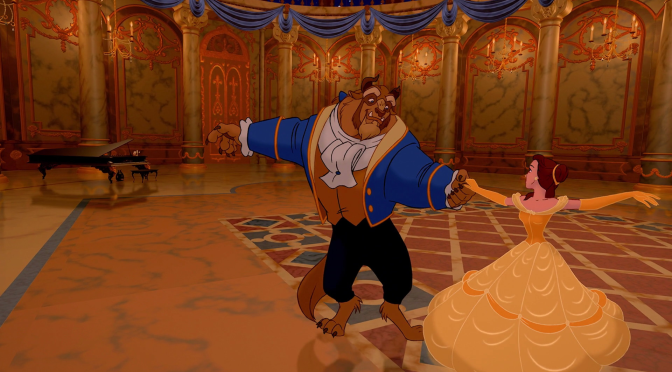
Of course it is also a cartoon, and much of the triumph of it is based in the animators’ successes. The imagery is gorgeous, the detail in each frame is wonderful, the design of the castle is fantastic (we’ve already talked about the influences of Cocteau’s film, but it’s clear again here). The famous ballroom scene is wonderful – the “camera work” marvellous, the creation of the ballroom awe inspiring (genuinely we all thought it was real at the time!). Time and again the filmmakers use inspired framing and composition that conveys the emotion. The performances they draw from their characters is exceptional – the expressiveness given to all of the characters, from Belle and the Beast to the faceless tankards in the castle, is brilliant. You can freeze-frame any single scene from the movie and be able to instantly identify how every character feels.

The famous ballroom, a sweeping series of camera shots and a landmark in computer illustration

This is the true Disney magic: this world is real, because everyone in it feels so alive. It captures your heart, from its marvellous stained-glass opening telling the backstory, to the triumphant swelling score that meets the ending. I’ve barely mentioned the songs, but each one is brilliant, an instantly recognisable, pleasurable earworm – in fact, this film may have the best songs of any Disney film in the canon. Beauty and the Beast is so good that, never mind being nominated for best picture, it arguably would have won in many years (it lost to The Silence of the Lambs: it’s hard to imagine a film more tonally different!). Endlessly enchanting, charming, warm, funny, moving and exciting, this is a masterpiece and a landmark in Disney animation.

Time Bandits (1981)


Time travelling roguery in Time Bandits 

Director: Terry Gilliam

Cast: Craig Warnock (Kevin), David Rappaport (Randall), Kenny Baker (Fidgit), Malcolm Dixon (Strutter), Mike Edmonds (Og), Jack Purvis (Wally), Tiny Ross (Vermin), John Cleese (Robin Hood), Sean Connery (Agamemnon), Shelley Duvall (Pansy), Katherine Helmond (Mrs Ogre), Ian Holm (Napoleon), Michael Palin (Vincent), Ralph Richardson (Supreme Being), Peter Vaughan (Winston), David Warner (Evil), Jim Broadbent (Compere)

After leaving Monty Python, each Python went their own way. Terry Gilliam had been the slightly odd one, the eccentric animator who played the weirdos at the edge of the frame. Time Bandits would be pivotal in repositioning him as an ambitious, visionary director with a striking visual sense. It would also allow him (and co-writer Michael Palin) to create a fairytale fable with something for all ages, a film about a child’s view of the world which adults could embrace.

Kevin (Craig Warnock) is a dreamer, a young kid adrift in his parent’s materialistic world. Until one night a gang of dwarves calling themselves “Time Bandits” emerge out of his bedroom cupboard. They have a map that allows them to travel through time and use it to commit crimes and then escape to different centuries. Kevin joins them in their adventures, but none of them know they have attracted the attention of the Evil Genius (David Warner) who wants to use the map to escape his prison and recreate the world in his own image.

I still remember watching this film when I was younger and really enjoying (I must have watched it dozens of times). I have to say it holds up extremely well. Sure Craig Warnock isn’t the most inspired child actor of all time, but he has a wide eyed innocence and enthusiasm that anchors the film really well. Gilliam’s direction is brilliantly good – wild and inventive, like a punk-rock fairytale. The dwarfs make an inspired grouping, each embracing the once-in-a-lifetime chance of playing leading roles.

The main reason for the film’s success is Gilliam. His work is extraordinarily detailed and imaginative, while his visual sense makes shots that cost hundreds of pounds look like millions. Huge swathes of the film are shot with a low-angle lens that allows us to see everything from the perspective of our heroes, and also makes each of these larger-than-life events seem even more awe-inspiring. The design of the film is extraordinary, with striking images confronting you at every turn, either a recreation of events or the bizarre visuals of the “time of wonder”.

And those visuals are outstanding. Can you think of any other film where a knight on horseback bursts out of a bedroom cupboard, charges around the room in medium shot, and then gallops off through a field that has suddenly replaced the bedroom wall? How about an ogre who lives on a ship that is then revealed to be a hat for a giant who lives underwater? Evil’s Fortress is a swaggeringly brilliant triumph of production design, while his goat skulled, tall, hooded monsters must surely have been playing in JK Rowling’s mind when she came up with the Dementors.

The design also echoes the possibility that this is all a child’s fantasy. A careful look at Kevin’s bedroom shows pictures of everything we encounter. The final confrontation with Evil takes place on a set clearly inspired by the Lego bricks, chess board and toys that litter Kevin’s bedroom. 

The playful tone is also reflected in its lampooning of the “adult” world of technology for its dull materialism: Kevin’s parents watch a bullying gameshow (compered by a demonic Jim Broadbent) while sitting on armchairs still in their plastic wrapping. Evil’s obsessions all revolve around lasers and the microchip.

Away from all this, the film has a simple structure. It’s basically a series of really rather fun historical sketches, linked together by an engaging fantasy narrative. These scenes attracted guest star performers, all of whom excel (though it is odd to see them get top billing – Cleese is on screen for about three minutes, but gets top-billing!). 

The guest stars are terrific – Holm is hilarious as a chippy, height-obsessed Napoleon; Cleese very funny as a visiting-Royal-inspired Robin Hood, treating all around him with condescension; Ralph Richardson brings an absent-minded imperiousness and dry wit to his role as God; Connery sprinkles a touch of movie-star bravado as a kindly, gentle Agamemnon (the uncommented on joke being the movie’s ideal father figure is most famous for sacrificing his daughter…). 

If any performer high-jacks the film it’s David Warner as a dry-witted, viciously ego-maniacal Evil Being, getting most of the best lines. A sequence where he obliterates several underlings for minor transgressions hums with dark humour (and punchlines with the accidental obliteration of another minion off screen, met with a sheepish “Sorry”). On top of that, Warner brings just the right level of sinister child’s-nightmareish quality to the role, helped by a striking costume design that makes him look the love-child of a crocodile and a car engine.

The leads of the film (Kevin and the bandits) are extremely well drawn by Palin’s script, each of them with sharply distinctive personalities. David Rappaport (allegedly incredibly unpopular with the others due to his haughty disregard for them) is perfect as the arrogant self-appointed leader, but Jack Purvis is a stand-out as the warmly brave Wally. More than a few commentators have pointed out that the Bandits all serve as representatives of the members of the Monty Python troop, which adds another level of fun watching the film.

Time Bandits is electric good fun. I have no doubt I might find more to criticise without the memory of enjoying it so much when I was younger. Some of the sketches work less well than others – the scene with the ogre doesn’t quite work, and the ending, twistedly funny as it is, does feel slightly abrupt is. But the film never outstays its welcome, and it’s put together with such glee and accomplishment that there is always a line or an image that sticks with you. It’s a dark fairytale for children of all ages – and making something the whole family can enjoy is really quite a feat. Palin and Gilliam would have put together a sensational series of Doctor Who.

Rogue One: A Star Wars Story (2016)


The characters of Rogue One. I struggle to remember their Dingly-Dang sci-fi names.

Director: Gareth Edwards (Tony Gilroy)

Cast: Felicity Jones (Jyn Erso), Diego Luna (Cassian Andor), Ben Mendelsohn (Director Krennic), Donnie Yen (Chirrut Imwe), Mads Mikkelsen (Galen Erso), Alan Tudyk (K-2SO), Riz Ahmed (Bohdi Rook), Jiang Wen (Baze Malbus), Forest Whitaker (Saw Gerrera), Genevieve O’Reilly (Mon Mothma), Jimmy Smits (Bail Organa), Guy Henry (Grand Moff Tarkin), Alistair Petrie (General Draven)

When Disney got hold of the complete rights for Star Wars, they were motivated by one thing above all: making a shitload of cash. In that goal, they’ve been very, very successful. Rogue One fills out (pads out) the story of how the Rebels got hold of the Death Star plans, something the original film (correctly?) reckoned could be covered in a few lines of dialogue. Anyway, for complex, muddily explained reasons, the rebels needs Jyn Erso (Felicity Jones), daughter of chief designer on the Death Star Galen (Mads Mikkelsen), to rescue a pilot from a rogue general to get a message from her father. Or something. Anyway, things eventually lead to a major space battle as our heroes try to steal the plans from a giant computer database.

Rogue One is hugely popular. You’ll go a long way before you meet someone willing to say a bad word about it. It’s been hailed as a far superior dip into the franchise ocean than JJ Abrams’ The Force Awakens. This is inexplicable to me. I genuinely can’t understand it. As far as I can tell, Rogue One is little more than a fair to middling action film, hugely reliant on ramming in as many references and easter eggs from previous films as it can, rather than actually doing anything new or unique with the franchise. 

For me it’s a sprawling, rather dull film with no depth or patience. The first hour is genuinely quite boring, with each over-designed location blending into the next. The whole film seems designed to require as little attention as possible: short scenes, planet to planet, each having little real impact on the next emotionally. The battles are designed and shot like things intended to be cut up into YouTube clips. No-one talks during the fights, we rarely learn anything about characters during the prolonged action – instead it’s a series of moments, straining at the leash to be cool, with personal sacrifices determined by plot requirements rather than by natural character growth. 

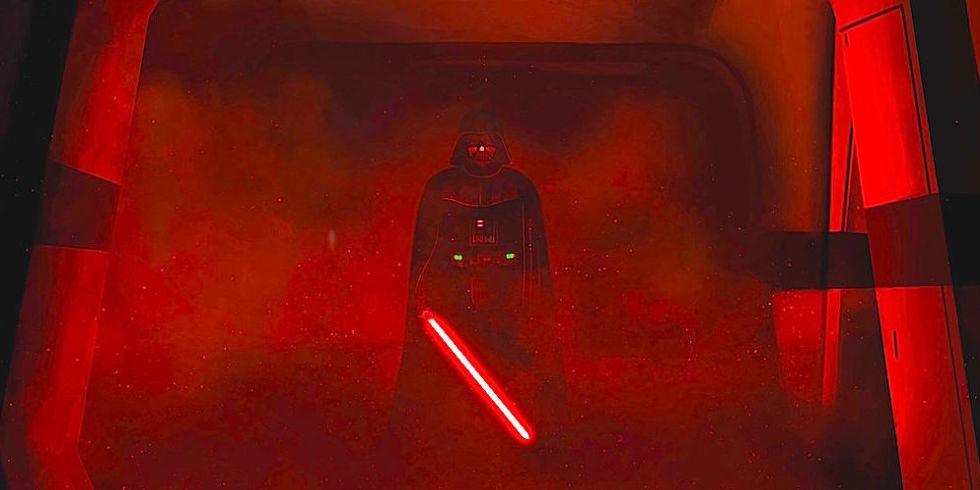
Watching parts of it you can enjoy the moments: a blind man taking out Stormtroopers, or Darth Vader cutting down rebels. But there is little to tie these moments together. Plot and characterisation are treated in the same chunked way – events grind to a halt so Mads Mikkelson can tell us what happens next, or Cassian can bluntly talk about how being a rebel is tough on the nerves. In the original Star Wars, plot, character and action were woven together so we learned about all three together. Here they are silos, with action the focus. It feels like a film made for YouTube, more interested in pop culture references with only the flimsiest story propping it up, designed to be spliced up online.

Darth Vader lets rip in a section that seems designed as a YouTube moment of the future

Now the lead character, Jyn Erso. I don’t understand this character. Who is she? What is it she actually wants? For the first hour or so of the film she makes no decisions at all, but does what a series of older male characters tell her to do. There is nothing in the film that allows us to get to know her. Her actions aren’t dictated by character, or even logic, she simply shuttles around the carousel of ever-changing planets whenever the plot needs her to, mouthing whatever sentiments the film needs in order to move on. The film needs her to be a disaffected criminal? She is. The film needs her to be a distraught daddy’s girl? There we go. The film needs her conversion into a rebel freedom fighter? Boom. What does she feel about this? What awakes her idealism, and converts her from criminal to self-sacrificing hero? Nobody knows, the film doesn’t care. It doesn’t help that Felicity Jones’ headgirlish primness is a total mismatch for a gritty, tough-as-nails fighter from the wrong-end-of-the-tracks.

There are many people in this film, but precious few characters. It’s quite damning that the person who makes the biggest impact isn’t a person at all but a robot – and K-2SO is basically a walking cynical punchline, a battle-ready C3PO. Diego Luna’s Cassian is so thinly sketched it’s hard to invest in him at all: the film has no interest in character development so we are bluntly told his characteristics in ham-fisted dialogue. He has a vague speech about how he’s Seen Bad Things, and that’s deemed sufficient to explain all his actions. The worst is Riz Ahmed’s pilot, whose motivations are so unaddressed he spits out some final words to supply his motivation just as he snuffs it. Donnie Yen and Jiang Wen are little more than a collection of cool sounding quirks – Blind One, and Blind One’s Friend. Can you even remember their names? 

On the plus side, Ben Mendelsohn is pretty good as an ambitious Imperial officer edging his way up the greasy pole – most of the more interesting dialogue scenes feature Death Star office politics. Mads Mikkelson mines every inch of humanity and compassion from his role. At the other end of the spectrum, an unrestrained Forest Whitaker lets rip as a plot mouthpiece, delivered in his most overripe manner. (There’s some kind of backstory to his relationship with Jyn, but the film never bothers to go into this, because that time is better spent with Whitaker spouting bland, faux-epic, lines like “Save the rebellion. Save the dream”, round mouthfuls of scenery.)

There has been a lot of discussion of the digital recreation of Peter Cushing as Grand Moff Tarkin – I’ve no real moral problem with it (lord knows, a glance at his CV tells you Cushing would probably have loved to have been in this film), and Guy Henry does a pretty good vocal recreation of Cushing. It looks a little odd the more you watch it – it’s probably going to date the film quite badly in ten years time – with more than a hint of the “uncanny valley” in Tarkin’s face. It makes sense, though, including the character in the film – and at least we get some characterisation and motivation.

Edward’s visual ability allows him to film his toy collection in a way that at least feels a bit fresh, but it’s a film made by a fanboy, more interested in getting as many references from the past in than creating something new. Edwards rams in everything from Blue Milk to AT-ATs. Now there is a certain pleasure in spotting this stuff, don’t get me wrong. But will it reward future viewing? The final space battle sequence might as well be a child filming smashing his toys together.

My point is, remove all the vast amount of Star Wars ephemera from this, and what do you have left? Once you’ve exhausted the pleasure of seeing that bloke Obi-Wan cuts the arm off in the bar in the first film, or you’re no longer excited by admiring the recreation of the Rebels’ base, what is there left in the film for you to enjoy? Imagine this was a stand-alone story – what would really make you come back? It’s so shrunken and dependent on Star Wars that it stops almost exactly 5 minutes before Star Wars starts – and, I would argue, means the start of that film makes much less sense.

That’s the final problem – for all the talk of Star Wars being a huge universe, this film only stresses how small it is, how reliant it is on events that have already happened or spinning its plotlines off from references in other films. No matter where we go, the same people keep popping up, the same beats keep getting hit. The film is daring, I suppose, in killing off nearly the entire cast over the course of the film – but these characters have been so poorly developed that their deaths lack any impact. It’s a film overwhelmingly fascinated by surface and fan-wanking over the old films, than showing anything new. 

Now I know you could level some of these charges against The Force Awakens – but that was a film with engaging characters and fresh, enjoyable dialogue that introduced a few new concepts for the films to go forward with. Within moments of their first appearances, you knew what kind of person Rey was (bold, determined, wistful, searching) or Finn (conscience-stricken, inventive, desperate) – hell the dinky robot had more character than the cardboard cutouts here. The internet obsession with shipping Finn & Po shows how much these characters came alive. Can you imagine anyone spinning out theories of backstory or subtext about any of the people here? No, because they’re not people, they’re plot devices. 

If a truly inventive director had got hold of this material, we could have ended up with something that felt really fresh. Instead we have something that is basically juvenile and dim: front row seats at a child’s game that jumps from set-piece to set-piece with no interest in weaving them together. Possibly only the 6th best Star Wars film.

The Hobbit: The Desolation of Smaug (2013)


Martin Freeman does some good work in one of the rare moments where the film actually does a scene from the original book

Director: Peter Jackson

Cast: Martin Freeman (Bilbo Baggins), Ian McKellen (Gandalf), Richard Armitage (Thorin Oakenshield), Benedict Cumberbatch (Smaug/Necromancer), Evangeline Lilly (Tauriel), Luke Evans (Bard), Lee Pace (Thranduil), Stephen Fry (Master of Lake Town), Orlando Bloom (Legolas), Graham McTavish (Dwalin), Ken Stott (Balin), Aidan Turner (Kili), James Nesbitt (Bofur)

The Hobbit films are an interesting opportunity to watch a team try to recapture lightening in a bottle. The Lord of the Rings films were not just a hit – they were a cultural phenomenon and changed the lives of nearly everyone involved in their production. For many of the actors it will be the first line of their obituary. The Hobbit followed the same shooting plan (two years in New Zealand, three films shot back to back) but somehow it didn’t manage to recapture the same magic. It still made squillions of dollars of course, but it’s not as loved as the first trilogy.

Of course the main problem with this is that the three films were (let’s be honest) a rather bloated inflation of a pretty short kids’ book into almost 8 hours of film making. The Desolation of Smaug is one of the biggest victims of this aggressive padding, as action sequences are crammed into to fill up the running time, at the cost of those moments of character development that made the first trilogy such a rewarding investment (and even made the first film an enjoyable experience for all its faults).

This film is all too aware that it is a “big film” and a guaranteed box-office smash, so gives us the action it thinks the punters want. Strangely it all feels more like a contractual obligation (“Peter we need more Tolkien. Three more to be exact. Do what you have to do!”) – what it probably needed (as did the whole trilogy) is a new pair of eyes on it, a fresh take, rather than Jackson having to go back to the well. To be fair Jackson acknowledged this, and tried to hire Guillarmo Del Toro to direct the trilogy (still credited as creative consultant).

The action sequences in this film bizarrely expand moments from the book with overblown padding – they are invariably the duller parts of the film. In that I’ll include the ludicrous semi-comic barrel escape of the dwarves (turned from floating down the river to a chase orgy of Dwarves-Elves-Orc conflict) and the overextended attempt to dispose of Smaug in the Lonely Mountain (again marked by unbelievable acts of athleticism and derring-do which seem so out of step I wonder if we are meant to take them seriously). Add in the huge amount of action given to Jackson-favourite Legolas and we have an awful lot of dull, over-choreographed action padding out a very slim story (no more than 6 chapters of the original book). What the makers seem to feel are the film’s tentpole highlights are in fact the sags in the fabric.

It’s a shame because the moments where the film does hew more closely to the story of the book are easily the best bits. The confrontation between Bilbo and Smaug is the film’s real highlight (helped by Benedict Cumberbatch’s superb vocal work as the self-satisfied fire breather), and (with some tweaks) it’s pretty much straight out of the book. The material in Laketown is faithful enough to the tone of the book, while adding depth to its story and the life of the town so that you invest in its fate (Luke Evans does a good job with surprisingly little as Bard). The inclusion of Beorn the shapeshifter I could have done without (one for the fans) and stupid as the spider attack is, at least it was in the original book. But the more the film starts to focus away from the dwarf plotline and onto elf politics or the terribly vague rise of Sauron story, the less it holds your attention.

Bless him, by 2013 Jackson was probably the only person on the planet excited by seeing Orlando Bloom in a film. The acrobatic elf has all the depth and interest of a cartoon character, while his now heavily over choreographed fight scenes seem to be taking place in a different universe from the first trilogy. In fact, all the scenes involving the elves are deathly dull and add very little to the plot, little more than limp attempts to tie in the LOTR story more fully into The Hobbit. This focus on Legolas also steals screen time from the dwarves, making many of them little more than extras in their own story.

The problem with ramming so much action and extra plot in to link the films into LOTR is that we don’t get the time with the characters we need in order to feel the necessary concern for them. The main problem here is that there are too many characters. There are three people who can claim to be the lead in this film (Bilbo, Gandalf and Thorin). Behind them there are at least 10 prominent supporting characters and behind them at least another 12 small but important characters. That’s 25 characters the film needs to be juggle – in other words about 6.5 minutes each if you divide it equally. Jackson does a decent job with juggling these it has to be said – but it’s still way too many. I challenge any non-Tolkien fan to successfully identify pictures of all 13 dwarves without prompts.

It’s a shame as there are some very good performances in this. Martin Freeman continues to be perfect for the lead role, decent, brave and resourceful (but with small flashes of “ring addiction”); Ian McKellen of course just is Gandalf; controversial as her extended storyline is, I rather liked Evangeline Lilly’s performance; Ken Stott does a lot with limited screen time as Balin. Richard Armitage demonstrates his star charisma again as Thorin, a complex part he invests with a Shakespearean gravitas: in this film Thorin is at times kindly, stubborn, generous, selfish, patient, temperamental, a warm friend, a deeply suspicious comrade – Armitage holds all these threads together brilliantly. Honestly the guy is an absolute star.

Overall, I enjoyed Desolation much more than I remember doing in the cinema. Perhaps it helps that I’ve seen all three films, and understand more where this film is going. It’s still an overblown, overstuffed piece of work that doesn’t have the sense of soul that LOTR has. It mistakes high octane action for human interest and struggles to make all the characters in the film make an impression. A braver adaptation would have reduced the number of dwarves – but I can just imagine the riot from the book fans… What this film really is, of course, is 4-5 really good scenes, surrounded by padding to boost the running time – but those scenes (Smaug and Bilbo, Thorin confronting the people of Laketown, the few quiet talking bits) are very well done, and they just about make the film work. On repeated viewings you’ll find yourself drifting out to make a cuppa during the barrel chase. But you’ll certainly be in your seat when Bilbo first enters the Lonely Mountain’s treasure store. And its miles better than what was to come.